



Abstract
With the rapid developments in cloud technology, the cloud Enterprise Resource Planning (ERP) system is indispensable when investigating the adoption and implementation of manufacturing systems among industries. The cloud ERP system can support manufacturing systems through various cloud services. The study was based on the well-known Information Systems Success Model (ISSM) to explore the predictive power of these theory-based variables. Our research provides an integrated managerial model to predict the continuance intention of adopting the cloud ERP system to enable effective manufacturing. The paper employed Structural Equation Model (SEM) to verify and confirm the hypotheses from an online survey in Taiwan. The empirical results have confirmed that (1) self-efficacy and convenience positively predict perceived ease of use; (2) information quality, system quality, service quality, perceived price, and perceived ease of use positively predict satisfaction; perceived security has no significant effect on satisfaction; (3) perceived ease of use, perceived security and satisfaction positively predict continuance intention. This study’s analysis results thus provide a suitable integrated framework to predict continuance intention. Finally, our research provides practical and managerial recommendations for manufacturing industries of adopting the cloud ERP system.
Keywords
Introduction
The decision to adopt manufacturing system technology and information systems is the most critical adoption decision by manufacturing industries. The cloud Enterprise Resource Planning (henceforth, cloud ERP) system represents the latest development and rapid improvement in cloud computing and mobile network technology. The cloud ERP system can integrate the information resources of various separate functional departments into the manufacturing industry and provide accurate information to authorized employees at any time. The integrated information resources within the manufacturing industry can be effectively optimized by integrating, monitoring, and distributing these applications to help improve the manufacturing industry’s operational processes with desired efficiency and performance.1–8
The manufacturing system can support the cloud ERP system services. Additionally, the system can provide some cloud service function modules to assist the operation of the industry’s functional processes to meet the needs of the manufacturing industry. These applications include manufacturing, warehousing, procurement, and project and human resources management. Using the cloud ERP system, employees can now conduct online remote system service operations. Connecting and logging in to authorized accounts through personal computers or mobile devices makes accessing the cloud ERP system platform easy. Furthermore, employees can conveniently perform their tasks in operation, inquiry information, and related functions. The current utilization rate of the system is gradually increasing in demand across different sectors.8,9
On the other hand, ERP system operators have provided manufacturing industries with many convenient and valuable function modules. The systems can continue to provide system-related service functions to update and to provide new function modules to meet the industry’s requirements. The main concerns of the cloud ERP system evaluation are increasing process efficiency, providing integrated information, reducing operating costs, enhancing system security, and raising location-independent accessibility.8–10 Understanding the key factors affecting employees’ decision to adopt cloud ERP systems is worthy of thorough discussions to fill the gap in the extant literature.
Our study explores the factors determining employees’ willingness to adopt cloud ERP systems based on The Information Systems Success Model (henceforth, ISSM) proposed by DeLone and McLean. 11 ISSM has been studied to understand the successful adoption of information systems. Past research has supported the rigor of this model.11–14 Our study was situated within the tradition of the ISSM by studying the following empirically-verified variables: perceived security, perceived ease of use, and perceived price.12,15–17
Our research explored predictors of users’ consideration when adopting cloud ERP systems. Our research explored the impacts of perceived ease of use, information Systems Success Model, perceived price, and perceived security on satisfaction and continuous intention. This study proposes an integrated research framework to explore these factors. This research hopes to gain an in-depth understanding of the employees’ willingness to use the system continually. Additionally, through these empirical results, our study attempts to provide manufacturing industries with managerial recommendations to enhance their effectiveness by understanding the relationships among these variables.
Related research and hypothesis development
Information Systems Success Model (ISSM)
DeLone and McLean 11 proposed the Information Systems Success Model, which includes system quality, information quality, use, user satisfaction degree, individual impact, and organizational impact. System users are those who can use various system services. The ISSM is mainly used to evaluate the success of an information system. Its theoretical propositions are based on the effects of information and system quality on the use of the system and user satisfaction. DeLone and McLean 12 proposed an updated ISSM framework by adding the service quality variable to more accurately detect information systems and discuss e-commerce systems as a measure of success. The similarity between the e-commerce and the cloud ERP system is that both are information systems, but the difference is that the mechanism of network construction is different. ISSM can evaluate the success of introducing information systems into manufacturing industries. Therefore, this study uses the ISSM to evaluate the adoption of cloud ERP systems. The present study derives from the updated ISSM framework with four study variables below 12 :
Information quality: The user believes that the information content provided by the cloud ERP system is easy to understand, clearly presented, and relatively comprehensive.
System quality: The user believes that the cloud ERP system is stable and responds quickly to process and find information.
Service quality: The degree to which users believe that the service provided by the cloud ERP system is reliable and meets users’ needs and problem-solving tasks.
Satisfaction: The degree to which users feel satisfied with the convenience of system data access, system function services, and system operation security protection using the cloud ERP system.
DeLone and McLean 12 further found that information, system, and service quality could positively predict user satisfaction. Related studies have found that information and system quality positively predict user satisfaction.13,14 Udo et al. 18 have confirmed that service quality significantly influences satisfaction in an e-business environment. In addition, Scholars have also found that an e-business system can a cloud ERP system refer to as a standard and mainly need to meet the factors of three specific factors (technological, management, and environmental).1,10
Fleischmann et al. 19 found that satisfaction significantly influences continuance intention for studying software updates in information systems. Scholars have confirmed that satisfaction positively predicts continuance intention.14,20 Extant literature has further revealed that the relationships among most variables from the ISSM are significant. Thus, our study developed the following hypotheses:
H3: Information quality positively affects satisfaction.
H4: System quality positively affects satisfaction.
H5: Service quality positively affects satisfaction.
H11: Satisfaction positively affects continuance intention.
Perceived ease of use and other antecedent variables
Self-efficacy refers to how consumers have sufficient skills to utilize them independently and search for products they want to purchase in online services. 21 Self-efficacy also refers to the individual’s belief that users can perform a specific task. 22 The definition of self-efficacy measures how users believe they can use cloud ERP systems, operate through the cloud of devices and take advantage of available services. 23 Abdullah et al. 24 found that self-efficacy could influence perceived ease of use (PEOU). Existing literature has lent support to the proposition of the following hypothesis:
H1: Self-efficacy positively affects perceived ease of use.
Convenience and ease of operation of cloud services are essential for the cloud ERP system. Users’ perceptions and cognition determine whether a product or service is considered to be convenient.25,26 In our study, convenience refers to the degree to which users believe that cloud ERP systems can have standard operating procedures, making the process faster, and ultimately providing very convenient services. 27 Cho and Sagynov 28 have concluded that convenience significantly influences perceived ease of use. Therefore, this study proposed the following hypothesis:
H2: Convenience positively affects perceived ease of use.
Satisfaction and other antecedent variables
Perceived price refers to the reasonable price users consider when obtaining products and services. 29 Perceived price in this study refers to the degree to which users believe that the service provided by the cloud ERP system is cost-effective, valuable, and reasonable, and the price is worthwhile when compared with the service. 30 Furthermore, Tsao 17 found that perceived price significantly influences user satisfaction. Therefore, the following hypothesis was stipulated to guide this study:
H6: Perceived price positively affects satisfaction.
Davis 15 once proposed the Technology Acceptance Model (TAM), composed of the external variables below: Perceived ease of use, perceived usefulness, usage attitudes, behavioral intentions, and actual behaviors. TAM is mainly used to illustrate how users can accept new information technology. The revised definition was used to measure the user’s belief about the ease of use of the cloud ERP system, as well as users’ understanding that interactive operations are simple and how easy the process is. 15 One of the variables in the present study is perceived ease of use (PEOU). Amin et al. 31 found that perceived ease of use significantly influences user satisfaction. Therefore, the following hypothesis was proposed:
H7: Perceived ease of use positively affects satisfaction.
Perceived security refers to service provision level, website system construction, and system requirements. Schaupp and Bleanger 32 noted that security refers to users’ personal information. For example, users are concerned about whether their accounts or passwords are protected by encryption and whether users’ system security requirements are met. This variable was measured by how users believe that personal privacy information, operating-related data, and transmitted data are protected safely when using the cloud ERP system. 33 Safitri 16 also found that perceived security significantly influences satisfaction with a mobile website. Therefore, the following hypothesis was stipulated to guide this study:
H8: Perceived security positively affects satisfaction.
Continuance intention and other antecedent variables
Continuance intention refers to the extent that users are willing to continue using the cloud ERP system. This variable focuses on the degree to which users believe the cloud ERP system usage will be recommended to relatives and friends and their continual use in the future. 34 Additionally, Gupta et al. 35 found that perceived ease of use positively predicts continuance intention to use an information app. Routray et al. 36 found that perceived security significantly influences continuance intention. Therefore, the current literature review has justified the proposition of the following two hypotheses:
H9: Perceived ease of use positively affects continuance intention.
H10: Perceived security positively affects continuance intention.
Research method
Research framework
This empirical research was based on the model of information systems (ISSM), which includes information quality, system quality, and service quality, among others. Moreover, according to the characteristics of cloud ERP, the other five variables (i.e., perceived ease of use, self-efficacy, convenience, perceived price, and perceived security) were studied for their effects on user satisfaction and continuance intention. This study included these variables in the following research model, as shown in Figure 1.
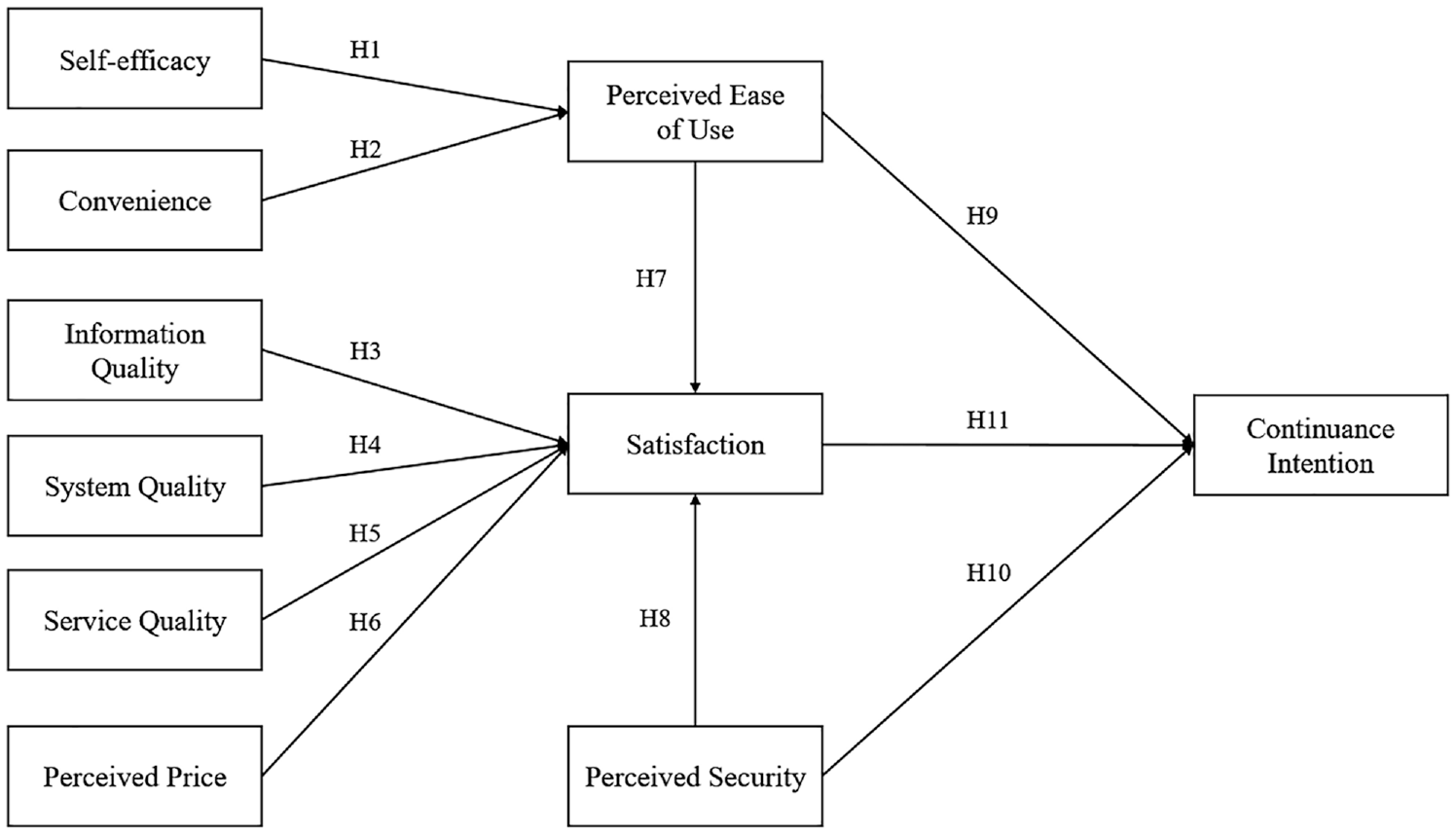
Research model.
Sampling method and instrumentation
The questionnaire design was divided into two parts. The first part was personal background information; the second part collected factors influencing employees’ continuance intention to use the cloud ERP system. The questionnaire comprised dimensions of the study variables measured by a series of Likert-type seven-point scales. At the beginning of the questionnaire, it was stated that the respondents must have experience using cloud ERP systems. The sample was recruited from those who have used cloud ERP systems previously. The questionnaires were distributed using a convenient sampling method through Facebook social networking sites and forums as the distribution platform and location. The questionnaire data were collected for 4 months, between February 22, 2021, and June 26, 2021. A total of 510 questionnaires were collected, but 75 invalid questionnaires with incomplete responses and some unquantifiable samples were later deleted. The final count of valid questionnaires was 435, with a good response rate of 85.3%. The employees’ different levels of willingness to use the cloud ERP system are unprocessed. In the sample questionnaire, perceived ease of use (self-efficacy, convenience), satisfaction (information quality, system quality, and service quality, perceived price) and perceived security affect employees’ willingness to continue using the cloud ERP system. Based on the basis of equal initial values, the weight values of all factors are set to 1 . 37
Data analysis
This section is divided into reliability and validity, descriptive statistics, and structural equation model analysis.
Analysis of reliability and validity
The reliability analysis of the study follows Hair et al.′s 38 criteria. First, Cronbach’s alpha and Composite Reliability (CR) must be greater than 0.7. As shown in Table 1, Cronbach’s alpha values (0.733–0.907) and CR values (0.849–0.942) are higher than 0.7. These statistics show that the questionnaire has a high level of reliability.
Reliability and convergent validity tests.

The questionnaire also has good construct validity as measured by the convergent and discriminant validity coefficients. Construct validity is mainly divided into convergence and discriminant validity. The study follows the criteria 39 to detect each factor’s average variance extraction (AVE) value in terms of convergence validity. Overall, all AVE values (0.652–0.844) are more than 0.5 and all factor loadings are larger than 0.5, with their values ranging from 0.76 to 0.92 (as shown in Table 1), indicating a solid convergence validity. In terms of discriminant validity, the study employed the square root of AVE to see if portions are larger than the horizontal and vertical lines of the values of each correlation coefficient, as shown in Table 2, showing that the questionnaire has good discriminant validity.
Discriminant validity result.

Descriptive statistical analysis
Regarding the gender distribution of the participants, there are 228 males (52.4%) and 207 females (47.6%). The proportion of males is relatively high in the sample. University education accounts for the most significant proportion of 74.9% in our sample. For an employee’s experience, the group with 4–7 months is the highest, accounting for 32.6% of the sample. In terms of tools to access the cloud ERP system, desktop PCs account for 49.4% of the sample, followed by smartphones (32.6%.). Regarding how employees utilize the cloud ERP system, a recommendation from users’ supervisors or elders accounts for the highest percentage (32.4%), followed by online media advertising, which accounted for 19.5%. Regarding the primary purpose of using the cloud ERP system, participants who state “meeting work requirements” are the highest (64.1%). Finally, most respondents work in manufacturing-related companies (68.5%).
Structural equation model
This study used a structural equation approach (i.e., Structural Equation Model, SEM) and Smart PLS 2.0 to analyze and verify our research hypotheses. The 11 hypotheses proposed in this study are tested by SEM based on whether the t value of each hypothesis is greater than 1.96 (a t value greater than or equal to 1.96 indicates a significant impact). The results of the path verification of the overall structure pattern in this study are shown in Figure 2. Except for Hypothesis H8 (Perceived Security → Satisfaction; β = −0.031, t = 0.570 < 1.96), which did not reach the significant level, the remaining 10 hypotheses are all significant. A summary of the test results is shown in Table 3. Except for hypothesis H8, the empirical data all support the remaining 10 research hypotheses, H1–H7 and H9–H11.

Structural model results.
The results of SEM testing.

Conclusion
Summary
In conclusion, employees’ self-efficacy and convenience positively impact the perceived ease of use of the cloud ERP system. When using the system, our findings conclude that employees’ perceptions are critical to its successful implementation. For example, they would develop easy-to-use perceptions when employees believe that they can effectively use the system’s functions and services in their standard operating procedures and the convenience of system services. Perceived ease of use has a statistically significant impact on employee satisfaction with the system. When using the system, the employee believes that it provides easy-to-understand information content, and when the system operation is stable and quick to respond. Other factors to increase employee satisfaction may include whether users perceive the service is reliable and could meet employees’ needs, when the service charges are reasonable, if the performance ratio is high, whether the cloud ERP system is easy to use, and if the interaction and operation are simple, etc. Employees’perceived security of the system does not predict employee satisfaction, meaning that when using the system, their satisfaction is not affected by whether they believe that personal privacy information and operation-related data are secured. There is no statistically significant impact on the degree of satisfaction. We speculate that the employee might believe that the current system has a primary security protection mechanism that is already sufficient and has no direct impact on the employee’s cloud system operation and subsequent satisfaction. The main reason is the environment of use, the level of contact and the difference in cognitive safety for the inconsistency between the test result of hypothesis H8 and the literature studies. 16
Employees’ perceived ease of use, security, and satisfaction significantly impact the continuous intention of the cloud ERP system. The findings suggest that the employee thinks the system is easy to use and learn. Ease of use, personal privacy information, and operation-related data are protected by security, convenience in system data access, user satisfaction with system function and operations, etc. These predictors may increase the degree of continuous usage intention of the cloud ERP system.
Theoretical implications
These empirical results concur with findings in the literature, except in Hypothesis 8. For example, our findings concur with DeLone and McLean. 12 The predictor roles of two crucial variables (i.e., perceived ease of use and perceived price) also echo the findings reported in.17,31 On the one hand, this study further explores the continuous intention of the cloud ERP system. Three variables, perceived ease of use, perceived security, and satisfaction, affected users’ perceptions.34–36 The above test results and the previous literature research findings are mostly the same, so it is possible to use this model to explore the continuous intention influencing factors of the cloud ERP system verified by inspection. Therefore, this empirical research provides an integrated framework to predict the continuous use intention of the cloud ERP system.
Practical implications
The study also has several practical implications. First, many enterprises have provided different versions of cloud ERP system solutions. Manufacturing industries can decide to adopt a suitable cloud ERP system based on the variables empirically examined in this study to assist the industry’s daily operations of manufacturing management. Industries can further improve the system’s connectivity and stability to ensure no delays or crashes with the system to improve employee satisfaction.
Second, it is recommended that manufacturing industries adopt a cloud ERP system because the construction cost is low, and the service charge of the system at the perceived price is reasonable. A local ERP system only needs to build a computer room, firewall, and other software and hardware to take advantage of its advantages. The cloud ERP system is solely dependent on the cloud service provider. Therefore, it is recommended that small and medium-sized manufacturing industries could adopt the operation mode of the system. Moreover, services to assist the industry’s cloud system can be quickly implemented.
Third, the system’s security protection is one of the necessary guarantees for a stable operation by emphasizing the development of the industry’s operation and future performance. The cloud ERP system can no longer obtain the databases easily. Conversely, it is easier for industries to access the local ERP system’s databases. It is built and managed by the industry, but the cloud system service access is limited to administrators, and other employees can only read the frontal cloud data with permission. The employees have no access to the cloud rear-end database upon permission. It is recommended that service providers ensure the system’s data security, strengthen the security measures and strict control of cloud protection data access, and encrypt the static data in transmission or existing in the cloud database. The operating mode of the cloud database is publicly disclosed to ensure the system’s data security.
Fourth, for a cloud ERP system, it is recommended that the industry improve the ease of operation and convenience to provide full-scale online assistance instructions to enhance the employee’s self-operation ability. For employees, if a manufacturing application needs to handle existing manufacturing processes, they can immediately connect to the ERP system through its mobile version to view manufacturing data and the latest manufacturing work tasks. Employees can immediately obtain the necessary information through rich data analysis and visualization. Therefore, the system’s service quality and the employee’s satisfaction and willingness to use it can be further improved. Additionally, the cloud ERP system can provide some cloud service function modules to assist the operation of the industry’s functional processes to meet the development and design of the microturbine engine. Some of these applications include Manufacturing Management, Project Management, R&D Management, Warehouse Management, among others. The industries adopt a suitable cloud ERP system, which can assist to achieve results such as reduced design cycles and development costs, and predicted reliability.
Finally, it is recommended that the manufacturing industries could make the following improvements when adopting cloud ERP systems. Service, information, and system quality should meet the needs of employees, increase innovative application functions, and provide cost-effective cloud system services to justify the adoption decision. The improvement of employees’ satisfaction promotes their willingness to continue to use. Users’ willingness will therefore be strengthened and enhanced, and the continuous use of the cloud ERP system will be further improved.
Limitations and future research
This study has several limitations that must be considered when interpreting our findings. First, convenience sampling prevents certain groups of employees from sharing their valuable opinions. Due to time and resource constraints, the questionnaires were distributed only through leading social network groups. Future research could use quantitative research to understand the impact of various study variables. It is recommended that a case study or qualitative study should be carried out as follow-up research on this crucial topic. Second, more established cases and examples are included in in-depth interviews to explore their practical implications for engineering manufacturing. Third, it is recommended that follow-up research with other critical variables (e.g., subjective norms and innovation acceptance) should be included to develop a more comprehensive model.
Footnotes
Handling Editor: Chenhui Liang
Declaration of conflicting interests
The author(s) declared no potential conflicts of interest with respect to the research, authorship, and/or publication of this article.
Funding
The author(s) received no financial support for the research, authorship, and/or publication of this article.
