



Abstract

Railway fasteners and vibration damage
Researchers in China have established the major cause of vibration induced structural damage in metro vehicles.
Metro vehicles
Public transport is incredibly important to quality of life – and of the economies – in all countries, and in all regions of those countries. As such, any disruption to these infrastructures can result in serious problems for populations and economies. Metropolitan regions are particularly sensitive to any disruption, with so many moving pieces in complicated transport systems.
One of the major causes of these disruptions is mechanical failure of metro vehicles, and researchers at Southwest Jiaotong University in China [Shi Y, Dai H, Wang Q, et al. Abnormal vibration analysis of metro axle box based on vehicle-track coupling system. Advances in Mechanical Engineering 2023; 15(1). DOI: 10.1177/16878132221143573], have developed a system to identify the causes of certain kinds of machine failure in metro vehicles.
Machine failure in metro vehicles can take a number of forms, but some of the most common are mechanical and structural failures, and it is known that most of these problems are caused by vibration. However, while vibration is known as the cause of failure, it is usually a catalyst for some underlying fault within the structure of the vehicle. Stresses owing to abnormal vibration can lead to or be caused by: faulty couplings owing to manufacturing defects, amplified problems associated with wheel imperfections, spring resonance, bolt loosening, and axlebox failure.
The authors have created a technique to identify these underlying failures that can cause or lead to abnormal vibration.
Abnormal vibration can lead to serious structural failure in railway vehicles

What frequency is responsible
The team started by carrying out a field test on a vehicle with a structural fault. They determined the real-time vibration characteristics of different components of a metro vehicle: the axle box, the ground wire terminal, and the ground bracket. They identified various times where vibrations intensified, and worked out that these intense vibrations were not a function of vehicle speed but that they were a function of the nature of the track-vehicle interaction.
Through this analysis, the authors determined that an excitation of 90 Hz was the main culprit for abnormal vibration, but they needed more information: is the vehicle the cause or is it the track?
The main culprit for damage can be identified and mitigated
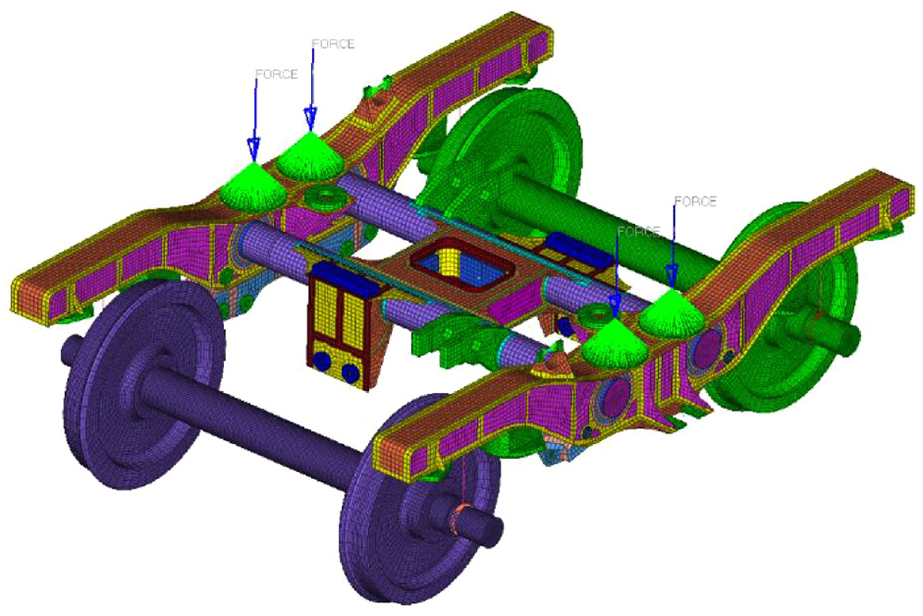
Using finite element modelling, the research team could treat the vehicle and track as a coupled system and modify and investigate parameters to establish the main causes of structural failure. By changing the track’s composition, 90 Hz vibrations can resonate or be suppressed. The answer lies in the track fasteners: the components that keep the rails attached to the sleepers.
Fasteners
The researchers’ analysis has determined that the only significant cause of abnormal vibrations is the interaction of the fasteners with the whole system. For ordinary track, that is where the fastener-sleeper-track component is undamped, the fastener stiffness changes in the mode responsible for the 90 Hz resonant problem. For damped track, the stiffness stays within safe operating conditions and no abnormal vibration modes occur.
Conclusion
The continuous and safe operation of metro rail vehicles is of fundamental importance to infrastructure. The work presented by this paper in Advances in Mechanical Engineering gives engineers worldwide access to vital information: how to build your tracks to mitigate damage caused by abnormal vibrations. The impact of this knowledge can not easily be overstated.
