



Abstract
The purpose of this study is to obtain the peak of the gas explosion load which is affected by many factors and is not easy to determine. Explosion peak is a key factor in the time-load curve of the explosion field. In this paper, the static and dynamic modal analysis method of gas explosion fracture of reinforced concrete prefabricated slabs is used to obtain the static fracture, maximum reflective pressure applied and peak dynamic load of prefabricated plates. In the actual explosion study, all three prefabricated plates broke at one-third, and the peak dynamic load was 6.743 times the span buckling load in the plate. The analysis also shows that when plastic hinges appear at one-half, the above ratio is 3 times. The calculated peak is within the pressure range of the explosion test. The Baker model is used to fit the explosion time-load curve. This function is applied to the dynamic analysis of the finite element analysis of the explosion plate, and the failure of the plate is more consistent with the explosion case site. The median value of the explode field load time-load equation with the curve function can be applied to the rapid evaluation of post-explosion structure.
Introduction
In China, from the 1950s to the end of the 1990s, a large number of multi-storey buildings used prefabricated panels as structural panels for floor panels and roof panels. After the residential gas explosion, many old houses were seriously damaged. In order to assess the safety of the buildings after the disaster, it is necessary to clarify the time history curve of the explosion field, the complexity of the gas explosion, the uncertainty of the energy of the explosion, how to obtain the explosion. The peak value of the real load, which is a key factor in the time history curve of the explosion field, can be helpful for the safety assessment of other structural members of the building in the later period.
When the room is full of explosive gas mixtures, the room is a detonation area, and the room is also an explosive reaction container, which is different from the explosion of TNT explosives in the room. The explosion reaction area of TNT is only the outer size of the explosive. Zeldovich, 1 Von Neumann 2 and Doring independently proposed a ZND model for the structure of the detonation wave. They each improved the C-J theory and proposed the ZND model. The model regards the detonation wave array as composed of forward shock waves and subsequent chemical reaction zones, which travel along the explosives at the same speed, and the terminal plane of the reaction zone corresponds to the C-J state.
In gas phase explosives, Webber, 3 Davis et al., 4 Kamlet and Jacobs, 5 Liu et al. 6 had researched or tested findings that the propagation speed of this formation is generally 1500–4000 m/s, and the pressure at the final section of the explosion reaches several MPa, and the temperature reaches 2000–4000 K. Cai et al. 7 made three prestressed concrete channel slabs according to a 1:3 reduction model, and carried out simulation tests under air explosion overpressure to obtain a partial load test value, which is closer to the finite element simulation value.
Molkov et al., 8 Qin et al. 9 had made gas explosion tests, there is a rough curve shape from Chyży and Mackiewicz. 10 The shortcomings in their research are carried out experimental studies with ideal models with certain hypothetical conditions, such as fixed explosive volume, which often ignores the impact of furniture and decorations in the room on the transmission and diffusion of explosive waves. Because of the uncertainty of the amount of each gas explosion, the peak load effect is a difficult problem.
This paper analyzes the explosion peak value of the explosion field from the static limit fracture mechanics of the reinforced concrete prestressed hollow slab after the gas explosion of the house, and the failure mode of the slab under the dynamic impact load.
According to the response speed of the explosion gas in the detonation area, the time when the detonation wave front reaches the all-directional enclosure of the room in the three-dimensional room can be calculated separately. In this way, the time frame of the explosive shock wave can be determined. After the peak and time range of the explosion determined, the load curve of the gas explosion is clearer.
We analyzed the gas explosion cases in the Shanghai Overseas Ring Road area from 2013 to 2020, and delineated the relationship between the damage to the building components and the number of casualties, as shown in Figure 1.

2013–2020 area within Shanghai outer ring road gas explosion case.
From Figure 1, Of the 31 accidents, except for one accident without building structure damage, 23 of the gas explosions had floor collapsed, accounting for 74%. On average, there was one casualty for every floor damage. Therefore, the failure analysis of floor slabs is a meaningful study.
Theoretical model
Geometric model
Prestressed concrete precast hollow slabs can usually be simplified as simply supported slabs. In most cases, the width of the precast reinforced concrete slab is 0.5m, and the thickness is 0.12 or 0.18 m. Span of most slabs in length direction in residential buildings is 3.0–4.2 m. The calculation diagram is shown in the Figure 2. In the figure, the unit of the load P(x,t) is kN/m.

Prefabricated board calculation diagram.
Figure 3 is the mode shapes of the plate under dynamic load. Take i = 1, 2, 3, … to get different modes of plate vibration Jones, 11 as shown in Figure 3(a) to (c). It would be evident that only the first mode has a significant influence on the problem.

Mode shapes diagram under dynamic load: (a) i=1, (b) i=2 and (c) i=3.
Mathematical model
Then the dynamic deflection curve differential equation of the plate is as follows:

Where, m is the unit mass of the prefabricated slab, I is the moment of inertia of the prefabricated slab, E is the elastic modulus, and the vibration of the slab can satisfy the equation (1) by using

Where,
When equation (2) is multiplied by

For a given dynamic load

For the convenience of derivation, the graph of gas explosion test value can be used from Engebretsen, 12 as shown in Figure 4, which shows a pressure-time profile from an experiment where transition to detonation occurred. The first pressure rised at t = 2.51 s is the shock wave which compresses the unburnt gas. The pressure continues to rise after the shock wave, and subsequently a transition to detonation occurs. As a direct result of this pre-compression, the detonation pressure in the transition process is much higher than the pressure in a stabilized detonation wave (i.e. CJ-pressure). The sum of the shaded parts of each end of the pressure-time curve divided by the total time is the average pressure value:


Pressure-time profile from a pressure transducer.
Where,
Timoshenko and Young,
13
assumed that the shock pulse of the explosion load is


Blast impact load.
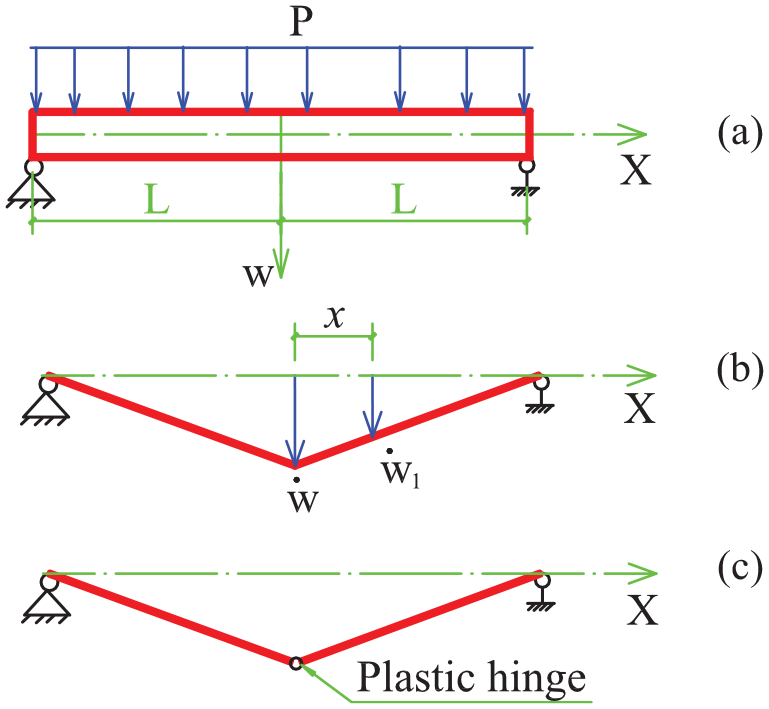
(a) Load layout, (b) velocity field and (c) plastic hinge diagram.
Slab static failure load is
When
When

Where,

The deflection of any point (x) on the slab is

As shown in Figure 6(b).

Where, Q is the shear force, M is the bending moment, m is the unit mass,

Substituting equation (10) into equation (11), we get:

Integrate the above formula x to get:

Where, we know from the boundary conditions: when

Where,

Results and discussions
Parameter discussion
When

When the impact load is
When the impact load is
When

The velocity field and plastic hinge of the plate, when the impact load
When
Due to the plastic hinge, there is
After derivation, there is the following equation (17):

Introducing

Where points out that the range of
When
When
Case studies
General situation of house structure under indoor explosion
In November 2020, a gas explosion occurred in a residential area in Baoshan District, Shanghai, China. In the safety assessment of the house after the gas explosion, the author took pictures of Figures 8 to 10 at the scene. The live photos of the damage of the reinforced concrete prefabricated hollow slab after the explosion are shown in Figures 8 to 10. The fracture pattern of the prefabricated hollow slab is mainly broken into three segments, and the cast-in-place layer of the slab which is damaged on the left side of the nearby one-third places are the most seriously ruined, and the calculated span of the slab is 3.6 m.

The wall of the indoor explosion part is broken.
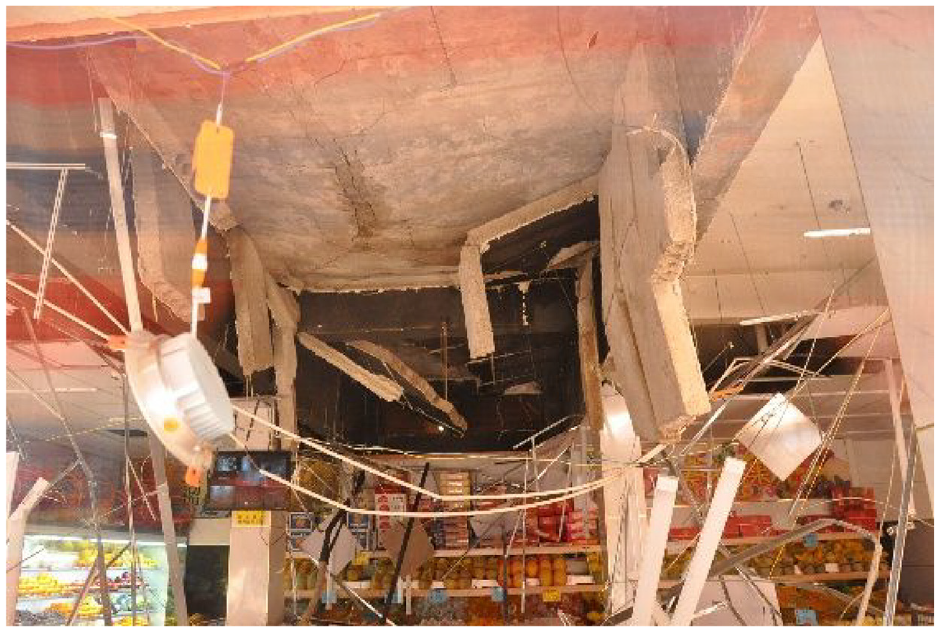
Concrete slab fractured by gas explosion.

The slab fracture and space distribution map of the house after the explosion.
The length of the prefabricated slab is 3.6 m, the width is 0.5 m, and the dead load is 4.5k N/m2; the used load is 2.0 kN/m2, one slab dead load sketch 2.25 kN/m, and one slab dead live sketch is 1.0 kN/m2.
Other characteristics of reinforced concrete prestressed hollow slab. The section size and reinforcement of the plate are detailed in Figure 11, and the irregular plate section is transformed into an H section in Figure 12, the unit is mm.
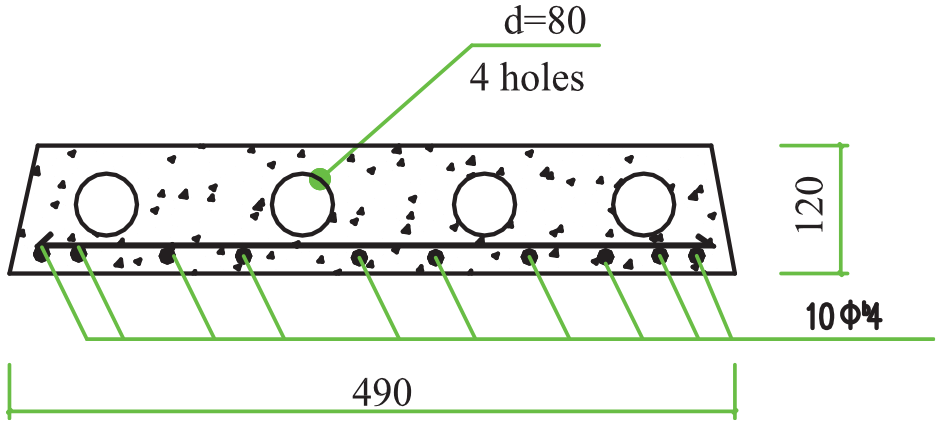
Reinforcement diagram of precast slab section.

Sections with constant moment of inertia.
In Figure 11, the yield strength standard value of cold drawn bottom carbon steel wire is
In Figure 12, the moment of inertia of the section is I, and the mass per meter of the slab along the span direction is m; half of the board span is L, and
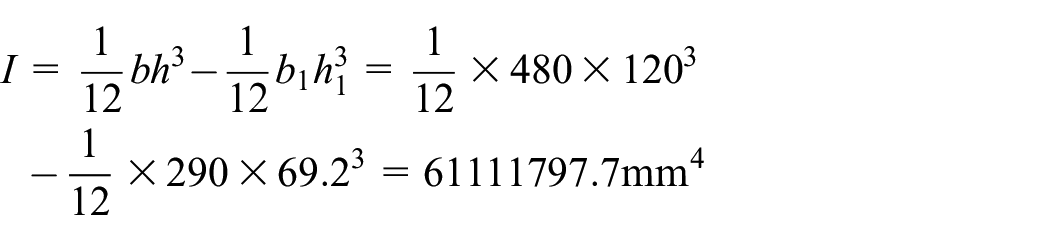
After converting the irregular section into a regular section, the bending moment of inertia I of the section can be calculated according to Figure 12, as follows:


As Table 1, according to equation (4), the vibration frequency of the first first/second/third/fourth cycle of the slab can be calculated.
Vibration frequency and period of the slab.

From Table 1, it can be seen that the first/second/third/fourth vibration period of the plate is 89.699/21.75/9.70/5.4 ms. The first self-vibration frequency of the plate is

From GB 50907-2013
15
Code for design of blast resistant chamber structures, there are two pairs of sides of simple supports. If the two pairs of sides are free and have no support, then the round frequency coefficient is
In a room with dimensions of length, width, and height, it is assumed that the spatial coordinates of the ignition point are (0.0, 1.5, 1.5 m), Using the data of Li et al., 16 When the gas explosion velocity is 1991 m/s, the time for the explosion wave front load to reach the nearest/farthest wall and board surface is 0.785–2.670 ms.
The natural vibration first/second/third/fourth period of the slab is 33.5/8.1/3.6/2.0 times longer than the gas explosion time in the room. In other words, the action time of the gas explosion load is much shorter than the natural vibration period of the prefabricated plate. On the other hand, when the natural vibration period of the slab is similar to the duration of the explosion load, it is more likely to cause a larger amplitude. The comparison between the natural vibration period of the slab and the explosion time can determine whether the resonance failure is caused.
Explosion peak load solution
The internal force of the a-a section is at one-third of the span, the bending moment is


In the same way, the internal force of the b-b section is at the span one-half, the bending moment is

Judge the section type of bending member GB 50010-2010 14 :

The compression zone of the prefabricated board is on the upper flange, and the bending moment of 10 cold drawn steel wires at yielding is

That is,
The static buckle load of the plate is
At one-third slab span:


From Figures 8 to 10, the prefabricated board is broken into three sections, substituting

Then we can get:

From
At one-third slab span:

Then the dynamic pulse peak value of the gas explosion load is
In this way, the upper load value is obtained, which causes the impact load value of the plate to be twisted at one-third.
The above peaks are similar to the fourth and fifth trial values of gas explosion by Zhan et al. 17 This shows that the values obtained by this method are within the trusted range.
Similarly, if only a plastic hinge appears on one-half span, this is:




Through comparison, when the reinforced concrete slab is properly reinforced, that is to say, when the bending strength is determined by the amount of the steel bar, the impact load when a plastic hinge appears in the span is smaller than that of the plastic hinge that appears at one-third of the span. Calculations show that a plastic hinge takes 38.6 kN/m2 load at one-third, and a plastic hinge at one-half span requires a 13.08 kN/m2 load.
Explosion load-time curve fitting
In many gas explosion load-time functions, Baker’s is more concise. Baker et al. 18 has proposed an approximate functional relationship between the detonation pressure of the gas in the restricted space and time:

In the above formula, the symbols are shown in Figure 13,

Explosion overpressure-time function of combustible gas in confined space.
Calculations show that a plastic hinge takes 38.6 kN/m2 load at one-third, In equation (19)
In the inner room of the explosion, the floor is also affected by the reflection wave of the roof. The intensity of the wave is inversely proportional to the three parties of the distance (R). Considering that the window has pressure relief, therefore the peak reflection wave is:

In general, we can draw the relationship between explosive overpressure and time under the action of reflected waves, as shown in Figure 14.

Explosive overpressure wave-time, reflection wave-time and load fitting diagram.
With Figure 14, the shock wave curve-time, reflection wave-time curve diagram can be used to digitally simulate the gas explosion site, visualizing the overall building safety after the disaster, and refining the dynamic analysis.
At the same time, in order to simplify the load curve, the equation is obtained by linear regression. It is “Linear fit wave” as shown in Figure 14. The equation of linear fitting explosion load (y) and time (x) is:

Where
Linear fitting is a linear load that smooths peaks and valley loads during explosions. The load y of the equation (20) is much smaller than the peak
With Figure 14, the gauss nonlinear fitting of the load time history curve is carried out. As shown in the dotted line, the gauss equation is as follows:

Where,
In this way, if in the case of a gas explosion, under relatively similar conditions, the breakpoint of the plate is one-half of the slab, that is, the plastic hinge is at one-half, and the explosion impact load is much smaller. The peak impact load of the plate, the explosion load-time curve, and the load linear fitting of the load can be obtained in the same way. If the breakpoint of the slab is in the middle, that is a plastic hinge at one-half span requires a 13.08 kN/m2 load.
According to the response speed of the explosion gas in the detonation area, the time when the detonation C-J wave front reaches the all-directional enclosure of the room in the three-dimensional room can be calculated separately. In this way, the time-load function of the explosive shock wave can be determined. After the peak and time range of the explosion determined, the load curve of the gas explosion is clearer.
Failure analysis
With the time-load curve of explosion, as shown in the explosion shock wave curve in Figure 14, it can be applied to finite element analysis. A model is established as shown in Figure 15, which is calculated to verify whether the dynamic characteristics of the plate under the time-load curve are consistent with the damage after the gas explosion.

Finite element model of slab, beam and column floor plan and grid subdivision: (a) floor plan (unit: mm) and (b) grid subdivision.
Figure 15(a) designs a 0.5 m wide reinforced concrete slab with a span of 3.6 m, with holes on both sides and no lateral support. The plate is placed on the beam, and both ends of the beam are on the column. Figure 15(b) divides the plate into a grid of 0.2–0.3 m.
During the loading process, the plate deforms in the first three modes, and the first mode is bending failure, occupying the main position, as shown in Figure 16(a). In the second mode shear wave travels along the plate, as shown in Figure 16(b). The third mode is that the plate is twisted up and down, as shown in Figure 16(c).
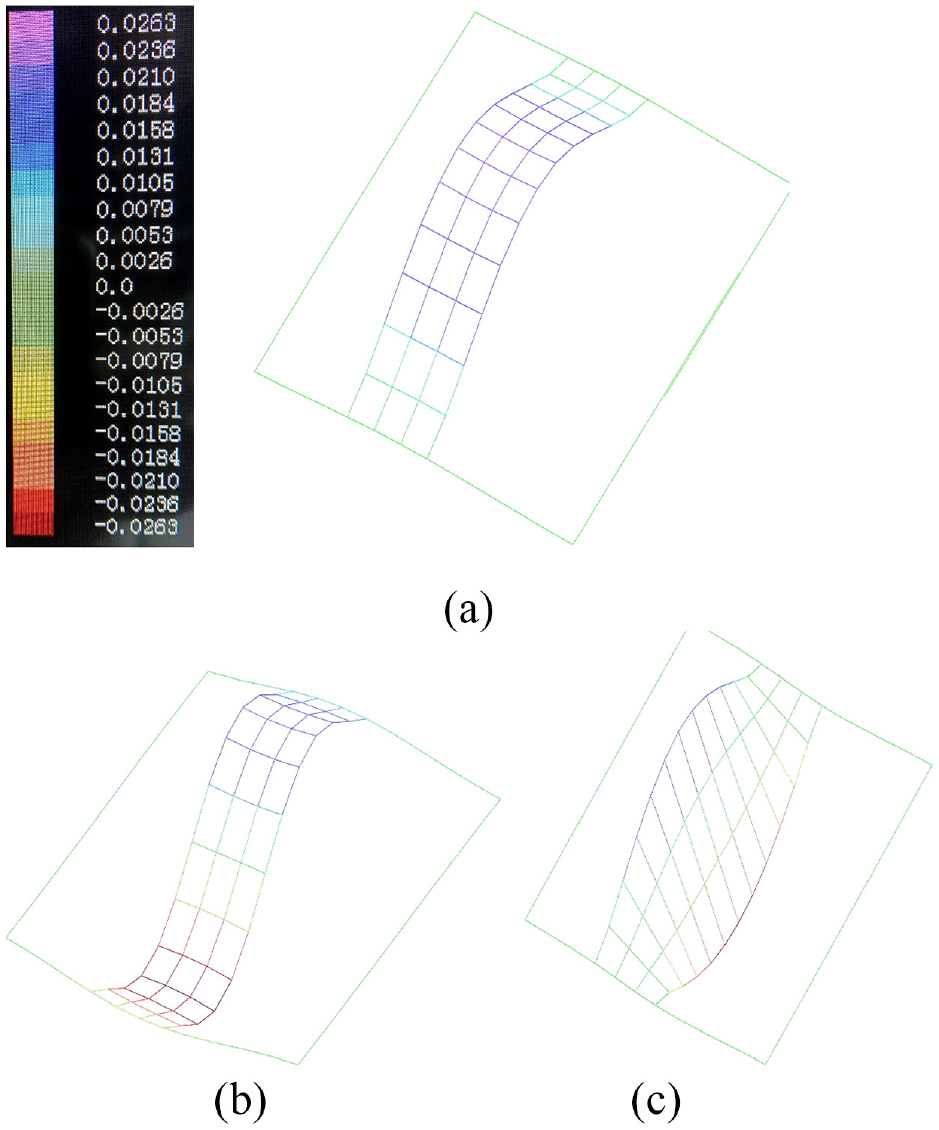
Finite element simulation results of the slab under explosion: (a) the bending failure displacement diagram, (b) the shear wave displacement, and (c) twisted up and down displacement.
According to the response speed of the explosion gas in the detonation area, the time when the detonation wave front reaches the all-directional enclosure in the room in the three-dimensional room can be calculated separately. In this way, the time frame of the explosive shock wave can be determined. After the peak and time range of the explosion determined, the load curve of the gas explosion is clearer.
As can be seen from previous calculations, when the explosion C-J wave propagates along the span, the plate is bent and damaged in the first mode, and the steel bar stretches and bends in the slab span at a load of 13 kPa. At the peak explosion load of 38.6 kPa, the curved range of the steel bar expands symmetrically to the support along the span, which is much greater than the normal use design load of the prefabricated slab of 1.5 kN/m2.
In the prefabricated slab, cold-drawn steel wire is used. In terms of the tensile limit deformation of the material, this is because the elongation rate of the prestressed steel bar is only 3% to 6%, which is far lower than 21% of ordinary steel bars. Under the sudden impact of the explosive load, the steel wire at the bottom of the slab is broken.
Because the prefabricated slab is a one-way reinforcement, that is, a reinforcement at the bottom of the slab, there is no steel mesh on the slab surface. When the pressure resistance of the upper concrete of the slab is greater than that of the lower steel bar, it is reflected in the “lack of steel bar” in the tension area at the bottom of the reinforced concrete bending member, and the number of steel is insufficient. Therefore, low elongation is also one of the main reasons why prefabricated plates are easily broken in explosions.
In addition, when the explosion C-J propagates in the direction, it will also cause the vibration of the side wings of the plate, which is torsion, and then the acceleration plate is damaged. Due to the impact load, the reinforced concrete slab system with less reinforcement tends to be brittle, which is different from the high-circulation fatigue failure of aluminum-magnesium alloy.
In order to prevent the sudden fracture of the prestressed slab during the explosion, non-prestressed steel bars with good elongation should be arranged in the slab; it is also in the case of an internal explosion that far exceeds the use load, and the implosion high-pressure gas is released through deformation without breaking. In the anti-explosion reinforcement design of old houses, adding a concrete post-cast layer of steel mesh on the surface of the prefabricated slab can effectively prevent the floor from collapsing.
Conclusion
Because every gas explosion accident occurs in a house, there are different factors affecting the peak explosion load, and the destructive forces of the explosion are different. In order to assess the safety of the post-explosion structure, the key is to clarify the explosion load time curve of the explosion. In this study, the peak of the explosion load is calculated according to the impact characteristics of reinforced concrete prefabricated slabs. The peak obtained is also within the range of some gas explosion test values. The time-load curve is fitted according to Baker’s formula. At the same time, the finite element method which is used to verify that the failure of the slab is consistent with the actual situation. It is proved that it is feasible for this method to describe complex explosion loads with functions.
(1) The fitting of the explosion time-load curve and the fitting of linear equations are used in different situations. The explosion time-load curve can more realistically restore the historical characteristics of the explosion during the internal detonation of the building structure, which can be used for the overall dynamic analysis of the structure. The advantage of linear fitting is that the calculation is simple and fast, transforming dynamic calculation into an approximate static problem.
(2) The analysis shows that slab reinforcement can improve the lateral stability of the unidirectional slab and improve the torsion resistance of the slab better. Adding reinforced concrete superimposed layers to the one-way plate surface of the reinforcement project can effectively prevent the floor from falling.
(3) This method is applicable to the structural safety assessment of ordinary explosion equivalent gas explosion in civil buildings. It is not suitable for structural shear damage caused by explosions of large-yeld fuel air bombs outside buildings, and accident analysis of component powder damage.
Fitting the time history curve of the explosion field provides a key step for the structural safety assessment of the house after the explosion.
In order to reduce the research on the damage to people caused by the house explosion, it is not enough to study the explosion load alone. In the future, it should also be combined with the sensor matrix before the explosion with artificial intelligence. For example, when it is found that the gas has leaked, it can be mechanically forced to ventilate, or notify personnel to evacuate. Even if the explosion is inevitable, a small amount of gas can be detonated in advance to reduce the destructive power.
Footnotes
Appendix
Handling Editor: Chenhui Liang
Declaration of conflicting interests
The author(s) declared no potential conflicts of interest with respect to the research, authorship, and/or publication of this article.
Funding
The author(s) disclosed receipt of the following financial support for the research, authorship, and/or publication of this article: This work has been supported by the Key Project of National Natural Science Foundation of China (Grant No.11932010).

Supplemental material
Supplemental material for this article is available online.
References
Supplementary Material
Please find the following supplemental material available below.
For Open Access articles published under a Creative Commons License, all supplemental material carries the same license as the article it is associated with.
For non-Open Access articles published, all supplemental material carries a non-exclusive license, and permission requests for re-use of supplemental material or any part of supplemental material shall be sent directly to the copyright owner as specified in the copyright notice associated with the article.
