



Abstract
To overcome the inefficiency of slicing process of rapid prototyping based on STL models, an improved slicing algorithm is proposed. The method builds integral topology of STL models in advance using a Hash table, which enables to get contours directly, and then reduces the search range in slicing by establishing the slicing relation matrix, which can effectively reduce the time cost of slicing. It has been demonstrated that the algorithm has nearly linear time complexity. The method is proved to be effective and efficient through application cases, and the results show better performance than other existing algorithms, especially when the STL model is complex or large.
Introduction
With the continuous development of science and technology, some challenges are put forward in the field of the manufacturing industry. The need to shorten the processing cycle and improve the flexibility of production is increasing day by day. Traditional manufacturing methods can no longer meet the requirements. By contrast, Rapid Prototyping (RP) is a faster and more flexible manufacturing means. Based on the principle of layered manufacturing, the RP technology decomposes the three dimension (3D) model into a series of section outlines, then takes the section shape as the filling boundary, and fills and accumulates layer upon layer until the complete component is formed. The process of discretizing 3D model into two-dimensional section is the basis of the whole manufacturing process, which is one of the key problems to be solved in rapid prototyping.
Currently, most rapid prototyping software systems treat Standard Triangle Language (STL) files as intermediate process files. The STL file consists of a series of discrete triangles that simulate 3D entities and describe them as the normal vector of the triangle and the tri-coordinate list of X, Y, and Z coordinates. For the determined layering direction, the layering process is to intersect the model with a series of tangent planes perpendicular to the layering direction, obtain the intersection points of the tangent planes with different layering heights and triangles, and connect these intersection points in order to form a closed contour. Obviously, when STL files are very large, the layered processing process will inevitably cause a lot of time consumption. At present, there are many improved hierarchical processing algorithms, and the commonly used algorithms include hierarchical algorithms based on topology information.1,2 Hierarchical algorithm based on triangle position. 3 Hierarchical algorithm based on triangle grouping.4,5 Hierarchical algorithm based on hash functions. 6 Algorithm of coordinate layering based on STL model. 7 Direct slicing algorithm based on compressed voxel model for rapid prototyping. 8 Fast parallel algorithm based on pipeline mode. 9 And the party check algorithms based on the fact that a straight line intersects any closed curve. 10 However, for large or relatively complex models, the processing efficiency of most existing hierarchical algorithms is still unsatisfactory. In this paper, an improved hierarchical algorithm is proposed from the perspective of improving the efficiency of hierarchical processing and combining the ideas of the algorithms in.1,4 In this algorithm, the topology reconstruction algorithm based on hash table is used to establish the overall topology structure of the model in advance, and then a hierarchical relation matrix is established to solve the contour line. Through the comparison and analysis with the existing algorithms, it is proved that the algorithm in this paper significantly improves the layering efficiency.
Topological reconstruction based on STL model
Topology reconstruction algorithm based on hash search
Although the STL file is simple in structure and easy to handle, due to the organization of its data structure, each vertex of each triangle will be repeatedly recorded by other triangles sharing the vertex, resulting in the triangles recorded in the STL file being relatively independent of each other, and the lack of topological relationships among the graphic elements (points, lines, and faces) constituting the entity, which greatly affects the efficiency of hierarchical processing.
Topological relation reconstruction of STL model mainly includes removal of redundant data and establishment of topological element adjacency relation. The process of removing redundant data is the aggregation and merging process of vertices. Judging whether the new vertex is a redundant point by searching the vertex storage structure, thus ensuring that each vertex does not repeat recording. The process of establishing the adjacency relation of geometric elements is to realize fast topological access between any point and edge, edge and face, face and face by establishing a reasonable data structure. The whole process of topology reconstruction is to continuously read triangles, remove redundant vertices by searching, establish a non-repeating point table, and record the inclusion and adjacency relationship between each topology element in the topology structure.
The geometric elements of STL model topology reconstruction mainly include points, edges and triangles. In order to reduce storage requirements, the topology structure designed in this paper only establishes point table and polygon table to record topology information between vertices and triangles. The data structure of the design point table and polygon table is as follows in Figure 1:

Data structure design: (a) point table data structure and (b) surface data structure.
For the more complex STL model, if the method of direct traversal is adopted in the process of finding vertices, the efficiency is undoubtedly extremely low. Many scholars have proposed solutions to the problem of excessive time cost in establishing topology structure. Basically, the vertex searching process is accelerated by introducing additional data structures. Zhang and Joshi 11 introduces an improved and robust slicing algorithm with efficient contour construction to reduce the slicing time and be able to slice a complex STL model with millions of triangles (resulting from high-accuracy STL files). Jinyi and Baoming 12 and Dai et al. 13 introduces balanced binary tree to improve topological reconstruction efficiency. Zheng and Zheng 14 and Tao et al. 15 introduces the algorithm of topology reconstruction combined with red-black tree structure. The time complexity of these two methods is O(nlgn), but in the case of a large amount of data, it takes a large time cost to maintain the balance of the tree structure. Wang 16 and Yanyun et al. 17 proposes to use Hash table as additional data structure to quickly establish topology structure with time complexity up to O(n), but the space complexity is slightly higher than the previous two methods.
In this paper, a vertex hash table is constructed to realize fast topology reconstruction, and the Hash table loading factor is set to 0.5. Since the STL model is a polyhedron composed of triangles, it can be inferred from Euler formula that the actual number of vertices of the model is about one-half of the number of triangles, so the length of the hash table is taken as the largest prime number not greater than the number of triangles. According to the research conclusion of Skala et al., 18 after repeated tests, the Hash function of the following form is constructed:

where floor means rounding down, % means remainder, Vx, Vy, and Vz are X, Y, and Z coordinates of vertices, α, β, γ, and K are coefficients, and p is Hash table length.
In the actual application process, it is difficult to ensure that each hash address only corresponds to a unique key value, which will result in hash conflicts. In the chain address method, all elements with hash address “i” form a linked list called synonym chain, and the head pointer of the linked list is stored in the ith unit of the hash table, so the search, insertion and deletion are mainly carried out in synonym chain. In this method, firstly, a hash function is used to calculate the storage location of key sets. If all positions in the address space of the hash table are from 0 to m–1, all the keys in the key set are divided into m subsets, and the keys with the same address belong to the same subset. We call the keys in the same subset synonymous with each other. Each subset is called a bucket. Usually, the entries in each bucket are linked by a linked list, which is called synonym sub-table. All entries with the same bucket number are linked in the same synonym sub-table, and the header nodes of each linked list form a vector. In this paper, chain address method is used to resolve hash conflicts, and key values with the same hash address are added to the linked list of corresponding addresses. The structure is shown in Figure 2.

Data structure of Hash table.
The complete topology reconstruction process is as follows:
(1) Establishing a vertex Hash table, a point table and a surface table;
(2) Reading in a triangle;
(3) Calculating Hash addresses of three vertexes;
(4) Searching the corresponding Hash address in the vertex hash table, if so, indicating that the point already exists, and turning to step 5; If not found, it means a new point, go to step 6;
(5) The point already exists, add the index of the current triangle to the adjacent triangle index chain of the vertex in the point table, and go to step 7;
(6) The point is a new point, adding the index of the current triangle to the index chain of the triangle adjacent to the point, adding the point to the point table, and adding the index of the point to the corresponding address in the Hash table;
(7) Adding the indexes of the three vertices in the point table to the current triangle, and adding the triangle to the surface table;
(8) Go to step 2 until all triangles have been read.
According to the topological relation established above, the topological structure between points and planes can be efficiently established, which provides necessary preconditions for subsequent data processing.
Analysis of algorithm efficiency
In this algorithm, Hash table is used to speed up the process of topology reconstruction. Hash table can directly access a data structure of the specific corresponding value through the given key value, and map the key to the position in a table to directly access the record, thus speeding up the access speed, thus accelerating the speed of topology reconstruction, but the efficiency of Hash table depends heavily on the performance of Hash function. The design of hash function directly determines the performance of hash table by determining the collision probability of hash table. Therefore, if the hash function is not too complicated or the loading factor is too high, the probability of hash collision will increase, and the query efficiency will decrease. Therefore, a reasonable Hash function is the main factor that determines the efficiency of the algorithm. The parameters are chosen as
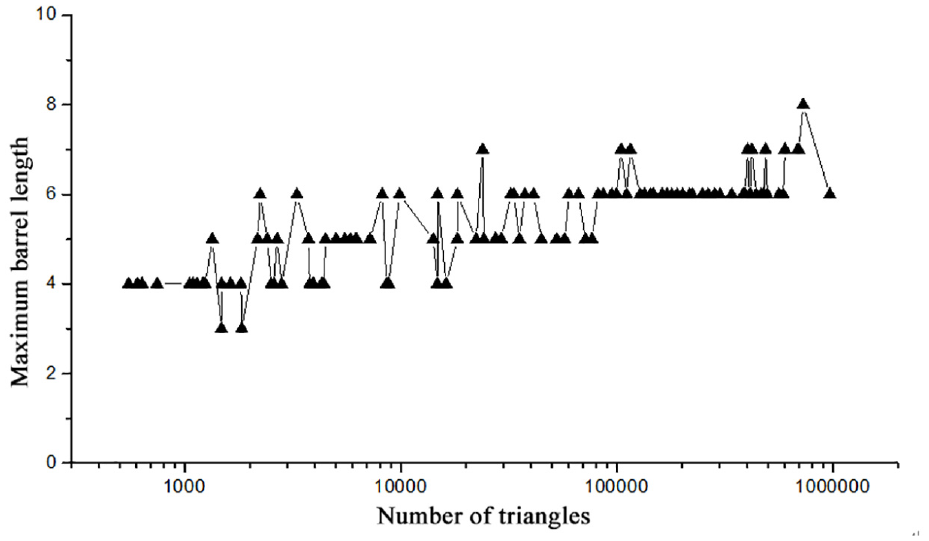
Maximum bucket lengths of hash table.
The test results show that the Hash function designed in this paper can well disperse the model vertices, and the maximum barrel length can be stabilized within a certain range for STL files of different sizes, which proves that the Hash function in this paper has good performance.
Taking topology reconstruction algorithm based on red-black tree as comparison algorithm, STL files of different sizes are tested under the same software and hardware environment. The results are as follows in Figure 4:

Time consuming comparison of different algorithms.
The results show that compared with the existing better algorithms, the algorithm adopted in this paper effectively reduces the time for topology reconstruction. When the STL file is large, the algorithm in this paper shows more obvious advantages.
Improved stratification algorithm of STL model
Construction of hierarchical relation matrix
In order to reduce the judgment of intersection relation, it is first necessary to establish the hierarchical relation matrix of tangent plane and triangle. The hierarchical relation matrix uses the serial number of each hierarchical layer as an index, and adds all triangles that have intersection points with the same hierarchical layer to the same layer of the matrix, thus establishing a set of intersecting triangles for each hierarchical layer. Its data structure is shown in Figure 5.

Slicing relation matrix.
In the actual situation, the positional relationship between the triangle and the sub-level is relatively complicated, and there is a case where the triangle intersects the sub-level but the intersection point does not need to be calculated. Therefore, in the grouping process, it is necessary to specifically analyze the relative positional relationship between triangles and tangent planes, and to exclude the situation that intersection points do not need to be calculated. In the case where the triangle intersects the tangent plane, the positional relationship can be divided into the following seven types as shown in Figure 6:

The position relationship of triangles and the tangent plane.
For cases 1 and 2, triangles pass through the tangent plane. These two cases will not produce repeated intersection points, and both need to be calculated. For cases 3 and 4, the triangle intersects the tangent plane on one side. According to the common-edge rule of STL model, there must be an adjacent triangle intersecting the plane on the same side in both cases. If the intersection point is calculated for both cases, the intersection point will be repeatedly calculated, which will affect the generation of contour lines. Therefore, only the triangle conforming to case 3 will be retained here, and case 4 will be eliminated. For cases 5 and 6, the triangle intersects the tangent plane at one point. From the closeness of STL model, it can be seen that among the adjacent triangles located at the vertices on the tangent plane, there must be an adjacent triangle intersecting the tangent plane at two points. For the last case, the triangle lies on the tangent plane. According to the closeness of STL model, a group of triangles adjacent to the triangle intersect with the tangent plane on one side, so this situation can also be ignored. To sum up, in the process of stratification, only the first three situations need to be considered.
According to the above analysis, the triangular hierarchical interval division rules are established as follows:
Assuming that the layering direction is the positive direction of the Z axis, the height of the layer is h, the initial layering height is Z0, and the three vertices of the triangle are ZMax, ZMid, and ZMin respectively according to the size of the Z coordinate, then the layering sequence number interval (m, n) intersecting with the triangle can be calculated by the following formula:

where ceil indicates an upward integer value.
Considering the following special cases:
(1) if the triangle satisfies ZMin = ZMax, skip the triangle;
(2) if the triangle satisfies ZMax <= Z0, then the triangle is not considered;
(3) if the triangle satisfies ZMin < Z0, then the corresponding interval of the triangle is (0, n);
(4) if the triangle satisfies ZMin = Z0 and ZMin! = ZMid, then the corresponding interval of this triangle is (m + 1, n).
According to the above rules, the establishment of hierarchical relation matrix can be completed by sequentially accessing each triangle, calculating its hierarchical interval and adding an index to each group corresponding to the interval.
Searching for intersections on opposite sides
After obtaining the hierarchical relation matrix, the contour line can be calculated by topological relation according to the triangles recorded in the matrix. For each sub-level, the corresponding triangle grouping is taken out, the adjacent triangles are continuously tracked through topological relation and the intersection points are calculated one by one. When all triangles in the group are accessed, the slice outline of this layer has been extracted.
Calculating the intersection of a triangle and a subdivision is essentially calculating the intersection of a triangle’s edge and a subdivision. According to the partition rule proposed in the previous section, it can be seen that the triangles retained in the hierarchical matrix all intersect the tangent plane at two points. Obviously, if the intersection points are calculated in triangular units, then each intersection point will be calculated twice. Therefore, the intersection point of contour lines is calculated based on edges to avoid duplication of intersection data.
The location of the intersection between the edge and the stratification plane is relatively simple, either passing through the plane or crossing at an endpoint. Here, only the intersection point needs to be calculated for the first case. The schematic diagram of the intersection between the edge and the stratification plane is as follows in Figure 7:

Calculation of the intersection point of the edge and the tangent plane.
According to the spatial geometric relations, there are:

The obtained intersection coordinates:

For a triangle, the value of ZMid determines the edge that intersects the facet. If ZMid is just above or below the sub-level, the intersecting edges are two edges formed by ZMin, ZMax and ZMid, ZMax. On the other hand, if ZMid is located above the stratification plane, the intersecting edges are ZMin, ZMax and ZMid, ZMax. In order to prevent triangles from repeated access, a flag bit is set for each triangle. When the triangle is accessed, it is set. The flag triangle has been processed. When the contour calculation of one layer is finished, reset it for the contour calculation of the next layer. Defining the search rules:
(1) as shown in Figure 8a, if the current edge passes through the tangent plane, the triangle sharing this edge is directly taken out from the current triangle as the triangle to be accessed, and the unprocessed edge with intersection point is taken as the next edge to be processed;
(2) as shown in Figure 8b, if the current edge intersects the tangent plane at an endpoint (a vertex of the triangle), in this case, the adjacent triangle of this vertex is found. Since the current triangle has been marked at this time, only an adjacent triangle that meets the requirements and the flag bit is not set can be found, then this triangle is the next triangle to be accessed. Obviously, this triangle intersects the current triangle at this vertex, and the edge formed by the other two vertices is taken as the next edge to be processed.
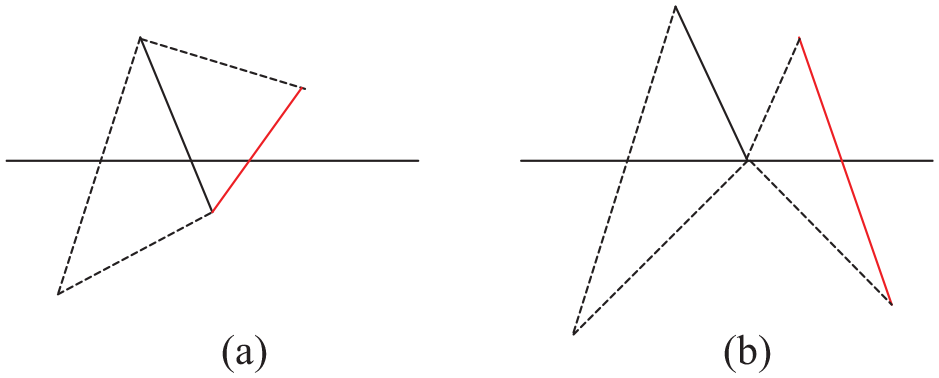
Searching rules with (a) and (b).
Since the STL model is a closed entity, the cross-sectional profile of each layer must also be closed. Search according to the above rules. If the next unmarked triangle cannot be searched, then the contour has been closed, that is, it returns to the original triangle, thus a contour has been formed and the search process is finished. However, if there are multiple closed contours in one layer, there will be unprocessed triangles in the triangle group recorded in the hierarchical matrix. Therefore, after generating a contour line, it should also be judged whether there are triangles that intersect the layer but have not been processed: if there are such triangles, the new contour line should be calculated continuously. If all the intersecting triangles have been processed, the contour lines of this layer have been extracted.
To sum up, the main process for extracting contour lines is as follows:
(1) Creating a new contour line;
(2) Taking any triangle as a starting triangle in the triangle grouping of the current layer, and taking out an edge intersecting with the sub-layer as an edge to be processed;
(3) Judging the positional relationship between the edge to be processed and the stratification plane. If it is handed over to the endpoint, record the point directly. Otherwise, the intersection point is calculated according to formula (4) and the contour line is added;
(4) Setting that current triangle mark position bit;
(5) Searching for the next triangle to be accessed according to the search rule, if the next triangle can be searched, finding the next side to be processed, and turning to step 3. If not, go to step 6.
(6) Judging whether unmarked triangles exist in the triangle grouping. If it exists, take this triangle as the starting point of the new contour line and go to step 1. If it does not exist, go to step 7.
(7) Reset the flag bits of all triangles in the grouping, and end the contour extraction of the current layer.
Analysis of algorithm efficiency and case verification
Analysis of algorithm efficiency
The hierarchical algorithm proposed in this paper first constructs a hierarchical relation matrix, then calculates contours hierarchically using global topological relations, and finally obtains a complete set of contours. Compared with the general hierarchical algorithm based on topological relations, the algorithm in this paper groups triangles in advance and excludes the situations that do not need to be considered. During the hierarchical process, the intersection triangle set can be directly obtained, which reduces the computation of intersection judgment and avoids the occurrence of invalid situations. Compared with the layered algorithm based on triangle grouping, the algorithm in this paper establishes the global topology structure in advance by optimization method, which avoids the time consuming of establishing the local topology structure. For different layered thicknesses, the topology structure only needs to be established once without repeated calculation.
Considering the hierarchical process proposed in this paper, it is mainly divided into three stages: topology reconstruction, triangle grouping and contour calculation. Let the number of triangles be N and the number of layers be k, with each triangle intersecting with l sub-layers on average, and each sub-layer intersecting with f triangles on average. In the process of topology reconstruction, each triangle is processed once, and the time complexity of hash lookup can be approximately considered as O(1), so the overall time complexity is O(N). In the grouping process, all N triangles need to be traversed, each triangle performs l grouping operations, and the overall time complexity is O(l·N). In the worst case, each triangle intersects all k sub-planes, where l = k. In general, k is much less than N, so the complexity is approximately O(N). In the process of calculating the contour line, a total of k packets need to be traversed, and each packet needs to access all f elements in the packet, so the time complexity is O(k·f). Considering the worst case, each sub-level passes through all N triangles, and the complexity becomes O(k·N), which can be approximately considered as O(N). According to the above processes, the overall time complexity of the hierarchical algorithm is O(N), and the overall efficiency of the algorithm is very high.
Application case verification
Taking Beethoven model as an example, the triangle set and contour line corresponding to one layer are shown in Figure 9:

The slicing process of Beethoven model: (a) Beethoven model, (b) set of intersecting triangles, and (c) contour line.
The overall layering effect of the model is shown in Figure 10:

Stratified result of Beethoven model.
According to the above results, it can be seen that the algorithm can correctly divide triangles and generate complete contour lines, which verifies the correctness of the algorithm.
Four models shown in Figure 11 are selected as test examples, and the number of triangles in each model is 6226, 11,244, 45,486, and 104,270 respectively. Under different layering thicknesses, the layering algorithm based on topological relation (algorithm 1), the layering algorithm based on triangle grouping (algorithm 2) and the algorithm proposed in this paper are used to stratify each model respectively, among which algorithm 1 uses the method introduced in this paper to establish topological structure, From the experimental results, the algorithm used in this paper can improve the efficiency by 2–7 times compared with the algorithms in different layers. The required time comparison is as follows:

Test models (a) the number of model triangles with 6226, (b) the number of model triangles with 11244, (c) the number of model triangles with 45486, and (d) the number of model triangles with 104270.
Compared with other algorithms, this algorithm has a smaller time cost (Figure 12). Take Figure 12c as an example. When the number of layers is 3000, algorithm 1 takes 8 s, algorithm 2 takes 3 s, and the algorithm used in this paper takes 1 s, which is several times higher than other algorithms. The results show that, in the case of large STL files, the time consumption of the algorithm in this paper is greatly reduced compared with the other two methods, which proves the efficiency of the algorithm in this paper.

Time consuming comparison of different algorithms with models in Figure 11(a–d).
Conclusion
In order to solve the problem of low efficiency of existing layering algorithms, this paper proposes an improved STL model layering algorithm. The algorithm uses the topology reconstruction algorithm based on hash search to establish the overall topology structure of the model in advance, and then reduces the search scope of hierarchical calculation by establishing hierarchical relation matrix, thus effectively reducing the time consumption of STL model layering.
Through the example verification, it is proved that the algorithm can correctly generate the cross-sectional profile and effectively improve the layering efficiency. Compared with other algorithms, this algorithm has less time cost, especially for the more complex STL model, this algorithm has more obvious advantages.
Footnotes
Acknowledgements
We thank Prof. Chengwei Li (School of Electrical Engineering and Automation, Harbin Institute of Technology) for the help in conducting this experiment.
Handling Editor: Chenhui Liang
Declaration of conflicting interests
The author(s) declared no potential conflicts of interest with respect to the research, authorship, and/or publication of this article.
Funding
The author(s) disclosed receipt of the following financial support for the research, authorship, and/or publication of this article: The work was supported by General Program of Science and Technology Development Project of Beijing Municipal Education Commission (Grant No. KM202310005034), Beijing Science and Technology Planning Project (Grant No. Z221100006422007), and Beijing Postdoctoral Research Foundation (Grant No. 2022-zz-056).
