




Abstract
The study presented in this work deals with analytical methods for an axisymmetric problem of an elastic layer partially reposing on a rigid circular base, and is indented along the upper surface with a rigid punch. The contact between the medium and the base is smooth. This boundary value problem is transformed into a system of dual integral equations. In contrast to the classical approach consisting in resolving the corresponding Fredholm equation of the second kind, the latter equations are obtained from an infinite algebraic system of simultaneous equations, where the particular case
Keywords
Introduction
The problems of the theory of elasticity are more significant in mechanics in particular those concerning contact. Indeed, the concentration of the efforts and the tiredness of the material often occurs in the zone of contact between structural components. This is why the zone of contact is classified critical zone. Due to its potential applicability to several constructions of practical importance, the contact problems in solid mechanics involving an elastic layer sitting on an elastic half-plane, elastic and rigid foundations have been extensively researched. Foundation grillages, pavements of highways and airfields, railways ballast, and ball and roller bearings are some of the application areas of contact mechanics. The classical theory of contact mechanics started with the work of Hertz. 1 The axisymmetric problem of the surface indentation of an isotropic elastic half-space by a smooth rigid circular punch or indentor was first examined by Boussinesq. 2 Lebedev and Ufliand 3 considered the punch problem for an elastic layer resting on a rigid foundation. The contact problem of the elastic medium substrate body has been investigated by Dhaliwal. 4 Hayes et al. 5 obtained a theoretical solution to the punch problem of axisymmetric indentation of an infinite elastic layer bonded to a rigid half-space as a model for the layered geometry of cartilage and subchondral bone. An axisymmetric contact problem for an elastic medium on a rigid foundation with a cylindrical hole has been studied by Dhaliwal and Singh. 6 The contact problem of a half-space pressed onto a rigid base with a cylindrical protrusion or pit has been treated by Shibuya et al. 7 Their second paper 8 deals with the contact stresses of an elastic plate pressed onto a rigid base with a cylindrical protrusion or pit. In the work, the layer thickness on a rigid base with a cylindrical protrusion or pit and is indented by a rigid stamp has been analyzed by Hara et al. 9 Kebli et al. 10 solved the problem of elastostatic deformation of the elastic medium. The thermoelastic contact problem has been studied by Guerrache and Kebli. 11 The solution for an axisymmetric torsion problem was presented by Kebli et al. 12
Various programs based on the finite element method FEM have been created in parallel with developments in computer technology. The FEM is applied to the calculation of contact stresses between two or elastic bodies with friction on the contact surface by Ohte. 13 In the paper, the FEM for solving a contact problem of elasticity theory has been examined by Barlam. 14
The half-space is compressed by a rigid cylindrical surface has been examined by Komvopoulos, 15 the contact stresses, and displacements in the contact area are determined using a numerical method. An analytical method and a FEM are used to solve a receding contact problem for two elastic layers supported with a Winkler foundation by Oner et al. 16 Yaylaci 17 discussed a comparison between numerical and analytical solutions for the receding contact problem. Their second work 18 deals with the contact problem of an elastic layer resting on a rigid foundation, resolved by FEM.
The frictionless contact problem for an elastic medium on a rigid circular base can be reduced to a system of dual integral equations by using a Hankel transformation, and the Boussinesq stress functions, which is transformed to solving an infinite system of simultaneous algebraic equations through the Gegenbauer’s formula by expressing the normal stress under the indenter as an appropriate Chebyshev series. It seems there is a similar method to that in works8,10 that is convenient to obtain the numerical results. The results analytical are presented with a discussion to illustrate the validity and accuracy of the proposed analytical method with this problem given by a half-space case treated by Shibuya et al. 7 An FEM based approach to this problem is also developed. The results have shown a graphical form that the FEM is in good agreement with the analytical method.
Governing equation of the problem and its solution
Problem description
Figure 1 shows the geometry and coordinate system studied. It uses a cylindrical coordinate system





Coordinates and configuration.
All stress components vanish at infinity.
Analytical solutions
To satisfy the field equations of the linear theory of elasticity and in the absence of the body force fields, the displacements and stresses in a medium without torsion can conveniently be expressed in terms of two harmonic stress Boussinesq




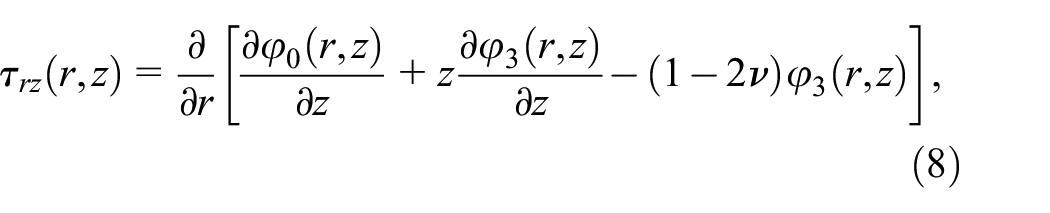




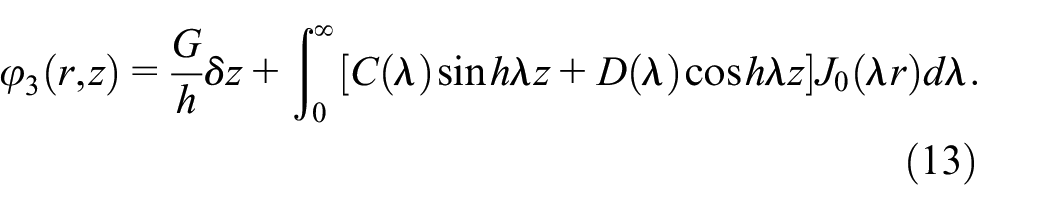


The




Assuming 20 (formula 6.522.2), the integral formula


Permits us to solve the dual integral equations (17) and (18), using the following expression

Substituting from equation (23) into equation (17), and making Gegenbauer’s formula 20 (formula 8.531.1), we get


we obtained

where

Equation (26) must hold for an arbitrary value of

In matrix form, equation (28) becomes

where

We can derive the results for the particular case. The result obtained in the problem
7
is easily obtained by taking
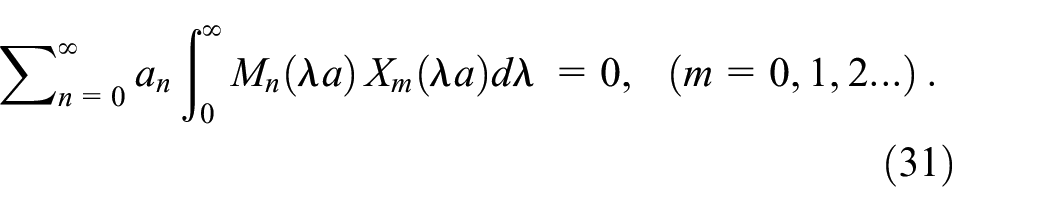
We write the system equation (29) in dimensionless form, which allows us to facilitate their simplification and to generalize the results. By setting the following changes of variables

Then

where


and


Numerical results
To estimate the unknown coefficients
Coefficient values

Expressions for the physical quantities
The nondimensional normal displacement in the plane

where
Therefore, the nondimensional normal stress in the contact region between the elastic medium and the rigid base can be expressed in appropriate Chebyshev series, with unknown coefficients

The stress state around the plane of contact base can be described by the stress singularity factor defined as 10

The substitution of equation (40) into equation (41), we obtained

The behavior of nondimensional normal displacement

Variation of
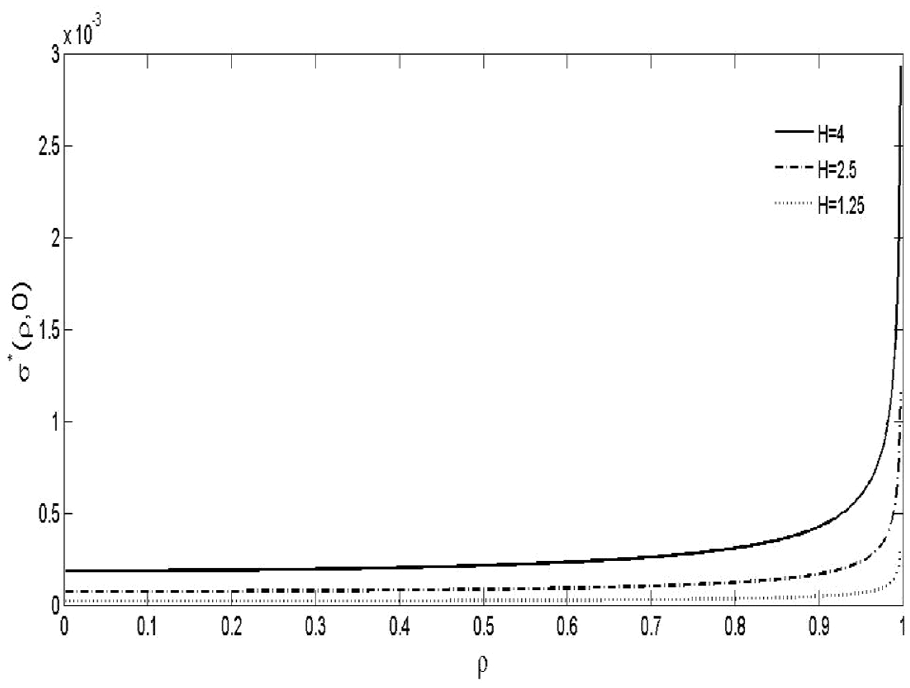
Variation of

Variation of
Finite element simulation modeling
In the modeling carried out, an axisymmetric finite element method Figure 5 is constructed based on the joint model of Figure 1. The method numerical solution requires as an input some material and geometrical properties. The layer is assumed isotropic and elastic, geometric are taken as

Boundary condition applied (a) and mesh of model (b).
The contour of normal stress distribution on the layer thickness obtained from the numerical method is plotted to the
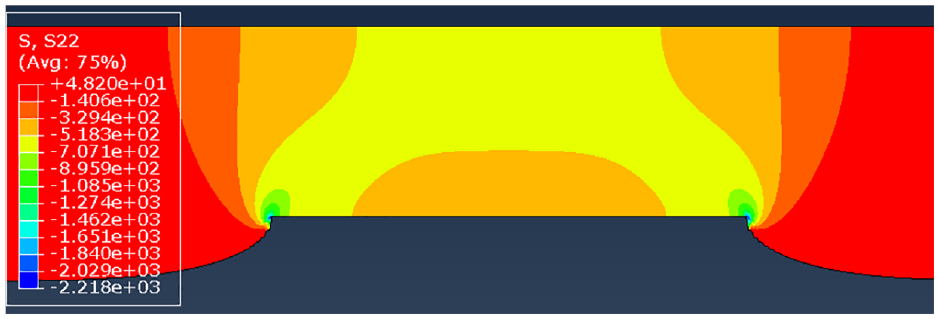
Contour of normal stress distribution on the layer thickness.

Normal stress of distribution along the rigid base surface.

Contour of Von Mises stress distribution of a layer thickness.

Von Mises stress distribution at the rigid base surface.

Contour of vertical displacement distribution on the layer thickness.

Distribution of vertical displacement in the plane
Conclusion
In the present work, the frictionless axisymmetric contact problem for an elastic layer thickness partially reposing on a rigid base is considered. The problem is solved by using a boundary value, the theory of elasticity, and the integral transformation technique. The finite element method FEM is performed for this problem. Following is a summary of some findings provided from mathematical formulations and the results:
− Using the Boussinesq stress functions and the Hankel integral transformations, the studied axisymmetric frictionless contact problem of an elastic medium is reduced to a system of dual integral equations.
− Instead of the traditional Fredholm equation approach, the latter equations are converted into an infinite algebraic system of simultaneous equations. Only the problem’s geometrical parameters are dependent on this system. This allows numerical results of the infinite algebraic system to be obtained for various values of the radius of the rigid base and the thickness layer.
− The thickness layer and the base radius effect on the distribution of normal displacement, normal stress, and stress singularity factor are clarified by numerical computations and graphical results.
− The methods of analysis and the result of this work are consistent with the result obtained by Shibuya et al. 7
− The computational approach based on the finite element method is validated by the analysis described.
Footnotes
Appendix
Handling Editor: Chenhui Liang
Declaration of conflicting interests
The author(s) declared no potential conflicts of interest with respect to the research, authorship, and/or publication of this article.
Funding
The author(s) received no financial support for the research, authorship, and/or publication of this article.

Data availability statement
The authors of the article assert that they do not supply their work and that everything that supports the findings of this study is fully available in the paper.