




Abstract
In this paper, we present the results of a simulation of a 3 MWp photovoltaic plant in Nigeria using four case study scenarios: ground-mounted fixed inclined monofacial, and bifacial photovoltaic installation, as well as monofacial and bifacial photovoltaic installations with trackers. The bifacial gains, tracker gains, and bifacial-tracker gains were calculated for each configuration. The fixed ground-mounted inclined bifacial PV system gained 12% annual average bifacial gain over a fixed ground-mounted monofacial system, while the bifacial system with a solar tracker gained 8.9% over a monofacial system with a solar tracker. A monofacial PV system with a tracker over a fixed inclined monofacial system has a tracker gain of 16%, while a bifacial PV system with a tracker over a fixed inclined bifacial system has a tracker gain of 13.2%. The monofacial system with a solar tracker outperforms a fixed inclined bifacial system by about 4%. The sensitivity analysis performed to determine the effect of system parameters such as albedo and ground clearance height on bifacial PV systems reveals that the increase in specific energy production per kilowatt-hour per year is directly proportional to the albedo of the surface area on which the bifacial PV systems are installed, and adequate ground clearance height is required between the ground and the installed bifacial PV plants.
Keywords
Introduction
With more than 700 GWp of installed capacity as of 2020, 1 solar photovoltaic (PV) systems have grown to be significant contributor to global energy mix in recent years. The PV installation is rapidly expanding around the world and in 2021, solar PV alone accounted for more than half of all renewable energy expansion, followed by wind and hydropower.2,3 The PV energy production is strongly influenced by local climatic conditions, such as sunlight intensity and the ratio of diffuse radiation to global solar radiation,4,5 and other ambient conditions (such as ambient temperature and wind speed), which vary significantly from one location to another. Presently, the majority of PV installed globally are fixed tilted monofacial, which absorb solar radiation at the front surface,6,7 however, bifacial modules are gaining momentum and are expected to have a market share of 50% by 2029. 8 This projection is based on the fact that bifacial photovoltaic (PV) cells and modules can absorb solar irradiance utilizing both the front and back sides, resulting in a higher daily and annual energy yield for the same module area as monofacial PV modules.6,9–11
The advent of bifacial technology, as well as single-axis tracking system (1T) and dual-axis tracking system (2T), is likely to challenge the dominance of fixed tilted monofacial, 7 because it has the potential to achieve low levelized cost of energy of PV systems.12,13 The deployment scenario (orientation of the system), system parameters, and environmental conditions all have an effect on the energy generated by bifacial PV modules in comparison to monofacial PV modules. 11 Some studies have examined the factors that affects the energy yield gain of bifacial modules and such factors include tilt angle, clearance height and albedo 14 ; non-uniformity of back illumination and seasonal sun position, 15 ratio of diffuse radiation to global solar radiation, 16 altitude angle of the sun, 17 row spacing, 18 and latitude of the installation site. 19 Jang and Lee 20 reported that when the reflective material size was doubled, the specific yield increased by 1.6%. According to Beal et al., 21 the power gain of bifacial solar cells is dependent on the height of the ground clearance, which can vary between 13%and 35% in sunny conditions and 40%–70% in cloudy conditions. For a study conducted by, 22 the variability of different ground conditions with gravel, white non-woven fabric, and artificial grass has shown that the white non-woven fabric ground had the best albedo of 0.21 and the highest bifacial gain of 14.5%. The extra energy yield from bifacial PV system relative to the monofacial PV system is usually quantified using bifacial gain, which is defined as the increase in specific energy yield (kWh/kWp) of the bifacial module in the same system over the monofacial module due to the absorption of irradiance at the rear side.
Most previous experimental and simulation studies on bifacial PV systems are concentrated in high latitude regions. It has been established that bifacial gain is greater in high latitude regions17,23–25 due to the low altitude angle and wide range of azimuth angle. 26 However, the obvious abundant solar irradiation available in the equatorial region has made installing photovoltaic (PV) systems more attractive 27 and more reliable with less intra-annual variability. Therefore, it is critical for the adoption of bifacial systems at low latitudes to accurately estimate the potential energy yield and then optimize the system to increase the energy yield. Solar tracking systems are effective way of increasing the amount of solar radiation received by photovoltaic modules. 28 The market share of tracking system is on the rise because it has the ability to enhance the energy yield at a lower cost. 24 The solar trackers are in charge of keeping the surface of the PV modules nearly perpendicular to direct irradiance almost all of the time, allowing them to collect a greater amount of irradiance. 29 Single-axis tracking and dual-axis tracking are the two main categories of solar tracking systems.30–32 According to Seme et al., 33 previous research and studies have shown that the tracker gain ranges between 22% and 56% in comparison to a fixed solar PV system. However, this gain is highly dependent on some system parameters such as the location’s climatic condition, and tracking-axis degree of freedom and control system.
To enhance the incident solar radiation on a PV system, Zhu et al. 31 designed and investigated the performance of a single-axis tracking structure and observed performance ratio of 96.40%. The results of a dual-axis solar tracking experiment revealed that on cloudy days, the system can generate up to 11% more energy than a fixed PV system. 34 The validated modelled result for single axis solar tracking of bifacial and monofacial systems by Pelaez et al. 35 shows that the annual measured bifacial energy gains of 7%–9% agree with modeled expectations to within 1%–2%. However, daily bifacial gain could vary widely, for example, from 8% to 14% for two single-axis trackers as reported by Stein et al. 36 for a location in New Mexico (USA). Zengwei et al. 37 demonstrated through the modelling of performance of inclined east-west (IEW) and horizontal east-west (HEW) solar tracking systems for bifacial PV panels. According to these authors, a variation in albedo from 0.2 to 0.8 resulted in linear increment and solar radiation gain of up to 25% for the horizontal east-west and 31% of bifacial PV panels tilted east-west. The studies on the modelling, analysis on the installation of bifacial PV modules at high latitude and PV systems with a tracker are presented in Tables 1 and 2.
Research studies on bifacial PV modules at high latitude.

PV systems with a solar tracker.

The combination of bifacial photovoltaic modules and horizontal single-axis tracking has demonstrated that it is possible to achieve the lowest possible levelized cost of electricity.45,46 Since the majority of research on the performance of a bifacial solar PV module is done in high latitude regions and according to the findings of these studies, bifacial PV modules perform better at higher latitudes. Solar tracking systems can be used to improve the performance of this type of module in low-latitude regions. In the deployment of large-scale PV systems in regions with high direct normal irradiance, single axis solar tracking shown its ability to boost the energy yield and it is economical. 35 In this study, performance comparison analysis of fixed tilted monofacial, fixed tilted bifacial, single-axis tracking monofacial, and single-axis tracking bifacial. To achieve this objective the following activities were carried out:
Determine the energy yield from each installation.
Evaluate the bifacial gain and the tracker’s gain relative to fixed inclined monofacial installation.
Determine the influence of ground clearance height and albedo on the specific energy yield on the bifacial installation.
Materials and methods
Location and system design
A design 3003 kWp system to determine the influence of location-specific conditions and the relative performance of the system with bifacial modules and sun-tracking system. Tambuwal in the Sokoto State of Nigeria (12.40° N 4.64° E) in north west of Nigeria (see Figure 1) was chosen due to its proximity to the state capital, which is about 101 km and the elevation of the site above sea level is 254 m. Meteonorm 8.0 data show that the annual average diffuse fraction (diffuse/global horizontal irradiance) is 47.8 %. This can be useful for bifacial applications because the diffuse fraction of a location affects the energy yield and bifacial gain.15,16,42 Tambuwal has a hot semi-arid climate and is situated in the dry Sahel region, surrounded by sandy savannah. 47 For simulation analysis, four scenarios, which are outlined below, are considered.
Ground-mounted fixed inclined monofacial photovoltaic
One-axis horizontal tracking monofacial photovoltaic
Ground mounted fixed inclined bifacial photovoltaic
One-axis horizontal tracking bifacial photovoltaic

Map of Nigeria showing the study location (Tambuwal in Sokoto State).
Because the location is in the northern hemisphere, the system is assumed to face the equator, which is south facing with an azimuth of 0 and tilt angle of 15°, which is slightly greater than the location’s latitude. Increasing the tilt angle benefits the system by increasing the amount of ground reflected irradiance that reaches the backside of the bifacial PV module,40,48 and improve the passive cleaning of the installations.
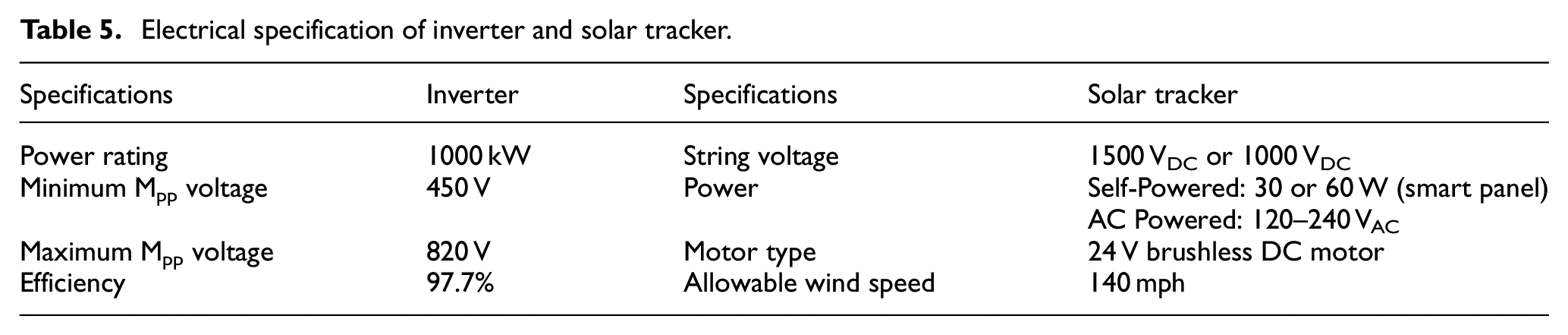
The number of modules, inverters, trackers, and other specifications used in all scenarios was the same because the primary objective is to analyze the gain in energy generation when using various technologies and configurations (monofacial, bifacial, and tracking systems) or a combination of both. The string size is 18 modules per string and the number of strings is 439.The electrical characteristics and specifications of the modules, inverters and trackers used in the simulations are shown in Tables 3 to 5, respectively.
Equipment specifications.

Electrical specifications of the two solar PV modules.

Electrical specification of inverter and solar tracker.
Simulation tool
PVsyst 7.2 was used for the simulations because it is a sophisticated tool with numerous features for detailing the PV system and has a quick simulation time. 49 In several comparative studies, the software has received considerably high ratings and recommendations50,51 unlike Homer and Retscreen which lacks building 3D modeling and shading analysis due to neighboring building.
Theoretical framework
The global horizontal irradiance (GHI) on specific location can be determined using satellite data, a ground weather station, or a clear sky model. The clear sky models are used to estimate the clearness index in other to determine the maximum solar radiation in a particular location.
52
The Kasten-Czeplak (KC) clear sky model for the global horizontal irradiance (




Where

The sum of irradiance on the plane of an array is written as 56 :

where

The power and energy output from any of the PV systems can be determined from 25

Where

By comparing energy yield for monofacial and bifacial systems, the total energy gain for a bifacial system, as well as the gain from using tracking system, are calculated. The bifacial gain is a measure of the increased specific energy yield of bifacial photovoltaic (PV) systems over monofacial PV systems. The bifacial and tracker gain for each configuration is computed and depicted as 25 ;




The
Simulation set-ups
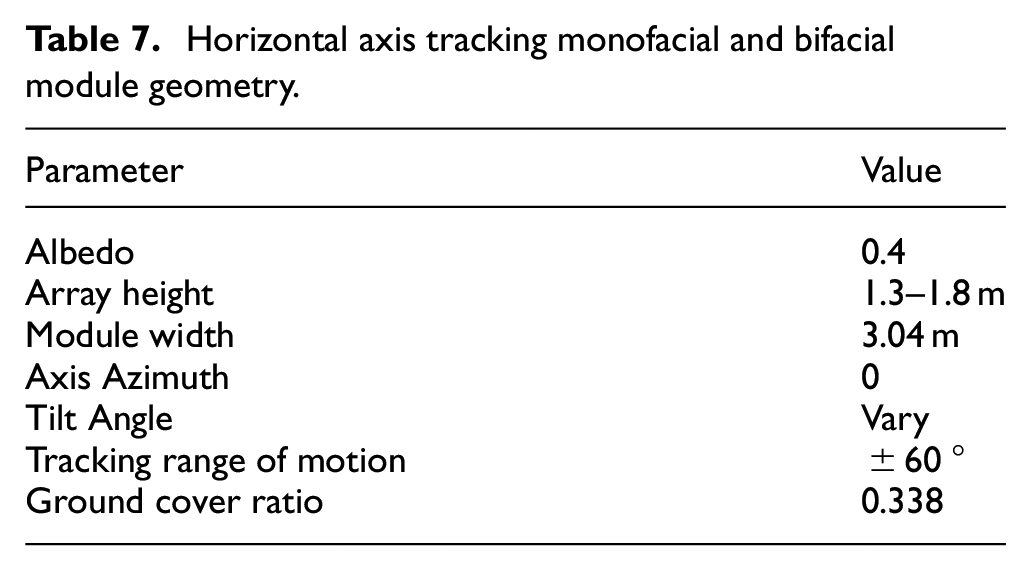
For all systems, the panel width is 3.04 m, the row-to-row distance was calculated to be 9 m. The elevation angle for the worst scenario (December) in the northern hemisphere and the ground clearance height was considered to determine the sufficient pitch in other to avoid shadow. The ground clearance height was 1.5 m, and the albedo for the desert environment was assumed to be 0.4 as suggested by Samer et al. 60 and Gul et al. 61 Tables 6 and 7 represent the system parameter values for the four scenarios being investigated. The values for the system parameters are as stipulated in the PVsyst 7.2 datasheet and NEXTracker. 62
Fixed inclined monofacial and bifacial module geometry.

Horizontal axis tracking monofacial and bifacial module geometry.
Result and discussion
Site solar radiation on the horizontal surface
The values in Figure 2 were extracted from the Meteonorm 8.0 database using PVsyst 7.2. The diffuse radiation is higher than direct for the month, of February, March, and August. This is related to cloudy days being prevalent during those months at Tambuwal. 63 Figure 3 shows that the clear sky model used in Section 2.3 to calculate global horizontal irradiance followed the same trend as the PVsyst model. The clear sky model overestimates global horizontal irradiance slightly more than the PVsyst model. The percentage difference between the two models is 6.11%.
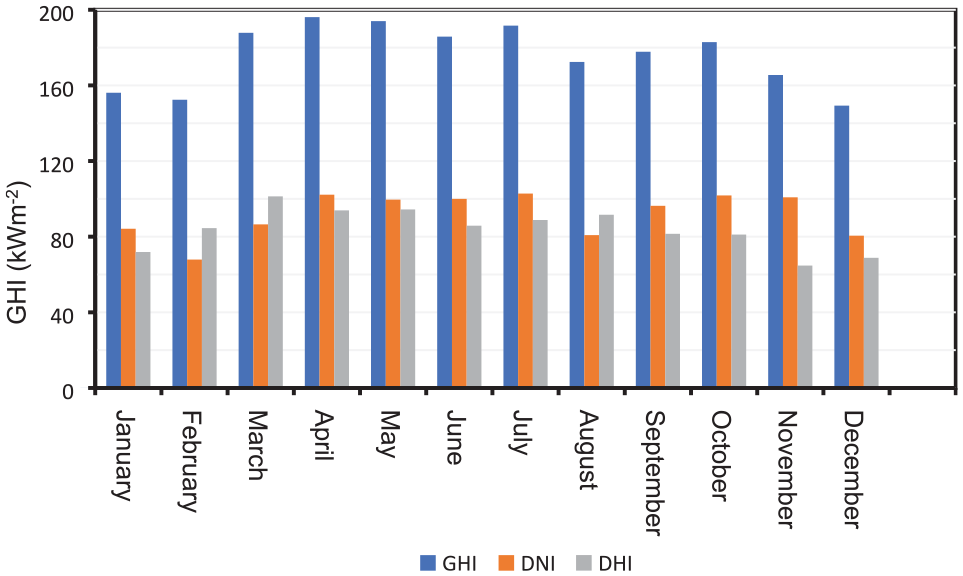
Monthly estimation of global, direct normal, and diffuse horizontal irradiance.

Modelled and simulated monthly estimation of global horizontal irradiance.
Comparative analysis of energy output from the systems
The global incident gain on the collector plane for the fixed tilted system is 2.4% and that of including a tracking system is 24%. Figure 4 depict the monthly DC energy generated by the PV installations and it can be observed that irrespective of the month, the fixed tilted monofacial system produces the least amount of electricity, while the bifacial PV system with a solar tracker produces the highest amount of electricity. Furthermore, Figure 4 shows that the fixed tilted bifacial PV system outperforms the fixed tilted monofacial PV system, this is because bifacial PV module has the ability to absorb solar radiation incident on the front and rear side and hence increasing the energy yield. 18 However, this system generated less electricity than the monofacial PV system with tracking system.

Monthly energy production from the PV array for various PV systems.
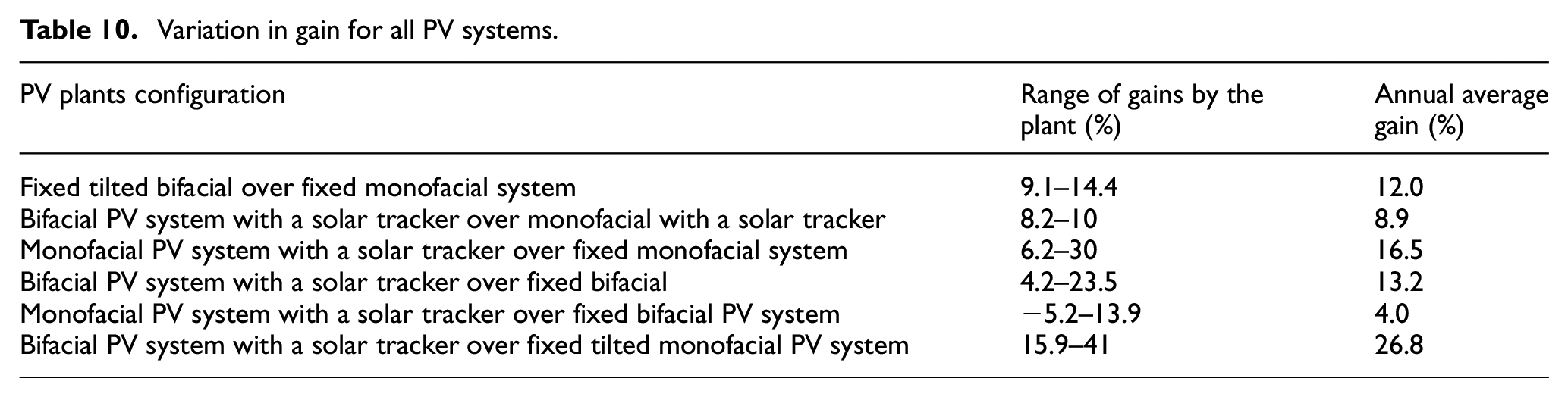
Figures 5 to 7 illustrate the gains obtained by various PV system configurations. To sum up, the bifacial PV system with a solar tracker has the highest gain with the monthly total gain ranging between 15.9% and 41.0%. Barbosa de Melo et al. 29 reported a similar result, with monthly gains ranging from 19.39% to 27.39% for a location in Brazil. Figure 5 shows that the fixed tilted bifacial PV system outperformed the fixed tilted monofacial system in all months, with gain varied from about 10.7% in October and November to about 14.4% in June and annual average bifacial gain of 12%. Similarly, the tracked bifacial PV system, relative to tracked the monofacial PV system, have gain that varied from 8.2% in November to 10.0% in February with annual average gain of 8.9%. This result is in line with the studies conducted by Sun et al., 23 Pelaez et al., 35 and Rodríguez-Gallegos et al. 64 The authors concluded that a fixed bifacial PV module at low latitude can achieve a bifacial gain of 8%–12%, and a single bifacial tracking system can achieve a global average of 9%. The influence of the rear surface has a significant impact on power generation, however, because of the movement caused by the trackers, the irradiance reaching the ground behind the modules in tracked systems is lower than the irradiance reaching the ground behind the modules in fixed systems. 29 The global horizontal irradiance for the location is 2112 kWhm−2. The fixed bifacial system receives 16.84% (356 kWhm−2) of the global horizontal irradiance on the rear side, whereas the bifacial system with a solar tracker receives only 10.94% (273 kWhm−2). The tracker enables the module to capture a greater proportion of direct irradiance on its front side, while reducing the influence of the rear side.

Bifacial gain for the fixed bifacial system and bifacial system with a solar tracker over the monofacial PV system.

Solar tracker gain over PV systems without tracker.

Monthly gain for a bifacial system with solar tracker over fixed tilted monofacial and monofacial system with solar tracker over a fixed bifacial system.
Figure 6 shows that the systems with solar trackers (monofacial and bifacial) outperform their counterparts without trackers. The monofacial PV system with a solar tracker has a 16.5% average tracker gains over the fixed inclined monofacial PV system, while the bifacial PV system with a tracker has a 13.2% average tracker gain over the fixed bifacial system. The trackers gain has the lowest value in January, February, November, and December. This can be attributed to the presence of more diffuse radiation than direct radiation, as solar trackers are known to be more reliant on direct radiation. 65
Furthermore, in Figure 7, we compare the systems with the highest and lowest energy yields; bifacial PV system with a solar tracker and fixed monofacial PV system. We also look at a tracker-eq16 monofacial PV system and a fixed bifacial PV system. The annual average gain of a bifacial PV system with a tracker over a fixed monofacial PV system is 26.8%. In the months of January, February, and December, the fixed tilted bifacial PV system produced more energy than the monofacial PV system with a solar tracker. This performance of the fixed bifacial PV system over a monofacial PV system with a solar tracker in some months can be attributed to the presence of higher diffuse radiation in those months. 48 Overall, the monofacial PV system with a solar tracker outperforms the fixed bifacial PV system with an annual average gain of approximately 4%.
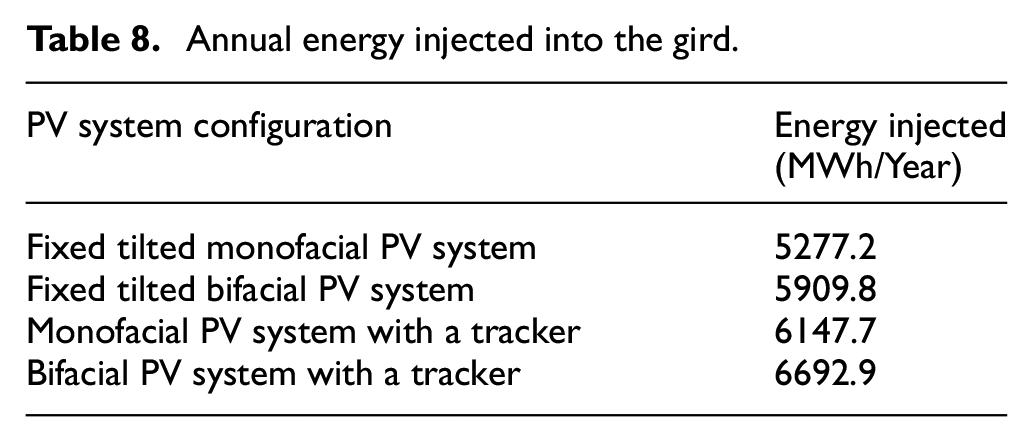
We have the annual energy injected into the grid and the specific energy production per kilowatt in a year presented in Tables 8 and 9. While Table 10 represents the variation in gain and the annual average gain in all the photovoltaic systems. The figures and tables show the energy estimate generated by the various systems.
Annual energy injected into the gird.
Specific energy production per kilowatt peak per year.

Variation in gain for all PV systems.
Sensitivity analysis of the bifacial PV systems
The surface albedo on which bifacial PV modules are installed, as well as installation geometry such as ground clearance height, have been identified as factors influencing the energy output of the bifacial PV system performance.66,67 Therefore, we investigated the influence of these two parameters on the performance of the bifacial PV installation. The influence of the two parameters is apparent in Figures 8 and 9. The albedo varies linearly with the specific energy yield for both the fixed tilted bifacial system and the bifacial system with a tracker at a ground clearance height of 1.5 m as shown in Figure 8. As illustrated in Figure 9, increasing the ground clearance height has little effect on the energy yield in a system with a lower albedo. For a fixed bifacial PV system with lower albedo, the saturation point for energy yield improvement with increased module ground clearance height is lower than a system with higher albedo. The optimum ground clearance height after which there is not much significant energy increase for a system with albedo 0.35, 0.30, 0.25, 0.20, and 0.15 is 3.00, 2.75, 2.50, 2.00, and 1.75 m, respectively.

Influence of Albedo on the specific energy production at 1.5 m ground clearance height.
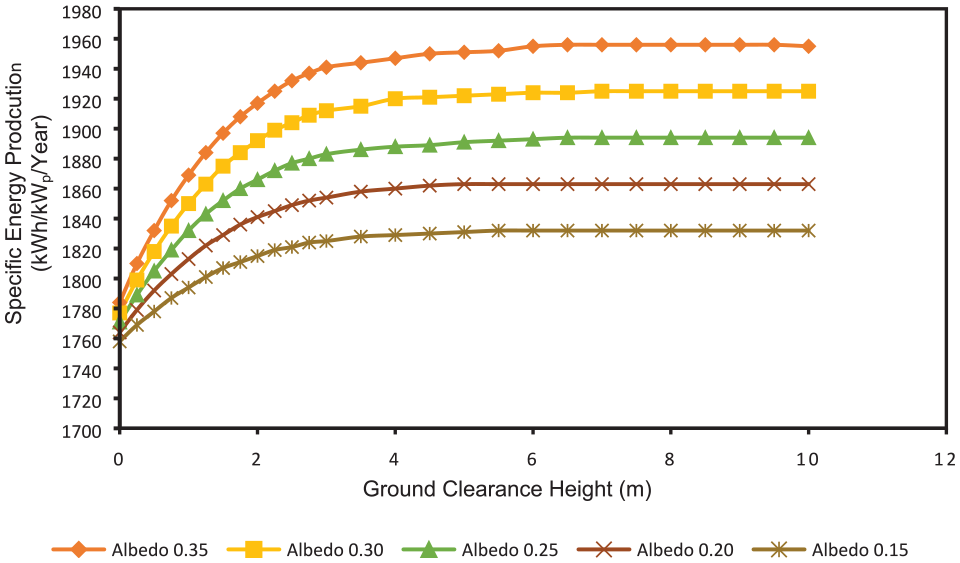
Influence of ground clearance height over the specific energy production at usual various albedo values (Fixed bifacial PV system).
Conclusion
The performance of four different solar PV plant scenarios, which are fixed tilted monofacial PV plant, fixed tilted bifacial PV plant, monofacial PV plant with a solar tracker, and bifacial PV plant with a solar tracker were investigated in this study. Photovoltaic system simulations were carried out in this work adopting technologies that can be used to enhance PV system performance; trackers and bifacial modules. Tambuwal is located in Nigeria’s Sahel region, with a semi-arid climate, and was chosen due to the desert’s proximity to the state capital, which is about 101 km away.
The annual average bifacial gain for a fixed tilted bifacial system over a monofacial fixed tilted system is 12%, while the bifacial gain for a bifacial PV plant with a solar tracker over a monofacial PV plant with a solar tracker is 8.9%. The annual average tracker gains for a monofacial PV plant equipped with a solar tracker over a monofacial fixed tilted PV plant are 16.5%. The tracker gain for a bifacial PV plant with a solar tracker over a fixed bifacial PV plant is 13.2%. The bifacial PV plant with a solar tracker produced the most energy and comparing the energy gain to a fixed monofacial PV plant that produced the least energy resulted in approximately 26.8% of the bifacial gain. Interestingly, with an annual average gain of 4%, monofacial PV plants outperformed fixed tilted bifacial PV plants.
Finally, the effect of albedo and ground clearance height affect the performance of a bifacial PV plant are examined. According to the analysis, albedo varies linearly with energy yield, and sufficient clearance height should be provided for the bifacial PV plant to increase the amount of energy generated. It is critical to determine the economic viability of each of these scenarios; therefore, future work will concentrate on the economic factors that can influence the decision on which method is best suited for this location.
Footnotes
Acknowledgements
Rahimat O Yakubu acknowledges and appreciate the PhD scholarship support by Kwame Nkrumah University of Science (KNUST) Kumasi Ghana through “KNUST Engineering Education Project (KEEP)” an ACE impact project, funded by the Government of Ghana as part of the World Bank Africa Centers of Excellence (ACE) for Development Impact Project. Furthermore, the authors appreciate the support from the Faculty of Environmental Sciences and Natural Resources Management, Norwegian University of Life Sciences, Ås, Norway.
Handling Editor: Chenhui Liang
Declaration of conflicting interests
The author(s) declared no potential conflicts of interest with respect to the research, authorship, and/or publication of this article.
Funding
The author(s) received no financial support for the research, authorship, and/or publication of this article.
