




Abstract
The hydrodynamic bearing is the key part of many rotating machines, and dynamic characteristics of the bearing would affect the operation performance of machines directly. Thus, this study focused on dynamic characteristics of long journal bearings and tried to illustrate the influence of surface roughness on dynamic performances of long bearings. Applying Christensen stochastic model and long bearing approximation, the modified Reynolds equation was established. To solve the modified Reynolds equation, the numerical integration method was applied. It is found that the surface roughness would significantly weaken the stability threshold speed, normal stiffness coefficients (
Keywords
Introduction
The hydrodynamic bearing plays an important role in many rotating machines, and the performances of these machines depend on the dynamic and static characteristics of the bearing. Especially, dynamic characteristics of the bearing directly determine operation accuracy of machines. Thus, it is very necessary to discuss the dynamic performances of hydrodynamic bearings.
Based on the fourth order Runge-Kutta method, Khonsari and Chang 1 calculated the journal center trajectory of a short hydrodynamic bearing at equilibrium position suffered a transient impact, and displayed stability boundary of the journal center after calculating threshold speed of the bearing. After that, a lot of works had been done by applying this method. Considering non-Newtonianism of the lubricant, Lin et al. 2 illustrated the influence of couple stress on the nonlinear stability of short hydrodynamic bearings. Several years later, applying Rabinowitsch fluid model, Lin et al. 3 discussed the linear stability of short hydrodynamic bearings lubricated with pseudoplastic fluids. To solve the Reynolds equation, perturbation method was applied by them which means that the non-Newtonian factor of the pseudoplastic lubricant cannot be larger than 1. But the non-Newtonian factors are larger than 1 for most pseudoplastic lubricants. To solve this problem, Tian and Chen 4 proposed a new method and expanded value range of the non-Newtonian factor from (0, 1) to all the positive real numbers. During the calculation of journal center trajectory and threshold rotating speed of hydrodynamic journal bearings, the derivation process was complex because of the different coordinate systems. Using unified polar coordinate system, Huang et al. 5 derived the journal center trajectory and threshold rotating speed of hydrodynamic journal bearings and simplified the derivation process. After that, Huang et al. 6 studied the linear stability of long hydrodynamic bearings, and found that there were two threshold rotating speed for long hydrodynamic bearings which is quite different with short bearings. Besides, they discovered that the linear stability range of the long bearing was nearly coincided with the clearance circle which means the linear stability of long hydrodynamic bearings were very good. Except discussing the stability of hydrodynamic bearings through journal center trajectory, a few other methods had been proposed. Applying Hopf bifurcation theory, Amamou and Chouchane 7 obtained the threshold speed of long hydrodynamic bearings. Wang and Khonsari 8 discussed the stability of long bearings with axially groove.
Although the studies above are very important for discussing the dynamic performances of hydrodynamic bearings, all bearings discussed in there studied are smooth. However, the real surface of bearing cannot be smooth, and the static and dynamic performances of hydrodynamic journal bearings would be affected by the surface roughness. To describe the distribution characteristics of the bearing surface roughness, Christensen 9 proposed a stochastic model and there were two kinds of surface roughness in this model: longitudinal and circumferential. Combining this stochastic model with perturbation method, Lin 10 illustrated the influence of surface roughness on static and dynamic performances of hydrostatic thrust bearings compensated by capillary. Applying this model and Hopf bifurcation theory, Lin11,12 studied the nonlinear stability of short hydrodynamic bearings considering two kinds surface roughness: isotropic and longitudinal. Walicka et al.13,14 discussed the effects of non-Newtonian lubricants on static characteristics of thrust bearings considering the surface roughness. Tian and Li 15 displayed the influence of non-Gaussian distribution of surface roughness on the linear stability of short hydrodynamic bearings, and found that roughness distribution would affect threshold speed of the bearing significantly. In their opinion, the non-Gaussianity of roughness cannot be ignored during discussing the stability of hydrodynamic bearings manufactured by machining such as turning, milling and grinding. Gururajan and Prakash 16 discussed the static characteristics of long bearings considering the surface roughness. By proposing a new set of calculation models, Xie and Zhu17–19 investigated the static and dynamic characteristics of the floating ring bearing considering the micro asperity of bearing surface, and their results were verified by experiments and previous literatures.
Going through the studies above, it was found there was hardly any studies on dynamic characteristics of long bearings with surface roughness. Thus, the discussion on dynamic characteristics of long bearings considering surface roughness was displayed in this study. It was found that the threshold speed and dynamic characteristics of long bearings were affected by the surface roughness significantly for the bearing with a large eccentricity ratio. Thus, the influences of surface roughness cannot be ignored during discussing dynamic characteristics of long journal bearings.
Analysis
The journal bearing with surface roughness is illustrated in Figure 1. R is the bearing radius, x = Rcosθ is circumferential coordinate, φ is attitude angle and e is the eccentricity. The local film thickness h = h0 + hs(z, ξ), where h0 = C + ecosθ is the oil film thickness of smooth bearing surface and C is the radial clearance, hs = δ1 + δ2 is the fluctuation of surface topography (δ1 is the fluctuation of journal surface and δ2 is the fluctuation of bearing surface), and ξ is a random variable reflecting the asperities of surface roughness. For other parameters: ω is angular speed of the rotating bearing, W is the loads imposed on the bearing, and fε and fφ are oil film forces on eccentric direction and the direction perpendicular to it. The Reynolds equation of a hydrodynamic journal bearing could be written as:

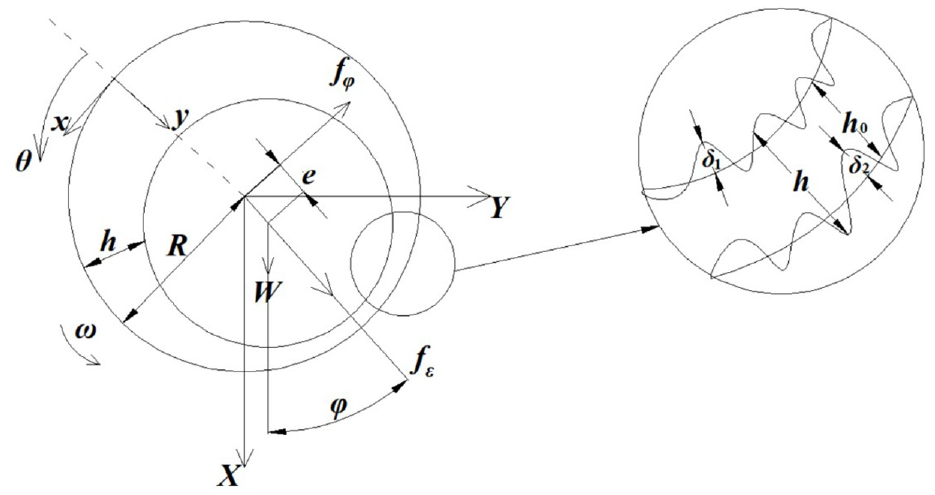
Illustration of surface roughness for a journal bearing.
Considering longitudinal roughness of the bearing surface and taking expectation of Reynolds equation (1), the Reynolds equation in statistical form is found 9

The operator E(*) is the expectation of variable (*) which is defined as:

where g(hs) is the probability density distribution function of random variable hs, and the distribution region of hs is (−c, c), here c = 3σ and σ is the standard deviation of hs. Regarding the longitudinal surface roughness as Gaussian distribution, and the distribution function g(hs) could be written as

Applying the Christensen statistical model, 9 considering the longitudinal surface roughness, statistical equation (2) is changed into

Based on the equations (3) and (4), the expectation values of h and h3 could be obtained

Introducing the following non-dimensional relationships:
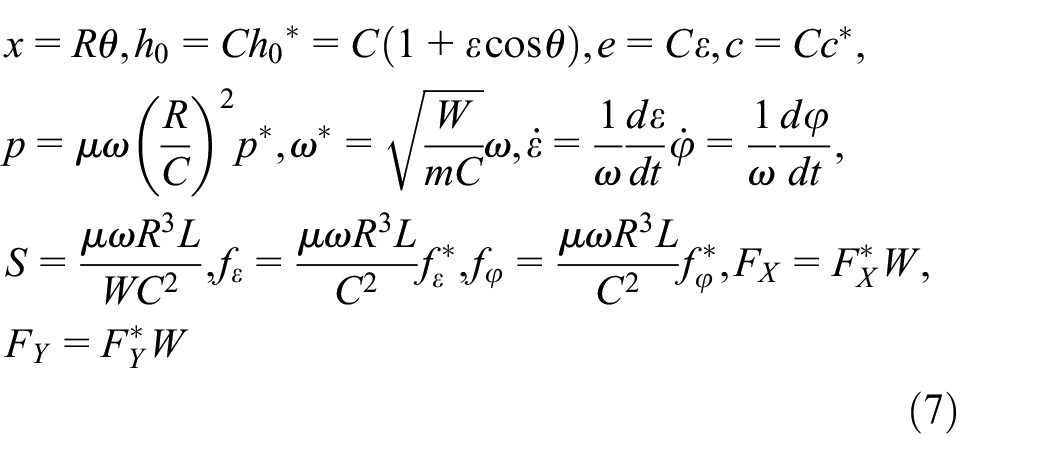
Bringing in the long bearing approximation, the non-dimensional Reynolds equation of a long bearing could be written as

Putting the expectation values of h and h3 into equation (8), the stochastic equation is obtained as follows:
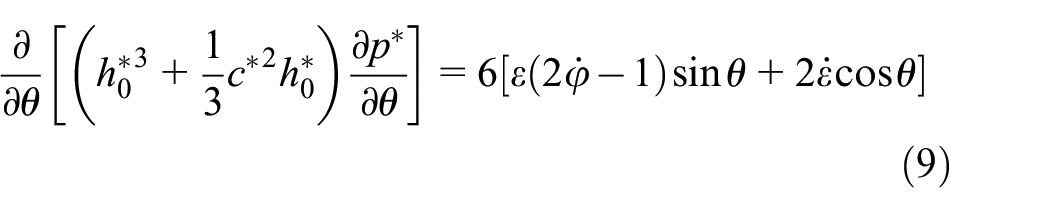
Applied the half-Sommerfeld boundary conditions p*(θ = 0, θ = π) = 0, the oil film pressure in non-dimensional form is obtained

where A is the integration constant and the value is

Then taking the definite integral of non-dimensional pressure from 0 to π, the oil forces in non-dimensional form could be derived
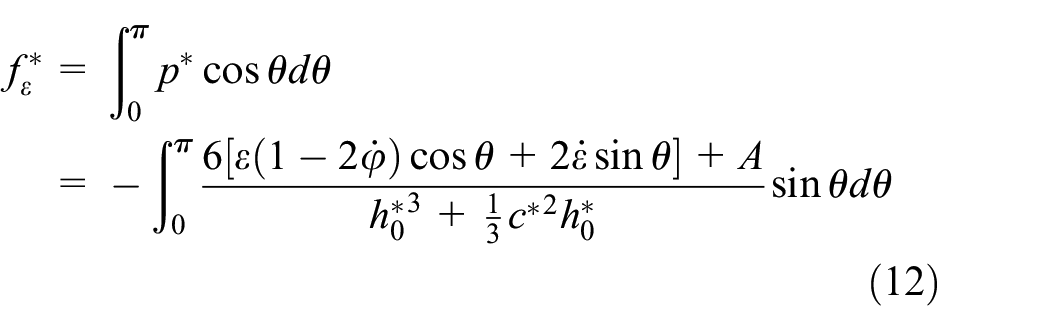

In Figure 1, applying the equilibrium relationships of journal in horizontal and vertical directions, the resultant forces in X and Y directions could be found


And the journal accelerations in X and Y directions are


where ω* is the non-dimensional angular velocity of the rotating journal.
When the journal at equilibrium location, which means the journal accelerations equal 0. At this situation, the attitude angle φ and the Sommerfeld number S are derived from equations (16) and (17) as follows


Considering following state vector

Taking the derivation of the state vector

For the journal at the equilibrium location, Jacobi matrix of the state equation (21) could be obtained

The subscript s means the journal at the equilibrium location, and
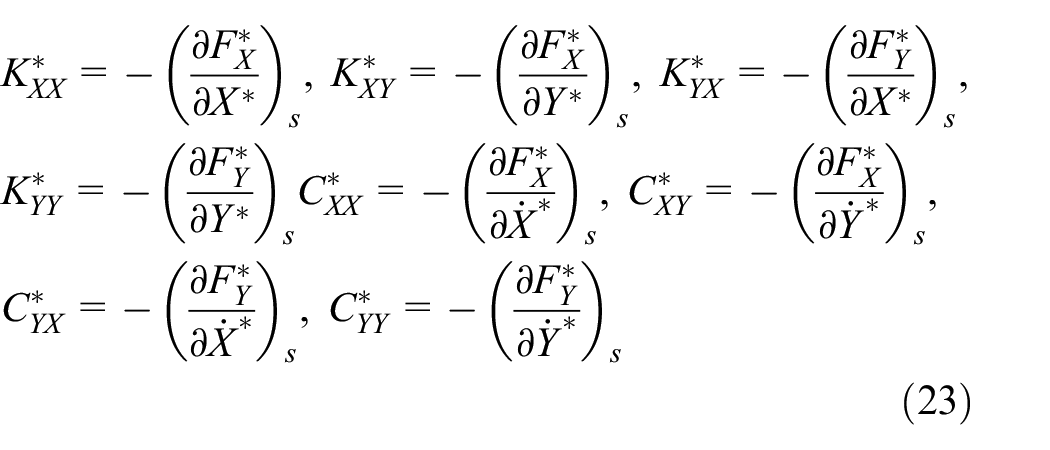
And the expressions of
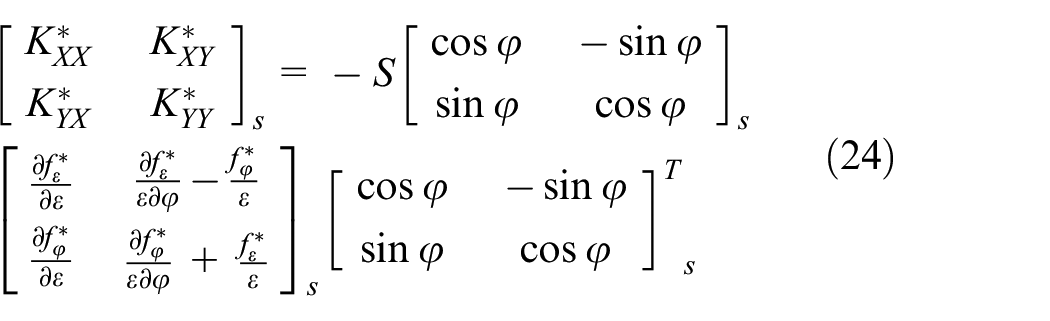

With equations (12) and (13), the values of elements in the middle matrix at the right sides of equations (24) and (25) are


where the values of parameters Ai (i = 0,1,2) are

The values of definite integration in equations (12), (13), and (26)−(28) are hard to deduce by analytic method, so seven-point Gauss–Legendre integral formula is applied as follows

here f is the integrand, a and b are defined as upper and lower limit of the integral, λi (i = 1,2…7) are node factors, and xi (i = 1,2…7) are weight factors. The values of λi and xi are:

The characteristic equation of Jacobi matrix (22) is

where |
Then stability threshold speed of the long bearing could be deduced by applying the Routh-Hurwitz stability criterion:

where

The flow chart of above derivation procedure is displayed in Figure 2.
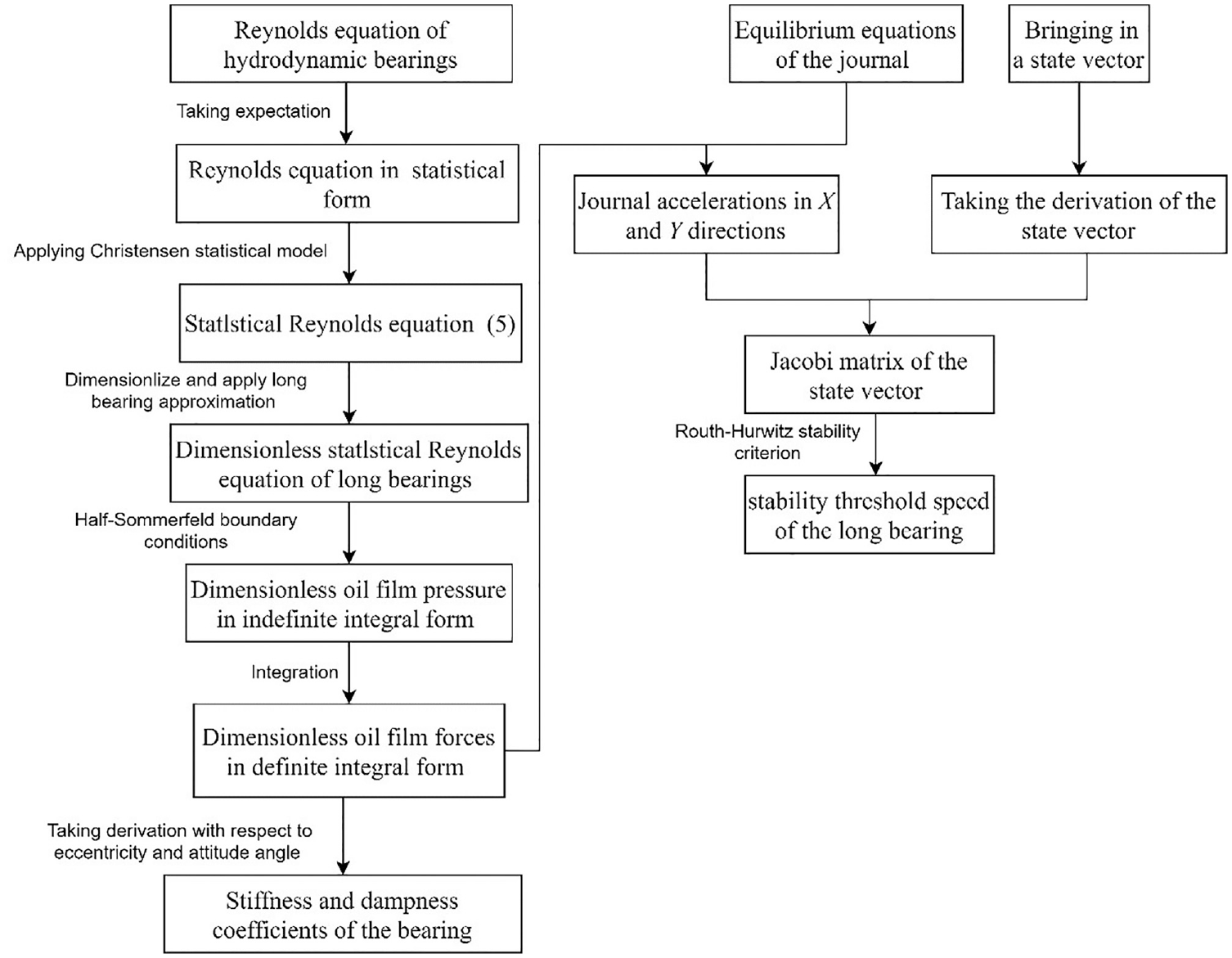
The flow chart of derivation procedure in Section 2.
Model verification
The dynamic characteristics of hydrodynamic long bearings considering longitudinal surface roughness is discussed in this study, and the parameter c was chosen to characterize distribution of the surface roughness. For the smooth surface, c = 0. When the value of c is larger, the surface of the bearing is rougher. To verify validity of the derivation in this discussion, the smooth results (c = 0) of threshold speed in this study is compared with the results of Amamou and Chouchane 7 in Figure 3. It is found that the two results agree well with each other, and the correctness of this study is validated.

The relationships between the threshold speed and the eccentricity ratio with different roughness parameters (c = 0, 0.2, 0.4).
Results and discussion
In Figure 3, the influence of eccentricity ratio on the threshold speed considering longitudinal surface roughness is displayed. When the eccentricity ratio ε is less than 0.6, the differences between the smooth and rough bearings can be ignored. For the situation of eccentricity ratio ε larger than 0.6, the effect of surface roughness is obviously, especially at the situation of eccentricity ratio ε larger than 0.7. The longitudinal surface roughness of hydrodynamic bearings reduces the threshold speed when the eccentricity ratio ε is larger than 0.6, and with a larger eccentricity ratio, the influence is more obviously. Thus, when the long bearing is rotating at the situation of eccentricity ratio ε larger than 0.6, the longitudinal surface roughness should be avoided during the bearing machining.
The influences of the longitudinal surface roughness on the dynamic characteristic coefficients are illustrated in Figures 4 and 5. The relationships between the eccentricity ratio and the four stiffness coefficients with different roughness parameters (c = 0, 0.2, 0.4) are displayed in Figure 4. The effects of the longitudinal surface roughness on the crossed stiffness coefficients (

The relationships between the four stiffness coefficients and the eccentricity ratio with different roughness parameters (c = 0, 0.2, 0.4).

The relationships between the four dampness coefficients and the eccentricity ratio with different roughness parameters (c = 0, 0.2, 0.4).
In summary, it is found that the longitudinal roughness of bearing surface would weaken dynamic characteristic coefficients of bearings, especially for the bearing with a larger eccentricity ratio. The lubrication flow model applied in this study is laminar which is same with the models applied in previous studies on hydrodynamic bearings. For the bearing with longitudinal roughness, the lubricant would be easier to be extruded out of the bearing. With a larger eccentricity ratio, the extrusion effect is more obviously. And this is the reason for dynamic characteristic coefficients of bearings would be weakened by the longitudinal surface roughness.
Conclusions
The dynamic characteristics of long hydrodynamic bearings considering longitudinal surface roughness was discussed in this study. Based on the discussions above, several conclusions could be obtained as follows:
The influence of longitudinal surface roughness on the threshold speed of long bearings cannot be ignored for the situation of eccentricity ratio larger than 0.6.
The normal stiffness coefficients
The longitudinal surface roughness would weaken the stability of hydrodynamic bearings, so this kind of roughness should be avoided during machining process of bearings.
Footnotes
Handling Editor: Chenhui Liang
Declaration of conflicting interests
The author(s) declared no potential conflicts of interest with respect to the research, authorship, and/or publication of this article.
Funding
The author(s) disclosed receipt of the following financial support for the research, authorship, and/or publication of this article: This research is supported by Science Challenge Project (No. TZ2018006-0102-03), National Natural Science Foundation of China (No. 51875223).
