



Abstract
Although bearings have been used in many rotating machineries, the literatures relative to matched bearings are very scarce. The distributions of contact load and contact angle between bearing parts are the key indicators to reflect the operating condition of bearings, which can directly influence the wear rate and fatigue life of bearings. Owing to the complex and compact structure of matched bearings, it is hard to judge and evaluate what happens inside the matched bearings by experiments. To solve this problem, this paper presents a novel method to determine the distributions of contact load and contact angle of matched bearings under complex working conditions. Firstly, to establish the nonlinear relationship between internal deformations of balls and applied loads, a comprehensive model is proposed by using the coordinate transformation method and the Hertz contact theory. Then, the accuracy of the proposed model is validated by comparing the stiffness values with those reported in the existing reference. Finally, a pair of 7206B bearings is used as a case to introduce the use of the proposed model. The influences of installation type, preload, combined loads on the distributions of contact load and contact angle of matched bearings are detailed analyzed and studied.
Keywords
Introduction
Angular contact ball bearings installed in pairs have obvious advantages than single bearings, which can provide higher load carrying capacity and better deformation resisting performance. 1 Consequently, matched angular contact ball bearings are widely applied in numerous kinds of rotating mechanical systems due to their excellent mechanical properties and high reliability. As the fundamental components in complex machinery systems, their mechanical characteristics play a crucial role in the transmission properties of force and vibration of the whole system. Although matched bearings have a large number of applications in engineering practice, the relevant literature on matched bearings are very scarce. Owing to the different installation types and mechanical behaviors of bearings, the modeling approach of single bearings cannot be applied to the analysis of matched bearings. Accordingly, a method for the modeling of matched bearings is imminent.
Over the past years, many scholars have carried out a great number of studies on single ball bearings from different aspects, such as vibration characteristics, 2 fatigue life, 3 fault diagnosis, 4 stiffness calculation, 5 and heat analysis, 6 etc. Aktürk et al. 2 investigated the vibration of a shaft-ball bearing system by a nonlinear three-degree-of-freedom model, and the result indicates that the ball number and preload can significantly affect the dynamic characteristics of the rotating system. Pattabhiraman et al. 3 developed a procedure to evaluate the fatigue life of silicon nitride hybrid ball bearings under various uncertainties, and the results indicate that the failure probability can be reduced by decreasing the maximum crack size and increasing the fatigue threshold. Cui et al. 4 presented a new method for defective ball bearings to determine their local defects quantitatively and locally. Sheng et al. 5 calculated the speed-varying stiffness of ball bearings based on the quasi-static model and the implicit differential method. Yan et al. 6 proposed a precise numerical model for ball bearings to investigate the thermal dissipation of bearing cage at ultra high rotating speed. The distributions of contact load and contact angle can directly reflect the operating condition of bearings. Accordingly, the study on the distributions of contact load and contact angle also has attracted attention of domestic and foreign scholars. Liao and Lin 7 established a simple, three-dimensional expression to calculate the elastic deformation of a ball bearing, in which the contact angle was considered as a function of the position angle of balls. Amasorrain et al. 8 developed a calculation procedure to determine the load distribution of a four contact point slewing bearing. Daidié et al. 9 analyzed the variations of contact load and contact angle of a slewing ball bearing under different loading cases by a 3D simplified finite element model. Petersen et al. 10 studied the influence of a raceway defect on the load distribution of a ball bearing, and the result indicates that the load on the defect-free raceway section increases with the increasing circumferential extent of defect. Li et al. 11 presented a mechanical model for an angular contact ball bearing with a localized defect on its outer race, and the influences of operating condition and defect size on the variations of contact angle and contact load were analyzed. Liu et al. 12 used an analytical calculation method to investigate the influence of combined loads including radial and axial loads on the distributions of contact load and contact angle of ball bearings. Zhang et al. 13 proposed an improved quasi-static model for ball bearings to analyze the distributions of contact load and contact angle, in which the influence of ring misalignment was considered.
The research objects of the above-mentioned works mainly aim at single bearings. So far, the scientific literature about matched bearings is quite sparse. The theory and research achievements about matched bearings are far less abundant than those of single bearings. Therefore, the research on matched bearings has begun to attract increasingly attention from scholars. Bercea et al.14,15 proposed a set of general formulas to investigate the load characteristics of double-row bearings with different installation types. Li and Shin 1 presented a dynamic thermo-mechanical model to analyze the influence of bearing installation type on the thermo-dynamic behaviors of a spindle-bearing system, and the results indicate that the bearing orientation has obvious influence on the stiffness of whole structure. Karacay and Akturk 16 investigated the vibration behaviors of a spindle supported by a pair of angular contact ball bearings using a five-degree-of-freedom model. Gunduz et al.17,18 proposed an analytical model to study the modal characteristics of double row angular contact ball bearings. Zhang et al. 19 constructed a universal model to calculate the preload, stiffness and contact angle of matched angular contact ball bearings only subjected to an axial load. Yang et al. 20 employed the experimental method to determine the stiffness values of angular contact ball bearings with different configuration forms. Lin and Jiang 21 proposed an improved quasi-static model to study the influences of initial contact angle, installation type, and pretension method on the stiffness values of duplex angular contact ball bearings. Yang et al. 22 presented an analytical model to analyze the influences of combined loads and angular misalignment on the load distribution of double-row tapered bearings. The matched bearings have been widely used in numerous kinds of rotating equipments. The distributions of contact load and contact angle are the key indicators to reflect the operating condition of matched bearings, but the related literature for matched angular contact ball bearings has not been reported to date. To the author’s best knowledge, mainly owing to the geometry complexity of matched angular contact ball bearings. This prompts us to carry out the present work to provide a useful and meaningful reference for the research theory of matched bearings.
In this paper, a comprehensive model is constructed to study the loading characteristics of matched angular contact ball bearings. The article outline is the following. In Section 2, a five-degree-of-freedom model is constructed based on the coordinate transformation method. Then the contact load and contact angle can be determined by the proposed model. In Section 3, the proposed model can be verified by comparing the calculated stiffness values with those reported in the existing literature. In Section 4, the influences of installation type, preload and combined loads on the distributions of contact load and contact angle are investigated minutely. In the end, some main conclusions are given briefly.
Modeling method
Harris and Kotzalas 23 have given several mechanical equilibrium equations to calculate the load distribution and displacement of single bearings. However, these equations are inapplicable in the calculation of matched bearings due to the different structures between single and matched bearings. All the installed bearings are interacted on each other. The relationship between internal geometrical deformations and complicated working conditions needs to be determined. Based on the coordinate transformation method, a comprehensive model can be constructed by considering the force balance relation of each bearing in the modeling of matched bearings. To carry out the simulation of matched bearings, the analyzed model must be simplified to some extent. Thus, five assumptions are adopted in this study:
The manufacturing error and assembly tolerance of matched bearings can be neglected.
The influences of retainer, sealing ring and other elements on the loading behaviors of matched bearings can be neglected.
The contact deformations between rolling elements are in elastic range.
The rotating speed of matched bearings is low, so the centrifugal force and gyroscopic torque acting on each ball can be neglected.
The influences of temperature variation, lubrication condition and other factors on the loading properties of matched bearings can be neglected.
Coordinate transformation
Generally, the matched angular contact ball bearings are often installed by the styles of face-to-face arrangement (DF) and back-to-back arrangement (DB), as depicted in Figure 1. The matched bearings installed in the arrangement of DF or DB can withstand axial loads in different directions. In the arrangement of DF, the load lines of left and right balls point toward the inside of matched bearings. For the DB arrangement, the load lines of left and right balls point toward the outside of matched bearings. In Figure 1,
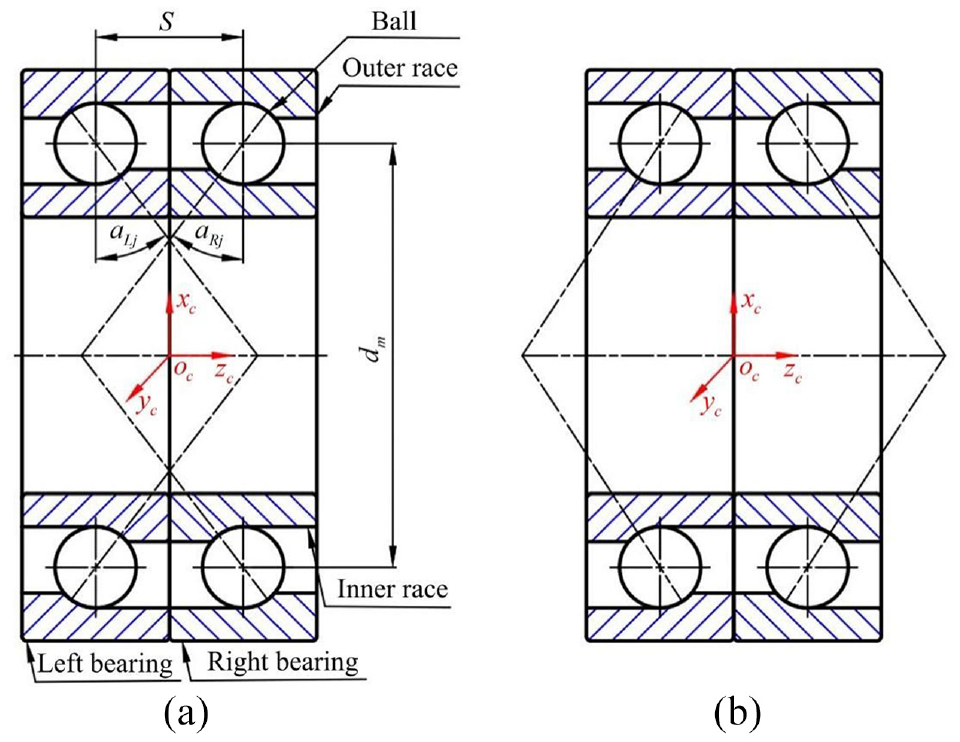
Schematic cross-sections of DF and DB arrangements: (a) face to face arrangement and (b) back to back arrangement.
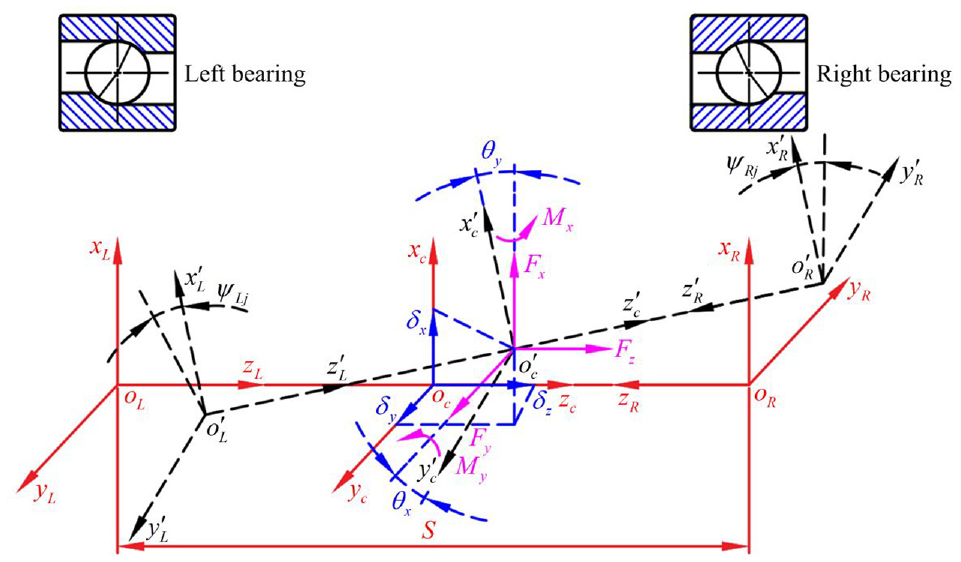
The coordinate transformation method can be applied to establish the load-deformation relationship of different elements of matched bearings. To analyze conveniently, six auxiliary coordinate systems can be adopted in this study depicted in Figures 2 and 3.
Three initial coordinate systems: a global coordinate system
Three transformed coordinate systems:

Coordinate system of DF arrangement.
Coordinate system of DB arrangement.
The above coordinate systems follow the right-hand rule. Generally, it can be assumed that the combined loads are applied on the geometrical center of matched bearings and the force balance can be conveniently studied by keeping the outer races fixed in space. For the usual case, the matched bearings can subjected to loads in five directions: an axial load

with




where the triangle functions

with


where the coefficient
In
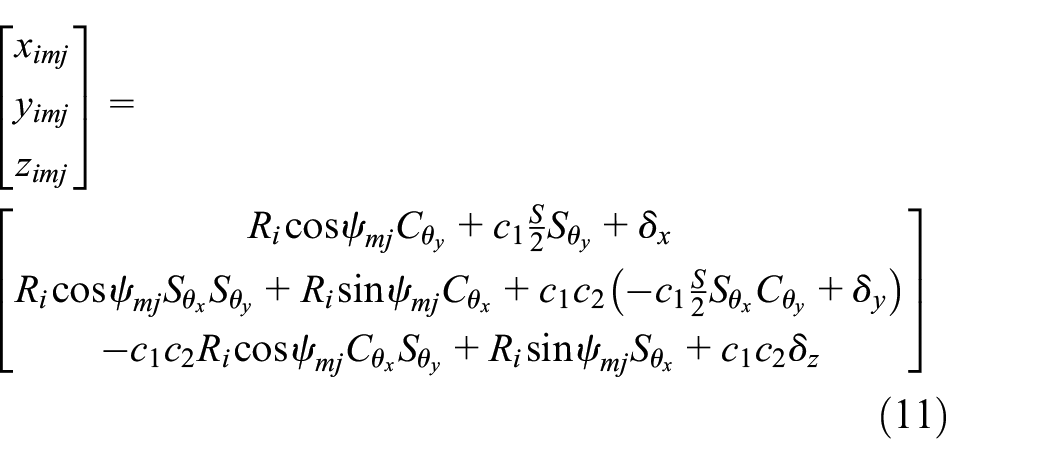

Angular position of balls.
In this research, the outer races are fixe. Accordingly, in

in which
Equilibrium equations of matched bearings
The geometric relationship between the centers of the j-th ball and the races is depicted in Figure 5. When the bearing is unloaded,

Relative positions between bearing elements.
The distance

Based on the geometric relationship demonstrated in Figure 5, the radial and axial distances

The distance

The normal deformation

Therefore, the normal contact load

where

Based on the analysis above, the load balance equations of inner races can be obtained as:

Figure 6 shows the iterative flowchart of the proposed model. As demonstrated, the error
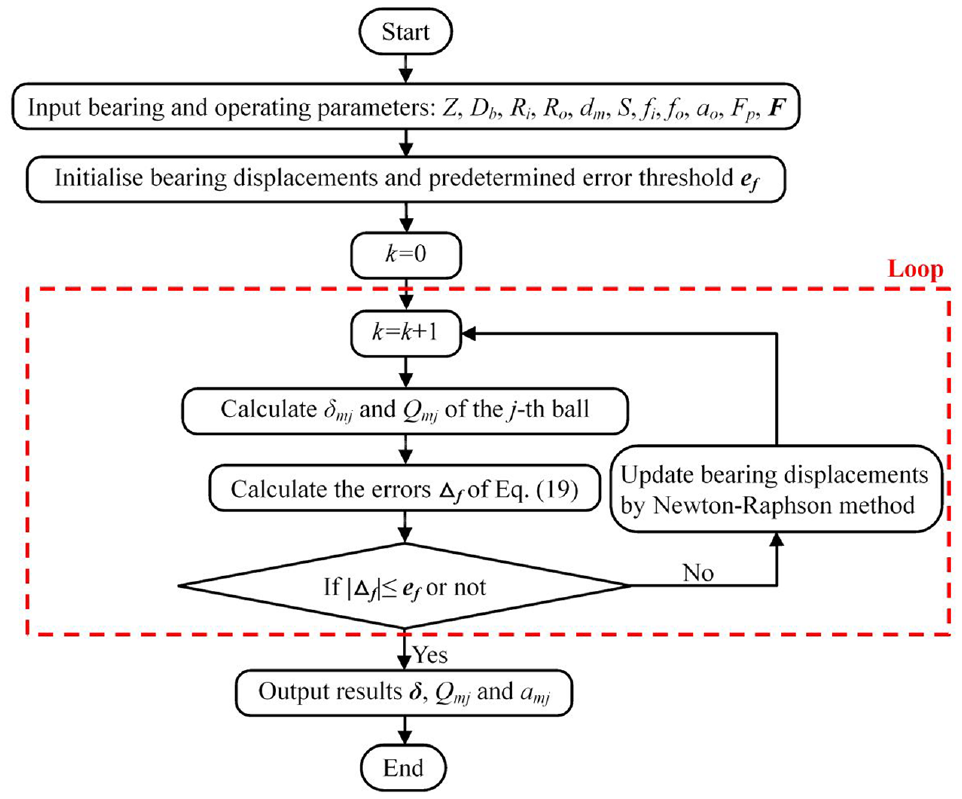
Flowchart of the proposed model.
Model validation
To validate the proposed model, the stiffness coefficients of matched bearings obtained by the proposed model are compared with those in the existing literature. Based on the definition of stiffness, the five-DOF stiffness matrix can be formulated by taking the partial derivatives of external load vector
Parameters of the example case in Gunduz and Singh. 17

Comparison of the results obtained by the proposed model with those in Gunduz and Singh. 17

Results and discussion
Based on the proposed model, a pair of angular contact ball bearings (Type: NSK7206B) with DF and DB arrangements can serve as a research case. Table 3 shows the specifications of NSK7206B bearing. Preload, structure parameters, operating condition and installation type play vital roles in the bearing application. The loading characteristics of matched bearings are intimately affected by the above parameters. In Section 4, the influences of these parameters on the distributions of contact load and contact angle of matched bearings under complex working conditions are analyzed in detail.
Specifications of NSK7206B bearing.

Influence of preload
The angular contact ball bearings installed in pairs must be preloaded to eliminate the clearance between rolling elements and thus to improve their operation performance. To investigate the influence of preload on the distributions of contact load and contact angle of matched bearings, take

Contact load with different preloads: (a) DF arrangement and (b) DB arrangement.

Contact angle with different preloads. (a) DF arrangement and (b) DB arrangement.
Influence of initial contact angle
Initial contact angle is a key factor to influence the bearing load carrying ability. In actual application, the angular contact ball bearings with angles of 15°, 25°, 40°, and 60° are most widely used in various rotating systems. To study the influence of these angles on the distributions of contact load and contact angle, a combined load vector

Contact load with different initial contact angles: (a) DF arrangement and (b) DB arrangement.

Contact angle with different initial contact angles: (a) DF arrangement and (b) DB arrangement.
Influence of external loads
The external loads have an important influence on the mechanical behaviors of matched bearings. To investigate the influence of radial loads on the distributions of contact load and contact angle of matched bearings, the radial loads

Contact load with different radial loads: (a) DF arrangement and (b) DB arrangement.

Contact angle with different radial loads: (a) DF arrangement and (b) DB arrangement.
To study the influence of axial load on the loading characteristics of matched bearings, the distribution curves of contact load and contact angle with different axial loads are depicted in Figures 13 and 14, respectively. As demonstrated, the contact load and contact angle are uniformly distributed when the matched bearings are under pure axial load. For the bearing with axial load and preload in the same direction, the contact load and contact angle increase accordingly with the increase of axial load. However, for the bearing with axial load and preload in opposite directions, the contact load and contact angle decrease with the increase of axial load. According to equations (16), (17), and (19), it can be concluded that the matched bearings will be ineffective when the ball deformation of a bearing reduces to zero. As depicted in Figures 13 and 14, the contact load and contact angle of the bearing with axial load and preload in the opposite directions are equal to zero when

Contact load with different axial loads: (a) DF arrangement and (b) DB arrangement.

Contact angle with different axial loads: (a) DF arrangement and (b) DB arrangement.
To study the influence of tilting moments on the loading characteristics of matched bearings, the tilting moments
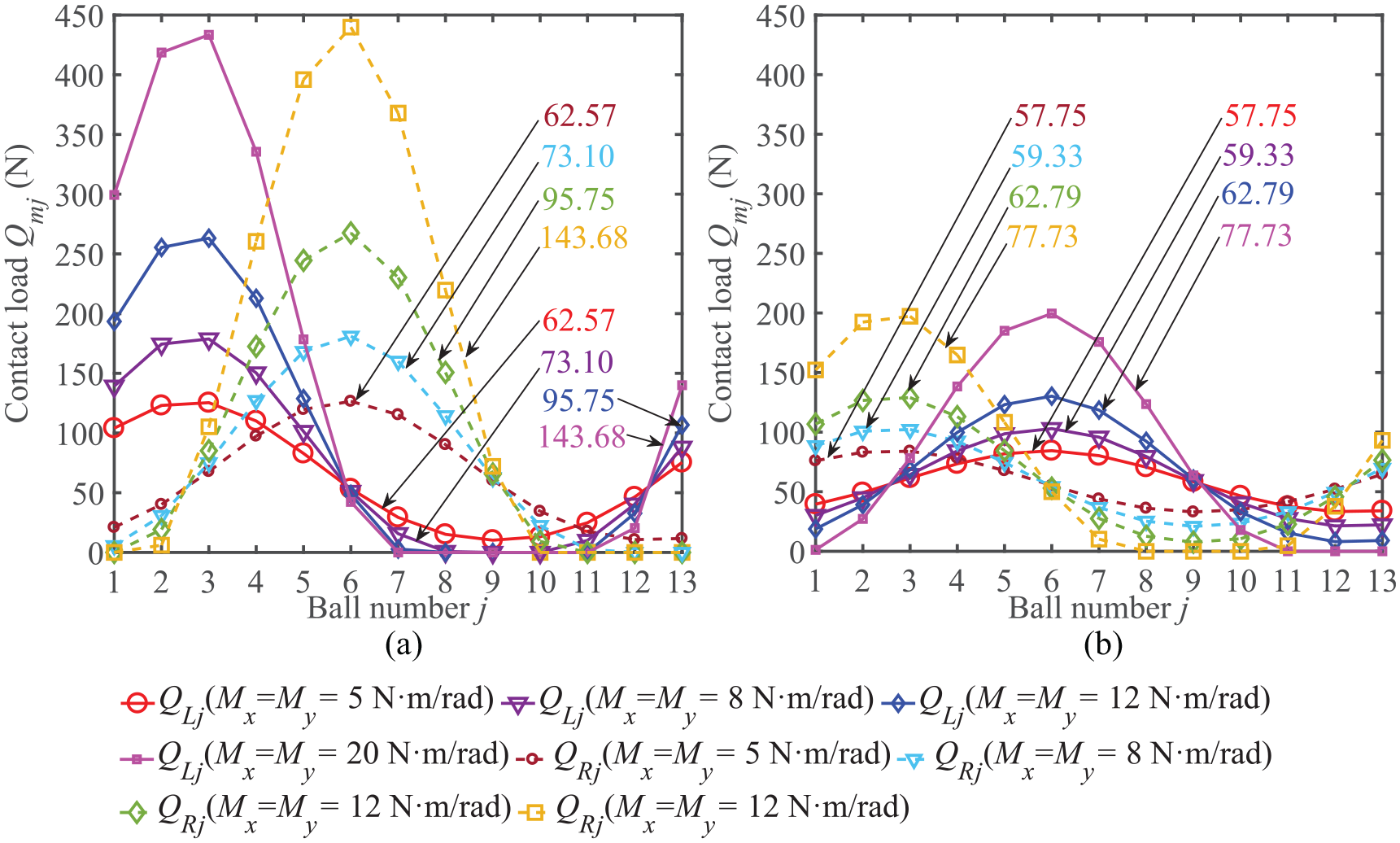
Contact load with different tilting moments: (a) DF arrangement and (b) DB arrangement.

Contact angle with different tilting moments: (a) DF arrangement and (b) DB arrangement.
Conclusions
The main purpose of this paper is to study the distribution characteristics of contact load and contact angle of matched bearings under complex working conditions. For this purposes, a novel model of matched bearings is established by using the universal coordinate transformation method. The distributions of contact load and contact angle of matched bearings under different installation types, preloads, operating conditions are studied in detail. The main conclusions can be drawn:
With the increasing preload, the number of laden balls, the mean values and distribution uniformities of contact load and contact angle increase correspondingly. Under the preload and external loads, the distribution uniformities of contact load and contact angle of DB arrangement are better than those of DF arrangement.
With the increasing initial contact angle, the mean value of contact angle increases, the mean value of contact load decreases first and then increases, the number of laden balls and the distribution uniformities of contact load and contact angle decrease. Moreover, the variations of contact load and contact angle of DF arrangement are more obvious than those of DB arrangement.
With the increasing pure radial loads, the mean value of contact load increases, but the mean value of contact angle and the distribution uniformity of contact load and contact angle decrease. The number of laden balls reduces at first with the increase of radial loads and then becomes to a constant when the radial loads reach a certain level. With the increasing pure axial load, the contact load and contact angle of balls are uniformly distributed and the matched bearings will fail when the deformation of each ball in a bearing is equal to zero. Accordingly, it is significant to emphatically study the axial mechanical properties of matched bearings. Under the pure radial loads or axial load, the loading characteristics of DF and DB arrangements are equivalent. With the increase of pure tilting moments, the mean value of contact load increases, whereas the mean value of contact angle, the number of laden balls and the distribution uniformities of contact load and contact angle decrease. DB arrangement is more suitable to withdraw the tilting moments than DF arrangement as a result of its longer load center distance.
This paper reveals the distribution characteristics of contact load and contact angle of matched bearings under different working conditions, which can offer some references to the selection, design and assembling of angular contact ball bearings.
Footnotes
Appendix A
Handling Editor: Chenhui Liang
Declaration of conflicting interests
The author(s) declared no potential conflicts of interest with respect to the research, authorship, and/or publication of this article.
Funding
The author(s) disclosed receipt of the following financial support for the research, authorship, and/or publication of this article: This study was supported by Talent Introduction Fund of Zaozhuang University of China, grant number 745010207.
