



Abstract
Nowadays, with the rapid development of the intelligent era and the concept of Internet of Things being proposed, more and more sensors will play a more important role. Providing a sustainable power source for sensors has become the focus of current research in microsystem power generation. The harvesting of widely available vibrational energy from the environment for use as an alternative power source for sensors is of great significance in efficient energy utilization. Researchers have been working on developing efficient energy harvesters for broadband and efficient energy harvesting. Nonlinear energy harvesting holds more significant promise. In this paper, we summarized and reviewed the research progress of three different harvesting methods from the perspective of varying energy harvesting methods. We also listed the operation of various harvesters under different excitation types. At the same time, nonlinear energy harvesters with different structural characteristics are reviewed, the benefits of nonlinearity on energy harvesting are effectively collected, and the practical applications are summarized. Finally, current methods and mechanisms to improve the collection efficiency of energy harvesters are described and summarized. Briefly, this review introduces the research development of existing energy harvesting technologies, summarizes the technically difficult problems faced by piezoelectric energy harvesting technologies, and provides an outlook for future research and development trends of piezoelectric vibration energy harvesting technologies.
Introduction
Background
With the advancement of technology, smart sensors that connect everything to make our lives colorful. These sensors all require energy to power them. Energy is strategically important to the survival and development of all mankind, and traditional fossil energy sources are becoming stretched over time due to their non-renewable nature. Using clean energy in the environment has become a hot topic of research today. 1 Typically, micro-sensors are utilized in harsh environments and require a separate power source to supply them. Due to the nature of chemical batteries, not only is long-term use not guaranteed, but they need to be replaced in a timely manner and are subject to leakage. Wired power requires wiring, which is often long and complex, and requires dedicated staff to maintain it, so the capital investment for wired power is enormous, and the use of batteries brings additional replacement costs and environmental pollution problems. 2 The harvesting of energy available in the environment to provide a clean power source for various electronic equipment sensors is of great research importance. 3
The ability of an electronic device sensor to operate stably over a long period depends on its power supply. Providing the sensor with a sustainable power supply would undoubtedly solve many problems, improve the sensor’s performance and make it more adaptable to complex environments. 2 Vibrational energy in the environment is a complex energy consisting of many frequency bands, ranging from the human body to wildlife, from industrial machinery to vehicles, from large buildings to bridges, and from water flow to wind power. As a pervasive source of clean energy in the environment, vibration can be a good candidate for exploitation. Piezoelectric energy harvesting technology is an operating mechanism that captures the vibrational energy in the environment and transforms it into electrical energy. Vibration energy harvesting technology relies on materials, mechanical engineering, and micro technology, and the rapid increase in the capabilities of these areas is now also contributing to the development of vibration energy harvesting technology. Therefore, in the future, vibrational energy harvesting technology will play a part in many more areas. 4 Vibrational energy harvesting technology will be utilized in an even wider range of applications as energy is gradually being harvested in a wide range of applications. 5
The energy harvesting techniques that have been widely studied can be divided into electrostatic, 6 piezoelectric,7,8 electromagnetic,9,10 and frictional,11,12 depending on the principle used. Piezoelectric vibration energy harvesting (PVEH) technology is the most widely researched and widely used method due to its advantages over other energy harvesting methods in many aspects, such as: simpler structure, smaller size, no additional use of electrical energy, easy integration, higher efficiency of electromechanical conversion in low-frequency environments and long service life. 13 At present, scholars have done a lot of research on PVEH technology, improving and perfecting PVEH devices in terms of theory and practice, and making continuous efforts to improve the practicality and durability of the devices, so that piezoelectric energy harvesting technology can truly become one of the effective ways to solve energy shortages, various environmental problems and produce sustainable energy from the environment. 14 PVEH in general and piezoelectric cantilever beams, in particular, have been studied in-depth and many optimization solutions have been proposed. However, PVEH still has problems such as relatively low efficiency, narrow frequency range, relatively high cost, and dependence on the development of materials science.4,15
PVEH review status
In recent years, piezoelectric energy harvesting technology has made great achievements in research and development. Excellent research papers have been published on various aspects of piezoelectric energy harvesting, such as device structures, energy sources, piezoelectric materials, and applications. Several researchers have reviewed and commented on piezoelectric energy harvesting. Liang et al. 16 analyzed five configurations such as monostable, multi-stable, multi-degree of freedom, frequency up-conversion and stress optimization based on existing structural designs and compared the properties of several piezoelectric materials. Sezer and Koç 17 reviewed the research advances in inorganic, organic, composite and bionic piezoelectric materials in recent years, while reviewing the application of piezoelectric energy harvesting at the nano-micron level in several neighborhoods, the review focused mainly on the exposition of piezoelectric materials. Jiang et al. 18 also conducted a comprehensive review of several different steady-state harvesters and piezoelectric-magnetic hybrid energy harvesters according to their structures, which mainly focused on the progress of the classification of monostable, bistable, and multi-stable, but the performance of various steady-state structures was not compared and discussed. Mahajan et al. 19 only briefly reviewed the experimental and field implementation applications of piezoelectric energy harvesting technology. The review was more about how the specific implementation of piezoelectric energy harvesting technology in road bridges. Wu et al. 1 reviewed and summarized the high-power piezoelectric energy harvesters from a structural point of view, and the authors pointed out that with the selection of 3D printable piezoelectric materials prepared, the design of materials with efficient piezoelectric power generation properties can become an important research direction in the field of energy harvesting. Zhou et al. 20 reviewed the progress of tristable vibrating energy harvesters, and the review introduced control models and approximate analytical methods, while stating the design, experiments, influence mechanisms, and optimization.
Novelty of this review
In general, the above review presents different aspects of piezoelectric energy harvesting techniques, but there are still some shortcomings:
There is no review for the summary analysis and comparison of the impact of different operating modes on the performance of the harvester.
There is no paper for the review of the statistical comparison of the impact of different excitation types on the output performance of the harvester.
The review of different dynamic characteristics was limited to the classification and comparison of structures with the same characteristics, and there are no articles comparing and discussing the output performance for different kinds of steady-state structures.
The classification of piezoelectric energy harvesting technology in different fields of application is insufficient.
Therefore, this paper aims to bridge the above-mentioned gaps and expand the research on piezoelectric energy harvesting techniques. The main contributions of this review are the following four aspects:
Review of the different electromechanical conversion modes by compiling and summarizing the typical operating modes of piezoelectric energy harvesting, and comparative analysis of the collected power of the conversion modes in the form of a graphical discussion.
From the perspective of different excitation types, the energy harvesting structures of different excitation types were classified, and the effects of the three excitation types of harvesting structures on the performance of the harvester were statistically analyzed in a table.
Several dynamical characteristics of the energy harvester were reviewed, and the output performance of different steady-state structures was compared and analyzed in the form of a table to optimize the design of future piezoelectric energy harvesting structures.
The applications of piezoelectric energy harvesting technology in different fields were categorized and summarized, and at the same time, the shortcomings of piezoelectric energy harvesting technology at the present stage were sorted out and analyzed in the light of the material compiled in the review papers, and future research directions and work were proposed.
Piezoelectric harvester model and excitation type
As the technology is updated and iterated, the research on piezoelectric energy harvesting technology is becoming more and more advanced. As the most classic of many studies is still the simplification of the piezoelectric harvester model, which calculates piezoelectric energy harvesting technology simple and fast. Piezoelectric energy harvesters not only have many different modes of operation, but also can be divided into many different harvesters depending on the type of excitation. There are no articles in the existing literature that provide a comparative analysis of different excitation types and different modes. This section will review and analyze the piezoelectric models, modes, and excitation types.
Piezoelectric harvester model
Depending on the mode of operation, the vibration energy harvesting methods are classified as electrostatic, electromagnetic and piezoelectric. The operating modes and performance characteristics of the three ways have significant differences. Among the three types, the piezoelectric type has been widely studied because of its adaptability, ease of miniaturization, and lack of external power supply. 21
The classical lumped model of piezoelectric energy harvesting was first proposed in 1996 by Williams and Yates, 22 as shown in Figure 1, which is a single-degree-of-freedom mechanical model consisting of a proof mass, a spring, and damping. Because the model is intuitively simple and easy to use, it has remained active in the field of micro-vibration energy harvesting after more than a decade of development.
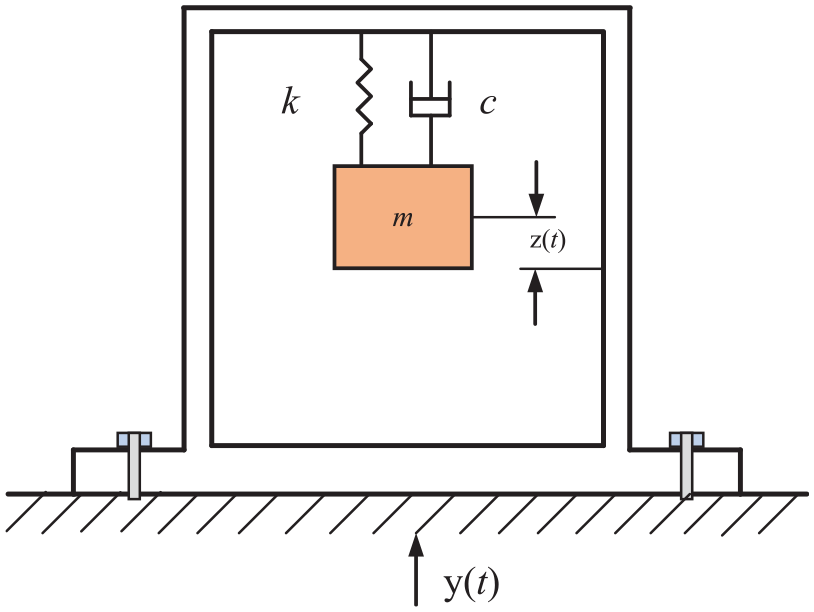
Mechanical model of vibration energy harvester.
The aggregate model consists mainly of a verification mass m, a spring k and a damping c. When the model is subjected to vibration, the verification mass moves relative to the outer frame, and this relative movement is the basis for power generation. Assuming that the outer frame is subjected to a displacement excitation of y(t) and y(t) = Y0cosωt is a sinusoidal excitation, the relative movement displacement is z(t), and the equation of motion is

where, m is the proof mass; c is the damping constant; and k is the spring constant.
The force on the verification mass is equal to the force on the verification mass-spring-damper, that is

Thus the instantaneous power 22 can be obtained, p(t) being the product of the force of the proof mass and the velocity

When the external vibration is assumed to be continuous, the model power generation 22 can be obtained from equation (3)

where, ζt is the transducer damping factor; ωn is the resonant angular frequency; Y0 is the amplitude of vibration; and ω is the angular frequency of vibration.
A conclusion can be drawn from equation (4) that the power generated by the set total model is proportional to the cube of the vibration frequency. This means that more power is obtained in scenarios with higher vibration frequencies. The power generated is also highest when the harvester is operating at resonance, while being inversely proportional to the damping coefficient 22

Theoretically, when the damping coefficient is 0 produces infinite power, but in practice the value of ζt is greater than 0. And in practice some damping is unavoidable to limit the power output, considering the effect brought by air damping, equation (5) should be modified 22

Electromechanical conversion mode
Piezoelectric energy harvester is a device that uses the mechanical electrical energy conversion characteristics of piezoelectric materials to achieve electrical energy conversion. To study the mechanical characteristics of piezoelectric harvest, it is most important to study the electromechanical conversion of piezoelectric materials. For an elastomer, there can theoretically be an infinite number of vibration modes. For piezoelectric materials there are many operating modes, but all of them have zero components except d32, d31, d33, d15, and d24. Among these five modes, there are d32 = d31 and d24 = d15. 21 Therefore, the main focus during the study was on the three operating modes d31, d33, and d15.
Among most piezoelectric ceramics, the d15 piezoelectric shear coefficient is the highest compared to the commonly used d33 and d31 piezoelectric strain coefficients for axial and transverse modes. 23 As a result, energy harvesters operating in d15 shear mode can produce higher voltage and power output.
Ma et al. 24 proposed a combined model of two piezoelectric effects in a single-crystal type with vertical electrodes to improve the collection performance of piezoelectric single crystals, and obtained the shear piezoelectric effect in single-crystal type d15 by eliminating the transverse piezoelectric effect along the length direction. Gao et al. 25 proposed a single crystal bridge-based PIN-PMN-PT shear-type piezoelectric energy harvester. The highest power density obtained from this energy harvester is 1.378 × 10⁴ W/m3, which is 5.5 times higher than the power density of the same structure using piezoelectric ceramic material and much higher than that of conventional cantilever energy harvesters. Under the condition of 0.25 N inertia force, the maximum output voltage and output currents are 21.6 V and 6 × 10⁻⁴A respectively, and the maximum output current is three times of the same structure using piezoelectric ceramic material. Ren et al. 26 designed a PMN-PT single-crystal piezoelectric cantilever beam structure based on the d15 mode of operation. In the study, the operating principle of the device was derived and the factors affecting the output were analytically derived. The maximum voltage and power of 91.23 V and 4.16 mW, respectively, could be obtained at 60 Hz and a cyclic force of 0.05 N. Malakooti and Sodano et al. 27 developed a model based on Timoshenko beam theory to study the electrical energy output in the shear mode operation of piezoelectric materials. The model applies to different geometries and piezoelectric elements and provides a good reference for designing a d15 shear energy harvester with optimal performance.
To apply the excellent performance of PMN-PT single crystal in d15 mode to the low-frequency environment, Zeng et al. 28 designed a cantilever beam-driven low-frequency energy harvester based on d15 mode. The device consists of two symmetrically assembled mezzanine structures and a cantilever beam, where the mezzanine structures can be driven by the cantilever beam. High shear stress can be generated in PMN-Platinum wafers by the resonance of the cantilever beam. This structure can fully utilize the shear properties of the crystal. It is shown that the maximum voltage and power density of 60.8 V and 10.8 mW/cm3, respectively, can be obtained at a verification mass of 13.5 g and a resonance frequency of 43.8 Hz. Kumar et al. 29 designed a piezoelectric cantilever beam that harvests energy from blood pressure variations of the cardiac cycle with an intrinsic frequency close to the heartbeat frequency. The harvester can operate in two different modes, d15 and d13. The study compared the performance of different materials in d15 shear mode d31 transverse mode, and it was found that the maximum power of PZN-PT in shear mode was about 13 μW among all the materials studied. Wang and Liu 30 introduced a shear piezoelectric energy harvester for harvesting energy from pressurized water flow, which converts flow energy into electrical energy by the vibration of a piezoelectric film. Experiments show that when the excitation pressure oscillation amplitude is 20.8 kPa and the frequency is about 45 Hz, the generated open-circuit output voltage is 72 mV and the instantaneous output power is 0.45 nW. All these studies provide a good reference for developing d15 shear operation mode in future energy harvesting.
It is well known that d15 working mode can obtain higher performance output than d33 and d13 working modes, but pure shear deformation is complicated to achieve in practical applications. In common PZT piezoelectric materials, the piezoelectric constant in the d33 mode is approximately twice that in the d31 mode, and when both modes have the same dielectric constant, the d33 mode device is expected to produce twice the voltage of the d31 mode device. 31 Therefore, studying the harvester operating in d33 mode is one way to improve the output performance of the energy harvester.
Sil and Biswas 32 introduced a vibration energy harvester for microelectromechanical systems based on the d33 mode of operation to study the improvement of the device performance by changing important parameters such as length, thickness, width, position of the mass, and piezoelectric material of the beam through simulation analysis. However, the effect of electrodes on the output performance is ignored. Choi et al. 33 developed an energy harvesting MEMS device. The structure of the device is a piezoelectric cantilever beam double crystal structure and the material chosen is PZT. In order to generate strain parallel to the electric field and thus generate electrical energy using the d33 piezoelectric mode, it designed the PZT film in the shape of a forked finger. A load of 5.2 MΩ at first-order resonant frequency can achieve a power output of 1.01 μW and a voltage output of 2.4 V. The simulation also verifies the effects of mass, beam shape, and damping on the power generation performance, but ignores the effect of electrodes on the output performance. A helical cantilever beam has also been designed, which has the advantage of being simultaneously compact, with reduced resonant frequencies and small damping coefficients. Park et al. 34 introduced an energy harvester for microelectromechanical systems using the d33 mode of operation, which consists of a single cantilever structure with a supporting silicon membrane, a piezoelectric layer, and forked finger electrodes. The experiments simulated maximum output power at the resonant frequency of 528 Hz and optimal load of 2.2 MΩ and produced 1.1 μW power output at 0.39 g of vibration. However, they did not consider the effect of electrodes on the output performance.
To verify that the size of the electrodes can affect the output performance of the d33 operating mode energy harvester. Kim et al. 35 developed an d33 type piezoelectric energy harvester with a single deformed cantilever beam structure composed of forked finger electrodes. In order to model and analyze the factors influencing the output power, this study uses angle-preserving mapping and Roundy’s sequential circuit model, and the resulting analytical equation for the power output can well explain the effect of electrode size on the output power of the d33 mode. Ahmad and Khan 36 introduced an in-plane polarized piezoelectric thin-film energy harvester implemented with a double-sided helical electrode, the structure of which is shown in Figure 2. The study measured the output power as a function of load resistance and the input frequency. The power reaches a maximum when the load matches the output impedance and the input frequency is at the anti-resonant frequency of the PZT diaphragm.

The schematic of the d33 mode diaphragm with proof mass and the polarization distribution. 36
Although the d33 mode is better than the d31 mode in terms of performance, there are still some difficulties in obtaining higher output performance purely in terms of structure. To solve this problem, Tang et al. 37 developed a d33 mode harvester based on forked-finger electrodes. To obtain high-performance PMN-PT piezoelectric film, a hybrid process of wafer bonding and mechanical grinding for thinning was investigated. Experiments show that a peak voltage of 5.36 V and power of 7.182 μW can be obtained at a vibration level of 1.5 g acceleration and 406 Hz operating conditions, corresponding to 17,181.8 μW/cm3 obtained. Lee et al. 38 introduced two modes of piezoelectric microelectromechanical generators, d33 and d31, and a PZT deposition machine using an aerosol deposition method was developed to prepare high-quality PZT film. Experiments show that the piezoelectric microelectromechanical generator in d33 mode can achieve a maximum output voltage of 4.127 V and a maximum output power of 1.288 μW at 2 g acceleration and 214 Hz. To improve the power output of this structured harvester, Jinfeng et al. 39 introduced an improved barbell-shaped piezoelectric energy harvester using the d33 operation, which is structured with a rectangular multilayer single crystal stack of Pb(In1/2Nb1/2)O3-Pb(Mg1/3Nb2/3)O3-PbTiO3 material, as shown in Figure 3. The parallel and series connection cases of multilayer piezoelectric elements are investigated. Experiments show that the structure has better vibration durability than the conventional cantilever beam type, and the maximum output current can reach 800 μA and the maximum power density is 39.7 mW/cm3 under the excitation of 5 g acceleration in the parallel connection case.

Schematic of the proposed barbell-shaped piezoelectric energy harvester (BSPEH). 39
Although the d31 mode has no advantage over the d33 mode of operation in terms of large power output, the d31 mode conversion may have a greater advantage in energy conversion in operating environments requiring small size and low-pressure sources. 40
Wang et al. 41 introduced a dual-vibrator micro-piezoelectric energy harvester based on a stainless steel substrate. To improve the stress distribution and increase the strength of the device, the structure is widened with a pair of curves at the root of the cantilever beam, while the stainless steel substrate allows the device to withstand harsher environments. The study shows a maximum output power of 2.347 μW at a resonant frequency of 40.2 Hz and 0.25 g acceleration. In order to enable a piezoelectric stack to obtain a large energy output at a low input force, Zhang and Lee 42 designed a piezoelectric stack operating in the d31 mode and integrated into an energy harvesting pedal to design a novel pliable amplification mechanism using a pseudo-rigid body and a topology optimization method to achieve the purpose of amplifying the input load.
To address the shortcomings of the d31 operating mode in terms of power output, changing the piezoelectric material is also an effective way to increase the piezoelectric power output. Yang et al. 43 proposed a high-performance vibration energy harvester with a piezoelectric ceramic film prepared using cryogenic body PZT bonding and thinning techniques, which not only have an integrated silicon quality but also perform well in terms of performance. The study shows that the maximum output voltage of the harvester is 3.4 V and the maximum output power is 20.2 μW under 0.5 g acceleration excitation, and the maximum output voltage is 6.08 V and the maximum output power is 57.6 μW under 1 g acceleration excitation. Md Ralib et al. 44 designed a microcomputer voltage electrical energy harvester operating in d31 mode, which is a cantilever beam structure with Si/Al/AZO/Al layers, where the piezoelectric material AZO has a high piezoelectric coupling coefficient. It is shown that an open-circuit voltage of 1.61 V can be obtained at a resonant frequency of 7.7 MHz. To solve the problem of collecting frequency range, Guan et al. 45 designed a novel frequency tuning mechanism for extending the operating frequency range of a piezoelectric harvesting system based on the d31 mode of operation, and the study also explored the d31 and d33 mode coupling. Singh et al. 46 introduced a d31 type piezoelectric vibration energy harvester. This harvester has two metal electrodes sandwiched between a zinc oxide piezoelectric layer at the top of the structure. It was shown that an open circuit peak voltage of 306 mV could be obtained at an intrinsic frequency of 235.38 Hz and 0.1 g excitation conditions.
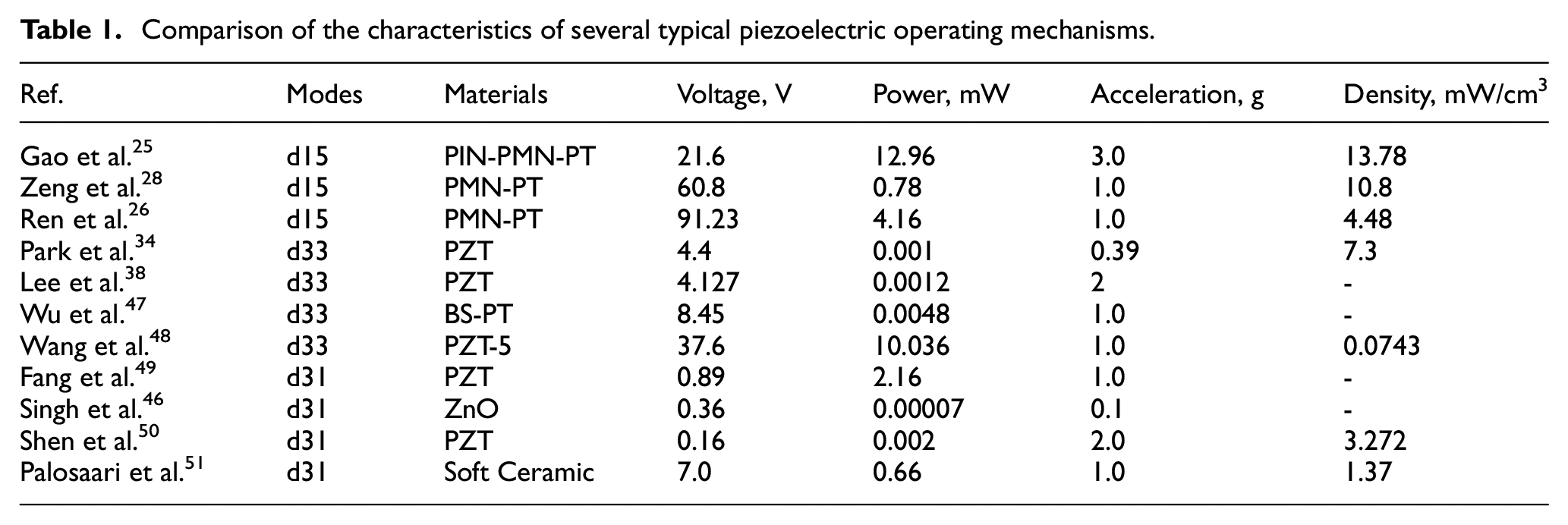
Table 1 shows a comparison of the characteristics of several typical piezoelectric operating mechanisms, although the output characteristics of piezoelectric energy harvesters are related to the piezoelectric material used, the form and geometric parameters of the structure, the magnitude of the excitation, etc. But through a simple comparison, we can see the performance of the three typical modes in terms of power output. D15 shear mode is superior in all aspects of output performance compared to the other two operating modes. There is a great advantage in power output, and power density is also greater. However, there are relatively few reviews of research papers on d15 shear patterns due to the difficulty in obtaining the forces of shear patterns in a practical setting. The output performance of each of the d33 operating modes is relatively average and better than the d31 mode in terms of voltage output. Although the output power shown in these reports is in the microwatt range, the output power is considerable considering the small size and volume of the entire piezoelectric material and the low acceleration in these reported tests. The d31 operating mode has shortcomings in power output compared to the other two operating modes, but has its advantages in the low frequency and low vibration source operating environment.
Comparison of the characteristics of several typical piezoelectric operating mechanisms.
Excitation types of harvester
The development of piezoelectric energy harvesters has a history of more than three decades, and the principles, mechanisms and implementation methods of piezoelectric energy harvesting have been extensively studied. Among many studies, the innovation of piezoelectric energy harvesting structures is particularly prominent. There are many innovative structures that can achieve high-efficiency and broadband energy harvesting, and at the same time, piezoelectric energy harvesting has been widely studied and popularized. Piezoelectric energy harvesting structures can be classified into three types: shock type, resonance type, and vibrational energy harvesting structures under stochastic excitation. The impact energy harvesting structure can work without considering the resonance frequency, and is mainly used in the environment of impact excitation. Resonant energy harvesting structures, on the other hand, need to operate at the resonant frequency to achieve maximum power output while obtaining maximum displacement. 61 The vibration energy harvesting under stochastic excitation mainly works under the working condition of stochastic excitation, which can realize the nonlinear energy harvesting of stochastic excitation, and has relatively wide applicability.
Impact excitation
Impact piezoelectric energy harvesting can overcome the frequency matching problem of resonant energy harvesting devices and realize broadband energy harvesting. Chen and Hu 62 reported a hybrid energy harvester with electromagnetic induction components attached to the top of the cantilever beam and working in the impact mode. When the harvester obtains a power of 429.3 μW, the external excitation characteristics are 4.5 mm in amplitude and 13 Hz in frequency. The results of the study show that the piezoelectric element operating in the shock-induced vibration mode can have more power output than that in the shock mode. Based on PZT materials, Al Ahmad 63 studied the energy harvesting process of free-falling droplets hitting the tip of a piezoelectric cantilever. The piezoelectric material PZT converts the kinetic energy of the droplet into electrical energy, creating an electrical charge. Experiments show that 0.23 g of water droplets fall at a speed of 3.43 m/s and can generate 23 μW of energy. Ju and Ji 64 introduced an indirect-based PVEH device. As shown in Figure 4, the device uses MFC (Macro Fiber Composite) material as a cantilever beam and a movable metal ball as a verification mass. After the basic characteristic study measurements, the researchers optimized the high-performance output device to obtain a higher power output of 963.9 μW at an acceleration of 3 g and an excitation of 18 Hz, as illustrated in Figure 5.
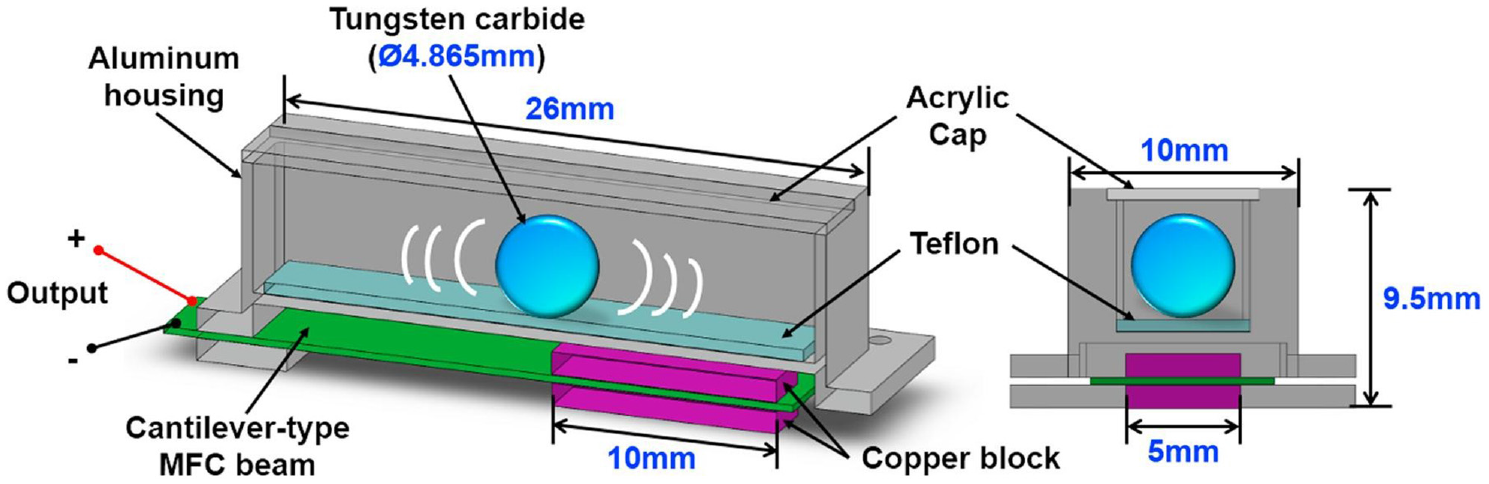
Schematic diagram of the proposed piezoelectric energy harvester using tungsten carbide ball and MFC cantilever. 64

RMS voltage and average power vs. load resistance for a device with parallel connected MFC cantilevers (3 g acceleration at 18 Hz has been applied). 64
Ilyas and Swingler 65 proposed a harvester to collect the impact energy of raindrops. The average power of the single device in this study is not high, and the energy output is less than 90 nW, but the study also provides a good research demonstration for impulsive piezoelectric energy. In addition, to realize the requirement of collecting vibration energy in a broadband environment, Liu et al. 66 designed an energy harvester with silicon as the cantilever beam and silicon as the mass. Under the impact of the acceleration of 1g, it can work in a vibration environment with a frequency of 30–47 Hz, while outputting power generation from 19.4 to 51.3 nW. Dulin et al. 67 established a nonlinear mathematical model including shock and electromagnetic induction, and studied and analyzed the response characteristics of the system. Gu and Livermore 55 introduced a method of striking a high-frequency resonator with a low-frequency resonator, allowing energy to be collected mainly at the coupled vibrational frequencies of the system. The experimental results show that the average power output is 0.43mW under the excitation of 8.2 Hz and 0.4 g acceleration.
Chen et al. 3 proposed a piezoelectric energy harvester driven by magnetic field shock, and established a multi-degree-of-freedom mathematical model of PEH displacement, velocity and voltage output. The results showed that the energy produced by a single impact was 0.4045 mW. In order to broaden the operating frequency range of the harvester, Liu et al. 68 proposed a broadband harvester introduced by a mechanical brake. Broadband frequency responses of piezoelectric vibratory systems with one-sided and two-sided cutoffs are explored in depth. Experiments show that 34–100 nW of power can be generated under base acceleration of 0.6g, top and bottom brake distances of 0.75 and 1.1 mm, and a frequency band of 30–48 Hz.
Zhang and Qin 69 proposed a tunable frequency piezoelectric energy harvester using a rope-traction impact type piezoelectric energy harvester with a high-frequency generating beam pulled by a rope or a low-frequency driving beam impinging on the generating strain. By varying the rope length from 0.5 to 2 mm, the central operating frequency can be changed from 74.75 to 106 Hz, widening the operating bandwidth by a factor of 4.2 compared to the conventional harvester. Rui et al. 70 designed an energy harvester consisting of excitation beam, collection beam and protection beam in order to break through the limitation of resonance state. It can be seen from the test results that 52.1 μW of energy can be obtained in the working frequency band of 1.9–4.2 Hz.
Jiang et al. 71 proposed a V-shaped piezoelectric vibration energy harvester with shock stops. As shown in Figure 6, the device has a brilliant performance in power output, which can generate a maximum power of 0.442 mW under excitation of 0.1 g and 12 Hz. The harvester can also harvest energy in a vibration environment in the frequency range of 8–15 Hz.
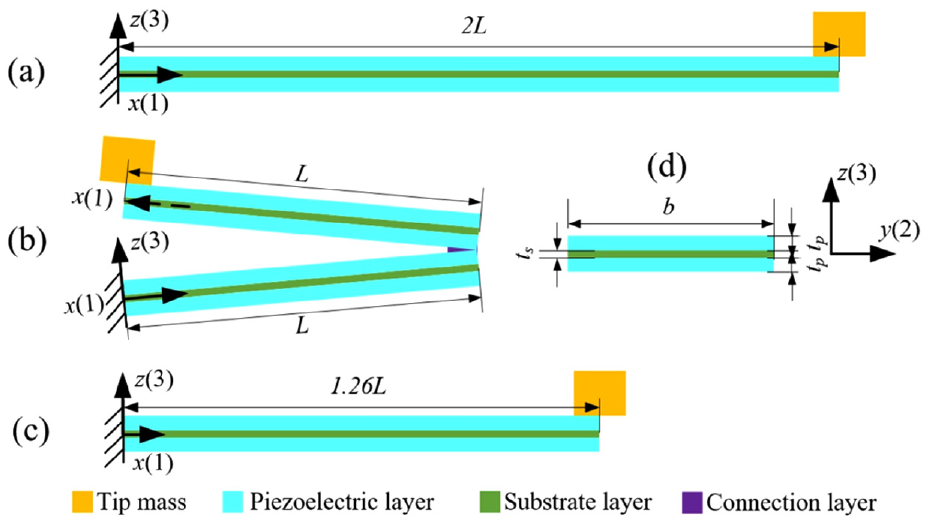
Schematics of PVEH. 71
Fan et al. 72 developed a dynamic electromechanical coupling model to study impingement-type PVEH. As shown in Figure 7, the structure consists of a cylindrical capsule with a free-moving sphere and a dielectric elastic membrane inside. The results of this study show that, with smaller excitation, optimized energy output can be obtained by reducing the inner radius of the capsule and the radius of the sphere. Halim et al. 73 proposed and demonstrated a broadband piezoelectric energy harvester based on shock upconversion. The device is a low-frequency driven beam of tip mass striking two high-frequency piezoelectric beams, and the harvester widens the bandwidth of the collected frequencies by setting the stiffness of the beams. Experiments show that a peak power of 377 μW can be generated under 0.6 g acceleration and 14.5 Hz excitation.

The sketch of the DE-based VI energy harvester. 72
Vijayan et al. 74 studied nonlinear collision energy harvesting, and the results showed that energy harvesting by the impact is a reliable means to broaden the working bandwidth of energy harvesters. Unlike energy harvesting where linear systems excite only one mode of operation, nonlinear shocks can excite multiple modes for the same excitation frequency. Halim and Park 75 introduced a broadband low-frequency vibration energy harvester based on piezoelectric ceramics. It uses mechanical shock to impact the cantilever secondary beam, which directly causes the cantilever beam to change, and simultaneously excites a nonlinear frequency conversion mechanism, resulting in broadband energy harvesting. The research results show that the device can collect vibration energy in the range of 9–24 Hz under the acceleration excitation of 1 g, while outputting a peak power of 449 μW. Isarakorn et al. 60 used an impact cantilever beam to achieve frequency conversion. This is a dual-stage energy harvester that harvests energy from human footsteps, delivering an average power of 0.82 mW at 14.08 Hz and 0.93 g acceleration.
Resonant excitation
Different from the impact type piezoelectric energy harvesting, in the resonance type vibration energy harvesting work, the most critical point is the adaptation of the structure frequency and the external excitation frequency. Resonant energy harvesting has special requirements for excitation from the environment. To obtain optimal power values, the resonant frequency of the piezoelectric harvester must match the harmonic frequency of the vibration source. Naimet al. 52 proposed a piezoelectric cantilever energy harvester based on mechanical vibration. The research shows that the voltage and power collected under the acceleration of 1 g and the external excitation of 345.75 Hz are 595.5 mV and 14.85 μW, respectively. Various researchers have attempted breakthroughs in cantilever-type energy harvesting,76,77 and Li et al. 78 introduced an up-conversion energy harvester that combines a single pendulum with magnetic coupling. As shown in Figure 8, the device mainly aims at ultra-low frequency vibration energy harvesting. The experimental results show that the power output of 2 mW can be obtained when the excitation frequency is 2 Hz and the acceleration is 0.37 g. Magoteaux et al. 79 studied two different energy harvesting for UAV landing gear, using curved beams with piezoelectric material. Experiments have shown that curved beams generate more energy than conventional cantilever beams. Erturk et al. 80 proposed a distributed parameter model to analyze the electromechanical coupling behavior of L-shaped piezoelectric energy harvesters. From the results of the study, it can be found that compared with the traditional cantilever beam, the L-shaped structure can be tuned as a beam with two different natural frequencies at the same time, and can output higher power.

The frequency up-converting harvester. 78
Piezoelectric energy harvesters usually have output power peaks around the resonant frequency during operation, which complicates the acquisition of ambient vibration excitations consisting of multiple frequencies. Shin et al. 81 proposed an ultra-wideband piezoelectric energy harvester tuned by autonomous resonance, as shown in Figure 9. The structure can adjust the natural frequency of the device in combination with ambient vibration without human intervention. The working bandwidth of the device is 1400% higher than that of the fixed resonance energy harvester, as shown in Figure 10. This work was undoubtedly huge progress. Liu et al. 82 fabricated a thick-film piezoelectric cantilever power generator array using precision fabrication techniques. The structure improves the flexibility of the collection frequency and expands the working frequency band by means of an array of piezoelectric cantilevers. The effective power of the device is 3.98 mW, and at the same time, a small range of frequency modulation can be achieved. As we all know, most resonant energy harvesting devices are passive, and active exploration is relatively novel research.

Schematic illustration of the doubly clamped beam energy harvester with the mobile proof mass. 81
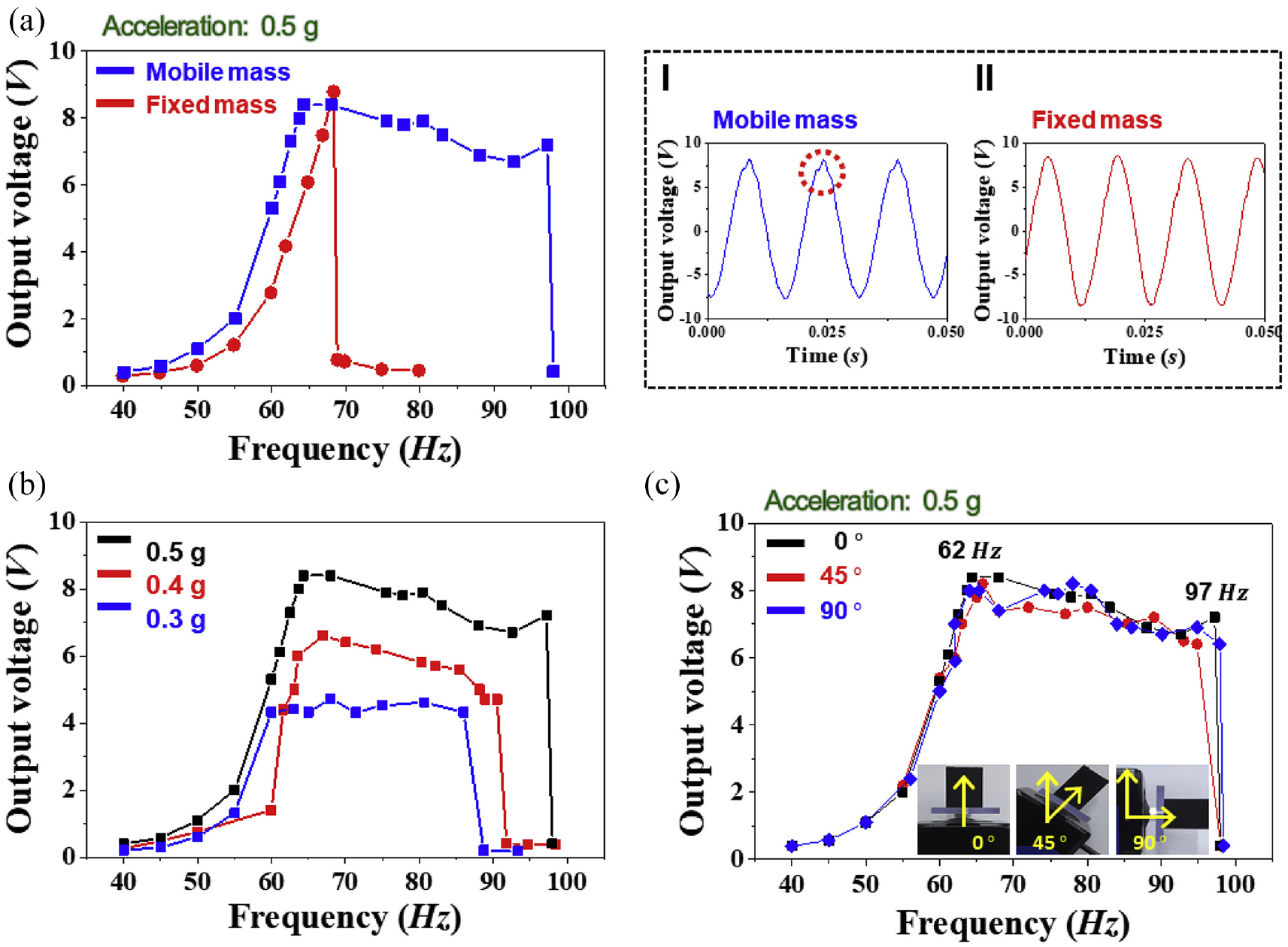
(a) Resonance frequency tuning range comparison of energy harvesters with the mobile and fixed proof masses, (b) resonance frequency tuning range and output voltage with a variation of the acceleration of applied external vibrations, and (c) resonance frequency tuning range and output voltage with respect to the applied vibration angle to the gravitational direction. 81
Cheng et al. 83 explored an active energy harvesting technique that employs an energy harvester consisting of a piezoelectric-spring-mass-damped mechanical resonator and other components, and developed a mathematical model of the dynamical system. The study theoretically proves that at the resonant frequency, active technology can broaden the operating bandwidth better than other harvesting technologies at the technical level. Stein et al. 84 introduced a new resonant inverter topology that performs well for dynamic energy harvesting. This experiment shows that the power output by the topology is twice that of a conventional harvester near the resonant frequency.
Dhakar et al. 53 designed a novel low-power piezoelectric energy harvester as shown in Figure 11, which consists of a composite cantilever beam and a verification mass at the free end. In order to reduce the intrinsic frequency of the structure, the composite cantilever beam design could reduce the resonant frequency to 36 Hz. Zheng et al. 85 proposed a vibrating energy harvester incorporating magnetic levitation, and the structure could output 42 V at 3.4 g amplitude and 9 Hz excitation frequency. Li et al. 56 designed an energy harvester based on a PVDF thin film dual-resonance structure, and the dual-cantilever beam structure was used to achieve 15–22 Hz resonance collection. The collision of the cantilever beam due to the amplitude increase produces strong mechanical coupling, which achieves the goal of broadening the frequency band, and the device with this dual-resonance structure can obtain higher power than the sum of the two independent devices in a low-frequency environment.

Design of PEH-S with a polymer spring attached to piezoelectric bimorph. 53
The geometry of the cantilever beam affects the piezoelectric energy harvesting to some extent. Hosseini and Hamedi 86 used the Rayleigh-Ritz method to design a V-shaped cantilever beam with a calculated trapezoid and obtained an accurate analytical formula based on the resonant frequency. This formulation presents a novel idea that among all trapezoidal V-shaped cantilevers with uniform thickness, the simplest triangular-tapered cantilever yields the largest resonance frequency and highest sensitivity, and the sensitivity decreases as the ratio of the trapezoidal base increases. Zhao et al. 87 designed an adaptively tuned piezoelectric vibration energy harvester by using external current intervention. Through the intervention of DC voltage, the resonant frequency of the system is controlled to cope with the complex vibration in the environment.
Stochastic excitation
Unlike the previous two excitation forms, randomly excited piezoelectric energy harvesters can be considered a significant topic for collecting ambient vibration energy at present. In traditional research and development, aligning the intrinsic frequency of a linear system with the ambient vibration frequency is a common harvesting technique for linear vibration system energy. Ambient vibration frequencies are inherently complex, discontinuous and unstable. To repair these shortcomings, nonlinear systems have been created, but nonlinear systems are difficult to extend to practical applications because of their small amplitudes. 88
In order to make up for the shortcomings of linear and nonlinear systems, the use of stochastic resonance phenomena to explore and study new vibration energy harvesting technologies has become one of the current research hotspots. The concept of stochastic resonance was first proposed by Moure et al. 89 in 1982, and it was mainly used to study the periodicity of the Earth’s ice age. In 2014, Foupouapouognigni et al. 90 focused on the study and analysis of energy harvesting using stochastic resonance to optimize bistable states. This study builds a model of a theoretical nonlinear oscillator with excitation and harvestable vibrations modulated by short periods. Studies have shown that for frequencies where stochastic resonance does not occur, the power output is lower than the power consumed. Zhou et al. 91 proposed an energy harvester with a frequency conversion mechanism in a stochastic vibration environment, which is mainly aimed at ultra-low frequency vibration energy harvesting. Studies have shown that when the operating frequency band is 3 and 7 Hz, the potential will increase rapidly. Zhao et al. 88 proposed a novel bistable motion system. The research is to use elastic springs to diagonally support a mass block that can move freely in a straight line. This design can overcome the limitations of small vibration energy harvesters. Wu et al. 92 proposed a piezoelectric self-excited vibration energy harvester for microscale energy storage. The device has the characteristics of self-excited vibration, which can convert the stochastic vibration energy in the environment into harmonic current for storage. The research results show that the maximum output voltage is 237.99 mV under harmonic excitation. Fan et al. 57 proposed a bistable two-element piezoelectric energy harvester, as shown in Figure 12. The harvester uses the direct excitation element as an external oscillation source to excite large amplitude oscillations through parameterized magnetic coupling. Both components can achieve a continuous and effective working bandwidth, and the bandwidth coverage is 10–17.3 Hz under the critical basic excitation level of 0.5 g, as illustrated in Figure 13.

Schematic of the proposed bistable wideband energy harvesting device. 57

Theoretical results of the coupled system with different gap distances between the two magnets under a 0.5 g base excitation: (a) the parametrically excited beam and (b) the directly excited beam. 57
Masoumi and Wang 93 studied a rotary energy harvester that utilizes self-correcting stochastic vibrations. Compared with existing tire energy harvesters, the device exhibits greater power output and a wider operating frequency band. Madinei et al. 54 designed a piezoelectric energy harvester for the energy generated by vehicle vibration. The research results show that the harvester can obtain an output power of 1.32 mW under natural vibration and optimal load, and operate in a frequency bandwidth of 1–3 Hz.
Table 2 listed the structural characteristics of piezoelectric energy harvesters for different excitation types. Depending on the type of excitation, piezoelectric energy harvesting structures are broadly classified into three categories. One is a shock-excited piezoelectric energy harvesting structure. The main working environment of this type of harvester is under shock excitation, so the impact-type energy harvesting structure does not need to consider the problem of frequency matching, and most of the shock-type harvesters work under the shock mode induced vibration. From the table analysis, it is found that the impact-type energy harvesting structure is mainly used in the low frequency or ultra-low frequency environment, and the working frequency range is mainly concentrated in about 10 Hz. Therefore, shock-excited energy harvesters are very challenging for high power output. In order to make up for the shortcomings, many scholars have broadened the working bandwidth by studying tunable collection structures, or seeking to combine piezoelectric and magnetoelectric to achieve higher power output.
Comparison of the performance of different excitation types of piezoelectric harvesters.

The main consideration of the resonant energy harvester is the matching of the structural frequency and the environmental frequency. From the situation listed in the above table, it can be concluded that the resonant energy harvester can obtain relatively good power output without high acceleration when working, and the working frequency range also ranges from 10 Hz to several 100 Hz. It can be seen from the above table that the power output of the resonance type is not high, which has a great relationship with the frequency requirements of the resonance type in the environment. Resonant energy harvesters generally face two challenges. First, the power that the resonant structure can generate in the low-frequency vibration environment cannot meet the demand. Second, considering the problem of frequency matching, the frequency collected by the vibrating structure near the resonance frequency is limited, so broadband vibration energy collection cannot be achieved. How to achieve broadband energy harvesting will be a research focus for developing resonant energy harvesting structures in the future.
Unlike shock and resonance, stochastic excitation energy harvesters are best suited for harvesting vibrations in real-world environments. Due to the complexity, instability and discontinuity of vibration frequencies in the environment, the use of traditional linear or nonlinear energy harvesting systems has certain limitations. Therefore, it is of great significance to develop and study vibration energy harvesters under stochastic excitation, and stochastic excitation energy harvesters are expected to be widely used in practical applications.
Dynamics of energy harvesters
Vibrations in the environment generally have a wide frequency range and are mostly focused on the low-frequency region. 94 However, conventional linear energy harvesters have a narrow excitation frequency range, relatively high frequencies, and low collection efficiency. 95 Common piezoelectric energy harvesters used today are linear in approach. To broaden the response band of an energy harvester, an array structure can be utilized on a linear basis. 96 However, the limitations of linear methods are still relatively large, so many scholars have adopted nonlinear methods to enhance the performance of the harvester and to obtain energy from broadband vibrations. 97
Marinkovic and Koser 98 have solved the problem of linear systems operating in non-resonant conditions by using “smart sand” to induce non-linearity, resulting in a device with a response bandwidth of 100 and 70 Hz at a constant displacement of 100 m and a constant acceleration of 3 g/m2. The nonlinear vibration energy harvester is more tolerant and adaptable to the central frequency and bandwidth of vibration than the linear vibration energy harvester. 99 Chen et al. 100 introduced non-linearity based on an array-type structure formed by three piezoelectric cantilever beams with two permanent magnets placed at the free end and externally. The improved method increases the output power and energy conversion efficiency compared to a linear piezoelectric array-type energy harvester without magnets. The power output and the width of the response band of the nonlinear device are better than those of the linear device, and are more adaptable to different excitations. 101 It should be pointed out, however, that non-linearity has a very significant effect on the overall system and that system performance may deteriorate as the non-linearity increases, especially in electromechanical coupling where the excitation amplitude varies. 102 Furthermore, nonlinear vibrational energy harvesters can have one or even more steady states, thus widening the frequency range of energy harvesting. Depending on the number of steady states, we classify nonlinear vibration energy harvesters as monostable, bistable, or multi-stable.
Monostable
The monostable is one in which the harvester is just one steady state. Trimming the system nonlinear by adding magnets is a relatively common measure to constitute a nonlinear energy harvester.
Mann and Sims 103 placed a magnet at each end so that the free magnet in the middle produced a nonlinear response force that varied the resonant frequency of the device by modifying the relative position between the magnets. Studies of this nonlinear system have shown that the nonlinear response of the system can be utilized to produce a larger response over a relatively wide range of frequencies, thereby increasing the ability to obtain energy. However, experiments have shown that factors such as the amount of mechanical damping have a relatively larger effect on the system, and the maximum output power of the system has not been derived and verified. Tang and Yang 104 used two cantilevered beams with a magnet at one end, the upper one acting as a magnetic oscillator and the lower one with a piezoelectric sheet made of macro-fiber composite (MFC). The schematic diagram of which is shown in Figure 14. At relatively high excitation levels (acceleration of 2 m/s 2 ), the frequency response ranges from 22 to 28 Hz, with a bandwidth of up to 6 Hz and a 41% increase in output power over the linear system. The difference between the experimental and simulated results of the device at higher excitation levels is relatively large, presumably due to the effect of experimental changes in damping and the addition of a magnetic dipole, but illustrates the role of non-linearity in widening the frequency response range and also in increasing the output power. Zhang et al. 105 investigated a model of a cantilever beam with a tip magnet at the free end and a permanent magnet at the base using the finite difference method and the multiscale method to determine the intrinsic frequency and steady-state response of the forced vibration. It is shown that the shift between hardening and softening of the frequency response curve can be achieved by adjusting the distance between the two magnets and that the presence of the tip mass increases the response amplitude of the first mode while decreasing the response amplitude of the higher-order modes.

Proposed nonlinear PEH interacting with magnetic oscillator. 104
The above studies of nonlinear energy harvesters have shown systems behaving similarly to linear systems at lower excitation levels. Firoozy et al. 106 have more comprehensively studied a system consisting of a tip magnet, two external magnets and a piezoelectric cantilever beam. A complete model of the system dynamics has been developed and the effects of mechanical damping, external loads, tip magnets, external magnets, and magnet gaps have been analyzed. A schematic diagram of the system is given in Figure 15 below. The results show that a nonlinear system with the addition of a tip magnet and an external magnet can significantly increase the power output over a relatively wide frequency range compared to a linear system without a magnet. The output power can also be increased by using a reduced mechanical damping ratio, increasing the tip magnet mass, and selecting a suitable gap distance.

A schematic of a nonlinear energy harvesting system. Piezoelectric cantilever beam with unimorph configuration under translational base excitation. 106
Vibrations in the environment come from all directions and are accompanied by swaying vibrations. Fan et al. 107 proposed placing four cantilever beams in each of four symmetrical directions, with the end having a magnet inside converging on the center and placing a ferromagnetic sphere in the middle. Not only does it introduce monostatic nonlinearity, but it also collects energy from different directions as well as rotational and oscillatory motions, while having the effect of broadening the frequency band. Inspired by the human body doing push-up movements, Yang et al. 108 proposed a hexagonal bionic skeleton structure, combining the skeleton structure with a spring and then coupling it with a magnet, which can get a response in the frequency range of 5–15 Hz. At an excitation level of 0.08 g, the maximum output power of the piezoelectric unit can reach 0.1 mW and the maximum output power of the electromagnetic unit can reach 0.8 and 0.63 mW for hybrid, low frequency, and broadband energy harvesting environments.
The introduction of a magnet component into the piezoelectric harvester allows the structure to achieve nonlinear energy harvesting. The power output and operating bandwidth of the harvester can also be increased by using springs or by applying axial preload. Rezaei et al. 109 developed an electromechanical model of a nonlinear system using a spring as the applied restoring force and derived control equations in dimensionless form. By analyzing the three cases of linear, hardened and purely nonlinear response forces, it is concluded that: when the response force is linear, the output voltage decreases, which is not the desired effect; when the response force is hardened, the linear part does not work and the nonlinear function has the effect of widening the frequency band; when the response force is purely non-linear, the system is unaffected by the frequency shift and the resonant bandwidth and output voltage both increase. The increase in bandwidth is greatest when the spring is mounted on the free end. However, attenuated vibration of the spring causes a reduction in the output voltage. Leland and Wright 110 used a piezoelectric bimorph but added a proof mass between the bimorph. By applying an axial load between the bimorph, the resonant frequency of the harvester could be fitted. The size of the proof mass not only adjusted the resonant frequency but also the output power. Applying an axial load reduces the resonant frequency by about a fifth, but the article investigates frequencies between 165 and 250 Hz and does not deal with the output at lower frequency cases.
The collision method allows the system to become nonlinear and broaden the frequency band. Zhi-qiang et al. 111 compared the output performance of the three operating states – free, preload and collision – and concluded that the collision approach allows for non-linearity, combining a wider frequency band and higher output power compared to the other two.
Whether a structure is monostable or bistable is not fixed. Wang et al. 112 used multiple nonlinear means, applying various nonlinear effects such as preload force effects, impact effects, spring effects, etc. The device consists of a suspension spring plate, a plug plate, and a support frame. In particular, the preloaded spring plate has a Duffing bistable nonlinear characteristic of the mass-spring system. When the excitation level is low, low amplitude, narrow bandwidth oscillations occur in the monostable position of the spring plate below the baffle. When the excitation level is high, the expected bistable oscillations are suppressed by the baffle plate, producing broadband monostable impact vibrations.
Bistable
A bistable state has two stable states, with a double-well recovery potential, and periodic well-to-well oscillations may occur after a certain level of excitation, strengthening the capacity of the energy harvester by order of magnitude. 113 The bistable energy harvester can achieve large amplitude at low frequency and broadband conditions. The maximum power generation can be achieved when the load resistance is selected at the right value. 114 Bistable energy harvesters have a wider response band and higher output voltage levels than monostable at different acceleration levels. 115
Flycatchers in the biological world close their blades rapidly when they sense an external stimulus, a speedy passage phenomenon similar to the rapid crossing between two stable states. Inspired by this phenomenon, and because it can occur without magnets in the flytrap and would be cost-effective, Qian et al. 116 investigated the design of a bistable piezoelectric vibration energy harvester without magnets. This device has two cantilevered beams and has pre-displacement constraints at the free ends of the cantilevered beams. The constraints cause the two cantilevered beams to bend and twist in both directions, which results in a higher mechanical potential energy of the device. The excitation level is 2 g with a large power output between 10.5 and 12.0 Hz. Using bistable composites with dynamic response broadband characteristics also allows simple structures with non-linearity. Arrieta et al. 117 applied bistable composites on a simple cantilever beam model, resulting in energy output of 3–5 mW in the frequency range of 19.5–21.5 Hz at an excitation level of 0.25 g. The excitation level is low, but allows for large power output.
The most common measure to achieve bistability is to combine piezoelectric and magnetoelectric. Ferrari et al. 118 used a ferromagnetic cantilever beam with an external permanent magnet, as shown in Figure 16. The attraction of the permanent magnet to the free end of the ferromagnetic cantilever beam gives the device a bistable state, with the RMS value of the output voltage at the peak increasing by 400% compared to the monostable state. Adjusting the position of the magnet also results in a change in the performance of the system. Cao et al. 119 made the system exhibit a variety of different nonlinear situations by varying the magnitude of the external magnet tilt angle. This not only adjusts the response frequency bandwidth, but also produces large amplitude high energy motion.

Piezoelectric converter made nonlinear and bistable by a ferromagnetic substrate cantilever and a fixed permanent magnet. 118
Rui et al. 120 designed a magnetically coupled piezoelectric energy harvester using MFC. Experimental results show that output power of 3.28 mW and a frequency bandwidth of 3.5 Hz can be achieved with a harmonic excitation of 4 m/s 2 . This is a 35% increase in output power and a two-thirds increase in bandwidth compared to a conventional single cantilever beam energy harvester. Manjuan 121 designed a piezoelectric-electromagnetic composite bistable nonlinear vibration energy harvester, comparing both the case with and without an iron core, that is, the bistable and monostable cases. The experimental results show that the harvester with an iron core can significantly broaden the frequency band, enabling a high voltage output at response frequencies between 30 and 35 Hz, and that the power with an iron core is 49 mW, approximately four times that of the iron-coreless device. The optimized unit achieves a power output of 95.1 mW over 18.8–43 Hz. Combining an arrayed structure with a piezoelectric-electromagnetic composite form, Qingqing 122 proposes an arrayed arrangement of three piezoelectric cantilever beams, using magnets instead of tip mass blocks, which turns an otherwise linear structure into a nonlinear one, which results in an increase in the output voltage of the structure, as well as a 2.34-fold increase in the half-power bandwidth.
Most of the above-mentioned energy harvesters are constructed as cantilever beams, which do not collect vibration energy from multiple directions, and vibrations in the environment can be from many directions, resulting in energy loss. Andò et al. 123 propose a bi-axial vibration energy harvester consisting of two magnetically coupled bistable cantilever beams with orthogonal directions of deflection, allowing two-dimensional energy harvesting and also the advantage of bistable broadband. Noting that in practical situations it is probable that a combination of sway and vibration will excite the system, Fan et al. 124 proposed an energy harvester consisting of a piezoelectric cantilever beam, a drum and a frame. The roll of the drum collects the energy of the sway and is also able to collect the energy of the vibration in a single direction; the piezoelectric cantilever beam placed perpendicular to the drum collects the energy of the vibration in the orthogonal direction; the additional mass block with magnets makes the system non-linear. Modifying the starting point of the drum serves to adjust the operating bandwidth and increase the output voltage. The frequencies of human movement belong to the category of ultra-low frequencies. Through magnetic coupling, the low-frequency movements of the human body can be transformed into high-frequency vibrations of the piezoelectric cantilever beam. This method generates a high voltage output and facilitates energy harvesting. 125
The well-to-well oscillation of bistable is essential to broadening the frequency band and improving output performance. Radice et al. 126 pondered how a bistable device in a relatively steady state can be excited to the interwell orbit. He proposed that the introduction of relatively rigid elements near the equilibrium point of the bistable device can broaden the device band and reduce the amplitude of the excitation out of the interwell oscillation. This approach is very innovative and provides new ideas for scholars’ research, but the applicability has not yet been verified.
Multi-stable
Bistable with two balanced positions and one unbalanced position, well-to-well oscillations crossing from one stable equilibrium position to the other can be used to broaden the frequency band and improve output performance. Multi-stable well-to-well oscillation range can span two or even more equilibrium positions to achieve higher power output. 20
Zhou et al. 127 proposed a tri-stable broadband vibration energy harvester, which introduces non-linearity through a combined piezoelectric-electromagnetic approach. The performance of the bistable and tri-stable structures was experimentally compared. The results showed that at an excitation level of 4 m/s 2 , the tri-stable had a higher output voltage between 3.5 and 11.8 Hz, while the bistable only had a smaller output voltage oscillating between wells, at an excitation level of 5.85 m/s 2 , the frequency response of the tri-stable ranged from 3 to 13.4 Hz, while the bistable only had a frequency response of 6–11.7 Hz. 128 This indicates that at lower excitation levels, the tri-stable state has a broader response band than the bistable state and may achieve better output performance. Wang et al. 129 constructed a new tri-stable galloping piezoelectric energy harvester by introducing nonlinear magnetic force based on the conventional piezoelectric energy harvester. Experimental and numerical results show that the structure has performance better than the conventional galloping-based piezoelectric energy harvester, and a maximum power of 0.73 mW can be available from a wind speed of 7 m/s 2 . Mei et al. 130 focused on the energy harvesting of rotational motion and designed and investigated a tri-stable piezoelectric energy harvester for rotational motion, whose performance was studied from a theoretical point of view through the Lagrange equation. Numerical simulation and experimental validation were also carried out to demonstrate that the tri-stable piezoelectric energy harvester can effectively harvest energy from the rotational motion over a wide range of rotational speeds and that the theoretical model matches the experimental data. Hai-Tao et al. 131 proposed a tri-stable energy harvester with a staircase-shaped potential well. By adjusting the distance of the fixed magnet to the symmetry axis to create an asymmetric staircase-shaped potential well structure, the potential difference between adjacent potential wells was reduced, making it easier to excite well-to-well oscillations, which in turn gives the harvester a wider response bandwidth and better output performance. Previous studies have focused on tri-stable energy harvesting structures connected to pure resistors. As research progressed, Yan et al. 132 proposed an enhanced tri-stable energy harvester with a series resistor-inductor resonance (RL) circuit connected to a piezoelectric layer. Numerical results showed that energy harvesters with RL circuits could greatly improve the energy harvesting efficiency and provide a good perspective on the development of nonlinear energy harvesting techniques, but there was a lack of research on broad frequencies. Jiang et al. 133 proposed a tri-stable energy harvester based on shape memory. The article described the effect of external temperature on the inherent frequency. It proposed that the tri-stable shape memory harvester has a relatively wide response band, can automatically adjust the intrinsic frequency, and has better output performance than the conventional linear structure.
The multi-stable energy harvester can compensate the shortage of bistable harvester to some extent. Huang et al. 134 developed a new quad-stable energy harvester in order to improve the energy conversion capability of the energy harvester under weak excitation and to compensate for the shortcomings of the bistable energy harvester. By changing the spacing of the magnets, four stable equilibrium positions can be achieved in the static state, and the experimental results show that the quad-stable energy harvester can achieve better voltage and power output. Tan et al. 135 proposed an asymmetric quadratic steady-state energy harvester for improving the performance of energy harvesters. This study used the harmonic balance method to derive the coupling relationship between amplitude, constant term, and output voltage, and the multivalued phenomenon of the asymmetric quad-stable energy harvester was found in the theoretical numerical calculations. Zou et al. 136 investigated a four-stable cantilever beam piezoelectric energy harvester by introducing nonlinear four-stable vibrations. Numerical simulations of the developed mechanical model are performed to analyze the effects of different magnetic spacing on the power generation performance and dynamic response, and this study makes a theoretical contribution to the use of piezoelectric energy harvesters in wake dancing situations. Qian et al. 137 developed a quadratic steady-state energy harvester whose equilibrium coordinates can be defined by the user like programing and can be customized for different vibration environments. It is capable of outputting a peak power of 575 μW at an excitation acceleration of 2 m/s 2 and 8.5 Hz. Jiang et al. 138 applied bifurcation theory to study a five-stable series model. The study placed the five-stable model under low-frequency excitation to analyze the multivalued response, the burst oscillations and the series characteristics, which reveals the behavior of the system dynamics to some extent.
Gao et al. 139 experimentally revealed the phenomena of dynamical bifurcation, escape from potential wells, high energy orbits and chaotic oscillation, and designed and implemented a tri-stable structure and two quad-stable structure. The multi-stable energy harvester can achieve an RMS current of 80.15 mA and an RMS power output of 440.98 mW over a frequency bandwidth of 5–12 Hz, which is a significant advantage over other nonlinear energy harvesters. Wang et al. 140 made a quadratic nonlinear vibration energy harvester by combining a set of magnets providing magnetism in the spring and a nonlinear spring in contact with the surface of a cantilever beam. The conversion between monostable to quadratic can be achieved by adjusting the distance between magnets. According to the experimental results, it can be found that compared with other methods, the quad-stable state is more likely to respond under low intensity excitation, with a wider frequency band and higher output power. Yang and Cao 141 proposed a new tri-stable hybrid vibration energy harvester using a geometric nonlinear technique to tune the resonant frequency and widen the bandwidth, which was shown to have wider resonant bandwidth than monostable and bistable energy harvesters. Yang et al. 142 presented a magnetically levitated hybrid energy harvester with tri-stable nonlinear behavior utilizing four external static magnets in the same plane. Theoretical and experimental studies demonstrate that the harvester has a frequency bandwidth of 3–8 Hz and output power of 6.9 and 6.44 mW in the horizontal and vertical directions, respectively, at 8 Hz frequency and 1 g acceleration.
Zhou et al. 143 investigated a nonlinear broadband tri-stable piezoelectric energy harvester, and experimental results showed that the structure obtained a wide frequency range of 15.1–32.5 Hz. Zhou et al. 144 presented a novel quadruple-stable energy harvester, a structure comprising a bimorph cantilever beam with a tip magnet and three external fixed magnets. Experimental results showed that the device has a wider frequency band and a larger output voltage than the bistable energy harvester. Zayed et al. 145 designed a quad-stable 2-DOF energy harvester that can obtain a superior 7.3 Hz broadband over a bistable energy harvester at an acceleration of 3 m/s 2 . Mei et al. 146 designed a quad-stable piezoelectric energy harvester for low-frequency rotational motion. They demonstrated through theoretical studies, numerical calculations and experimental validation that the quad-stable structure could operate over a lower and wider frequency range than the bistable and tri-stable.
Zhou et al. 147 formed a penta-stable energy harvester by combining a cantilever beam with tip magnets and a base with four fixed magnets. And to achieve the penta-stable state, the four magnets were installed on an inclined surface. After experimental verification, it was concluded that this penta-stable structure is the most likely to excite well-to-well oscillations and obtain higher output power than the bistable structure at lower excitation levels. Kim and Seok 148 proposed a new type of energy harvester with multiple steady states. By changing the distance between the magnets and the distance between the magnets and the cantilever beam in various ways, five state transitions between monostable and penta-stable states were achieved. In the study, it was found that the tri-stable and quad-stable states can co-exist and that the amplitude of the well-to-well oscillations is larger at this time and also more likely to excite well-to-well oscillations.
Current multi-stable energy harvesters have superior performance, but the number and coordinates of their equilibrium positions cannot be arbitrarily specified. Therefore, Zou et al. 149 designed a multi-stable energy harvester with programmable equilibrium positions, and verified the performance of this harvester in charging capacitors at tri-stable and hepta-stable states through simulations and experiments, demonstrating the feasibility structure and providing new ideas for subsequent research and applications. Multi-stable energy harvesters outperform linear energy harvesters mainly because they can excite well-to-well oscillations, which are strongly related to the nonlinear restoring force. Zhang et al. 150 proposed a novel nonlinear restoring force model, proposing using rotating magnetic charge to calculate the magnetic force. Through simulation experiments, it is found that the model can predict the nonlinear restoring force of monostable, bistable and tristable states well, and the potential well of the nonlinear energy harvester can be designed by modifying the model to improve the performance of the harvester.
Comparative of nonlinear energy harvesters
The number of steady states varies on the performance of the energy harvester in terms of parameters such as response frequency bandwidth and output power. This section compares the performance of several nonlinear energy harvesters, as shown in Table 3. The principles of several nonlinear energy harvester applications are also summarized and future directions are predicted.
Performance comparison of several nonlinear energy harvesters.

Table 3 lists the principle, excitation level, response frequency and output power of several nonlinear energy harvesters with different numbers of steady states. Depending on the number of stable states, we classify the nonlinear energy harvesters into three categories, namely monostable energy harvesters, bistable energy harvesters and multi-stable energy harvesters. By comparing the principles of different energy harvesters, we can see that a combination of piezoelectric and electromagnetic is generally used to achieve non-linearity. By inducing nonlinearity through magnets and then interacting with piezoelectric beams, a nonlinear energy harvester can be made. By adjusting measures such as the angle and distance between the magnets, the number of steady states of the harvester can be controlled to meet diverse needs. In addition to combining piezoelectric and electromagnetic to induce non-linearity, we can see from Table 3 that applying axial loads and using composite materials can also cause non-linearity with better advantages. However, applying axial loads requires materials with superior mechanical properties, and the properties of composite materials are also more demanding and not easily available. At the same time, we can find that at the same excitation level, the more the number of steady states, the easier it is to be excite, the response band is broader and the output performance is better. Moreover, bistable and multi-stable states have lower resonant frequencies than monostable, which are more suitable for low frequencies, wider frequency bands and more adaptable to environmental vibrations.
In the future, there will be up-and-coming research prospects for combining various methods of introducing non-linearity such as electromagnetism, axial loading and collisions to achieve multi-stability. However, this needs to be based on the development of materials technology. This is because only by having materials with excellent properties can we guarantee excellent performance and stable operation of energy harvesters.
Application of energy harvesting technology
PVEH can be applied in multiple areas, including architecture, MEMS, biomechanics, and human motion. This section focuses on the practical applications of PVEH techniques in various fields.
Biological activity and medical field
The process of biological movement is filled with a lot of energy that can be used. For example, special shoes can collect the energy generated by humans when walking to small power devices. Qian et al. 151 designed an embedded piezoelectric footwear energy harvester for human walking energy recovery. Using a force amplification frame, the vertical impact force is amplified and transferred to a horizontally placed piezoelectric stack for energy harvesting. Simulation and experimental results show that the average power obtained from shoes with 8 6 and 4 piezoelectric stacks is 7, 9, and 14 mW respectively, at a walking speed of 4.8 km/h. In further research, a two-stage force amplified piezoelectric sensor was used to obtain a larger power output. 152 Yin et al. 153 investigated the output performance of a piezoelectric energy harvester mounted on a shoe during one gait cycle. Through the testing of the experimental prototype, the results show that there are eight high power peaks in a gait cycle, which can provide effective power output in the range of human walking frequency and have good application prospects.
With the development of technology, the application of piezoelectric energy harvesting to biological activities is increasing. Wang et al. 154 proposed a portable energy harvester developed by a multi-stability-based frequency upconversion method. This structure that can effectively utilize biomechanical vibration energy while possessing the advantages of miniaturization and ultra-low frequency. The study showed that the harvester worked well under 1 g acceleration and broadband frequency conditions from 1 to 11 Hz in shaker experiments. The harvester also performed well in different wearable positions in human walking, jogging, and handshake activity tests. Wang et al. 155 conducted a detailed study of the relationship between the output power of nonlinear piezoelectric energy harvesters under real human motion excitation and load resistance, and designed nonlinear energy harvesters for harvesting energy from human lower limb motion for use under different load resistances. The experimentally measured power results were consistent with the numerical analysis. Quattrocchi et al. 156 used a magnetically coupled bistable piezoelectric cantilever beam to obtain energy from human motion, as shown in Figure 17. The experimental results demonstrate that the shallow potential well bistable energy harvester outperforms the conventional linear energy harvester for walking and running. Rubes and Hadas 157 describe a bistable design for a piezoelectric cantilever beam with a tip mass that harvests electrical energy from the slow oscillating motion during human walking. Fan et al. 158 designed a nonlinear piezoelectric energy harvester that can be installed in a shoe, which consists of a ferromagnetic sphere, a sleeve, and a piezoelectric cantilever beam with a magnetic mass fixed at the free end of the cantilever beam. It was demonstrated that the harvester could harvest energy from different directions and different excitation sources generated by the human foot. Shi et al. 159 proposed a novel structure of piezoelectric-electromagnetic coupled energy harvester, which can satisfy both wide operating bands and multi-directional energy harvesting. Studies have demonstrated that it can capture the nonlinear shock vibration energy of low-frequency motion in human movement.
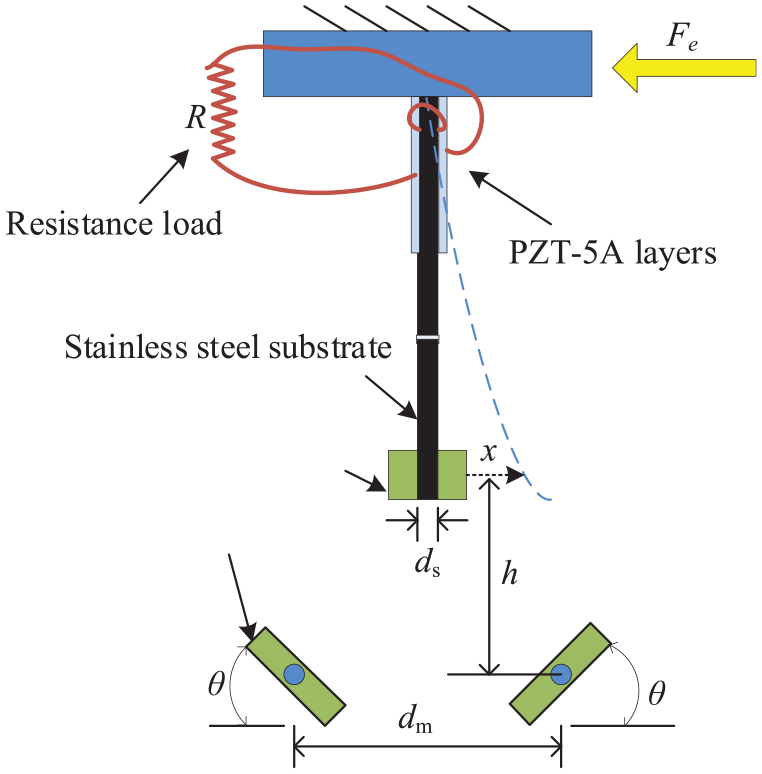
The nonlinear energy harvester with external magnets of variable inclination. 156
The application of piezoelectric energy harvesting technology in the medical neighborhood is still in a developmental stage. Amin Karami et al. 160 designed nonlinear monostable and bistable energy harvesters can convert the heart’s vibrations into electrical energy to charge the pacemaker’s battery. Studies have shown that the bistable energy harvester outperforms the monostable energy harvester in terms of power level and heart rate sensitivity. It can generate more than 3 μW of power to meet the power requirements of a pacemaker. Ansari and Karami 161 designed a small nonlinear piezoelectric energy harvester connected to the myocardium, which converts myocardial motion into electrical energy to power the thus lead-free pacemaker. Kondapalli et al. 162 implanted a piezoelectric suture close to the heart valve region to generate electrical energy using nonlinear valve perturbations, offering the possibility of self-powering wireless ultrasonic microsensors.
Engineering and industrial fields
Piezoelectric energy harvesting plays an important role in the field of vehicle roads, such as powering traffic signals, monitoring the road health of bridges, etc. Khalili et al. 163 developed a piezoelectric energy harvesting device that converts mechanical energy of the road into electrical energy in order to convert the mechanical energy generated by the movement of the vehicle on the road into electrical energy. The piezoelectric sheets are composed in parallel, and a piezoelectric stack is capable of generating a minimum voltage of 95 V and obtaining a root mean square power of 9 mW when excited by 66 Hz as an external load of 500 KΩ. Song et al. 164 presented the design of a micro power supply for a piezoelectric road energy harvester. The study consisted of multiple cantilever beams, and the output current was rectified by optimizing the back-end circuit, resulting in good power output. Jung et al. 8 introduced a polymeric PVDE piezoelectric energy harvesting module for road applications. The results of this study show that a higher improved output power can be obtained by connecting multiple units in parallel. When the vehicle passes at 8 km/h, 200 mW of power can be generated at an external resistor of 40 kΩ. Gao et al. 165 developed a piezoelectric energy harvesting device specifically for railroad applications to harvest low frequency and low amplitude energy from rail systems. The model can achieve 4.9 mW of power and 22.4 V of voltage output, and performance is undoubtedly excellent. In reviewing the application of piezoelectricity to bridges, Wang et al. 166 concluded that the power that a vehicle can collect through a single transducer operation is usually meager.
Li and Jing 167 described a nonlinear X-shaped structure formed using a horizontally and vertically mounted and connected piezoelectric harvester with the advantages of both a cantilever beam type and a beam harvester supported by a spring-mass system. Research has shown that the device could collect bridge vibration energy to power bridge health monitoring sensors. Zhang et al. 168 introduced a nonlinear energy harvester using magnetic levitation and showed that the harvester can generate considerable energy under the excitation of different bridge vibrations even when the intrinsic frequency of the bridge varies between 2.664 and 6.581 Hz. Andò et al. 123 proposed a nonlinear bistable energy harvester that can produce a large amplitude response over a wide range of operating frequencies and can be used to harvest low-frequency vibration energy from road traffic. Li et al. 169 designed a high-performance low frequency bistable vibration energy harvesting board with end-mass blocks. They showed that the harvesting board could generate output power higher than 1 mW, which can power some wireless sensors to monitor the health of structures. Manla et al. 170 proposed a non-contact based piezoelectric energy harvester that can be used in a tire pressure monitoring system to power the pressure sensors inside the vehicle tires. Yi et al. 171 proposed a piezoelectric rotating energy harvester with eight typical nonlinear flexural bridges, and the structure converts kinetic energy at low frequencies into electrical energy to implement a battery-free tire pressure monitoring system. Studies have shown that the harvester can effectively power commercial tire pressure monitoring systems. Zhang et al. 172 proposed a nonlinear rotational energy harvester that can be mounted on a car tire, a structure that broadens the rotational band while stabilizing high-energy orbital oscillations.
Fluid field
Wind energy is a renewable and clean energy source that is widely available in the environment and inexhaustible. Wind turbines are large machines with large sizes and fast rotation speeds, which are suitable for grid-connected power generation but not for powering small sensors. Therefore, we think about the vibration energy harvester excited from eddy excitation vibration, chattering, etc. to collect wind energy. Wang et al. 173 studied the eddy-excited vibration wind energy harvesting problem, proposed a non-contact indirectly excited composite piezoelectric wind energy harvester, and investigated the structure from theoretical and experimental aspects. The results show that the wind energy harvester can operate effectively in the wind speed range of 5.5–40 m/s. The wind speed bandwidth and output power increase as the sensor mass increases and the housing mass decreases.
Karami et al. 174 designed a nonlinear piezoelectric wind energy harvester with low start-up wind speed and is not limited by a specific wind speed. Tan et al. 175 proposed a piezoelectric-electromagnetic dance energy harvester with a piezoelectric-electromagnetic synergistic design. They showed that the harvester turns off the electromagnetic module operation when the wind speed is less than the critical wind speed. When the wind speed exceeds the critical wind speed, the piezoelectric and electromagnetic modules will work together. Chen et al. 176 proposed a softened nonlinear aeroelastic dance energy harvester that harvests energy from wind and foundation vibrations. Karami et al. 177 developed a new compact nonlinear piezoelectric wind harvester, a structure that stabilizes a piezoelectric biaxial by repelling magnetic forces. Studies have shown that the energy harvester can generate sufficient power over a relatively large range of wind speeds. Wang et al. 178 proposed a dynamic multi-stable structure consisting of a piezoelectric beam and a rectangular plate to achieve the harvesting of variable speed wind energy, as shown in Figure 18, which exhibits bistable features at low wind speeds and tri-stable characteristics at high wind speeds. Studies have shown that the system can maintain a large output in variable speed wind environments.

Schematic of the proposed dynamic-stable flutter energy harvester (DFEH). 178
The ocean contains rich and colossal energy, wave energy is a renewable and clean energy source with development potential. The multi-degree of freedom wave energy harvester is widely used and has superior comprehensive performance. 179 Younesian and Alam 180 proposed a nonlinear multi-stable system consisting of a nonlinear recovery mechanism and a linear damper generator. This simple new system can broaden the frequency bandwidth of the wave energy absorber and the bandwidth of the power output damping factor, which can significantly improve the absorption efficiency of the pendular wave energy converter. Liang et al. 181 proposed a wave energy converter pickup system based on a mechanical motion rectifier that can convert bi-directional wave motion into un-directional generator rotation. Simulation analysis shows that the system has higher output power compared to the linear damped force pickup system, and the system has also proven its feasibility through laboratory tests and ocean tests, providing ideas for ocean energy harvesting.
Li et al. 182 studied a vibration energy harvesting system coupled with specially arranged piezoelectric sheets through an X-structure, as shown in Figure 19. It is shown that the system has excellent nonlinear characteristics and can improve the efficiency of wave energy collection at low frequencies. Bao and Wang 183 designed a bladeless rotating piezoelectric energy harvester using a tipping bucket, which consists of a piezoelectric beam structure, a magnetic wheel, and a tipping bucket. It has been shown that the structure can achieve intermittent energy harvesting at ultra-low fluid flows and continuous operation at higher fluid flows, making it suitable for harvesting energy in fluids with a wide range of water flow rates.

Design of the X-structured harvester. 182
Rezaei et al. 184 introduced an improved acoustic piezoelectric energy harvesting method by adding a nonlinear restoring force to the acoustic cantilever beam with piezoelectric energy harvester to broaden the frequency band of operation. Zhou et al. 91 proposed a bistable acoustic energy harvester to collect the energy from the noise. Experimental results showed that the harvester could operate at relatively low noise intensity and achieve coherent resonance, resulting in large voltage output. Lallart et al. 185 inn this paper, a nonlinear processing method is proposed to optimize the acquisition of acoustic energy. Studies have shown that nonlinear optimization methods can increase the harvested energy by a factor of 10 and double the bandwidth, providing a good perspective for powering electronic devices from ambient sound and noise.
Summary and outlook
This review has provided a comprehensive overview of the operating mechanism, typical operating modes, kinetic characteristics and various excitation types of piezoelectric harvesters. The aggregate model and electromechanical conversion modes often used in piezoelectric harvesting technology were introduced first. The research results of the three electromechanical conversion modes were presented using a top-down approach, and were compared and analyzed in a tabular format. In the section on different excitations, a detailed collection of three piezoelectric energy harvesters operating under different excitation conditions was reviewed, and their performance was analyzed and discussed. In the section of dynamic characteristics, different steady-state piezoelectric energy harvesters were reviewed in detail and their performance for different steady states was compared and some theoretical calculations were reviewed. Based on some existing cases, potential application scenarios of piezoelectric energy harvesting technology were reported and a clear classification was presented.
Current research results in the neighborhood of piezoelectric energy harvesting are fruitful. Still, the harvesters of papers to comb through the comparison reveal that there are some shortcomings in piezoelectric harvesting technology. First, due to the complexity of environmental vibrations. It is challenging to achieve broadband collection when solving the frequency matching problem. The combination of piezoelectric and magnetoelectric is currently a method used to solve broadband collection, but this approach is confronted with the problem of how to improve the efficiency of nonlinear energy harvesting. Secondly, the harvester working occasions are mainly concentrated in low-frequency environments, and the power output is hard to break the limit of milliwatt and microwatt. There are not many high-frequency harvesters for specific application scenarios. Finally, research on fatigue and cracking of energy harvesting devices has been neglected. Undeniably, piezoelectric energy harvesting technology is fruitful at the level of theoretical research. Still, it is insufficient to make up for the shortcomings in power and bandwidth, which has led to the fact that there are still few piezoelectric products on the market to achieve wide application.
The future research of piezoelectric energy harvesting technology can be started in the following directions to transform the results of theoretical research into more practical applications. Regarding power output, multi-degree-of-freedom energy harvesting is used to break the research bottleneck of single-degree-of-freedom. High output power can be achieved by changing the source of vibration in the environment to accommodate shear mode energy harvesting. Highly integrated technology is utilized to reduce the size and power consumption, and the harvest circuit is incorporated into the system to improve flexibility and output power density. By coupling and integrating the collection of various nonlinear capabilities, we break through piezoelectric-electromagnetic and piezoelectric-friction and combine piezoelectric-electromagnetic-friction conversion mechanisms into one system to improve performance while expanding the applicability of the product. In terms of operating bandwidth, the spring device is used as the response component of the harvester, and a tuning structure is introduced to the device to realize the tuning function of the harvester and broaden the bandwidth of the harvester operation.
Footnotes
Handling Editor: Chenhui Liang
Declaration of conflicting interests
The author(s) declared no potential conflicts of interest with respect to the research, authorship, and/or publication of this article.
Funding
The author(s) disclosed receipt of the following financial support for the research, authorship, and/or publication of this article: This work is supported by the National Key R&D Program of China (2020YFB0905900).
