This paper proposes initial-boundary value problems for time-fractional analogs of Kuramoto-Sivashinsky, Korpusov-Pletner-Sveshnikov, Cahn-Allen, and Hoff equations due to a bounded domain. Adequate conditions for the blowing-up of solutions in limited time of previously mentioned conditions are displayed. The Pohozhaev nonlinear capacity strategy is considered. Illustrative examples are given for each of the investigated equations.
Fractional calculus works on the powers of the differential equations that are not numbers such that most wonders in science and designing are communicated by partial differential equations. Fractional calculus was initiated as a pure mathematical aspect in the middle of the 19th century.1,2 The concept of fractional or non-integer order derivation and integration can be followed back to the beginning of numbers order calculus itself.3
For the most part, physical marvel might depend on its current state and on its chronicled states, which can be displayed effectively by applying the hypothesis of derivatives and integrals of fractional order.4 Due to this, several analytical techniques are used to derive exact, explicit, and numerical solutions of nonlinear fractional partial differential equations, where the modeling of physical phenomena is very interest to many scientists and researchers up to now.5
With these achievements, we study time-fractional equations for funding blowing-up solutions by using the Pohozhaev nonlinear capacity method6–11; more absolutely, on the choice of test functions according agreeing to initial and boundary conditions beneath thought for the time-fractional equations. In 2021, Alsaedi et al. gave a simple case of the analysis of a rough blow-up, that is, the case where the solution tends to infinity as on , more exactly, when the integral
for , here , non-zero constants with initial conditions
where is a given function. This work is devoted to blowing-up solutions of time-fractional analogues of the above equations. The approach to the problem is based on the Pohozhaev nonlinear capacity method; more precisely, on the choice of test functions according to initial and boundary conditions under consideration. The solutions for nonlinear partial differential equations has attracted a large number of researchers, as many papers have emerged around this study (see Refs12–15). We donate a straightforward case of the investigation of a harsh blow-up, that is, the case where the solution tends to infinity as on more precisely, for the given function , the integral
tends to infinity as .
The rest of the paper can be outlined concisely as follows: “Preliminaries” section contains some definitions and properties of fractional order integral and differential operators that will be used later. In the “Blowing-up solutions of the time-fractional equations” section the Pohozhaev nonlinear capacity method has been applied to above equation and illustrates the obtained results by some examples at the end of each section.
Preliminaries
For real-valued function , the fractional integral of Riemann–Liouville is defined by
where ,
is the Euler gamma function16 and “*” is the convolution operation. The Sobolev space is defined for the function by (Kilbas et al.16)
Let and . The Riemann-Liouville fractional derivative of order is defined as
The Caputo fractional derivative of order is defined as16
If then the Caputo fractional derivative of order is defined as
The Theorem 2.2 assure the blow-up of solutions to (9).
Theorem 2.2. The solution of problem (9) blows-up in a finite time18
is , whenever .
Blowing-up solutions of the time-fractional equations
The time-fractional generalized Kuramoto-Sivashinsky equation
In this section we consider the time-fractional generalized Kuramoto-Sivashinsky equation (1) where are the parameters and is the fractional order. The problem (1) is also called KdV-Burgers-Kuramoto equation with time-fractional derivative as it may be a generalization of the taking after well-known equations. The equation (1) coincides with
The classical fractional Burgers equation take the form
whenever and in (1);
The classical fractional KdV equation take the form
whenever and in (1);
The classical fractional Kuramoto-Sivashinsky equation take the form
whenever , in (1),
and . We investigate the question of the blow-up of a classical solution
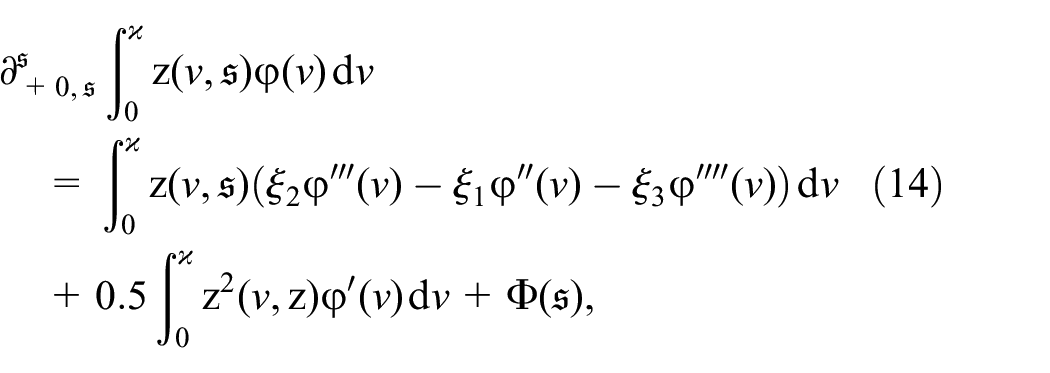
of problem (1). Assume that . Using integrating by parts from multiplication the time-fractional generalized Kuramoto-Sivashinsky equation (1) and , we get
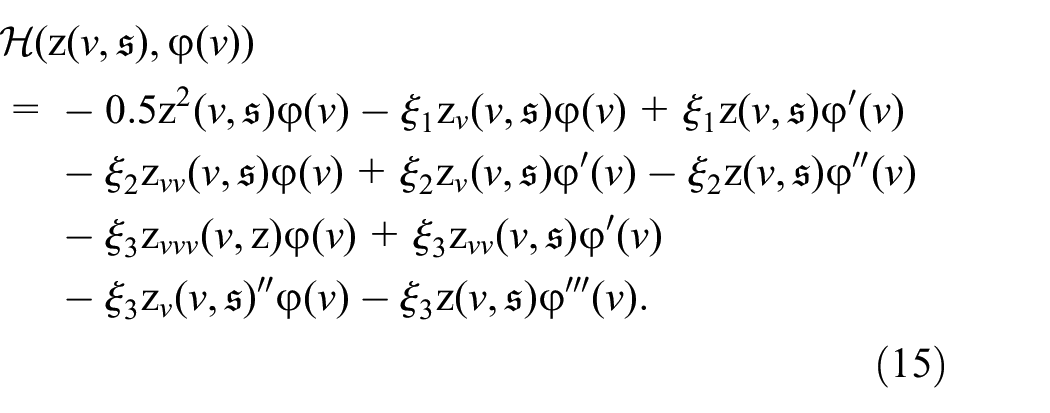
where
and ,
Consider monotonically nondecreasing function , and satisfy the following properties
Then we have
where
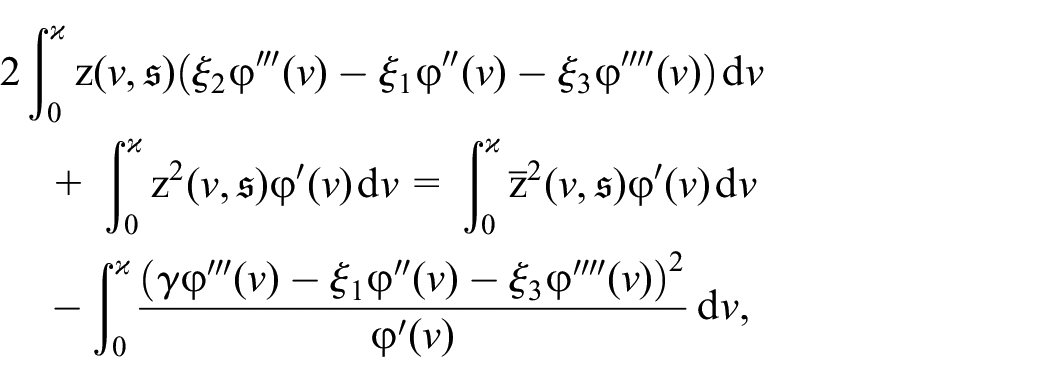
The Hölder inequality implies that
Then, expression (14) takes the form
where and
Theorem 3.1. Let , the function ψ satisfy conditions (16) and the solution of the equation (1) belongs to . If for all and then , where satisfies estimate (10).
Proof. Obviously
where . Since the function is an upper solution of equation (9), so for where inequality (10) hols for . Whereupon for .
Example 3.2. (Fractional Burgers Equation) Let in problem (1) on and the solution of problem (1) satisfy the boundary conditions
Then, if we obtain and . Hence it follows from Theorem 3.1 that the solution of problem (1) blows up in finite time under the condition
Example 3.3. (Fractional KdV Equation) Consider the problem (1) with , on equipped via boundary conditions
Letting we obtain and . Indeed, Theorem 3.1 implies that the solution of problem (1) blows up in finite time under the condition .
Example 3.4. (Fractional Kuramoto-Sivashinsky Equation) Consider the problem (1) with and on via boundary conditions:
Letting we obtain and . So, Theorem 3.1 holds and the solution of problem (1) blows up in finite time under the condition
The time-fractional Korpusov-Pletner-Sveshnikov equation
In this section we consider the time-fractional Korpusov-Pletner-Sveshnikov equation (2), here, are the parameters and is the fractional order with . The equation (2) is called the Korpusov-Pletner-Sveshnikov equation with time-fractional derivative as it is a generalization of the following well-known equations. We study the question of the blow-up of a classical solution of the problem (2). Assume that and the solution of the problem (2) exists. Multiplying the time-fractional Korpusov-Pletner-Sveshnikov equation (2) by and integrating by parts, we obtain
where
and
Consider monotonically nondecreasing function with
and following properties
Then we have
where Form the Hölder inequality, we get
Then, expression (17) takes the form
where
and
Theorem 3.5. Let , the function satisfy conditions (18) and the solution of the equation (2) belongs to . If and then for , where satisfies estimate (10).
Proof. Obviously , where . Since the function is an upper solution of equation (9), therefore for where estimate (10) holds for . Whereupon for .
Example 3.6. (Fractional Korpusov-Pletner-Sveshnikov Equation) Let , and consider problem (2) on with Dirichlet type boundary conditions
Suppose that for all Then, if we obtain and
So, from Theorem (3.5), we conclude that the solution of the problem (2) blows up in finite time via
The time-fractional Cahn-Allen equation
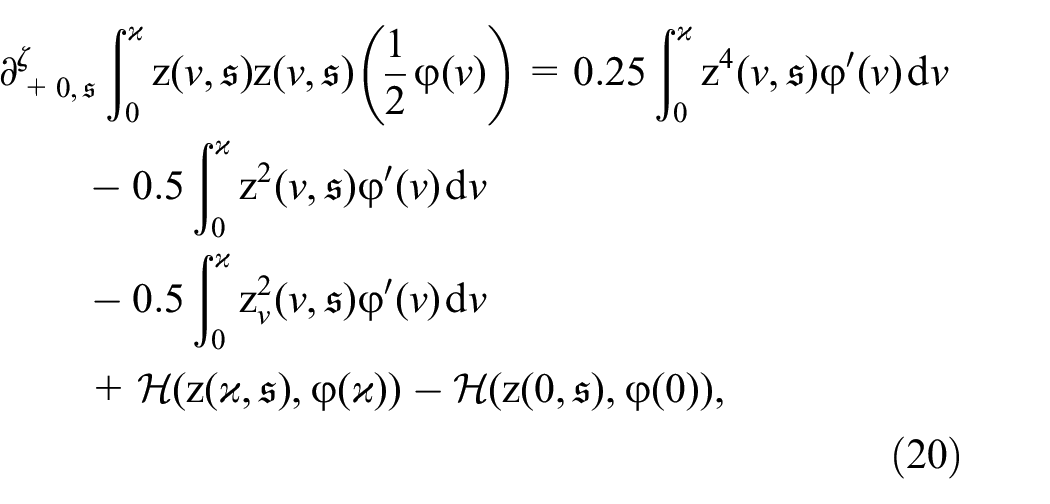
In this section we consider the time-fractional Cahn-Allen equation (3), where is the fractional order with . The equation (3) is called the Cahn-Allen equation with time-fractional derivative as it is a generalization of the following well-known equations. We investigate the question of the blow-up of a classical solution of problem (3). Assume that and the solution of problem (3) exists. Multiplying the time-fractional Cahn-Allen equation (3) by , we have
where
Consider the monotonically nondecreasing function , such that and satisfy the following properties
Then we have
where . By employing the Hölder inequality, we have
and
we also get
Then, expression (20) takes the form
where
and
Theorem 3.7. Let , the function satisfy condition (21) and the solution of the equation (3) belongs to . If
and then for , where satisfies estimate (10).
Proof. Obviously where . In the other hand the function is an upper solution of equation (9), therefore where satisfies estimate (10). Whereupon for .
Example 3.8. (Fractional Cahn-Allen Equation) Consider the problem (3) on under nonlocal dynamical boundary conditions
Letting we obtain and
Therefore Theorem 3.7 implies that the solution of problem (3) blows up in finite time via the condition
The time-fractional Hoff equation
In this section we consider the time-fractional Hoff equation where is the fractional order with . We investigate the question of the blow-up of a classical solution of the problem (4). Assume that and the solution of the problem (4) exists. Multiplying the time-fractional Hoff equation (4) by and integrating by parts, we have
where
Consider monotonically nondecreasing function , such that and satisfy the following properties
Then we have
where . The Hölder inequality implies that the estimate
Then, expression (25) takes the form
where
and
Theorem 3.9. Let and the solution of the equation (4) is such that
and let the function satisfy conditions (26). If and then for each , where satisfies estimate (10).
Proof. Obviously where . Since the function is an upper solution of equation (9), therefore for where satisfies estimate (10). Whereupon for .
Example 3.10. (Fractional Hoff Equation) Let consider the problem (4) on under nonlocal dynamical boundary conditions
Letting we obtain
and . Thus, Theorem 3.9 implies that the solution of the problem (4) blows up in finite time under the condition
Conclusion
We donate a straightforward case of the investigation of a harsh blow-up, that is, the case where the solution tends to infinity as on more precisely, when for the given function , the integral (6) tends to infinity as .
Footnotes
Handling Editor: Chenhui Liang
Author contributions
AB: Actualization, formal analysis, methodology, initial draft, validation, and investigation. MKAK: Methodology, actualization, validation, investigation, formal analysis, and initial draft. MB: Methodology, actualization, validation, investigation, formal analysis, and initial draft. MES: Validation, actualization, formal analysis, methodology, investigation, simulation, initial draft, software, and was a major contributor in writing the manuscript. XGY: Methodology, actualization, validation, investigation, formal analysis, and initial draft. All authors read and approved the final manuscript.
Declaration of conflicting interests
The author(s) declared no potential conflicts of interest with respect to the research, authorship, and/or publication of this article.
Funding
The author(s) received no financial support for the research, authorship, and/or publication of this article.
ORCID iD
Mohammed KA Kaabar
Availability of data and materials
Data sharing not applicable to this article as no datasets we’re generated or analyzed during the current study.
References
1.
BertramR. The development of fractional calculus 1695–1900. Hist Math1977; 4(1): 75–89.
2.
HajiseyedaziziSNSameiMEAlzabutJ, et al. On multi-step methods for singular fractional -integro-differential equations. Open Math2021; 19: 1378–1405.
3.
PodlubnyI. Fractional differential equations: an introduction to fractional derivatives, fractional differential equations, to methods of their solution and some of their applications. San Diego, CA: Academic Press, 1998.
4.
SahadevanRBakkyarajT. Invariant analysis of time fractional generalized Burgers and Korteweg-de Vries equations. J Math Anal Appl2012; 393: 341–347.
5.
Al’shinABKorpusovMOSveshnikovAG. Blow-up in nonlinear Sobolev type equations, vol. 15. Berlin: Walter de Gruyter, 2011.
6.
AlsaediAAhmadBKiraneM, et al. Blowing-up solutions of the time-fractional dispersive equations. Adv Nonlinear Anal2021; 10: 952–971.
7.
MitidieriEPokhozhaevSI. The absence of global positive solutions of quasilinear elliptic inequalities. Dokl Math1998; 57(2): 250–253.
8.
MitidieriEPokhozhaevSI. A priori estimates and blow-up of solutions of nonlinear partial differential equations and inequalities. Proc Steklov Inst Math2001; 234: 1–362.
9.
MitidieriEPokhozhaevSI. Towards a unified approach to nonexistence of solutions for a class of differential inequalities. Milan J Math2004; 72: 129–162.
10.
PohozhaevSI. On a class of initial-boundary value problems for equations of Korteweg-de Vries type. Differ Equations2021; 48(3): 372–378 .
11.
PohozhaevSI. On the nonexistence of global solutions of the Cauchy problem for the Korteweg-de Vries equation. Funct Anal Appl2012; 46(4): 279–286.
12.
AhmadBAlhothualiMSAlsulamiHH, et al. On a time fractional reaction diffusion equation. Appl Math Comput2015; 257: 199–204.
13.
AlsaediAAhmadBKiraneM, et al. Blowing-up solutions for a nonlinear time-fractional system. Bull Math Sci2017; 7: 201–210.
14.
CaoJSongGWangJ, et al. Blow-up and global solutions for a class of time fractional nonlinear reaction-diffusion equation with weakly spatial source. Appl Math Lett2019; 91: 201–206.
15.
XuQXuY. Extremely low order time-fractional differential equation and application in combustion process. Commun Nonlinear Sci Numer Simul2018; 64: 135–148.
16.
KilbasAASrivastavaHMTrujilloJJ. Theory and applications of fractional differential equations. Amsterdam: Elsevier (North-Holland), 2006.
17.
AlsaediAAhmadBKiraneM. A survey of useful inequalities in fractional calculus. Fract Calc Appl Anal2017; 20: 574–594.
18.
HnaienDKellilFLassouedR. Blowing-up solutions and global solutions to a fractional differential equation. Fract Differ Calc2014; 4: 45–53.