



Abstract
The influence of various influential factors on the flow field, temperature, and concentration variations are observed throughout the study of thermo-physical properties. The transfer of heat in fluids and thermal instability/stability are fascinating areas of study because of their vast range of applications, and physical significance in many engineering systems. This research aims to investigate and evaluate the flow characteristic, heat and concentration variations of hybrid nanofluids containing MHD natural convection flow of micropolar CuO-Ag/water in porous media across a vertically positioned plate. The flow model is treated with suction/injection at the plate’s surface, thermal radiation, heat generation and absorption, Joule heating, and viscous dissipation. The non-Fourier theory for the heat flux model is used to diminish the thermal instability. Mathematical system for the proposed model having some physical aspects results in a system of PDEs form which is restricted the boundary layer approximation is used. The PDEs model is then converted into an ODEs system using the suitable transformations. Numerical scheme RK-4 in collaboration shooting technique is used to find the best approximate results. For the validation of the employed technique, a comparison is offered from literature to confirm the dependability of the produced solution. Physical characteristics of the given solution have been studied and demonstrated against various associated influential factors. In the case of hybrid nano-structures, thermal growth is accelerated rather than in the event of nanofluid. The momentum layer thickness is more essential in hybrid nanoparticles than in nanoparticles. It’s also being looked at how crucial flow parameters affect heat transmission and skin friction.
Keywords
Introduction
Every sector demands heat transfer characteristics in a period because of the rising need for thermal energy. Due to its various uses in a wide variety of sectors, such as biomedicine and engineering, culminating in the incredible ability of nano-science to speed up the rate of thermal convection from adjacent sources. It piqued the interest of scientists and investigators. Heat efficiency refinement might give a leg up on other requests, such as plasma research. Computers, nuclear reactors, and other microelectronic devices use microchips, space cooling, energy production, and so much more. Choi and Eastman 1 gave the concept of melting nanometer sized particles in conventional fluids. Xuan and Li 2 developed preparatory procedures for a variety of nanoparticle samples and investigated thermos-physical parameters such as shape, quantity, quality, and dimensions using a rectilinear Riga plate. Rawat et al. 3 studied the flow of silver and copper nanofluids. Because the Riga bowl’s height was considered to be infinite, they used the speed of the top wall. Many different types of research4–9 have been conducted on nanofluids to investigate its heat transmission properties. A nanomaterial type may not have all the desired properties for an application there may be physical or spiritual factors. Despite the many serious applications, hybrid nanofluids are ready to have different properties, so they are very important.
A hybrid nanofluid is a novel form of nanofluid made up of two or more nanoparticles dispersed in a base fluid. By balancing the advantages and disadvantages of single suspensions, hybrid nanofluids can improve heat transmission, high efficiency thermal conductivity, and stability. Since nanoparticles have a larger aspect ratio, a better thermal network and are widely used in nuclear power sectors such as generator cooling, electronic cooling, coolant in machineries, and coolant for freezing towers, it is because of the complex formation of nanomaterials. The ability of hybrid nanofluids to improve thermal conductivity allows them to be considered the thermal energy in real-world concerns. Waini et al. 10 investigated hybrid nanofluids moving on permeable surfaces with a fixed volume percentage of 0.1% nanoparticles of alumina and copper nanoparticles. To hybridize nanofluids in aqueous aggregates, some of the previously introduced nanoparticles were added. Ashwinkumar et al. 11 investigated a vertical cone and plate using thermal non-linear radiation are used to circulate a CuO-Al2O3/water hybrid nanofluid. Heat transfer owing to the stretched surface dusty nanofluid flow and dusty hybrid nanofluid flow was examined by Samrat et al. 12 Refs13–19 are some examples of foundation investigations in the area of hybrid nanofluids. The micro-polar liquid theory is a boundary layer theory that considers nanoparticle micro-rotation. Eringen 20 investigated micropolar fluid can be thought of as an improvement to the Navier–Stokes state. They are a sort of microfluidics because they take into account the fluid’s microstructure as well as the substrate’s inertial characteristics, allowing for experimentation. The transport of heat from the sheet stretched across micropolar fluid was studied by Hassanien and Gorla. 21 Subhani and Nadeem 22 explored flow in a permeable material that is time-dependent, concentrating on two-dimensional micropolar MHD fluid flow, after the model was mathematically solved. The Hybrid nanofluid containing Copper and Alumina Alloy nanoparticles in base fluid water was taken for MHD boundary layer flow through a movable slandering needle, and various parameters for nanoparticles and hybrid nanoparticles ware investigated. 23 In another study, the hybrid nanofluid comprising the Copper and Magnesium Sulfate nanoparticles in base fluid water is studied for the non-Newtonian pseudo plastic Williamson flow under the effects of suction/injection on the stretched surface, heat generation, and thermal conduction to explore the fluid momentum and energy characteristics. 24 References25–28 include further studies on micropolar fluids and nanofluids.
In recent years, the problems of employing the vertical plate with nanofluids have been examined by numerous researchers. Khalid et al. 29 and Hussanan et al. 30 employed a vertical oscillating plate with a Newtonian heating and a constant temperature at the wall to solve Casson fluid flow. Aliet al. 31 looked at how a Brinkman-type nanofluidic flowed on a perpendicular plane sheet in water through four distinct nanoparticle morphologies. Second-grade fluid over an infinite perpendicular smooth plate in a time-dependent way is investigated by Imran et al. 32 They used the Laplace transform method to solve the system of differential equations. The influence of silver nanoparticles on the MHD free convection flow of Jeffrey fluid across an oscillating vertical plate embedded in a porous medium was examined by Mohd Zin et al. 33 The Atangana–Baleanu and Caputo–Fabrizio fractional derivatives for the generalized Cason fluid model with heat generation and chemical reaction were compared and analyzed by Sheikh et al. 34 Application of Caputo–Fabrizio derivatives to MHD free convection flow of the generalized Walters’-B fluid model was studied by Ali et al. 35 Casson fluid convection was studied using atangana baleanu and caputo–fabrizio fractional derivatives by Sheikhet al. 36 Ali Shah et al. 37 studied magneto-hydrodynamic free convection flows in porous media with thermal memory across a moving vertical plate. Ghalambazet al. 38 investigated the flow and heat transport of hybrid nanofluids across a vertical plate using mixed convection and stability analysis. In the presence of hall current, nonlinear convection, and heat absorption, Amala and Mahanthesh 39 investigated hybrid nanofluidic flow across a perpendicular rotating plate. Khashi et al. 40 used a hybrid Cu-Al2O3/water nanofluid to study mixed convective stagnation point flow toward a vertical Riga plate. In water, kerosene, and motor oil, Hussananet al. 41 investigated convective thermal transportation in micropolar-nanofluids containing copper oxide nanoparticles. Khalidet al. 42 looked at the close form solution for the free convective flow of nanofluidic along a ramping wall temperature.
The term MHD refers to a fluid that is subjected to magnetic and electromagnetic forces. Solar panels, highly conductive-boilers, and the polymeric industry all employ the MHD. Researchers have done a wide range of work in this field. The idea is to protect nanofluids from being affected by electromagnetic forces. The squeezing of micro liquid flow in a magnetic field-affected medium was examined by Ghadikolaei et al. 43 The Keller box approach was used by Ullah et al. 44 to statistically study a non-Newtonian fluid across a stretched sheet in the presence of a magnetic field and Newtonian heating. The heat transmission of a ferrofluid down a vertical conduit in the presence of a magnetic field was explored by Gulet al. 45 In nanofluids, hybrid nanofluids, and micropolar fluids/nanofluids, magnetic and electromagnetic forces are studied, for instance the references46–54 respectively, presented the significance literature about the said study.
The impacts of numerous operational parameters, For example, Reynolds number, nanoparticle volume percentage, and slip effects are only a few examples have been established in several earlier investigations, both solo and in combination. As the author knows, the effects of multiple slip in hydro-magnetic mixed convection are a micropolar nanofluid in turbulent flow with radiation as well as a heat-slip source in the presence of a non-Fourier flow were not studied first. In certain uncommon instances, numerical solutions are studied, and graphs are utilized to discuss the broad physical meaning of different parameters. Elattar et al. 55 examined hybrid nanofluid flow over a slender stretching.
For the heat flux, the well-known law about flow was initially presented by Fourier and Darboux. 56 The evolution of parabolic energy expression is constrained by this rule. Using the energy expression, it is evident that the disruption can be seen initially by the flow medium. This is known as the paradox of heat conduction. To prevent this, Fourier’s law of thermal conduction is altered in a variety of means and situations. Cattaneo 57 provides an improved version of Fourier’s equation of heat conduction, which incorporates the thermal relaxation time component. He found that the existence of thermal relaxation time causes the hyperbolic energy expression to arise. Christov 58 is the source of the Cattaneo hypothesis modification. In the Cattaneo–Christov heat flow model, he used the upper-convective Oldroyd derivative. Other relevant literature of non-Fourier flux is found in Refs.59–61
In this article, the non-Fourier theory is employed on the nanofluid model through vertical sheets. For simulation purpose, using proper similarity transformations, the governing nonlinear PDEs are converted into a group of nonlinear system, which are then numerically solved using the Rk-4 and shooting approaches. The numerical solutions generated in the graphical structures explained the flow system in detail.
Description of fluid flow and its mathematical formulation
Considered the two-dimensional incompressible combine convective micropolar hybrid nanofluid flow that is past a vertical sheet. Hybrid nanofluids comprise the copper oxide and silver nanoparticles suspended in the host fluid water (CuO-Ag/water). The flow is assumed under the effects of suction-injection, nonlinear thermal radiative flux, viscous dissipation, and heat generation-absorption. Non Fourier theory named Cattaneo-Christov heat model is employed on flow in order to stable the heat transfer throughout the boundary layers. As displayed in Figure 1, the magnetic field B0 is applied to the surface in an orthogonal manner. The temperature value at the surface is

Basic structure of fluid flow.
Under the above assumptions, the governing Navior’s Stokes system is as follow, 62

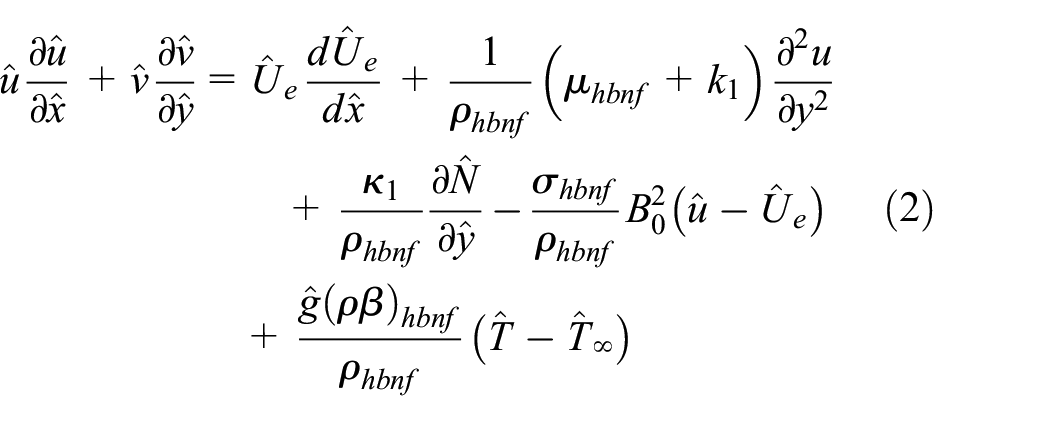


The term

Where

The thermal relaxation (non Fourier flux)
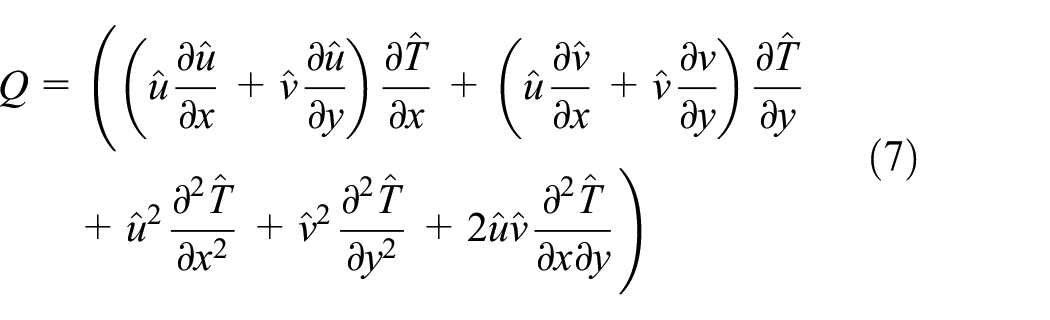
Rewriting the equation (4) with the help of equations (5) to (7) as,

The equation that controls fluid flow has the following boundary conditions 63 :

Where
Thermo-physical properties of hybrid nanofluid
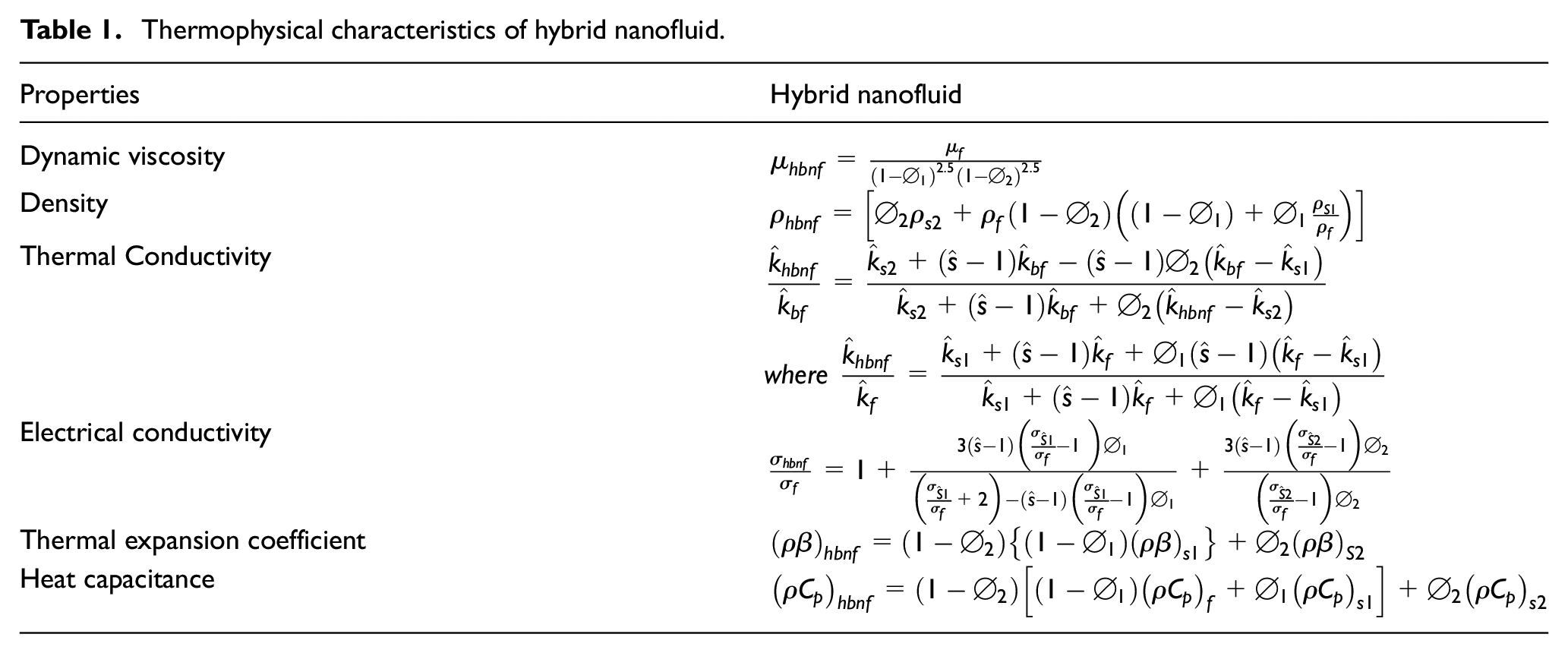
In order to maximize the efficiency of an energy conversion system, thermal performance must be optimized. The thermos-physical properties of the applied fluids utilized in energy conversion systems greatly influence this kind of thermal performance. The parameters of thermal conductivity, specific heat, and dynamic viscosity is greatly affected by thermal transportation. As potential heat transfer fluids, hybrid nanofluids are affected by a variety of factors, including volume fraction, the size of solid particles, and the temperature. This research focus a hybrid nanofluid flow model composed of a host fluid water and the CuO and Ag nanoparticles have been employed to demonstrate its properties. The volume fractions of CuO nanoparticles and Ag nanoparticles are denoted by the numbers
Thermophysical characteristics of hybrid nanofluid.
The values of nanoparticles and host fluid.

Comparison table of Skin friction

Suitable similarity transformations
The purpose of suitable similarity transformation is to decrease the intricacy of fluid flow system in order to compute the quick and easy way to find the solution of the problem. The appropriate transform variable are,

Expressions in equation (10) into equations (1) to (3) and (8) give the following non-dimensional system of momentum, micropolar fluid, and non-Fourier temperature distributions.


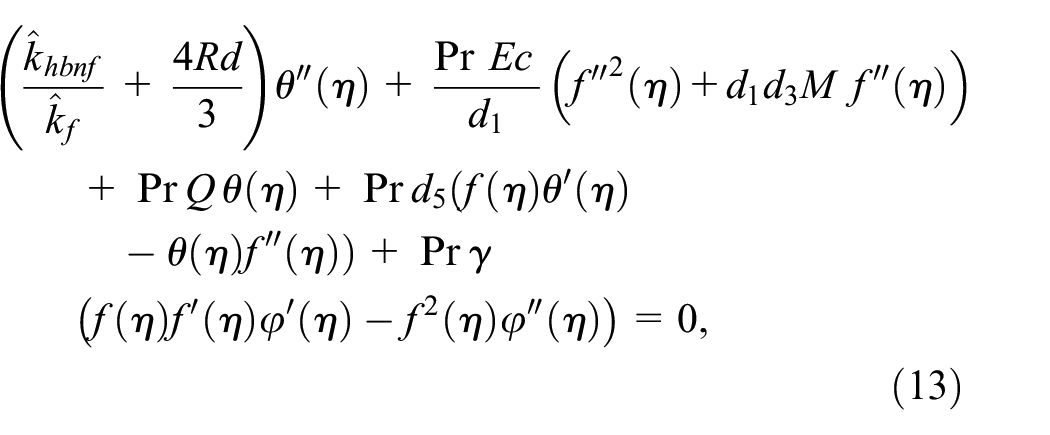
with corresponding boundary conditions,

Here the non-dimensional quantities are define as,
In the above equations, the dimensionless constant has the value of

Surface drag force and Nusselt number (magnitude of convectional heat transfer)
The calculation of skin friction is important from an engineering perspective since it use to estimate not only the overall frictional drag force imposed on an object, but also the rate of convectional thermal transfer on its plates. Reynolds analogy establish these relationship which relates two-dimensionless parameters: skin friction coefficient (Cf), which is a non-dimensional frictional stress, and Nusselt number (Nu), that reflects the amount of convectional thermal transfer.
Here the skin friction and local Nusselt quantity are defined as,

With the help of non-dimensional variable equation (10), the thermal transportation coefficient


Solution process of the hybrid nanofluidic system
Digital computers and advance methods are used in computational fluid dynamics (CFD), which uses conservation laws (such as the conservation of mass, momentum, and energy) to make quantitative predictions about fluid movement. CFD has grown in relevance and accuracy, yet no forecast is ever 100% accurate. However, a sophisticated CFD solver is able to effectively solve these complicated physical system numerically by transforming these rules into differential equations. We use Shooting method and RK4 as CFD solver in order to find best estimation results and predict the dimensionless quantities.
Basic principles of the shooting technique
The transport equations are quite nonlinear and can be affected by boundary circumstances. The R-K-F fourth–fifth-order structure and shooting approach may be used to compute this numerically. This method has a small margin of error. Converting the resultant differential equations into first-order equations is the first step in solving the framed model of a hybrid nanofluid flow problem. The essential replacements for the aforementioned step are as follows,

Few assumptions are taken to solve the fluidic model:
A relevant number
Conditions in the far-field w.r.t
The scale of convergence is 10−5, and
For calculations, the step size is recorded as
Equations (11) to (13) can be written as

Corresponding conditions according to the variable are as,

Where
Numerical results and discussion
This article examines micropolar hybrid nanofluidic flow across a perpendicular plate. Using the shooting and RK4 approaches, the governing equations and associated boundary conditions are expressed and resolved numerically, subsequent in ODEs. Graphics are used to show the effects of different settings on the hybrid nanofluid flow and its characteristics. Relevant parameters are suction-injection (S), heat generation/absorption (
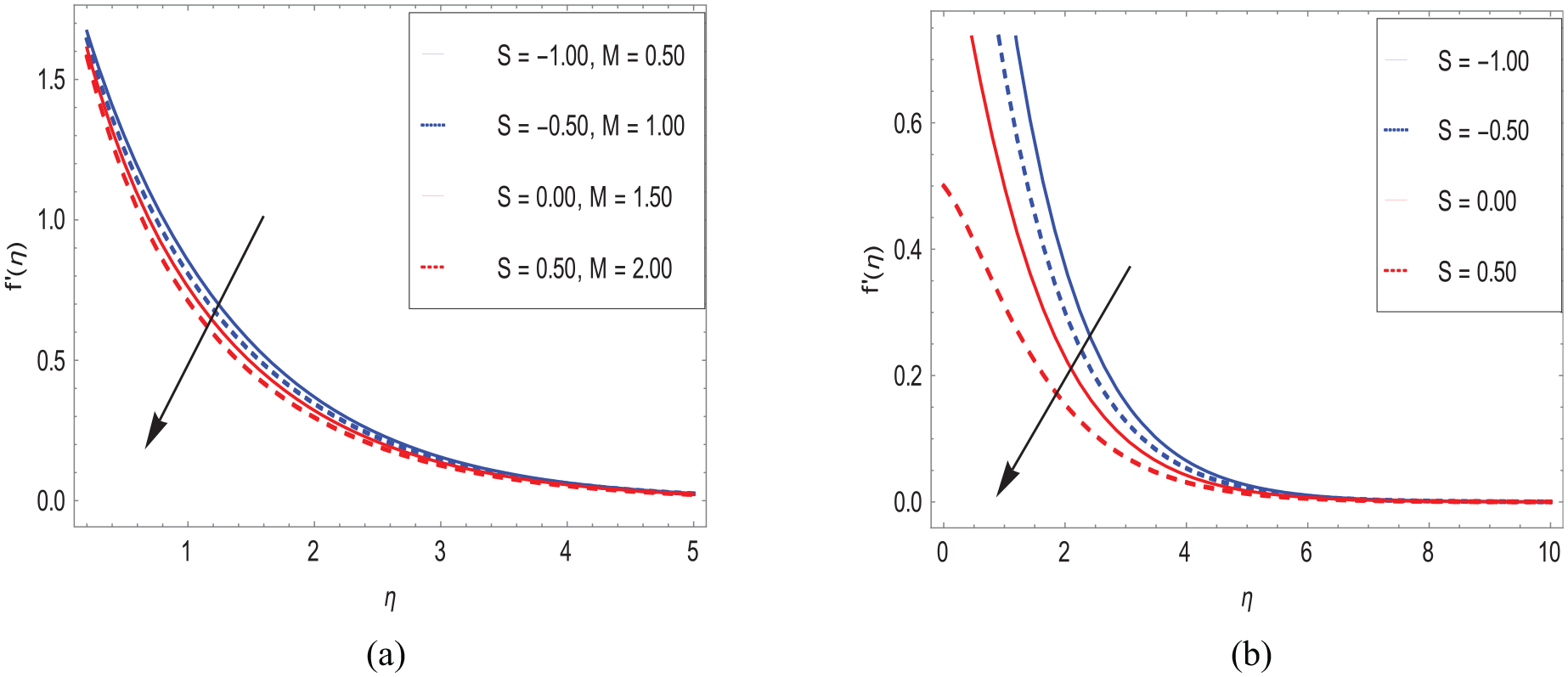
Influence of (a) magnetic parameter and (b) suction-injection parameter on velocity profile.

Influence of (a) micropolar parameter, (b) Eckert number, and (c) heat generation/absorption parameter on velocity profile.
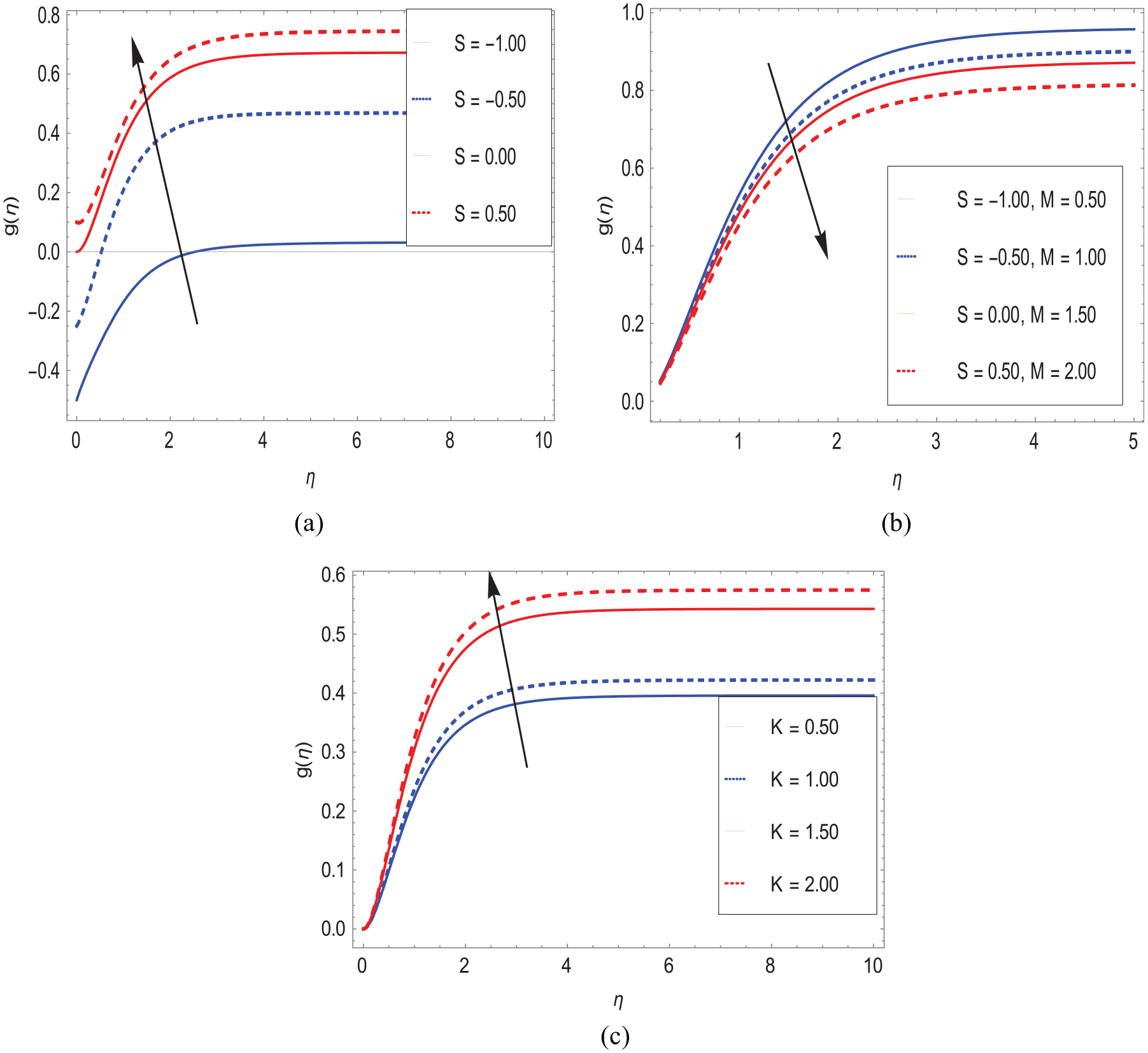
(a) Suction-injection parameter, (b) magnetic parameter, and (c) micropolar quantity on micropolar field.

Influence of (a) Eckert number and (b) thermal relaxation parameters on temperature distribution.

Influence of (a) thermal radiation and (b) Prandtl number for temperature distribution.

Different volume fraction for temperature profile.

Skin friction quantity for (a) magnetic parameter against heat suction absorption, (b) thermal stratification against heat suction absorption, and (c) suction injection parameter.

(a) Prandtl number and (b) thermal relaxation against thermal radiation in local Nusselt number field.
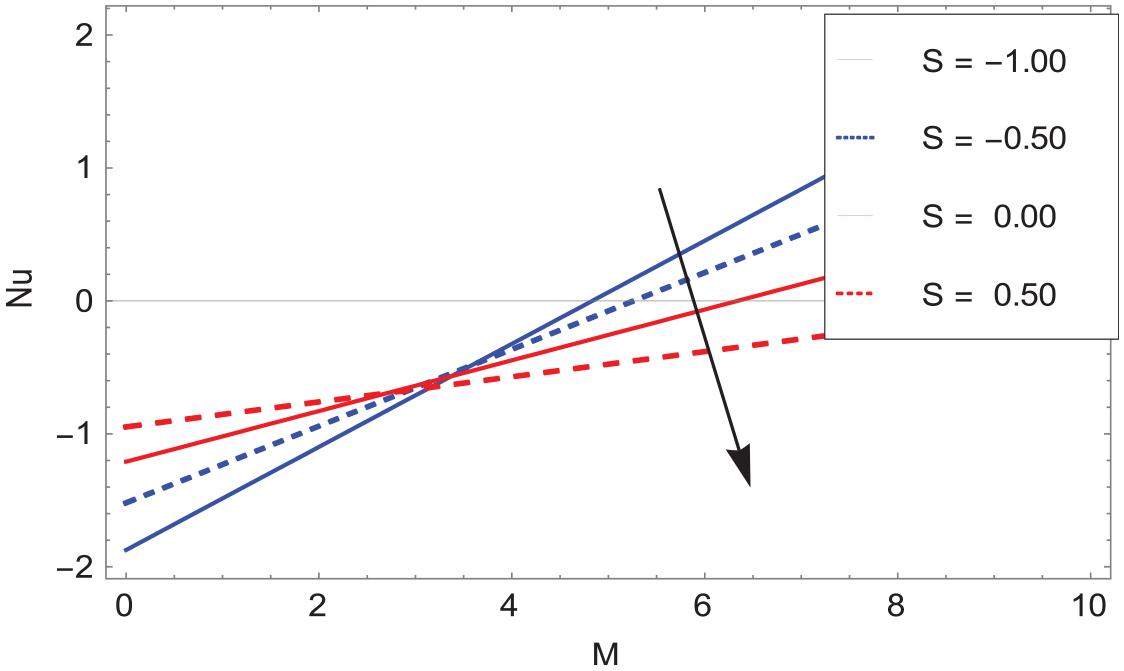
Heat suction absorption against magnetic parameter n local Nusselt number field.
Influence of skin friction and local Nusselt number
Figures 8 to 10 exhibit the skin friction and local Nusselt number variations against various parameters. In Figure 8(a), the magnetic field in collaboration heat suction injection observations rapidly elevate the drag force field. Figure 8(b) displays the thermal stratification versus heat suction. Figure 8(c) displays the rising effect of magnetic parameter and heat suction injection quantity. However, beyond a specific range of magnetic parameters, the skin friction factor suddenly rises. Figure 8 indicates that increasing the magnetic parameter increases the heat transfer coefficient, whereas the radiation parameter (Rd) has the opposite effect. However, increasing the magnetic value causes the heat transfer coefficient to increase exponentially. Figures 9 and 10 shows the increasing variations between the Prandtl number and thermal relaxation against thermal radiation in the local Nusselt number field and decreasing variations between the heat suction absorption and the magnetic parameter of the local Nusselt number field. Figures 11 and 12 show the contour effects of drag force and local Nusselt number. Contour study is significant for the irregular surface outline of any shape at boundary. The nano-type tiny particles shapes are usually irregulars. The contour plots of skin friction and local Nusselt numbers for various physical parameters dispatch here. Figure 11(a) shows the decreasing effect in Skin friction variation against the increasing range of suction/injection and magnetic parameter. As skin friction is directly proportionate to the square of the velocity and is directly proportional to the area in contact with the fluid thus the presence of Lorentz force on the plate with suction/injection effect disturb the drag force at boundary layer. Figure 11(b) and (c) shows that the particular values of Prandtl number increases the effect of drag force monotonically. Figure 12(a) to (c) displays the local Nusselt number dropping effect against magnetic effect with suction injection parameter and Prandtl number near the boundary and far the boundary as well. It can be noted that the Nusselt number proportional to the heat transfer rate is decline by the rising Lorentz force.

Contour plotting of skin friction coefficients against (a) Suction-injection parameter, (b) Magnetic parameter, and (c) Prandtl number.
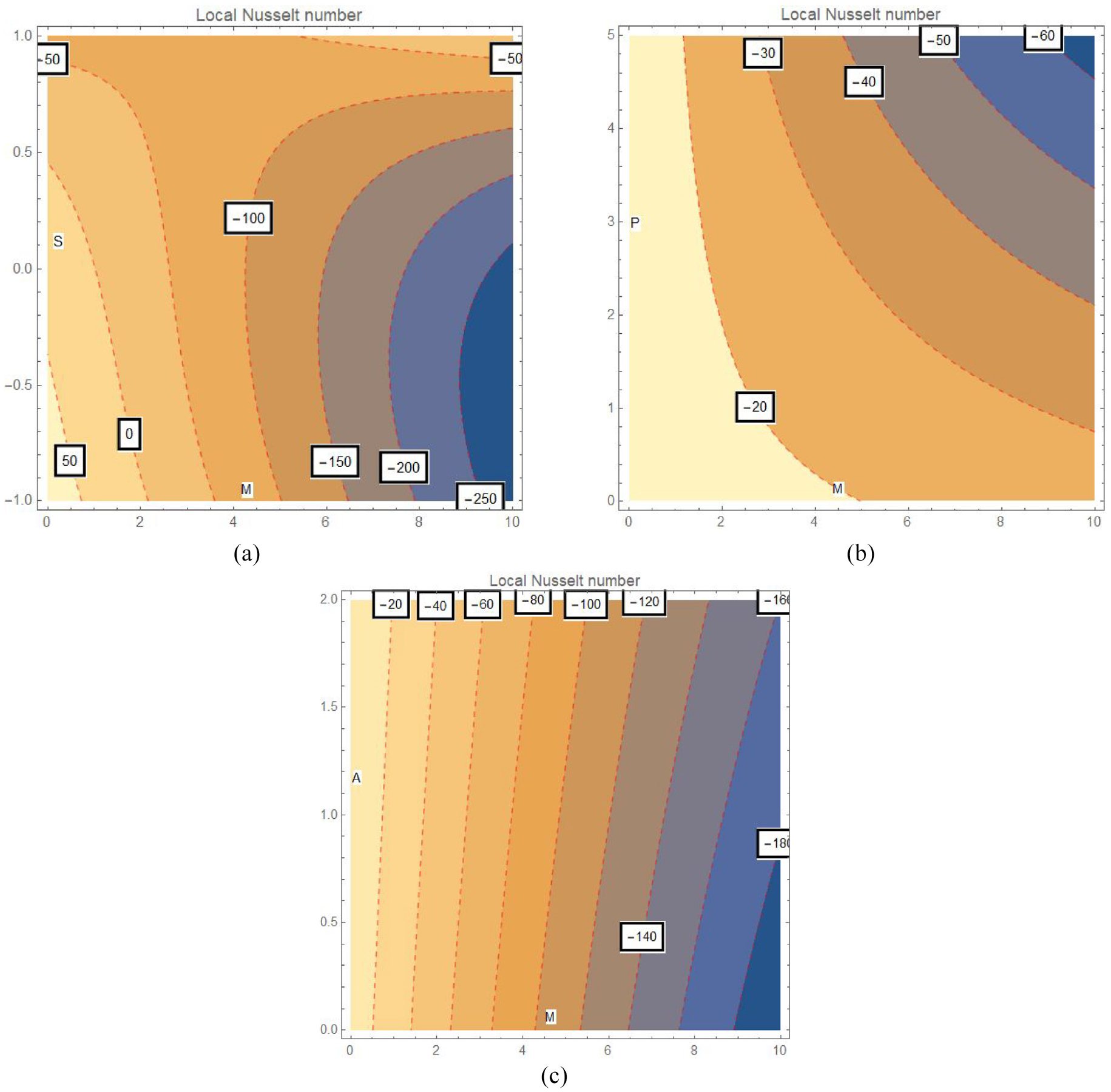
Contour plotting of local Nusselt number against (a) Suction-injection, (b) Prandtl number, and (c) Magnetic parameter.
Conclusions
This work investigates the suction/injection effect in the flow of a micropolar hybrid nanofluid composed of cooper oxide and silver nanoparticles in the host fluid water (CuO-Ag/water) via a vertically positioned plate. The flow of a hybrid nanofluid is predicted using correlations based on the volume fraction of nanoparticles (CuO and Ag). The similarity technique was used to extract ODEs from the physical system of partial differential equations. Using the shooting method in collaboration Rk-4 numerical technique, the nonlinear reckonings of the flow model solved successfully. Key points from the results are as follows:
The flow field and energy distribution is much significant in the case of injective flux rather the suction flux.
Velocity profile decrease with the increasing range of magnetic, micropolar, and suction/injection parameters, where as it elevates due to the increasing values of Eckert number and heat generation absorption quantities.
Micropolar flow field is positive correlated with the suction injection fluxes but resistive against magnetic force.
Eckert number, thermal time relaxation parameter, and thermal radiation have highly favorable influential toward the energy distribution near the surface.
Surface drag force enhance due to the magnetic effect and suction-injection fluxes.
Footnotes
Acknowledgements
The researchers would like to thank the Deanship of Scientific Research, Qassim University for funding the publication of this project.
Handling Editor: Chenhui Liang
Declaration of conflicting interests
The author(s) declared no potential conflicts of interest with respect to the research, authorship, and/or publication of this article.
Funding
The author(s) received no financial support for the research, authorship, and/or publication of this article.
