



Abstract
In order to solve the problems of short circuit, open circuit and insulation faults in aviation cables, a fault diagnosis method based on BP-Adaboost algorithm is proposed in this paper. The BP neural network is used as the weak classifier in the Adaboost algorithm, and many weak classifiers are composed a strong classifier with stronger classification performance to diagnose fault categories. The BP-Adaboost fault diagnosis model is established, and the BP-Adaboost algorithm is improved to adapt to the multi-classification faults of cables, so as to identify the short circuit, open circuit, and insulation faults in the aircraft cable as well as normal working conditions. The accuracy of classification is analyzed; the results of the algorithm are analyzed by Matlab software, and the analysis results show that the improved BP-Adaboost algorithm has a relatively good classification performance for multi-class aviation cable fault diagnosis. Finally, the feasibility of the algorithm proposed is verified through an example combined with cable fault detection equipment.
Introduction
Aviation cables provide the functions of power transmission, information transmission, and energy conversion to ensure the normal operation of the avionics system, fire control system, electrical system, and operating system on the aircraft. It is called “neural network” in the entire aircraft, 1 has a pivotal position. However, with the rapid development of electromechanical equipment in the aviation field, the cable connection between the various equipment on the aircraft has become more and more complicated. At the same time, the fault diagnosis in the aircraft cable has become very difficult. Some minor faults in the cables are not even detectable by maintenance personnel, leading to a large number of aviation accidents. According to statistics, about 20% of aircraft accidents each year are caused bycable failure. 2 For example, in May 2019, a Russian Sukhoi 100 passenger plane caused a fire in the left side engine of the aircraft due to a short circuit in the engine cable, resulting in a tragedy of 41 deaths; at the end of November 2016, a plane carrying football players the Brazilian plane crashed due to a cable problem causing a circuit failure, and 71 people were killed in the accident. 3
Therefore, in order to ensure the flight safety of the aircraft, it is necessary to accurately diagnose the cable faults of the aircraft to avoid accidents. There are many traditional aviation cable detection methods, such as bridge method, 4 audio induction method, 5 traveling wave method, 6 among which traveling wave method includes pulse current method, three pulse method, pulse voltage method, secondary pulse method, low-voltage pulse method, etc. 7 Because these traditional aviation cable detection methods are very cumbersome when detecting faulty cables, and as the complexity of the system increases, their adaptability is getting worse and worse. For example, the bridge method needs to know the specific cable when performing detection. Information, and it can only detect some faults in the cable, which has great limitations. At the same time, these traditional aviation cable detection methods require a lot of manpower and material resources when detecting cable faults, and are no longer suitable for cable fault detection in the current environment.
With the application of intelligent algorithms in fault diagnosis, it also provides a new idea for the fault diagnosis of aviation cables. The monarch butterfly optimization (MBO) algorithm is an algorithm based on the migration behavior of monarch butterflies. It has fast convergence speed, high efficiency and strong local search ability. The moth search algorithm (MSA) is inspired by the lateral positioning and navigation mechanisms of moths in nature, and it can improve population diversity with a high degree of merit-seeking ability. Sparrow search algorithm (SSA) is a swarm intelligence optimization algorithm proposed by simulating the foraging and anti-predation behavior of sparrow groups, SSA determines the optimal individual by updating the positions of discoverers, joiners, and alerters in turn, it has high convergence speed and accuracy, and has a good application effect in fault diagnosis. The grasshopper optimization algorithm (GOA) is a meta-heuristic intelligent optimization algorithm proposed in 2017 that imitates the migration and foraging of locusts in nature, by mapping the small-scale movement behavior of larvae to local development with short steps, and mapping the large-scale movement behavior of adults to global exploration with long steps, the optimization is carried out in a manner similar to “step-tank coordination,” it is effective for solving multi-objective optimization problems. Sine-Cosine Algorithm (SCA) is a new population-based stochastic optimization algorithm, SCA creates a number of initial random candidate solutions, and then uses mathematical models based on sine and cosine functions to make these solutions fluctuate in the direction or the opposite direction of the optimal solution, it has the characteristics of simple structure, few parameters and easy implementation, but it is easy to fall into local optimum. 8 The slime mold algorithm (SMA) simulates the diffusion and foraging behavior of slime mold and uses adaptive weights to simulate the process of positive and negative feedback generated by the “slime mold propagation wave” based on the biological oscillator, which is a stochastic optimization algorithm with good application prospects. The Marine Predators Algorithm (MPA) is a bionic intelligent optimization algorithm based on the predator-walk strategy, Brownian motion of marine predators, and predators’ foraging behavior of prey creatures. This algorithm can effectively improve the recognition accuracy. Harris Hawk Optimization (HHO) algorithm is a new type of swarm intelligence optimization algorithm, which mainly includes the exploration phase and a development phase. The algorithm can improve the solution accuracy and convergence speed, and has high stability. 9 Adaboost algorithm is also a commonly used ensemble algorithm for fault diagnosis. This paper is based on the Adaboost algorithm to diagnose faults occurring in aviation cables. The Adaboost algorithm is essentially an iterative algorithm. Its core idea is to train different classifiers (weak classifiers) for the same training set, and then combine these weak classifiers to form a stronger final classifier (strong classification). Because the Adaboost algorithm has a high detection rate and is not prone to over-adaptation, it has been studied and studied by many scholars.
The outline of this paper is organized as follows: Section 2 briefly reviews some existing work related to the research. The improved BP-Adaboost algorithm is presented in Section 3. Section 4 illustrates the construction method of the cable fault diagnosis model in detail. Section 5 analyze the BP-Adaboost algorithm results. Section 6 presents a case of the proposed approach. Finally, conclusions from the research are drawn in Section 7.
State of the art
In recent years, many scholars at home and abroad have also proposed methods that are different from traditional cable fault detection to adapt to the current complex aircraft cable fault detection. Foreign scholars such as Su et al. 10 proposed a Support Vector Machine (SVM) fault diagnosis method, which can accurately classify fault targets and effectively improve the accuracy of fault classification; Dhumale et al. 11 proposed a fault diagnosis method based on Artificial Neural Network (ANN), which trains the artificial neural network by collecting the characteristic data of the fault, and uses the trained artificial neural network to analyze the existing fault diagnosis is simpler than before, and the diagnosis result is more efficient; Han et al. 12 proposed a fault diagnosis method based on Decision Tree, which can identify the type of fault more accurately, intelligently, intuitively, and efficiently, and greatly shorten the time of fault diagnosis. Domestic scholars such as Wu et al. 13 proposed a cable fault detection algorithm based on Spread Spectrum Time Domain Reflection (SSTDR), which uses a direct sequence spread spectrum signal as a detection signal. Analyze and test in the process, but the process will become very cumbersome when the wiring is complicated for aviation cables; The Time-frequency Domain Reflection (TFDR) method proposed by Liu et al. 7 transmits a Gaussian envelope frequency modulation signal to the faulty cable, and uses cross detection technology to process the reflected signal of the faulty cable to determine the fault Type, but the Gaussian envelope signal affects the communication of the cable and cannot be detected in time; Jiang et al. 14 proposed a DC grid fault detection method based on the Back Propagation (BP) algorithm. The BP neural network is used to train the data to identify the type of fault, but when the amount of data is too large, the training of BP neural network will consume a lot of time. Li et al. 15 proposed an algorithm combining support vector machine and Adaboost to diagnose faults, and used particle swarm algorithm to adjust the dynamic weight of SVM-Adaboost, which improved the accuracy and convergence speed of Adaboost algorithm, but the SVM algorithm is difficult to implement for large-scale training samples, which made the Adaboost algorithm unsuitable for fault diagnosis with a large amount of data. Jiang et al. 16 proposed a multi-fault diagnosis algorithm of the Adaboost algorithm with bias weights, constructing different weak classifiers with adaptive weights for different biased data sets, and then when constructing the weak classifiers, a small number of the loss functions are evaluated. The items of the class were given higher weight to enhance the influence of the minority class samples, thereby improving the accuracy of the final classifier, but increasing the complexity of the algorithm and reducing the efficiency of the algorithm.
In the past 2 years, many scholars have put forward their own views on the application of integrated algorithms in fault identification. Zhang et al. 17 propose an enhanced variant of the Salp swarm algorithm (SSA) with an integrated variation strategy and restart mechanism, referred to as CMSRSSSA. CMSRSSSA enhances the exploration and exploitation capabilities of SSA by adopting CMS, and using RS to overcome the limitations of the single search mechanism of SSA. CMSRSSSA well compensates for the shortcomings of SSA, and has better test results and less time complexity than other algorithms in solving continuous optimization problems. Li et al. 18 propose a novel integrated learning method based on multi-objective particle swarm optimization (MOPSO), which can quickly determine the coefficients of each sub-model so that it avoids falling into a local optimal solution, while in order to avoid the problems of instability and low classification accuracy of a single model, MOPSO is combined with a traditional classifier, and the combined classifier has a higher classification than a single classifier. Wang et al. 19 proposed an ensemble multi strategy-driven shuffled Frog leading algorithm (EMSFLA), which combines the traditional SFLA algorithm with an adversarial learning-based, mutation and crossover strategy extracted from differential evolution to solve models of solar cells Parameter optimization problem, the experimental results show that the method can balance the diversification and intensification of the optimization process well, and has strong stability and reliability. Charoenkwan et al. 20 proposed a new stacked ensemble learning method, which can recognize objects with high accuracy using only sequence information without any structural information.
Aiming at the problems existing in the existing methods of detecting aircraft cable faults, a new method is proposed to replace the previous maintenance methods to improve the efficiency of cable maintenance. 21 This paper mainly adopts the BP-Adaboost algorithm as a diagnostic method for detecting aviation cable faults, and establishes a fault diagnosis model for aviation cables. The BP neural network is used as the weak classifier in the Adaboost algorithm. At the same time, a certain amount of the algorithm is also done. Improved to adapt to the multi-classification problem of cable faults, improve the accuracy of fault classification, and through the analysis of part of the fault data combined with Matlab software, the results obtained are compared with the results of the BP neural network classification alone, and finally BP- The diagnosis effect of Adaboost algorithm is better than that of BP neural network. Finally, the specific results are analyzed with the cable fault diagnosis instrument, which indirectly proves the feasibility of the BP-Adaboost algorithm in diagnosing aviation cable faults.
Improved BP-Adaboost algorithm
BP neural network
The BP neural network (Back Propagation Neural Network) algorithm is a multi-layer feed forward neural network. It is the process of forwarding signals and back propagating errors. The most basic topology is shown in Figure 1, it is composed of the input layer, hidden layer and output layer. Although the BP neural network can realize the mapping function of non-linear problems and has strong independent learning ability, but it has certain limitations. The BP algorithm uses the gradient descent method, when dealing with complex nonlinear problems, the convergence speed is very slow, and it is easy to fall into a local minimum, which makes the training result of the network deviate from the correct result. The algorithm structure does not have a standard, in most cases, people’s experience is used to decide the number of neurons, if the number of neurons is too large, it is prone to over-fitting, and if the number of neurons is too small, it is prone to fail to converge. Therefore, directly using the BP algorithm to classify cable faults still has certain limitations.

The basic topological structure of BP neural network.
Adaboost algorithm
The Adaboost (Adaptive Boosting) algorithm is a mechanical learning method based on the Boosting algorithm by two scholars, Yoav Freund and Robert Schapire, in the mid-20th century. By constructing a strong learner that performs better and generalizes better than a single learner. 22 The Adaboost algorithm can make good use of different algorithms as its weak classifiers, through repeated learning, while constantly changing the probability distribution of the training sample data and the proportion of the weak classifier in the strong classifier, the final output is determined. The key core of the Adaboost algorithm lies in the selection of weak classifiers, choosing a suitable weak classifier can greatly improve the accuracy of Adaboost classification,23,24 and the error rate can be adjusted adaptively according to the feedback results of the weak classifier, improving classification accuracy and high execution efficiency, so this algorithm is widely used by people. 25 Its model structure is shown in Figure 2.

Adaboost model structure.
Improved BP-Adaboost algorithm
Two-class BP-Adaboost algorithm
The Adaboost algorithm combines multiple learning models as a whole to improve the learning ability and generalization ability of the algorithm, 26 the original design is to solve the two-classification problem. The basic two-classification process is as follows:
Input sample set:
Step1: Initial sample weight, that is, the weight

Step 2: There are

Step3: Calculate the classification error rate

Step 4: Calculate the weight coefficient

Step 5: Update the weight


Step 6: Combine these weak classifiers to get the final strong classifier

Finally, a strong classifier to solve the two-classification problem is obtained, and the algorithm flow ends.
Since this article is aimed at the problem of faults in the cable, it is a classification problem of multiple faults at the same time, and the BP-Adaboost algorithm is mainly aimed at the two-class nonlinear problem, so it is necessary to carry out a certain amount of the BP-Adaboost algorithm, improved to adapt to the multi-classification problem of aviation cable fault diagnosis. 27
Improved multi-class BP-Adaboost algorithm
The multi-class BP-Adaboost algorithm proposed in this paper is improved in three aspects based on the two-class BP-Adaboost algorithm. First, when faced with multi-classification problems, the basic learner is designed as a BP neural network with a multi-node output layer to directly solve the multi-classification problem, avoiding the use of two-class BP-Adaboost to solve the multi-classification problem and improving the classification efficiency. The second is to use the binary representation method to represent the classification marks (fault categories), which reduces the complexity of the algorithm, makes the algorithm run more easily, and improves the efficiency of the algorithm. The third is when comparing the results obtained by training with the expected classification results, instead of calculating the error, the classification error rate is calculated. According to formulas (11) and (12),
When performing the multi-classification problem of the BP-Adaboost algorithm, suppose the given multi-class data training set is
Step 1: Initialize the probability distribution of the training data, that is, the weight

Step 2: The BP neural network is trained on multiple data training sets to obtain

The result of converting

Step 3: Calculate the classification error rate of the output

Step 4: Calculate the weight of the generated weak classifier in the final strong classifier

Step 5: Update the weight


Step 6: Finally, the data results are normalized, and the outputs of

Among them, the Round function rounds the numerical result of the final calculation according to the accuracy requirements.
So far, the classification error rate is obtained through the improved multi-classification BP-Adaboost algorithm, the classification result is diagnosed, and the algorithm flow ends. The pseudo-code of the algorithm is shown in Table 1.
The Pseudo-code of BP-Adaboost algorithm.

The flow chart of BP-Adaboost algorithm improvement is shown in Figure 3.

BP-Adaboost algorithm flow chart.
Cable fault diagnosis model construction
Due to many failures such as an open circuit, short circuit, insulation, high resistance failure, corrosion of the protective layer, etc., a series of failure problems will occur in aviation cables. For these faults, this paper selects some cable faults as the classification results of the cable fault diagnosis model.
This paper focuses on diagnosing three types of faults: open circuit, short circuit, and insulation, and establishes a cable fault diagnosis model. First, it is necessary to determine the characteristic quantities that cause open circuit, short circuit, and insulation faults in the cable, and then use these characteristic quantity data as a training set for diagnosing aviation cable faults. According to the experience of inspectors when detecting aviation cable faults, the data of voltage, current, and resistance have a great influence on the occurrence of faults in the cable. At the same time, the inspectors found that the temperature change will also have a great impact on the performance and transmission of the aviation cable, so the temperature is also used as one of the characteristic quantities to detect the aviation cable failure. In summary, the voltage, current, resistance, and temperature are taken as the characteristic quantities of the aviation cable fault diagnosis model. 28
The cable fault diagnosis model is shown in Figure 4, by determining the fault characteristic quantity, the fault training set sample is composed, and the weight of the initial sample is given, and the initial sample data combined with the weight is studied and trained by the BP neural network, when the training result meets the error requirement of the judgment, the corresponding training result will be output. The output training result is regarded as a weak classifier under the current sample, and the weight of the weak classifier at this time in the final strong classifier is calculated, and then the sample weight of the training data set is calculated through the BP neural network, updated the weights of the data training set, and perform the next BP neural network training. After such a repeated training process, a number of weak classifiers with different weights will be obtained, and these weak classifiers with different weights will be combined into a strong classifier. Through the learning and training of the strong classifier, fault classification results of four types of aircraft cables are 1, 2, 3, and 4, which correspond to the fault types of open circuit, short circuit, insulation, and normal. At this point, the process of aviation cable fault diagnosis is over.
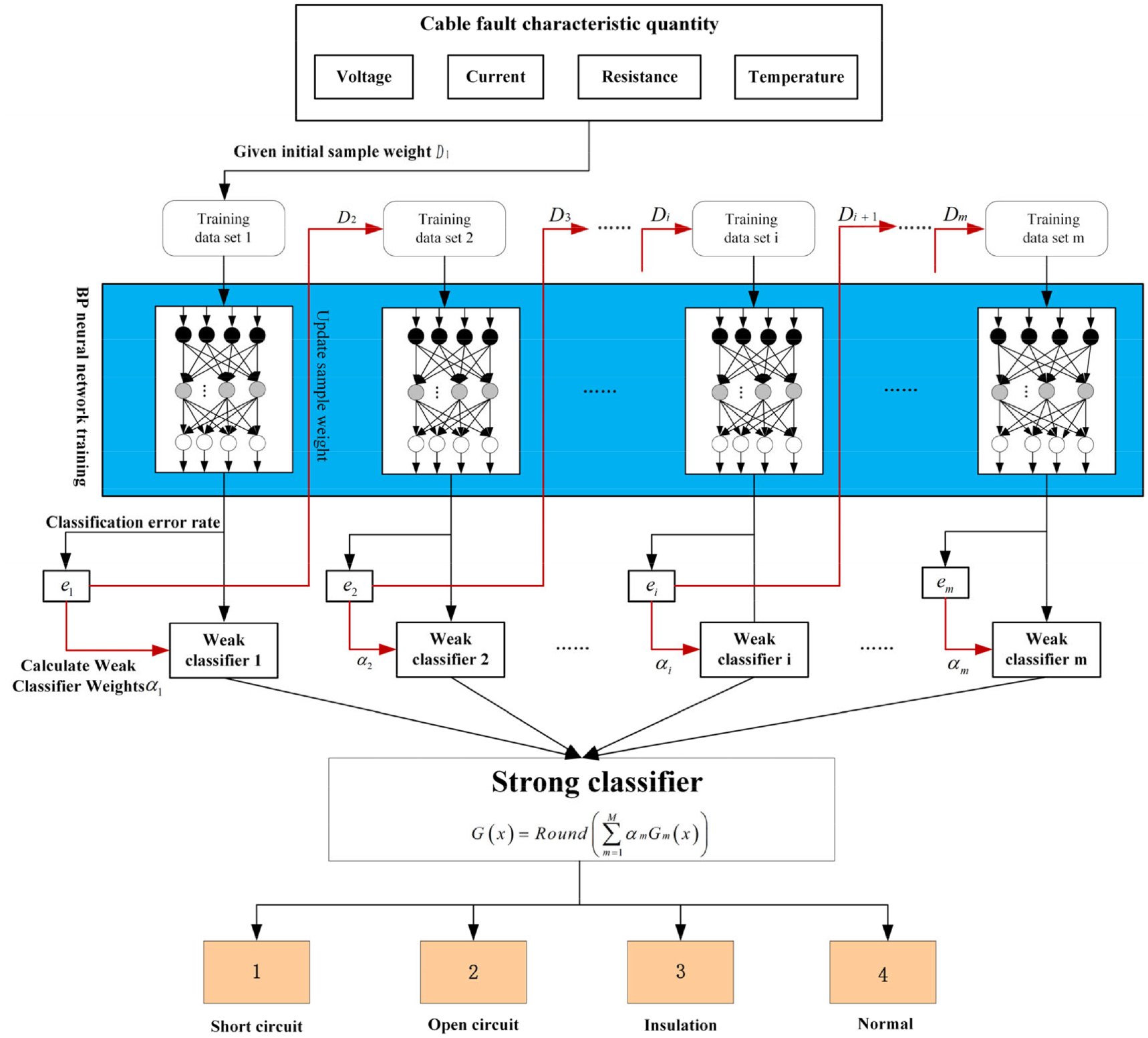
Aircraft cable fault diagnosis model.
Analysis of BP-Adaboost algorithm results
Initial parameter setting
Before the algorithm analysis, the basic parameters of the BP-Adaboost algorithm need to be set. Because the BP-Adaboost algorithm uses the BP neural network as a weak classifier in its algorithm, it is necessary to set the structural parameters of the BP neural network to meet the requirements. Since this paper uses voltage, current, resistance, and temperature as the characteristic quantities for diagnosing aviation cable faults when establishing the aviation cable fault diagnosis model, the input layer of the BP neural network is composed of four types of data: voltage, current, resistance, and temperature. Since the cable fault diagnosis model sets three types of faults: short circuit, open circuit, and insulation, at the same time, the normal cable line is also used as a diagnostic result. Therefore, the output layer of the BP neural network also has four types of data, namely short circuit, open circuit, insulation, and normal. The judgment of the number of neurons in the hidden layer of BP neural network is based on the following empirical formula (16) and the analysis of the results of many attempts and repeated calculations, and finally the number of neurons in the hidden layer is determined to be 8. Determine the number of BP neural networks according to the number of data training sets, that is, the number of weak classifiers is 10. So the model structure of BP neural network is “4—8—4.”

The structure of the BP neural network is “4—8—4,” the maximum number of iterations is 100, the learning rate is 0.1, the learning target is 4e−5, because each set of sample data consists of four feature quantities, which are voltage, current, resistance, and temperature, respectively, the dimension of the sample data is 4. Determination of the number of weak classifiers: Although the larger the number of weak classifiers, the better the classification results of the final combined strong classifiers will be, but when the number of weak classifiers is too large, the test results will be over-fitted and the accuracy will be reduced, so it is necessary to determine the appropriate number of weak classifications. In this paper, the number of weak classifiers is always increased during the training process, and the test error is counted, when the error reaches a certain threshold and no longer decreases, the iteration is terminated, and the number of classifiers at this time is optimal. Finally, the number of weak classifiers M = 10 is determined by testing. The number of iterative rounds of the model is 10, and the initial training sample weight
Result analysis
After the basic parameter setting is completed, the voltage, current, resistance and temperature of the aircraft cable when a fault occurs are recorded, and the data in the cable under normal conditions is recorded at the same time. The data obtained from the experiment is processed and then placed in training sample collection mode for testing and training. This paper randomly obtains 650 sets of experimental data from the acquisition system, of which 500 sets of data are used as training samples and 150 sets of data are used as test samples, and then gradually increase the size of the training set and test set, and study the weak classifier of single BP neural network and the classification accuracy of the multi-class BP-Adaboost strong classifier under different training set sizes. The fault types are divided into four categories (short circuit, open circuit, insulation, and normal), which are marked as 1, 2, 3, and 4 respectively. Run the improved BP-Adaboost algorithm program through the Matlab software, record the running results of Matlab at this time, and get 10 weak classifiers, that is, the number of errors generated by each BP neural network in the classification process, as shown in Figure 5. It can be seen that when the BP neural network is used as a classifier to diagnose faults, the data group that each classifier classifies incorrectly is about 16 groups, and the classification accuracy is not very high.

Number of BP neural network data classification errors.
While calculating the number of classification errors of the weak classifier, the classification error rate corresponding to each weak classifier and the average error rate of the weak classifier at this time is calculated. Then record the error rate of the classification result of the BP-Adaboost strong classifier, and compare the result with the classification result of the BP neural network, the result is shown in Figure 6. It can be seen from the figure that the average error rate of BP neural network classification is 10.33%, and the classification error rate of BP-Adaboost strong classification is 3.89%. At this point, it can be seen that the classification error rate of the BP-Adaboost strong classifier is 6.44% lower than that of the BP weak classifier. Therefore, compared with the BP neural network alone, the BP-Adaboost algorithm improves the accuracy of fault classification, and the classification effect is significantly higher than the classification effect of the BP neural network alone.

Comparison of classification error rate betweenBP-Adaboost algorithm and BP neural network.
The traditional two-class BP-Adaboost algorithm usually adopts the OvO (One vs One) disassembly method to solve the multi-class problem when facing the multi-class problem, that is to compare each analogy in the training sample pairwise, so that the multi-class problem is transformed into multiple two-class problems to solve. This article is to classify the four states of the cable: open circuit, short circuit, insulation, and normal. According to the classification principle of the OvO type BP-Adaboost algorithm, the four classification problems of the cable are transformed into six groups of two classification problems. These six groups are “open circuit, short circuit,”“open circuit, insulation,”“open circuit, normal,”“short circuit, insulation,”“short circuit, normal,”“insulation, normal.” However, the improved multi-class BP-Adaboos algorithm in this paper can directly deal with various fault problems. The following uses 150 sets of test data to compare the test results between the algorithm proposed in this paper and the traditional OvO-type BP-Adaboost algorithm. The test results are shown in Figure 7.

Comparison of results between BP-Adaboost algorithm and OvO algorithm.
As can be seen from Figure 7, both algorithms can diagnose and identify the fault types that occur in the cable, and the maximum classification error rate is controlled within 8%. When the test data are 30 groups, the OvO-type BP-Adaboost algorithm, the test effect of the OvO-type BP-Adaboost algorithm is slightly better than that of the improved BP-Adaboost algorithm in this paper. When the number of test data increases, the classification effect of the multi-class BP-Adaboost algorithm is better than that of the OvO-type BP-Adaboost algorithm. Moreover, the total classification error rate of the multi-class BP-Adaboost algorithm is also lower than that of the OvO-type BP-Adaboost algorithm. Because this paper is aimed at the problem of aircraft cable faults, the amount of data when diagnosing it is relatively large. Therefore, in this detection environment with large amounts of data, the detection effect of the multi-class BP-Adaboost algorithm proposed in this paper is better.
From the analysis of the time complexity of the algorithm: in the case of the same test data set, the traditional OvO-type BP-Adaboost algorithm is to select two analogs for one-to-one comparison each time, when there are
Compared with the same type of BP-Adaboost algorithm, it is found that the algorithm proposed in this paper improves the efficiency and accuracy of aviation cable fault diagnosis. The algorithm proposed in this paper needs to be compared with other types of algorithms to verify the superiority of the algorithm proposed in this paper. Because SVM is the most classic classification algorithm, it is very representative, and the algorithm proposed in literature 10 is used to solve the circuit fault problem of complex electromechanical products, which is similar to the research problem of this paper, so the two are used as a comparison. In the following, the multi-classification BP-Adaboost algorithm proposed in this paper is compared with the fault diagnosis method of GWO-SVM proposed in literature 8. Taking 350 sets of cable fault data as an example, the data type is a 360 × 4 matrix, where 200 sets of data are the training set and 160 sets of data are the test set, each case corresponds to 40 sets of sample data, where 1–40 sets are the breakage case, 41–80 are the short-circuit case, 81–120 are the insulation case, and 121–160 are the normal case. The detection results of GWO-SVM are shown in Figure 8. The corresponding classification error rates are 12.5%, 5%, 10%, and 7.5%, respectively, and the average classification error rate is 11.125%.

GWO-SVM test results.
Similarly, when the number of samples is a matrix of 160 × 4, the classification errors of the four faults of the BP-Adaboost algorithm are counted. The results are shown in Figure 9. Under the same conditions, the classification errors of each fault of the BP-Adaboost algorithm are respectively are 7.5%, 2.5%, 5.0%, and 0, and the average classification error rate is 3.75%.

BP-Adaboost test results.
The test results of the BP-Adaboost algorithm and the GWO-SVM algorithm are compared, and the results are shown in Table 2. It can be seen from the table that the classification error rates of the four faults of BP-Adaboost are lower than those of GWO-SVM. And the average error rate of BP-Adaboost is 3.75%, which is 7.375% different from that of GWO-SVM.
Comparison of BP-Adaboost and GWO-SVM test results.

By comparing the test results of the improved BP-Adaboost algorithm in this paper with BP neural network, BP-Adaboost algorithm of the same type of OvO type, and other types of fault diagnosis algorithm GWO-SVM, the results show that the improved BP-Adaboost algorithm in this paper has good classification effect in diagnosing the types of faults occurring in aviation cables.
Case analysis
Through the above analysis and introduction, it can be known that the BP-Adaboost algorithm has a good classification effect in aviation cable fault diagnosis, the following is combined with specific experiments to further verify the superiority of the method.
In order to verify the feasibility of the BP-Adaboost algorithm proposed in this paper in practical applications, the cable fault detection instrument developed based on the BP-Adaboost algorithm is used to diagnose the faults in the cable. The specific experimental content is arranged as follows:
Prepared a 50-meter-long communication cable with built-in five cores (blue, green, red, black, and yellow), and set up a cable failure experiment, the analog cable will have three faults of “short circuit, open circuit, and insulation” in the experiment.
Used the cable detection instrument to detect a single fault in the cable to prove that the algorithm can detect the fault in the cable.
Then, the cable detection instrument is used to detect the multi-type mixed faults in the cable, so as to prove that the developed cable detection instrument can accurately identify the multi-type faults in the cable.
The experimental results show the feasibility of the BP-Adaboost algorithm for cable fault diagnosis.
The following is a single fault experiment on the cable using the experimental equipment.
Open circuit test
Divide the existing cables into two groups: The first group is the blue, green, and red cables that have no open circuit failure; The second group is black and yellow cables, the cables that have broken circuit faults after being destroyed by human beings, as shown in Figure 10, using the two-wire multi-channel part of the fault detection instrument to detect the open circuit fault in the cable.

Cable experiment group setting.
At this time, the cable data measured by the cable tester is normal as shown in Table 3, the first three groups of channel ports are “CH0, CH1,”“CH2, CH3,”“CH4, CH5,” the measured data is normal, which means that no faults occurred in the cable and the actual settings are consistent; “CH6, CH7,”“CH8, CH9” serial port display data is “Test errors,” this data type indicates that the cable at this time is not connected somewhere, and an open circuit fault has occurred, which is the same as the fault problem of the previous design.
Open circuit test data.

Short circuit insulation test
Insulation is an important indicator to measure the performance of a cable, whether the cable is insulated will directly affect whether a short-circuit fault occurs in the cable. Therefore, the insulation and short-circuit are regarded as the same group for experiments.
The first three sets of cables (blue, green, and red) are set to an insulated state, and the last two sets of cables (black, yellow) are set to a non-insulated state for comparison. After the preparatory work before the experiment is finished, carry on the insulation short circuit experiment of the cable, the data obtained is shown in Table 4.
Insulation short circuit test data.

The result of the first three sets of experiments is −2.00, which means that the value measured by the instrument at this time is an infinite value or a resistance value that is much larger than that set by the instrument itself, indicates that there is no connection between the channels, to show that the group of cables themselves are insulated; the fourth and fifth groups of measured data are 0 and 362.28 MΩ respectively, it indicates that the cables of the fifth group are lower than the set insulation value and have an insulation failure, which leads to a short-circuit failure of the cables of the fourth group, the measured results are consistent with the previously set failure results.
The following is an experiment in which multiple faults are mixed together on the cable.
There are four states in the cable: one set of open circuit fault, one set of short circuit fault, one set of insulation fault, and two sets of normal cables, and the corresponding channel ports are “CH0, CH1,”“CH2, CH3,”“CH4,” CH5,”“CH6, CH7,”“CH8, CH9.” The test results of the cable fault detection instrument are shown in Table 5.
Multi-fault test results.

Y indicates that there is a fault in the cable, and N indicates that there is no fault in the cable. (No fault default is the normal state.) The detection result is consistent with the fault type set before, indicating that the cable fault detection instrument can accurately detect whether it is facing a single fault or a multi-type mixed fault. It can detect the types of faults in the cables, which also shows the feasibility of the multi-class BP-Adaboost algorithm proposed in this paper in the actual diagnosis of cable faults.
Conclusion
This article addresses a series of problems that are not conducive to diagnosis, such as complex fault diagnosis of aviation cable and long cycle:
A BP-Adaboost algorithm, which is different from the previous aviation cable fault detection method, is proposed, the fault data is classified twice. For the first time, the BP neural network is used as the weak classifier of the algorithm to diagnose the fault data for the first time, the result of the diagnosis is diagnosed again using the Adaboost algorithm, and finally the result of the algorithm classification is obtained, which improves the correct rate of cable fault diagnosis.
The algorithm used has been improved from a two-category problem to a multi-category problem to solve, the output of the marked number is changed to binary expression to facilitate the output of the algorithm, the error rate generated during the iteration process is no longer calculated, but the classification error rate during the iteration process is calculated to improve the accuracy of the algorithm in identifying faults.
Run the improved algorithm in Matlab software, and compare the result with the classification result of the BP neural network, the results show that the classification accuracy rate of the BP-Adaboost algorithm is higher than that of the BP neural network classification, compared with the traditional OvO algorithm, the improved BP-Adaboost algorithm has less detection time and higher efficiency. Compared with other types of fault diagnosis algorithms, the classification error rate of the multi-class BP-Adaboost algorithm proposed in this paper is also lower.
This shows that the improved BP-Adaboost algorithm has obvious accuracy and superiority in the fault diagnosis of aviation cables. After completing the fault diagnosis of aviation cables, the next phase of the research work will study the fault location of aviation cables. How to accurately locate the faults occurring in the cable is the focus of our future research.
Footnotes
Handling Editor: Chenhui Liang
Declaration of conflicting interests
The author(s) declared no potential conflicts of interest with respect to the research, authorship, and/or publication of this article.
Funding
The author(s) disclosed receipt of the following financial support for the research, authorship, and/or publication of this article: This work is supported by the grant from the Natural Science Foundation of Jiangxi Province (Key) Project (CA202108382) and supported by the National Key Laboratory (Engineering Center, Base) Open Fund (GT202108060).
