




Abstract
This study considers two-dimensional elliptic granular crystals respectively with different aspect ratios. Using a micromechanics-based micromorphic model, macroscopic micromorphic constitutive modulus tensors of elliptic granular crystals are obtained. Two modes of Taylor expansion of relative displacements are used to establish contact relation between particles. This study obtains micromorphic transverse-rotational and longitudinal waves. Obvious dispersions of micromorphic waves are given in 2D elliptic granular crystals. With increase of aspect ratio, width of frequency band gap increases when wave propagates along
Keywords
Introduction
Granular crystals are ordered closely packed or disordered packed systems of elastically interacting solid particles1,2 which are arranged in one-, two-, or three-dimensional lattices. 3 Nowadays, many studies focus on the metamaterial design through dynamic response characteristics of granular crystals,4–8 which can control wave propagation behaviors to obtain some mechanical properties such as energy absorption, heat absorption, noise reduction. It is necessary to deeply understand mechanisms of wave’ propagation and control in granular crystals. Considering the discrete nature of granular crystals and the complexity of contact behaviors between particles, the dispersion is an important wave propagation behavior of granular crystals, 9 which is verified by experiments.10,11 Due to dispersion characteristics, the wave velocity depends on the frequency (or the wave length) when waves propagating in granular crystals. And the dispersion has a close relevance to the microstructure in granular crystals.12–14 How to correctly describe the relationship between the dispersion and the microstructure is an important and difficult issue for granular crystals.
Discrete particle models15–18 or continuous medium models19–22 are both applied to simulate wave propagations and dispersions in granular crystals. Discrete particle models are closer to discrete natures of granular crystals, therefore, wave propagations can be directly described from the microscopic view using the energy transfer among particles. In this way, it is convenient to consider microstructural information and contact constitutive relationships on dispersions at the micro scale. However, there are seldom studies based on discrete particle models reporting the prediction of frequency band gaps resulting from dispersions. It is noted that frequency band gaps have great significance in designing metamaterials based on granular crystals. Besides, the wave is actually a conception under the continuum framework, which gives the difficulties in how to quantitatively describe wave propagations and how to assess effects of discrete information after homogenization on dispersions by discrete particle models. As for continuous medium models, the conception of wave is naturally fulfilled because it is built on continuum mechanics framework, which provides more accurate quantitative analysis of wave propagation in granular crystals. And numerical methods based on continuous medium models usually have higher computational efficiency than those based on discrete particle models for the computational scale of engineering problems. However, continuous medium models usually lack the microscopic information such as length scales associated with microstructures, which leads to the difficulty in describing relationships between microstructures and dispersion behaviors of granular crystals correctly.
Based on the above analysis, a continuous medium model containing enough microscopic information is an appropriate choice to simulate wave propagations in granular crystals. On the basis of this background, micromechanics-based continuous medium models20–23 have been proposed by Chang and Ma 23 first to investigate microstructural effects and interactions on macroscopic mechanical behaviors. Therefore, micromechanics-based continuous medium models are appropriate to present macroscopic measures reflecting discrete nature and develop macroscopic constitutive relationships containing microscopic information for granular crystals. Early, the continuous medium in the micromechanics-based continuous medium models is usually the classical or Cosserat medium.24–27 For example, Bacigalupo and Gambarotta 27 proposed an enhanced micropolar homogenization procedure for periodic granular materials to simulate dispersion behaviors. However, classical and Cosserat media lack enough macroscopic measures with respect to microscopic information in the homogenization process. Recently, the micromorphic continuum theory 28 is introduced to develop micromechanics-based continuous medium models. For example, Biswas and Poh 29 proposed a micromorphic computational homogenization framework for heterogeneous materials. Silva et al. 30 presented a multiscale micromorphic model to simulate localization problems of quasi-brittle media. Comparing with classical and Cosserat continuum theories, the micromorphic continuum theory has the capacity of providing complete deformation modes of microstructures and more macroscopic measures relating to microscopic information.31,32 Subsequently, some micromechanics-based micromorphic models20–22,31 are developed and applied to describe wave propagations and dispersions in granular materials. Misra and Poorsolhjouy 33 first proposed a micromorphic model based on a micromechanical approach and applied the model to analyze dispersions in elastic granular media20,33 and 1D granular crystal.21,34 Following this method, Xiu and Chu22,35 proposed a first-order micromechanics-based micromorphic model to predict dispersions and frequency band gaps of granular materials. 22 Furthermore, Xiu et al. 31 derived macroscopic micromorphic constitutive modulus tensors for granular crystals with different specific 3D microstructures, instead of granular materials based on a hypothesis of isotropic contact density distribution in above models.22,35 In this way, more microscopic information is considered by specific particle arrangements and sizes, void ratios, and coordination numbers. And dispersions predicted by the micromechanics-based micromorphic model are obtained for different granular crystals. 31 But above studies still used the conventional circular or spherical particles which differ from real particle shapes to some extent. Actually, different particle shapes need to be investigated to match the real physical situation. Usually, effects of particle shapes on wave propagations or dispersions in granular crystals are studied by discrete particle models.36–39 To our knowledge, there seem no studies associated with particle shapes through the micromechanics-based continuous medium model to investigate wave propagations and dispersion behaviors in granular crystals. And recently, Zhou et al. 40 proposed a micromechanics-based micropolar model considering the elliptic particle assembly to investigate some static problems of granular materials. But there still lack studies based on micromechanics-based micromorphic models considering particle shapes to investigate the static and dynamic problems of granular crystals or materials.
In this study, one important object is to introduce the consideration of particle shapes into the micromechanics-based micromorphic model. For simplifying derivations, the two-dimensional elliptic particle is considered. Then, macroscopic micromorphic constitutive moduli and micromorphic dispersion equations are derived for 2D elliptic granular crystals. Furthermore, dispersions and frequency band gaps of micromorphic waves are analyzed in 2D elliptic granular crystals with different aspect ratios of major and minor axes and with different directions of wave propagations. And this study discusses effects of two modes of Taylor expansion of relative displacements between two elliptic particles on dispersions. Wave velocities of micromorphic waves are also investigated in elliptic granular crystals for situations with different aspect ratios and different directions of wave propagations.
The micromechanics-based micromorphic model
Firstly, a globe coordinate system x and a local coordinate system


A material point P and its microstructural volume element V.
where
(1) Mode A (Taylor expansion at the particle center)

where

Therefore,
(2) Mode B (Taylor expansion at the contact point)
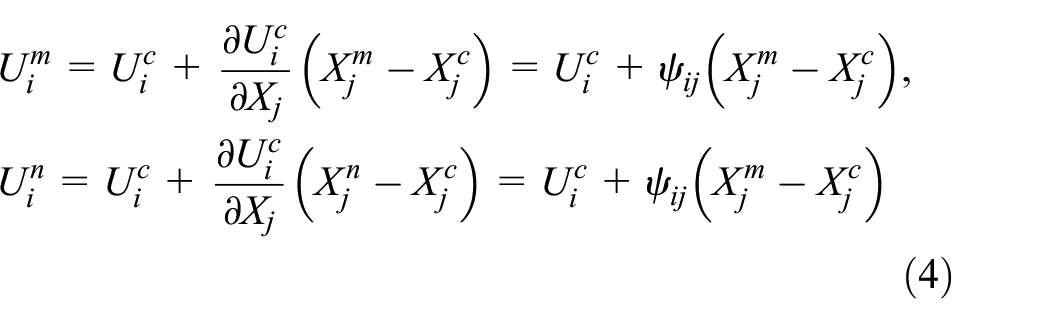

where the superscript

Then, in the micromorphic theory, the most important hypothesis, the decomposition of motion, needs to be introduced. In our previous studies,22,31 the microscopic actual motion (displacement and rotation) of a particle is a sum of an average of the microscopic actual motions of particles and a fluctuation related to the average motion. The average displacement

The macroscopic displacement is equal to the average displacement, while the macroscopic rotation is a sum of the rigid body rotation and the average rotation,
22
that is,

Substituting equations (2)–(5) into equation (1),
(1) Mode A (Taylor expansion at the particle center)
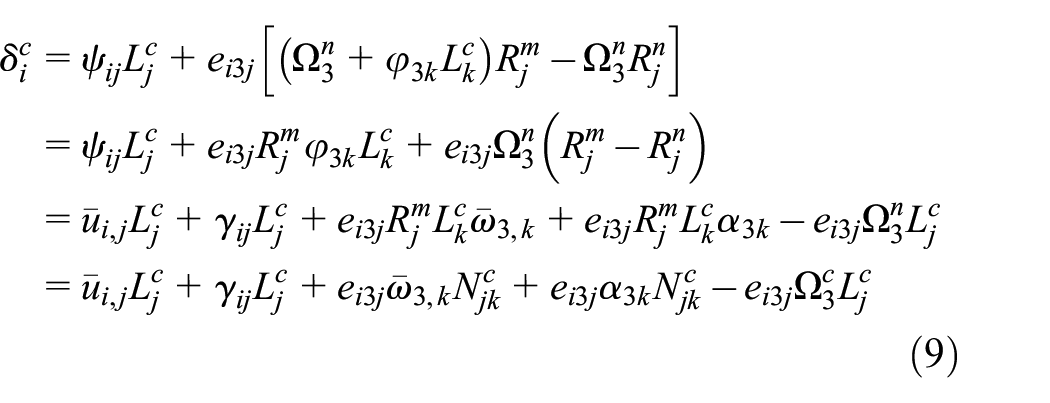

where
(2) Mode B (Taylor expansion at the contact point)


where
Then, the relative displacement and rotation can be decomposed into the following equations:

There is an important method in the micromechanics-based micromorphic model to establish the relations between strain and stress measures through a hypothesis that the macroscopic deformation energy density

The detailed discuss can be seen in our previous study. 22 And 2D contact constitutive equations are used by


where


in which

where
Then, we can derive the macroscopic stress measures in 2D granular crystals. And brief derivation processes are given as


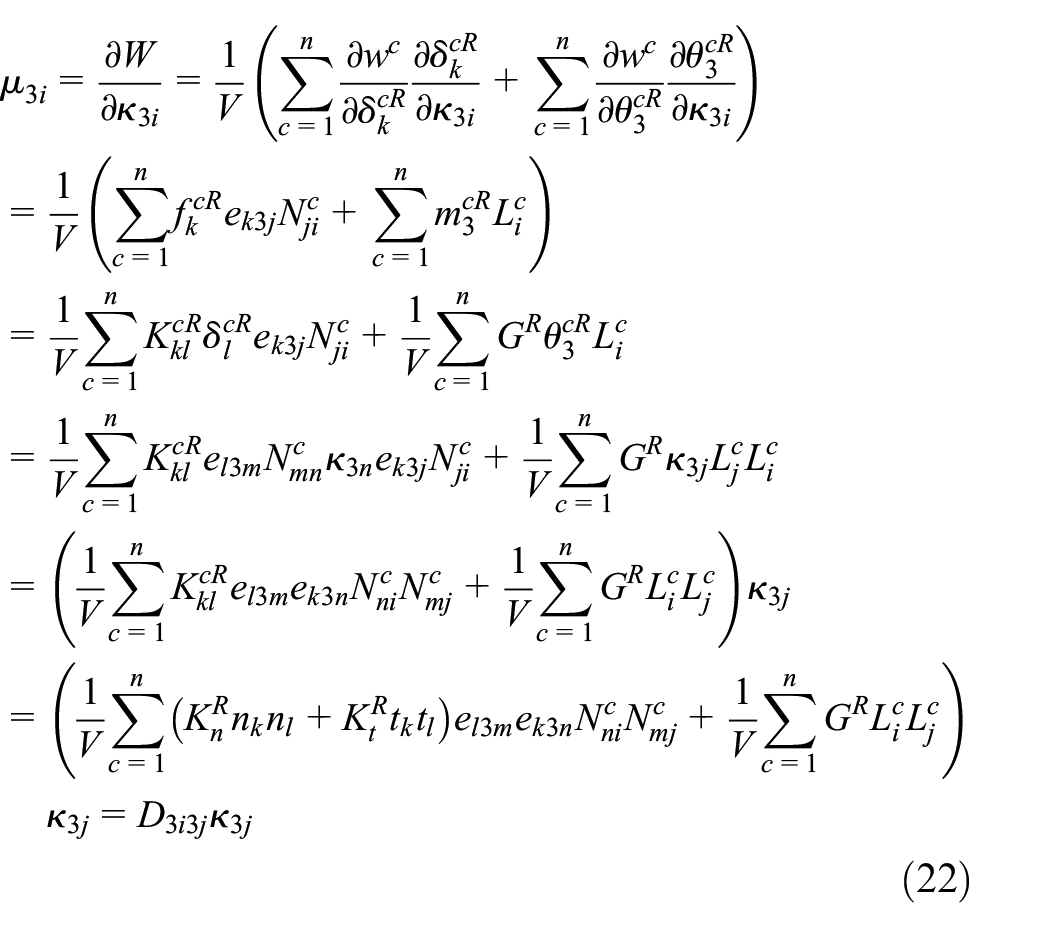
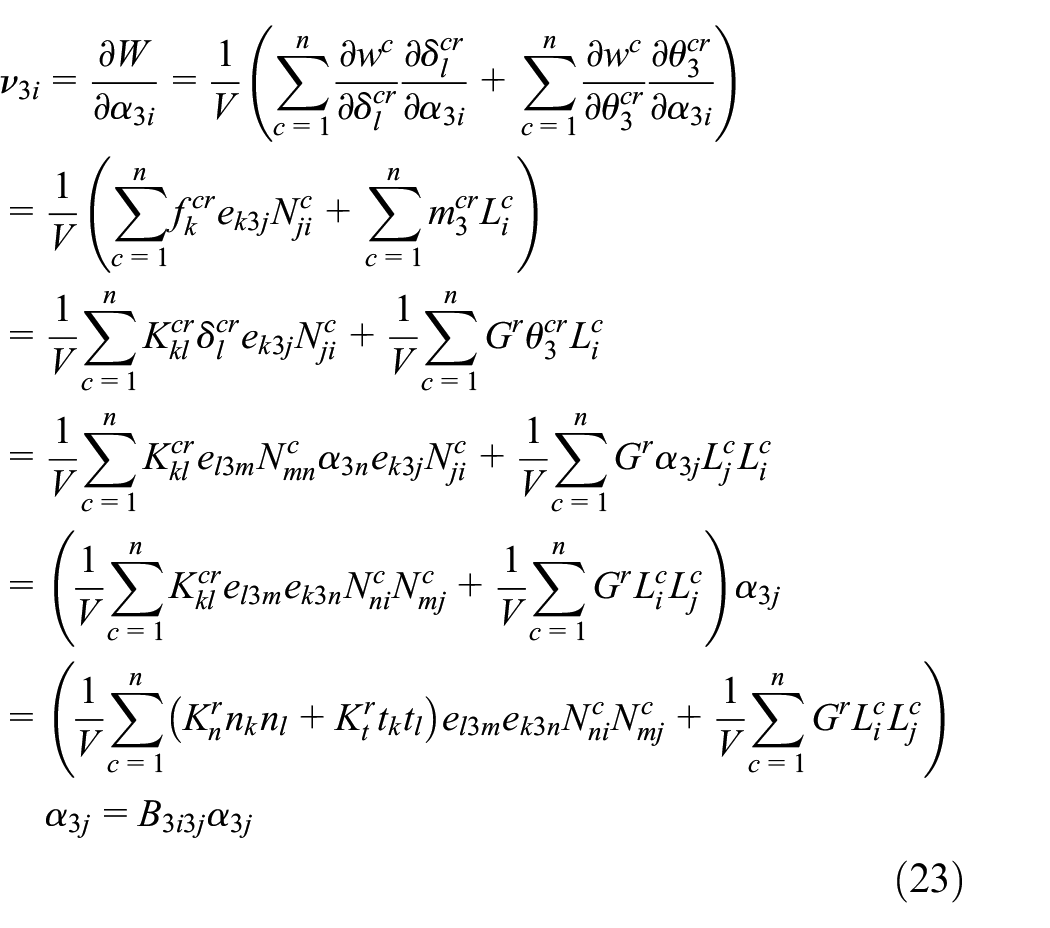
where 2D micromorphic constitutive modulus tensors are expressed by discrete summation forms:

It is noted that these micromorphic constitutive modulus tensors of ellipsoidal granular crystals can be actually obtained for the 3D problem as

And the derivation process is similar with that in our previous study. 31 However, these equations in equation (25) are too hard to be solved. Therefore, we investigate the 2D problem for elliptic granular crystals in this study instead. Besides, our previous study 31 has given the micromorphic constitutive modulus tensors for 3D spherical granular crystals, and equation (25) can degenerate into that in our previous study 31 if 3D ellipsoidal particle degenerates into a sphere particle.
Considering the configuration of 2D elliptic granular crystals as seen in Figure 1, the specific constitutive modulus tensors can be obtained for equation (24). Note that the fabric tensor


Wave equations and dispersion equations in granular crystals
Firstly, a plane wave propagates along

Then, substituting equation (30) and constitutive equations (20)–(23) into balance equations, 22 we can derive wave equations for 2D elliptic granular crystals as followings show
(1) Along


(2) Along
Wave equations for situations along
Solutions of wave equations are obtained in harmonic wave forms as followings show

where
Substituting equation (33) into equations (31)–(32), equations about relations between
(1) Along

where

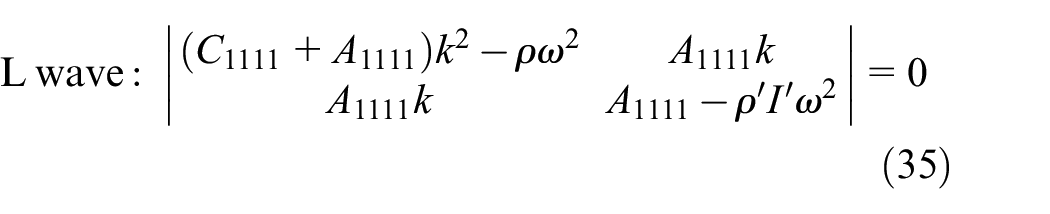
(2) Along
Similarly, the dispersion equations for situations along
According to dispersion equations, we can obtain cutoff frequencies
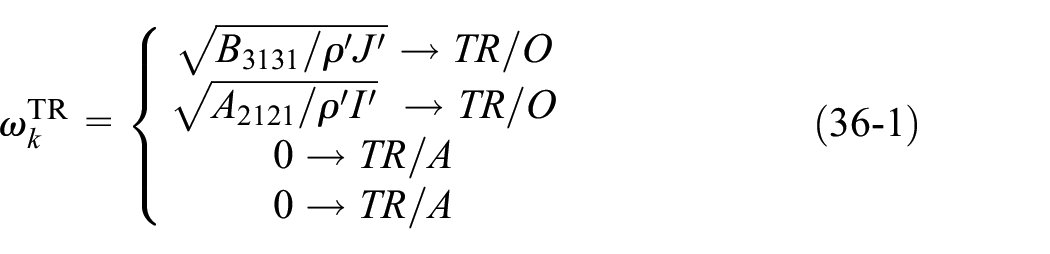

where O and A indicates the optical and acoustic branches. Then, referring to dispersion equations (34) and (35) and degrees of freedom (DOFs) in wave equations (31) and (32), we can obtain DOF
Dispersion behaviors in 2D elliptic granular crystals
According to dispersion equations, dispersion curves can be obtained. It is noted that microscopic parameters have effects on dispersion equations, and they are referred from Xiu et al. 31 and given in Table 1.
Values of microscopic parameters.

Dispersions in different aspect ratio a/b
In above discussions, we considered two modes to describe the relative displacement by Taylor expansions. In this part, Mode A, that is, using Taylor expansion at the center of particle, is investigated, and the comparisons of dispersion behaviors between using Mode A and Mode B are considered in the next part.
Firstly, Figure 2 gives dispersion curves and frequency band gaps of elliptic granular crystals for different
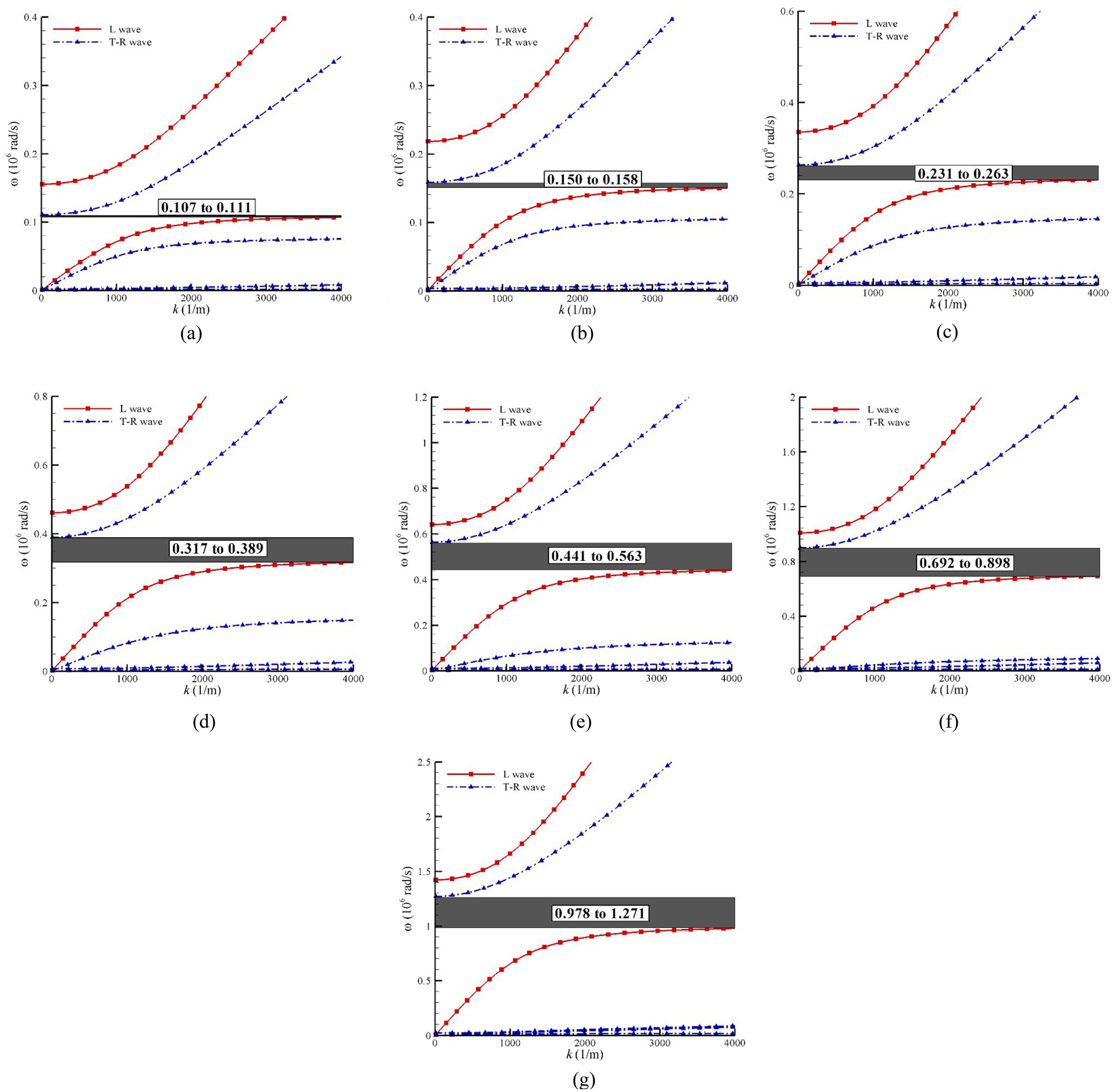
Dispersion curves and frequency band gaps of elliptic granular crystals for different
Widths and average frequencies of frequency band gaps of elliptic granular crystals for different


Dispersion curves and frequency band gaps of L waves for different

Dispersion curves and frequency band gaps of high-frequency branches of T-R waves for different
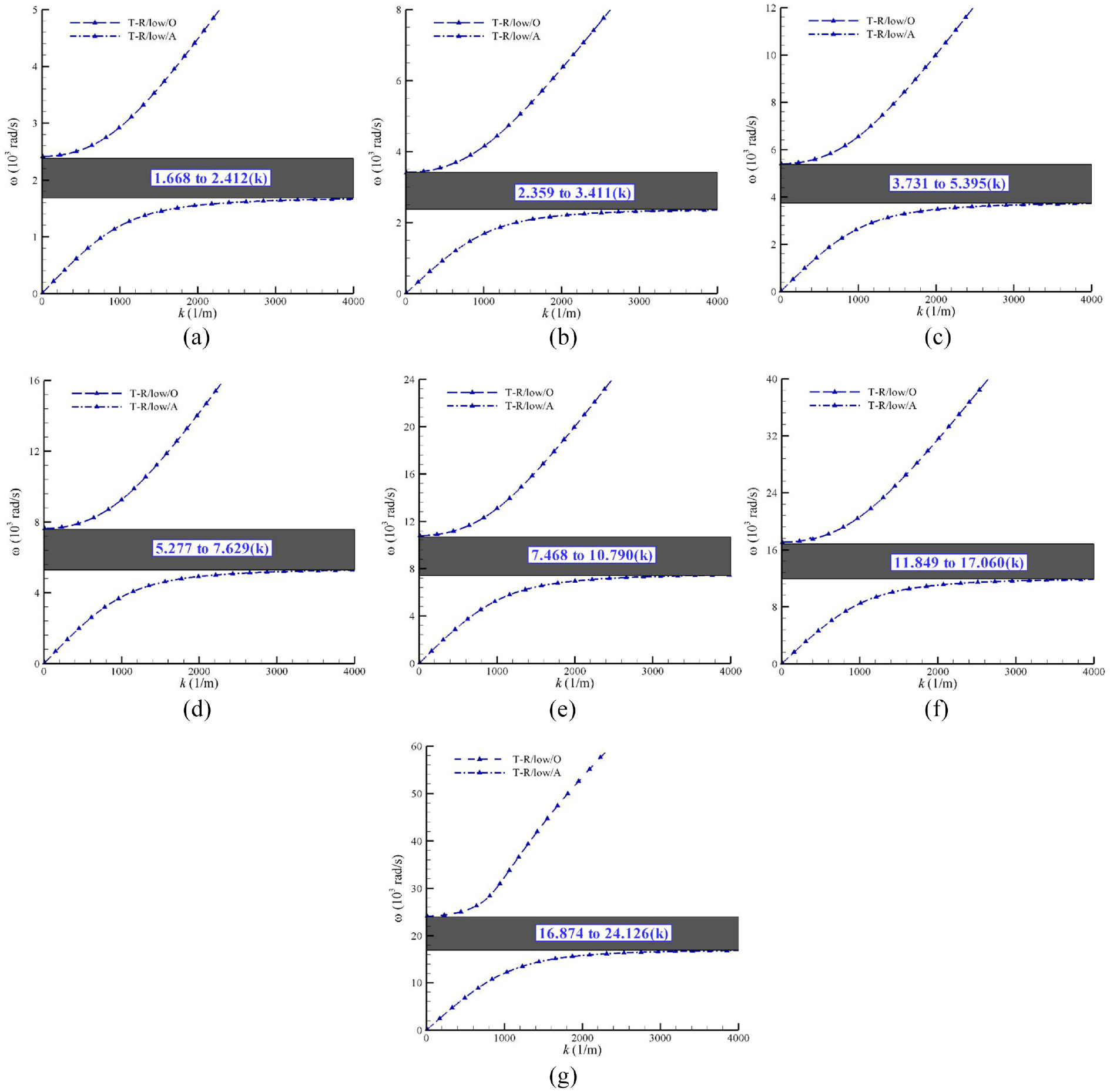
Dispersion curves and frequency band gaps of low-frequency branches of T-R waves for different
Here, we record the width of frequency band gap and the average frequency in band gap for the situation


Curves of aspect ratio

Curves of aspect ratio
And maximal errors of equations (37) and (38) are about 4%. Accordingly, we can also obtain the
Furthermore,

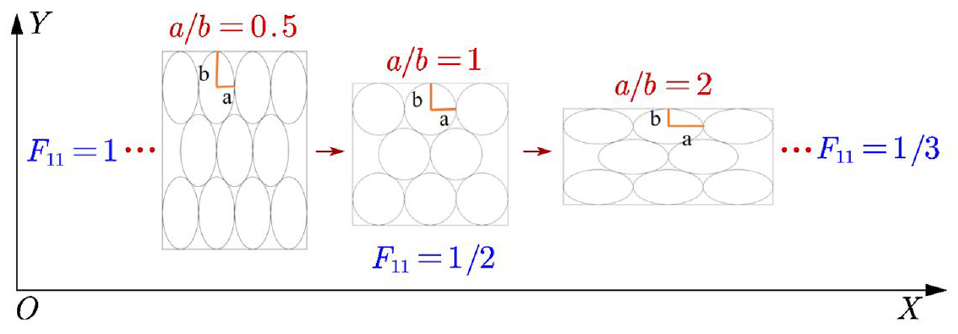
Evolution of fabric of elliptic granular crystals.
Considering the wave propagation along



And more in-depth and detailed relationship between dispersion behaviors of elliptic granular crystals and their fabric information will be discussed in next studies.
Dispersions by Mode A and Mode B
As mentioned above, there are two modes to describe the relative displacement by Taylor expansions at the particle center (Mode A) or the contact point (Mode B). In this part, we investigate dispersion behaviors of elliptic granular crystals by these two modes.
We can also obtain dispersion curves and frequency band gaps of elliptic granular crystals for different
Widths of frequency band gaps of elliptic granular crystals for different

Dispersions in x2 versus x1 directions
In above parts, we investigate the wave propagation along
Figure 9 shows dispersion curves and frequency band gaps for different


Dispersion curves and frequency band gaps for different
Widths and average frequencies of frequency band gaps of elliptic granular crystals for different


Curves of aspect ratio
Different from equation (37),
Wave velocity in 2D elliptic granular crystals
Because of dispersions in elliptic granular crystals, the wave velocity changes accordingly with the frequency when wave propagating in granular crystals. It has great significance of investigating the wave velocity in elliptic granular crystals. And the wave velocity can be obtained by taking a derivative of the circular frequency
Wave velocity in different aspect ratio a/b
Firstly, Figures 11 to 13 respectively give the wave velocities of L, high-frequency and low-frequency T-R waves versus the frequency for different
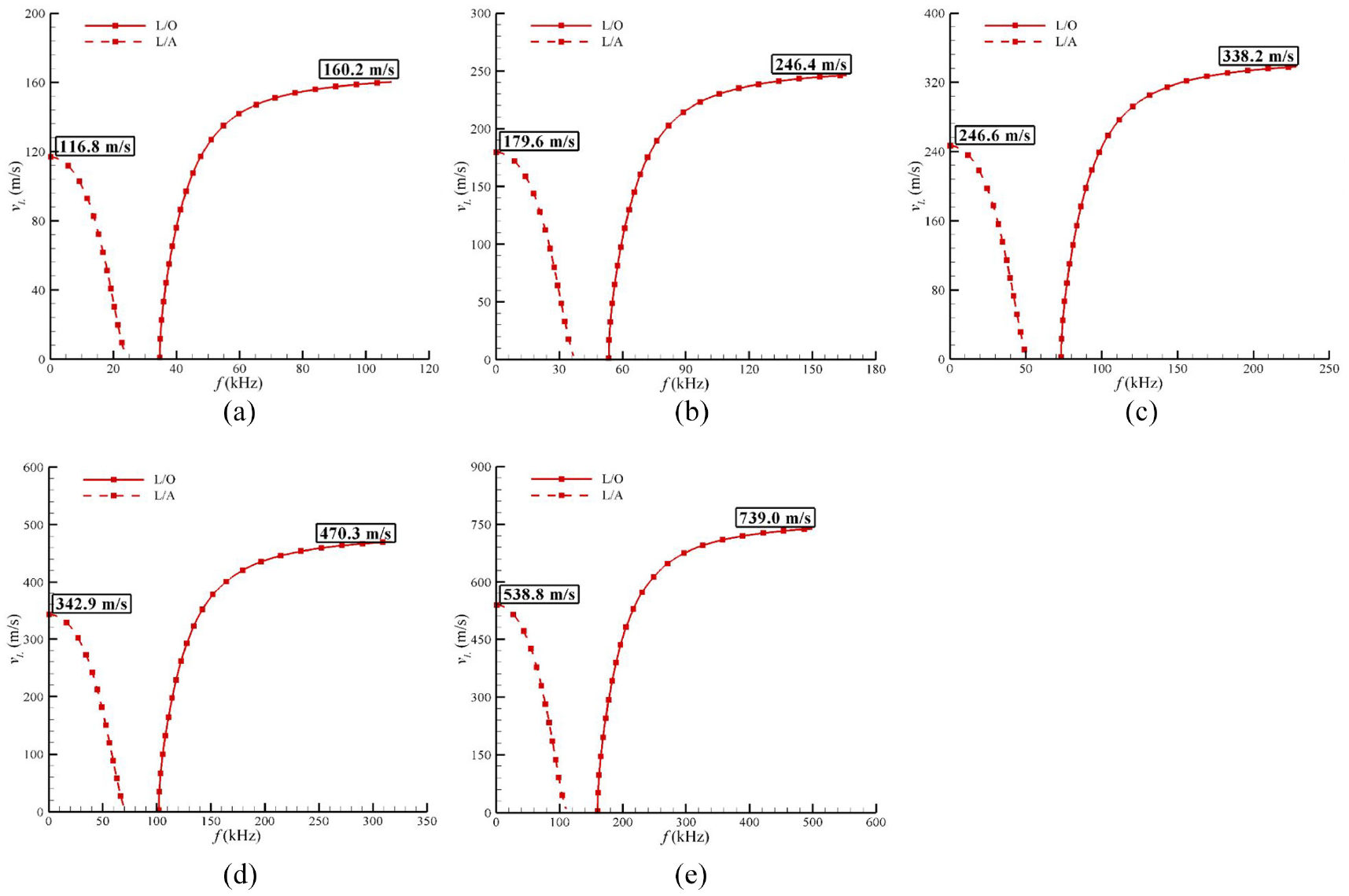
Curves of frequency versus wave velocity of L wave for different
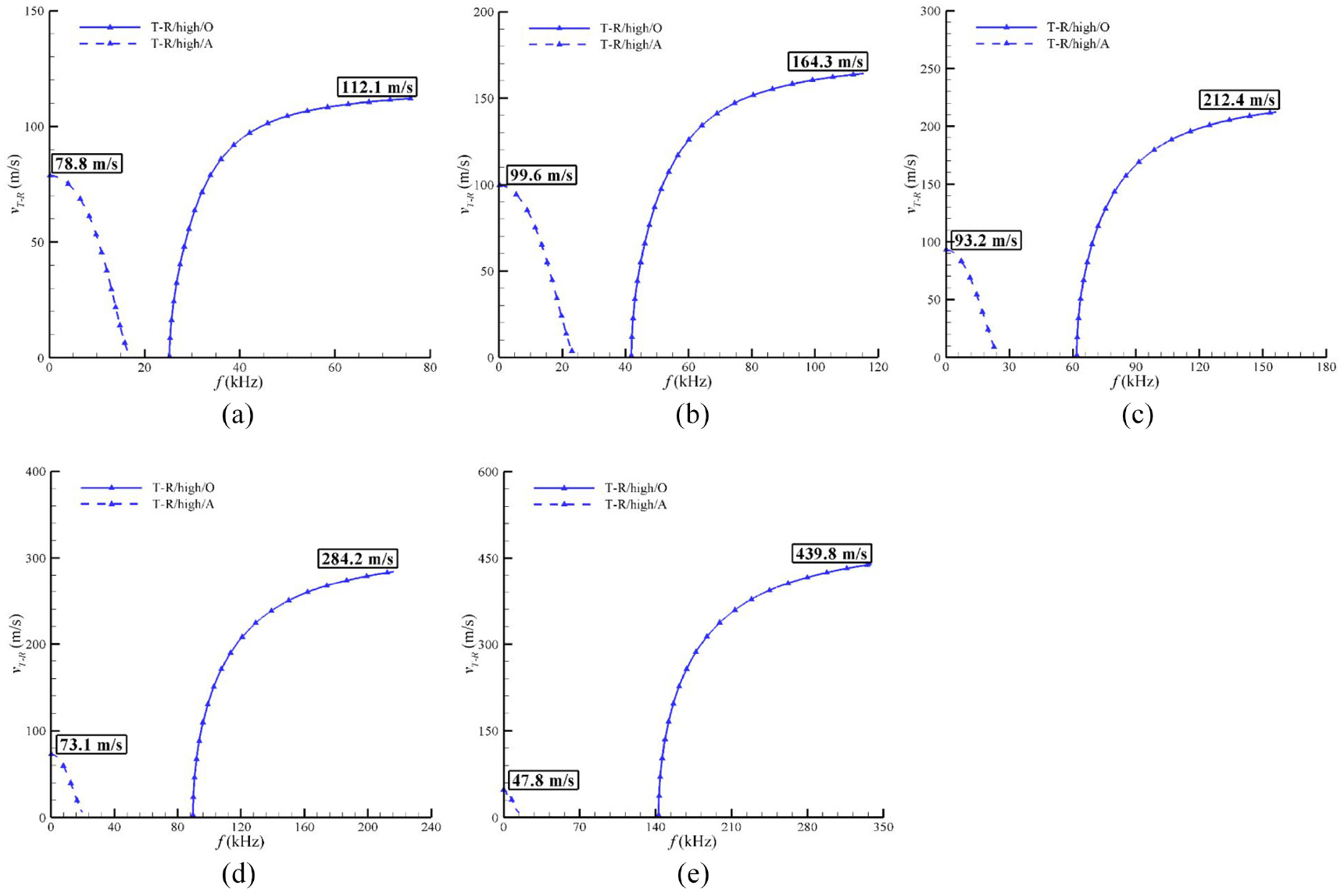
Curves of frequency versus wave velocity of high-frequency branches of T-R waves for different
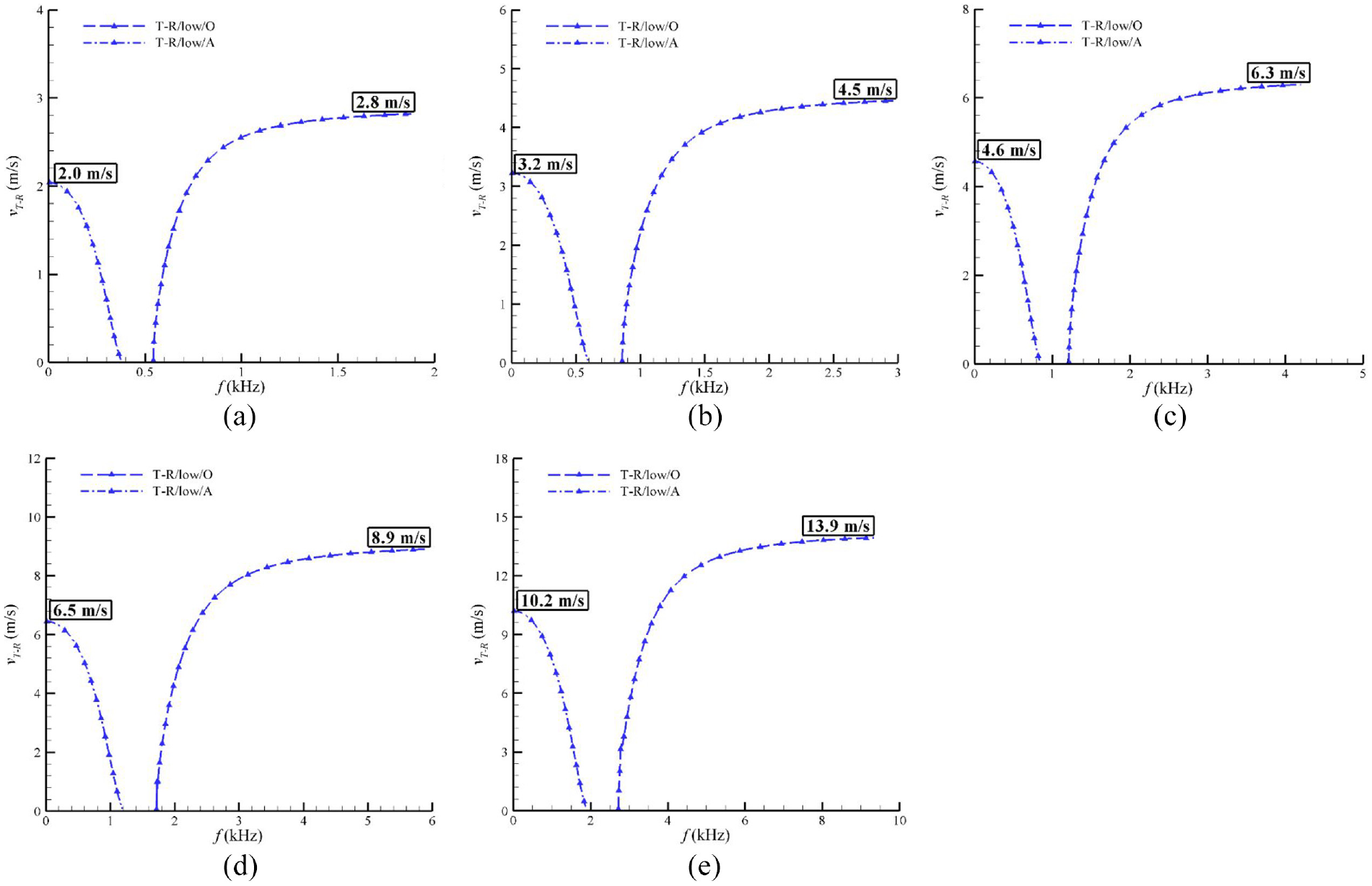
Curves of frequency versus wave velocity of low-frequency branches of T-R waves for different

Curves of
Wave velocity in x2 versus x1 directions
Similar with the rules for dispersions in
Wave velocities

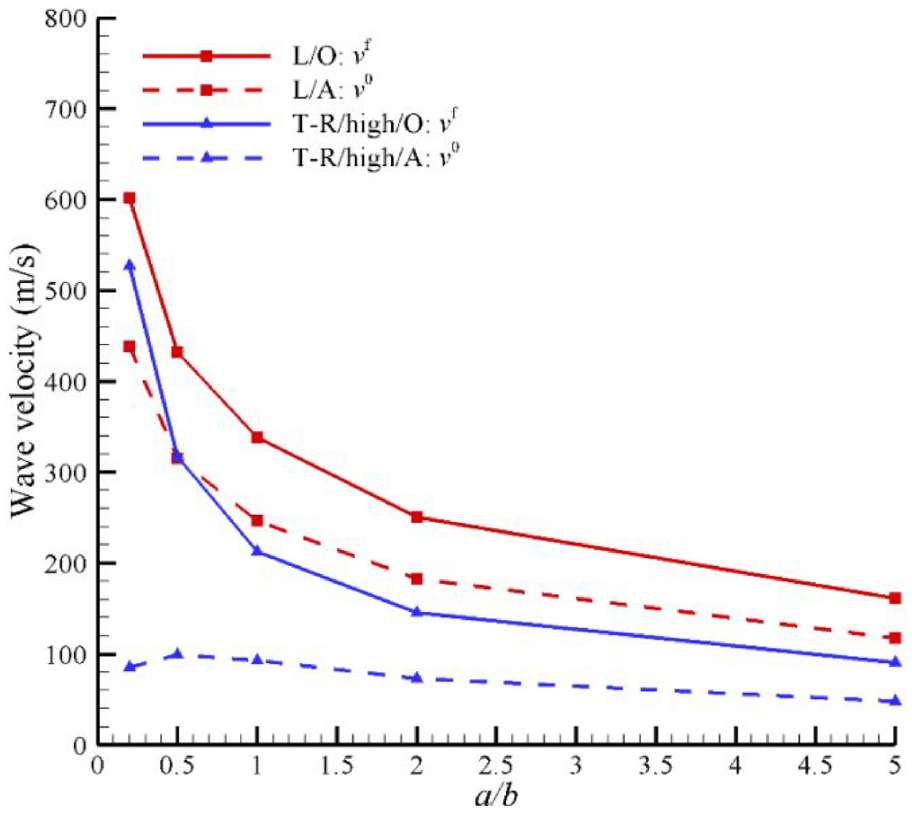
Curves of
Discussion and conclusion
Dispersion is an important wave propagation behavior in granular media such as granular materials, crystals, and structures, and it is closely related to the microstructure of granular media. Discrete particle models15–18 can conveniently simulate the relationship between dispersion and microstructure of granular media, but they are limited by the computational scale. Traditional continuous medium models 28 can quantitatively describe dispersion behaviors, but they are not enough to accurately simulate the effect of microstructure. The micromechanics-based continuum models27,31,33 include advantages of discrete and continuum models in describing dispersion and the effect of microstructure. And among these models, the micromechanics-based micromorphic model can provide more macroscopic variables and deformation modes with respect to microstructural information in the process of homogenization for granular assembly, which is seen as a complete model. The microstructural information such as particle arrangement and size, void ratio, and contact stiffness are analyzed for their effects on dispersion behaviors. But previous studies21,22,31,33 on micromechanics-based micromorphic models lack discussions about the particle shape and its effect on dispersion behaviors.
One of major objects in this study is to introduce the factor of particle shape into the micromechanics-based micromorphic model and investigate the effect of particle shape on dispersion behaviors of granular crystals. Then, a micromechanics-based micromorphic model is derived for 2D elliptic granular crystals in this study, where macroscopic micromorphic constitutive modulus tensors are identified by summation expressions of contact stiffness and microstructural parameters in 2D closely packed elliptic particle assembly. This study uses two modes of Taylor expansion of relative displacement and rotation to establish the contact relation between two particles. And two sets of micromorphic constitutive modulus tensors are derived respectively based on the two modes of Taylor expansion. Two micromorphic wave modes, that is, coupled transverse – rotational (T-R) and longitudinal (L) waves are predicted. Then, dispersion equations of micromorphic waves are derived for 2D elliptic granular crystals, and accordingly, dispersions and wave velocities are obtained in 2D elliptic granular crystals. The main conclusions are given as followings:
Obvious dispersion behaviors are predicted for elliptic granular crystals with different aspect ratio
Two modes of Taylor expansion of relative displacement and rotation have little effect on the total frequency band gap of elliptic granular crystals, which can influence dispersions and frequency band gaps of T-R waves when multiply increasing microscopic parameters with respect to the rotation.
Dispersions and the frequency band gap have the opposite rules when it considers the wave propagation along
The velocities
The situation with a larger
Footnotes
Handling Editor: Chenhui Liang
Declaration of conflicting interests
The author(s) declared no potential conflicts of interest with respect to the research, authorship, and/or publication of this article.
Funding
The author(s) disclosed receipt of the following financial support for the research, authorship, and/or publication of this article: This work was supported by the National Natural Science Foundation of China (Grant no. 12002245, 12172263, and 11772237). This support is gratefully acknowledged.
