



Abstract
It is a common experience that the interior noise of an underground train vehicle increases suddenly when it just runs into a track section with steel spring floating slabs, significantly reducing passengers’ comfort. This paper investigates the reasons, and control, of such noise through field tests and model simulations. The effect of rail surface irregularity on interior noise was investigated first by analysing data collected from interior noise tests, rail surface irregularity measurement and by analysing the modal behaviour of the slab. Noise radiation of the track slab was then analysed using the acoustic boundary element method while the vibration of the steel spring floating slab track is predicted based on an infinitely long periodic structure model; And finally with the prediction models, a parameter study was performed for the steel spring floating slab, on the purpose of improving the parameters to make the track less noisy. The research presented in this paper may provide a reference for the design of steel spring floating slabs in terms of noise control.
Keywords
Introduction
In recent years, subways have been rapidly built in large- and medium-sized cities in China, and this has brought great convenience to people’s mobility; environmental vibrations induced by subway operations have received increasing attention. A steel spring floating slab track is one of the most effective vibration controlling measures that has been widely used in areas with special vibration reduction requirements.1–4 However, the sound pressure level inside a train (train interior noise) can increase by 5–10 dB5,6 when the train passes through a track section with steel spring floating slabs; this significantly decreases the comfort for passengers. On-board staff who experience such noise regularly can develop physical and psychological diseases 7 .
The interior noise of the train can be controlled either by reducing the noise emitted from source or by cutting off the sound transmission path, with the former being the fundamental method. 8 The interior noise includes noise from the wheel and rail, auxiliary equipment, current collector system and traction system; these noises are transmitted to the interior space via air-borne paths and/or structure-borne paths. 9 The noise of the wheel and rail, which is the main source of interior noise for underground train, is generated by vibrations of the wheel, rail and other parts of the track, and the surface roughness of the wheel and rail 11 are the root cause of the vibration. Thompson10–12 studied the vibration characteristics and noise radiation of the rail, wheel and sleeper of a ballast track and established the TWINS model to simulate the rail with continuous support for predicting the contribution of the rail and wheel to total noise. Sheng et al. 13 found that the noise radiation of ballastless tracks of high-speed railways can be attributed to rail vibrations using noise radiation calculated from a 2.5-dimensional boundary element and vibration calculation model based on an infinitely long periodic structure. Koo et al. 14 developed an elastic wheel to reduce the noise of subway wheels; for the elastic wheel, a rubber material was inserted into the teel rim or installed on the surface of the wheel web, which helps reduce the stiffness and increase the damping of the subway wheels. Interior noise can be reduced by 4–5 dB(A) on a subway line with such elastic wheels; however, its durability is yet still a great concern. The field test of Zhao et al. 15 revealed that a rail corrugation has a significant effect on interior noise. In addition, the author suggested that interior noise can be reduced effectively by controlling rail roughness and installing a rail shock absorber. Yu et al. 16 found that rail roughness has a significant effect on the noise in the driver’s cab by calculating the excitation load using the vehicle-track coupling dynamic analysis and analysing the influence of the rail roughness on interior noise using the boundary element method. However, there has been little research on whether the interior abnormal noise in a steel spring track is dominated completely by rail roughness.
The vibration reduction principle of the steel spring floating slab track is that the upper part of the track structure is completely isolated from the foundation by the spiral steel spring; the dynamic load attributed to train operation is balanced by the mass inertia of the suspended floating slab. The system can effectively isolate vibrations with frequencies greater than about two times the natural frequency of the system. The dynamic characteristics of the steel spring floating slab track are related closely to the damping capacity, and it can affect the noise radiation of the structure. The dynamic characteristics of steel spring floating slabs have been studied extensively. Cui and Chew 17 analysed the dynamic response and force transfer of a conventional track and a floating slab track under the excitation of a simple harmonic load using the flexibility method. The study found that the floating slab track system was effective for reducing forces transmitted at frequencies above the designed frequency compared to the fixed slab track system. Gupta and Degrande 18 found that the parametric excitation of a discrete floating slab track reduces its vibration damping performance at low frequencies when using the periodic structure method. Hussein and Hunt 19 simulated a discrete periodic non-field floating slab track using the Fourier repeat element, periodic Fourier and correction phase stepping methods. A vehicle running on a discrete floating slab bed can induce the parameter excitation of track slabs arranged periodically along the track direction; however, it does not affect the speed of the subway vehicle. Further, this study found that the number of resonance peaks increased with an increase in track length. Ding 20 simulated a three-dimensional modal analysis on a floating slab track using MIDAS/GTS software. They studied the transmission ratio of a floating slab track under the influence of vibration eigenfrequencies, mode shapes of vibration and modal participation mass. Lei and Jiang 21 established a model for the dynamic analyses of a steel spring floating slab track based on finite elements, and they found that the stiffness and damping of the isolator are the governing factors, whereas the stiffness and damping of the rail pad are not important. Wei et al. 22 applied semi-active magnetorheological (MR) dampers to a traditional steel spring floating slab track; they established a coupled dynamic model of the vertical vehicle-magnetorheological steel spring system for the safety analysis and vibration reduction assessment, and this theoretically validated the feasibility of the semi-active magnetorheological steel-spring FST.
Steel spring floating slabs are widely used in subways because of their excellent ability to reduce vibrations. Most studies focused on abnormal interior noises caused by the floating steel spring plate; only a few studies focused on the sound source and optimisation of noise reduction. It is difficult to reveal the characteristics of the structural noise radiation of the track because field tests have many unknown factors such as structural parameters of the floating slab track and the surface roughness of the rail. Thus, simulation calculations should be introduced to study the characteristics of the structural noise radiation of the rail based on actual parameters.
This study investigates reasons for a sudden increase in the interior noise of a train in a steel spring floating slab track section of a domestic metro based on field tests and simulation calculations, and it identifies the main factors affecting the noise to provide a reference for controlling the interior noise of a train in a steel spring floating-slab section.
Comparison of vibrations and sound radiations between the two tracks based on measured data
This study tested four elements to analyse the reason for the interior noise of the steel spring floating slab section: roughness on the rail surface, internal noise within railway metro vehicles, dynamic characteristics of track structure and vibration of track structure. One section of the metro with a steel spring floating-slab track was selected as the experimental section; this selected section is a shield tunnel with a 5 mm inner diameter, a one-way length of 2 km laid with a steel spring floating slab track of nearly 800 m installed with an HYT fastener and operated with a type A vehicle. In the same interval, a conventional slab section was selected for the experimental comparison. The subway train passes at a speed of 70 km/h.
Rail surface roughness
Corrugation analysis trolley (CAT) Mark 3 is employed for field work because it can be installed on the rail to measure the wave wear on the rail surface; it has the advantage of being able to simultaneously measure the rail wave wear over longer distances. The roughness was converted into the frequency domain at a speed of 70 km/h for convenience in comparing the rail surface roughness between the floating slab and conventional tracks (Figure 1).

Rail surface roughness.
Vehicle interior noise
This study employed hand-held acoustic testers (Bruel and Kjaer) to collect the interior noise signal within a frequency range of 0–5000 Hz. The test site was located in the middle of the third compartment of the subway; the microphone was set 1.2 m from the floor of the compartment. The test time period was selected to be between 22:00 and 23:30 to eliminate interference from passengers. Figure 2 shows the acquisition results of the in-car noise when the train enters the section of the steel spring track from the conventional track. This study uses linear weighting based on the following considerations:
The structural noise radiation of a steel spring floating slab track belongs to low-frequency noise, and the use of A-weighted low-frequency noise underestimates the effect of low-frequency noise on human. 23
In the analysis of structural noise, most scholars utilise linear weighting to evaluate structural noise. 24 Therefore, this study also uses linear weighting.
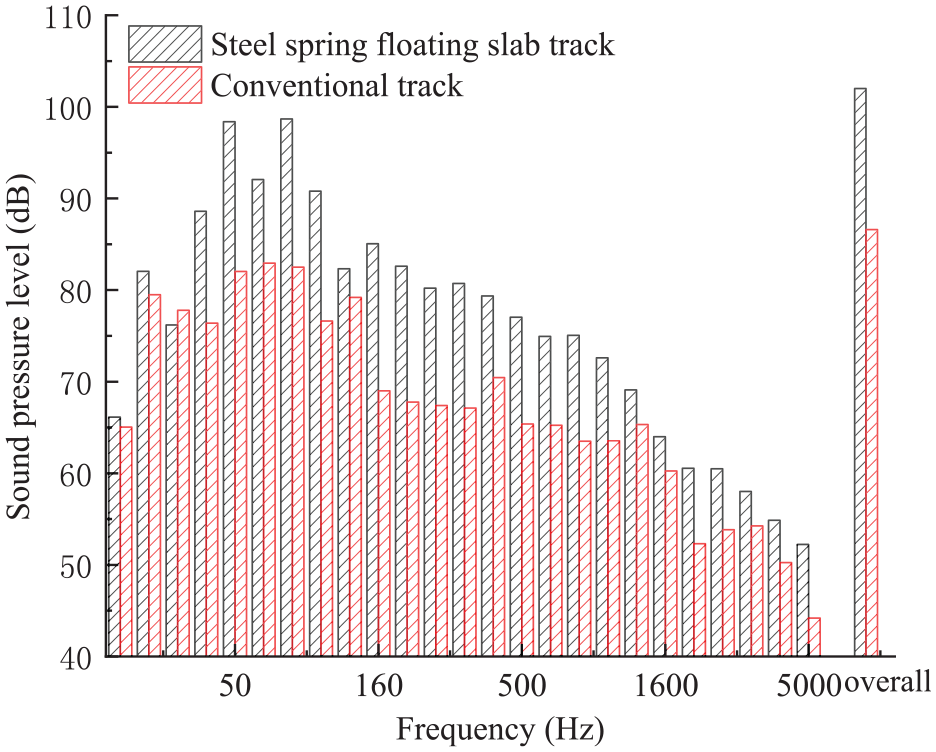
Comparison of interior noise between floating slab and common tracks.
Figure 2 shows that the total sound pressure level in the carriage reaches 102 dB when the subway pass through the steel spring floating slab track section; a total sound pressure level of 89.6 dB is obtained when the train pass through the conventional track. The main frequency of in-car noise is focused on the centre frequency of 40–80 Hz when the train passes through the section of the steel spring floating slab because the main frequency range of the noise is the frequency segment of the sound pressure level within 10 dB below the peak of the sound pressure level (Figure 2). The in-car noise is focused on the centre frequency of 25–125 Hz when the subway passes through the section of the conventional track (Figure 2). The interior noise of these two tracks show significant differences in the centre frequency of 40–5000 Hz, where the overall sound pressure level of steel spring floating slab track is 11.4 dB higher than that of the conventional track. The maximum difference can be up to 16 dB (at 50 Hz). The surface roughness of steel spring floating slab rails is not the main factor that leads to an increase in in-car noise because steel spring floating slab rails show better surface condition than ordinary rails below 252 Hz (Figure 2). The key factor may be the rolling noise of wheel and rail as the equipment noise inside the train is identical; the rolling noise of wheel and rail can be simulated by the mathematical model after some model parameters are decided by experimental studies.
Track vibration
In this study, a displacement hammer and multipoint excitation multipoint response method were used to obtain the frequency response function and characteristic frequency of the track structure; this can support the modelling and simulation analysis. The hammer (K8206-002) strikes the vertical direction of the rail, and acceleration sensors are used to collect the frequency response. The striking point and arrangement mode of the acceleration sensor are shown in Figure 3; the frequency response function of the sleeper mid-span is shown in Figure 4.
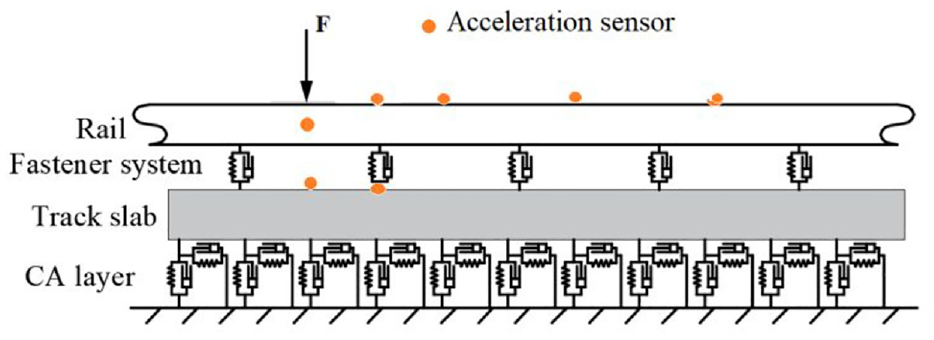
Striking point and the arrangement mode of acceleration sensor.

Frequency-response function of sleeper mid-span.
Resonant frequencies of the steel spring floating slab track and the conventional track on the fastener stiffness were 266 and 277 Hz, respectively, as shown in Figure 4. The fastener stiffnesses of the two types of track structures were 1.092 × 10⁸ N/m and 1.002 × 10⁸ N/m. The Pinned-Pinned resonance frequencies of the steel spring floating slab track and conventional track, which are closely related to the sleeper spacing and width of fasteners, are 1036 and 1160 Hz, respectively. Thus, the two types of track structures can be compared because of their similar fastener stiffness and sleeper spacing.
This study found no significant difference (p > 0.05) between the frequency response characteristics of the rails of the two types of track structures at the mid-span. However, no resonance peak was obtained, and this is inconsistent with the findings of Hussein et al., 2 where a local resonance peak appeared in some frequency bands below 200 Hz on a floating slab track. The force hammer cannot excite the structural vibration of the track slab, and therefore, the influence of the track slab on the rail frequency response function is not shown in this experiment.
The vibration characteristics of the track structure were tested in the test section to study the noise emission of the track structure, wherein the floating slab section and conventional track section had similar line conditions. This experiment adopted the rugged EDAQ data acquisition system, and the range of the Lance vibration acceleration sensor was 0.5–3000 Hz.
According to the requirements for laying out test points in the measurement of the internal vibration of a railway tunnel caused by a passing train (GBT 19846–2005), the rail vibration test sensor is arranged at the rail waist above the sleeper (500 g), the vibration test sensor of track slab is located at the centre of the track (7 g), and the vibration test sensor of tunnel wall is placed 1.2 m (7 g) away from the rail surface. The result of each test point is the arithmetic mean of the test results of 10 trains to eliminate the interference of random data. Vibration test results for the two-track structure are shown in Figure 5.
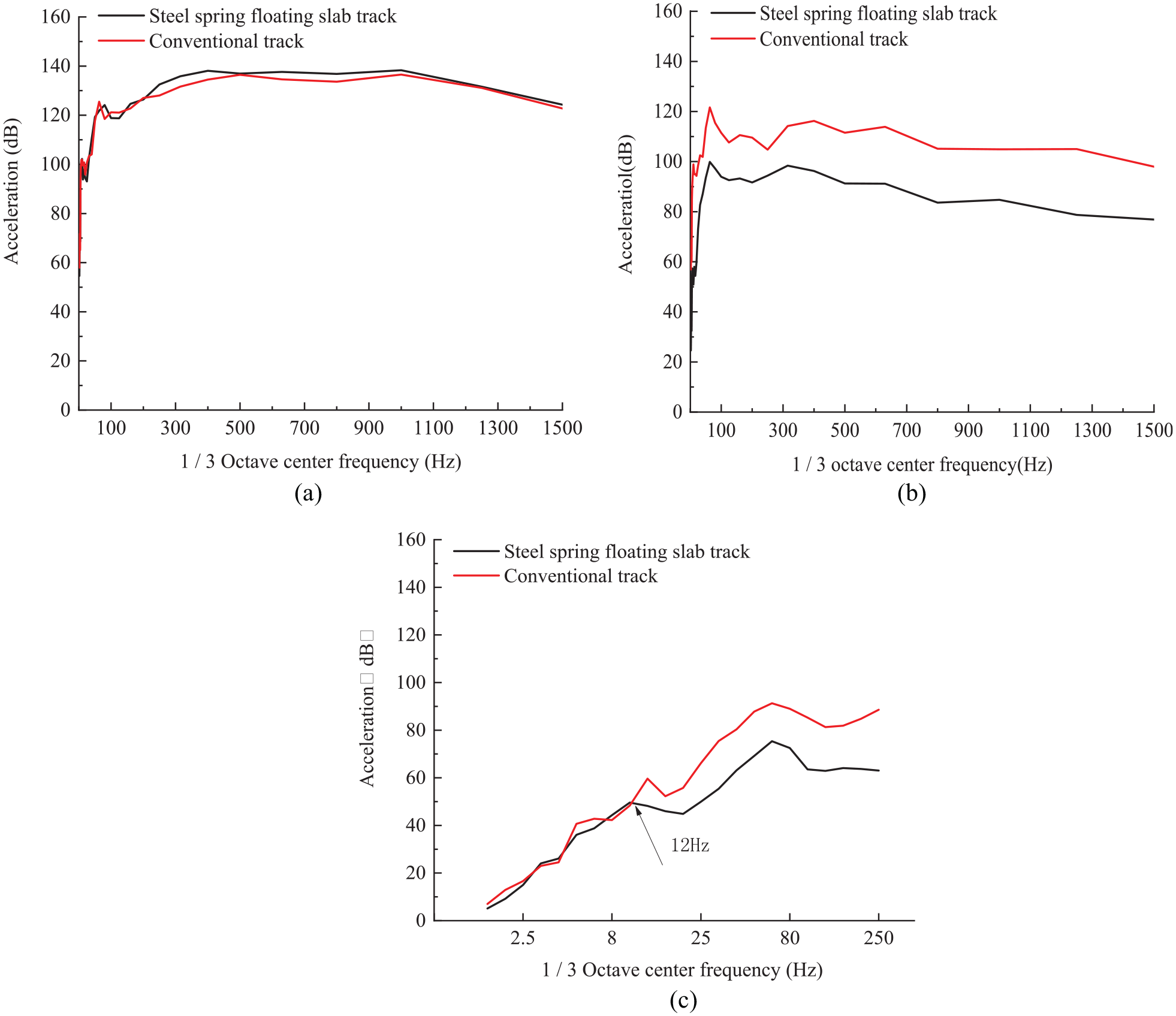
Comparison of vibration acceleration between the two track structures: (a) vertical acceleration of the rail, (b) vertical acceleration of the track slab and (c) vertical acceleration of the tunnel wall.
A similar vibration spectrum was observed between the two track structures (Figure 5(a)), which indicates that these two types of track structures had similar vibration sources; the vibrations of the track were comparable. Significant frequencies of vibration were in the range of 200–1000 Hz for both track structures. In addition, we found that the rail vibration of the steel spring floating slab track was significantly stronger than that of the conventional track at 250–450, 600, and 800 Hz. These findings indicate that the rail surface roughness is the main factor that contributes to the difference in rail vibrations between the two track structures.
The vibration test of the track plate revealed that the vibration of the floating slab track plate at 800 Hz was considerably higher than that of the conventional track slab (Figure 5(b)). This phenomenon results from the vibration damping principle of the floating slab track; the heavy weight of the floating slab and the vibration of the floating slab stimulated by the absorbed vibration energy lead to violent low-frequency vibrations. The maximum characteristic frequency of the two types of track slab vibration is approximately 60 Hz with an amplitude difference of approximately 16 times (Figure 5(b)). Our findings reveal that the characteristic frequency is generated from rail vibrations and has no significant correlation with the track structure. In addition, the vibration of the steel spring floating slab track is evident below 100 Hz, and this is related to the vibration of the track slab.
Test results of the tunnel wall vibration of the two tracks (Figure 5(c)) show that the vibration isolation frequency of the steel spring floating slab track is 12 Hz. Compared to the conventional track, the steel spring floating slab track has a greater damping effect on the vibration above 12 Hz, with a damping amount of the tunnel wall of 10 dB within 1–80 Hz. A similar damping effect on the vibration was observed between the two tracks when the vibration frequency was below 12 Hz.
Summary
The above experiments indicate that
The interior noise increases from 89.6 to 102 dB (range of 0 to 5000 Hz) and the vertical vibration of the tunnel wall decreases from 96.6 to 78.7 dB (range of 0 to 250 Hz) when the train enters the steel spring floating slab track from the conventional track.
The surface roughness of steel spring floating slab rails is not the main factor that leads to an increase in the internal noise of a metro train.
The resonant frequencies of the steel spring floating slab track and conventional track in this experimental section on the fastener stiffness are 266and 277 Hz, respectively. The rail and track slab can be considered as a whole when the analysis frequency is below these points.
The vibration isolation frequency of the steel spring floating slab track in this experimental is 12 Hz.
Prediction of sound radiation from a track
Modelling and verification
The effect of rail roughness and track structure on noise emission and the contribution of different track structures to noise emission should be studied using mathematical models because they are difficult to distinguish or illustrate using field experiments. A vibration analysis model of a steel spring floating slab track was established in this study using the infinite periodic structures theory.14,25,26 The rail was simulated by the Timoshenko beam, and the track slab was calculated by the mode superposition method; the train was loaded with a moving load. The track model for the loading moving loads is shown in Figure 6. An infinitely long periodic structural model of the track slab is shown in Figure 7

Track model with moving load.

Infinitely long periodic structure model of track slab.
The 2.5-dimensional equation of the rail vibration of a floating slab track is given as 14

where

where P0, fjs, and US represent the amplitude of excitation load, reaction force of s fastener in the j track slab, and the connection between the s support and the rail, respectively.
The rail displacement can be induced by the excitation load and coupler reaction as

where the displacement caused by excitation load can be expressed as

The displacement caused by the reaction force of the fastener can be written as

where




where

and



where Kp, and Grs represent fastener stiffness, loss factor of the fastener, and response of the s fastener to the r fastener, respectively.
Considering the periodicity of the track structure, the coupler reaction is expressed as


The support method of Wrinkler’s lab was used for this model. The total stiffness of the floating plate track spring is 8.8248 × 10⁷ N/m considering that the floating slab track slab is considered a rigid body. This study focuses on noise, which has a higher analysis frequency than the vibration. The calculation results have low error when considering the floating slab track as a solid element because the track slab is thick, and the lower support stiffness is low.
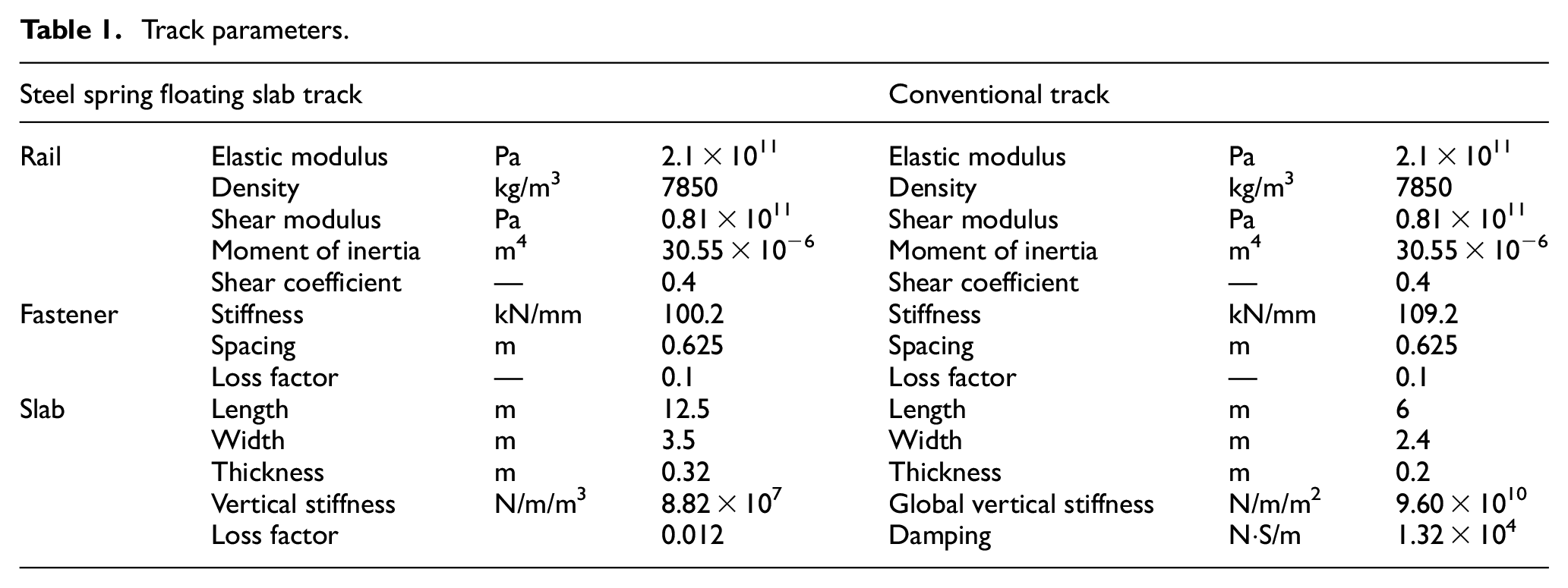
Parameters used to calculate the model of the steel spring track and conventional track are listed in Table 1, wherein the stiffness of the fastener is obtained by the dynamic testing of the rail, track slab geometry is the result of the field test, and total supporting stiffness of the steel spring floating slab is calculated according to the mass of the floating slab and vertical strike isolation frequency.
Track parameters.
The effect of rail roughness on the vibration of the track slab was analysed by calculating the vibration mode of the track slab and comparing the characteristics of rail surface irregularity. The main mode shapes of the track slab below 600 Hz are shown in Figure 8.

Main mode shape: (a) fundamental mode (8 Hz), (b) fourth order mode (20 Hz), (c) eighth order mode (297 Hz), (d) 14th order mode (220 Hz), (e) 19th order mode (300 Hz), (f) 20th order mode (322 Hz), (g) 23rd order mode (383 Hz), (h) 25th order mode (446 Hz), (i) 28th order mode (472 Hz) and (j) 34th order mode (564 Hz).
The vibration response of a thin plate can be obtained by solving a differential equation using the mode-superposition method. Point positions in Figure 9 are the track slab positions of the 10th set of fasteners; points a–j correspond to the main mode shapes of the track slab in Figure 8.

Dynamic flexibility of the middle of the track slab under 600 Hz: (a) below: 200 Hz and (b) 600 Hz.
Theoretical simulation results of the dynamic flexibility of the thin plate theory are considerably different from those of the solid element, especially the bending mode of the track slab, and it can be regarded as the error caused by the calculation of the thin plate theory resulting from the thick track slab being thick and the lower support stiffness being low. Thus, this study employed the finite element method to calculate the rail response. In this method, the track slab is simulated using the SOLID45 element, and the finite element mesh has a size of 0.05 m that is one-sixth times less than the bending wavelength corresponding to the highest frequency considered. The rail response is solved by substituting the dynamic compliance between the couplers of the floating slab track into equation (3-3b).
The calculation results of the vertical acceleration mobility in the rail span were compared with experimental results as shown in Figure 10.

Validation of the model of infinitely long periodic structure model.
Figure 10 shows the simulation results of the infinitely long periodic structure model are consistent with the overall trend of the test results when the frequency exceeds 100 Hz. Further, an obvious difference was observed between the results of the simulation calculation and the experimental test at a frequency of 100 Hz; this was attributed to the heavy structure of the floating slab and track slab, which results in the fact that the vertical strike test could not excite the vibration of the track slab and reflect the vibration of the track slab. Thus, we can conclude that the infinitely long periodic structural model is reliable.
Structural noise radiation of the steel spring floating slab track
The main frequency band of this analysis was below 300 Hz, and it corresponds to the low-frequency noise. The use of A-weighted low-frequency noise underestimates the effects of the low-frequency noise on humans13–15; therefore, this study used linear weighting.
Thompson proposed the noise radiation calculation method. 16 First, the rail impedance of the steel spring floating slab track was obtained using the floating slab-infinitely long periodic structure model calculation model. Subsequently, the acoustic power of the radiated noise from the track slab was calculated using the model of the track slab built using the ANSYS finite element software and acoustic boundary element module in the LMS Virtual Lab. The radiated noise had a frequency ranging from 0 to 1600 Hz and a frequency step length of 10 Hz. The surface roughness of the rail is the measured roughness of the floating slab track; CKL840 is selected for the wheel excited by the wheel-rail force in steps of 10 Hz. The simulation results are shown in Figure 11.

Vibration response of two types of tracks: (a) Rail noise radiation, (b) Slab noise radiation and (c) Total noise radiation.
Figure 11 shows that the rail noise radiations of the steel spring floating slab track and conventional track are 107.8 and 105 dB, respectively, in the frequency range of 0–1600 Hz. Further, their track slab noise radiation are 105.3 and 94.5 dB; the total noise radiations are 121.9 and 106.3 dB, respectively.
The noise of the track slab of the steel spring floating slab track is almost larger than that of the conventional track slab in the entire frequency band, especially in the low-frequency domain below the centre frequency of 400 Hz. Therefore, the structural noise radiations of both rails are from the track; however, the difference in the structural noise radiation of the two rails comes from the rail plate. The parameters of the floating slab track should be studied to reduce noise because the interior noise anomaly of the steel spring track section is closely related to the noise radiation of the track slab.
Parametric study for noise radiation from the steel spring floating track
Response of track structure by unit force
The wheel-rail force comprises rail and wheel mobilities, and the first resonance frequency of the rail on the fastener is 266 Hz, which is obtained through experimental testing (Figure 4). The rail and track slab could be considered as a whole when the analysis frequency was low. The wheel mobility is larger than rail mobility, and therefore, the simulation analysis can be performed under unit force excitation. The following simulation calculations used unit force excitation.
Before studying the noise radiation of the two types of track structures, it is necessary to understand their force response under unit force. A comparison of the rail and track slap vibration acceleration responses of the steel spring floating slab and conventional tracks under unit force is shown in Figures 12 and 13.

Comparison of rail vibration acceleration responses of two tracks: (a) below 1500 Hz and (b) below 600 Hz.

Comparison of vibration displacement responses of two track slaps.
Compared with the conventional track, the vibration acceleration of the floating slab track showed a local peak in the frequency domain of approximately 300 Hz; this is attributed to the fourth mode of the track slab. No significant difference is found in the acceleration response of the vibration between the two rail tracks above 600 Hz.
Effect of vibration isolation frequency on the noise radiation of the track slab
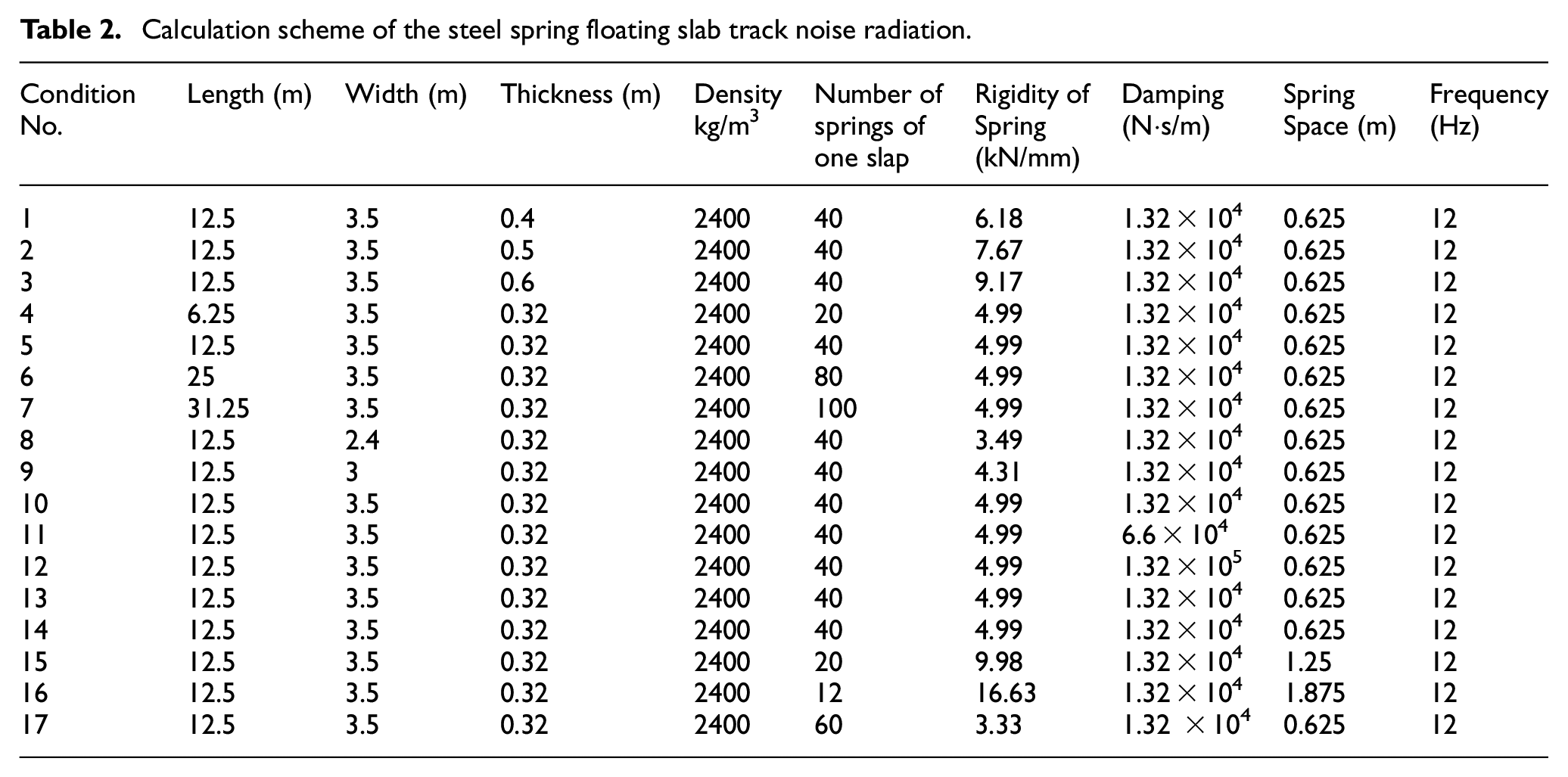
The noise radiation of a steel spring floating-slab track is a main cause of abnormal interior noise; therefore, the noise in the carriage can be reduced by optimising the structure of the steel spring floating slab on the premise of not affecting the damping effect of the steel spring floating slab. Table 2 summarises 17 different cases used to study the effect of the structural parameters on the noise radiation of the track slab. These parameters include the vibration isolation frequency, damping, track slab geometry, steel spring support spacing excited by unit force, and step 10 Hz. The speed of the train is 60 km/h.
Calculation scheme of the steel spring floating slab track noise radiation.
Effect of the geometric size of the track slab on the noise radiation of track slab
The effects of the length, thickness and width of the track slab on noise radiation are studied under certain vibration isolation frequency and track slab density, with the help of calculating schemes 1–10, as shown in Figure 14.

Noise radiation for different slab sizes: (a) Noise radiation for different slab thicknesses, (b) noise radiation for different slab lengths and (c) noise radiation for different slab widths.
Figure 14(a) shows the effect of slab thickness on noise radiation. An increase in the width of the track plate can reduce noise radiation of the slab because increasing the thickness can increase the unit mass of the track slab; however, this increases costs.
Figure 14(b) shows that the longer the length of the track slab, the lower is the noise radiation for a certain width and thickness of the track slab. The acoustic wavelength is 5.7 m when the main frequency of the noise is 60 Hz (Figure 2) and the sound velocity is 340 m/s. Therefore, the length of the slab should be more than 5.7 m. The longer the track slab is, the lower is the flexibility and the natural frequency. In addition, a floating slab that is too long is not conducive for transportation and construction; therefore, the longest floating slab is analysed to be 31.25 m in this study.
The effect of the width of the track slab on the noise radiation does not exhibit an obvious pattern, as indicated in Figure 14(c). This is because acoustic waves propagate along the longitudinal direction of the track slab; therefore, the transverse length does not have a significant effect.
Effect of damping coefficients on the noise radiation of track slabs
The effects of different damping coefficients on the noise radiation of the track slab are shown in Figure 15, under the conditions of calculation schemes 11–13. An increase in the track slab damping is beneficial to the absorption of the inner energy of the track, which reduces the noise in the track slab. The noise radiation of the vibration frequency of 1.32 × 10⁻⁴ Hz is nearly 14 dB higher than that of 1.32 × 10⁻³ Hz. However, excessive damping can lead to the amplification of middle- and high-frequency vibrations, and this is not conducive to the damping effect of the floating slap. However, this increased damping reduces the damping effect.

Noise radiation of different damping.
Effect of spring spacings on the noise radiation of track slabs
The effect of the arrangement position of the steel spring on the noise radiation of the track slab was studied and the equivalent stiffness under one track plate was constant under the condition of calculating schemes 14–17. Figure 16(a) shows the sound radiation level when the spring space is one times, two times and equal to the sleeper spacing. Figure 16(b) shows the differences in the sound radiation level when adding a column of springs at the centre of the track slab.

Noise radiation for the arrangement of the steel spring: (a) different spaces and (b) different columns.
The wider the distance between the steel spring fulcrums, the lower is the bending stiffness of the track slab, which increases both the vibration and the noise. The placement of a steel spring in the centre of the strong noise radiation has a certain effect on noise reduction; however, it is not sufficiently effective. Therefore, with a certain total stiffness, the noise of the track slab can be controlled by reducing the distance between the spring supports or by adding a column of springs at the centre of the track.
Conclusions
Theoretical modelling and in-situ test were combined to analyse the factors that led to an increase in the interior noise in a floating slab track section. The model was further used to improve the parameters of the track slab so that it can simultaneously achieve vibration and noise reduction. The main conclusions and suggestions are as follows.
The radiated noise acoustic power of the floating slab, radiated noise acoustic power of the rail, and total radiated noise acoustic power of the floating slab track were approximately 6 dB higher than those of the conventional track for the same rail roughness. The acoustic radiation of the steel spring floating slab track structure has a certain effect on the interior noise.
A local vibration peak appears on the steel spring floating slab track in the frequency range below 600 Hz, and it is related to the mode of the track slab.
The radiated noise of the steel spring floating slab decreases with the frequency of vibration isolation, floating slab damping, and length of the track slab.
By keeping the equivalent stiffness under one track plate unchanged, decrease in the interval of the steel spring supports and increase in the number of columns of the steel spring supports will reduce the noise radiation from the steel spring floating slab.
Footnotes
Handling Editor: Chenhui Liang
Declaration of conflicting interests
The author(s) declared no potential conflicts of interest with respect to the research, authorship, and/or publication of this article.
Funding
The author(s) disclosed receipt of the following financial support for the research, authorship, and/or publication of this article: This study was supported by the National Natural Science Foundation of China (52002340), the National Natural Science Foundation of China(52078433), Sichuan Science and Technology Program(2020YFH0007).
