In this paper, we have studied the transport of heat and mass in viscous fluid flow over a disk, rotating with variable angular velocity, whereas, both the nonuniform injection and suction velocities can take place through its porous surface. Moreover, the disk is stretched (shrunk) with variable velocity in its own plane. Besides that the temperature and concentration functions, defined at the surface of disk, are assumed nonuniform and nonlinear, whereas, their nonlinear nature can be expressed in the form of algebraic and non-algebraic functions, however, the uniform and linearly variable temperature and concentration functions at the surface of the disk are easily obtained by fixing the exponents of these functions either zero or one. Diffusion of these two quantities in flows over such disk are the fundamental objective of current investigations. Six PDE’s control the fluid motion along with the diffusion of heat and mass in flow over the rotating disk of such special characteristics. The system of PDE’s is transformed into a set of ODE’s, which is solved numerically with the help of bvp4c package of MATLAB. The present simulation and its solution are exactly matched with the solution of classical problems of rotating disk flows with the additional characteristic of diffusion of heat and mass in flows. Therefore, we have seen the individual and combined effects of all physical parameters on field variables under consideration. The higher order governing equations are nonlinear PDE’s, which are converted into the system of ODE’s in view of proper similarity transformations. Moreover, the tangential and radial shears, shaft torque, rates of the diffusion are evaluated at the surface of the disk, whereas, they are graphed against different parameters and interesting results have been presented. It is found that the nonlinear nature of surface temperature and concentration reduced the thermal and concentration boundary layers, however, the large negative values of power index parameters give rise to an overshoot in temperature and concentration profiles.
The rotating disk flows has extensive applications in automobiles, physics, engineering, industries, and other field of sciences, whereas, the mathematical simulations of these practical problems have been proposed by Kármán1 and he carried out the remarkable investigation for incompressible flow over an infinite rotating disk. This pioneering work is highly cited, furthermore, it is also modified and extended, whereas, many researchers discussed different aspects of the rotating disk flow problems. Moreover, the injection and suction of fluid through the porous boundaries or surfaces during a fluid motion is investigated by Prandtl.2 Cochran3 extended the results of Kármán1 and he provided standard and acceptable numerical solution to the von Kármán equations. Prandtl introduced the concept of addition (removal) of mass in (from) flow regime through porous surface and this has further applications in boundary layer theory and cooling of the surfaces of high speed aircrafts. Furthermore, Crane4 obtained the closed form solution of two-dimensional flow problem over a stretching sheet/surface. Later on, this problem was extended to three-dimensional flow by Wang.5 Fang6 investigated the steady flow over a stretchable rotating disk. Stuart7 was the first one who found the behavior of flow under the influence of uniform suction (blowing), when it is developed on the surface of a porous and rotating disk. He obtained different results for the steady flow and considered the large suction cases, however, he did not provide reasonable solutions for an instant injection. The most relevant and interesting modifications have been made to the classical von Kármán problem as discussed in Zandbergen and Dijkstra.8
The transport of heat and mass in flow is the intense need of engineers and physicist, therefore, the diffusion processes have applications in many engineering systems, however, it is most important to understand the mechanism of cooling of devices particularly the equipment designed for chemical, mechanical, and civil engineering systems. Mathematicians are working actively in these research fields as well. In many industrial equipment, heating is one of the fundamental obstacle in execution of a machine which quickly reduces its performance and durability. To overcome these difficulties, researchers worked on different techniques for cooling of machine. Different coolants have been formed and multiple techniques have been devised to settle down and resolve these issues. Therefore, heat transfer is an attractive area of research in the realm of fluid dynamics. After classical work of von Kármán, many researchers have been studied the transport of heat from a rotating disk in flows. In this connection, for the very first time, Millasp and Pohlhausen9 dealt with the outcome of heat transfer over a rotating disk at a fixed temperature. They presented numerical results for Prandtl numbers between 0.5 and 10. Sparrow and Gregg10 attempted to solve flow, heat, and mass transfer problem, therefore, they studied the diffusion of heat and mass in viscous flow over a rotating disk. They gave a brief analysis of injection on the flow characteristics and found series type solutions for large suction. In all of the above papers, incompressible flow has been studied. The consequences of compressibility were investigated by Ostrach and Thornton.11 Later, many authors have studied the heat transfer near a rotating disk considering different thermal conditions.12–19
In this paper we emphasized on the diffusion of heat and species mass in viscous fluid flow, which is maintained over a variably porous, rotating, heated, and stretching (shrinking) disk. Note that the temperature and species concentration, defined at the surface of the disk, are nonuniform and they are varied nonlinearly with the radial distance. The nonlinear behavior of these two functions is controlled by a parameter, involved in the exponent of a linear function, however, the parameters in the exponent can take any finite value. The fluid flow, diffusion of heat and species mass in flow over such disk is governed by a set of six PDE’s. The set of PDE’s along with boundary conditions are converted into a system of boundary value ODE’s. This task has been achieved by constructing and using proper similarity transformations. The similarity transformation gives rise to six dimensionless numbers, whereas, two more parameters appeared in energy and concentration equations and they described the nonlinear nature of temperature and concentration functions, defined at the surface of the disk. However, their effects have been investigated on flow field properties. Furthermore, we have discussed the combined and individual effects of all the flow parameters on field variables, whereas, we also recorded their effects on the flow quantities. The higher order nonlinear coupled ODE’s are solved numerically with the help of package of MATLAB. The present simulation and its solution are exactly matched with the solutions of classical problems of rotating disk flows with the additional effects of heat and mass transfer. Therefore, we have seen the individual and combined effects of these parameters on all field variables. Moreover, tangential and radial shears, shaft torque, rates of heat and mass transfer are evaluated at the surface of the disk, whereas, they are graphed against different parameters and interesting results have been presented. In case of shrinking (low and high), injection and rotation, thin thermal and concentration boundary layers are observed at the vicinity of the disk, however, these boundary layers are further decreased with different kinds of nonlinear variable temperature and concentration, taken at the surface of the disk.
Formulation of the problem
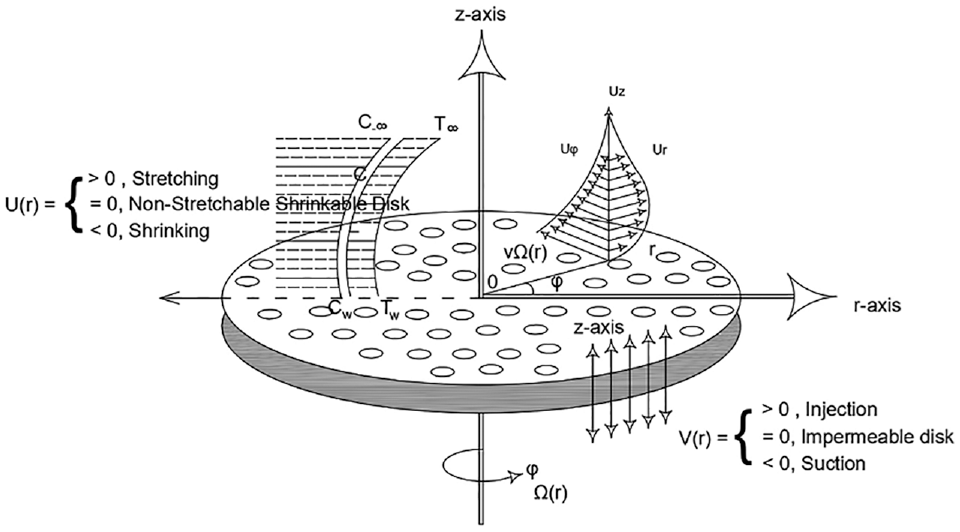
In the present case, we assumed and simulated the flow problem in cylindrical coordinate , whereas, the flow in maintained over a porous, rotating, stretching (shrinking) and heated disk, and the velocity vector has three components . Furthermore, axi-symmetric flow is taken into account, that is, the field variables do not depend on . Moreover, the velocity vector has three components, that is, , and in , and directions, respectively. The flow geometry is such that the infinite porous and heated disk is located at , it rotates about the axis and fluid can enter/leave through the porous surface in the direction of -axis. The disk is also stretched (shrunk) in the direction with proper and variable stretching (shrinking) velocity . The disk is kept at variable temperature , whereas, the species concentration at its surface is nonuniform and denoted by . The governing equations for the motion of fluid, transport of heat, and mass are the continuity, momentum, energy, and species concentration equations. Uniform thermal properties are taken in this simulation, whereas, the body forces and viscous dissipation terms are neglected. Geometry of flow model is shown in Figure 1.
Geometry of the flow.
All the governing equations are presented in cylindrical coordinates for axi-symmetric flow. Therefore, the in-compressible continuity equation is:
momentum equation is:
momentum equation is:
momentum equation is:
Energy equation is:
Concentration equation is:
The terms on the left of equations (2)–(4) define the components of convective acceleration in cylindrical coordinates, that is, , and coordinates), respectively, whereas, the terms in these three equations, multiplied by “” are the components of viscous force. Note that term in equations (2 and 4), containing is pressure force (normal stresses to the control volume). Moreover, the term on the left and right of equations (5)–(6), represent the convection and diffusion of heat and species mass in fluid, respectively. The elastic, heated, and concentrated solid surface (disk) is porous and rotating, therefore, the fluid in contact with the disk will gain the velocity of disk. Note that the fluid attached to the disk has injection/suction, stretching/shrinking and angular velocities , and , respectively, whereas, the fluid at far field is stagnant. Moreover, the no temperature and concentration jumped conditions state that the fluid will maintain the temperature and concentration of the surface(disk), attached to it. Furthermore, the temperature and concentration function will be prescribed at the ambient region. So the necessary and sufficient boundary conditions are established for the modeled problems which come into force from the physical geometry of the simulated problem and they have the form:
where , , , , and are fluid density, viscous, thermal, and mass diffusivities and pressure, respectively. The field variables defined at the surface of the disk are such that: , where the controlling parameters, are associated with stretching (shrinking), injection (suction), and rotation, respectively. Note that the disk temperature and species concentration at its surface are variable and they are expressed as and , where and determine the nonlinear nature of temperature and species concentration functions, taken at the surface of the disk. Note that for , both the diffusion variables are uniform, whereas, for these two variables have linear form and they depend on the radial distance . Similarly, the ambient temperature and species concentration are nonuniform and expressed as , . Furthermore, and are the controlling parameters for the temperature and species concentration at wall (ambient region), respectively. Remember that, , , and have the dimension of diffusivity. Here, we found a set of similarity variables for the velocity field, pressure, temperature, and species concentration functions. A set of new variables is generated in view of the quantities, defined at the boundaries, for the modeled problem. Besides that, these transformations have the ability to generalize the simulated problem and they include all the nonuniform boundary inputs. The variable angular velocity is strictly varied with -axis. These latest inputs and information are combined in the similarity variables and finally they take the form:
The new variables in equation (8) are further simplified and we choose value for the parameters and finally we get:
where are defined above. By substituting the variables from equation (9) into equations (1–6), we obtained the following system of ODE’s:
where prime denotes the derivative with respect to . By substituting the definitions from equation (9) into equation (7), we have:
where , and are stretching (shrinking), rotation and injection (suction) parameters, respectively. Note that equations (14) and (15) are reduced into the following form for :
where, we obtained the classical definitions of Prandtl number and Schmidt number . Note that the above set of ODE’s give us the fluid velocity, pressure, diffusion of heat and mass in viscous flow from the disk, which has constant surface temperature and uniform concentration. This means that the disk is kept at constant temperature and uniform concentration.
Comparison of the present simulations with the classical models
In this section, we emphasized on the comparison of present simulation with the classical problems of rotating disk flows. Therefore, we consider the previous work of von Kármán, Sparrow and Gregg, whereas, we compared the present results with these two classical papers (simulations). Note that von Kármán1 studied viscous fluid flow over a disk, rotated with uniform angular velocity, whereas, Sparrow and Gregg10 studied the diffusion of heat and mass in viscous flow over a porous and rotating disk.
Comparison with Sparrow and Gregg model
The problem formulated and presented by Sparrow and Gregg10 is retrieved easily, and it is obtained such that the parameters in equation (8) are given the following specific value:
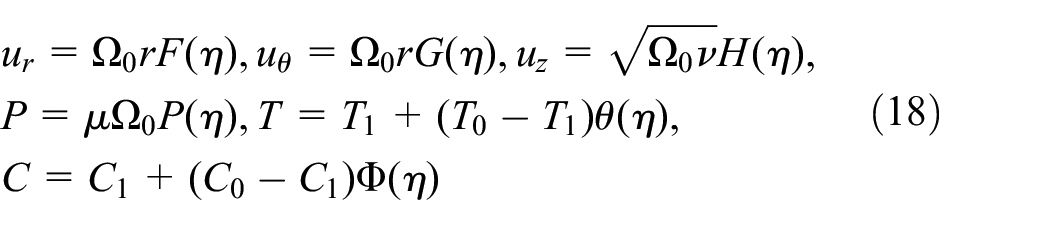
By using the above value of different parameters into equation (8), we get:
Note that the transformations in equation (18) are matched with the similarity variables of Sparrow and Gregg10 and when we substituted the transformation from equation (18) into governing equations along with boundary condition in equations (1)–(7), we exactly recovered the classical problem of Sparrow and Gregg.10
The important properties of the flow field have been evaluated and solution of the problem is calculated and presented in Table 1. The values in Table 1 are obtained from the numerical solution of the problem and they are exactly matched with the results, published in Sparrow et al.10 In this table some seven quantities are determined, four field variables are evaluated at the surface of cylinder, whereas, the thickness of momentum, thermal, and concentration boundary layers is also calculated and shown in this table. The results of this table are obtained for different values of injection and suction parameter . Moreover, we recovered more results of the Sparrow et al10 and they are graphed in Figure 2. We exactly found their results in this figure. The rates of heat and mass transfer are graphed in Figure 2 against . Note that is varied from negative to positive values, which show injection and suction through porous disk. Moreover, Sparrow and Gregg used for the injection and suction parameters, whereas, in the current simulation, is representing that physical quantity. The rates of heat and mass transfer is decreased with the increasing of , for (large injection), whereas, both the rates have been vanished and same is the case with skin friction coefficient, however, it became zero for Moreover, the shear stress gives a bell shaped curve, which means that it has a fixed and uniform value for large injection and suction, however, the shear stress profile has maximum value of 1 for in the neighborhood of zero. Here, has been given zero value because the stretching and shrinking effects are not considered in the paper of Sparrow and Gregg.10
Comparison of the numerical solution with problem10 problem. Note that the present results are exactly matched with the results of Sparrow et al.10 Moreover, , and are representing the thickness of momentum, thermal, and concentration boundary layers.
−4
0.2495
4.0052
2.8024
0.2503
0.1246
0.3573
−3
0.3312
3.0121
2.1056
0.3326
0.1654
0.4751
−2.5
0.3947
2.5206
1.7595
0.3967
0.1973
0.5674
−2.0
0.4848
2.0385
1.4177
0.4886
0.2428
0.7004
−1.5
0.6136
1.5799
1.0870
0.6241
0.3089
0.9006
−1.2
0.7104
1.3281
0.8998
07316
0.3609
1.0670
−0.8
0.8463
1.0364
0.6730
0.9013
0.4410
1.3494
−0.4
0.9576
0.8016
0.4798
1.0859
0.5225
1.6980
−0.2
0.9956
0.7033
0.3696
1.1790
0.5612
1.8944
−0.08
1.0121
0.6497
0.3515
1.2350
0.5834
2.0191
0
1.0205
0.6159
0.3231
1.2722
0.5975
2.1041
0.06
1.0254
0.5916
0.3028
1.3001
0.6085
2.1706
0.1
0.0280
0.5758
0.2897
1.3187
0.6513
2.2152
0.3
1.0341
0.5022
0.2296
1.4122
0.6486
2.4452
0.5
1.0291
0.4364
0.1782
1.5066
0.6802
2.6876
0.6
1.0230
0.4063
0.1557
1.5541
0.6954
2.8125
0.7
1.0147
0.3779
0.1353
1.6018
0.7098
2.9402
0.8
1.0045
0.3511
0.1168
1.6503
0.7243
3.0702
1.0
0.9790
0.3022
0.0854
1.7491
0.7517
3.3363
1.6
0.8758
0.1885
0.0281
2.0608
0.8319
4.1693
2.0
0.7979
0.1360
0.0114
2.2848
0.8841
4.7378
3.0
0.6183
0.0603
0.0006
2.8987
1.0133
6.1538
4.0
0.4861
0.0289
0.0000
3.5734
1.1515
7.5471
5.0
0.3951
0.0155
0.0000
4.2832
1.2922
8.9151
(a) Rates of heat transfer (Nusslet number) and mass transfer (Sherwood number) and (b) torque and shear-stress (skin friction) are graphed against for10 problem.
There are four subplots in Figure 3, the first, second and third graphs show the profiles of dimensionless velocity components, that is, axial, transverse, and azimuthal velocities, whereas, the fourth graph of this figure shows the temperature and concentration profiles. All the profiles in Figure 3 are increased with the increasing of . The zero value of corresponds to impermeable disk, therefore, the positive and negative values of show injection and suction through the porous disk, so in these figures, we considered three different cases of . All the profiles and the thickness of their respective boundary layers are increased with the increasing of . Moreover, the velocity overshoot is observed in the profiles of (radial component of velocity), hence the overshooting values are increased with the increasing of . All the profiles are asymptotic in nature, however, the profiles show that the fluid layer has maintained the temperature and species concentration of wall for large values of , however, the thickness of fluid layer of constant temperature is increased with the increasing of .
Effects of injection and suction are seen on the dimensionless field variables in the absence of stretching and shrinking, whereas, the results are exactly matched with.10
Compairison with von Kármán
The benchmark solutions of von Kármán model are simply retrieved when we changed the parameters, used in new variables, presented in equation (8). Meanwhile, the following value are assigned to the parameters:
where, is taken in the von Kármán problem and it represents the uniform angular velocity of the disk. After putting these values of the parameters, the transformations in equation (8) are absolutely transformed into the von. Kármán’s variables, introduced for velocity components and pressure:
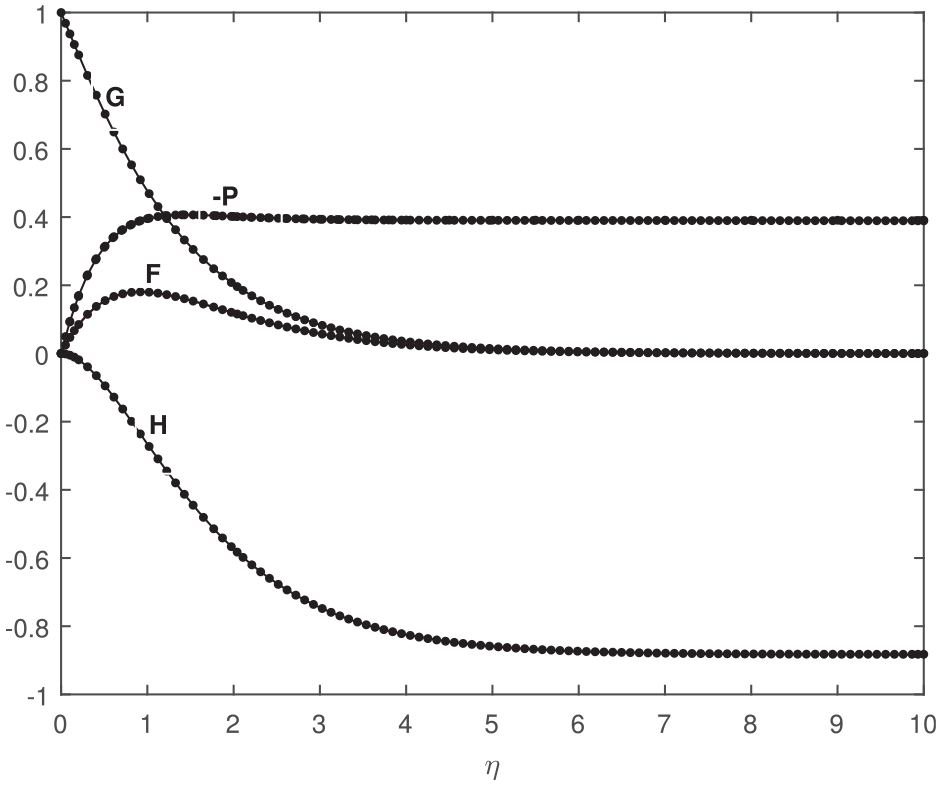
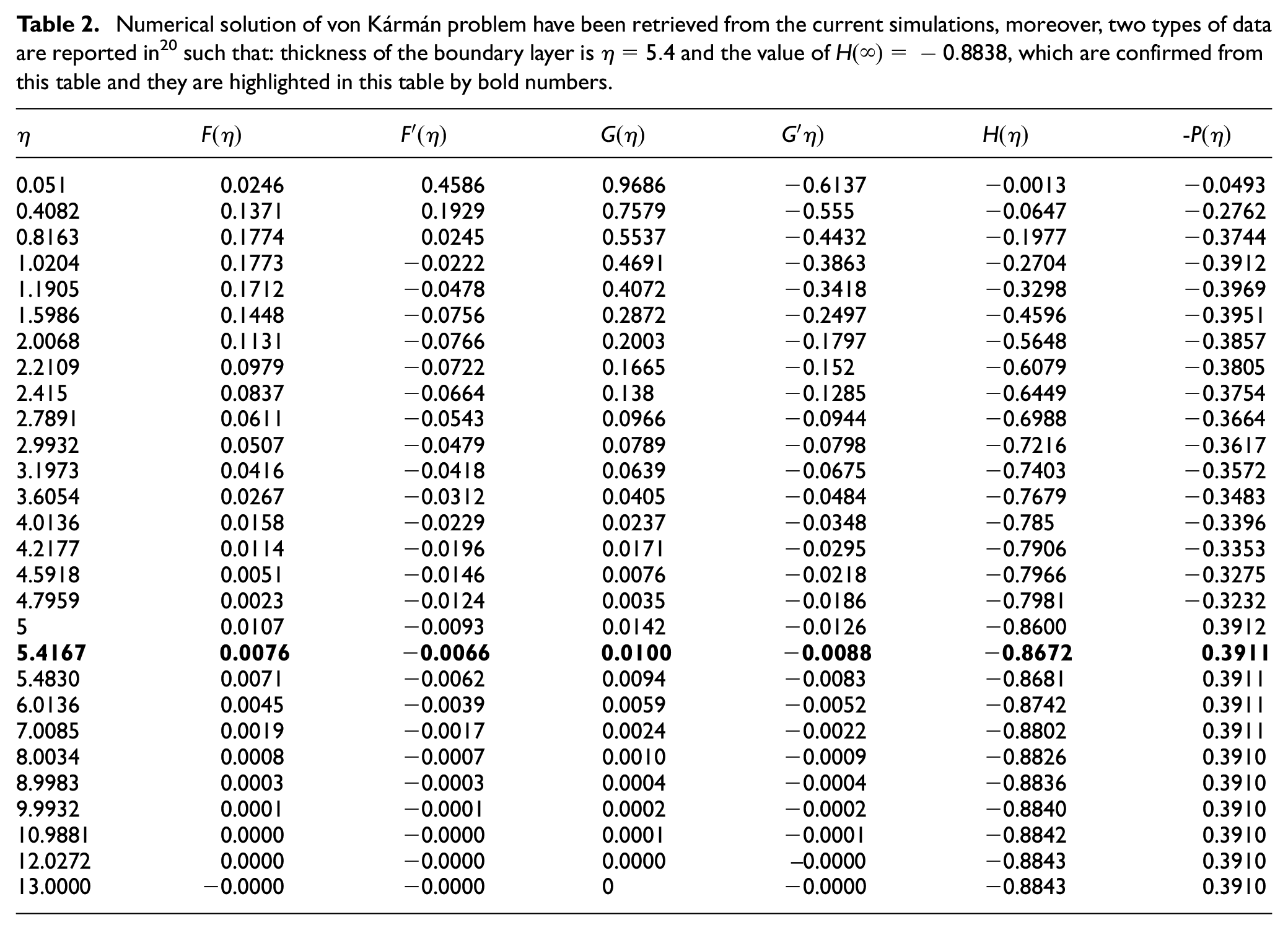
where . The above values are used into equation (1–4) and we exactly recovered the classical problem of von Kármán. The boundary conditions in equation (7) are regained for his problem in view of equation (20). Note that he did not consider the transport of heat and mas in flow, therefore, the diffusion equations for energy and mass are not taken in this comparison. The equations (obtained in this case) are solved numerically with the help of MATLAB using package and the results are presented in Figure 4 and Table 2. The field variables are plotted against , which are absolutely identical to already published solution of von Kármán given in White.20 The numerical data of the solution is presented in Table 2, whereas, the numerical values of are obtained at various values of . In Figure 4, and are denoting the von Kármán variable, whereas, they are used to represent the pressure and three velocity components.
Comparison of the numerical solution (dotted lines) of the problem obtained in this case with the von Kármán solutions (solid lines).
Numerical solution of von Kármán problem have been retrieved from the current simulations, moreover, two types of data are reported in20 such that: thickness of the boundary layer is and the value of , which are confirmed from this table and they are highlighted in this table by bold numbers.
-
0.051
0.0246
0.4586
0.9686
−0.6137
−0.0013
−0.0493
0.4082
0.1371
0.1929
0.7579
−0.555
−0.0647
−0.2762
0.8163
0.1774
0.0245
0.5537
−0.4432
−0.1977
−0.3744
1.0204
0.1773
−0.0222
0.4691
−0.3863
−0.2704
−0.3912
1.1905
0.1712
−0.0478
0.4072
−0.3418
−0.3298
−0.3969
1.5986
0.1448
−0.0756
0.2872
−0.2497
−0.4596
−0.3951
2.0068
0.1131
−0.0766
0.2003
−0.1797
−0.5648
−0.3857
2.2109
0.0979
−0.0722
0.1665
−0.152
−0.6079
−0.3805
2.415
0.0837
−0.0664
0.138
−0.1285
−0.6449
−0.3754
2.7891
0.0611
−0.0543
0.0966
−0.0944
−0.6988
−0.3664
2.9932
0.0507
−0.0479
0.0789
−0.0798
−0.7216
−0.3617
3.1973
0.0416
−0.0418
0.0639
−0.0675
−0.7403
−0.3572
3.6054
0.0267
−0.0312
0.0405
−0.0484
−0.7679
−0.3483
4.0136
0.0158
−0.0229
0.0237
−0.0348
−0.785
−0.3396
4.2177
0.0114
−0.0196
0.0171
−0.0295
−0.7906
−0.3353
4.5918
0.0051
−0.0146
0.0076
−0.0218
−0.7966
−0.3275
4.7959
0.0023
−0.0124
0.0035
−0.0186
−0.7981
−0.3232
5
0.0107
−0.0093
0.0142
−0.0126
−0.8600
0.3912
5.4167
0.0076
−0.0066
0.0100
−0.0088
−0.8672
0.3911
5.4830
0.0071
−0.0062
0.0094
−0.0083
−0.8681
0.3911
6.0136
0.0045
−0.0039
0.0059
−0.0052
−0.8742
0.3911
7.0085
0.0019
−0.0017
0.0024
−0.0022
−0.8802
0.3911
8.0034
0.0008
−0.0007
0.0010
−0.0009
−0.8826
0.3910
8.9983
0.0003
−0.0003
0.0004
−0.0004
−0.8836
0.3910
9.9932
0.0001
−0.0001
0.0002
−0.0002
−0.8840
0.3910
10.9881
0.0000
−0.0000
0.0001
−0.0001
−0.8842
0.3910
12.0272
0.0000
−0.0000
0.0000
–0.0000
−0.8843
0.3910
13.0000
−0.0000
−0.0000
0
−0.0000
−0.8843
0.3910
Results and discussion
A set of appropriate similarity variables is formed which transforms the system of PDE’s along with the boundary conditions into a new system of boundary value ODE’s. The system of ODE’s is solved numerically with the help of bvp4c package of MATLAB, however, effects of different parameters are seen on field variables. The system contains seven dimensionless parameters, whereas, they control the injection (suction), stretching (shrinking), rotation, thermal, and mass diffusivities, the nonlinear nature of both surface temperature and species concentration. However, effects of all these parameters are seen on the field variables and the new results are presented in different graphs.
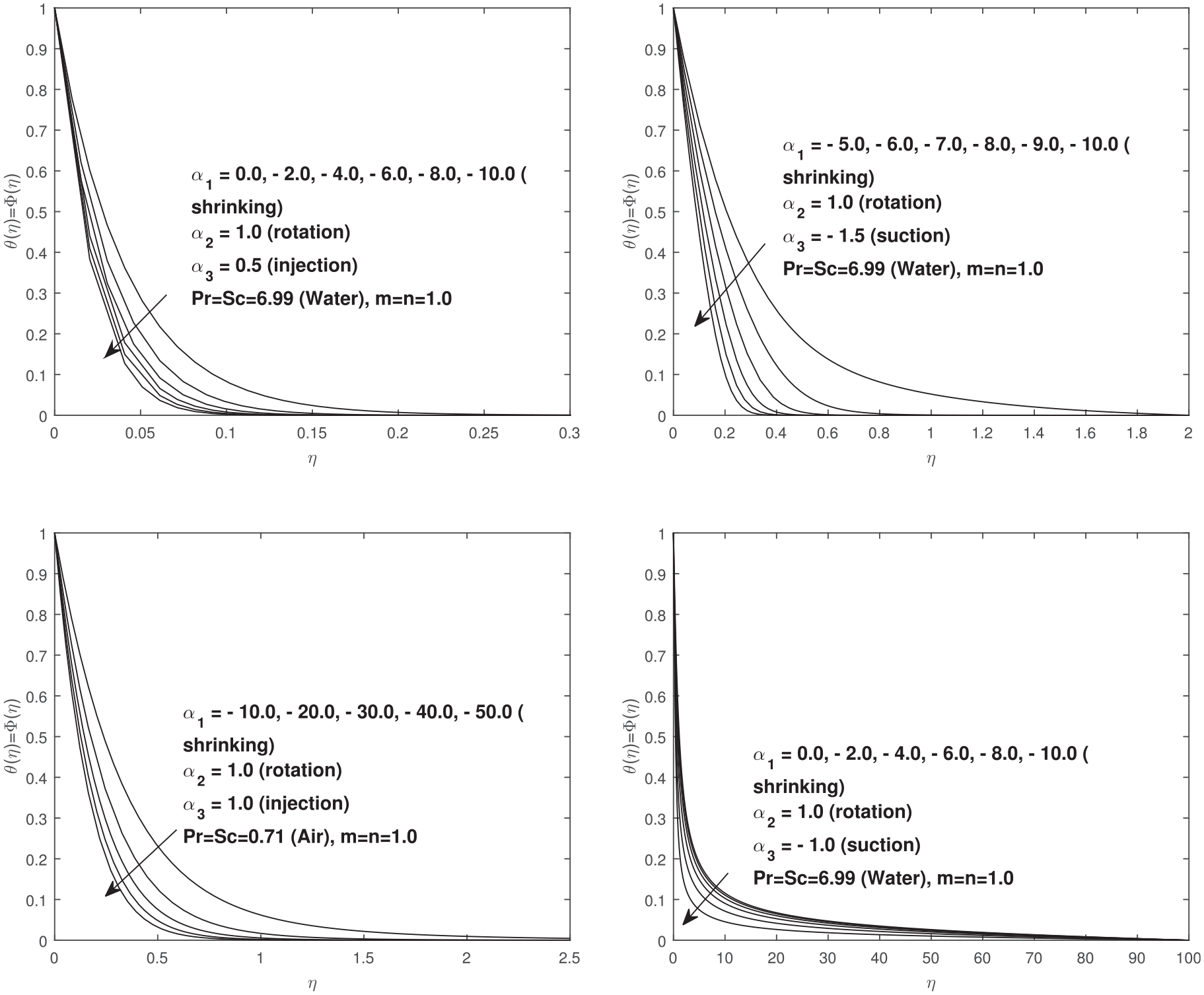
In Figures 5 to 10, the temperature and concentration profiles are graphed against for different values of the parameters. Note that each curve in all these figure is representing both the temperature and concentration distributions. Furthermore, the small (large) Prandtl/Schmidt corresponds to fluids having low (higher) viscosity or strong (weak) thermal/mass diffusivity, therefore, we emphasized on the individual and combined role of thermodynamic and dynamical properties of the fluids and disk, whereas, we confirmed that they have changed the flow features and transport behaviors of heat and species mass more effectively. We observed changes in profiles of velocity, temperature and concentration functions with the variation of all these properties. These characteristics have been measured by means of dimensionless quantities. On the other hand, the two dynamical behaviors of disk are controlled by and , which may get any value from the set of real number and will present a different physical situations and they have been focused in the present figures. However, four different cases have been taken in Figure 5. In this figure, effects of injection parameter () are seen on these two (temperature and concentration) field variables in the presence of stretching () and rotation, whereas, the investigations are carried out for two different fluids. The profiles are smoothly changed in all these figures, whereas, in case of shrinking, the fluid of relatively higher viscosity (water) is taken in presence of intermediate suction, thin thermal, and concentration boundary layers are observed near the surface of the disk. In case of small injection, unit stretching and rotation, overshoots in the profiles of these two functions are observed near the surface of the disk, however, the overshoots are increased with the increasing of injection. Moreover, the profiles are smoothly changed and decreased with the increasing of injection. These observations are noted for large values of shrinking parameter and fluids of small viscosity (air). On the other hand both the thermal and concentration boundary layers are decreased for increasing of in this case. For stretching, injection, rotation, small and , the temperature, and concentration profile are not exactly asymptotic in nature. Note that the most suitable, accurate and cheap solutions are obtained for fluids, having higher Prandtl and Schmidt numbers. In case of stretching, shrinking, injection and rotation, however, the solutions are more expensive, weak and poor (worst solutions) in case of stretching, rotation, injection, and small Pr and Sc.
Effects of injection parameter are seen on and (the dimensionless temperature and concentration variables) for different cases of (stretching and shrinking).
Effects of stretching parameter are seen on and (the dimensionless temperature and concentration variables) for different values of (suction).
Effects of injection parameter are seen on and (the dimensionless temperature and concentration variables) for different values of (stretching case).
Effects of suction parameter are seen on and (the dimensionless temperature and concentration variables) for different values of (stretching case).
Effects of parameters and (they determine the nonlinear nature of temperature and concentration functions at the disk) are seen on temperature and concentration profiles.
Effects of parameters and (they determine nonlinear nature of temperature and concentration functions at the disk) are seen on temperature and concentration profiles.
In Figure 6, we focused on the variation of suction and its effects are demonstrated on temperature and concentration profiles, whereas, we have taken the cases of low and high injections in the presence of stretching and large shrinking for water and flows over a rotating disk. In Figure 5, four different cases have been discussed. Effects of suction parameter are seen on the two field variables in the presence of stretching and rotation. The profiles are changed smoothly in all figures, whereas, in case of small suction, for fluid of high viscosity (water), thin thermal and concentration boundary layers are observed near the surface of the disk. However, an overshoot is seen for the case of stretching, which decreases with the increase of suction parameter. Moreover, for intermediate suction and shrinking, thermal and concentration boundary layers are increased as suction increases near the surface of the disk. For large values of suction and low viscous fluid (air), increase in thermal and concentration boundary layers is seen, but for very large values of suction, the temperature and concentration profiles are not exactly asymptotic in nature. In Figure 7, four different cases have been discussed. Effects of stretching parameter are seen on the two field variables in the presence of injection/suction and rotation. The profiles are changed smoothly in all figures, whereas, in case of small stretching, fluids of higher viscosity like water, thin thermal, and concentration boundary layers are observed near the surface of the disk. However, an immediate downfall in its profile is seen for the case of small injection, which decreases with the increase of stretching parameter. Moreover, for large suction and stretching, thermal, and concentration boundary layers are increased as stretching parameter increases near the surface of the disk. For large (and very large) values of stretching and for low viscous fluids (inviscid fluids, e.g. air and gases), the temperature and concentration profiles are not exactly asymptotic in nature. In Figure 8, four different cases have been discussed. Effects of shrinking parameter are seen on the two field variables in the presence of injection/suction and rotation. The profiles are changed smoothly in all the figures. In Figure 8(a) and (b), thin thermal and concentration boundary layers are observed for both injection and suction cases, which decreases with the increase of shrinking parameter. In Figure 8(c), large values of shrinking parameter are taken and thin boundary layers are seen, which decreases with increase of shrinking parameter near the surface of the disk. However, temperature and concentration profiles are not asymptotic for small suction and shrinking case, which are shown in Figure 8(d).
Effects of nonlinear and uniform disk’s temperature and surface concentration are studied and their effects are seen on and distributions. In Figure 9, the temperature and concentration profiles are graphed for three negative and zero values of . Note that the diffusion of heat and mass in water over a rotating and shrinking disk is investigated in the presence of injection. It is observed that the thermal and momentum boundary layers are decreased for large values of , however, thin thermal and concentration boundary layers are observed for that values of . Moreover, an overshoot in the profile of two diffusion functions is observed for negative values of and it enhances with large negative values of In Figure 10, the same field variables are investigated under the same physical situation for three positive and zero values of . Note that the boundary layer thickness is decreased with the increasing positive values of , however, no overshoot in the temperature and concentration profiles is observed for positive values of .
Shaft torque, shear stress, and the rates of two diffusion functions
The viscosity of fluid produces a tangential shear stress at the vicinity of the disk and it possesses strong resistance to the disk motion, in order to control this difficulty, more torque is needed at the shaft to get steady rotation. Therefore, the tangential shear stress is evaluated with the help of Newton’s law of viscosity as:
Furthermore, this shear stress is evaluated at the surface of the disk, therefore, the transformation, proposed in equation (9), are substituted in the above standard definition and we obtained its simplified version as:
On the other hand the shaft torque measures the shear on one side of a rotating disk and it is given by the formula , where is the disk radius. In view of the expression for , the shaft torque becomes:
So, both the tangential shear and the shaft torque are directly related to the slope of the tangential velocity profile at the disk. Furthermore, another shear stress, namely, surface shear stress, which is less important than tangential shear stress can also be determined. Using Newton’s shear stress relation: , where, the subscript denotes the shear stress at the surface of the disk, in view of the transformation given in equation (9), it takes the form: .
Similarly, the heat and mass transfer from the surface of the disk into the fluid is calculated by applying Fourier’s and Fick’s laws as: , respectively. The transformation, adopted in equation (9), are substituted in these two laws and we obtained that:
Moreover, the heat and mass transfer coefficients are defined by:
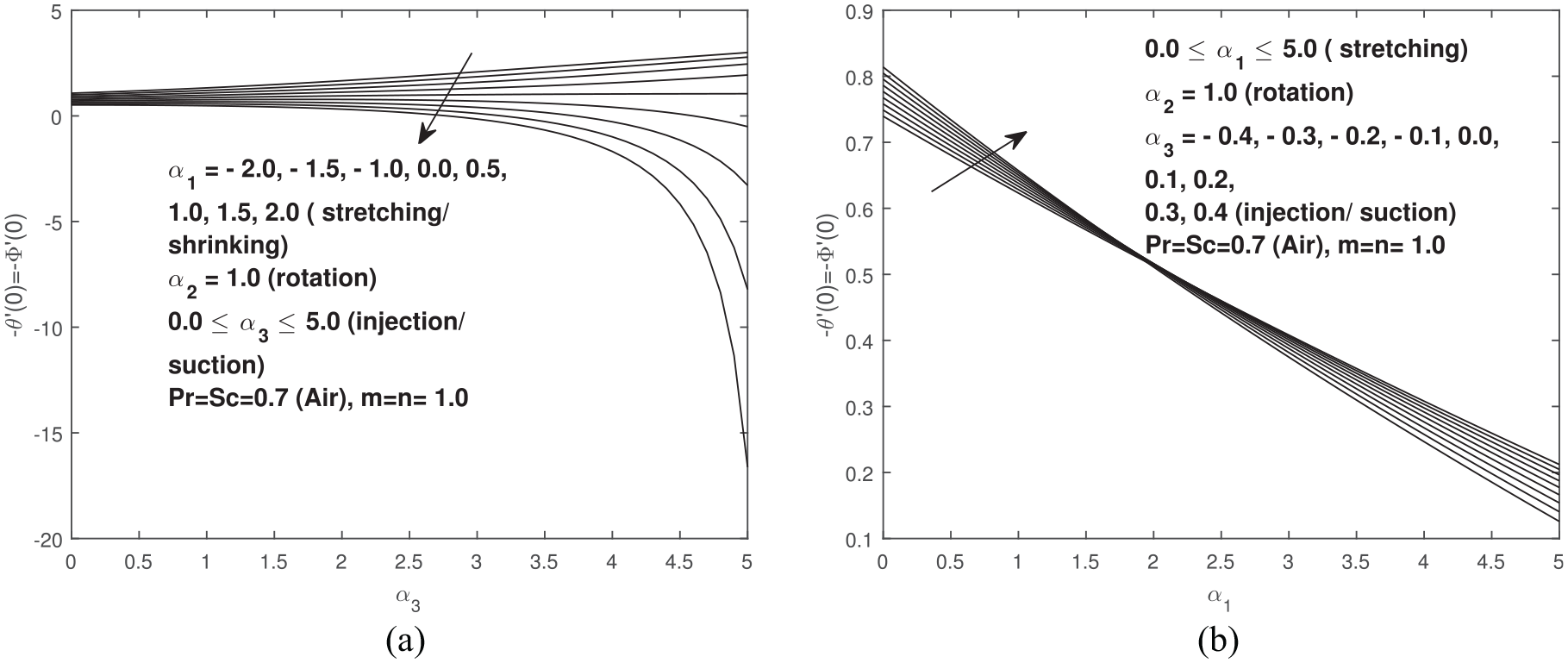
Finally, the quantities and are properly nondimesionlized and we get . Note that and are the Nusslet and Sherwood numbers, respectively. The graphs of and are given in Figure 13 for all three different parameters , and respectively.
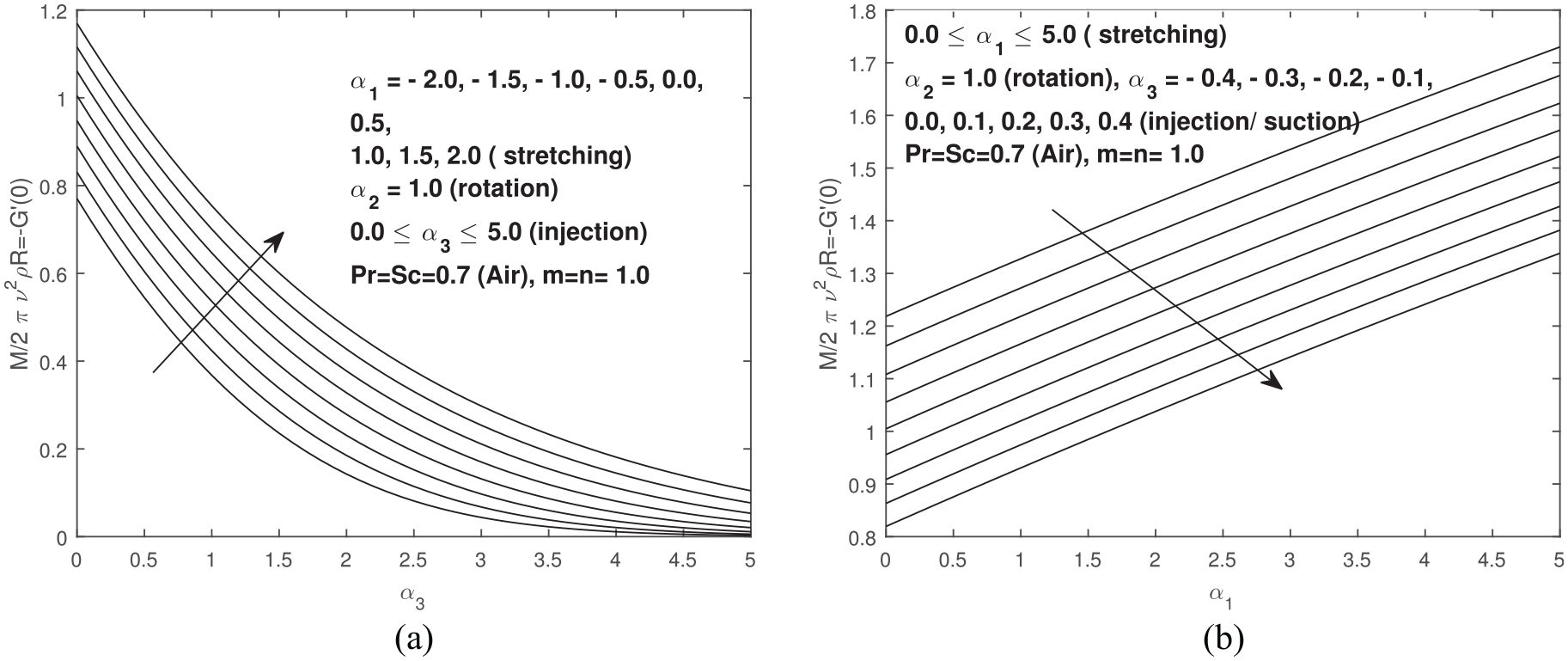
In Figure 11(a) and (b), both linear and nonlinear variations in the tangential/resistance shear stress have been seen, depending on the dynamical behavior of the rotating disk. therefore, in Figure 10(a), the tangential resistance shear stress is plotted for multiple values of injection/suction against stretching/shrinking whereas, the investigation are carried out for the transport of heat and species mass in gases, however, the resistance shear stress is independent of these fundamental thermodynamic properties. Over the fixed range of injection parameter, nonlinear and decreasing pattern is seen. But this behavior is changed linearly and quickly for fixed range of stretching, and variable suction/injection as shown in Figure 11(b). In Figure 12(a), surface shear stress is graphed for fixed range of injection and variable stretching/shrinking. For some value between 2 and 2.5 of , behavior of the profiles changes from decreasing to increasing. Similarly, in Figure 12(b), the surface shear stress is shown for fixed range of stretching , with variable injection/suction parameter, uniform increasing behavior in the profiles is recorded for this case. In Figure 13(a), Nusslet and Schmidt numbers are plotted for fixed rang of injection , a sudden decrease is observed as stretching parameter increase in the presence of large injection. In Figure 13(b), Nusslet and Schmidt number are plotted for fixed rang of stretching , an increase is noted for small stretching parameter. Both linear and nonlinear behaviors of the surface shear stress have been seen in Figure 11(a) and (b). The linear profiles of this quantity (in Figure 11(b)) are graphed against stretching parameter for porous disk, whereas, it has zero value for all and when is zero. Moreover, the nonlinear profiles of that specific quantity intersect at a common point, when it is graphed against injection for different values of stretching and shrinking parameters. In this case, the flow is maintained over a porous and rotating disk, which is stretched/shrunk with different velocities.
(a) Tangential shear stress is evaluated against for different values of , and (b) surface shear stress is calculated against for different values of .
(a) Surface shear stress is evaluated against for different values of and (b) surface shear stress is calculated against for different values of .
(a) Nusslet number and Schmidth number are evaluated for different values of against , and (b) surface shear stress is calculated against for different values of .0.
Conclusion
A generalized model of flow problem is undertaken for the diffusion of heat and mass in fluid motion such that the flow is maintained over a porous, rotating, stretching (shrinking), and heated disk. Note that the disk has variable angular velocity, whereas, the porous disk allows the nonuniform injection/suction through its surface. Moreover, the disk has been stretched/shrunk with variable velocity in the radial direction. The temperature of the disk is nonuniform and variable species concentration is assumed at its surface. The present simulated problem can be transformed into the classical models easily and fairly, and the published results of two papers have been retrieved by adjusting the parameters of the current modeled problem. Moreover, an overshoot in the velocity, temperature, and concentration profiles is observed for certain values of the parameters and this overshoot increases with the increase of some parameters and decreased with the variation of some other parameters. Furthermore, the rates of heat and mass transfer as well as skin friction vanished for different ranges of large injection. In case of intermediate stretching, an overshoot in the temperature and concentration profiles has been observed, for the transport of heat and mass in fluids of higher viscosity. Besides that, thin thermal and concentration boundary layers are observed for the fluid of higher viscosity in case of stretching and injection. The temperature and species concentration, at the surface of the disk, are taken in the forms of uniform, linear, quadratic, non-algebraic functions, and their inverse function, however, it is observed that this variation has strictly changed the temperature and concentration profiles and the associated boundary layers are also reduced with the kind of nonlinearities. The comfortable solutions are obtained for all cases of injection, shrinking and rotation for fluid having high and , whereas, poor solution are obtained for the fluids of low and for the case of stretching, rotation and injection. Very thin boundary layers are noticed in some cases.
Footnotes
Appendix
Handling Editor: Chenhui Liang
Declaration of conflicting interests
The author(s) declared no potential conflicts of interest with respect to the research, authorship, and/or publication of this article.
Funding
The author(s) received no financial support for the research, authorship, and/or publication of this article.
ORCID iDs
Muhammad Bilal
Aftab Alam
References
1.
KármánTV. Über laminare und turbulente Reibung. ZAMM1921; 1: 233–252.
2.
PrandtlL. Bemerkungen über die Entstehung der Turbulenz. Z angew Math Mech1921; 1: 431–436.
3.
CochranWG. The flow due to a rotating disc. Math Proc Camb Philos Soc1934; 30: 365–375.
4.
CraneLJ. Flow past a stretching plate. ZAMP1970; 21: 645–647.
5.
WangCY. The three-dimensional flow due to a stretching flat surface. Phys Fluids1984; 27: 1915–1917.
6.
FangT. Flow over a stretchable disk. Phys Fluids2007; 19: 128105.
7.
StuartJT. On the effects of uniform suction on the steady flow due to a rotating disk. Q J Mech Appl Math1954; 7: 446–457.
8.
ZandbergenPJDijkstraD. Von Karman swirling flows. Annu Rev Fluid Mech1987; 19: 465–491.
9.
MillsapsKPohlhausenK. Heat transfer by laminar flow from a rotating plate. J Aero Sci1952; 19: 120–126.
10.
SparrowEMGreggJL. Mass transfer, flow, and heat transfer about a rotating disk. ASME J Heat Transfer1960; 82: 294–302.
11.
OstrachSThorntonPR. Compressible laminar flow and heat transfer about a rotating isothermal disk. No. NACA-TN-4320, 1958. Moffett Field, CA: National Advisory Committee for Aeronautics.
12.
TadrosSEErianFF. Generalized laminar heat transfer from the surface of a rotating disk. Int J Heat Mass Transf1982; 25: 1651–1660.
13.
EvansGHGreifR. Forced flow near a heated rotating disk: a similarity solution. Numer Heat TR A-Appl1988; 14: 373–387.
14.
Le PalecG. Numerical study of convective heat transfer over a rotating rough disk with uniform wall temperature. Int Commun Heat Mass Transf1989; 16: 107–113.
15.
HiroseKYokoyamaTOuchiM. Numerical Study of convective heat transfer on the horizontal isothermal rotating disk. Transactions Japan Soc Mech Eng Ser B1995; 61: 3770–3775.
16.
AttiaHA. Transient flow of a conducting fluid with heat transfer due to an infinite rotating disk. Int Commun Heat Mass Transf2001; 28: 439–448.
17.
TurkyilmazogluM. Purely analytic solutions of magnetohydrodynamic swirling boundary layer flow over a porous rotating disk. Comput Fluids2010; 39: 793–799.
18.
SharmaKVijayNMakindeOD, et al. Boundary layer flow with forced convective heat transfer and viscous dissipation past a porous rotating disk. Chaos Solitons Fractals2021; 148: 111055.
19.
ZhouSSBilalMKhanMA, et al. Numerical analysis of thermal radiative maxwell nanofluid flow over-stretching porous rotating disk. Micromachines2021; 12: 540.
20.
WhiteFM. Viscous fluid flow. 2nd ed. New York: McGraw-Hill, 1991.