




Abstract
Indian metro system is comprised of many functional units for enabling smooth run of trains namely tracks, rolling stock, signaling and communication, operations and control center, projects, and design. Among those functional units, Rolling Stock (RS) is an integral part of any rapid transit system and also the most critical space if proper maintenance measures are neglected. The rolling stock department comprises interdisciplinary teams working together to ensure efficient delivery of trains on a service run. The trainsets of Metro Rail Networks are often subjected to both periodic and corrective maintenance based on service requirements. The maintenance schedule of the trainsets is monitored through a wireless communication mode. The train operator is responsible for alerting the nodal person regarding subsequent correspondence in the event of any emergency maintenance necessity. Therefore, this paper concentrates on the development of an IoT-based automatized maintenance prioritizing platform based on the incorrect operational sequence number that pops up in the operator’s cabin. A mathematical model is synchronized with the alert triggering signal from the field to categorize hierarchical decision-making on preventative and corrective maintenance. Simultaneously, a Genetic Algorithm is implemented to analyze the adopted combinations of maintenance say M1, M2, and M3 to identify the model that produced precise results. The test results reveal that the M3 model, which includes both corrective and preventative maintenance exhibits higher efficiency with a probability of 0.92%–0.98%. In addition, the combined maintenance prioritization system M3 offers the quickest analyzing time in the cloud computing platform (0.18 s) and the highest transaction performance on real-time datasets.
Keywords
Introduction
India has nearly 13 operational Mass rapid transit systems (MRTS). MRTS is widely used due to its speed, reliability, and comfort. 1 The only Indian metro to bag an award from a world safety organization is Chennai Metro Rail Limited (CMRL). Chennai metro rail Limited (CMRL) began its service run in 2017 as a joint venture of the Government of India and the Government of Tamilnadu. The CMRL’s major control is headquartered at the Koyambedu Operations and Control Centre (OCC) in Chennai, Tamilnadu. The OCC is responsible for the overall control of mainline viaducts, underground tunnels, and depots. The Rolling Stock (RS) depot is located on the OCC campus and spans around 26 hectares. RS depot began service run initially with 36 trainsets, further expanding to 52 trainsets. In Figure 1 the RS depot consists of three sheds such as a stabling area with a washing line where the trains are parked during night time as well as the trains that have to be serviced the next day, inspection sheds where the trains are subjected to periodic checks and other services, storage sheds where the spare parts are stored and maintenance equipment are stationed. Rolling stock (RS) is considered to be the most centric space of any mass rapid transit system. An efficient maintenance schedule is adequate to achieve a reliable RS system. The rolling stock department of CMRL consists of vehicles that move on track, Rail road vehicles (RRV), and diesel locomotives other than the trainsets. In order to carry out the maintenance activities, the CMRL has a perfectly trained in-house maintenance team and contract team. The rolling stock department’s maintenance strategy is divided into two categories: periodic/preventive maintenance and corrective maintenance. The in-house team carries out the corrective maintenance activities while the periodic maintenance activities are entrusted to the contract fleet. RS’s maintenance strategy selection/performance influences the commuter’s safety aspects and riding comfort. The duration of maintenance depends on the condition of the train set, the composition of the work fleet, availability of spare parts, dwelling time of the trainset for maintenance, availability of track, and their rectification time. The accessibility of inspection lines is determined by the RS depot layout. 2

Rolling stock depot internal layout.
The rolling stock (RS) depot at CMRL consists of four inspection bay lines with overhead powerlines, and workshop lines with pits. The inspection lines accommodate trains that are scheduled to be serviced ahead of their maintenance time limit. 3 Once the trains have arrived for service, the outsourced contract team is responsible for servicing and maintenance to ensure that trains are fit for 7 days.
The day and time when the train will be fit for service from the day it has undergone maintenance are crucial for the RS depot control. 4 The trains inside the inspection lines move with the help of overhead electric lines. The trainset which requires corrective maintenance measures is moved into the workshop line with the help of battery shunters. The shunters are transferred from one workshop line to the other with the help of a drum trolley. The maintenance activities are planned well ahead in order to accommodate the trainsets on the inspection lines according to the availability of the work team. In the event of an emergency, the trainset will be driven to the depot or by using an RRV if the train is unable to run on its own. The rolling stock depot consists of working rooms adjacent to the inspection bay lines in order to facilitate the technicians easily attending to the maintenance action. There have been many decision models conceived to assign a trainset for maintenance works. 5 This study intends to serve as a model for prioritizing the maintenance actions in order to successfully make the train fit for further service without any schedule errors. Maintenance practices have been followed in the rolling stock department of every rail transit system but, very few research works have been concentrated in the domain of prioritizing the maintenance actions. As a result, the study has developed an automized IoT-based maintenance alerting platform for the rolling stock department to prioritize and decide which maintenance alert is to be given high priority based on the nature of severity that is, number of times it has occurred based on the data stored in the metro cloud as a repository.
Existing methods adopted in rolling stock concerning maintenance strategy
The components of rolling stock must be kept under adequate supervised maintenance in order to deliver a safe and reliable service. 6 The RS system cannot function reliably unless the existing maintenance crew and facilities for the available trainset are specified. 4 Railway failure prediction is challenging due to a lack of real-time database availability, which lowers performance targets. 7 Many researchers have investigated on the areas of preventive maintenance and schedule rostering of rolling stock. In Table 1 the significant scientific contributions that support this study are listed.
Existing literature database and inferences.

Most of the previous research works have been concentrated on optimizing the maintenance schedule by reducing the maintenance time in the planning horizon and also by reducing the operating cost using mixed integer programing problems, heuristics, decision tree models, genetic algorithms, etc. Therefore, the researchers of this study adopted a genetic algorithm approach and deployed them into a database platform also known as “Metro cloud” to prioritize the maintenance activity of rolling stock based on its severity and relevance.
Outlook of organizational workflow carried out in rolling stock in India
The rolling stock depot consists of n number of teams working toward successful day-to-day operations. Engineers and investigators used to establish inspection and maintenance routines for railway infrastructure and rolling stock systems based on prior knowledge and judgment. 17 The program planning and inspection in charge (PPIO), often known as a planner, is the hotspot of the rolling stock depot. PPIO is responsible for the movement of trains inside the rolling stock depot. In addition, they are also responsible for the maintenance of trainsets and issue job cards to various other departments that is, electrical, communication, and track for performing maintenance on trains. In addition to PPIO, the technical cell and inspection team are responsible for documentation works carried out on the trainsets. Technical cell portrays the annual monthly report of the trainsets. The report includes the maintenance schedule adopted for each train, mileage recorded during every maintenance action, and the fitness of the train. The fitness of the train is evaluated by an in-house maintenance team that is, Aradhana Engineering Works (AEW). Periodic maintenance work of the rolling stock depot is characterized by inspecting the physical fitness of the trainsets through various in-house maintenance teams, maintenance of building infrastructure and assuring the availability of spare components in the RS depot. Frequent activities planned under a preventive maintenance strategy drives up the total cost incurred for rolling stock maintenance. 9 The trainsets will be available on the inspection bay lines for periodic maintenance at a fixed time horizon, while the rest of the trainsets will be stationed inside the stabling sheds. If any component of the rolling stock fails, the train operator must notify the PPIO. Furthermore, if any component is found to entirely deteriorate and requires replacement, the PPIO assigns job cards to the appropriate departments, instructing them to replace the component as quickly as feasible. Rolling stock depot includes PPIO, storeroom, inspection cell, technical cell, electrical service team, overhauling equipment’s service, train operator control room, AEW, and higher authority officials cabins along with conference halls. In the event of a failure in electrical or mechanical components, corrective maintenance is performed by in-house professionals. These components are available in the component storeroom of Alstom. The machineries available within the rolling stock depot is owned by CMRL and their periodic maintenance is leased out to external agencies. The majority of the staff members are outsourced rather than the in-house metro team and hence there is a lack of workflow that is, technical knowledge transfer between the two teams that at times leads to repeated arise of common or default issues. PPIO serves as the nodal planning officer to whom all other departments should report within the rolling stock depot.
Data mining for corrective maintenance strategy formulating the pre-requisites actions
Maintenance strategy of PPIO and data collection
Rolling stock is subjected to weekly maintenance and functional checks. Maintenance of rolling stock is highly essential as it is directly proportional to the comfort and safety level of passengers. 6 The maintenance schedule is planned based on the capacity of the in-house fleet and the availability of by-lines for inspection, signaling, and washing purposes. The maintenance schedule as well as the parameters included in the study was obtained from the Chennai Metro Rail Limited (CMRL) rolling stock depot. In Table 2 the existing maintenance schedule for the 42 trainsets with two functional depots, D1 and D2, in order to efficiently prioritize and accomplish the RS maintenance task is shown.
Rolling stock maintenance strategy.

The trainsets are planned to be serviced in two depots namely D1 and D2 based on their track availability. The trainsets of each category namely set A, B, C, D, E, F, and G are subjected to weekly checks which determine the train fitness for a period of 7 days. When this assumption results in intractable shunting difficulties at some stations, the rolling stock plan must be changed later in the planning process. 10 The weekly check includes technical inspection of parameters such as bogies, air generation treatment units, pneumatic accessories, traction converter, transformer, battery box, coach area, cab operator cabin, saloon, and roof area. According to the pre-defined running standards of Indian metros, every parametric issue has a rectification measure that is provided in the RS manual. Every train set is subjected to external washing after every service run based on their schedule. The weekly check schedule is manually planned and executed, involving a significant amount of effort. In the event of an emergency failure of trainsets on the line, the availability of tracks in bay lines is minimal and null at times.
In Table 3 IOS number associated with the respective functional failures are represented. The IOS numbers are pre-set and predefined into the train circuits. During the service run, the malfunctioning of any parameter is alerted by a pop-up message that indicates the location of the functionality failure. The Train sets are also fed with an automatic remedy alert system that will be visible on the operator’s screen. In case of failure of remedial alert, there is a need for immediate maintenance intervention. The location of the failure is given as DMC1 and DMC2 which indicates the driver’s motor car cabin whereas TC1 and TC2 represent the second and third car of the train. The train operator initiates a telephonic alert to the depot PPIO officer, who would then organize the available work team to resolve the reported issues. The record of the failure is retrieved from the memory box attached beneath the Operator’s cabin. The same is forwarded to the technical cell and the report based on occurrence and type of failure is registered manually. Rolling stock consists of two sections, the car body, and the bogie portion, each of which is made up of many components namely wheels and axles. The other components of a rolling stock system include the bogie, pantograph, door unit, scroll compressor, braking system, heating, air conditioning, coupler, etc. 17 The functionality and weekly check parameters are also integrated with IOS numbers available in the train memory box and the same is reported to the depot in case any issue pops up on the TO’s operating screen. Real-time evaluation of the failure is possible only after examining the train in the maintenance center to perform the resolving actions. If a component that needs to be replaced is not available within the depot, the train set is not allowed to perform any further service or trials and is relocated to the stabling sheds with the help of an RRV or battery shunter. Only after fixing the new component, the train is moved on to the mainline for service run.
Incorrect operational sequence (IOS) numbers and descriptions associated with the functional parameters of rolling stock.

Therefore, this study aims to overcome the above-mentioned issues systematically. In recent times systems that assist automatic predictions by incorporating real-time constraints have become popular. As a result, a metro cloud is being developed to store inspection records that detail the errors discovered during functional and weekly checks. The PPIO can access these records from the metro cloud in the future to see if any faults that were recorded previously have occurred recently. During weekly checks, every parameter is inspected by the outsourced team and marked as fit/unfit against the checklist. This necessitates additional waiting time for train sets on bay lines for inspection, and a great deal of energy and human force is consumed escalating maintenance costs. Ascertaining the extent or severity of maintenance is not an easy task whereas n number of deciding variables makes it difficult to sort down the maintenance schedule. 12 Hence certain activities need to be performed on a priority basis. Based on previous inspections, this database stored in the metro cloud platform will serve the purpose of indicating the priority of performing a maintenance activity during weekly trainset checks in order to save energy, maintenance costs, and human power rather than performing an activity that is not required each time the trainset is subjected to maintenance. It is also planned to notify the train operator (TO) of which adjacent depots are available for emergency maintenance and to notify the TO before the train arrives at the depot to plan the depot utility ahead of the train’s arrival. Since all existing communication is centered on a wired platform, there is less opportunity for data modification and retrieval in database administration, resulting in overuse of resources and excessive maintenance costs.
Enhancing fault notification followed in rolling stock and steps to synchronize with the metro cloud
In the current scenario, faulty electrical and mechanical components of rolling stock are notified to PPIO through a walkie-talkie, which may induce communication delays or errors. Therefore, a wireless cloud computing platform also known as “Metro Cloud” is utilized for metro network applications. The PPIO system and the control system of the train operator will both have an operator interface installed at the same time. Any anomalous alerts or signals that emerge on the train operator’s screen will be recognized in the metro cloud and necessitate prompt attention. The time gap required to confirm the alarm with the metro cloud via PPIO is set at 20 ms. This allows the PPIO to ensure that the train requires emergency repair intervention.
Systematic and structured maintenance operations are the current trend in every service industry. Automation of the maintenance sector helps to improve the robustness of operations. The repair activities of the rolling stock are thus subjected to improve their maintenance program through a cloud-based monitoring system known as “Metro Cloud,” which integrates maintenance parameters utilizing the IoT concept. In Figure 2 the schematic representation of the proposed IoT-based network design comprising a wireless network, and a database for monitoring the maintenance alert during a service run is illustrated. The goal of integrating these technologies is to gather, process, and analyze categorized maintenance operations, such as preventive and corrective maintenance, based on their severity for further monitoring. Since the existing wireless network system is controlled manually, a wireless cloud-based data mining technology is used to transmit information even when the rolling stock is reported to be at a significant distance from the depot. The application of the system includes two processes: one is to store the database and categorize the activities, other is real-time monitoring of the application. A Metro data center should be constructed to monitor the database that affects decision-making.

Proposed data communication platform between data notification module and metro cloud.
Model development to incorporate in the metro cloud for maintenance strategy, for the work-fleet coordination
In the proposed method, a mathematical model is formulated by considering the preventive and corrective maintenance strategy. The purpose of preventive/periodic maintenance is to minimize the unexpected breakdown of any system that might incur a loss in the operating cost of the rolling stock. Regular maintenance activity includes washing of trains, internal cleaning of trains by the housekeeping team, driver cabin control check, door, and HVAC functioning by the AEW staff, pantograph, and electric check by an in-house team. The basic functionality of every train operation is checked once the trainset has been assigned for maintenance. A laptop is attached to the train set’s workbox to retrieve data and save it as a report in case an error appears on the operator’s screen. Every error flash message that appears on the train operator’s screen is included as a coding set within the train control unit and a feasible solution is suggested to the operator until the train reaches the depot for further maintenance actions. If errors are displayed frequently, the PPIO is notified, who then creates a job card for the issue, which is subsequently forwarded to the appropriate fleet for further action. Initially, the trainsets were subjected to 72-h tests, before being extended to 7 days after a thorough analysis of the entire system. The trainset is considered to be fit for 7 days once it has passed through periodic maintenance as per the schedule proposed by the AEW staff in accordance with the PPIO team. In a conventional railway system, this check is not possible very often as there may be delays in the time run to divert them to depots. A – check maintenance is carried out once a month in detail where the entire panel structures are opened to carry out the maintenance worklist. The duration and severity of maintenance performed increase as the type of check increases. The overhauling equipment is designed in such a way that they are prone to less maintenance. Rather than preventive-only corrective or emergency maintenance activity is performed on the overhauling equipment due to external natural interventions that is, large intensity rainfall, birds attack, etc. In the proposed model development for maintenance strategy, the following notations were as followed: C(t) – Cost function for the maintenance strategy with respect to desired time interval t C(X) – Net cost function assigned for the undertaken train station with entire strategy datasets Hn(x) – Weightage prioritizing factor assigned to each weightage based on the maintenance rate n – Number of active components involved in the station subsystems Y(Z) – Reliability function of the station with train crossing zone analyzing factor W(Z) – Weightage assignment concern with probability rate to estimate the choice of maintenance y(t) – Variable with time perspective subsystem factor w(t) – Indicator of station subsystem with no redundancy h(x) – Influencing factor with respect to IoS number to generate warning notification channel a, b – Constraints fixed for scheduling and closing frame w, z – Constraints associated with preventive and maintenance strategy Zn– Index of component choice used for specified station subsystem PPIO periodic depots arrival rate Cf– Other environmental factors contributing rate in the quantitative periodic schedule Ui+n– Sample analysis for stability with respect to vectors Z Λt– Failure rate of the analyzing components of the station Ω– Success rate of the analyzing component of the previous and next station stability rate W, Z – Weightage rate with respect to cost function and time ki– Integral part of the mean value maintenance rate kp– Proportional rate of the mean value of the preventive rate f (0) – Functioning rate with respect to initial time f (n) – Functional rate with respect to the final train arriving time γ– System reliability rate σ– System stability rate with correction action kf– Functioning schedule rate fixed on comparing the maintenance priority strategy rate Y(T) – Net vector matrix assigned based on the most prioritizing IOS number warning signal rate W(T) – Weight matrix assigned for the most qualitative corrective action P(X) – Final prioritizing output for action actuation F(X) – Functioning block with desired warning signal activation C(X) – Finalized cost function assigned for present train station on comparing risk impact rate of ith and i(n−1)th stations
Now, the decision making for the preventive action modeling is carried out by multi-objective functions with their randomizing cost functions as follows


X indicates the qualitative linguistic variable of the different subsystem holding most probable useful datasets to perform decision making. In equation (2),

The boundary condition by considering the critical and normal constraints based on the working scheduling as denoted as Y(z) and y(t) with adaptive constant values a and b twice the constraint since both preventive and corrective correlations are involved. After, taking mass balance equation,

The

The equation (5) indicates the decision-making modeling for the preventive maintenance strategy to be executed for the IOS number randomizing based on the immediate requirement of the rolling stock. From the metro cloud triggering signal with decision final constraint signal will be sent to complete the process with minimum span of response time. Now the equation (5) is reconsidered to include corrective maintenance parameter to execute the complete multi-decision for the rolling stock once PPIO indicates its action measures through IoT module. The corrective maintenance alert is provided by the train operator directly to the OCC which in turn is redirected to the PPIO. Once job card is raised the corrective maintenance team (CMT) tries to rectify the error on the service line by transferring information from depot. If the train is fit to continue its service on the mainline the job card is canceled and the same is reported to the PPIO. In case even after providing assistance if the trainset is not able to continue on service line the train is declared as sick after physical inspection by the CMT. The sick trains are then transported to the depot either by using a diesel locomotive engine or by using a rail road vehicle (RRV) to the depot. This trainset is stationed on the workshop line without overhauling electric supply with the help of battery shunters.
Based on the short comings and CMT team planning list, the modeling equilibrium stage is remolded as

In equation (6),

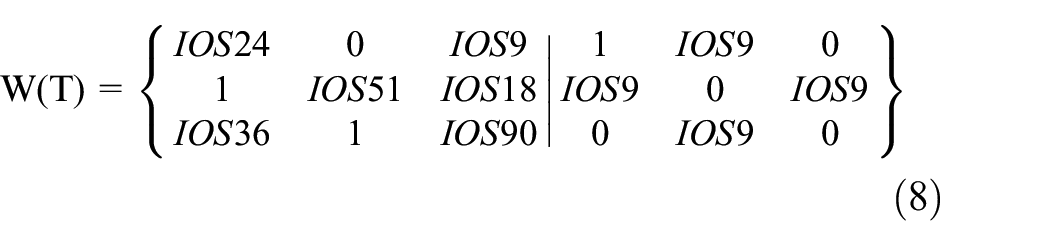
On the basis of equations (7) and (8), under different constraints the assignment of influencing vector values keeps on assigning based on the identified sensitivity vectors constraints

Based on the final multi-decision cost function result of equation (9), the cloud actuated signal will reach the PPIO panel interface screen to execute the required remedial maintenance action. So, immediately the CMT seeks assistance from the RS manufacturer for proceeding with further rectification works. After sorting out the issue the train is subjected for test and trial run under various speeds to identify the shortcomings. If found fit the train will be deployed on mainline for run the very next day with an assisting engineer from the CMT team to ensure the fitness when the train is back for interaction with tracks. The CMT engineer then certifies the fitness for the next 7 days and proceeds with the closure of job cards. The same issue will be reported by the technical cell in the monthly report in order to portray the error to the higher officials, so that in case any further technical assistance or support is required from the company side the same can be claimed before the train completes it liability period for free service.
Results and discussion
Reliability assessment by considering IOS number to prioritize the preventive and corrective maintenance action
Adequate performance of statistical analysis on database is considered as a challenge in reliability analysis.
6
Modeling a track system with cost function
Testing parameters cross-correlation and its impact while changing the random reliability.

In Figure 3 the proposed genetic algorithm for the maintenance strategy is shown. Initially, population initialization will be activated from the metro-cloud to evaluate the current running status of the scheduled platform through connecting to the nodal server. From the nodal server, GA will allocate various fitness value to the chromosome accompanied with preventive and corrective actions required to improve the convergence rate through maximum iterations. The cross over rate will be formulating the pair through M1, M2, M3, Enable, and Idle. Once each pairing is analyzed, the mutation of the process’s will be initiated to find out the best fitness value to the accompanied pair holding highest risk probability rates to finalize the optimal result. Since the proposed work concentrates on the various preventive and corrective actions to be carried out in the rolling stock of the station subsystems, the coined chromosome structure is given by comparing existing and new populations through the execution of offspring’s.

Proposed genetic algorithm maintenance strategy execution till the convergence is attained.
In the proposed work, the developed mathematical model is fed as input platform to analyze the constraints using a Genetic Algorithm which is pre-designed for greatest usage. Because of the intricacy of the chromosome formulating investigations as shown in Figure 4, in the proposed work chromosome framework as a 3 × n system structures whose first column addresses the sort of IOS popped in the subsystem, the second line demonstrates the repetition level and third column indicates the prioritizing the maintenance actions. The model actually takes a look at the framework unwavering quality for all the conceivable excess methodologies lastly, the one with the most elevated dependability esteem is chosen as a definitive technique. It is worth focusing on that cross correlation gets match with the wellness work activation, since the framework cost and weight are autonomous of the technique and rely altogether upon the prioritize level and the IOS number, so they are fixed for all various methodologies undertaken for the experimentation under normal, abnormal, saturated and identical states. The cross over probability obtained by deploying GA in past studies indicates values in the range of 0.65. 18 The finalized results obtained in Table 4 indicates the combination of M1 and M3 has been prioritized first with a probability value in the range of 0.92–0.98.

Chromosome structure of the proposed application of maintenance category.
In Figure 5, the time scale response is given to validate the most probability factor under different scenarios. The result shows the time taken for the generation round-run till it reaches the stability to counterpart the convergence rate to its maximum with a minimum number of iterations. Based on the dynamic influence, the iteration automatically varies based on the IOS warning activation with the desired station subsystems with the optimized best value to carry out in real-time to save time and energy.
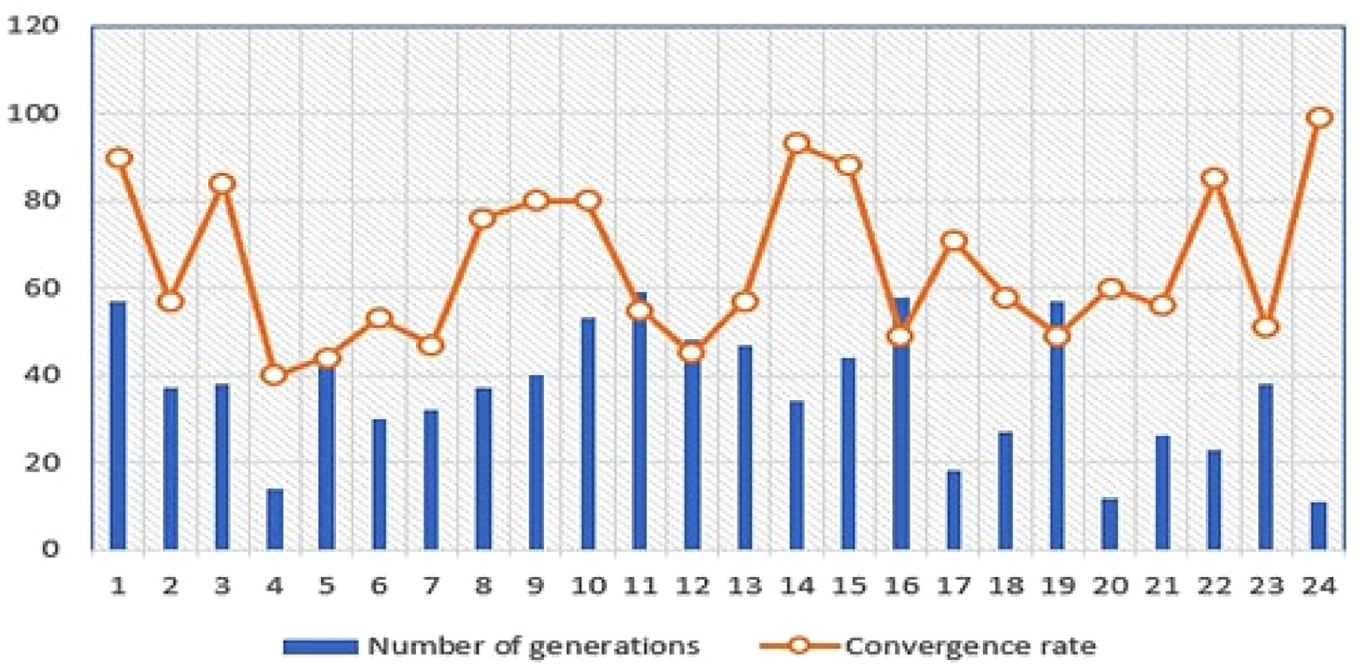
Convergence occurring rate with respect to number of generations.
The experimental run began by fixing the maximum time slot of 22 s to prioritize the different undertaken maintenance strategy as shown in Figure 6. Once the data is stored in the metro-cloud, the received IOS number reputation level and remedial actions to be executed is taken from its computation optimizing table. Based on the ranking of the impact level, for the proposed computation platform the Genetic Algorithm (GA) is fused with the mathematical model developed for the rolling stock to get better result and attains the score rate of 4 in the scaling out of 5. Among the individual and combined scenarios, M3 exhibits better results with minimum analyzing time of 20 s in comparison with M1 and M2. Furthermore, based on the higher score rate, the reliability test is undertaken for the M3 by comparing with individual maintenance system of M1 and M2.

Experimental results to prioritize the maintenance on basis of analyzing time.
In Figure 7, it is confirmed that around 250 IOS number notification were communicated to the cloud platform, to evaluate the reliability rate of each strategy. The M3 combined strategy provides higher reliability rate of about 98.12 on comparison with individual strategy of M1 and M2. This is attained because the developed mathematical model cumulatively considers the maintenance alert and starts to randomize the reliability rate on correlation matrix ratio. Among the given trained inputs, M3 platform starts to identify its severity by self-driven mode due to the presence of adaptive constant parameter a and b in the model.

Reliability analysis conducted for multiple IOS number communicated to the cloud.
In saturated circumstances, system reliabilities are typically more noteworthy than 0.90. System dependability was fixed at 0.65 and impact dependability was diminished from 0.89 to 0.39 to be more sensible to assess the impacts of the turning framework on the rolling stock systems holding five categories such as M1, M2, M3, E, and I. The solid quality values acquired for various methodologies are accounted for in Table 5. Obviously, the proposed methodology is the most suitable to provide immediate maintenance decision based on higher dependability. The dynamic methodology remains fairly unaffected by continuous communication from rolling stock field various notification rates and demonstrates the best in five scenarios. Subsequently, it is to be considered as a dependable technique for a rolling stock scheduling framework for identifying the desired maintenance choice against the popped IOS number in an automated closed loop. Moreover, to assess the impacts system quality redundancy rate was fixed at 0.98 to choose the best strategy under cross-correlation matrix frame structure. The proposed procedure showed a superior presentation with less dependable and higher quality rate at different redundancy level holding value of 0.988. It is said to be the best system for all the conceivable mixes of M3 outcomes to demonstrate the adaptability of the proposed methodology that settles for a decent decision within frameworks of rapid data analysis rate in the metro cloud.
Comparison of undertaken various strategy at different redundancy level.

Validation of proposed data communication efficiency by calibrating between metro-cloud and rolling stock
Normally, in the existing rolling stock maintenance scenario continuous IOS pop-up notification is communicated to metro cloud through the IoT module. Once the IOS number is decrypted, the system will start to check with its priority level in the optimization table to decide upon which desired maintenance action is to be communicated to the PPIO platform. Preventive and maintenance strategy holds many sub-category actions to be executed based on the IOS number generated from the field data module. Hence important multi-decision-making strategy process is initiated in developed metro cloud that helps to identify whether the generated IOS number falls into the category of either preventive or corrective action and the same is communicated as triggering signal to the field PPIO nodal junction to intimate the labor automatically through front end operator interface as shown in Figures 8 and 9.

Priority optimization table for preventive and corrective operator interface.
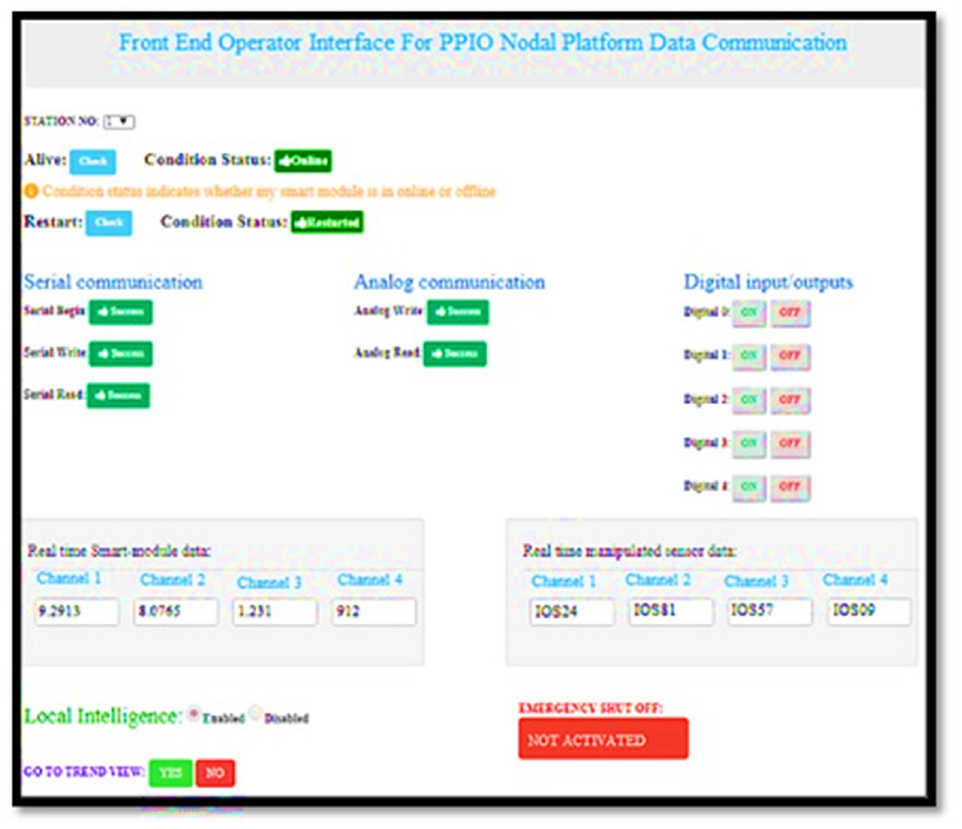
Front end operator interface for the PPIO nodal engineer.
Figure 10 is the MySQL database platform to uphold all the lists of IOS number and its corresponding maintenance strategy by pointing its exact sub-maintenance execution protocols. In the optimization table, the history of received IOS numbers on manipulating the mathematical model synchronized with the metro-cloud will start to prioritize the IOS number based on its impact by segregating it under two categories of corrective and preventive maintenance strategy. The IOS number that requires immediate maintenance intervention is popped on the top based on its severity range. In the virtuality mode it is visible that the IOS number which requires immediate attention is denoted as “RISE” under the preventive maintenance strategy whereas toward the end the IOS number which requires least attention is represented as “DROP.” The least popped IOS number may/may not require attention indicating low priority level. An integrated smart IoT module of a rolling stock department is accomplished by employing a smart IoT module that accepts and transmits various sensor datas from site to the metro cloud. Wifi connectivity is established within the smart IoT module based on the IEEE 802.11b/g/n Wireless local area network (WLAN) standards. It is designed to offer a throughput of 150 Mbps with enhanced channel width of about 20–40 MHz. Data is encrypted by 256 bits key to ensure proper data integrity during transmission. Figure 6 represents the Front-end operator interface developed for PPIO nodal platform to indicate the IOS number received for the current day through various channel ports from the field of rolling stock through IoT module. The signals received under the realtime smart-module data is converted into IOS number under real time manipulated data. The signals received in the channels are decrypted into IOS numbers based on the channel frequency.
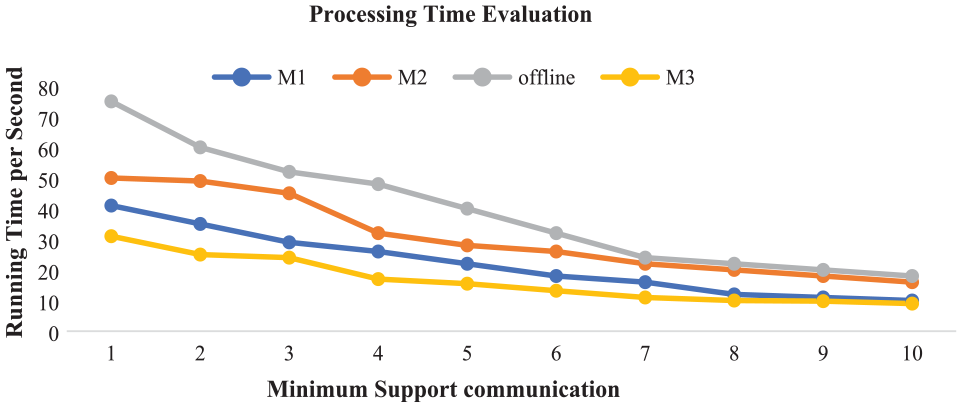
Analyzing the performance of undertaken strategy against the running time.
In Figure 10 it is clearly intimated that the M3 strategy which is cumulative of preventive and corrective provides very minimum running time of around 12–18 s(s) confirming the higher precision, clearer the productivity benefit of the information mining calculation planned in this paper. Past studies 19 where GA approach indicates a good performance yielding best solution was obtained in less than 100 s indicating the need for an additional maintenance center. Since other scenarios like M1 and M2, have taken more time for optimization and utilized more time for decision making holding the value of 31 and 24 s respectively.
In Figure 11 as the quantity of number of records increase in the My SQL database consecutively that is, 32 records on first day, 38 records on second day, 41 records on third day, 54 records on fourth day, and 63 records on fifth day. After computation it is observed that the M3 strategy makes the operating time to rely on the smaller rate of 29–50 s while comparing it with offline mode which indicates higher time of about 75 s. Therefore, the developed mathematical model provides accurate results for M3 strategy with lower running time for execution of maintenance prioritization.

Analyzing the efficiency of the strategy in the metro cloud by pointing records reliability.
In Figure 12 the transaction counts of channels received on a monthly basis for four strategies M1, M2, M3, and offline under various boundary limits is shown. Overall, with the increase in number of cases reported on a Monthwise scenario, the operating time of the four strategic information mining calculations shows a descending pattern. In comparison with that of an offline mode the running time is found to be 90 s in case of 5000 reported abnormalities whereas in case of M3 strategy it is found to be reduced to 55–60 s for the same number of reported cases.20–26

Monthwise channel transaction count impact on the undertaken strategies.
Further, the results of month-wise transaction of data from field to metro cloud indicates that M3 provides fast automated wireless decision action on comparing the M1 and M2 with the maximum duration of 60 s. Few other studies from the past indicates that the average solution time proposed by GA approach is 20.56 min for 118,640 (Reliability 19.10%) reported malfunctioning pops which indicates reliability increases with decrease in number of alerts notifications. 4 The continuous assistant information mining dependent on the remote correspondence component enhancement of the IoT framework planned in this paper has the best presentation. The reason of advancing the remote correspondence system dependent on the IoT is accomplished on the characterization of rolling stock requirements.
Conclusion
The inception of IoT and wireless communication technology have created various advancements in the field of railway industry especially within metro rail which requires highly systemized automation. The communication platform is optimized and improved based on operational requirements. Therefore, this paper develops a genetic algorithm for a wirelessly reported malfunctioning/errors in rolling stock of a metro rail. The algorithm fits into the realtime database to segregate the severely reported segments of maintenance. The algorithm is thus made capable of predicting the preventive and corrective maintenance component that requires immediate attention based on the severity of error occurrence. The experimental results prove that the combined maintenance prediction component M3 strategy gives precise results in running time in comparison with the other combinations developed for prioritization of maintenance activities. This model of wireless communication enhanced by the IoT system thus proves to be reliable in case of maintenance prediction for the rolling stock of Indian metro rail system to improve the operating efficiency. The future expansion of the study relies on deploying the model in realtime to explore the model workability with more depot control centers for maintenance.
Footnotes
Handling Editor: Chenhui Liang
Declaration of conflicting interests
The author(s) declared no potential conflicts of interest with respect to the research, authorship, and/or publication of this article.
Funding
The author(s) received no financial support for the research, authorship, and/or publication of this article.

Data availability statement
Some or all data, models, or code that support the findings of this study are available from the corresponding author upon reasonable request.