




Abstract
With the development of social economy, facing the challenge of depletion of fossil fuel energy, countries in the world have paid close attention to the development of new energy sources in recent years attention is being focused on power engines that use new renewable energy. The Stirling engine is such a power engine. Compared with traditional combustion engines, Stirling engine has the advantages of wide fuel sources, no knocking, high thermal efficiency, low noise, low operating costs, low gas pollution, and high economy. Then, the waste heat can be used to power the Stirling engine. This waste heat will be used in aviation, aerospace, land, ocean, and other fields. The study studied the changes in power and efficiency by changing the ratio according to the dynamic configuration of the Stirling engine and by changing the thermodynamic ratio of the engine. In addition, when installing the regenerator in the Stirling engine system, the changes in output and efficiency were also studied. The results show that the dynamic parameter α is increased, the engine efficiency decreases. When the temperature ratio β increased, the engine efficiency decreased. Then, the efficiency of the Stirling engine with a regenerator was found to be higher than that of the Stirling engine without the regenerator. The results focused on dynamic configuration of the Stirling engine to utilize new renewable energy. This work provides a reliable model and theoretical guidance for improving the FPSE’s performance.
Introduction
Recently, interest in renewable energy has been increasing worldwide. The more and more serious environmental pollution and energy shortage leads to develop power engines that use new renewable energy. In advanced countries such as Denmark, Germany, the United States, and France, the supply of renewable energy has already reached a maximum of 20%. 1 In line with this, the Stirling engine can be considered to be very suitable for this global trend of new and renewable energy research because it shows very high efficiency for renewable energy. The Stirling engine is an external combustion engine invented in 1816 by Robert Stirling. From the invention to the present, many improvements and developments have been made, and due to its excellent efficiency and its specificity, which are different from other engines, many studies have been conducted in recent years. 2
The FPSE was invented in 1964 by Beale.
3
The FPSE, as an external combustion type power conversion machine, which offers advantages of simple structure, long life without lubrication, and high efficiency.4,5 The FPSEs were also divided into three main types, namely alpha, beta, and gamma. This study mainly focus on the
So far, several investigations have been conducted to design and analyze a Stirling engine module. Jang et al.
9
proposed a new design method of FPSE, which the MAF and the OLF was used as a physical parameter. In addition, the basic shape of the Stirling engine was studied by applying the value of RE-1000, and when the Stirling engine was dynamically designed, the optimal operating range was defined. Therefore, a dynamic analysis was conducted excluding thermodynamic conditions. A prototype of a Stirling engine operating in an appropriate temperature range was developed, and research was conducted to prove the efficiency of the medium temperature Stirling engine. In consideration of the manufacturing infrastructure and technology, the initial pressure was 0.7 MPa and air was used as the working fluid.
10
In addition, the beta-type Stirling engine is adopted, and it is 360 rpm at 500 and 0.7 MPa, and the maximum output is 95.4 W and the thermal efficiency is 9.35%. Membrane Stirling engine has already been developed by Formosa et al.
11
The general sliding piston was replaced with a bent diaphragm, and the dead volume was reduced to improve performance.
12
In the development and verification of a prototype model of a 500 W gamma type Stirling engine, the effects of changes in phase angle and dead volume on the performance of the Donghae engine were studied by Alfarawi et al.
13
In the twin-power Stirling engine, experiments were conducted to understand the effect of various regenerator variables on the engine’s overall performance. Chi et al.
14
have been studied the operating mechanism of a
In summary, the Stirling engine has been studied from the perspective of thermodynamic analysis methods and optimization methods. At present, the single-objective parameter design method can no longer meet the high efficiency requirements of the Stirling engine. However, there are many factors that affect the performance of the Stirling engine. How to obtain the optimal parameter combination among many parameters, so as to achieve the best output power and thermal efficiency, has become a hot spot of international research in recent years.
Based on the previous research, this study has two extensions. Firstly, this paper has been established a thermodynamic-dynamic coupling model. The effects of operating and dynamic factors on the Stirling engine power and the Stirling engine generator efficiency. Furthermore, changes in power output and efficiency were also investigated when a regenerator was installed in the Stirling engine system. The method mentioned in the paper is also applicable to Stirling engine with different powers by adjusting the parameter range. Changing dynamic parameters is used to carry out the comprehensive optimization research on the performance of the Stirling engine, which provides a theoretical basis for the design of the operation and structural parameters of the Stirling engine.
Description of dynamic configuration
Area ratio (
)
Temperature ratio (
)
The
Regenerator
Regenerator is an additional device used to increase efficiency in the FPSEs. As shown in Figure 1, the regenerator is located in the reciprocating space of the displacer and is used to increase the efficiency of the FPSE.

The structure diagram of the gamma-type FPSE. 9
Usually, the regenerator is in the form of a mesh, but the friction of the air is greater than that of a Stirling engine operating without a regenerator, which can lead to a situation in which the efficiency may be reduced. In this paper, we tried to examine how much the presence or absence of the regenerator actually affects the change in efficiency in the FPSE.
Control method for a FPSE
Stirling engine was performed reciprocating motion by repeating expansion and compression by heating and cooling parts. As we all know, the Stirling cycle includes two isothermal processes and two isochoric processes. 31
Theoretical method
The Schmidt isothermal analysis method can be applied under the assumption that the reciprocating motion of the piston is a harmonic motion and that the regenerator is perfect. This analysis method is quite ideal, but it is widely used in the design of actual Stirling engines.31,32
Usually, when the working gas temperature, mass, volume are determined, the engine pressure can be calculated by the ideal gas state equation as shown below:

In order to facilitate the calculation, some complicated processes need to be simplified.
- The heat exchanger has no pressure loss and no internal pressure difference.
- Changes in the compression and expansion processes are isothermal.
- The working gas is the ideal gas.
- Regeneration is complete (assuming that the player is complete).
- During the cycle, the dead volume of the expansion space is maintained at the expansion gas temperature, and the dead volume of the compressed space is maintained at the compressed gas temperature.
- The gas temperature of the regenerator is the average of the expanded gas temperature and the compressed gas temperature.
- The changes in expansion and compression space follow sinusoidal curves.
The expansion space volume and compression space volume of the gamma-type FPSE are expressed as following:


The instantaneous total volume is expressed as follows:


Engine pressure based on average pressure, minimum pressure, and maximum pressure is determined by the formulas below.

The temperature ratio, exhaust volume ratio, dead volume ratio of expansion space, contraction space dead volume ratio, and regenerator dead volume ratio can be expressed as follows.




Numerical simulation
Simulation analysis condition
In the analysis, parameters necessary for cylinder and mass are referred to in Table 1 and parameters necessary for volume are referred to in Table 2. This paper assumes that the FPSE operates under atmospheric pressure, so the internal pressure is set at 1 atmosphere. Analysis time varies between 0 and 2 s depending on the resulting value of the variable.
Design values in the example. 9

Physical properties and initial conditions of simulation. 32

Therefore, we looked at how the engine performance changes by changing the value of the ratio of the size of the power piston and the displacer piston, the ratio of the heating part and the cooling part, and the variables of the regenerator.
Simulation modeling
Using Simulation X, the shape to be analyzed was modeled as shown in Figure 2. Stirling engine must apply an external force to start the machine. The displacement of the power piston in Figure 2 is 5 mm. The pistons in the Displacer cylinder and power piston cylinder start to work and the temperature changes as they go through HOT and COLD.
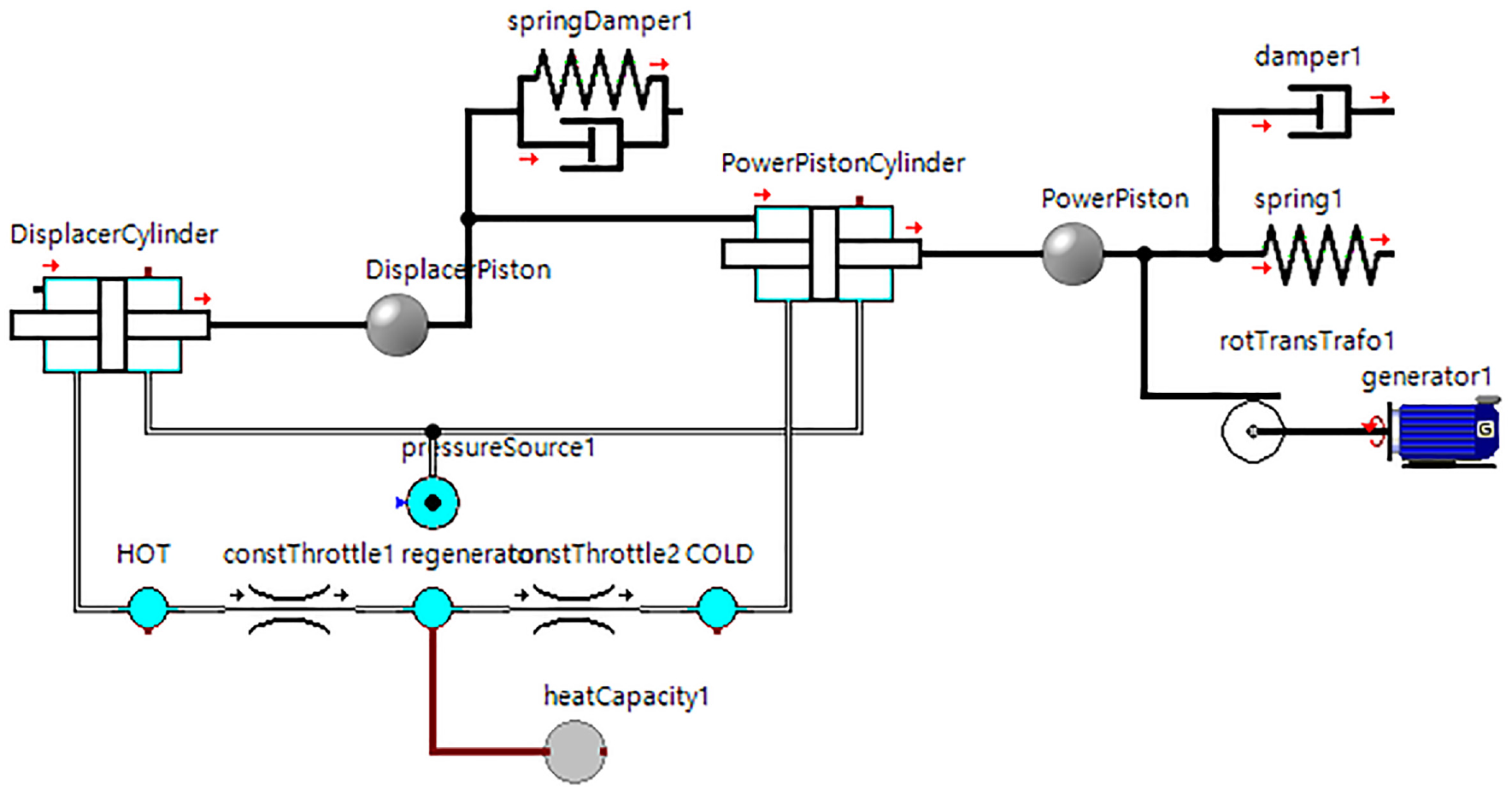
The scheme of FPSE modeling.
Double rod cylinder (displacer/power piston)
The most important thing in the Double Rod Cylinder is the displacement of the piston. This is because the actual output or efficiency changes a lot according to the displacement of the piston when the engine is operating.
Heat capacity
In this paper, it plays the role of inputting the heat capacity of the regenerator. The heat capacity is connected to one of the three volumes in the Figure 2. It is connected to the regenerator part differently from the hot and cold parts.
Volume
In Figure 2, the blue circled shape is volume, and each means the volume, heat transfer rate, heat transfer area, and initial temperature of the hot and cold parts. This part is used to show the shape of the heating part and the cooling part in an actual Stirling engine.
Constant throttle valve
In this paper, when the displacer piston reciprocates and creates an air flow, it is used to indicate the size of the space on either side.
Results and discussion
Influence of
Figures 3 and 4, it can be seen that both figures vibrate infinitely. However, as shown in Figure 3, when the size of the Power Piston is 25 mm, a red line, that is the Displacer piston, hits the top dead center of the cylinder. Even if the displacement of the power piston is larger, this effect is different to regard as a good shape because it affects the performance and durability of FPSE. The displacement, power, and efficiency, as shown in Tables 3 and 4.

Displacement (displacer piston diameter 45 mm – power piston diameter 25 mm).

Displacement (displacer piston diameter 45 mm – power piston diameter 35 mm).
Displacement of the displacer piston and power piston.

Power and efficiency under different area ratio.

Table 4 shows the data for
Influence of
From Figure 5 to Figure 6, a graphs show how the displacement change according to the change of α. Table 5 shows that the data of α. Comparing 573.15 and 773.15 K, the displacement of the Displacer Piston decreased by 12% and that of the Power Piston increased by 8.5%. Also, it can be seen that the power increases by about 21%. As seen from the previous analysis results, it can be seen that the higher the temperature of the heating unit, the higher the output. However, it can be seen that the efficiency according to temperature is 0.192% and 0.103%, and the efficiency decreases as the temperature increases. This is because the analysis was performed under the assumption that the pressure inside the cylinder of the Stirling engine used for the analysis in this study is atmospheric pressure. It can be seen that the efficiency is about 53.25% higher when the heating part is 573.15 K.
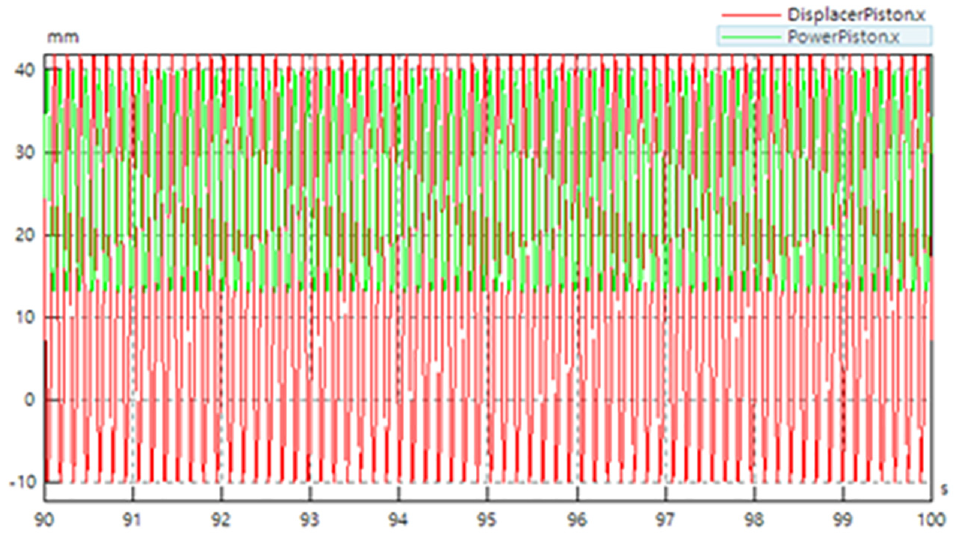
Displacement of HOT 573.15 K – COLD 293.15 K.

Displacement of HOT 773.15 K – COLD 293.15 K.
Output and efficiency under different temperatures.

Results show that, it can be seen that the output value also increases constantly as the temperature increases. In actual operation of the FPSE, the effective cycle can be achieved only when the change of
Influence of with/without regenerator
It can be seen that the displacement of the Stirling engine with Regenerator installed is smaller. Table 6 shows that the displacement of the Displacer Piston increased by about 9.8% and the Power Piston decreased by 11.2% compared to the Stirling engine without the Regenerator installed. Also, it can be seen that the power increases by about 13.4% and the frequency increases by 30%. The efficiency is higher in the Stirling engine with the regenerator installed, which as described above, when the air moves from the heating part to the cooling part, the heated air transfers heat to the regenerator and then moves to the cooling part. When the air moves to the heating part, the heat transferred is received, and the amount of heat required to heat the cooled air in the heating part decreases, thereby increasing the efficiency. Therefore, the efficiency of the Stirling engine with Regenerator installed is 40.06% higher.
Power under without regenerator and with regenerator.

Conclusions
As a dynamic energy conversion machine, the free-piston Stirling engine has the advantages of high utilization efficiency, long service time, and high reliability, and has good application prospects in aerospace, marine power generation, and other fields. In this paper, the performance and thermodynamic characteristics of the Stirling engine are studied by using the methods of simulation and optimization. Firstly, the dynamic model of the free-piston Stirling engine was established. Through theoretical analysis and numerical simulation methods, the changing law of output power and efficiency was studied by changing the dynamic parameters (area ratio) and temperature ratio of the Stirling engine, revealing the influence mechanism of dynamic parameters on Stirling engine. Furthermore, the effect of installing a regenerator on the output power and efficiency of the Stirling engine system was investigated. Results show that the dynamic configuration
Footnotes
Acknowledgements
We thank Department of Mechanical Engineering, Hoseo University for providing an academic license of Simulation X for simulation.
Handling Editor: Chenhui Liang
Declaration of conflicting interests
The author(s) declared no potential conflicts of interest with respect to the research, authorship, and/or publication of this article.
Funding
The author(s) disclosed receipt of the following financial support for the research, authorship, and/or publication of this article: This research was supported by Ludong University Talent Research Start-up Funding (No.20220035).
