




Abstract
To improve the evaluation efficiency of failure probability in RBDO models with uncertainty, many RIA-based, PMA-based methods have evolved as a powerful procedure, including the modified reliability index approach (MRIA), PMA two-level, PMA with sequential approximate programming (SAP). However, MRIA may encounter inefficiency and instability when applied to complex concave performance functions, and so does PMA two-level, not for PMA with SAP. The active set strategy-based SAP (ASS-based SAP) for PMA is proposed to accelerate computational efficiency through establishing an active set strategy and a deciding factor. The active set strategy defined by using inequality is to identify the feasible most probable target point (MPTP) in the inner loop. The decision factor integrates the reliability index and the active set strategy to quickly renew the active constraints in the outer loop. The reliability assessment and outer optimization are driven simultaneously, thereby the computational efficiency is strengthened. Numerical examples are compared with other reliability methods to demonstrate the excellent performance of the proposed method in efficiency and robustness. Results also show that the proposed method has the ability to solve complex RBDO problems.
Introduction
Reliability-Based Design Optimization (RBDO) is proposed as the most outstanding design tool to tackle uncertainties in engineering and is widespread attention in various fields.1–4 RBDO specifies the uncertainty as a probability optimization model, which includes the minimum cost-minimizing function and probability constraints with random distribution information to attain an optimized design that meets the expected reliability level.5,6 However, the evaluation inefficiency and numerical convergence difficulties of large and complex highly nonlinear systems severely limit the application of RBDO in engineering.
Generally, methods for solving RBDO could be roughly divided into the decoupling method,7,8 two-level method,9–11 and single-loop method.12–14 Amongst, the two-level method is the most prioritized method due to its simpler and more reliable. Specifically, two-level methods involve double loops in each iteration: the inner loop promotes reliability analysis while deterministic optimization analysis is run according to the outer loop. The key step is the inner loop, where does a sub-optimization program solve by either the reliability index approach (RIA)15,16 or the performance measure approach (PMA).17,18 RIA is essentially built on the simplified HL-RF algorithm19,20 to convert probability constraints into reliability index constraints and specify the most probable failure point (MPFP) of the limit failure surface. 21 Conversely, PMA adopts the inverse reliability analysis to capture the most probable target point (MPTP), which is located on the target reliability surface by converting probability measures into performance measures. 22 Therefore, PMA is unable to provide the information on the reliability index because it aims to minimize a complex constraint as the objective function and is subject to simple target reliability. However, a remarkable fact is that the solution of MPFP or MPTP must be numerically active and stable so that the process of evaluating probabilistic constraints can be effective. Otherwise, this sub-optimization procedure will aggravate the cost of probabilistic evaluations during the whole optimization process. For the outer loop, by means of the MPFP or MPTP, probabilistic constraints are converted to deterministic constraints according to the Taylor series expansion.22,23 This is the essential difference between the traditional RIA two-level and PMA two-level and has a property of nesting. Therefore, reducing the evaluation cost of probabilistic constraints could be started from both sub-optimization and outer optimization.
Initially, the traditional RIA two-level is deployed to search the MPFP and corresponding reliability indices, which often results in slow convergence and numerical singularities.5,24,25 Lin et al. 9 developed the modified reliability index approach (MRIA) by revising the reliability indices and implementing it to accurately and stably find solutions for MPFP. However, it also inherited some inefficient features of the MPFP search when highly nonlinear performance functions are involved and furthermore proposed the hybrid reliability method. 26 Thereafter, Cheng et al. 27 recommended the RIA-based sequential approximate programming (SAP) to capture simultaneous convergence of reliability assessment and design optimization by resolving a series of sub-programming the approximate MPFP, while it also optimizes the tolerance synthesis problems. 28 From the application examples, the SAP approach shows superior efficiency and robustness in comparison with the other reliability methods when assessing the reliability indexes. Alternatively, from the perspective of decoupling strategy, the traditional two-level optimization is completely converted into one-level optimization to remove nesting nature, but when it explores the multi-dimensional (i.e. multiple design variables) problem of the RBDO system, it still presents an unaffordable computational pressure.29,30
Compared to RIA-based, PMA-based is comparatively more effective and robust due to its being slightly affected by the types of distribution for random variables.31,32 However, the iterative scheme of the traditional PMA two-level sometimes is susceptible to numerical instability and non-convergence issues when computing the MPTP for a concave performance function with highly nonlinear problems.33,34 For this reason, many PMA-based optimization schemes have been emerged recently to strengthen the efficiency of searching MPTP, such as a step length adjustment (SLA), 35 hybrid chaos control (HCC) and modified chaos control (MCC), 21 a relaxed mean value (RMV), 36 etc. Although some efforts have been made to quickly search for suitable and efficient MPTP, the computational expense of PMA-based two-level is still heavy when complex performance functions are engaged. 37 Similar to the RIA-based method, Yi et al. 11 not only extended the framework of SAP strategy for the PMA-based probabilistic structural design optimization (PSDO) but also further studied the efficiency of SAP with PMA and conducted error analysis. 38 SAP strategy discretizes the RBDO problem into a series of approximate subproblems by first-order Taylor expansion and solved it before reaching the optimum. The merit of SAP is that reliability analysis and structural optimization design are performed at the same time, which greatly reduces computational cost issues. Inspired by the literature presented, PMA with SAP is more promising in convergence and efficiency.
In this paper, we suggest the active set strategy-based SAP (ASS-based SAP) for PMA to strengthen the efficiency and robustness of evaluating probabilistic constraints for large-scale RBDO applications. The critical step is to establish an active set strategy in the loop, where the feasible MPTP can be selected. Meanwhile, the reliability index and active set strategy are integrated into the outer loop to define the decisive factor, which is used to update the active constraints.
The outline of this article is organized along these lines: details of two fundamental RBDO approaches are specified in Section 2. The different iterative schemes derived from two basic approaches are discussed in Section 3. In Section 4, the process of deriving the proposed method is presented. In Section 5, three complex RBDO problems are shown to demonstrate the efficiency and robustness of the proposed method. Finally, the conclusions are drawn in Section 6.
Basic formulation of RBDO
RBDO 39 has evolved into a powerful design tool, which can explore the best design within the desired reliability level while meeting the constraints. Its basic mathematical expression is

where
In statistics, the random uncertainties are assessed by the probability model, where the cumulative distribution function (CDF),
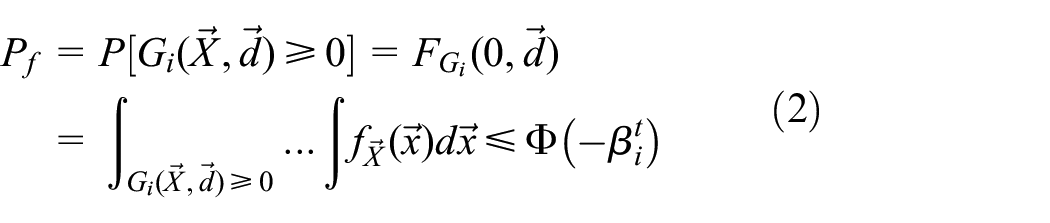
where
According to equation (2), the failure probability of the systems requires to be evaluated for each constraint where multiple integrations are involved. As we all know, it may be heavily costly to perform multi-dimensional integration throughout the coverage of JPDF. Thus, the probabilistic constraints of RBDO can be further assessed in two alternative forms 2


where
The probabilistic constraint in equation (1) is calculated by applying equation (3) with the reliability index, the generating RIA is

Similarly, equation (4) in terms of the performance measure function is utilized to compute the probabilistic constraint in equation (1), then, the PMA is derived

A review of existing basic method for solving RBDO
RIA
As stated in the introduction, the traditional RIA originated from computing the reliability index proposed by Hasofer and Lind,
19


The reliability index,
where
However, the conventional RIA has been acknowledged as intolerable numerical instability and inability to converge to the global optimum in searching for MPFP.9,17
MRIA two-level
MRIA
9
outperforms RIA in convergence and stability for computing the MPFP owing to a new reliability index

where

Combining equation (9) and equation (5), MRIA-based two-level is represented by

Here, the first level is that the inner loop executes equation (9) with the initial value
Compared with RIA, MRIA two-level could provide a reliable and correct solution while rejecting the shortcomings of RIA, however, the efficiency of searching for the MPFP problems has always been the bottleneck of MRIA two-level. 26
PMA two-level
PMA two-level
38
is similar to MRIA two-level, however, the simple difference is that its inner loop entailed the inverse reliability analysis in the

where

The iteration of equation (12) usually starts with the origin (i.e.
PMA with SAP
Yi and Cheng 38 successfully proposed the PMA with SAP method is represented by

Where

where

where

where
The proposed method
Iterative strategy of the proposed method
To further cut down the number of function evaluations without losing robustness, a new efficient and robust method-based SAP for PMA is proffered in this part, via establishing the active set strategy in the inner loop while defining the deciding factors in the outer loop.
For the inner loop, an active set strategy by using inequality is equipped, which is expressed as

where
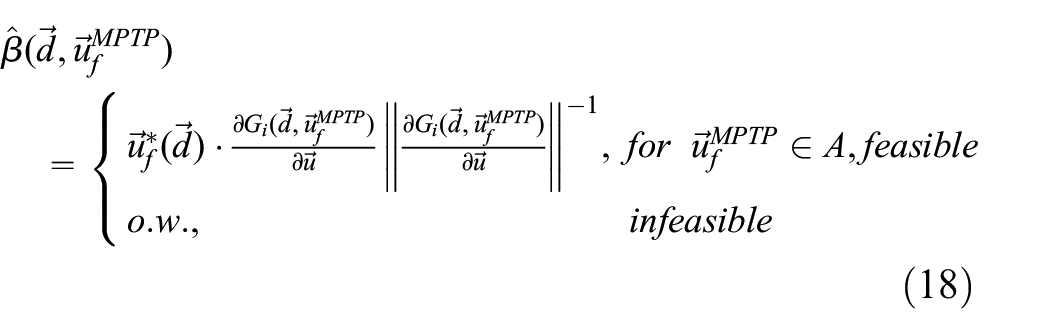
where
For the outer loop, a new decision factor is defined according to

where

where
Thus, the inner reliability analysis and outer optimization will run simultaneously at a faster speed than PMA with SAP. It is noteworthy that 6σ is suggested to filter the MPTP in equation (17) because the 6σ level design sufficiently considers the uncertainties in engineering and has good robustness and reliability. As shown in Figure 2, the 6σ level design has a 99.9999998% reliability level is far better than any σ level design. Therefore, the 6σ level is selected to search for MPTP efficiently and robustly.

σ-level and its reliability level.
Framework of the proposed method
The proposed method is known as the active set strategy-based SAP (ASS-SAP) and its flowchart is depicted in Figure 3. The specific steps of the ASS-SAP are listed below to measure the probabilistic constraints in RBDO:
Given
Transfer random variables to
Execute the inner loop by equation (11) and equation (17) to search for effective MPTP,
Transfer random variables to
if the convergence criterion

Flowchart of ASS-based SAP.
Examples
The ASS-SAP is integrated into two-level to analyze its performance when faced with complex RBDO problems. To better perceive the superiority of the recommended algorithm, two common mathematical and practical engineering examples are tested.
Example 1
This nonlinear mathematical problem is abstracted from the literature, 9 whose RBDO model is written as
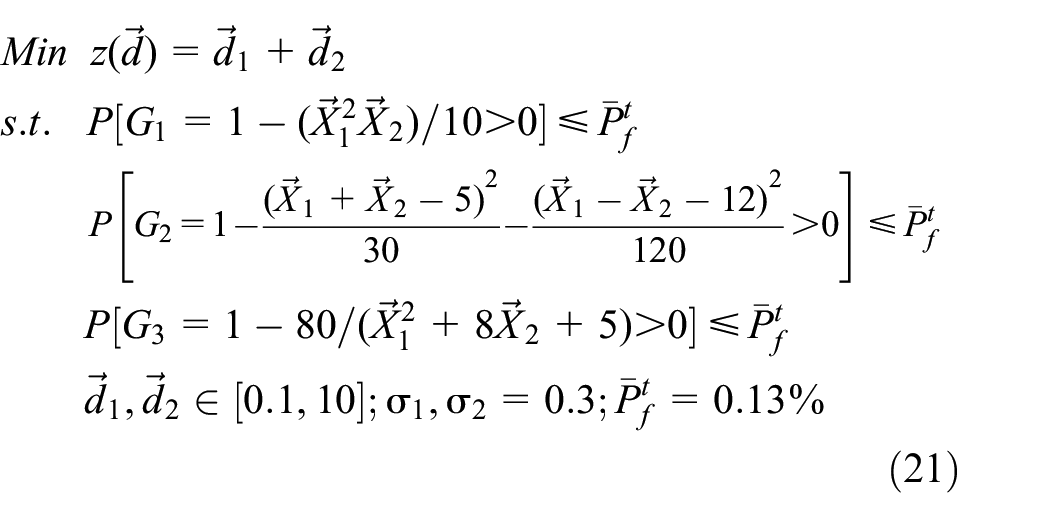
where
The outcomes computed for all approaches are brief in Table 1. The MCS is employed to evaluate the violation conditions of probability constraints by providing 106 samples size and offered in Table 2, where results have confirmed the failure probabilities (
Comparison results Example 1.

The method is extracted from Lin et al. 9
The method is taken from Yi and Cheng. 38
Reliability at the optimum by MCS in Example 1.

The method is extracted from Lin et al. 9
The method is taken from Yi and Cheng. 38
In Table 1, the values in each row comprise the number of iterations and FEs, then, the minimum cost function and the optimal design point, respectively, denote as 5/195 6.7318/(3.4409, 3.2909). It is stated that all algorithms can accurately arrive at the identical optimal design point at the same initial settings and convergence criterion (
Example 2
This high nonlinear problem, extracted from 2 and described with the below RBDO formulation

This model contains two random variables
Comparison results for Example 2.

The bold numbers are FEs obtained by ASS-based SAP for the convergence.
The method is extracted from Lin et al. 9
The method is taken from Yi and Cheng. 38
From Table 3, all the approaches except for the PMA two-level could successfully and stably reach the same minimum objective value

Iteration history of ASS-based SAP (iterations 1, 2, 6).
Table 4 presents the important effects of different convergence criteria (
Comparison results of FEs with different stopping criteria.

Source: The bold indicate FEs obtained by ASS-based SAP to the convergence.
The method is extracted from Lin et al. 9
The method is taken from Yi and Cheng 38
In addition, the MCS is implemented to assess the violation conditions of three constraints around the optimum based on 106 samples and tabulated in Table 5, where is presented that all failure probability of constraints around the optimal solution conforms to the given failure probability. Besides, it also hints that the MCS fails to evaluate the probabilistic constraint
Constraints are assessed by MCS for all methods with different stopping criteria.

The method is extracted from Lin et al. 9
The method is taken from Yi and Cheng. 38
Example 3
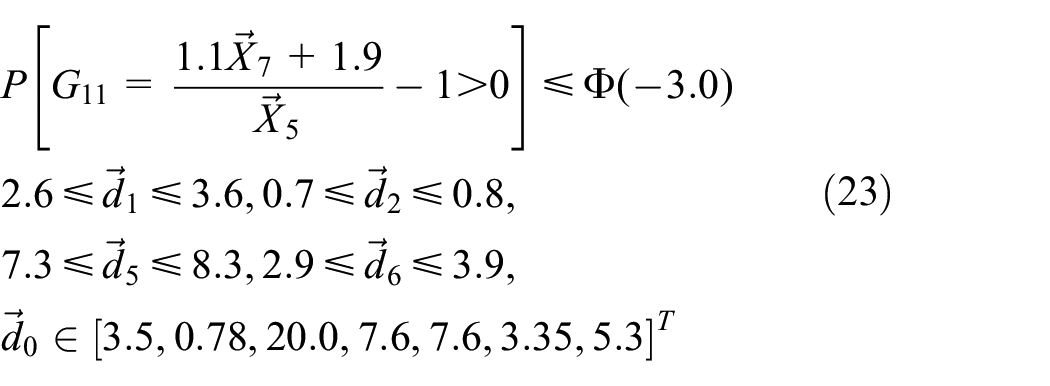
A practical engineering example is on the speed reducer design issue including seven random variables,



A speed reducer.
Stochastic parameters in Example 3.

This multiple design constraints example has been solved by Zhu et al. 2 and is also studied in this paper. The results are added in Table 7.
Comparison results in Example 3.

The method is extracted from Lin et al. 9
The method is taken from Yi and Cheng. 38
Table 7 shows a summary of the results (i.e. optimum, cost, iterations, FEs) computed by MRIA two-level, PMA two-level, PMA with SAP, and ASS-based SAP, where the approaches consistently converge to the same desired design point of [3.5765, 0.7000, 17.0000, 7.3000, 7.7527, 3.3584, 5.3004] and the minimum cost function of 3036.0 with the acceptable failure probabilities. As far as FEs are concerned, it could be observed that among these methods, the ASS-based SAP incurs a total of 7 iterations and 548 FEs are required to satisfy the stopping criterion
In Table 8, MCS is employed to simulate the reliability indices of each probabilistic constraint at the optimum utilizing
Reliability evaluation at the optimum by MCS in Example 3.

The method is extracted from Lin et al. 9
The method is taken from Yi and Cheng. 38
Conclusion
The prevailing iterative algorithms for MRIA two-level and PMA two-level reveal the shortcomings of inefficiency and instability to a certain extent when exploring convergence efficiency of concave performance functions, however, PMA with SAP method appears the opposite performance by performing reliability analysis and design optimization simultaneously. Considering the better performance of PMA with SAP, a simple and robust approach is further developed to strengthen the efficiency of PMA with SAP, which is named the active set strategy-based SAP (ASS-base SAP). In the framework of ASS-base SAP, an active set using inequality is equipped in the inner loop to robustly and effectively perform reliability analysis and obtain the feasible MPTP. Meanwhile, the decisive factor is defined according to the reliability index and active set strategy in the outer loop, which is used to quickly renew the active constraints. Since both the inner reliability analysis and outer optimization are carried out concurrently at a faster convergence speed than PMA with SAP, thereby, the efficiency is enhanced remarkably.
Several numerical examples, including RBDO numerical problems and a practical engineering case, are quoted to verify the robustness and efficiency of the proposed method. The comparative study of RBDO problems has shown that the ASS-based SAP achieves the most efficiency and has better robustness than the traditional ones (MRIA two-level, PMA two-level, PMA with SAP). Therefore, the proposed method is a more efficient and robust PMA-based for structural reliability analysis method. it can also be concluded that the proposed method has good applicability for solving complex RBDO problems of ongoing research topics, but does not perform well for the uniformly distributed problem.
Footnotes
Handling Editor: Chenhui Liang
Declaration of conflicting interests
The author(s) declared no potential conflicts of interest with respect to the research, authorship, and/or publication of this article.
Funding
The author(s) disclosed receipt of the following financial support for the research, authorship, and/or publication of this article: This work was supported by the National Natural Science Foundation of China [grant number 51679056].

Data availability
The data and code developed for this study are available from the corresponding author on reasonable request.