



Abstract
Rod pumping on offshore platform provides a solution to low efficient extraction of offshore heavy oil and the safety of working platform is the prerequisite for the implementation of this new technology. In this paper, a coupling dynamics model of rod pumping system and the jacket platform is established, and the dynamic characteristics of the pumping unit excitation, rod pumping system, and jacket platform is studied. Based on the analysis of the multi-body dynamics model, the three frequencies (pumping unit excitation, rod pumping system, jacket platform) are far apart, so the dynamic effect of rod pumping on the platform can be analyzed according to static load. Based on the limit working state and the cumulative damage theory of the structure, the safety evaluation standard for the increased load of the jacket platform is established. Under the extreme marine environment once in 50 years, the safety factor of the main structure of the platform is greater than 4, and the overall safety factor is 3% lower than that before the rod pumping operation. Offshore rod pumping has less influence on the jacket platform from analysis, and which lays a theoretical and safety foundation for offshore oil pumping.
Keywords
Introduction
The growth of China’s crude oil production depends on the sea, and the growth of offshore crude oil production depends on the Bohai Sea. In 2021, the crude oil output of Bohai Oilfield reached 30.132 million tons, making it the largest crude oil production base in China. The increase in crude oil accounts for nearly 50% of the increase in China. At present, 34% of oil production comes from the ocean, 1 and the main oil exploration will gradually shift from land to offshore.2,3
The Bohai Sea has confirmed 4.4 billion tons of proven crude oil reserves, and about 15% is heavy oil with a crude oil viscosity greater than 350 MPa·s. The production of unconventional heavy oil accounts for less than 1% Of the annual oil and gas production of over 30 million tons in the Bohai Oilfield. The conversion of heavy oil reserves into real production is of great significance for Chinese oil exploration and development.
For heavy oil, viscosity is the key factor determining the development regime. Heavy oil with the viscosity of less than 300 MPa·s can be effectively developed by water flooding, chemical flooding, well pattern thickening, and so on.4,5 While for heavy oil with viscosity greater than 350 MPa·s, steam injection shows its unique advantages and high recovery.6,7
Affected by the size limit of the offshore platform, the offshore mechanical oil extraction mostly uses submersible electric pumps as the main lifting equipment. Temperature rating of motors and cables in submersible pump is much lower than the steam injection temperature of 350°C (or even higher). 8 As a result, offshore heavy oil wells must use two injection-production pipe string operations to achieve thermal recovery development. The conversion efficiency between heat and production is low, and repeated replacement of the pipe string increases the operation risk, which becomes a bottleneck restriction for offshore heavy oil thermal recovery technology.9–11 Therefore, the integrated injection-production technology of thermal recovery wells in offshore heavy oil fields can not only greatly reduce the operating costs and improve the development benefits, but also contribute to the development of large-scale thermal recovery t in offshore heavy oil fields.
Most heavy oil fields on the land use the “steam huff and puff + rod pumping” method for mining, and the process flow is simplified into “steam injection → simmering well → blowout → pumping.” The successful migration of the mature “integrated injection-production technology” for thermal recovery of onshore heavy oil to offshore oilfields, which is an effective solution to the low recovery degree and recovery efficiency of offshore heavy oil fields.
Our team has successively developed/designed? key equipment suitable for rod pumping system on offshore platform, such as the small hydraulic pumping units (shown in Figure 1), wellhead equipment and downhole equipment, and eventually complete a “steam huff and puff + rod pumping” technology suitable for offshore platform heavy oil production.12–14
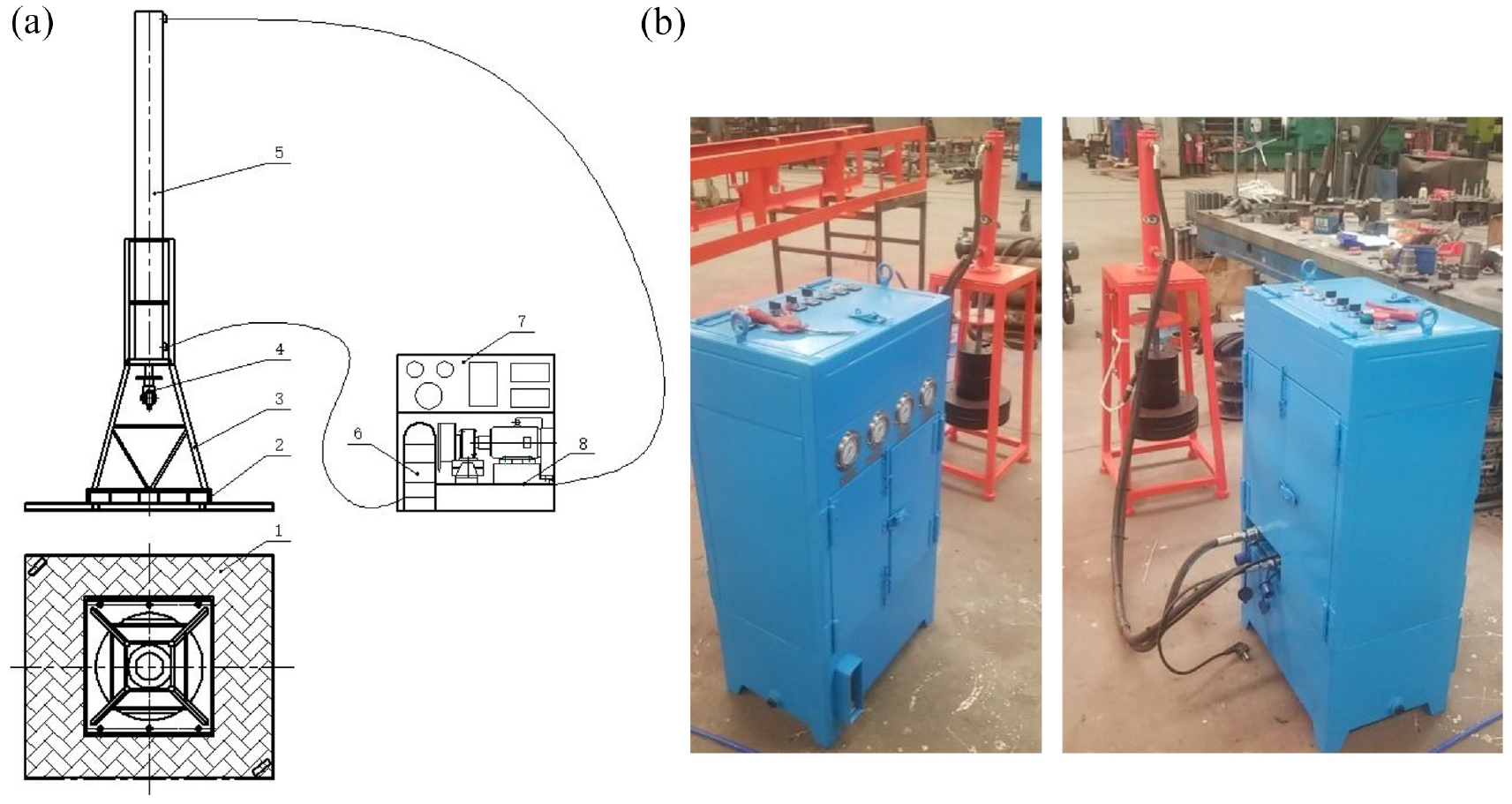
The small hydraulic pumping units for offshore platforms. 1-Platform wellhead cover, 2-Pumping unit mounting seat, 3-Pumping unit bracket, 4-Polished rod connector, 5-Two-stage telescopic hydraulic cylinder, 6-Accumulator, 7-Electric control cabinet, 8-Hydraulic station. (a) Schematic diagram of pumping unit structure and (b) pumping unit prototype.
The development of heavy oil with high-efficiency is a worldwide difficulty for offshore oil fields. The technology of rod pumping provides a possible effective way for offshore heavy oil thermal recovery, but the safety of working platform is the prerequisite for the implementation of this new technology.
The multi-body dynamics model
Bohai Offshore Oil is the pioneer of Chinese offshore oil development. In the six major marine oil and gas sedimentary basins in China, the geophysical exploration work is carried out the earliest, the number of wells is the largest, and the fixed production platforms that have been built account for more than 90% of the total number of similar platforms in the country. 15
Experimental model of rod pumping system on offshore platform is shown in Figure 2.

Experimental model of rod pumping system on offshore platform.
From the analysis of Figures 1 and 2, it can be seen that the hydraulic pumping unit is installed on the middle deck of the offshore platform, and the connected structure includes the sucker rod string and the offshore platform deck support beam. The simplified analysis model is shown in Figure 3.
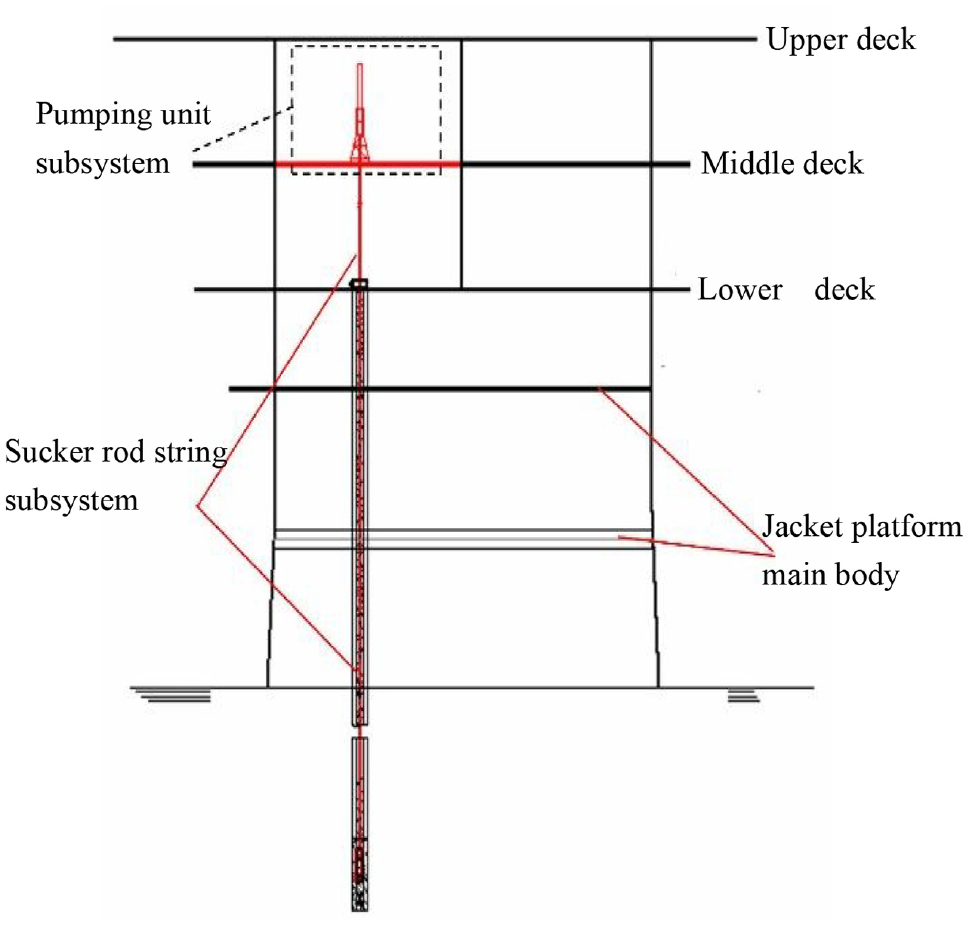
Schematic diagram of rod pumping on platform.
Multi-body dynamics model
According to Figure 3, the multi-body system of rod pumping on offshore platform mainly includes: sucker rod string subsystem, pumping unit and support subsystem, offshore platform wellhead area support subsystem.
The dynamic model of the multi-body system is shown in Figure 4. Where, Fu(t) is the excitation of the pumping unit, m
i
(

Multi-body dynamics model of rod pumping on platform.
Multi-body dynamics equation
Based on Figure 4, the differential equation of motion derived from the Lagrangian formula is:

Where:
Dynamics characteristics
The key of equipment dynamic response evaluation is to solve its dynamic balance equation. When structural damping and external load excitation are not considered, formula (1) is the free vibration equation of undamped structure, and eigenvectors of the structure can be obtained by solving it, so as to analyze the dynamics characteristic relationship of the rod pumping system and the offshore platform.
The test target platform is four-leg steel jacket platform, which integrates the drilling, completion, workover and production. The diameter of the four main piles is 1829 mm, and the platform design depth is 22.3 m. The hoisting weight of the deck and jacket are 2700 and 1000 t respectively. The wellhead area locates in the central north of the deck, with 20 pits in a 4 × 5 array. The distance between the wellheads is 1.8 m × 2.0 m.
The relationship between the hydraulic pumping unit (HPU) excitation and the dynamic parameters of rod pumping system and the target platform is shown in Figure 5.

Frequency relationship between HPU incentive and rod pumping and offshore platform.
The response calculation of the structure under dynamic load is generally closely related to the natural vibration of the structure. If the natural frequency of the structure is close to the load frequency, even if the load amplitude is small, the response of the structure will be large. On the contrary, if the natural frequency of the structure is more than 5 times of the load frequency, the dynamic response of the structure is similar to the response obtained when the dynamic load amplitude is used as the static load.
From Figure 5, the excitation of the pumping unit is more than 17 times different from the natural frequency of platform, and the rod pumping system is more than 16 times different from the natural frequency of platform. So that the excitation of the pumping unit will not cause resonance between the rod pumping system and the offshore platform. The additional dynamic load amplitude of the rod pumping on the platform can be analyzed as the static force load.
Safety evaluation standards
The safety of the structure corresponds to the state of the structural components. The safety of the structure is often described by the ultimate working state of the structure. For the structural state under cyclic loading, the residual strength based on the fatigue damage accumulation theory is the most common indicator.
Limit state evaluation model
The structure is deformed by the external load. When the external load increases to a certain level, the load does not change and the deformation continues to increase.
A limit state safety factor

Where,
The API specification defines this load as the ultimate load of the structure. “Standards for structural design of offshore steel fixed platforms” API RP 2A-LRFD, it is stipulated that the reserve strength coefficient of the jacket platform is about 1.8–2.4. 16
Cumulative damage evaluation model
The fatigue damage accumulation theory is to study the evolution law of fatigue damage and the fatigue failure criterion under the action of cyclic loading. At present, the most widely used cumulative damage theories mainly include Miner theory and Manson two-stage model in equal damage linear theory, Corten-Dolan theory in variable damage linear theory, Manson criterion and Corten-Dolan criterion cannot deal with the load spectrum of actual engineering structures. The randomness of the magnitude and order of peaks and valleys, while the miner criterion is more suitable for fatigue cumulative damage analysis under random spectrum because it does not consider the effect of loading order and the interaction between loads. 17
The distribution of the fatigue life of a structure or component is uniquely determined by the load it bears during the service period, and the fatigue life N can be regarded as the response under the action of the load excitation S. N curve is often used as the symmetrical fatigue limit
Persistence limit

Where:
The work safety factor under fatigue damage of components is defined as

“Code for Classification and Construction of Fixed Offshore Platforms” stipulates that the design fatigue life of each member and node of fixed offshore platforms should be at least twice the service life of the structure.
Based on Miner’s theory, combined with equation (3):

Where:

Then the cumulative damage evaluation standard for the safety of the in-service platform jacket is as follows:

Strength analysis results
The dynamic load
Using the extreme sea conditions of the Bohai Bay once in 50 years, 19 and the harsh working conditions of all pumping units on the platform with full load and full synchronization, the stress state diagram of the target platform before HPU operation is shown in Figure 6.

Stress extreme value of main leg before HPU loading.
From Figure 6, the stress levels of each leg before HPU loading are similar between 0°–90° and 270°–360°. However, in the range of 135°–225°, the stress value of the A pile leg is 20%–30% higher than that of the other pile legs.
From Figure 7, rod pumping system increases the local load of the platform, but the increasing local load is in the wellhead area of the platform, and the operating equipment and supporting equipment of the platform are just outside the wellhead area. After HPU loading, the load of the whole area of the platform is more balanced. Therefore, the force of the four main legs of the target platform is more balanced and the stress state is better.

Stress extreme value of main leg after HPU loading.
Before HPU loading, the safety factor of pile A is the lowest 4.45. After HPU loading, the safety factor of pile C is the lowest 4.31. The safety factor of the platform main structure is greater than 4, and the overall safety factor is 3% lower than that before the HPU operation. It can be seen that the HPU operation has less influence on the platform.
The dynamic load
Considering the corrosion and thinning of the pile legs and the decrease in strength under the marine environment of the in-service platform, based on the limit state evaluation standard and the cumulative damage evaluation standard, the additional load threshold for the LD jacket platform to allow increase oil production with rods is obtained as shown in Figure 8.

The target platform allows additional loads to be added.
From Figure 8, According to the cumulative damage evaluation standard LD platform, the additional load threshold value of the main leg of the platform under the intact condition of the lifting system with rods is less than the threshold value according to the limit working state standard, but the additional load threshold value due to the thinning of the wall decreases. The speed is obviously better than the latter. To evaluate the additional load threshold of the in-service jacket platform under the rod-bearing oil production system, it should be selected according to the smaller of the load threshold of the ultimate working state standard and the load threshold of the cumulative damage standard.
Conclusion
The dynamic model of multi-body system for rod pumping on the platform is established, which is the basis for the effective analysis of platform security. Through analysis, it is found the natural frequency of the rod pumping system is quite different from it of the platform, and both are far away from the excitation frequency of the pumping unit. Therefore, the dynamic load amplitude generated by the pumping unit on the offshore platform can be considered in accordance with the static load.
The ultimate working state of the structure and the evaluation standard of cumulative damage under the action of cyclic loads can be used as the basis for the safety evaluation of the jacket platform. Based on the API standard, the safety evaluation criterion for the additional load of the jacket platform is established.
The mechanical model of the rod pumping on a jacket platform in marine environment is established, and the mechanical equations of the main forces are listed. Under the extreme sea conditions of the Bohai Bay once in 50 years, and loading rod pumping according to the worst working conditions (all pumping units on the platform are synchronized), the safety factor of the main structure of the platform is greater than 4, and the overall safety factor is 3% lower than that before the pumping unit operation. It can be seen that the rod pumping has less influence on the main structure of the platform.
Footnotes
Handling Editor: Chenhui Liang
Authors’ note
We here state: The work described in this paper has not been published previously, and is not currently under consideration for publication elsewhere. The publication of this paper is approved by all authors and, if accepted, it will not be published elsewhere in the same form.
Declaration of conflicting interests
The author(s) declared no potential conflicts of interest with respect to the research, authorship, and/or publication of this article.
Funding
The author(s) disclosed receipt of the following financial support for the research, authorship, and/or publication of this article: This work was financially supported by the National Science and Technology Major Projects of Oil and Gas (2017ZX05064004), and the Natural Science Foundation of Shandong Province (ZR2020ME092), and the Fundamental Research Funds for the Central Universities, this is, the Opening Fund of National Engineering Laboratory of Offshore Geophysical and Exploration Equipment (20CX02308A).
