Forced convection flow of viscous fluid over a moving, porous, and heated cylinder of variable thickness is studied in this paper. The non-uniform cylinder is placed vertically in a quiescent fluid. All the field quantities (the normal and axial velocities and temperature), defined at the wall or surface of cylinder, are variable and may have non-linear form. An appropriate set of transformations is developed on the analogies of systematic classical symmetries for a system of partial differential equations (PDE’s), whereas, they are equipped with the representative of each velocity component, temperature function, and similarity variable. However, the PDE’s along with the boundary conditions (BC’s) are reduced into a system of boundary value problem (BVP) of ordinary differential equations (ODE’s) by using these new and unseen similarity variables. The system of non-linear coupled ODE’s, combined with the BC’s is solved, whereas, the numerical results are obtained for different values of the existing governing parameters. All the field quantities, skin friction, rate of heat transfer at the surface of the cylinder are evaluated with the help of package of MATLAB and the results are shown in different graphs. The present simulation generalizes all types of forced convection flow problems, over a porous and heated cylinder of variable (uniform) radius, when it is stretched (shrunk) with linear and non-linear (uniform) velocity. However, the simulated problem gives rise to a new set of problems and that they are valid for non-linear (linear and uniform) injection (suction) velocity.
Mixed convection flows happen in many industrial applications and natural process, for example, wind flow on the surface of solar receivers, cooling of electronic devices by exhaust fans, cooling of nuclear energy system in an emergency shutdown, installation of heat exchangers in an area of small velocity of air and flows in the deep cavities and chambers. Mixed convection in flow is usually occur in the other field of sciences such as geology, astrophysics, biology, oceanography, chemical processes, and crystal-growth techniques in ocean and atmosphere.
Convective flows over cylinder have been studied extensively by many researchers such as Nield et al.,1 Ioan Pop et al.,2 and Vafai.3 Chen and Mucoglu4 studied the force convective flow over a vertical and uniformly heated cylinder, however, they examined the behavior of fluid motion and diffusion of heat under the influences of buoyancy forces. Moreover, Mucoglu and Chen5 extended and modified the concept of Chen and Mucoglu4 and solved the problem for uniform surface heat flux. Furthermore, solutions of such flow models have been found within the boundary layers by many researchers such as Blottner.6 Bui and Cebeci7 examined the convection in flow of mixed type on a heated, circular, and vertical cylinder. Researchers also used the finite difference method and found the solution of some special problem, composed of mixed convection flow over a vertical cylinders, such as Lee et al.,8 Merkin and Mahmood et al.,9,10 Wang and Kleinstreuer,11 Kumari and Nath,12 Ali and Al-Yousef,13 Rahman and Mulolani.14 Note that the mixed convection flow problems have been solved for other geometries and such flow along a horizontal circular cylinder placed in porous medium with constant wall temperature was studied by Nazar et al.15 The mixed convection flow of nano-fluid within momentum and thermal boundary layers was examined by Nazar et al.,16 Patial et al.,17,18 Prakash et al.,19 Swati,20 and Wang.21 Most recently, the forced convection flows along a vertical and heated cylinder has been studied by Pandey and Kumar,22 Khan and Malik,23 Hayat et al.,24 Sinha et al.,25 and Khan et al.26
In this paper, a generalize model problem of forced convection flow is simulated over a variably porous and heated cylinder of non-uniform radius. Furthermore, the vertical cylinder is stretched/shrunk with the variable and non-linear velocity in a queiscent fluid. Note that this approach modifies the previous simulations of Jan et al.27,28 All the thermodynamic and kinetic properties, defined at the surface of porous, heated, and moving cylinder of variable radius are non-uniform (i.e. they have linear and non-liner form). The flow field variables are evaluated within a thin boundary layers, therefore, the equations of motion are simplified through the boundary layer approximations and similarity transformation. Also appropriate boundary conditions (BC’s) are imposed at the surface of cylinder. Moreover, keeping in view the physics of the problem and field variables, the incompressible continuity, momentum, and energy equations are simplified using similarity transformation and they are converted into a system ODE’s. The non-linear coupled ODE’s are then solved by method of MATLAB. The current modeled problem is the generalization of previous problems of natural (forced) convection in flow of viscous fluid over a stretching (shrinking), porous and heated cylinder of variable (uniform) thickness.
Formulation of problem
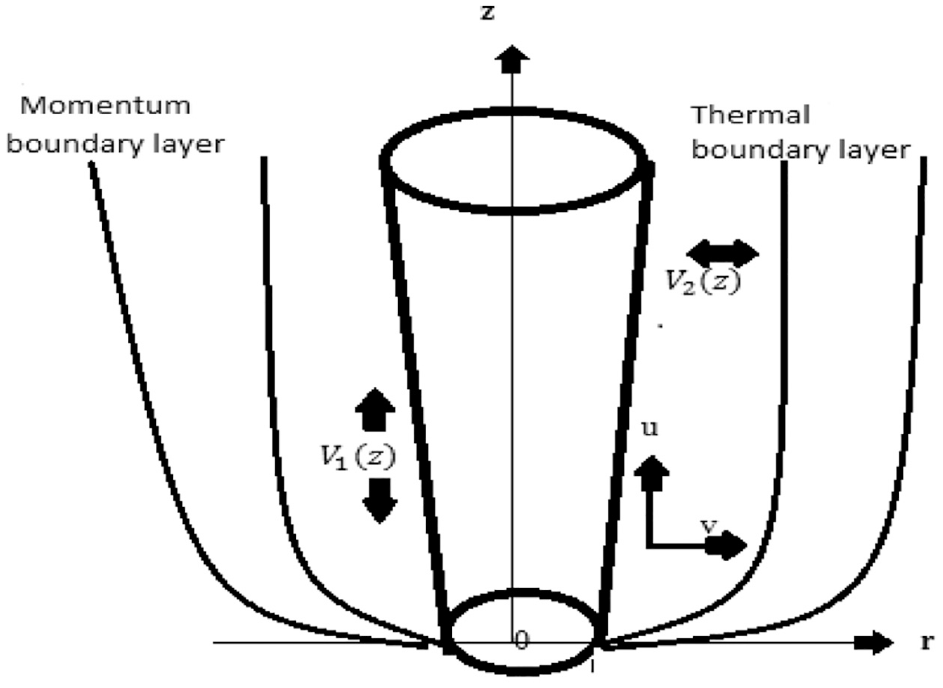
Consider the steady, laminar two-dimensional, and axi-symmetric flow of a viscous and incompressible fluid over a porous, moving, and heated cylinder of non-uniform radius. Moreover, all the field variables, defined at the wall of the duct, including the surface of the cylinder are non-uniform and non-linear. The schematic diagram of the simulated model is given in Figure 1.
Geometry of the current model.
Note that the surface temperature is greater than ambient temperature, whereas, all the thermal properties are uniform. The continuity, momentum and energy equation along with BC’s are taken in cylindrical coordinate system in order to simulate the problem in appropriate manner and the system of relevant governing PDE’s takes the following form4:
where, the subscripts denote the partial differentiation of the dependent variables w.r.t. independent variables. Note that equations (2) and (3) represents the boundary layer form of momentum and energy equations, respectively, whereas, the convective term in the momentum equation comes from Boussinesq approximation and the energy equation is free from the viscous dissipation term. The BC’s are
where, and are kinematic viscosity and thermal conductivity, also and are called temperature at the surface of cylinder and ambient region respectively, acceleration due to gravity is denoted by and the coefficient of thermal expansion is denoted by . Moreover, the variable temperature of the cylinder is represented by . The stretching (shrinking) velocity is demonstrated by and injection (suction) velocity is represented by . Note that and are the coefficients of stretching (shrinking) and injection (suction) velocities respectively. In equations (1)–(3), and are the representatives of velocity components taken in and directions, whereas, denotes the temperature distribution respectively. In order to solve governing PDE’s and BC’s in equations (1)–(4), we employed proper functions and similarity variable to transform them into a system of BVP of ODE’s. Therefore, we introduced the following variables for velocity components, temperature, and similarity function.
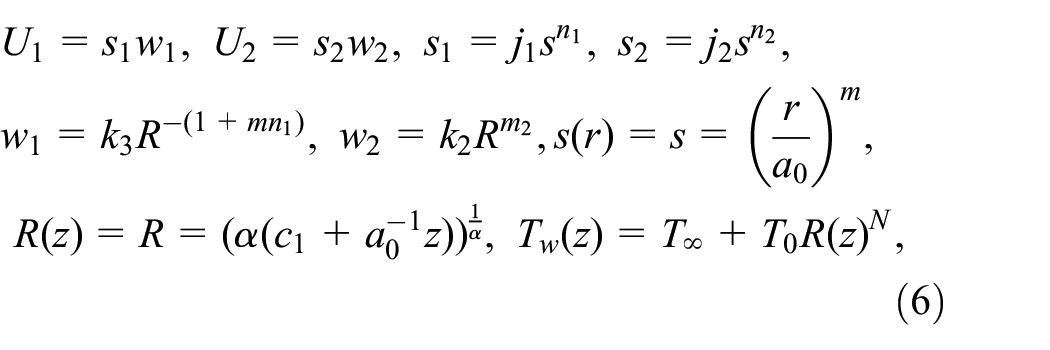
However, the known variables in equation (5) are expressed in the following form:
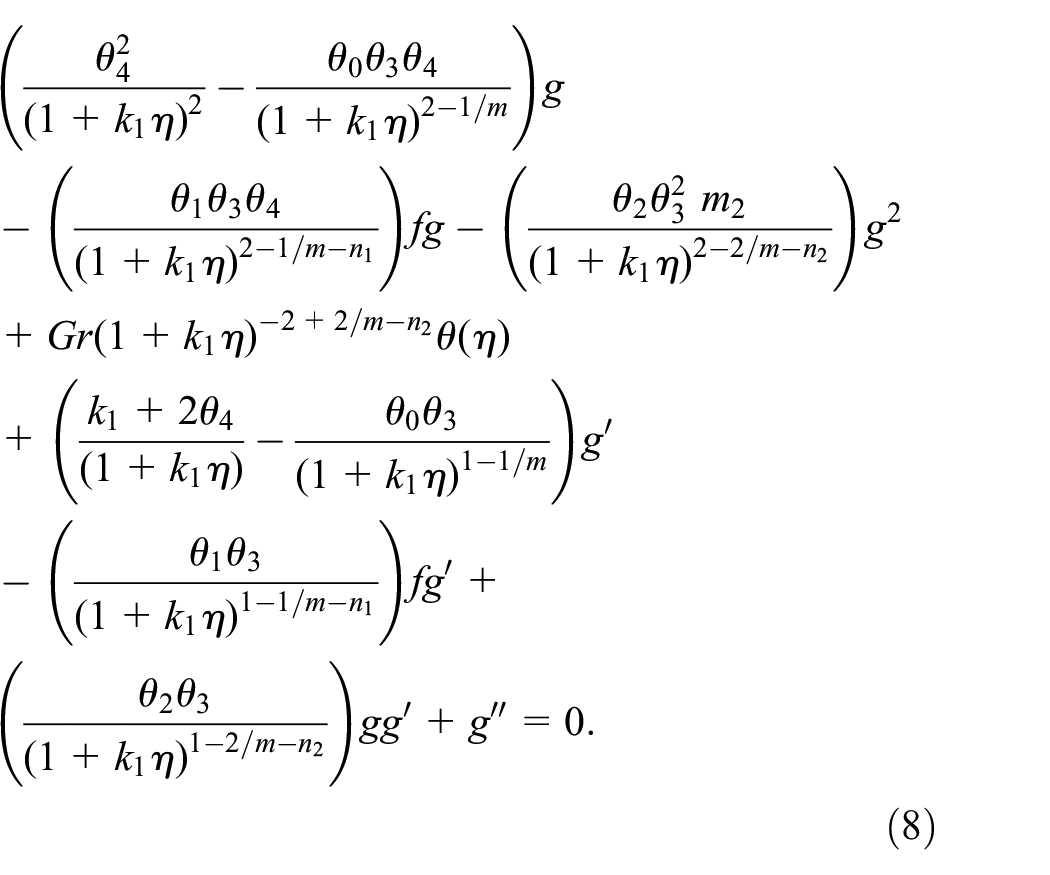
The non-uniform radius of the cylinder is denoted by and defines surface geometry. The new independent variable is so chosen that both the independent variables and are changed it significantly. The radial, axial velocities and temperature functions are denoted by , , and respectively. Note that the constants , , , , , and are the controlling parameters, whereas, and represent characteristic length and curvature parameter, respectively. Moreover, , , , , , and are different parameters appeared as exponents of variables in equation (6). The variables in equations (5) and (6) are substituted into equations (1)–(3) and we get the set of following ODE’s:
where, , and are dimensionless numbers. On the other hand, the prime denotes the derivatives of unknown functions w.r.t. . The non-dimensionalized quantities in equations are:
where, and are called Prandtl and modified Grashof number. The transformations in equations (5) and (6) are also used in equation (4) and we obtained the following BC’s:
Here we have new quantities , , and , whereas, they have replaced by field variable , , and respectively. These kinematic and thermodynamics properties of field are determined by solving the system of ODE’s in equations (7)–(9) subject to the BC’s in equation (11).
Evaluation of shear stress and rate of heat transfer at the wall of cylinder
Skin friction and rate of heat transfer at wall are defined as:
Skin friction coefficient is represented by (non-dimensional) and (non-dimensional) denotes Nusselt number. These physical entities are transformed into and , in view of the transformations given in equation (5) eventually we get the final forms of them as:
Graphs and discussion
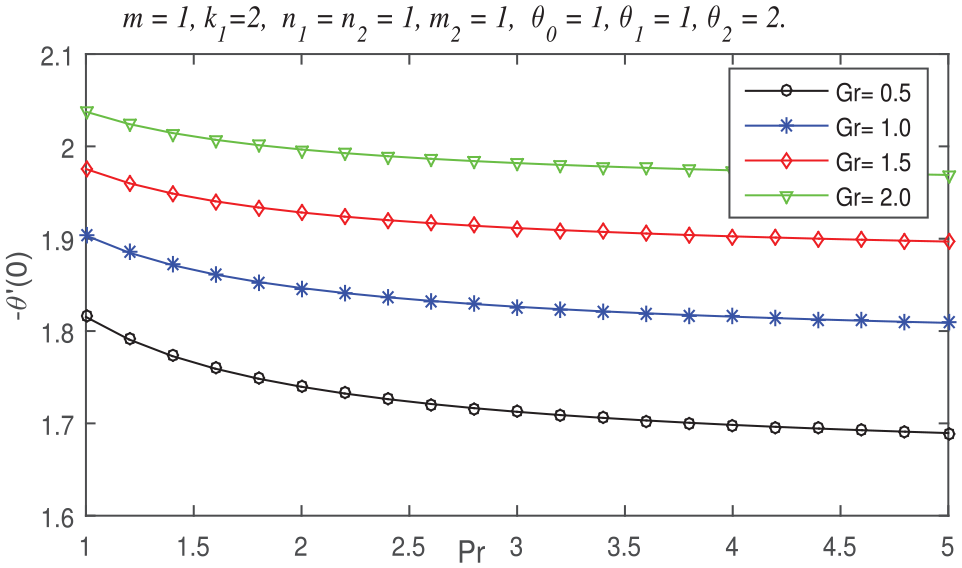
In this section, we discussed the numerical solution of equations (7)–(11), whereas, this solution of the problem is obtained by package of MATLAB. Multiple graphs are drawn in this paper from the numerical solution for different values of the parameters, whereas, the key results have been discussed in Figures 2 to 9. Effects of curvature parameter () are seen on the profiles of velocity and temperature in Figures 2 and 3 respectively for fixed value of other dimensionless numbers. The momentum and thermal boundary layers are increased with the increase of curvature . Moreover, the temperature profiles are also graphed against for the same set of parameters values. Similarly, effects of different are seen on the velocity and temperature profiles in Figures 4 and 5 respectively. It has been observed that the thickness of thermal boundary layers is decreased with the increasing of . Note that the large values of Gr present a weak bond between the fluid molecules. Therefore, it also decreases the strength of internal friction due to a strong enough gravity (accelerate the velocity of fluid). In laminar flow, the buoyancy parameter is highly effective within the boundary layer, formed during the moving and porous cylinder of non-uniform radius. Remember that the positive values of Gr support the fluid motion. It is known fact that the buoyancy forces are producing the motion of fluid near the surface of cylinder, therefore, the increase and decrease in the velocity is observed at the vacinity of wall and the boundary layer behavior in the profiles is obvious due to the increase and decrease of , however, the variation in velocity depends upon the value of thermal numbers. Figure 6 shows that the rate of heat transfer is increased with the increasing of Prandtl () number. Figure 7 demonstrates the graph of skin friction against for different values of stretching parameter (), and the profiles are decreased with the increasing of . Since higher means that the fluid will be more viscous and vice versa. Effects of parameter is observed on the rate of heat transfer in Figure 8, however, heat transfer coefficient is calculated against and respectively for different values of . It is observed that the profiles are increased with the increasing of , remember that on increase in implies an increase in the buoyancy force. The graphs are increased linearly with the increase of , however, it shows that the buoyancy force is increasing. In Figure 9, effects of parameter are seen on velocity curves. Note that is appeared in the exponent of different functions and determines the types and nature of non-linearity of stretching (shrinking) velocities and wall temperature at the surface. With the increase of the boundary layer thicknesses are decreased. Similar effects of are observed on temperature functions for the same set of parameters but the graph is not presented here.
Velocity profiles of are obtained from the numerical solution of equations (7)–(11) for various of these equations.
Temperature profiles are obtained from the numerical solution of equations (7)–(11) for various of these equations.
Velocity profiles of are obtained from the numerical solution of equations (7)–(11) for various .
Temperature profiles of are obtained from the numerical solution of equations (7)–(11) for various .
Rate of heat transfer at the wall of cylinder () drawn against for different .
Skin friction is drawn against for different values of stretching parameter .
Rate of heat transfer () is drawn against for different .
Effects of are shown on from the numerical solution of equations (7)–(11).
Comparison with literature
The current modeled problem in equations (7)–(9) is exactly matched with the published results of Poply et al.,29 Rangi and Ahmad,30 Vajravelu et al.,31 Mukhopadhyay and Ishak,20 and Mukhopadhyay and Gorla32 for given values of parameters, that is, when we fixed the parameters such that: , , , , , , , , , , , and large values of . Moreover, if and the problem reduces to the boundary layer flow along a stretching flat plate which was considered by Ali.33 Furthermore, if and the analytical solution of the thermal field was given by Grubka and Bobba.34 In Table 1, the numerical values of skin friction and rate of heat transfer are noted for different parameters.
Effects of various parameters are seen on skin friction and rate of heat transfer coefficient.
2
1
1
2
1
0.71
1
1
1
2
−12.1828
4.0137
3
−12.9427
7.1661
5
−13.1400
9.6073
7
−13.2541
12.1029
10
−13.3639
16.0737
1
1
2
2
0.7
1
1
1
0.2
−3.6588
2.0858
0.3
−5.0040
2.3856
0.4
−5.9616
2.5860
0.5
−6.7304
2.7848
2
2
2
2
1
0.7
1
1
1
−9.6643
3.5529
2
−10.3038
3.7170
3
−10.8697
3.8744
4
−11.3803
4.0256
1
1
2
1
0.7
1
2
1
2
−10.9838
3.1317
2
−10.5808
3.3126
3
−10.2299
3.4540
4
−9.9126
3.5720
Conclusion
We have concluded the main results and new observations with the following remarks:
The present model generalizes the problems of forced (convection) flow, over a vertical porous, moving and heated cylinder of non-uniform radius and thickness. Note that radius of the cylinder, its surface and the three field variables, defined at the wall are variable and may have linear, non-linear, uniform, algebraic and non-algebraic forms. Therefore, the diverse nature of all such problems is main objective of present simulation.
There are two different types of parameters in the final version of ODE’s, one set of parameters determines the non-linear nature of the field variables and wall thickness, whereas, the second set of parameters explores the set of dimensionless quantities.
We have seen indirect proportionality between velocity and temperature profiles with curvature parameter, however, for thermal parameters, there is direct and inverse proportionality between velocity and temperature profiles.
Skin friction and rate of heat transfer are graphed against different parameters and their linear, non-linear increasing and decreasing behaviors are observed.
Moreover, this research work can be extended to a corrugated cylinder of variable radius and the model may solve for exponentially variable thickness of wall of cylinder, whereas, the simulated problem can also be solved for non-Newtonian and Nano fluids flow easily. Furthermore, these investigations can be carried out for mixed convection flow and double diffusive convection in flow as well.
Footnotes
Appendix
Handling Editor: Chenhui Liang
Declaration of conflicting interests
The author(s) declared no potential conflicts of interest with respect to the research, authorship, and/or publication of this article.
Funding
The author(s) received no financial support for the research, authorship, and/or publication of this article.
ORCID iD
Sajid Rehman
References
1.
NieldDA, et al. Convection in porous media. New York: Springer, 2006. 3.
2.
InghamDBPopI. Transport phenomena in porous media. Oxford: Elsevier, 1998.
ChenTSMucogluA. Buoyancy effects on forced convection along a vertical cylinder. J Heat Transf1975; 97: 198–203.
5.
MucogluAChenTS. Buoyancy effects on forced convection along a vertical cylinder with uniform surface heat flux. J Heat Transf1976; 98: 523–525.
6.
BlottnerFG. Finite difference methods of solution of the boundary-layer equations. AIAA J1970; 8: 193–205.
7.
BuiMCebeciT. Combined free and forced convection on vertical slender cylinders. J Heat Transfer1985; 107: 476–478.
8.
LeeSLChenTSArmalyBF. Mixed convection along vertical cylinders and needles with uniform surface heat flux. J Heat Transf1987; 109: 711–716.
9.
MerkinJH. Mixed convection from a horizontal circular cylinder. Int J Heat Mass Transf1977; 20: 73–77.
10.
MahmoodTMerkinJH. Mixed convection on a vertical circular cylinder. Z Angew Math Phys1988; 39: 186–203.
11.
WangTYKleinstreuerC. General analysis of steady laminar mixed convection heat transfer on vertical slender cylinders. J Heat Transf1989; 111: 393–398.
12.
KumariMNathG. Unsteady mixed convection with double diffusion over a horizontal cylinder and a sphere within a porous medium. Wärme Stoffübertragung1989; 24: 103–109.
13.
AliMAl-YousefF. Laminar mixed convection from a continuously moving vertical surface with suction or injection. Heat Mass Transf1998; 33: 301–306.
14.
RahmanMMulolaniI. Convective-diffusive transport with chemical reaction in natural convection flows. Theor Comput Fluid Dynam2000; 13: 291–304.
15.
NazarRAminNFilipD, et al. The brinkman model for the mixed convection boundary layer flow past a horizontal circular cylinder in a porous medium. Int J Heat Mass Transf2003; 46: 3167–3178.
16.
NazarRThamLPopI, et al. Mixed convection boundary layer flow from a horizontal circular cylinder embedded in a porous medium filled with a nanofluid. Transp Porous Media2011; 86: 517–536.
17.
PatilPMRoySPopI. Unsteady effects on mixed convection boundary layer flow from a permeable slender cylinder due to non-linearly power law stretching. Comput Fluids2012; 56: 17–23.
18.
LokYYMerkinJHPopI. Mixed convection flow near the axisymmetric stagnation point on a stretching or shrinking cylinder. Int J Therm Sci2012; 59: 186–194.
19.
PrakashJ, et al. Radiation and Dufour effects on unsteady MHD mixed convective flow in an accelerated vertical wavy plate with varying temperature and mass diffusion. Walailak J Sci Techn2014; 11: 939–954.
20.
MukhopadhyaySIshakA. Mixed convection flow along a stretching cylinder in a thermally stratified medium. J Appl Math2012; 2012: 1–8.
21.
WangCY. Natural convection on a vertical stretching cylinder. Commun Nonlinear Sci Numer Simul2012; 17: 1098–1103.
22.
PandeyAKKumarM. Natural convection and thermal radiation influence on nanofluid flow over a stretching cylinder in a porous medium with viscous dissipation. Alex Eng J2017; 56: 55–62.
23.
KhanMMalikR. Forced convective heat transfer to sisko fluid flow past a stretching cylinder. AIP Adv2015; 5: 127202.
24.
HayatTAshrafMBShehzadSA, et al. Mixed convection flow of viscoelastic nanofluid over a stretching cylinder. J Braz Soc Mech Sci Eng2015; 37: 849–859.
25.
SinhaDJainPSiddheshwarPG, et al. Forced convective flow of a nanoliquid due to a stretching cylinder with free stream. J Appl Fluid Mech2016; 9: 463–474.
26.
KhanIAli ShahNTassaddiqA, et al. Natural convection heat transfer in an oscillating vertical cylinder. PLoS One2018; 13: e0188656.
27.
JanNMarwatDNKKhanTS. Viscous flow due to non-uniform cylinder with non-uniform stretching (shrinking) and porous velocities. Phys Scr2019; 94: 115222. 11.
28.
JanNKhan MarwatDNKhanTS. Heat transfer in viscous flow over a heated cylinder of nonuniform radius. Ain Shams Eng J2021; 12: 4189–4199–4.
29.
PoplyVSinghPChaudharyKK. Analysis of laminar boundary layer flow along a stretching cylinder in the presence of thermal radiation. WSEAS Trans Fluid Mech2013; 8: 4.
30.
RangiRRAhmadN. Boundary layer flow past a stretching cylinder and heat transfer with variable thermal conductivity. Appl Math2012; 03: 205–209.
31.
VajraveluKPrasadKVSanthiSR. Axisymmetric magneto-hydrodynamic (MHD) flow and heat transfer at a non-isothermal stretching cylinder. Appl Math Comput2012; 219: 3993–4005.
32.
MukhopadhyaySGorlaRS. Slip effects on boundary layer flow and heat transfer along a stretching cylinder. Int J Appl Mech Eng2013; 18: 447–459.
33.
AliME. Heat transfer characteristics of a continuous stretching surface. Wärme Stoffübertragung1994; 29: 227–234–4.
34.
GrubkaLJBobbaKM. Heat transfer characteristics of a continuous, stretching surface with variable temperature. J Heat Transf1985; 107: 248–250.