



Abstract
The opposed-piston, two-stroke (OP2S) diesel engine is a potential power system to promote thermal efficiency, but the engine has an inferior scavenging performance. Through variable intake/exhaust times, the combustion process can be effectively facilitated. For example, the VVT technology is used in traditional engines. However, this technology has not been applied to OP2S diesel engines. This present work analyzed parameters influencing the intake/exhaust times to find a way to realize variable intake/exhaust times in OP2S diesel engines. These parameters affecting intake/exhaust times were mainly focused on, for example, crank to link ratio (CLR), piston phase difference (PPD), and port height (PH). Through investigating their influence on IMEP, scavenging efficiency, and trapping efficiency, we evaluated the different schemes from performance, intake/exhaust phases, and realization cost. The results show that the PH scheme significantly precedes the PPD and CLR schemes for realizing the variable intake/exhaust times. The PH scheme owns a more extensive phase adjustment range of 31°CA, the IMEP of 0.75 MPa, and the scavenging efficiency of 0.74. To achieve better power and scavenging performance, the EPH should be 37.5% higher than IPH, and the PPD should be kept below 15°CA.
Keywords
Introduction
The global transportation industry’s demand for energy has been expanding year by year. Petroleum-derived liquid fuels dominate the energy market to power internal combustion engines (ICEs). 1 By 2040, global car ownership will double. The demand for petroleum-derived fuels will further increase. The combustion of petroleum-derived fuels will trigger more emissions to threaten the global environment and human health. To confront the environmental crisis, various zero-emission power systems, such as hydrogen fuel cells, etc. The wide application of new power systems relies on improving the energy supplement and safety system. These power systems difficultly replace the ICEs as the central power system in a short time. 2 Also, the ICEs must continuously improve fuel economy and power performance, and reduce emissions for our health and blue sky.
Conventional fuel engines have gradually optimized the combustion process through high-pressure common rail, variable valve timing (VVT), and unique combustion chamber structures. Integrating these technologies, the thermal efficiency of ICEs can reach up to 50%, 3 but the ICEs still possess great potential to reach the 60% thermal efficiency.4,5 Advanced technologies such as variable two-stage superchargers, variable EGR systems, low friction technology, etc., spring up to hit the top of thermal efficiency. Unfortunately, these technologies will increase the weight and manufacturing cost of ICEs.
Opposed-piston two-stroke (OP2S) diesel engines can further reduce weight due to the elimination of the cylinder head and crankshaft valve mechanism so that the OP2S diesel engine can reach higher thermal efficiency. Achates used a high-pressure common rail system on the OP2S diesel engine so that the engine could obtain the indicated thermal efficiency of 52% without adding other auxiliary systems. 6 This structure without a cylinder head can provide more possibilities for the layout and number of the OP2S diesel engine injectors. 7 For example, multiple fuel injections can also inject different fuels at different times according to other operating conditions. Moreover, the position of fuel injectors can be flexibly set to realize better the controllability of the spatial distribution of the fuel spray. 8 These inherent advantages of the OP2S diesel engine prompt it to overcome future energy and environmental challenges. 9
However, the short scavenging duration for the OP2S diesel engine possesses will result in low scavenging quality. In the scavenging process, the intake and exhaust processes run simultaneously, so the fresh charge and burned gases are effortlessly blended, leading to a more significant residual gas in the cylinder. This technical difficulty restricts the performance improvement of OP2S diesel engines. The engine performance was optimized by adjusting the time of intake/exhaust. The VVT can effectively improve thermal efficiency and reduce emissions of the conventional engine.10,11 The VVT technology has been widely used in traditional four-stroke engines.12,13 However, the VVT technology has not yet been applied to OP2S diesel engines. Compared with an independent valve (which is not affected by the piston movement), the scavenging process of OP2S diesel engines is realized by the piston movement and the port parameters.
This brings more opportunities to implement variable intake/exhaust timings. Compared with port width, port height will affect the opening and closing phases of intake/exhaust ports to determine the relationship between intake/exhaust flow and effective compression ratio. 14 The relative motion of the two pistons determines the piston phase difference. The increasing Piston phase difference will raise flame developing and rapid burning periods and reduce relative piston velocity and compression ratio. 15 Link length and crank radius are also the main factors influencing the piston movement. A multi-link technology varies the crank to link ratio by adjusting the stroke length in a four-stroke engine. Its indicated power can increase to 62% over the constant-stroke engine. 16 These possibilities of OP2S diesel engines provide more methods to vary intake and exhaust times for high performances. According to the opportunity, an equivalent method was applied to establish the GT-POWER model of the OP2S diesel engine. Through the root cause analysis method, this present work studied the main factors affecting the intake/exhaust phases to determine the critical parameters for evaluating their influence on the scavenging and power performances. Based on the evaluation, we tried to propose the optimal way to realize variable intake/exhaust times in OP2S diesel engines, helping the development of clean and efficient OP2S diesel engines for the future.
Identification of the factors influencing intake/exhaust times
In the scavenging process, the parameters, including port structure parameters, piston motion parameters, and engine operating parameters were analyzed to identify the factors influencing the intake/exhaust times of OP2S diesel engines.
Port structure parameters
The port structure parameters mainly include port size, port position, and port shape. The rectangular port is widely used in an OP2S diesel engine. The rectangular port is taken as an example to introduce port structure parameters affecting the scavenging process, as shown in Figure 1.

Port structure parameters.
The port size includes port area and port inclination. The port area mainly contains port height and port width, which are expressed by h and b respectively and can also be represented by dimensionless parameters height to stroke ratio βh and width to circumference ratio βb. Their definition is as follows:


Where S is the stroke, D is the cylinder bore, and n is the number of ports. The port width only affects the area of the intake and exhaust ports; the port height not only affects the port area but also affects the intake and exhaust phases.17–19 The port inclination contains radial inclination and axial inclination. The radial inclination generates a swirling flow,20,21 while the axial inclination angle creates a tumbling flow.22–24 The combination of radial inclination and axial inclination can achieve a complicated intake flow, but the inclination angle does not affect the intake/exhaust times. The change in the port position will directly cause a difference in the port area, and it will also affect the compression ratio and the intake/exhaust times. Generally, the OP2S diesel engine can achieve better performance when the port is located near the outer dead center. The closer the port is toward the outer dead center (ODC), and the larger the effective compression ratio of the OP2S diesel engine is. The larger effective compression ratio will accelerate mixing and burning. The port shape mainly includes the rectangular and the oval. The port shape primarily affects the intake flow and the port area but does not affect the intake/exhaust times. 25
Piston motion and engine operating parameters
The piston motion parameters mainly include piston phase difference (PPD) and crank to link ratio (CRL). They determine the movement law of the piston at a fixed stroke. The PPD is defined as the difference between the crank angle of the exhaust piston and the intake piston reaching the inner dead center. The PPD affects the intake/exhaust times and the compression ratio.26,27 The CLR is defined as the ratio of crank radius to link length. The CLR affects the intake/ exhaust areas and the intake/ exhaust times simultaneously. The engine operating parameters include the scavenging pressure difference 28 and the engine speed. 14 Both parameters directly affect the airflow movement without changing the intake/ exhaust times.
Root cause analysis
According to the previous literature on the parameters of the scavenging process, the root cause analysis method 29 is used to analyze the relevant parameters affecting the scavenging process, as shown in Figure 2. Parameters that directly affect the scavenging performance can be divided into compression ratio, intake/exhaust phases, intake/exhaust areas, and air movement. These performance parameters were adjusted through the control parameters in the OP2S diesel engine, such as CLR, PPD, port height (PH), and scavenging pressure difference. These parameters can be divided into two categories: adjustable parameters and non-adjustable parameters. According to the current technology, PPD, PH, engine speed, and scavenging pressure difference can be adjustable parameters. These parameters that affect the intake/exhaust times, mainly include CLR, PPD, and PH. Their influence on the scavenging process is studied to explore the feasibility of realizing the variable intake/exhaust times.

Root cause analysis to identify the factors influencing the port phase.
Simulation model and validation process
The simulation model of an OP2S diesel engine was established by an equivalent method as shown in Figure 3. The parameters of the OP2S diesel engine are shown in Table 1. The simulation validation of the OP2S diesel engine contained the scavenging and combustion processes, as shown in Figure 4. The in-cylinder pressure and heat release rate from the Achates diesel engine were used to validate the double Wiebe mode for the combustion process and WoschniGT model for the heat transfer process.

Piston movement of the OP2S diesel engine.
Specification of the OP2S diesel engine.


Validation of a 1D simulation model.
Double Wiebe model for the combustion process.
The heat release rate is mentioned in equation (3)

The Double Wiebe burn rate of premixed combustion is mentioned in equation (4)

The Double Wiebe burn rate of diffusion combustion is mentioned in equation (5)

Where
WoschniGT model for the heat transfer process.
The heat transfer is mentioned in equation (6)

Where

Where
So we obtained the first iteration model to get port parameters for the flow experiment and boundary conditions for the 3D simulation. The 3D simulation was used to create the intake/exhaust manifolds. The 3D model includes a cylinder, intake manifold, and exhaust manifold. In the 3D model, the intake piston temperature was 523 K, the exhaust piston temperature was 623 K, and the cylinder temperature was 573 K. Other parameters were consistent with the 1D model. Meanwhile, the flow experiment provided the mass flow to validate the 3D model. The main equipment and sensor parameters of the flow experiment are given in Table 2. The flow experiment with the intake pressure of 102 kPa and the environmental temperature of 20°C needed to achieve the intake pressure difference of 1 kPa. The scale of the port height was 4–30 mm. Every point was measured seven times. The measurement error was less than 0.06%. By combining the 1D/3D simulations and the flow experiment, we acquired the scavenging curves and the discharge coefficient. Then both parameters were respectively substituted into the1D simulation model of the first iteration, to attain the final simulation model. A detailed description of modeling and validation was found in Mattarelli et al. 26
Specification of the primary equipment sand sensors.

Results and discussions
Effect of motion parameters on diesel engine performance
Piston phase difference
OP2S diesel engines adopt asymmetric uniflow scavenging to realize a three-stage scavenging process. The process includes the free exhaust stage (intake port closes and exhaust port opens), the scavenging stage (intake port and exhaust port open), and the pressurized intake (intake port opens and exhaust port closes). Meanwhile, the asymmetric uniflow scavenging is the way for the OP2S diesel engine to reduce inlet and exhaust blending and improve the scavenging efficiency. To realize the three-stage scavenging process, a specific phase difference must be preset for two pistons. With a phase difference of 0°CA, the OP2S diesel engine cannot achieve the three-stage scavenging process by designing the port height. When the exhaust port height (EPH) is higher than the intake port height (IPH), as shown in Figure 5, the exhaust port closes late than the intake port. The fresh charge in the cylinder will flow into the exhaust manifold after the scavenging is finished. When the IPH is higher than the EPH, as shown in Figure 6, the intake port opens early than the exhaust port. The fresh charge in the cylinder will flow back into the intake manifold. Both schemes cannot effectively conserve the fresh charge to promote combustion.
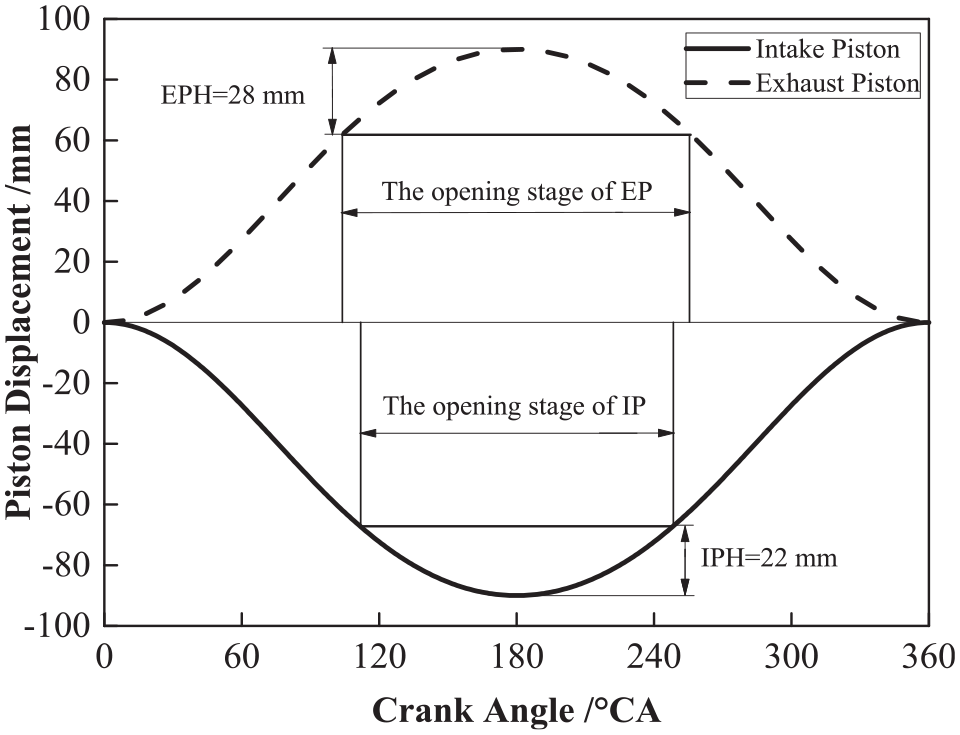
Piston displacement when the EPH is higher than the IPH.

Piston displacement when the IPH is higher than the EPH.
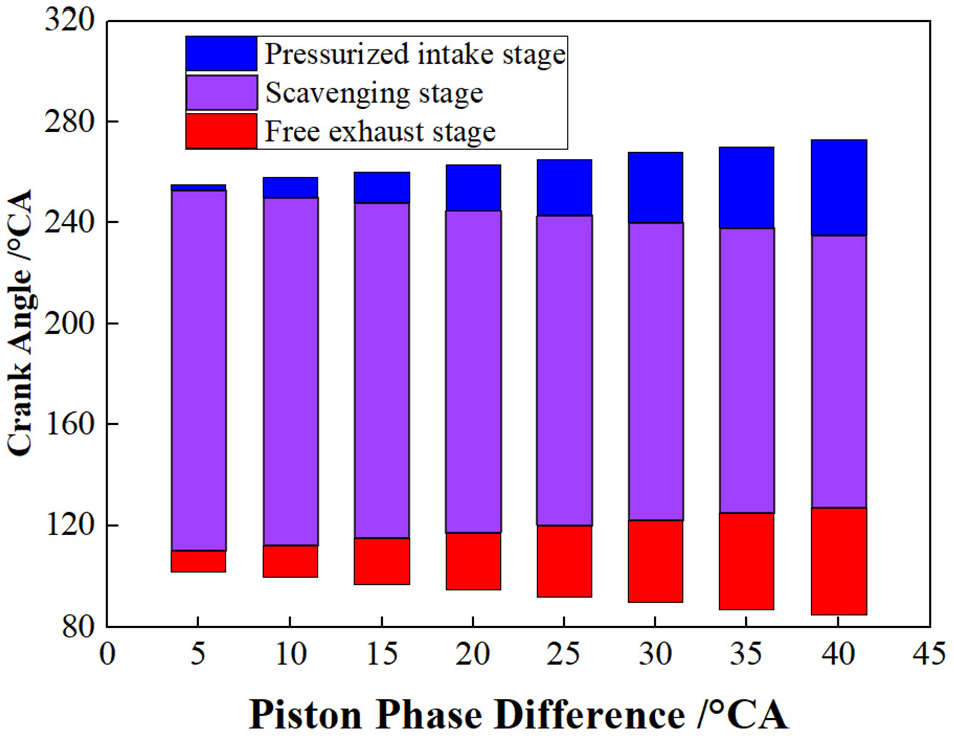
Figure 7 shows piston displacement under different PPDs. The greater the PPD is, the greater the piston distance is at the inner dead center (IDC). When the intake/exhaust port heights remain constant, the crank angle of the intake/exhaust stages also stays constant. As the PPD increases, the exhaust phase advances and the intake phase postpones. The advanced/ postponed degree is equal to the phase difference. This results in the extension of the free exhaust and pressurized intake stages, and a shortening of the scavenging stage.

Piston displacement under different PPDs.
Figure 8 shows the three-stage scavenging under different PPDs. The rising PPD will raise the crank angle of the free exhaust and pressurized intake, and shorten the crank angle of the scavenging stage. When the PPD increases from 5°CA to 40°CA, the crank angles of the free exhaust and pressurized intake stages increase by 34°CA and 36°CA, respectively. The rising crank angle of the free exhaust stage is slightly larger than the increasing crank angle of pressurized intake stages. Meanwhile, the crank angle of the scavenging stage decreases by 35°CA, deteriorating the scavenging process. Besides, the maximum change range of the intake port opening is 17°CA.
Three-stage scavenging under different PPDs.
Figure 9 shows the volumetric compression ratio under different PPDs. As the PPD increases from 0°CA to 40°CA, the volumetric compression ratio decreases from 22 to 12.3. The reduced volumetric compression ratio will reduce the in-cylinder temperature, worsening the ignition, and combustion processes. This is because the increase of the PPD shortens the maximum equivalent displacement and increases the minimum equivalent displacement, as shown in Figure 10. Before the PPD is below 15°CA, the volumetric compression ratio decreases slowly. After the PPD exceeds 15°CA, the volumetric compression ratio decreases linearly at a faster speed. This is attributed to the clearance volume of the OP2S diesel engine.

Volumetric compression ratio under different PPDs.

Equivalent displacement under different PPDs.
Figure 11 shows the backflow gas mass at intake ports. As the PPD increases, the backflow gas mass at an intake port decreases first and then increases. Before the PPD is below 15°CA, the backflow gas mass at an intake port decreases. The pressure of burned gases in the cylinder is higher than the pressure in the intake manifold. The gas in the cylinder will flow back into the intake manifold. The appearance of the PPD creates the free exhaust stage to reduce the in-cylinder pressure. After the PPD exceeds 15°CA, the backflow gas mass at an intake port increases, the increasing PPD will prolong the pressurized intake stage, but not raises the air trapped in the cylinder because the maximum air trapped in the cylinder is determined by the cylinder volume, the gas state, and the pressure difference. The excess gas will be spilled back into the intake manifold.

Backflow gas mass at intake ports under different PPDs.
Figure 12 shows performance parameters under different PPDs. As the PPD increases, the scavenging efficiency increases first and then decreases. Before the PPD is below 15°CA, the scavenging efficiency rises. The increase of the PPD advances the open time of the exhaust port. The in-cylinder pressure is higher, which helps the residual gas discharge independently. Before the PPD exceeds 15°CA, the scavenging efficiency reduces. The increase of the PPD will reduce the scavenging time. The fresh air cannot have enough time to carry the residual gas. Under the same fuel injection parameters, fresh air determines the combustion process and power performance. So The indicated mean effective pressure (IMEP) is consistent with the scavenging efficiency. However, the maximum IMEP appears at the PPD of 10°CA. The IMEP only reduces by 0.47% at the PPD of 15°CA, while the IMEP will reduce by 1.75% at the PPD of 15°CA. This suggested the PPD should be kept below 15°CA to obtain the scavenging and power performances. The results from Ma et al. 15 showed the indicated work would reach its maximum value at the PPD of 15°CA. Trapping efficiency is the ratio of the mass of fresh charge remaining in the cylinder at the end of the air exchange to the total mass of scavenging air provided by the scavenging pump during the scavenging process. Before PPD reaches 20°CA, the trapping efficiency decreases slightly. After the PPD exceeds 20°CA, the trapping efficiency increases rapidly. This is attributed to the increasing the backflow gas at intake ports in Figure 10.

Performance parameters under different PPDs.
Crank to link ratio
Figure 13 shows piston speed under different CLRs. As the CLR increases, the piston speed first decreases and then increases from the IDC to the ODC. Figure 14 shows the piston displacement under different CLRs. The piston displacement for the CLR of 0.32 is slightly larger than the piston displacement for the CLR of 0.24. The increase of the CLR does not affect the maximum piston displacement and the minimum piston displacement, so the volumetric compression ratio remains constant. Moreover, the increase of the CLR results in the change of the port phase: The opening time of the intake and exhaust ports is advanced by 3 CA, and the closing time of the intake and exhaust ports is delayed by 3°CA.

Piston speed under different CLRs.

Piston displacement under different CLRs.
Figure 15 shows the three-stage scavenging process under different CLRs. The increase of the CLR cannot affect the time of pressurized intake and free exhaust stages but increase the time of the scavenging stages. The time of the scavenging stage raises with the CLR increasing. This is because the increase of the CLR will not change the opening and closing times of ports. Combined with Figure 12, the increase of the CLR will reduce piston speed to increase the scavenging time. Figure 16 shows the port area under different CLRs. At the same crankshaft angle, the intake and exhaust areas slightly increase as the CLR increases. The larger port area facilitates the entry of fresh air and the discharge of exhaust gases. This is because the larger CLR will raise the displacement in the scavenging process.

Three-stage scavenging under different CLRs.

Port area under different CLRs.
Figure 17 shows the performance parameters under different CLRs. The scavenging efficiency and the IMEP continuously increase as the CLR increases. The increase of the CLR raises the opening area of the intake/exhaust ports and scavenging time. As a result, the fresh charge increases quickly, and the residual gas decreases quickly, so the scavenging efficiency increases. Correspondingly, the scavenging process provides more air to improve mixing and burning, enhancing combustion. As the CLR is increased from 0.24 to 0.32, the IMEP increases by 3.4‰, and the scavenging efficiency increases by 0.7‰. This indicates that an increase in the CLR does not significantly improve the performance of the OP2S diesel engine.

Performance parameters under different CLRs.
Effect of port parameters on diesel engine performance
Figure 18 presents IMEP and scavenging efficiency (SE) under different port width to circumference ratios (WCRs). The scavenging efficiency indicates to what extent the residual gases in the cylinder have been replaced with fresh air. The increase of port WCR increased the area of the intake and exhaust ports. The larger port area will promote the entering of fresh charge and the discharging of residual exhaust gas, finally raising scavenging efficiency. More fresh air mixed with fuel adequately, accelerating combustion. Besides, the increasing port WCR did not affect port phases and the volumetric compression ratio.

IMEP and SE under different port WCRs.
Figure 19 indicates IMEP and SE under different PHs. Under a scavenging efficiency, there is a maximum IMEP (the circle points). These circle points form an optimum line of IMEP. The optimum line indicates that the EPH is 37.5% higher than IPH. The optimum point (the star point) of the map emerges in the queue. It has an IPH of 20 mm and an EPH of 24 mm. When the PH is lower than the optimum point, the residual exhaust gas cannot discharge completely, and the high pressure of the cylinder hinders the fresh air from entering. When the PH is higher than the optimum point, the residual exhaust gas can discharge completely, and the low pressure of the cylinder cannot deposit the fresh air in the cylinder effectively.

IMEP and SE under different PHs.
Table 3 shows the exhaust phase under different EPHs. The IPH remains 14 mm, and its opening/closing time is 131°CA/23°CA. As the EPH is increased from 16 to 34 mm, the maximum range of the exhaust port at the opening time is 27°CA. Table 4 shows the intake phase under different intake port heights. The EPH remains 16 mm, and its opening/closing time is 117°CA /223°CA. As the IPH is increased from 14 to 34 mm, the maximum change range of the intake port at the opening time is 31°CA.
Exhaust phase under different EPHs.

Intake phase under different EPHs.

Parameters comparison to implementing variable intake/exhaust times
By comparing intake/exhaust phases (IEP), volumetric compression ratio (VCR), IMPE, and scavenging efficiency (SE), this present work analyzed the characteristics of PPD, CLR, and PH to realize the variable intake/exhaust times, as shown in Table 5. The phasing range of the PH is nearly double the phasing range of PPD and 10 times the phasing range of the CLR. That means the PH scheme can adapt to more engine operating conditions. The maximum IMEP of PH is greater than the maximum IMEPs of PPD and CLR. Although the phasing range of PPD is more than five times the phasing range of CLR, the IMEP of CLR did not increase significantly owing to influencing VCR. The maximum SE of PH is slightly less than the maximum SEs of PPD and CLR. In a word, the PH scheme possesses a more significant advantage for the performance improvement of OP2S diesel engines.
Comparison of different parameters.

To implement these technologies, the complexity and cost of the system will increase. The CLR scheme can be achieved by a multi-link technology, as shown in Figure 20. 16 This scheme will increase many links to vary CLR. These moving links will reduce operational reliability and increase maintenance costs. Especially, the large amount of space occupied by links seriously affects the compactness of the OP2S diesel engine. The PPD scheme can be achieved by synchronous belt transmission, 30 chain transmission, 31 and gear transmission, 32 as shown in Figure 21. Synchronous belt and Chain transmissions with the simple structure only have been adjusted by manual. Due to the low accuracy of these transmissions, they are only suitable for low and medium-speed conditions. The gear transmission is significantly better than the other two methods, but its structural complexity will increase. For one goal to adjust the intake and exhaust phases, it is uneconomical to employ a VVD scheme with gear transmission. The PH scheme can be achieved by a layered-port mechanism with fewer parts, 14 as shown in Figure 22. So it can make full use of the space on both sides of the cylinder liner without affecting the compactness of the OP2S diesel engine. The opposed-piston sleeve-valve engine was invented by Pinnacle Engines. Its light-load indicated efficiency will be increased by 15%–30% over conventional poppet-valve engines. 33 The sleeve-valve technology only was applied in 4-stroke engines and will raise more parts. Hence, the PH scheme also possesses the low cost and strong feasibility to vary intake/exhaust phases in an OP2S diesel engine.

A multi-link mechanism for the CLR scheme.
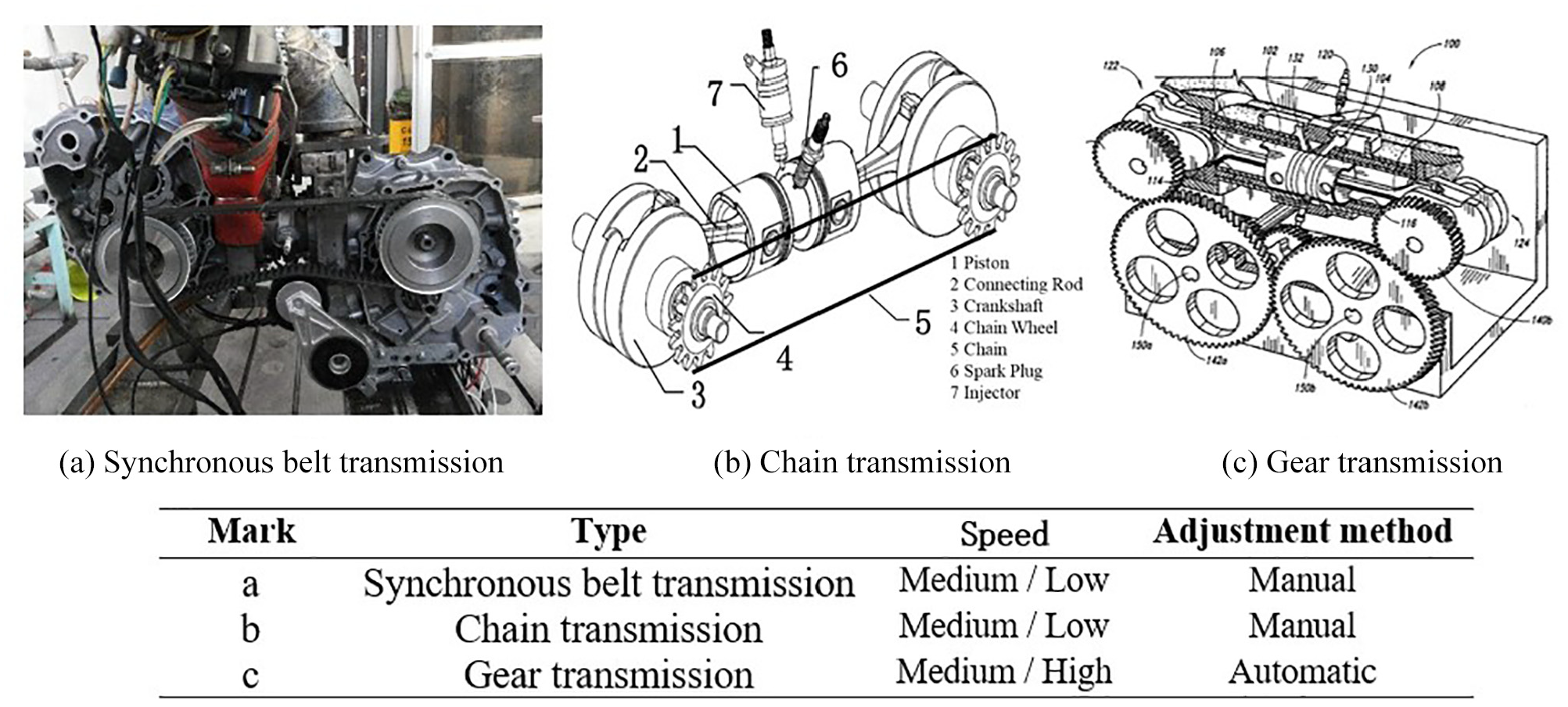
Different implementations of the PPD scheme.

A layered-port mechanism for the PH scheme.
Conclusion
Through the root cause analysis method, the parameters that affect the intake/exhaust times were studied in an OP2S diesel engine, to obtain the key parameters, including PPD, CLR, and PH. A 1D simulation model of the OP2S diesel engine was established to analyze and evaluate their characteristics. The following conclusions can be drawn:
Applying the root cause analysis method to draw the relationship diagram of the parameters, is an effective method to propose a new technology. The factors about piston motion, port structure, and engine operating were analyzed to determine the key parameters: piston phase difference, crank to link ratio, and port height.
Compared with CLR and PPD schemes, the PH scheme owns a more extensive phase adjustment range (31°CA), a significant performance improvement (IMEP can get 0.75 MPa, scavenging efficiency can get 0.74), and a low cost to realize the variable intake/exhaust times. Besides, the EPH should be 37.5% higher than IPH, to achieve better power and scavenging performance.
The PPD has a sigficant influence on the port phase and volumetric compression ratio, and also affects the intake and exhaust process of the OP2S diesel engine. Compared with the PH scheme, the PPD scheme cannot independently control the combustion process of the OP2S diesel engine. To achieve better power and scavenging performance, the PPD should be kept below 15°CA. Besides, the crank to link ratio has little influence on the port phase.
Footnotes
Appendix
Handling Editor: Chenhui Liang
Declaration of conflicting interests
The author(s) declared no potential conflicts of interest with respect to the research, authorship, and/or publication of this article.
Funding
The author(s) disclosed receipt of the following financial support for the research, authorship, and/or publication of this article: This research was supported by the Fundamental Research Program of Shanxi Province (grant No. 20210302123072).
