



Abstract
This paper investigated the effects of porous media layer (PML) and couple stress (CS) lubricants at pure squeeze action in an isothermal elastohydrodynamic lubrication (EHL) point contact with surface roughness (SRN) under constant load condition. The modified transient stochastic Reynolds equation was derived in polar coordinates by means of the Christensen’s stochastic theory and the Stokes’s CS fluid theory. The Gauss-Seidel method (GSM) and the finite difference method (FDM) were both used to solve simultaneously modified transient stochastic Reynolds, force equilibrium, elasticity deformation, and rheology equations. The simulation results revealed that the greater permeability (K) and porous layer thickness (Φ) are, the smaller central pressures (Pc) are, and the smaller film thicknesses (H) are. The times required for achieving maximum central pressures (Pcmax) decrease with increasing K and Φ. Due to squeeze and elastic deformation effects, the slope values of central velocity (Vc) change from negative to positive. The magnitude of Vc and Vmin decreased with decreasing K and Φ. The Hcmin of circular type RN are greater than that of radial type RN. The Pcmax of radial type RN are slightly greater than that of circular type RN.
Introduction
Due to self-contained oil reservoir and good low friction features, porous bearings have been extensively used in industry for a long time. They were widely used in clutches, brakes, and so on. The surface roughness (SRN) effect played a very important role in tribology domain, especially when SRN and film thickness have similar order of magnitude. In order to reduce the friction between the contact surfaces and improve the durability of the friction parts, different kinds of lubricating additives are joined to the base lubricant. Their rheological properties belong to non-Newtonian lubricants types. Many micro continuum theories are usually used to investigate rheological characteristics of non-Newtonian lubricants. The high pressure is accompanied by elastic deformation between contact pairs during squeeze process. Therefore, the effects of porous media layer (PML) and couple stress lubricants (CS) on squeeze elastohydrodynamic lubrication (EHL) motion with SRN are worth discussing.
Many tribological simulation methods1–6 have been presented to explore the effects of SRN. These papers used finite difference method (FDM) and finite element method (FEM) to analyze simultaneously the EHL characteristics of different surface roughness patterns using measured 3D or given stochastic gauss distribution surface roughness. They thought that the rough peak contacts of two surfaces and transient process during start-up are important topics in the future. Over the past years, the generation of the dimple on pure squeeze motion with Newtonian viscous fluid has attracted the attention of many scholars.7–9 But non-Newtonian lubricants, surface roughness, and porous media layer did not be considered. These effects are very important influence parameters in modern industry. Adding lubricant additives in lubricants can improve the load-carrying capacity and reduce the friction parameter.10,11 Many micro-continuum theories have been developed to describe the effects of additives. Stokes theory 12 considered the effects of couple stress, body couple, and asymmetric tensor. This model aims to investigate the effects of particle sizes. It can be applied to additives in lubricants. In recent years, many researchers13–15 have dedicated their studies on the effect of journal bearing using couple stress lubricant because of the extensive use of additives in lubricants for heavy load applications in industries. Many studies16–18 investigated the lubrication characteristics of porous journal bearings with different surface roughness patterns using non-Newtonian lubricants, but they did not consider elastic deformation. They believed that the permeability of porous media layer has significant effects for the characteristics of the porous journal bearings. However, the study on the effects of porous media and non-Newtonian lubricant with surface roughness on EHL circular contact at squeeze motion is insufficient. Therefore, these effects on squeeze EHL motion are necessary for further consideration.
This paper explores the effects of the CS lubricant between PML and elastic ball with SRN on squeeze EHL motion for fixed load condition. The finite difference method (FDM), Gaussian elimination method, the explicit method, and Gauss-Seidel iteration method (GSM) were used to calculate simultaneously the effects of the SRN, PML, and CS lubricants for pressure and film thickness distributions at each time step in the EHL region during pure squeeze process, but without asperities contact. To study the SRN behavior, Christensen stochastic model is adopted as it is a randomly varying quantity.
Theoretical analysis
The squeeze film mechanism as shown in Figure 1, a rough elastic sphere is approaching an infinite plate with rough porous medium layer (PML) for constant load condition, and neglect temperature effect. The compressible couple stress lubricant is filled between the ball and the plate. The local film thickness can be considered to include smooth part (h) and random part (δ):


Geometry of EHL under pure squeeze motion with CS lubricant, PML, and SRN.
According to the Stokes microcontinuum theory 12 and the usual assumption of EHL applicable to a thin film, the reduced momentum equations and the continuity equation governing the motion of the lubricant given in polar coordinates can be obtained as:



The velocity boundary conditions (BC) at the surfaces of the porous medium layer and elastic ball are:


Where

where
k is permeability parameter, φ is porous film thickness,
Due to continuity of the fluid motion in the porous region, the pressure p* satisfies the Laplace equation.

Integrating equation (2) using BC, the velocity component

where
Suppose the porous layer thickness is small. The pressure is continuous (p = p*) at z = 0. Integrating equation (8) across the porous layer thickness using

Substituting equation (10) into equation (7), the

Substituting

where

Taking the expected values of both sides of (12) by Christensen 1 theory, the modified transient stochastic Reynolds equation can be obtained as:

The expectancy operator is defined by

Most engineering rough surfaces are Gaussian in nature. 5 Choose a polynomial function close to the Gaussian distribution:

The function

By means of equations (15) and (16), the dimensionless form of the equation (14) can be derived for RTRN as:

where

For CTRN, the oil film can be expressed as:

The dimensionless form of the equation (14) can be derived for CTRN as:

where

The BC for equations (18) and (21) are:



The lubricant viscosity-pressure relation put forward by Roelands et al. 20 can be presented as:

The lubricant density-pressure relation put forward by Dowson and Higginson 21 were displayed as:

In EHD point contact, the film thickness can be presented as:

The

The deformation can be calculated as the sum of the deformation contributions from all pressure points j at the discrete points i :

The
Due to the constant load must be maintained all the time during the squeeze process, the force balance equation can be presented as:

Results and discussion
To discuss the effects of the CS lubricant between PML and elastic ball with SRN on squeeze EHL motion for fixed load condition. The modified transient stochastic Reynolds equation (18) and (21) with their boundary condition (23a)–(23c), film thickness equation (27), viscosity-pressure relation (24), density-pressure relation (25), and force equilibrium equation (29) must be solved simultaneously. The flow chart for the solution procedure is shown in Figure 2. The finite difference method (FDM), Gaussian elimination method, the explicit method, and Gauss-Seidel iteration method were used to calculate the numerical solutions of film thickness profiles (H) and pressure distributions (P) at each time step on pure squeeze motion, but without asperities contact. The computational parameters used in this research are listed in Table 1. The maximum analysis area initially selected was Xmax = 16.0. Since more than half of the analysis area was cavitation, the Xmax was reduced to half of its initial area, and so on, until Xmax = 2.0. The grid consists of 401 nodes uniformly distributed in the computational domain. The typical problem with
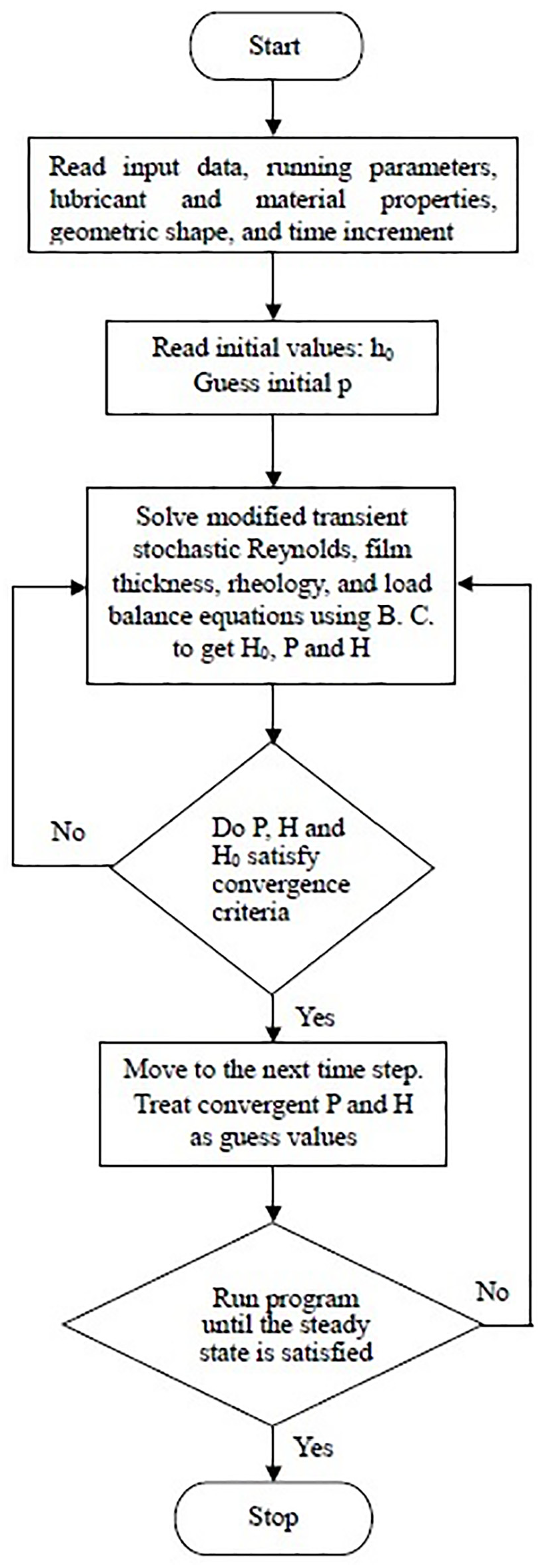
Flow diagram of computational procedure.
Computational data.

Figures 3 and 4 show the relative change in the P and H for an elastic sphere approaching a rough porous medium layer with CS lubricant under fixed load condition for different K (0.0127, 0.0191) and

P and H versus time using two different K.

P and H versus time using two different φ.
Figure 5 illustrates the Pc, Hc, and Hmin versus time for different K. The Pc increases rapidly to a maximum value with time at the early period, and then decreases slowly toward to the 1.0 (Hertzian pressure, Phertz) with time at the later period. The H decreases rapidly with time at the early period and then decreases slowly with time at the later period. The larger the K is, the smaller the Pc is, and the smaller the H is. The times need to achieve the Pcmax and the Phertz decrease as the K increases.
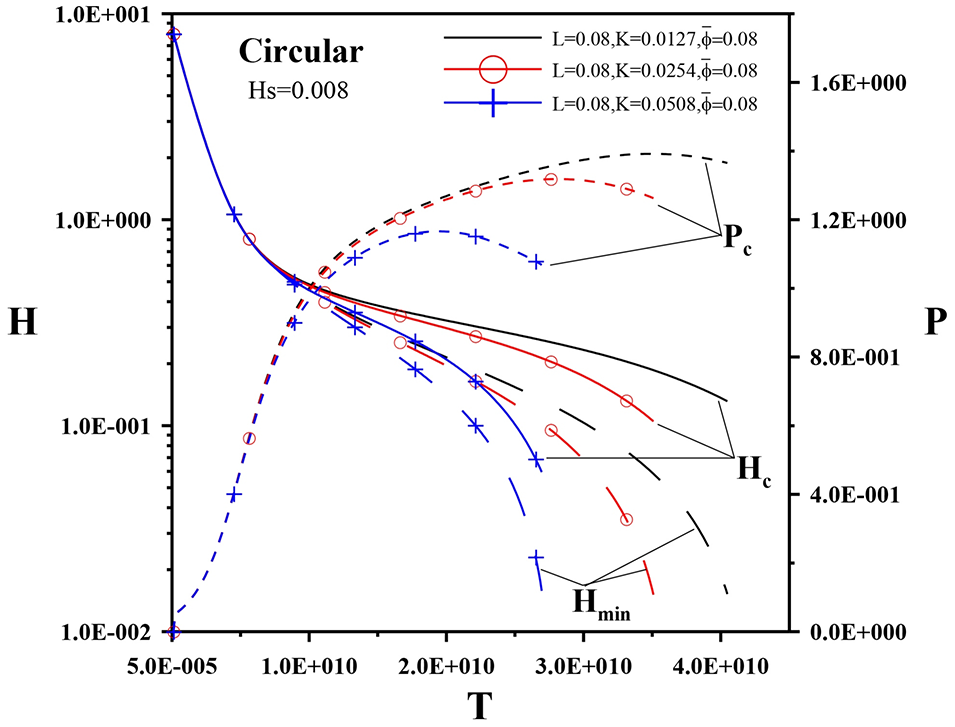
P c and H versus time using circular RN model for different K.
Figure 6 illustrates the Pc, Hc, and Hmin versus time for different

P
c and H versus time using circular RN model for different
Figure 7 illustrates the central normal squeeze velocity (Vc) and the minimum normal squeeze velocity (Vmin) versus different K. at the early period, the magnitude of the Vc and Vmin decreased rapidly with time. Due to squeeze and elastic deformation effects, the slope values of the Vc change from negative to positive. The magnitude of the Vc and Vmin decreased with decreasing K. The magnitude of Vc is smaller than the magnitude of Vmin at first half period. The magnitude of Vc is greater than the magnitude of Vmin at second half period.

V versus T using circular RN model for different K.
Figure 8 illustrates the Vc and the Vmin for different φ, at the early period, the magnitude of the Vc and Vmin decreased rapidly with time. Due to squeeze and deformation effects, the slope values of the Vc change from negative to positive. The magnitude of the Vc and Vmin decreased with decreasing

V versus T using circular RN model for different
Figure 9 illustrates the Pcmax and the Hcmin versus
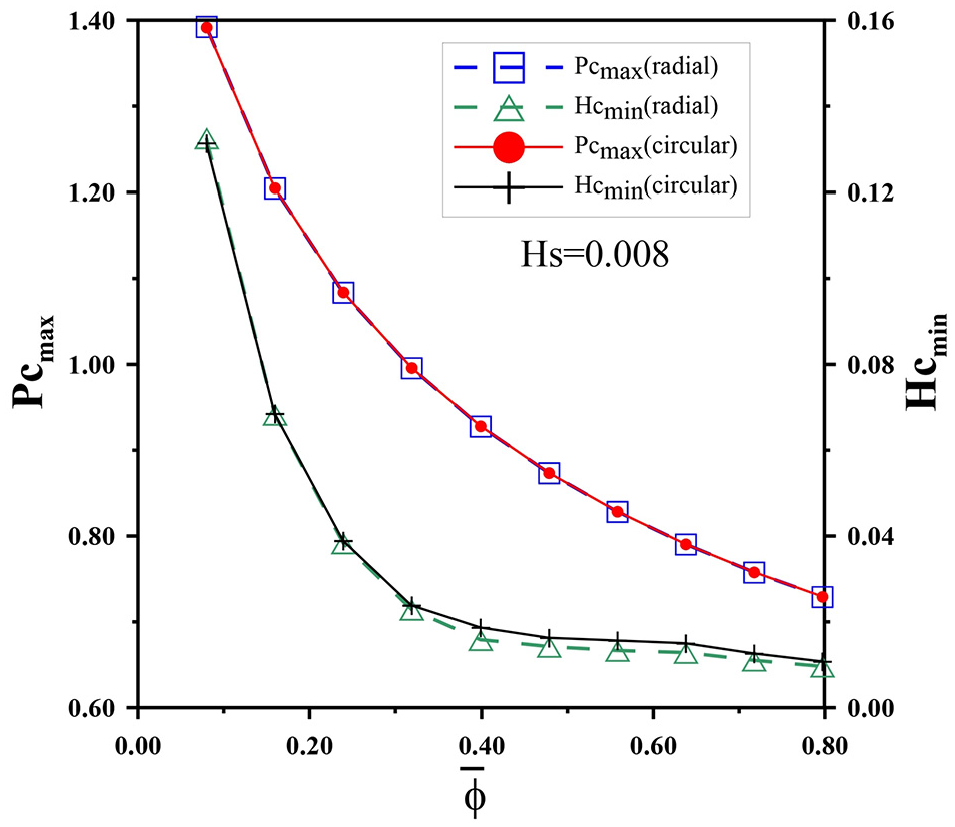
Pcmax and Hcmin versus φ for different RN type.
Figure 10 illustrates the Pcmax and the Hcmin versus K using the CTRN and the RTRN. The larger the K is, the smaller the Pcmax is, and the smaller the Hcmin is. The Pcmax of the RTRN are slightly greater than that of the CTRN under the same K condition. The Hcmin of the CTRN are greater than that of the RTRN under the same K condition. The CTRN has oil resistance effect. The RTRN has oil guide effect.

Pcmax and Hcmin versus K for different RN type.
Conclusion
A numerical method was developed to calculate the effects of the CS lubricants between PML and elastic ball with SRN on squeeze EHL motion for fixed load condition. The conclusions include:
The larger the K and
The larger the K and
Due to squeeze and elastic deformation effects, the slope values of the Vc change from negative to positive. The magnitude of the Vc and Vmin decreased with decreasing K and
The larger the K and
For the same K and
Footnotes
Appendix
Handling Editor: Chenhui Liang
Declaration of conflicting interests
The author(s) declared no potential conflicts of interest with respect to the research, authorship, and/or publication of this article.
Funding
The author(s) disclosed receipt of the following financial support for the research, authorship, and/or publication of this article: The authors would like to express their appreciation to the Ministry of Science and Technology (MOST 108-2221-E-143 -006) in Taiwan, R.O.C. for financial support.
