A nonlinear thermo-convective Arrhenius Casson fluid flow between two vertical parallel plates is modeled under the actions of exothermic chemical reaction, linear and nonlinear volumetric thermal and concentration expansions. The non dimensional coupled system of ordinary differential equations are solved numerically by using Parametric Continuation Method (PCM). The numerical results of (PCM) method are graphically justified with the solutions of package, which presented an excellent agreement with each other. For further validation of (PCM) method, the obtained results are also compared with previously published work and found an accuracy upto two decimal places. It has been found that Frank-Kameneskii’s parameter, depends on Arrhenius kinetics, has the tendency to enhanced the exothermic chemical reaction, which give rise in internal heat generation and heat transfer rate. The findings of the present study may be used for making energy source materials and in biological systems. Furthermore, the increasing values of are responsible to drop the exothermic reaction level within the flow system, due to which the mass transfer is reduced and make a reduction in concentration profile.
In the modern world and specially in the field of research chemical reaction performs an excellent role. As we know that there are two types of chemical reaction exothermic and endothermic chemical reaction. In exothermic chemical reaction heat and light which is the form energy is released to the environment, while in endothermic chemical reaction energy is observed from it is environment. In chemical reaction, the reaction rate mostly depend on the concentration of the fluids. These reactions have numerous application in industries, Animasaun.1 Order of reaction is very important terminology in the field engineering and industries, in which the reaction rate varies directly to the chemical reactant concentration rate of order one. The reactions in which the reaction rate is proportional to the nth power of the reactant concentration is called nth order chemical reaction. As we discussed exothermic and endothermic chemical reaction, common example of exothermic reaction is flame, which gives us heat as well as light. In this phenomenon dissipated energy is released to the surrounding, in which exothermic reaction enthalpy is always negative. Self ignition process is remarkable example of exothermic chemical reaction. Numerous papers have been published, concerning exothermic chemical reaction on a combustible material in the literature.2–4
In recent time researcher are trying to enhanced the thermal conductivity of the fluids, which is possible only to add some special types of nanoparticles to the fluids. In this regard Choi and Eastman5 was first to performed experiment and add some nanoscale particle in desired fluid, he found that these nanoscale particles produced increment in thermal behavior of the base fluids. Viscoelastic fluids behaves as elastic solids for a specific threshold magnitude, after removing of this stress it becomes liquids. It has so many applications in the engineering operations systems, foods preparing and preservation, drilling operations, and so forth. Hayat et al.6 elucidated heat transfer analysis of Viscoelastic Casson fluids with supplying convective heating at the given surface. Likewise heat and mass transfer have numerous application in the field of engineering, heat and mass transfer phenomena is very essential for various thermal engineering features. Concentration gradient between fluid and its surrounding produce natural convective flow. In pours medium heat and radiation effect on the Magneto hydrodynamics (MHD) was first presented by Mohiddin et al.7 Shehzad et al.8 explain measurement of heat and mass exchange, which is magnetically stream flow of Casson liquid. Mustafa and Khan9 probed magnetized Casson liquid along with suspension of nanoparticles on the nonlinear stretchable surfaces.
The study of combined effects of the magnetic field behavior on natural convection with a square cavity, and the presence of nanoparticles have adverse effects on the heat transfer at high volume fraction of the nanoparticles was studied by Mahmoudi and Abu-Nada.10 Adeosun et al.11 studied about MHD of a nonlinear convective flow of Arrhenius exothermic reactive fluids, with considering the effect of special parameters, within two vertical long palates. The purpose of this task was to investigate the influence of nonlinear convective parameter on heat and mass transfer with porous materials.
According to the boundary layer theory, non-Newtonian flow on heated surface which is exponentially stretching was examined by Hafeez and Chu.12 Mustafa and Khan9 have explained the magnetic and heat effects on MHD casson nanofluid, over nonlinear temperature across the stretching sheet. Bilal et al.13 have explained thermal radiation upon the laminar free convection boundary layer of a vertical plates, dealing with nonabsorbent gas for constant heat flux condition. They have studied about time varying hydro magnetic radiating fluid passed in infinite oscillating vertical plates, in which deeply explain some parameters such as Soret and Dufour. They have examined very big change in their heat conduction power after adding very small amount of nanoparticles as compared to common fluids.14–22
MHD nanoparticles are playing significant role in numerous industrial processes. Such fluids have broad range applications in optical industry as gratings, fiber filters, modulator, and polymer processes. MHD nanoparticles have great applications in the loud speaker/vehicles cooling, magnetic cell, generating hybrid fuels and electricity plants, etc.23–28
The motion of temperature dependent plastic dynamic viscosity and thermal conductivity of consistent incompressible laminar free convective magnetohydrodynamic (MHD) Casson fluid go with the flow over an exponentially stretching floor with suction and exponentially decaying internal warmth generation. It’s far assumed that the natural convection is pushed by way of buoyancy and space dependent heat era. The viscosity and thermal conductivity of Casson fluid is assumed to differ as a linear characteristic of temperature. by way of using appropriate transformation, the governing partial differential equations similar to the momentum and strength equations are transformed into non-linear coupled regular differential equations and solved by means of the Homotopy analysis approach. A new kind of averaged residual mistakes is followed and used to locate the premier convergence manage parameter.29–34
In the modern world most of the researchers use PMC strategy, that is why Grigolyuk and Shalashilin35 introduced and apply to many problems, which is considered difficult. PCM strategy is exceptionally delicate on to settle on a decision a proper continuation parameter. Vorovich and Zipalova36 and Riks37 presented a report to pick an proper heading for continuation parameter to get appropriate conditioning of the solution for linearized system of conditions. Varies application of nonlinear mechanics is carried in the geometrical elucidation.38,39 Watson and Holzer40 bring together PCM on Navier-Stokes equations. Most of the engineering problems contain nonlinear ordinary or partial differential equations. That is why, the analysts apply different technique to solve the given problems.
Some recent work on thermo-convective and magnetic have been included in the present article, in which Chilton-Colburn study about thermo convective fluid property in mini channel.41 Variables temperature and mass diffusion with arbitrary velocity for viscoelastic fluid flow has been recently studied by Saeed et al.42 Ionic liquid across micro channels of the peristaltic principle of electro osmotic flow (EOF) has been study by Humaira and Yasmin.43
For further validation of (PCM) method, the obtained results are also compared with previous published work and found an accuracy upto two decimal places. It has been found that Frank-Kameneskii’s parameter, depends on Arrhenius kinetics, has the tendency to enhanced the exothermic chemical reaction, which give rise in internal heat generation and heat transfer rate. The findings of the present study may be used for making energy source materials and in biological systems.
The present problem is concerned with the modeling and numerical solutions of Arrhenius reactive casson fluid flow between to verticals stationary plates, under the effects of linear and non linear volumetric thermo-convective along with magnetic effect. The concentration equation is coupled with temperature by introducing Arrhenius reactive term. The findings of the present study may be used for making energy source materials and in biological systems. According to our knowledge no literature is available for such types of Casson fluid problems.
Therefore, the aim of the present article is to investigate and model the behavior of fully developed, incompressible, electrically conducting, steady, linear and nonlinear thermo-convective, exothermic Arrhenius Casson fluid flow between two vertically porous parallel plates. The modeled governing equations in their PDEs form are dimensionalized by introducing some suitable dimensionless quantities, due to which the system of PDEs transformed in a system of nonlinear ODEs. The dimensionless system of nonlinear ODEs are then solved numerically by using Parametric Continuation Method (PCM) and package.
Mathematical formulation of the problem
A fully developed in-compressible, electrically conducting steady, non linear Arrhenius convective, fluid flow is considered between two parallel vertically long plates, separated by distance of from each other. The space between two homogeneous plates is filled with non-Newtonian Casson fluid driven by a constant pressure gradient against the gravitational force as shown in the Figure 1. The Cartesian co-ordinates system is taken at the center of the plates, in which y-axis along the flow direction and x-axis is perpendicular to the flow. Both plates are kept constant temperature and concentration and respectively. A constant field of strength is applied is perpendicular to y-axis. A uni-direction and two dimension velocity field is considered for the problem.
Geometry of the problem.
For rheological equation of in compressible casson fluid as follow44:
where, . By incorporating this value of in equation (1), the kinematic viscosity of Casson fluid becomes as follow:
where is known as plastic dynamic viscosity of the non-Newtonian fluid, is the product of the component deformation rate with itself, where is critical value base on non Newtonian fluid.
The Basic equation governing the fluid flow are given as11:
Continuity Equation:
Momentum Equation:
Temperature Equation:
Concentration Equation:
The appropriate boundary conditions for the flow induced by constant pressure with vertical long plates are given by11
In the above equation we have -modified pressure, K-permeability of the porous medium, -fluid dynamics viscosity is axial velocity absolute temperature, is concentration of the reactant, -initials fluid temperature, -fluids temperature at the wall, -linear volumetric coefficient in thermal expansion, -non volumetric coefficient in thermal expansion, -linear volumetric coefficient of concentration expansion, -nonlinear volumetric coefficient of concentration expansion, A-rate constant, E-activation energy, R-universal gas constant, -heat of reaction, -reactant diffusivity, -thermophoretic diffusion coefficient, -electrical conductivity, -magnetic field strength. The reaction kinetics type is expressed in terms of the symbol , where is numerical exponent value such that , where represent the Sensitized (laser induced) Kinetics, the Arrhenius kinetics, and the Bi molecular kinetics.
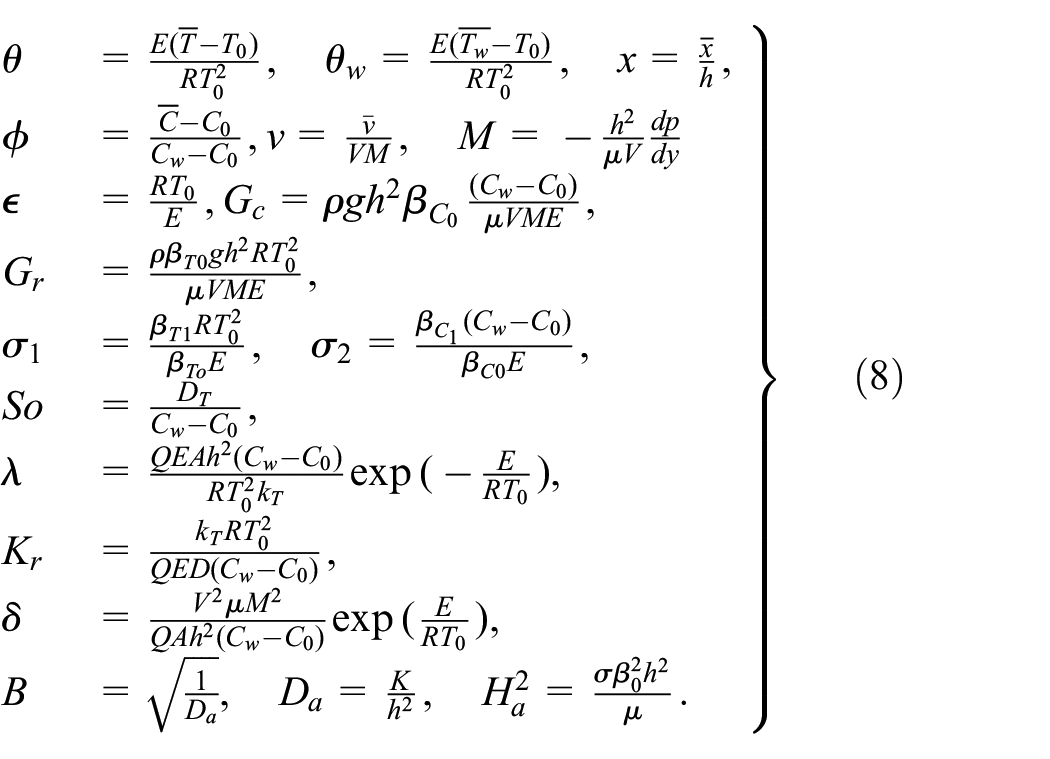
The following dimensionless variables are introducing in the equations (3)–(7).
After introducing the dimensionless variables, we get dimensionless governing equation
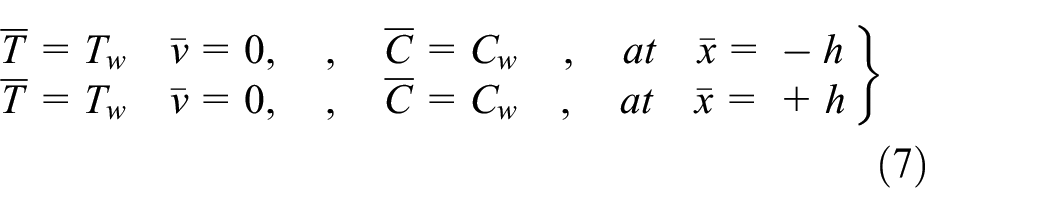
Now dimensionless boundary condition of the problem
where , , , and have thermal buoyancy parameter, concentration buoyancy parameter, nonlinear thermal convection parameter, and nonlinear concentration convection parameter respectively. Other important parameter , , , , , , , and are porous medium permeability parameter, Frank-Kameneskii parameter, activation energy parameter, viscous heating parameter, Concentration consumption rate parameter, wall temperature, Soret number, and Hartmann number respectively.
Parametric continuation method for solution
The necessary technique of parametric continuation method(PCM), apply to the systems of ODE’s (9–11), along with the boundary conditions (12) are presented with the following steps45–48:
Step 1: Obtaining first order ODE after converting the system of BVP
We introduce special functions for this purpose:
By using transformation (13) into the BVP (9–11) and (12) which take the form as:
with the corresponding boundary conditions
Step 2: Introducing the important parameter p
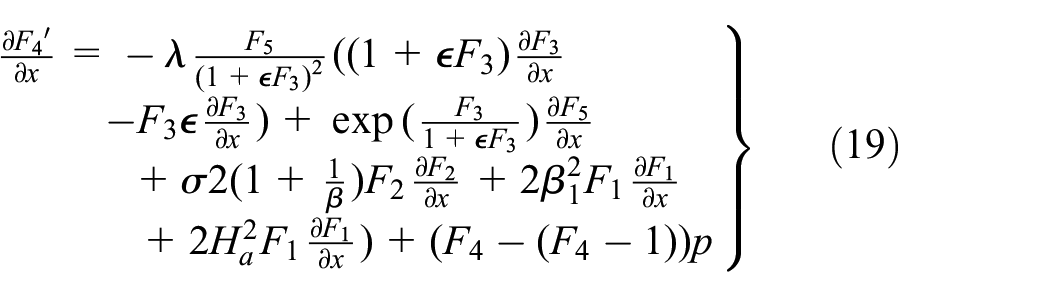
For obtaining a system of ODE in a p-parametric family, introducing the continuation parameter p in the system (14–17) carefully as follow:
Step 3: Differentiating by parameter “p”
Differentiate by parameter p, equations (18)–(20) take the following form with the parameter p
Here, R is the remainder, A is the coefficient matrix, and
Here i =1, 2,….6.
Step 4: Applying specify Cauchy problem and superposition principle for each component
where a-unknown blend coefficient and S,T-unknown vector functions.
from where obtaining the iterative form of the solution as:
Results and discussion
The Arrhenius reactive fluid flow between two vertical plates is modeled in the form of nonlinear equations (9)–(11), along with boundary conditions equation (12). The velocity, temperature and concentration profiles, are obtained by using two different numerical schemes PCM and , and are displayed through Figures 2 to 11. A comparative analysis has also been presented through figures between PCM and and for the validity of present numerical scheme, the obtained results are compared with previously published work in Table 1. The physical important quantities such as mass transfer, heat transfer rate, and wall shear stress, are calculated against different parameters and depicted through graphs.
Comparison of the present result with previous published work, when , , , and for present work .
Figure 2(a) to (d) depicts the variation of velocity profile for different physical parameters. Due to the dual nature of Casson fluid parameter , it plays an important role in fluid dynamics. For larger values of , it behaves like Newtonian fluid, while for the fluid becomes as non-Newtonian. Figure 2(a) shows the variation in velocity component due to the increasing values of . The Newtonian characteristics can be observed for the increasing value of , and as a result yield stress drops gradually which enhance the fluid velocity. Figure 2(b) illustrate the impact of thermal buoyancy parameter on velocity component of the fluid. Thermal buoyancy is the heat source term in velocity component of the fluid, which is responsible for the thinning effect in the fluid viscosity and as a result of the enhancement in velocity profile. The nonlinear thermal convection parameter measures the non-linearity in density-temperature relation. Increasing the value of means to increase the non-linearity in terms of thermal convection which accelerate the fluid velocity Figure 2(c). A likewise behavior of the velocity component can be observed for nonlinear concentration parameter in Figure 2(d), which give rise in velocity component due to non-linearity effect in density-concentration relation.
Velocity profile for fixed values of physical parameters , , , , , , , , , , , , and .
The predictive behavior of the velocity component , against physical parameters , , , and has been examined in Figure 3(a) to (d). Figure 3(a) elucidate the variations in velocity component against different values of concentration buoyancy parameter . The mass buoyancy is the ratio of concentration to inertial forces, which dominates the inertial forces by the increasing values of . Both thermal-convective buoyancy forces are responsible for downward motion of the fluid due to gravitational acceleration, but this downward velocity is intercepted by the porous nature of the medium, which takes away the fluid particle in x-direction. Figure 3(b) shows the impact of porosity parameter on the velocity component of the fluid. An increase in porosity parameter means to decrease porosity permeability, which brings about a reduction in flow resistance and that is the reason that the velocity component is increased. As a perpendicular constant magnetic field is applied to the system of vertical plates, which creates magnetic field lines in flow direction, according to right hand rule. These magnetic field lines produce Lorentz force, which has greater tendency to enhance the fluid velocity within the system. This prediction of velocity enhancement, due to Hartmann number , can be seen in Figure 3(c). Figure 3(d) shows the effect of activation energy parameter on velocity profile. The increasing value of brings about a reduction in velocity component, it may be due to the fact that the function value is decreases.
Velocity profile for fixed values of physical parameters , , , , , , , , , , , , and .
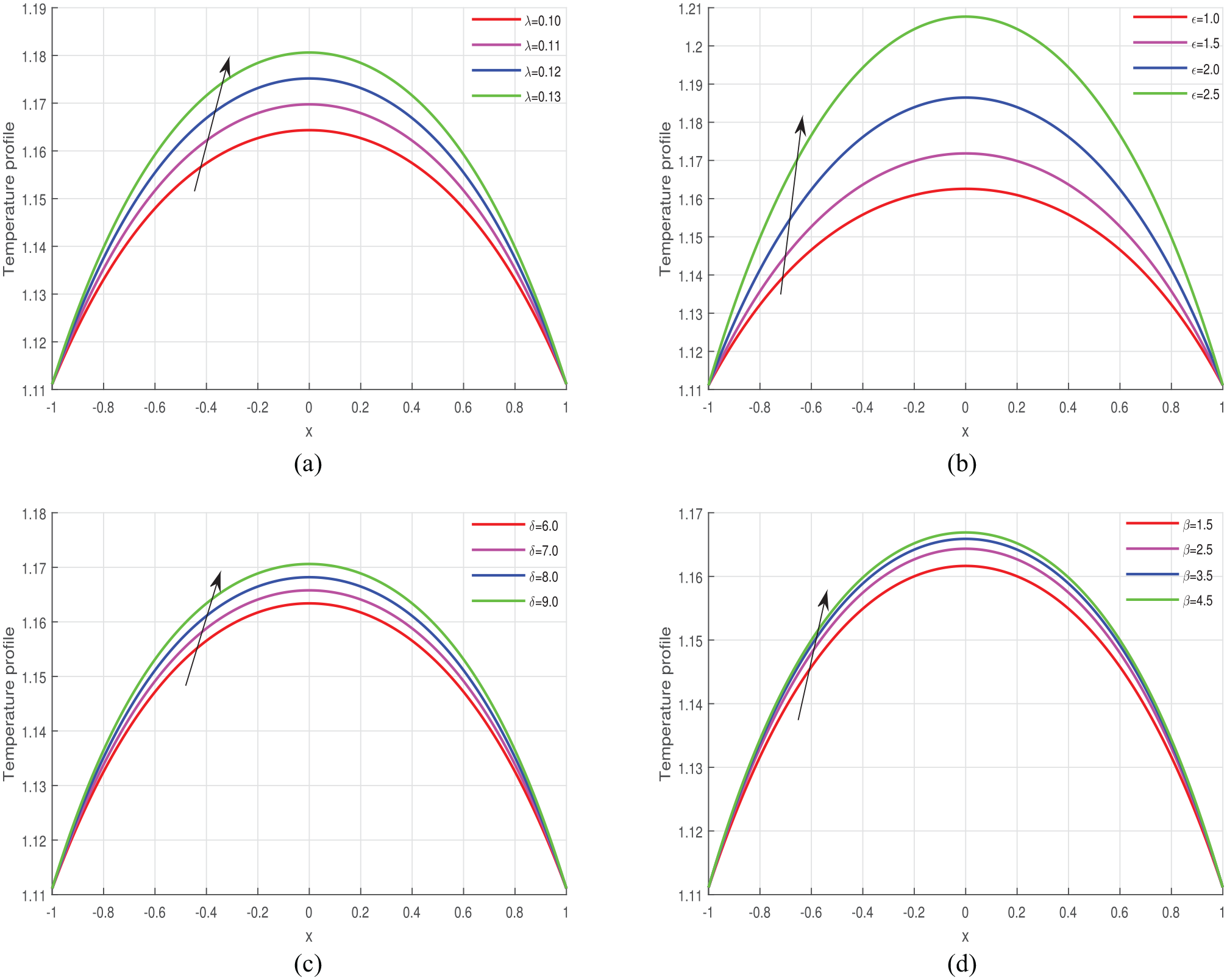
Frank-Kameneskii’s reaction rate parameter , depends on Arrhenius kinetics, has the tendency to exaggerate the exothermic chemical reaction, which give rise in internal heat generation. This effect of reaction rate parameter can be seen in Figure 4(a). The increasing values of enhances the ability of internal heat generation due to which the temperature profile is increasing. The activation energy parameter has a direct relation with temperature and it has also the ability to simulate the internal energy of fluid molecules, due to the exothermic reaction, which give rise the internal heat of the fluid, and it can be reason out for the enhancement of temperature profile, Figure 4(b). Figure 4(c) is concerned with the plot of temperature against the increasing values of viscous heating parameter. This can be reason out that an additional heat generation can be detected by the frictional interaction among the fluid particles and with the channel walls, which increases the internal temperature of the fluid. In the present fluid flow modeling the temperature equation (3) has been coupled with velocity equation (2) by adding the viscous term to the temperature equation. Due to this coupling of temperature and velocity, one can observed that the Casson parameter has an inverse relation with fluid’s viscosity within temperature equation. Its means that whenever the value of Casson parameter is increases the dynamic viscosity will be decrease and as a result the temperature profile will be increased, and these predictions can be easily observed in Figure 4(d).
Temperature profile for fixed values of physical parameters , , , , , , , , , , , , and .
The impact of porosity parameter, , Hartmann number, , concentration buoyancy parameter, , and thermal buoyancy parameter, , are sketched, respectively, in Figure 5(a) to (d). Figure 5(a) shows that the temperature profile is increasing with the increasing value of porosity parameter, . By the increasing value of porosity parameter, the exothermic reaction is created, and as a result the internal heat is generated, which becomes a source of the enhancement of temperature profile. The impact of Hartmann Number, , can be seen in Figure 5(b). This figure shows that Hartmann number has an enhancement effect on temperature profile. By applying an external magnetic field on the fluid flow, a drag like force called Lorentz force is generated, that has a tendency to prevents its generation. Higher value of Hartmann number is a source of Lorentz force and that is the reason that higher temperature gradient can be observed at the middle of the domain, due to which the isothermal lines moves upward and indicates higher heat transfer rate in that region. Figures 5(c) and (d) revealed the impact of concentration and thermal buoyancy parameters, respectively, on temperature profile. Both concentration and thermal buoyancy parameters have an inverse relation with viscous dissipation, this means that with the increasing values of both these parameters the thinning property of the fluid is encouraged which leads to the enhancement of temperature profile. This physical argument can be accomplished by Figure 5(c) and (d).
Temperature profile for fixed values of physical parameters , , , , , , , , , , , , and .
Figure 6(a) to (d) demonstrate the physical behavior of concentration profile under the effects of different parameters. The reactant consumption rate parameter, , has an inverse relation with both heat reaction and reactant diffusivity. The increasing values of are responsible to drop the exothermic reaction level within the flow system, due to which the mass transfer is reduced and make a reduction in concentration profile Figure 6(a). Figure 6(b) illustrate the impact of Frank-Kameneskii reaction rate parameter, , on concentration profile. An increasing values of cause a reduction in reactive concentration profile. As described earlier, Frank-Kameneskii’s parameter, depends on Arrhenius kinetics, has an ability to enhance the exothermic chemical within the fluid flow system, which exaggerate the internal heat generation. More fluid’s concentration is consumed for the enhancement of exothermic chemical reaction and it can be reasoned out for the decline of concentration profile. A similar result has been detected in Figure 6(c), for the increasing values of activation energy parameter, , on concentration profile. The activation energy parameter enhances the internal energy of the fluid particles, and as a result more heat transfer occurs, which may use more fluid’s concentration and eventually a reduction in concentration profile can be observed. The effect of Soret number is shown in Figure 6(d), which implies a decline in concentration profile with the increasing values of Soret number. This is due to the fact that Soret number has an inverse relation with concentration difference. Hence, the greater values of Soret number leads to lower mass transfer.
Concentration profile for fixed values of physical parameters , , , , , , , , , , , , and .
Figure 7(a) to (d) also gives a geometrical sketch to concentration profile against physical important parameters. Figure 7(a) and (b) depict the effects of both concentration and thermal buoyancy parameters, and , respectively, on concentration profile. Both these parameters are capable to increase the exothermic chemical reaction within the fluid flow that dissipate more concentration and put down the concentration profile. The effects of both nonlinear thermal and concentration convection, and , respectively, are shown in Figure 7(c) and (d). Both these nonlinear convection are involved in velocity equation, which is a reason for the enhancement of velocity profile, but it may required more reactant concentration and it can be elucidated for the decline of concentration profile.
Concentration profile for fixed values of physical parameters , , , , , , , , , , , , and .
The physical interest quantities, such as wall shear stress, heat and mass transfer rates, plays an important role in the field engineering and industry. Figure 8(a) to (d) shows the effects of wall shear stress against various physical parameters. Wall shear stress shows the uniform distribution of fluid flux throughout the surface of the plates. This uniform flux is produced by the electromagnetic induction which carries a uniform time varying current. The Casson parameter behaves like a non-Newtonian liquid, which create a resistance to fluid flux distribution, due to fluid’s viscosity. It can be reason out for the decrease of wall shear stress for the increasing values of versus concentration buoyancy , see Figure 8(a). Figure 8(b) also shows the impact of nonlinear thermal convection versus thermal buoyancy on wall shear stress. When the values of is increases against , wall shear stress is decreases, perhaps this is due to the nonlinear nature of . The variation of wall shear stress versus Hartmann and nonlinear concentration parameter, for various values of and , are respectively plotted in Figure 8(c) and (d). It is clear that, when the values of porosity parameter are increased, it create an interception of the fluid velocity, which reduce the wall shear stress Figure 8(c), while the increasing values of thermal buoyancy parameter also decrease the wall shear stress.
Variation of wall shear stress against different parameters.
From Figure 9(a) and (b) it can be observed that the heat transfer rate is reduce by the increasing values of thermal activation parameter versus , whilst the heat transfer rate is enhanced by the increasing values of porosity parameter against viscous heat parameter . The porosity parameter creates an opposing velocity against thermal buoyancy and hence a reduction in thermal activation energy is detected, which cause a decrease in heat transfer rate for and an increase for .
Variation of Nusselt number against different physical parameters.
Figure 10(a) and (b) shows a decreasing profile of the mass transfer rate for both thermal activation energy parameter and Soret number , against concentration consumption rate and reaction rate parameter , respectively. The internal energy of fluid particles is enhanced by activation parameter , due to which the heat transfer rate is increased and as a result consume more concentration, for the sake of this reason the mass transfer rate is reduced. Soret number has an inverse relation with concentration difference, which cause a decline in mass transfer rate with the increasing values of Soret number.
Variation of Sherwood number against different physical parameters.
For further validation of (PCM) method, the obtained results are also compared with previously published work and found an accuracy upto two decimal places. It has been found that Frank-Kameneskii’s parameter, depends on Arrhenius kinetics, has the tendency to enhanced the exothermic chemical reaction, which give rise in internal heat generation and heat transfer rate. In order to check the accuracy and reliability of the present results, the modeled equations (7)–(9) along with boundary conditions (10), are solved by two different numerical schemes, PCM and package. Figure 11(a) to (c) gives a comparative sketches of velocity, temperature and concentration profiles. Both the numerical results are very similar to each other, but PCM gives a very accurate and more rapid converges results in the sense of less time consumption than . The validity and accuracy of the present numerical schemes are also reported in Table 1. The present numerical results are also compared with previously published work, and a very excellent agreement is exhibited in Table 1.
Comparative analysis of PCM and bvp4c methods.
Conclusion
In the present article, a non-Newtonian Casson, linear and nonlinear thermo-convective Arrhenius reactive fluid flow is modeled between two vertical porous plates under the effects of exothermic chemical reaction and perpendicular applied magnetic field. The dimensionless governing equation of the flow are solved by two different numerical schemes Parametric Continuation Method (PCM) and package. The following results has been drawn on behalf of these simulation.
Frank-Kameneskii’s reaction rate parameter has the tendency to elevate the exothermic chemical reaction, which give rise in internal heat generation.
The activation energy parameter is significantly boosts the energy profile.
The increasing values of are responsible to drop the exothermic reaction level within the flow system, due to which the mass transfer is reduced and make a reduction in concentration profile.
The porosity parameter creates an opposing velocity against thermal buoyancy and hence a reduction in thermal activation energy, which cause a decrease in heat transfer rate for and an increase for .
Soret number has an inverse relation with concentration difference, which cause a decline in mass transfer rate.
The present research can be extended to sensitized and Bimolecular kinetics by taking the value of and , respectively.
The proposed model may be extended by taking different types of fluid over numerous type of geometries, or by modifying the proposed idea to nanofluid and hybrid nanofluid. Furthermore the present model may more generalized by reforming it to fractional derivative.
Footnotes
Appendix
Handling Editor: Chenhui Liang
Declaration of conflicting interests
The author(s) declared no potential conflicts of interest with respect to the research, authorship, and/or publication of this article.
Funding
The author(s) received no financial support for the research, authorship, and/or publication of this article.
ORCID iD
Muhammad Shuaib
References
1.
AnimasaunIL. Effects of thermophoresis, variable viscosity and thermal conductivity on free convective heat and mass transfer of non-Darcian MHD dissipative Casson fluid flow with suction and nth order of chemical reaction. J Nigerian Math Soc2015; 34: 11–31.
2.
UllahI. Activation energy with exothermic/endothermic reaction and Coriolis force effects on magnetized nanomaterials flow through Darcy–Forchheimer porous space with variable features. Waves Random Complex Media. Epub ahead of print 19 January 2022. DOI: 10.1080/17455030.2021.2023779.
3.
UllahZUllahIZamanG, et al. A numerical approach to interpret melting and activation energy phenomenon on the magnetized transient flow of Prandtl-Eyring fluid with the application of Cattaneo-Christov theory. Waves Random Complex Media. Epub ahead of print 23 February 2022. DOI: 10.1080/17455030.2022.2032472.;
4.
ChuYMNazirUSohailM, et al. Enhancement in thermal energy and solute particles using hybrid nanoparticles by engaging activation energy and chemical reaction over a parabolic surface via finite element approach. Fractal Fractional2021; 5: 119.
5.
ChoiSUSEastmanJA. Enhancing thermal conductivity of fluids with nanoparticles. In: Proceedings of the 1995 ASME international mechanical engineering congress and exposition, San Francisco, CA, USA, 12–17 November 1995.
6.
HayatTShehzadSAAlsaediA, et al. Mixed convection stagnation point flow of Casson fluid with convective boundary conditions. Chin Phys Lett2012; 29: 114704.
7.
MohiddinSSGurramDDasariN, et al. Influence of heat generation and radiation on MHD flow of natural convection. Int J Innov Technol Explor Eng2019; 8: 2278–3075.
8.
ShehzadSAHayatTQasimM, et al. Effects of mass transfer on MHD flow of Casson fluid with chemical reaction and suction. Braz J Chem Eng2013; 30: 187–195.
9.
MustafaMKhanJA. Model for flow of Casson nanofluid past a non-linearly stretching sheet considering magnetic field effects. AIP Adv2015; 5: 077148.
10.
MahmoudiAHAbu-NadaE. Combined effect of magnetic field and nanofluid variable properties on heat transfer enhancement in natural convection. Numer Heat Transf A Appl2013; 63: 452–472.
11.
AdeosunATGbadeyanJATitiloyeEO. Heat and mass transfer of a nonlinear convective arrhenius reactive fluid flow between two vertical plates filled with a porous material. Eur Phys J Plus2020; 135: 1–17.
12.
HafeezMChuYM. Numerical simulation for heat and mass transport analysis for magnetic-nanofluids flow through stretchable convergent/divergent channels. Int J Mod Phys B2021; 35: 2150198.
13.
BilalMGulTAlsubieA, et al. Axisymmetric hybrid nanofluid flow with heat and mass transfer amongst the two gyrating plates. Zeitschrift für Angewandte Mathematik und Mechanik2021; 101: e202000146.
14.
IkramMDImranMAChuYM, et al. MHD flow of a Newtonian fluid in symmetric channel with ABC fractional model containing hybrid nanoparticles. Comb Chem High Throughput Screen. Epub ahead of print 12 April 2021. DOI: 10.2174/1386207324666210412122544.
15.
AsjadMIAliRIqbalA, et al. Application of water based drilling clay-nanoparticles in heat transfer of fractional Maxwell fluid over an infinite flat surface. Sci Rep2021; 11: 18833.
16.
ChuYMKhanUZaibA, et al. Numerical and computer simulations of cross-flow in the streamwise direction through a moving surface comprising the significant impacts of viscous dissipation and magnetic fields: stability analysis and dual solutions. Math Probl Eng2020; 2020: 1–11.
17.
BilalMSaeedAGulT, et al. Numerical approximation of microorganisms hybrid nanofluid flow induced by a wavy fluctuating spinning disc. Coatings2021; 11: 1032.
AbdElSalamMARamadanMANassarMA, et al. Matrix computational collocation approach based on rational Chebyshev functions for nonlinear differential equations. Adv Differ Equ2021; 331: 1–17.
20.
ChuYMAli ShahNAgarwalP, et al. Analysis of fractional multi-dimensional Navier–Stokes equation. Adv Differ Equ2021; 2021: 1–18.
21.
AsjadMZahidMChuYM, et al. Prabhakar fractional derivative and its applications in the transport phenomena containing nanoparticles. Therm Sci2021; 25: 411–416.
22.
ZhouSSBilalMKhanMA, et al. Numerical analysis of thermal radiative Maxwell nanofluid flow over-stretching porous rotating disk. Micromachines2021; 12: 540.
23.
BuongiornoJ. Convective transport in nanofluids. J Heat Transf2006; 128: 240–250.
24.
JawadMSaeedABilalM, et al. The impact of magnetohydrodynamic on bioconvection nanofluid flow with viscous dissipation and joule heating effects. Eng Res Exp2021; 3: 015030.
25.
LvYPAlgehyneEAAlshehriMG, et al. Numerical approach towards gyrotactic microorganisms hybrid nanoliquid flow with the hall current and magnetic field over a spinning disk. Sci Rep2021; 11: 1–13.
26.
ShuaibMBilalMQaisarS. Numerical study of hydrodynamic molecular nanoliquid flow with heat and mass transmission between two spinning parallel plates. Phys Scr2021; 96: 025201.
27.
ChenSBJahanshahiHAlhadji AbbaO, et al. The effect of market confidence on a financial system from the perspective of fractional calculus: numerical investigation and circuit realization. Chaos Solitons Fractals2020; 140: 110223.
28.
AlrabaiahHBilalMKhanMA, et al. Time fractional model of electro-osmotic Brinkman-type nanofluid with heat generation and chemical reaction effects: application in cleansing of contaminated water. Sci Rep2021; 11: 24402.
29.
BertonPWuilloudRG. Highly selective ionic liquid-based microextraction method for sensitive trace cobalt determination in environmental and biological samples. Anal Chim Acta2010; 662: 155–162.
30.
ShuaibMBilalMAltaf KhanM, et al. Fractional analysis of viscous fluid flow with heat and mass transfer over a flexible rotating disk. Comput Model Eng Sci2020; 123: 377–400.
31.
KaushikJKBhatR. Thermal stability of proteins in aqueous polyol solutions: role of the surface tension of water in the stabilizing effect of polyols. J Phys Chem B1998; 102: 7058–7066.
32.
ZhangXHAlgehyneAEAlshehriGM, et al. The parametric study of hybrid nanofluid flow with heat transition characteristics over a fluctuating spinning disk. PLoS One2021; 16: e0254457.
33.
UllahIAlghamdiMXiaWF, et al. Activation energy effect on the magnetized-nanofluid flow in a rotating system considering the exponential heat source. Int Commun Heat Mass Transf2021; 128: 105578.
34.
UllahIHayatTAzizA, et al. Significance of entropy generation and the Coriolis force on the three-dimensional Non-Darcy flow of ethylene-glycol conveying carbon nanotubes (SWCNTs and MWCNTs). J Non-Equil Thermody2022; 47: 61–75.
35.
GrigolyukEIShalashilinVI. Large deflections of arches and shells of revolution. In: GrigolyukEIShalashilinVI (eds) Problems of nonlinear deformation. Dordrecht: Springer, 1991, pp.114–159.
36.
VorovichIIZipalovaVF. On the solution of nonlinear boundary value problems in elasticity theory by reducing them to the Cauchy problem. Prikl Mat Mekh1965; 29: 894–901.
37.
RiksE. An incremental approach to the solution of snapping and buckling problems. Int J Solids Struct1979; 15: 529–551.
38.
RiksE. The application of Newton’s method to the problem of elastic stability. J Appl Mech1972; 39: 1060–1065.
39.
RothertHDickelTRennerD. Snap-through buckling of reticulated space trusses. J Struct Div1981; 107: 129–143.
40.
WatsonLTHolzerSM. Quadratic convergence of Crisfield’s method. Comput Struct1983; 17: 69–72.
41.
WilkJ. Heat/mass transfer analogy in the case of convective fluid flow through minichannels. Int J Therm Sci2020; 156: 106467.
42.
SaeedSTKhanIRiazMB, et al. Study of heat transfer under the impact of thermal radiation, ramped velocity, and ramped temperature on the MHD Oldroyd-B fluid subject to noninteger differentiable operators. J Math2020; 2020: 1–14.
43.
YasminHIqbalN. Convective mass/heat analysis of an electroosmotic peristaltic flow of ionic liquid in a symmetric porous microchannel with Soret and Dufour. Math Probl Eng2021; 2021: 1–14.
44.
ShamshuddinMGhaffariA. Radiative heat energy exploration on Casson-type nanoliquid induced by a convectively heated porous plate in conjunction with thermophoresis and Brownian movements. Int J Ambient Energy. Epub ahead of print 4 January 2022. DOI: 10.1080/01430750.2021.2014960.
45.
ShuaibMShahRABilalM. Variable thickness flow over a rotating disk under the influence of variable magnetic field: an application to parametric continuation method. Adv Mech Eng2020; 12: 1687814020936385.
46.
ShuaibMShahRADurraniI, et al. Electrokinetic viscous rotating disk flow of Poisson-Nernst-Planck equation for ion transport. J Mol Liq2020; 313: 113412.
47.
BilalMAyedHSaeedA, et al. The parametric computation of nonlinear convection magnetohydrodynamic nanofluid flow with internal heating across a fixed and spinning disk. Waves Random Complex Media. Epub ahead of print 4 March 2022. DOI: 10.1080/17455030.2022.2042621.
48.
AlgehyneEAAreshiMSaeedA, et al. Numerical simulation of bioconvective Darcy Forchhemier nanofluid flow with energy transition over a permeable vertical plate. Sci Rep2022; 12: 1–12.