In this article, thermal buckling analysis of multilayer functionally graded graphene platelets (FGGPL) strengthened piezoelectric beam subjected to external electric voltage as well as humid conditions is illustrated. The effective Young’s modulus of the nanocomposite beam is estimated within the framework of Halpin-Tsai model. While, Poisson’s ratio, mass density, and piezoelectric properties are calculated by the rule of the mixture. Four FGGPL distribution types are considered in this study. A refined two-unknown beam theory considering shear deformation as well as thickness stretching effect is employed to describe the displacement components. The principle of virtual work including thermal, moisture, and electric loads is used to derive the stability differential equations. To check the accuracy of the obtained buckling temperature, some comparison examples are performed. The impacts of the GPLs volume fraction, distribution type, length-to-depth ratio, humid conditions, external electric voltage, and piezoelectric properties on the critical buckling temperature are studied.
Piezoelectric materials have been extensively used in many important industrial models and smart structures.1–6 This is because of their effective electro-mechanical coupling properties as well as the capability of converting the main energy types, namely mechanical and electrical energies to each other. Consequently, a lot of articles were performed to investigate the behavior of these materials which made dealing with the functionally graded materials (FGMs) more reliable as stated by Wu and his coworkers.7 El Harti et al.8 discussed the impacts of temperature and porosity on the dynamics of a flexible FG porous beam with bonded piezoelectric materials by using the finite element method and the Euler-Bernoulli theory, where the motion equations are derived using Hamilton principle. Mallek et al.9 analyzed the nonlinear dynamic behavior of piezolaminated functionally graded carbon nanotube-reinforced composite (FG-CNTRC) shell by using the first-order shear deformation theory (FSDT). Phuc and Kim Khue10 investigated the mechanical behavior of piezoelectric FGM plates resting on two-parameter elastic foundations under thermal conditions depending on the third-order shear deformation theory together with finite element method. Zenkour and Aljadani11 studied the electro-mechanical buckling behavior of simply supported functionally-graded piezoelectric (FGP) plates subjected to external electric voltage with the help of a quasi-3D refined plate theory. Sobhy12 discussed depending on a four variable shell theory the magneto-electro thermal bending of composite doubly-curved shallow shells consisting of two piezoelectromagnetic face sheets considering a variety of boundary conditions. Moreover, Abazid and Sobhy13 investigated the thermal and electro-mechanical size-dependent bending of simply supported functionally graded piezoelectric (FGP) microplates depending on a refined four-variable shear deformation plate theory together with the modified couple stress theory. Furthermore, Abazid14 explored the thermomechanical buckling, free vibration, and wave dispersion in smart piezo-electromagnetic nanoplates under humid conditions by using both the nonlocal strain gradient theory (NSGT) and the sinusoidal shear deformation plate theory.
Graphene, a two-dimensional thick layer of carbon atoms joined in a hexagonal form, has a low mass density in addition to superior electromechanical properties.15 It has been considered as an efficient reinforcement of the piezoelectric composite structures because it improves their electromechanical characteristics and stiffness.16,17 Mao et al.18 analyzed the small scale influence on the frequencies of graphene nano-platelets reinforced functionally graded piezoelectric composite micro-plate depending on the nonlocal constitutive relation in addition to von-Karman geometric non-linearity, where the nonlinear equations of motion were solved by the differential quadrature (DQ) method. Moreover, Rafiee et al.19 investigated the buckling of graphene epoxy nanocomposite beam and deduced that the buckling load increases with a very small increase of the weight fraction of graphene platelets (GPLs) into the epoxy. Sobhy and Alakel Abazid20 explored the impact of an axial magnetic field on the free vibration and mechanical buckling responses of an FG graphene-reinforced sandwich deep curved nanobeam with viscoelastic core by using the NSGT. Furthermore, Abazid et al.21 discussed the wave propagation in FG porous nanoplate reinforced by uniformly or non-uniformly distributed GPLs and lying on Pasternak elastic foundation depending on both the NSGT and new quasi 3D plate theory, where the motion equations were derived by employing Hamilton’s principle. In another article, Alakel Abazid22 studied the thermal buckling of porous GPLs-reinforced nanoplate resting on Pasternak foundation and exposed to magnetic field impacts in humid medium. The displacement field was described by employing the modified Reddy’s plate theory and the governing equations were deduced using the NSGT and the principle of virtual displacement. The literature includes a lot of articles that analyze the different behaviors of piezoelectric FG-GPLs like Refs.23–29
In the current study, the thermal buckling change of piezoelectric functionally graded graphene platelets (PFGGPL) beam which is subjected to external electric voltage in humid environment is discussed. Depending on the Halpin-Tsai model, the effective Young’s modulus of the nanocomposite beam is evaluated. Also according to the rule of the mixture, the Poisson’s ratio, mass density, and piezoelectric properties are computed considering four FGGPL distribution types. To represent the displacement components, a refined two-unknown beam theory is implemented considering both of the shear deformation and the thickness stretching effect. The stability differential equations are deduced by using the principle of virtual work including thermal, moisture, and electric loads. Next, the accuracy of the obtained buckling temperature is validated by comparing with some examples from other researches. Moreover, the influences of the GPLs volume fraction, distribution type, length-to-depth ratio, humid conditions, external electric voltage, and piezoelectric properties on the critical buckling temperature are all investigated.
Problem formulation
In this work, we consider multi-composite layers FG graphene platelets strengthened piezoelectric beam with length , width , and total thickness as illustrated in Figure 1. The present system is assumed to be subjected to an external electric voltage and hygrothermal conditions.
Configuration of multilayer functionally graded graphene platelets strengthened piezoelectric beam.
Displacement field
A modified refined two-variable beam theory30,31 that improved by introducing the thickness stretching effects is presented to describe the displacement components that given by
where denotes the component of the axial displacement of the mid-plane, the transverse deflection is divided into components , , and . The first two components indicate the bending, shear displacements. While, the function denotes the stretching participation of the displacement that controls the normal strain influence. The function represents the configure of the shear stress through the thickness of the beam, and it can be written as
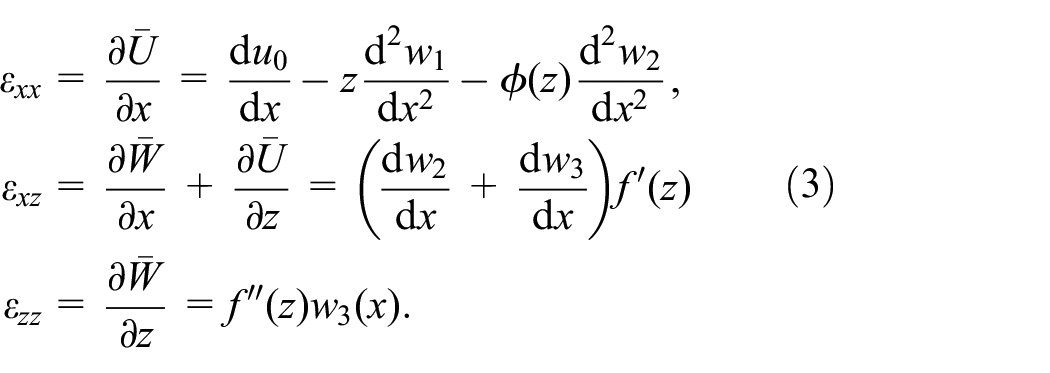
Based on the displacement field (1), one can obtain the components of the strains as:
Constitutive relations
With respect to the piezoelasticity theory,3,4,32 the constitutive relation for the components of the stresses and the electric displacements can be given as
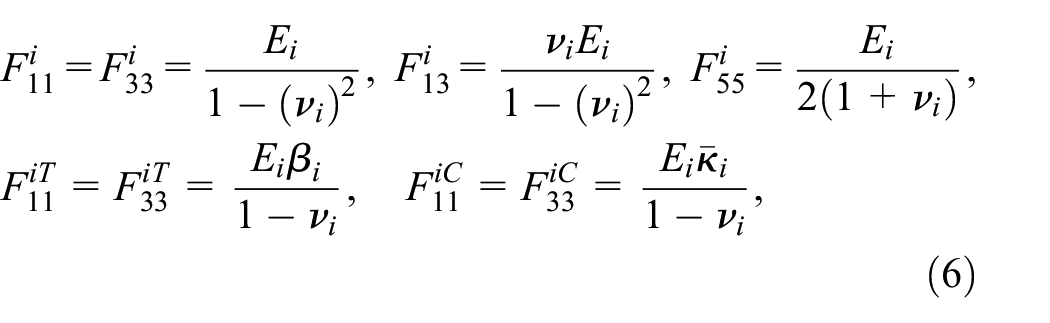
where , , and denote, respectively, the elastic coefficients, the thermal coefficients, and moisture coefficients of the FGGPLs composite beam; and denote the applied temperature and moisture, respectively; and represent the coefficients of the piezoelectric and the dielectric, respectively. The elastic coefficients, thermal coefficients, and moisture coefficients of the FGGPLs composite beam are written as
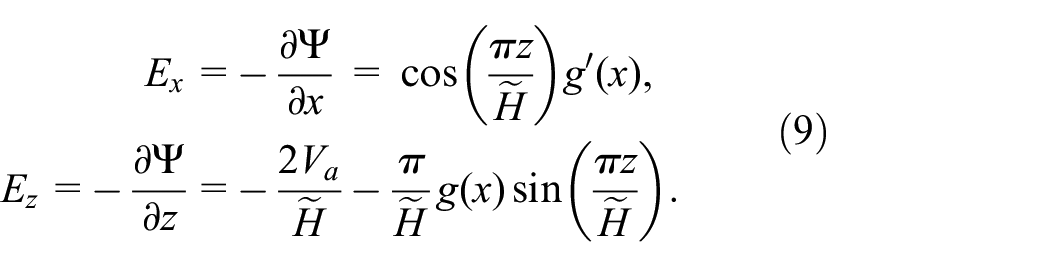
where represents the electric potential that can be defined as32
in which is the external applied voltage and is the electric potential at the mid-plane of the beam. Substituting equation (8) into equation (7) gives
Beam construction
Within the framework of Halpin-Tsai model, the effective Young’s moduli for the th layer of the composite beam are given by33
where stands for the piezoelectric Young’s modulus, and , in which , , and indicate the length, width, and thickness of GPLs, respectively; is the volume fraction of graphene for the th layer, and the coefficients and are written as33
in which indicates Young’s modulus of the GPLs. While, the effective material properties of the FGGPLs reinforced composite beam for the th layer, namely Poisson’s ration , mass density , thermal expansion coefficient , and moisture expansion coefficient can be evaluated as
in which , , , and are Poisson’s ratio of the GPLs (piezoelectric), the mass density of the GPLs (piezoelectric), the thermal expansion coefficient of the GPLs (piezoelectric), and the moisture expansion coefficient of the GPLs (piezoelectric), respectively. Furthermore, the remaining coefficients of piezoelectric and dielectric and , respectively, can be calculated as follows:
where , , , and define the piezoelectric coefficients of GPLs (piezoelectric), and the dielectric coefficients of GPLs (piezoelectric), respectively. With respect to a modified piece-wise rule, the volume fraction of GPLs will be diversed across the thickness of the beam layers as presented in Figure 1, and in the present analysis four different patterns of FGGP distribution are studied as follows:
Pattern 1
In this pattern, the graphene platelets can be steadily distributed throughout thickness . As a result, the volume fraction of the th layer can be expressed by
in which describes the weight fraction of GPLs.
Pattern 2
In this particular pattern, the volume fraction of graphene decreases in a monotonic way from its maximum value at the top-surface to minimum value at the bottom-surface of the beam. We can indicate the gradient-distributions of graphene by FG-V. Therefore, the volume fraction for each layer can be written as
in which represents the number of layers of the beam, and is a power-law index.
Pattern 3
The volume fraction of graphene equals at the mid-plane of the sheets. While, it has a maximum value at the upper and lower sheets. Consequently, is expressed as
Pattern 4
In this state, the volume fraction of graphene equals at the top and bottom beam surfaces. While, it has a maximum value at the mid-plane of the beam. Consequently, can be expressed as
Temperature and moisture fields
The applied temperature and moisture are distributed in the thickness direction of the FGGPLs beams, and they can be obtained for each layer depending on the equations of the heat conduction and moisture diffusion as
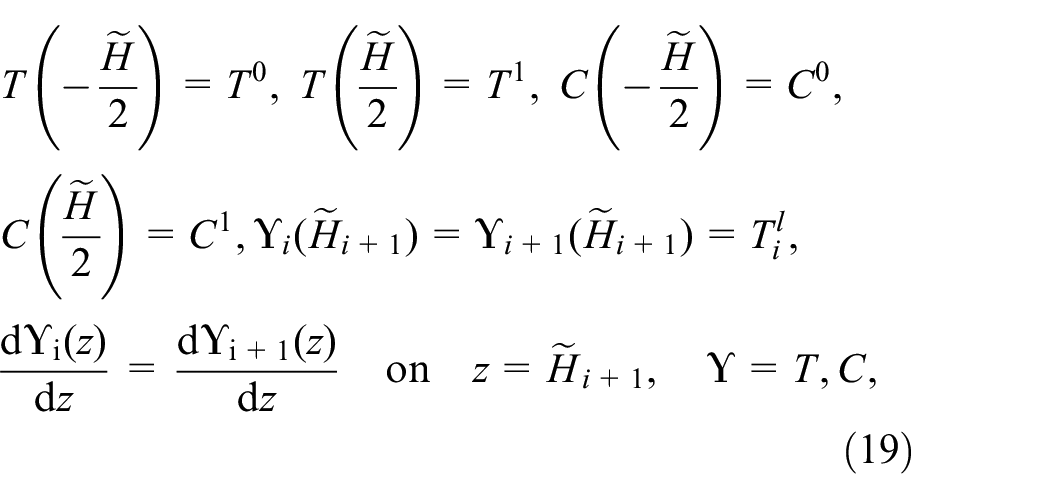
where is the thermal conductivity and moisture diffusivity for the th layer. Equation (18) will be integrated subject to the boundary conditions of temperature and moisture together with the continuity conditions, which take the forms
where indicates the interface coordinate between the layers and . In addition, the constants and are the temperature (moisture) of the lower- and upper-surfaces of the beam, respectively. Integration of (18) subject to (19) leads to
where denotes the number of the structure layers, , . Equation (20) gives the general mechanism of the temperature and moisture.
Governing equations
The equations of motion associated with the displacement field in equation (1) can be derived by utilizing the variation of the strain energy and the work done by the external force which can be stated by
in which , , and are the in-plane hygrothermal forces which are given, respectively, as
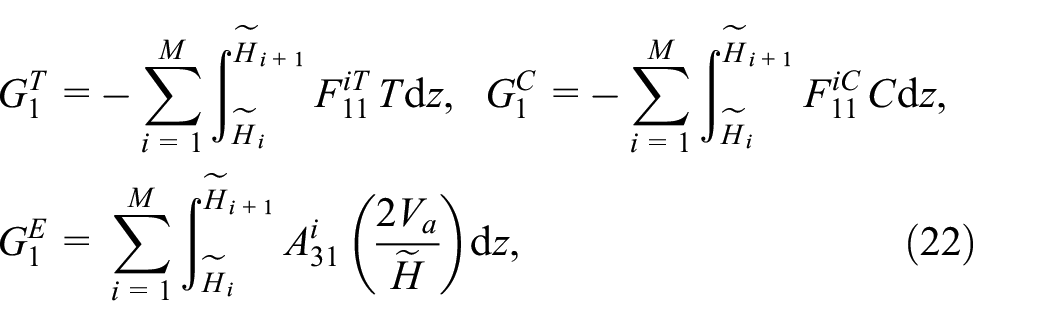
Substituting equation (27) into equation (26) leads to the governing equations in terms of the displacement components () and the electric potential () as:
where
Thermal buckling solution
The analytical solution of equation (29) is presented according to Navier’s solution procedure. The simply supported boundary conditions for the current shear and normal deformations beam theory at and are given as:
Accordingly, the displacements that satisfy the above boundary conditions can be given as:
where , is the mode number, , and are unknown parameters that can be determined. Inserting equation (32) into equation (29) gives the stability equations in the following form:
where denotes the columns
and the elements of matrix are expressed as:
For non-trivial solution of equation (33), the determinant should be equal zero. By solving the equation , one can obtain the buckling temperature change .
Numerical results
Numerical results for critical buckling temperature of FGGPL strengthened piezoelectric beams subjected to external electric voltage and humid conditions are presented in this section. The beam thickness is taken as m. In addition, the following data are used in the current analysis (unless otherwise stated): , nm, nm, nm, K, %. The properties of the piezoelectric material are defined as2: GPa, kg/m3, C/m2, C/m2, C/m2, C/Vm, C/Vm, K, . Whereas, the GPL properties are defined as2: TPa, kg/m3, , , , , , , K, , where is named as the piezoelectric multiple.2
A comparison between the obtained critical buckling temperature of functionally graded beam and that obtained by Kiani and Eslami34 is investigated in Figure 2. The results of Kiani and Eslami34 has been obtained by employing the Euler-Bernoulli beam theory (EBT) that neglects the shear deformation effect. While, the refined two-variable shear deformation beam theory (RSDT) is utilized to calculate the present results. As expected for the thick beam, a noticeable difference between the results of the EBT34 (the classical beam theory) and those obtained by the RSDT is obvious, indicating the shear deformation effects. Indeed, the effect of the shear strain is small for thin beams; while, it increases as the beams thickness increase. Therefore, the present theory including the shear deformation, predicts more accurate results than the EBT, especially for thick beams. Whereas, the results of the two theories are in agreement for a thin beam.
Comparing the obtained critical buckling temperature with that of Kiani and Eslami34 for an functionally graded beam ().
Figure 3 shows the changes of the critical buckling temperature of FGGPL strengthened piezoelectric beams with respect to various values of external electric voltage versus the length-to-depth ratio . Here, the four patterns 1, 2, 3, and 4 of FGGP are considered in the corresponding figures a, b, c, and d, respectively. It is noted that increasing the electric voltage enhances the strength of the nanocomposite beams. Therefore, the critical buckling temperature increases by increasing the external electric voltage . While, with decreasing the beam thickness, the beam becomes weaker, accordingly it needs smaller temperature to buckle.
Effects of the length-to-depth ratio and external electric voltage on the critical buckling temperature of FGGPL strengthened piezoelectric beams for four different patterns: (a) pattern 1, (b) pattern 2, (c) pattern 3, and (d) pattern 4 ().
Figure 4 represents the influences of the length-to-depth ratio and moisture concentration on the critical buckling temperature of FGGPL strengthened piezoelectric beams where the four patterns (a) pattern 1, (b) pattern 2, (c) pattern 3, and (d) pattern 4 are considered. It is observed that the critical buckling temperature decreases as both of the ratio and moisture concentration increase. Furthermore, the effects of on become more pronounced for larger values of the ratio . Indeed, increasing the humidity weakens the beam stiffness which leads to less buckling temperature.
Effects of the length-to-depth ratio and moisture concentration on the critical buckling temperature of FGGPL strengthened piezoelectric beams for four different patterns (a) pattern 1, (b) pattern 2, (c) pattern 3, and (d) pattern 4 ().
Figure 5 illustrates the changes of the critical buckling temperature of FGGPL strengthened piezoelectric beams regarding different values of graphene volume fraction against the length-to-depth ratio for four different patterns 1, 2, 3, and 4 in the corresponding figures a, b, c, and d, respectively. It is noticed that the beam stiffness increases as the graphene volume fraction increases leading to an increment in the buckling temperature . It is obvious for pattern 1 that the impacts of on become more noticeable for smaller length-to-depth ratios .
Effects of the length-to-depth ratio and graphene volume fraction on the critical buckling temperature of FGGPL strengthened piezoelectric beams for four different patterns: (a) pattern 1, (b) pattern 2, (c) pattern 3, and (d) pattern 4 ().
Figure 6 displays the effects of the external electric voltage and piezoelectric multiple on the critical buckling temperature of FGGPL strengthened piezoelectric beams for four different patterns (a) pattern 1, (b) pattern 2, (c) pattern 3, and (d) pattern 4. It is obvious for all patterns that the critical buckling temperatures are linearly varied and increase as both and increase. Moreover, the impacts of piezoelectric multiple on are more evident for higher values of .
Effects of the external electric voltage and piezoelectric multiple on the critical buckling temperature of FGGPL strengthened piezoelectric beams for four different patterns: (a) pattern 1, (b) pattern 2, (c) pattern 3, and (d) pattern 4 ().
Conclusions
This research is devoted to investigate the electro-thermal buckling behavior of piezoelectric FG graphene platelets beam (PFGGPL) which subjected to an external electric voltage and moisture conditions. In accordance with Halpin-Tsai model, the effective Young’s modulus of the beam was predestined. Depending on the rule of the mixture, Poisson’s ratio, mass density, and piezoelectric properties were measured under four FGGPL distribution types. The displacement components were expressed by using a refined two-unknown beam theory taking into account the shear deformation as well as thickness stretching effect. Moreover, the stability differential equations were derived by employing the principle of virtual work containing both of the thermal, moisture, and electric loads. Furthermore, the present formulations were validated by comparing the related outcomes with those of other published articles. It was concluded for all FGGPL distribution types that the critical buckling temperature increases by increasing each of the external electric voltage, the piezoelectric multiple, and the graphene volume fraction. However, the critical buckling temperature decreases by increasing both of the length-to-depth ratio and the moisture concentration.
Footnotes
Handling Editor: Chenhui Liang
Declaration of conflicting interests
The author(s) declared no potential conflicts of interest with respect to the research, authorship, and/or publication of this article.
Funding
The author(s) disclosed receipt of the following financial support for the research, authorship, and/or publication of this article: This work was supported by the Deanship of Scientific Research, Vice Presidency for Graduate Studies and Scientific Research, King Faisal University, Saudi Arabia (Project No. GRANT346).
ORCID iDs
Mohammed Sobhy
Fatemah HH Al Mukahal
References
1.
HouWZhengYGuoW, et al. Piezoelectric vibration energy harvesting for rail transit bridge with steel-spring floating slab track system. J Clean Prod2021; 291: 125283.
2.
MaoJ-JZhangW.Buckling and post-buckling analyses of functionally graded graphene reinforced piezoelectric plate subjected to electric potential and axial forces. Compos Struct2019; 216: 392–405.
3.
SobhyM.Piezoelectric bending of GPL-reinforced annular and circular sandwich nanoplates with FG porous core integrated with sensor and actuator using DQM. Arch Civil Mech Eng2021; 21: 1–18.
4.
ZhangSXiaRLebrunL, et al. Piezoelectric materials for high power, high temperature applications. Mater Lett2005; 59: 3471–3475.
5.
SobhyM.Analytical buckling temperature prediction of FG piezoelectric sandwich plates with lightweight core. Mater Res Express2021; 8: 095704.
6.
SobhyM.Stability analysis of smart FG sandwich plates with auxetic core. Int J Appl Mech2021; 13: 2150093.
7.
WuCCMKahnMMoyW.Piezoelectric ceramics with functional gradients: a new application in material design. J Am Ceram Soc1996; 79: 809–812.
8.
El HartiKRahmouneMSanbiM, et al. Dynamic control of Euler Bernoulli FG porous beam under thermal loading with bonded piezoelectric materials. Ferroelectrics2020; 558: 104–116.
9.
MallekHJradHWaliM, et al. Nonlinear dynamic analysis of piezoelectric-bonded FG-CNTR composite structures using an improved FSDT theory. Eng Comput2021; 37: 1389–1407.
10.
PhucPMKim KhueNT.New finite modeling of free and forced vibration responses of piezoelectric FG plates resting on elastic foundations in thermal environments. Shock Vib2021; 2021: 1–18.
11.
ZenkourAMAljadaniMH.Buckling analysis of actuated functionally graded piezoelectric plates via a quasi-3D refined theory. Mech Mater2020; 151: 103632.
12.
SobhyM.Magneto-electro-thermal bending of FG-graphene reinforced polymer doubly-curved shallow shells with piezoelectromagnetic faces. Compos Struct2018; 203: 844–860.
13.
AbazidMASobhyM.Thermo-electro-mechanical bending of FG piezoelectric microplates on Pasternak foundation based on a four-variable plate model and the modified couple stress theory. Microsyst Technol2018; 24: 1227–1245.
14.
AbazidMA.The nonlocal strain gradient theory for hygrothermo-electromagnetic effects on buckling, vibration and wave propagation in piezoelectromagnetic nanoplates. Int J Appl Mech2019; 11: 1950067.
15.
SobhyM.3-D elasticity numerical solution for magneto-hygrothermal bending of FG graphene/metal circular and annular plates on an elastic medium. Eur J Mech A Solids2021; 88: 104265.
16.
AbbasipourMKhajaviRYousefiAA, et al. The piezoelectric response of electrospun PVDF nanofibers with graphene oxide, graphene, and halloysite nanofillers: a comparative study. J Mater Sci Mater Electron2017; 28: 15942–15952.
SobhyMAlakel AbazidM.Dynamic and instability analyses of FG graphene-reinforced sandwich deep curved nanobeams with viscoelastic core under magnetic field effect. Compos B Eng2019; 174: 106966.
21.
AbazidMAZenkourAMSobhyM.Wave propagation in FG porous GPLs-reinforced nanoplates under in-plane mechanical load and Lorentz magnetic force via a new quasi 3D plate theory. Mech Based Des Struct Mach2020; 1–20. DOI: 10.1080/15397734.2020.1769651.
22.
Alakel AbazidM. 2D magnetic field effect on the thermal buckling of metal foam nanoplates reinforced with FG-GPLs lying on Pasternak foundation in humid environment. Eur Phys J Plus2020; 135: 1–27.
23.
WangYFengCSantiusteC, et al. Buckling and postbuckling of dielectric composite beam reinforced with graphene platelets (GPLs). Aerosp Sci Technol2019; 91: 208–218.
24.
WangYFengCWangX, et al. Nonlinear static and dynamic responses of graphene platelets reinforced composite beam with dielectric permittivity. Appl Math Model2019; 71: 298–315.
25.
WangYFengCYangJ, et al. Static response of functionally graded graphene platelet–reinforced composite plate with dielectric property. J Intell Mater Syst Struct2020; 31: 2211–2228.
26.
YangZFengCYangJ, et al. Geometrically nonlinear buckling of graphene platelets reinforced dielectric composite (GPLRDC) arches with rotational end restraints. Aerosp Sci Technol2020; 107: 106326.
27.
Al MukahalFHHSobhyM. Wave propagation and free vibration of FG graphene platelets sandwich curved beam with auxetic core resting on viscoelastic foundation via DQM. Arch Civil Mech Eng2022; 22: 1–21.
28.
AllamMNRadwanAFSobhyM.Hygrothermal deformation of spinning FG graphene sandwich cylindrical shells having an auxetic core. Eng Struct2022; 251: 113433.
29.
SobhyMAlakel AbazidM.Mechanical and thermal buckling of FG-GPLs sandwich plates with negative Poisson’s ratio honeycomb core on an elastic substrate. Eur Phys J Plus2022; 137: 1–21.
30.
ShimpiRP.Refined plate theory and its variants. AIAA J2002; 40: 137–146.
31.
ZenkourAMSobhyM.Axial magnetic field effect on wave propagation in bi-layer FG graphene platelet-reinforced nanobeams. Eng Comput2021; 1–17. DOI: 10.1007/s00366-020-01224-3.
32.
KeLLWangYSWangZD.Nonlinear vibration of the piezoelectric nanobeams based on the nonlocal theory. Compos Struct2012; 94: 2038–2047.
33.
SongMYangJKitipornchaiS.Bending and buckling analyses of functionally graded polymer composite plates reinforced with graphene nanoplatelets. Compos B Eng2018; 134: 106–113.
34.
KianiYEslamiMR.Thermal buckling analysis of functionally graded material beams. Int J Mech Mater Des2010; 6: 229–238.