



Abstract
The influence of input parameters on the load-carrying capacity of the large-diameter stiffened cylindrical shell has not been satisfactory understood. To obtain the global sensitivity indices for the load-carrying capacity of large-diameter stiffened cylindrical shells, a novel data-driven sensitivity analysis method is presented for the efficient calculation of Sobol’s indices. In the work, the analytical expressions to compute Sobol’s indices are derived in detail based on the Radial Basis Function (RBF) metamodel. Then, the collapse mode of stiffened cylindrical shells with different sections of stringers are simulated, and the sensitivity of the load-carrying performance to geometric parameters are analyzed. The results show that for the considered stiffened cylindrical shell: (1) The coupled flexural-torsional induced deformation becomes the main factor leading to the overall collapse of the large-diameter and heavy-load stiffened cylindrical shells. (2) The flange thickness of stringers has the strongest influence on the load-bearing capacity, followed by the web thickness of stringers. (3) The interaction influences between stringers and other components in stiffened cylindrical shells are insignificant and negligible compared to the individual influence of stringers.
Keywords
Introduction
Stiffened cylindrical shells are typical thin-walled structures widely utilized in launch vehicles for their considerably high efficiency in terms of strength, stiffness, and load-carrying capacity to weight ratios. The major concern of the stiffened cylindrical shells is the desired buckling and post-buckling behavior under the axial compression loading condition. As the load-carrying demand and the size of the stiffened cylindrical shells arise, the structural complexity and design parameters increase accordingly. Thus the calculation burden in the design optimization process becomes heavier. Although substantial research has been conducted to improve the load-carrying performance of this thin-walled structure, few of them aims to reveal how the components (i.e. design variables) affects the load-carrying performance of the stiffened cylindrical shells, which would be conducive to disclosing the stability-induced failure mechanism and improve the optimization efficiency. In this paper, we focus on the global sensitivity analysis of the large-diameter stiffened cylindrical shells.
Global sensitivity analysis (GSA) is an effective method to analyze how the input variables and their combinations affect the model responses, which will help designers recognize what should be of great concern in engineering practice.1,2 GSA can be classified into two categories: the derivative-based approach3–5 and the variance-based approach.6,7 The well-known analysis of variance (ANOVA), a typical variance-based approach, aims to decompose the variance of each input parameter and their combinations. 8 For thin-walled structures, although the effects of geometric imperfections on the load-carrying performance have been studied comprehensively,9–16 the influences of geometric parameters on the load-carrying capacity remain underresearched. Rigo et al. 17 and Khedmati et al. 18 investigated the effects of different parameters on the ultimate strength and collapse behavior of stiffened shells by systematically changing a single parameter and keeping the remaining parameters constant simultaneously. Based on the same strategy, Li et al. 19 analyzed the sensitivity of the ultimate strength of stiffened panels to geometric parameters, initial imperfections, and material properties. Khedmati et al. 20 studied the sensitivity of the buckling strength of cracked plate elements under axial compression to the crack size, location, and orientation. Nevertheless, they all ignored the cross interaction of parameters on the results. Zhang et al. 21 assessed the effects of parameters on the load-bearing capacity of corroded circular steel tubes by the Sobol sensitivity analysis method, which was computed by the Monte-Carlo(MC) or Quasi MC simulation technique. However, abundant samples are required in this method, which makes it impracticable for most computationally intensive model analysis, for example post-buckling analysis of stiffened cylindrical shells. To relieve the computational burden, data-driven analysis methods appeals to engineers due to their intrinsic capacity in mimicking the behavior of the real model with explicit analytical expressions. 22 Tian et al. 23 proposed a novel establishment method of the data-driven variable-fidelity surrogate model for the buckling prediction problems of the stiffened cylindrical shells and achieves higher prediction accuracy. Further, Tian et al. 24 proposed a data-driven modeling and optimization framework to enhance the optimization efficiency of undevelopable stiffened curved shells.
To extend the Sobol sensitivity analysis to expensive models, the polynomial chaos expansions25–27 are used as a surrogate model for the efficient calculation of sensitivity indices. However, the low order polynomial cannot mimic the high-dimensional and nonlinear model, while the high order polynomial is prone to over-fitting. 28 Song et al. 29 used the Kriging metamodel and MC method to quantify the effects of design variables and conducted the reliability-based design optimization of the high-strength steel tailor welded thin-walled structures without insignificant variables. Likewise, Qian et al. 30 incorporated the MC method and Kriging metamodel to screen the influential uncertain parameters of the vehicle restraint system. Zhou et al. 31 combined the artificial neural network and MC method for the calculation of sensitivity indices of the slat mechanism. However, these processes are usually tedious, computationally expensive, and oftentimes lacks sufficient accuracy due to the error accumulation in both the metamodeling stage and the MC calculation stage.28,32,33
This paper aims to propose an efficient method for the sensitivity analysis of the load-carrying capacity of the large-diameter stiffened cylindrical shells subjected to axial compression load. To this end, a novel data-driven sensitivity analysis method assisted by the RBF metamodel is proposed for the efficient calculation of Sobol’s sensitivity indices. The outline is as follows. Firstly, the basic methodology and framework of the proposed approach are introduced in Section 2, including the detailed variance decomposition of the RBF metamodel. Then, in Section 3, large-diameter and heavy-load stiffened cylindrical shells with different shapes of stringers are established as an example. And the proposed approach is applied for the sensitivity indices of the load-carrying capacity of the stiffened cylindrical shells. Finally, concluding remarks are summarized in Section 4.
Methodology
Explicit dynamic method for post-buckling analysis
In this study, a nonlinear displacement-controlled explicit dynamic method is applied for the post-buckling analysis of the stiffened cylindrical shells due to the superior performance in simulating the deformed shape from pre-buckling to post-buckling field until collapse. Via utilization of the explicit time integration with the central difference method, the equation of motion in the explicit dynamic method can be expressed as
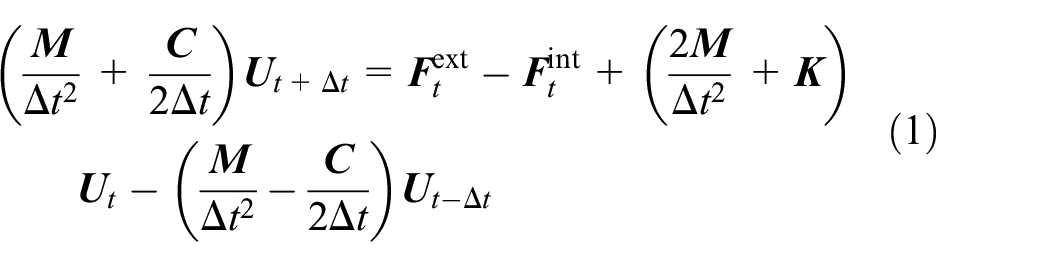


where
As is obvious in equation (1),
RBF metamodel
RBF metamodel appeals to engineers/researchers for its superiority in approximating highly nonlinear models in arbitrary precision. The classical RBF interpolation model, also called a forward network, consists of the input layer, hidden layer, and output layer. For a given training data set with

where

where
Based on the RBF’s unbiased prediction at the observed sample points, the following linear matrix equation can be concisely derived from equation (4) as

By calculating the inverse of the coefficient matrix
Variance decomposition of RBF metamodel for sensitivity analysis
The decomposition of the sum of squares is the key point in the analysis of variance (ANOVA). Suppose that the RBF metamodel

where

According to the orthogonal condition of equation (8), all of the terms in equation (7) can be obtained by the following integral operations
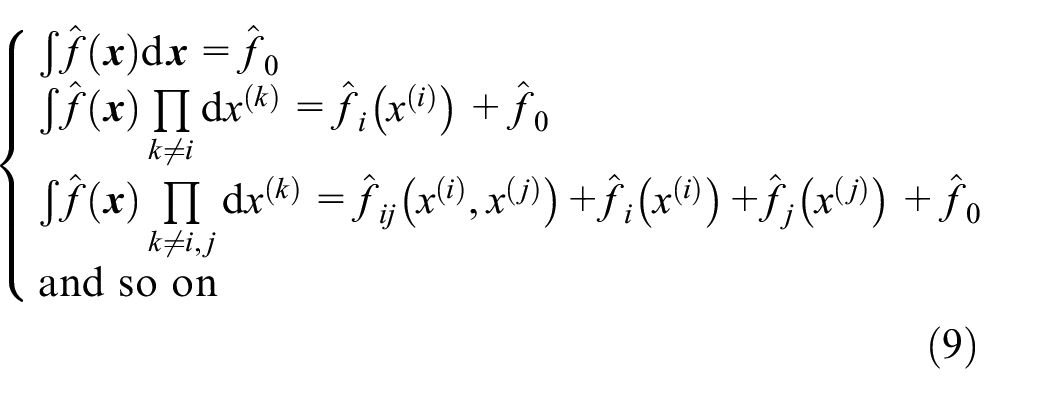
It follows from equation (8) that all summands in equation (7) are orthogonal in the sense that

where
With the above decomposition of the RBF model
Integrating the square of equation (7) over

Denoting



where
Proof.
Considering the subset

Then

Applying equation (9) we conclude that

After squaring and integrating over

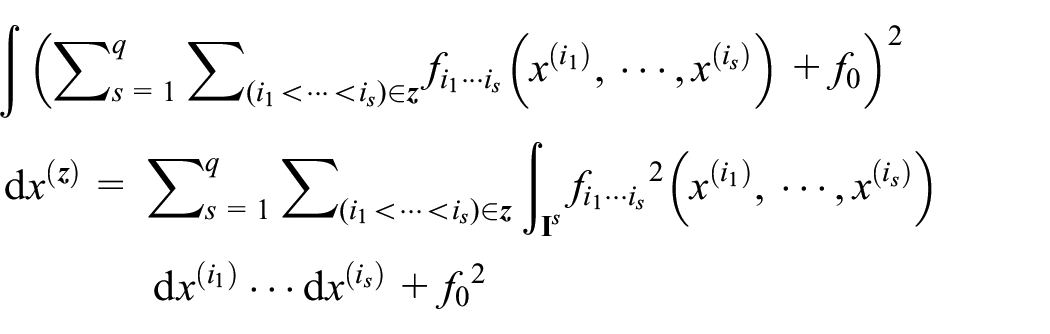
Finally, we obtain the following equation

By defining the ratios

as the global sensitivity indices and measurement of the interaction effects of variables


Specifically, the total sensitivity index of


As for the RBF metamodel-based computational issues, it is essential to compute the integral of
(1) Computation of

where


where

Substituting equations (21)–(24) to equation (20), we finally obtain

(2) Computation of
The square integral of the RBF metamodel

which can be further derived as

where

Substituting equation (28) to equation (27), we finally obtain

where
(3) Computation of
In advance,

where
Denoting

Based on the derivation of equations (27)–(29), equation (31) is finally arranged as

where
So far, the total variance and partial variance corresponding to


Thus, the sensitivity analysis of any expensive function
Framework of the RBF metamodel-based sensitivity analysis
To better present the whole procedure of the RBF-based sensitivity analysis, the framework is depicted in Figure 1 and the step by step descriptions are summarized as follows.
Step1. Establish the finite element model of stiffened cylindrical shells via Abaqus/Python scripts.
Step2. Generate the training sample points using optimal Latin Hypercube Design (OLHD) in the design space
Step3. The collapse load of the stiffened cylindrical shells are obtained via the explicit dynamic method.
Step4. Scale the observed sample points into an m-dimensional unit hypercube and construct the RBF metamodel
Step5. Designate any arbitrary subset
Step6. The integrals

The framework of RBF metamodel-based sensitivity analysis for stiffened cylindrical shells.
Global sensitivity analysis of theload-carrying capacity of stiffened cylindrical shells
Problem definition
A 9.5-m-diameter and 5-m-height metallic stiffened cylindrical shell subjected to axial compression load is investigated herein. Due to their considerable high efficiency in terms of strength, stiffness, and load-carrying capacity to weight ratios, the stiffened cylindrical shells applying the internal circumferential frames along with external vertical stringers to the skin is widely utilized as the main load-bearing component in launch vehicles. As is shown in Figures 2 and 3, the stringers are uniformly distributed around the external side of the skin, while the middle frames are distributed along the height direction on the internal side of the skin and two end frames are distributed at both ends of the structure. The stringers commonly applied in engineering include T-stringer, I-stringer, and omega-stringer, as depicted in Figure 2. Furthermore, the dimensions of the middle- and end-frames in the stiffened cylindrical shell are presented in Figure 2 as well.

Schematic of the stiffened cylindrical shell and the components.

Layout of the circumferential and end frames.
The finite element model of the stiffened cylindrical shell is established using shell elements. To avoid the influence of rigid boundary constraints of the model on the simulation results, two L-section boundaries which are mirror-symmetric to the end-frames are established both on the top and bottom of the model. Then, the bottom end of the model is clamped, while the top of the model restricts the translation and rotation degrees except for the axial displacement. The adequacy of the finite element mesh and proper displacement loading velocity adopted in this model were investigated using variations in element size and loading time.
37
The proper tradeoff between accuracy and efficiency is obtained with the following element size and displacement loading velocity: 40 mm for the skin, 2 elements for the web of the stringer, and 300 mm/s for the displacement loading velocity. Typical properties of the aluminum alloy adopted in this study are listed as follows: Young’s modulus
In the stiffened cylindrical shell, the vertical stringers carry the major compression load imposed on the structure, while the circumferential frames enhance the buckling resistance for the stringers, thus further improving the load-carrying capacity of the structure. Despite the skin will evolve into local instability or even local plastic deformation under a small axial compression load, the stiffened cylindrical shell can still carry the axial load from pre-buckling to post-buckling until the whole collapse of the structure. Figure 4 depicts the typical load-shortening curve of the stiffened cylindrical shell with various types of stringers, along with the collapse pattern at the collapse load. Due to the low torsional rigidity of the T-stringers, tripping will occur prior to beam-column type flexural buckling when the stiffened cylindrical shells carry the axial compression load. Then the stringers will fail rapidly upon tripping, leading to the subsequent loss of the load-carrying capacity of the stiffened cylindrical shells. Different from T-stringers, the collapse patterns of stiffened cylindrical shells with I-stringers and Omega-stringers are mainly dominated by the coupled flexural-torsional buckling of stringers due to their higher torsional rigidity compared to T-stringers.

The typical load-shortening curve of the stiffened cylindrical shell, along with the deformed shape evolutions.
Although the explicit dynamic method can simulate the deformation process and collapse pattern of the stiffened cylindrical shell, the insight into how the components (i.e. design variables) affects the load-carrying performance remains unrevealed. This information can be utilized to determine the design variables that affect the load-carrying capacity of the structure significantly, and then help guide the design process. In this study, we employ the RBF metamodel-based sensitivity analysis method to quantify and clarify the relative importance of the design variables (as shown in Table 1) on the collapse load of the stiffened cylindrical shells, which will be discussed in detail in the following section.
Range of the design variables.

Results discussion
Considering the high-dimensional and nonlinear attribute of the post-buckling analysis of stiffened cylindrical shells, enough sample points are needed to capture as much nonlinear feature information of the stiffened cylindrical shells as possible. Therefore, a set of 2400 sample points are generated throughout the whole design space via OLHD. The training sample points are selected from the 2400 sample points by the clustering method, while the remaining sample points serve as the validation set for the prediction accuracy of the RBF metamodel. And the root-mean-square error (RMSE) and R square (R2) are employed as the assessment criteria of the prediction ability, which are mathematically expressed as follows.


where
Four sets of 300, 400, 600, and 800 training sample points are selected independently to construct the RBF metamodel and the corresponding prediction accuracy is shown in Figure 5. The results in Figure 5 demonstrate powerfully the high prediction accuracy of the RBF metamodel. With the constructed RBF metamodel, we obtain the sensitivity indices of all the design variables in the stiffened cylindrical shells with different types of stringers, as shown in Figure 6, in which the sensitivity indices computed based on the different number of training sample points are also illustrated. Figure 6(a) to (c) all demonstrate that the design variables related to stringers (i.e.

Prediction accuracy of RBF metamodel for stiffened cylindrical shells concerning the sample size: (a) accuracy of RBF for stiffened cylindrical shells with T-stringers, (b) accuracy of RBF for stiffened cylindrical shells with I-stringers, and (c) accuracy of RBF for stiffened cylindrical shells with Omega-stringers.

Estimated individual sensitivity indices in stiffened cylindrical shells: (a) stiffened cylindrical shells with T-stringers, (b) stiffened cylindrical shells with I-stringers, and (c) stiffened cylindrical shells with Omega-stringers.
To further reveal the influence of different components on the load-carrying capacity, the main effects of an arbitrary subset of design variables are plotted in Figure 7 where
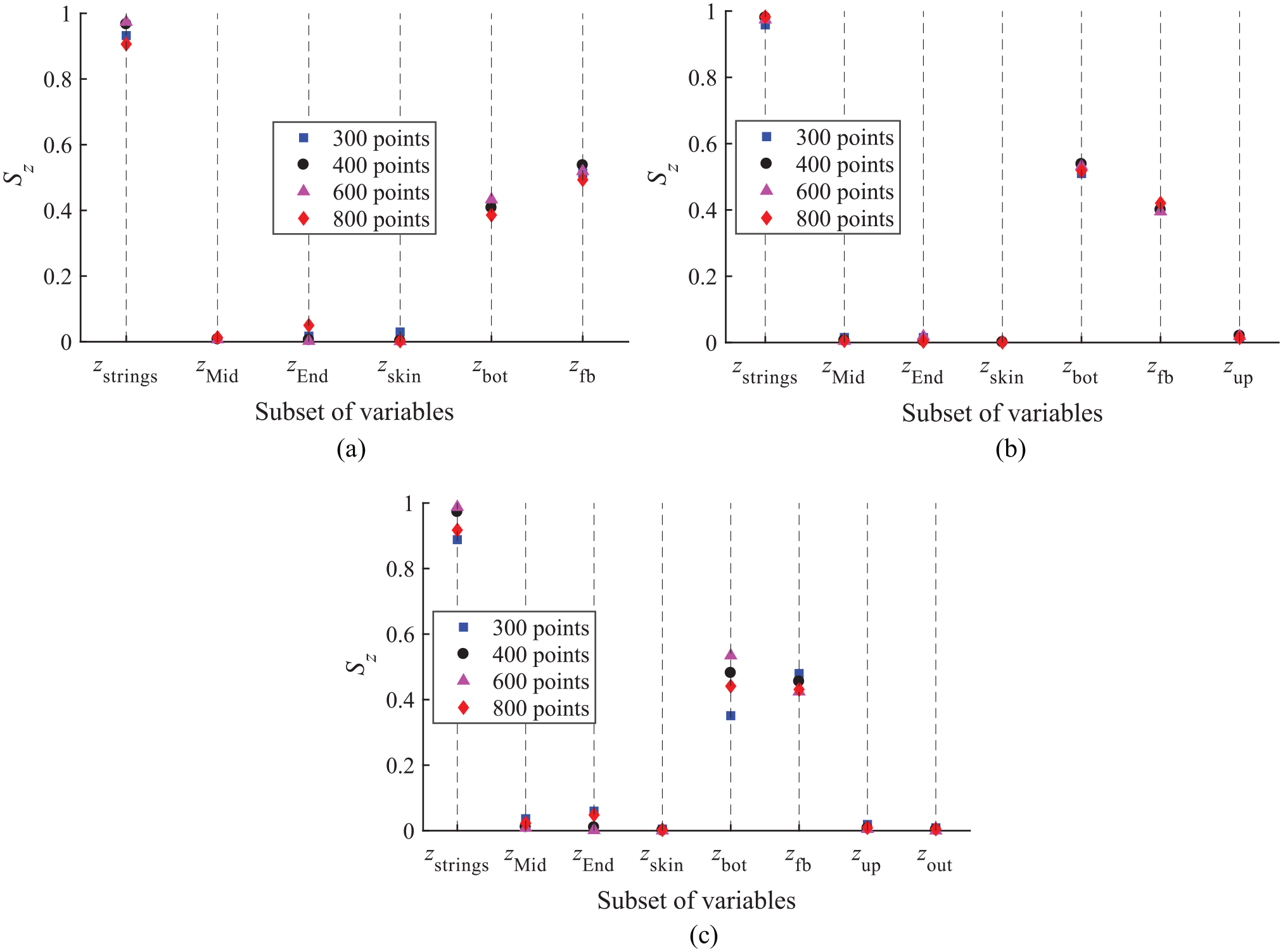
Estimated sensitivity indices of the typical subset of variables in stiffened cylindrical shells: (a) stiffened cylindrical shells with T-stringers, (b) stiffened cylindrical shells with I-stringers, and (c) stiffened cylindrical shells with Omega-stringers.
By denoting the interaction influence between two subsets of design variables as equation (37), we can easily obtain the interaction sensitivity indices between stringers and other components of stiffened cylindrical shells, as shown in Figure 8.


Estimated interaction sensitivity indices between stringers and other parts in stiffened cylindrical shells: (a) stiffened cylindrical shells with T-stringers, (b) stiffened cylindrical shells with I-stringers, and (c) stiffened cylindrical shells with Omega-stringers.
Figure 8 shows that the interaction sensitivity indices between stringers and other components in stiffened cylindrical shells are all smaller than 0.1, which demonstrates that the interaction influence on the load-carrying capacity is insignificant and can be negligible compared to the individual influence of stringers. Furthermore, by comparing the amplitudes of Figure 8(a) to (c), we can conclude that the interaction between T-stringers and other components has the relative largest effect on the collapse load, followed by I-stringers, and Omega-stringers has the least effect. This indicates that the support of the middle-frames and end-frames can improve the anti-instability performance of the T-stringers more obviously compared with I-stringers and Omega-stringers.
Conclusion
The main aim of this study is to identify and rank the importance of each design variable on the load-carrying capacity of stiffened cylindrical shells and provide a guideline for the efficient design of the structure under axial compression. To this end, a novel data-driven sensitivity analysis method using RBF metamodel is presented and the analytical formula for the Sobol’s indices are derived in detail. Then, the data-driven sensitivity analysis method is applied to the 9.5-m-diameter and 5-m-height metallic stiffened cylindrical shell with typical shapes of stringers, that is T-stringers, I-stringers, and Omega-stringers.
Simulation results show that the collapse pattern of stiffened cylindrical shells with I-stringers and Omega-stringers in axial compression is dominated by the coupled flexural-torsional collapse of stringers, while that of stiffened cylindrical shells with T-stringers is dominated by the tripping collapse of stringers. From the sensitivity analysis results, the varying impact of each design variable on the load-carrying capacity is observed. The thickness of the flange
Footnotes
Handling Editor: Chenhui Liang
Declaration of conflicting interests
The author(s) declared no potential conflicts of interest with respect to the research, authorship, and/or publication of this article.
Funding
The author(s) disclosed receipt of the following financial support for the research, authorship, and/or publication of this article: This research is supported by the National Key R&D Program of China (2017YFB0306200), National Natural Science Foundation of China (11902348), the Research Project of National University of Defense Technology (ZK20-27), and the Natural Science Foundation of Hunan Province, China (2020JJ5650). Additionally, Xing Ouyang and Bin Wang from Beijing Institute of Astronautical Systems Engineering are much appreciated for their helpful comments and suggestions. The authors also would like to thank the anonymous referees for their valuable comments.
