



Abstract
The non-Newtonian fluid flow plays an important role in industrial and manufacturing processes such as painting, printing, coating, and biomechanical. In the present paper, the steady two-dimensional MHD free convective flow of Casson fluid over a vertical surface is elucidated numerically with the impact of thermal radiation and chemical reaction are offered. The interaction of transverse magnetic field, viscous dissipation, and Hall current are taken into the account. A nonlinear flow system is developed to decompose the heat and mass transmission effects of this liquid, which is done by taking an appropriate extreme boundary condition. Non-dimensional nonlinear ordinary differential equations (ODEs) are diminished from governing partial differential equations (PDEs) via fitting transformations. The fundamental model of nonlinear constitutive flow laws is tackled numerically through the ND-solve technique in a Mathematica 11.0 environment. The computational upshot is also described explicitly to examine the consequences pertinent parameters. The attained sundry parameters are analyzed expediently, which include magnetic factor, radiation, chemical reaction, Prandtl number, heat source, modified Grashof number, and Schmidt number. The features of the governing relevant parameters on the flow frameworks are analyzed correctly via plots and tables. Additionally, the drag force, heat, and mass transference coefficients outlines are examined.
Keywords
Introduction
The synthetic industry, oil and gas, atomic energy, electrical energy, etc are the popular heat transfer phenomena nowadays. The section of particles from various temperatures is viewed as the exchange of hotness. Taking everything into account, heat move is the progression of hotness across the gadget limit because of the distinction in temperature between the framework and the climate. The hotness move in the framework can likewise be performed at various focuses inside the framework as a result of temperature contrasts. The presence of nanoparticles in the liquid furthermore impacts the hotness move of the liquid. The mixture of solid nanoparticles with a base liquid is known as nanofluid that was proposed by Choi. 1 There are several groups for the nanoparticles; chemically stable metals (gold, copper), metal oxide (alumina, silica), metal carbides (silicon carbide), metal nitrides (aluminum nitride, silicon nitride), and carbon in the various form (diamond, graphite) reported by Sarkar et al. 2
Khan and Pop 3 initiated the thermophoresis together with the Brownian motion effects on the boundary layer flow of a nanofluid past a steady stretching sheet numerically. Yirga and Shankar 4 claimed that the wall shear stress increases when the presence of nanoparticle volume fraction on MHD flows across a steady porous sheet. An analogous issue of MHD flow with the combination of thermal radiation and buoyancy effect has been reported by Pourmehran et al. 5 Samrat et al. 6 considered the effect of three kinds of nanoparticles respectively; silver, ferrous, and copper with water as a base fluid. The creator used the perturbation strategy to tackle and dissect the issue and has reasoned that the silver-water nanofluid is a decent coolant contrasted with copper and ferrous in water nanofluid. Rawi et al. 7 studied the Casson fluid with copper as nanoparticles that dissolved in a base fluid, carboxymethyl cellulose solution (CMC). The nanoparticle volume fraction in Casson fluid flow has enhanced the temperature profile, as illustrated by Rawi et al. 7 The Keller Box method has been used by Rawi et al. 7 and discovered that it is a productive technique to fix of the issue in the presence of copper-carboxymethyl cellulose-based nanofluid past a stretching sheet.
Hybrid nanofluids got the reaction of industry, particularly designing to investigate profoundly because of its broad specialized, modern, and logical applications like transportation, microfluidics, clinical assembling, and so on. The ideal mix of different nanoparticle properties has exhibited an exceptional heat transfer coefficient improvement with a low-pressure decline limit.8–12 According to Waskeen et al., 9 the blend of balanced-out nanofluids increment the warm conductivity rate with a minor measure of nanoparticle fixations in the liquid. Moreover, the proper hybridization of the better thermal conductivity of the nanocomposites has enlarged the heat transfer of the fluid and has reduced the disadvantage of increment of viscosity by Minea and Moldoveanu. 13 Normally, stable hybrid nanoparticles can be classified into three classes; metal, ceramic, and polymer.14–16
Several researchers have studied the heat transfer of metal nanomaterial alumina/copper because the hybrid nanoparticles can intensify the thermal conductivity and result in increasing the convective heat transfer.17–20 The existence of nanoparticles Al2O3 in a fluid has improved the Nusselt number coefficient, which characterizes the fluid’s heat transfer compared to other metal oxides by Mikkola. 21 It is obvious because the thermal conductivity of Al2O3 is higher as contrasted to other metal oxides. Furthermore, Al2O3 likewise shows a few brilliant properties like generally excellent dependability and synthetic latency by Suresh et al. 17 As stated in Mikkola, 21 the copper nanoparticle’s heat capacity is higher than the silver nanoparticle. Genuinely, heat limit is the measure of hotness expected to expand the temperature of a substance by 1°C. The fluid takes a long time to gain heat and a long time to cool. Therefore, the incorporation of copper and alumina in a liquid can altogether work on the thermal characters of the liquid just as steady hybrid nanoparticles.
Magneto-hydrodynamic (MHD) along with thermal radiation impacts on the wire coatings analysis for numerous categories of fluids are considered by several investigators.22–29 All these researches have so far presented numerical as well as analytical techniques for the solution of wire coating problems subjected to different types of non-Newtonian fluids. Marneni 30 then studied various features of mass transfer effect to liquid flow with constant heat flux as another flow issue. Narahari and Raghavan 31 examined the true computational outcomes for natural convective flow of Casson fluid subject to radiation effect and rising wall temperature impact. The diffusion thermal effect was later explored by Jha and Ajibade. 32 The Dufor effect raised the temperature of the fluid, implying that it can diminish the time it takes for it to reach steady state. The flow of unsteady hydro magnetic convective flow through a rotating framework in permeable channel along with Hall effects was analyzed by Seth et al. 33 The model of fractal-fractional unsteady convection flow of Newtonian liquid has been analyzed by Khan et al. 34 None of them did any analytical work on non-Newtonian fluid flow in a channel. Casson fluid flow is a new study on non-Newtonian fluid flow in vertical channels that was just published by a group of researchers. The effect of thermal radiation on Casson fluid flow via a vertical conduit was investigated by Khan et al. 35 They used a fixed vertical plate and an oscillating vertical plate to tackle the problem. The unsteady flow of Casson fluid through a fixed channel was examined by Ahmad Qushairi et al. 36 Mallikarjuna et al. 37 used numerical methods to solve the problem of pulsatile Casson fluid flow. Bukhari et al., 38 in addition to slip velocity, included the impacts of porosity and heat radiation. Divya et al. 39 described hydro magnetic flow Casson liquid with heat and mass transfer effects. Ahmad Sheikh et al. 40 studied non-Newtonian liquid flow in a channel with an external magnetic field and thermal radiation effect.
To author’s best idea, the subsequent specific objectives of this numerical study have remained undone, and the objectives are:
To investigate Hall current and viscous dissipation on MHD free convective flow of Casson fluid past a vertical plate in presence of thermal radiation with heat source/sink and chemical reaction.
The mathematical modeling equations of the non-linear partial differential equations are transformed into ordinary differential equations and then solved numerically.
The effect of various pertinent parameters on velocity, temperature, and concentration are demonstrated.
Also the skin friction, Nusselt, and Shrewood numbers are calculated numerically and given in the tabulated form.
Mathematical formulation
In this section, we describe the physical and mathematical description of the proposed model.
Physical description: we consider a steady state 2D hydrodynamic convective flow of Casson liquid by a vertical sheet having boundary layers, subjected to thermal and concentration buoyancy forces. By fixing the sheet in

The physical sketch and the Coordinate axes.
The basic equation for the Cassonnfluid can be expressed as 1 :

where
Mathematical description
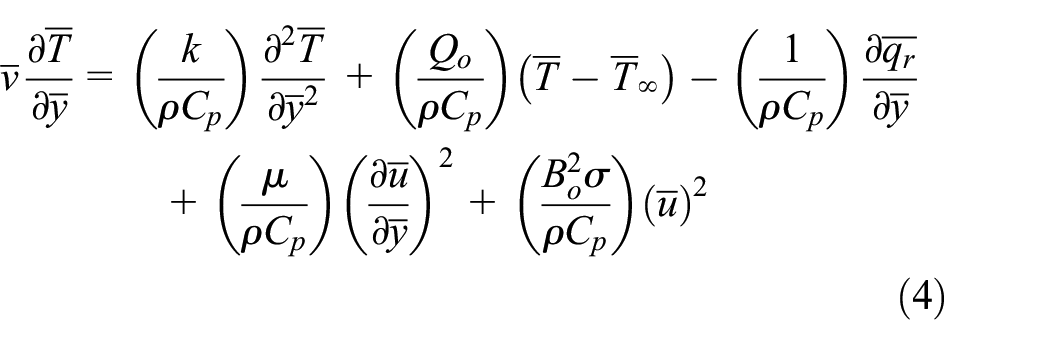
The governing flow equations are given in equations (2)–(5):



Subject to boundary conditions:

Here,
The radiative heat flux

Introducing equation (8)

Equation (2) is justified routinely whereas equations (3)–(5) are reduced into nondimensional form by using equations (7) and (8):


with the following extreme conditions

The variables appearing in equations (9)–(11) are defined as follows:

Defines as magnetic factor; Prandtl number; Heat source; Eckert number; Schmidt number; Radiation parameter; Chemical reaction parameter; Grashof and Modified Grashof numbers.
Physical quantities of interest
The important relationships for the engineering concern in the present exploration are
Skin friction
The dimensionless form of the

Nusselt number
The heat flow rate coefficient

Sherwood number
The mass flow rate coefficient

Results and discussion
This section is devoted to understanding clearly the physical insight and graphical interpretation. The nonlinear flow equations (9)–(11) subjected boundary postulates, in equation (12), are tackled numerically through ND-solve technique. While keeping
The variations in drag force coefficient
Variations in drag force coefficient under the influence of pertinent parameters.

Variations in heat transmission coefficient under the impact of pertinent constraints.

Variations in mass flow coefficient under the influence of pertinent parameters.

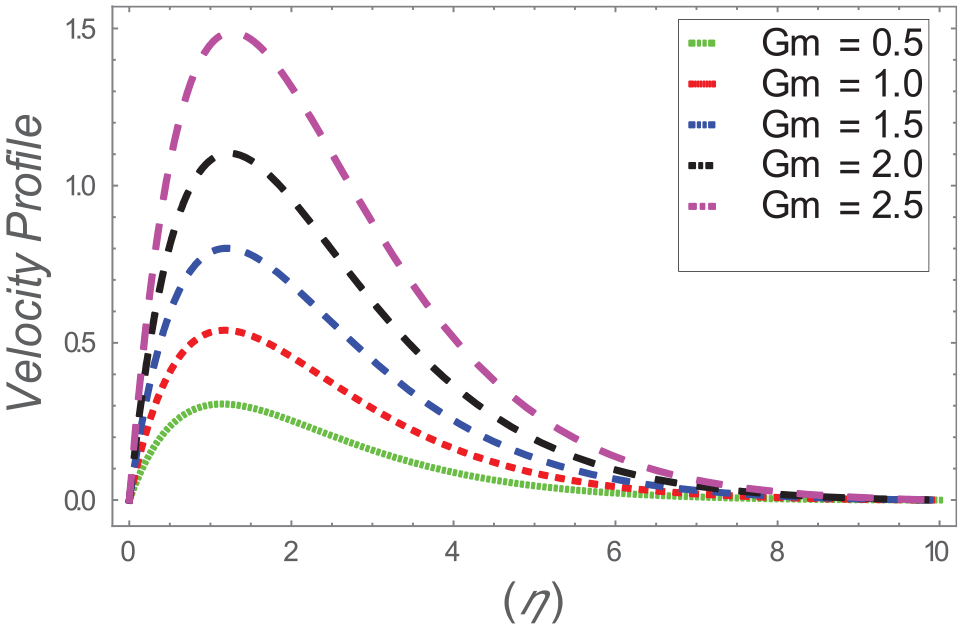
Figure 2, explains velocity curves reduce with increase of magnetic influence

Impact of
Impact of

Impact of

Impact of

Impact of

Impact of

Impact of

Impact of

Impact of

Impact of

Impact of

Impact of

Impact of
Impact of
Closing points
A numerical approach, the ND-Solve technique is employed to investigate Hall current and chemical reaction effects on the flow of Casson fluid over a vertically stretching sheet. The strategic remarks of current analysis are as follows:
The growing data of
It has been perceived that the fluid temperature develops with an augmentation in
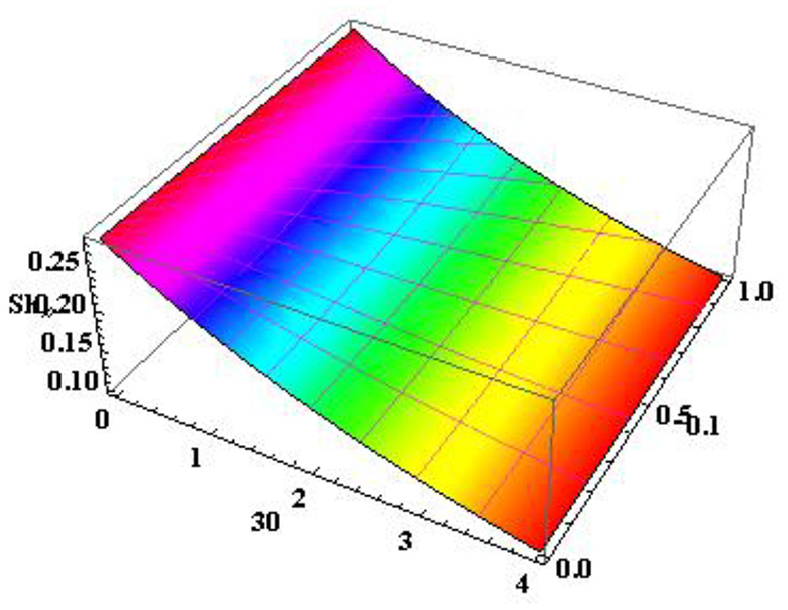
The fluid concentration profiles are noticed to have deteriorated with augmentation in
However, the surface drag force coefficient shown increasing attitude for the rising data of
Heat flow rate coefficient has shown the plunging behavior with rising values of
The mass flow rate coefficient has been noticed as a growing function of
Footnotes
Appendix
Handling Editor: Chenhui Liang
Declaration of conflicting interests
The author(s) declared no potential conflicts of interest with respect to the research, authorship, and/or publication of this article.
Funding
The author(s) received no financial support for the research, authorship, and/or publication of this article.
