




Abstract
Taking the deep foundation pit of a metro station with rich water environment as the research background, a three-dimensional model of seepage-stress coupling is established. Numerical simulation is used to study the deformation process and influencing factors of deep foundation pit dewatering and excavation of the station, and the influence of dfferent pre-dewatering conditions and different depths of the water-stop curtain on the deformation of the foundation pit is analyzed. The results show that during the dewatering and excavation of foundation pits, seepage-stress has an obvious coupling effect in dewatering and excavation. The stress concentration position of retaining structure and the maximum displacement of lateral displacement are about 0.5–0.6 excavation depth of pile body. With the depth of precipitation increases, the seepage effect in the soil layer is obviously enhanced, which is not conducive to the stability of the foundation pit.
Keywords
Introduction
Tianjin, Wuhan, Jinan, and many other regions have abundant and complex groundwater. In the water-proof design of deep foundation pits of subway stations in these areas, it is restricted by the site, construction difficulty and cost. A large number of suspended water-stop curtains are used that do not block the entire permeable layer but are embedded in the permeable layer. During precipitation, the seepage field around the foundation pit will change, causing seepage force and soil stress to redistribute. This will further affect the distribution of water and soil pressure on the retaining structure, and may even cause seepage damage to the retaining structure of the foundation pit and excessive ground settlement. It will adversely affect the stability of the foundation pit. For this reason, studying the influence of groundwater seepage on the deformation of suspended water-stop curtain foundation pit dewatering and excavation has important engineering guiding significance.
Scholars have carried out a large number of studies on the deformation laws of deep foundation pits under dewatering and excavation conditions through theoretical analysis, actual measurement analysis, and numerical simulation.1–7 The finite element method based on Biot 8 soil consolidation theory simulates the construction of foundation pits. It has good research results and is widely used in the analysis of actual deep foundation pit engineering. Najafzadeh and Oliveto9,10 use an artificial intelligence model to study the scour around pile groups under steady currents. The above-mentioned research mainly studies the situation where the water level outside the pit or the floor-standing water-stop curtain is small. Among the current research results on foundation pits with suspended water-stop curtains, Ding et al. 11 and Gao et al. 12 mainly studied the different depths of water-stop curtains. There are few studies on factor analysis in the case of precipitation. In addition, the current specification 13 does not consider the influence of the change of the seepage field outside the pit on the deformation of the foundation pit. The deformation behavior of the suspended water-proof curtain foundation pit during dewatering and excavation is not clear enough. In particular, the depth of the water-stop curtain in the deep foundation pit excavation and pre-dewatering deformation gauge needs further study.
Taking Jinan Metro Kaiyuan Road Station as the research background, this paper uses numerical analysis of foundation pit deformation laws and influencing factors during dewatering and excavation of foundation pits, and compares them with measured data and empirical predicted values to verify the rationality of the numerical simulation results. Through different working conditions, the influence of different excavation pre-dewatering and different suspended water-stop curtain depths on the deformation of the foundation under the seepage stress coupling model pit is analyzed.
Project overview
This subway station is located to the west of the intersection of Kaiyuan Road and South Huangtai Road in Jinan City, with an east-west orientation. The location of the station is shown in Figure 1. Jinan is rich in underground spring water. According to on-site geological exploration and nearby hydrogeological data, it is shown that the underground spring water where the foundation pit is located is mainly diving and confined water, and the water level is 27.66 m. According to the information provided by the geological survey report, the physical parameters of the soil layers involved in the calculation are listed as shown in Table 1.
Physical parameters of soil layer.


Geographical location of the station.
Kaiyuan Road Station is an underground double-decker island station. The total length of the station is 210.6 m, the depth of the foundation pit of the standard section is 15.77 m, the width of the standard section is 19.5 m, and the width is 24.0 m.The retaining structure of the foundation pit adopts retaining piles + internal supports. Dewatering adopts the solution of jet grouting pile water stop curtain, sleeve valve pipe grouting, and pumping in the pit. The design section of the foundation pit enclosure structure is shown in Figures 2 and 3.

Geological section.

Design section of enclosure structure.
Establishment of numerical model
Three-dimensional seepage stress coupling theory
Dewatering and excavation of deep foundation pits in areas rich in groundwater. In the process of dewatering and excavation of deep foundation pits in areas rich in groundwater, dewatering in the pit will cause a difference in the water head inside and outside the pit, resulting in groundwater seepage in the soil layer and changes in pore water pressure. As the pore water pressure of the soil changes, the soil stress field changes accordingly. As the pore water pressure of the soil changes, the stress field of the soil changes accordingly. The change of the stress field will induce the change of the soil porosity, and the change of the soil porosity will cause the change of the permeability coefficient, which will change the seepage field of the soil. Therefore, the soil seepage field and the stress field interact and influence each other in the deep foundation pit of the water-rich soil layer. That is, seepage and stress are coupled. For this reason, seepage and stress coupling can be applied to the simulation analysis of soil mechanical properties, and the coupling effect can be used for deformation analysis.
Differential equation of steady flow in soil and its solution with definite boundary
According to the flow law of Darcy’s law, the differential equation in the three-dimensional steady seepage process of soil is:

The boundary conditions in the seepage field are mainly two types: a constant head boundary and a given flow boundary, which are expressed as follows:

In the formula, the symbol ∼ is the known condition, and n is the normal scale.
Coupling model of soil seepage and stress
The pore water pressure in the soil affects the total stress. According to the effective stress principle of Terza Foundation soil, the total stress is a combination of effective stress and pore water pressure.

In the formula,

From Hooke’s law of small displacement, the coupling analysis equation of soil seepage and stress can be obtained as:

In the formula, E is the modulus of elasticity, v is Poisson’s ratio,
When a stable seepage occurs in the soil, the stable pore water pressure in equation

Calculation model
In this paper, the large-scale finite element analysis software Midas/GTX is used for numerical simulation. Use the mathematical theory of seepage and stress coupling in section 2.1 for model establishment and numerical analysis and calculation. The soil model adopts the modified MC constitutive. Finite element model of the retaining structure of cast-in-place piles in foundation pits calculated by elastic constitutive. According to the foundation pit engineering manual, the cast-in-place pile is converted into a plate element according to the equivalent stiffness, and the converted thickness t is calculated by the following formula:

In the formula, D is the diameter of the cast-in-place pile, L is the net distance between piles. It is known from the design drawings that the cast-in-place piles are lined up, and D is much larger than L.
In other assigned unit structures, the crown beam, concrete support, steel purlin, steel support adopt elastic structural models for simulation analysis and calculation. According to the soil parameters in Table 1 and the foundation pit design data, the three-dimensional model diagram obtained is as follows (Figures 4 and 5):

Numerical model (unit: m).

Enclosure structure.
Simulation of precipitation excavation process
Use Midas/GTS construction simulation step passivation and activation unit functions to simulate the excavation of foundation pit dewatering support. The specific working conditions are as follows: First establish the soil model and the supporting structure model, divide the mesh, and apply displacement boundary conditions; Then add the initial seepage field; Balance the initial stress field and clear the displacement; Activate the construction envelope and internal support in the order of the excavation and dewatering of the foundation pit. Activate the excavation pre-dewatering depth in turn, passivate the excavated soil, until the excavation reaches the end.
According to the construction organization design and survey data, the water level is located below the position greater than 1 m in the first layer of the excavation. For this reason, the simulated foundation pit dewatering construction conditions are as follows:
Numerical simulation verification
Figure 6 shows the comparison between the final surface results of finite element simulation calculation and empirical values. In the figure,

Comparison of normalization and empirical.
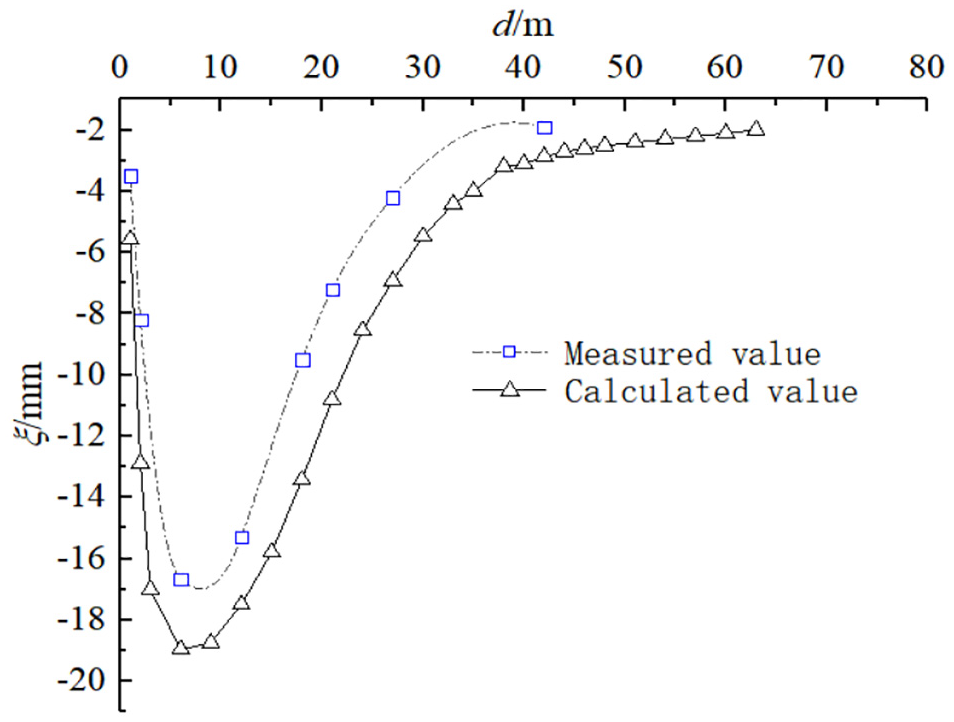
Comparison of surface settlement and measured value of surface subsidence value.
Results analysis
Horizontal displacement of pile
The long side direction of the envelope structure plate unit is selected as the research object. Extract the displacement cloud diagram of the enclosure structure after each excavation in the construction condition Table 2 for analysis. As shown in Figure 8. From the displacement cloud map after excavation, we can see: From the displacement cloud map after excavation, it can be seen that after the first layer of soil is excavated, due to the unloading of the soil in the pit, the earth pressure difference inside and outside the pit is caused, and the enclosure structure is displaced. After the first precipitation and the excavation of the second layer of soil, the displacement cloud map of the enclosure structure is obviously increased by the first layer of soil excavation. The reason is that soil consolidation and settlement occurred after precipitation. And after the first dewatering, the water pressure difference inside and outside the pit changes by one level to produce seepage effect. The active earth pressure outside the pit acts on the retaining wall, and the displacement of the retaining wall changes greatly. After the second precipitation and the excavation of the third layer of soil, the water pressure difference and seepage field at the upper level increased due to precipitation in the pit. The displacement of the envelope structure of the third layer changes more obviously, about 2.2 times the displacement of the envelope wall after the second excavation. The maximum lateral displacement of the enclosure structure is 0.5–0.6H. The water pressure difference and seepage force changes inside and outside the pit caused by dewatering aggravate the lateral displacement of the retaining wall in the passive area. This shows that the foundation pit has obvious seepage-stress coupling effect in the process of dewatering, excavation, and support.
Construction condition simulation.


Displacement cloud diagram of enclosure structure: (a) excavation of the first layer, (b) excavation of the second layer of earthwork, and (c) excavation of the third layer.
Water head changes
Figure 9 is a cloud map of groundwater changes after precipitation. It can be seen from the figure that after precipitation in the foundation pit of the subway station, the confined water head shows a partial decrease, and the drop area is the groundwater near the foundation pit. The reason is that after the construction is dewatered, the groundwater has seepage effect, seepage to the bottom or side wall of the foundation pit, causing the change of the groundwater level. The decrease in the pressure head causes a change in the total head. However, the existence of the foundation pit water-stop curtain isolates the seepage of groundwater outside the pit, so that the total head of the foundation pit does not change much.
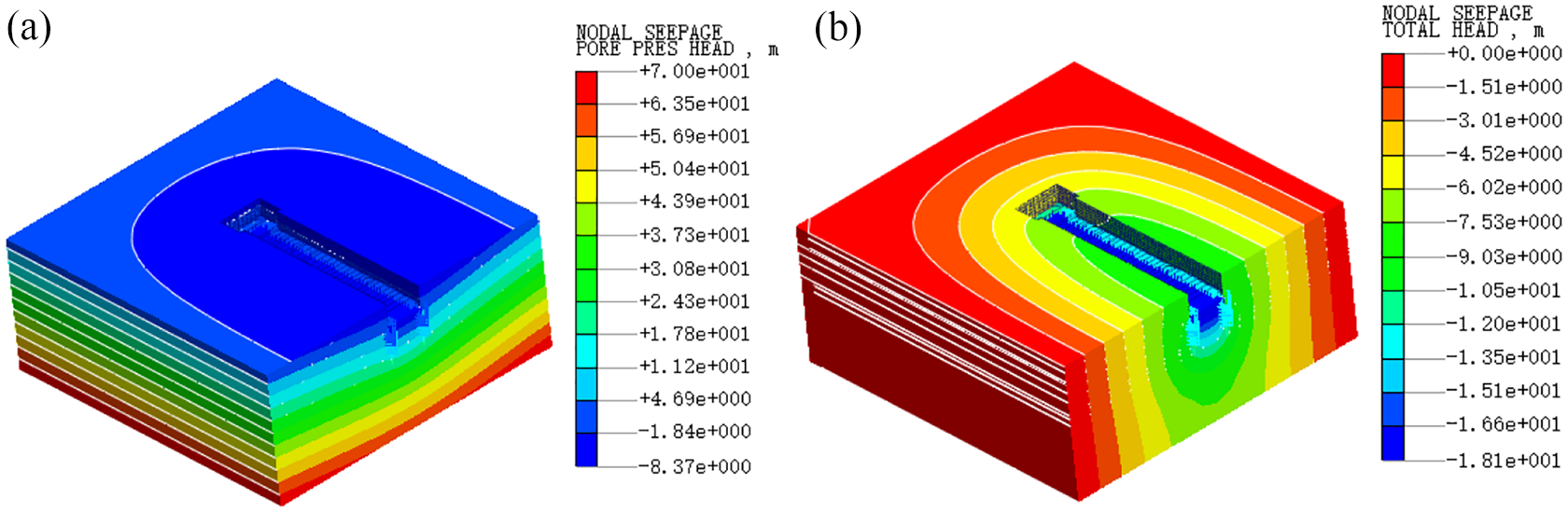
Cloud chart of excavation bending moment after dewatering: (a) total head change and (b) change of confined water head.
Changes in surface settlement
Figure 10 shows the surface settlement curve after the excavation of the deep foundation pit under the construction conditions in Table 2. It can be seen from Figure 10 that during the dewatering and excavation of the foundation pit, the surface settlement behind the wall presents a groove-shaped settlement in the main affected area. After the second precipitation excavation of the soil, the ground settlement behind the wall is obviously larger than the previous precipitation excavation. It shows that the factors that cause soil settlement due to changes in seepage outside the pit caused by precipitation cannot be ignored. The maximum settlement of the ground surface behind the wall is 0.5H from the side of the pit (H is the excavation depth), which is consistent with the measured law of the measured data. It can be seen from the shape of the curve that the surface settlement is caused by the lateral displacement of the retaining wall caused by seepage and the consolidation of the soil. For this reason, in the process of dewatering and excavation of deep foundation pits with suspended water-stop curtains, it is recommended to conduct key monitoring at places where the surface deformation is large. It prevents excessive deformation of the foundation pit caused by soil settlement, and guarantees the safety of deep foundation pit construction and deformation control.

Surface settlement simulation calculation.
Parameter evolution analysis
On the basis of the numerical calculation model of the deep foundation pit shown in Figure 4, the dewatering construction parameters and the depth of the water-stop curtain are changed and finite element calculation is performed. To analyze the influence of pre-dewatering before excavation and the depth of the water-stop curtain on the deformation of the foundation pit.
Pre-dewatering before excavation
The dewatering of the foundation pit is carried out by finite element simulation calculation according to two conditions: pre-dewatering by grades and pre-dewatering to the bottom of the pit at one time. Discuss the influence of excavated soil on the deformation of foundation pit under different precipitation conditions, and analyze the results of these two calculations.
It can be seen from Figure 11 that the surface settlement behind the wall caused by graded precipitation is larger than the measured value. The reason is that the seepage field influences the soil consolidation and settlement, making the settlement slightly larger than the measured value, but the settlement law is basically the same as the measured value. Compared with the other two cases, the surface subsidence curve of one-time dewatering to −1 m below the bottom of the pit has significantly increased surface subsidence. It shows that with the increase of the precipitation depth, the seepage changes in the soil layer increase obviously, which is not conducive to the stability of the foundation pit. Therefore, in actual deep foundation pit dewatering, a reasonable dewatering plan should be designed. Strictly do a good job of graded precipitation with pumping on demand to control the deformation of foundation pits and the impact on the environment.

Surface subsidence under different precipitation conditions.
Insertion depth of waterstop curtain
In water-rich areas, groundwater seepage outside the foundation pit causes excessive surface deformation, which is unfavorable for controlling the settlement of the surrounding environment. The deeper the suspended water-stop curtain, the larger the seepage path of the water level outside the pit, and the smaller the decrease of the water level outside the pit, which has a beneficial effect on controlling deformation. However, as the depth increases, the construction difficulty and cost of the waterproof curtain increase. In the current deformation control, as long as the deformation is within the control range, the protection requirements for the surrounding environment can be met. Therefore, on the basis of grading precipitation on demand, the control effect of different depths of suspended water-stop curtains on the settlement of the soil around the foundation pit is studied, which provides a reference for rationally determining the optimal water-stop curtain depth. The numerical calculation selects the construction conditions of the water-stop curtain with depths of 11, 14, 17, 20, 23, 26, 29, 32 m and no water-stop curtain, and carries out calculation and analysis.
Figure 12 shows the surface settlement curves of different depths of the water-stop curtain under graded precipitation. It can be seen from the figure that, in the case of pre-dewatering with different levels on demand, as the insertion depth of the water-stop curtain increases, the surface settlement outside the pit decreases. However, after increasing to a certain depth, the reduction effect of surface subsidence is not obvious, which is consistent with the basic law of the research results of literature. 16 Figure 13 shows the variation curve of the relationship between the maximum surface settlement outside the pit and the depth of the water-stop curtain. It can be seen from Figure 13 that when the depth of the water-stop curtain reaches 26 m, the surface deformation control meets the scope of monitoring technical specifications. 17 When the insertion depth of the water-stop curtain exceeds 26 m, the settlement difference between the settlement and the increased depth does not exceed 0.2% of the deformation control, and the surface settlement outside the pit changes little. This indicates that there is an optimal insertion depth for the water-stop curtain, which can control the deformation of the surface settlement outside the pit. When the insertion depth of the water-stop curtain is increased, the effect of controlling the surface settlement outside the pit is not significant.

Surface settlement under impervious curtain of different depth.

The relationship between the maximum surface settlement and the depth of impervious curtain.
Conclusion
During the dewatering and excavation of deep foundation pits, the coupling effect of seepage and stress is obvious. In the soil layer rich in groundwater, the dewatering and excavation of deep foundation pits should consider the impact of seepage flow brought by the seepage field, and take corresponding control measures.
Due to the existence of the seepage field, the surrounding structure and the excavation surface increase the influence of seepage force, and the side displacement of the surrounding structure increases. Dewatering causes a difference in the water head inside and outside the foundation pit, and the seepage effect affects the stress state of the soil body, causing the soil mass is affected by the lateral displacement of the enclosure structure and the consolidation and settlement of the soil mass during the excavation process, resulting in greater surface settlement.
For deep foundation pits rich in water, the depth of dewatering will affect the difference in water head inside and outside the foundation pit and the size of soil consolidation settlement. As the depth of precipitation increases, the seepage effect in the soil layer is obviously enhanced, which is not conducive to the stability of the foundation pit.
The water-stop curtain plays an obvious role in reducing the impact of groundwater seepage outside the pit and controlling the ground settlement outside the pit, and there is an optimal water-stop curtain depth. When the water-stop curtain is set less than this depth, the influence of ground deformation will increase, and when it is greater than this depth, the effect of ground deformation is not obvious, and it is of little significance to control deformation.
Footnotes
Handling Editor: Chenhui Liang
Declaration of conflicting interests
The author(s) declared no potential conflicts of interest with respect to the research, authorship, and/or publication of this article.
Funding
The author(s) disclosed receipt of the following financial support for the research, authorship, and/or publication of this article: The authors would like to express the appreciation to the financial supports from the National Natural Science Foundation of China (No.52168055, No.51678164), the Jiangxi Natural Science Foundation Program (20212AC B204001), the Guangxi Natural Science Foundation Program (2018GXNSFDA138009), the GDHVPS (2019).

Data availability
The datasets used and analyzed during the current study are available from the corresponding author on reasonable request.