




Abstract
In this study, a passive vibration control method termed as translational root mounting method is proposed and investigated, for suppressing the low frequency vibrations of spacecraft solar panels. The translational root mounting method employs dampers installed at the roots of solar panels to dissipate the dynamic energy. The key of translational root mounting method is that translational root mounting method modifies the fundamental mode shape of the solar panel, by releasing the translation freedoms at its root. The root of the solar panel then has translational freedom instead of rotational freedom. As a result of mode shape modification, the translational root mounting method enables the root dampers to have sufficient working stroke, however without obviously reducing the solar panel’s fundamental frequency. Finite element model of a satellite solar panel with the length of 7

Highlights
Research highlight 1: This research proposes an efficient passive method (termed as translational root mounting method) based on root springs and dampers to suppress the low frequency vibration of spacecraft solar panel. The proposed translational root mounting method obviously increases the working strokes of root dampers by modifying the mode shape of the solar panel, and consequently the requirement on the damper’s damping coefficient is dramatically reduced.
Research highlight 2: Applying finite element analysis, the limitation of conventional passive methods using rotational root spring-damper system is illustrated, and the proposed translational root mounting method is analyzed and verified. Finite element analysis results approve that the proposed passive method outperforms the conventional passive method based on rotational elastic-damper interface, by modifying the mode shape of the solar panel.
Research highlight 3: An equivalent non-linear one-degree of freedom theoretical model of a satellite solar panel is established, to analytically optimize the proposed translational root mounting method. Applying the translational root mounting method, for a 7-length satellite solar panel, the damping ratio of which can be elevated from 0.0027 to 0.326.
Introduction
Solar panels are one of the most important appendages for spacecraft and provide power for whole system in on-orbit flight. In order to meet the limited launch weight and the increasing power requirement, spacecraft solar panels are becoming lager and more flexible, and they usually have very low damping ratios, high dimensional order, low modal frequencies, and parameter uncertainties in dynamics.1,2 For a large and flexible solar panel, many disturbances such as orbit maneuver, thermal shock, debris impact, will result in low frequency vibration of solar panel. Since the spacecraft floats in the space, the entire spacecraft will response to the low frequency vibration of solar panel with motion or rotation. Thermally induced vibration of spacecraft appendages is a recurrent problem for many years. The vibrations typically occur on very low frequency booms or solar arrays due to sudden temperature changes at day-night or night-day transitions in the orbit. Sudden heating changes on a surface of an appendage may induce temperature gradients that generate time-dependent bending moments that deform the structure.3,4 In 1990, the two solar panels of Hubble space telescope were found still “jittering” more than 6 months after launch, when they pass between day and night in orbit.5,6 The vibrations of the two solar panels have significant influence on the stability needed for precise pointing, and NASA had no choice but replaced them by two damped solar panels in 2002. The in-orbit data of JAXA’s earth observation satellite “GOSAT” have demonstrated that when a satellite in Low Earth Orbit goes through an eclipse, the sudden thermal changes induce a difference in temperature between the sun side and the opposite side of the satellite’s solar array paddle. This temperature difference causes bending and then vibration of the solar array paddle. 7 The Upper Atmosphere Research Satellite (UARS) is also a prominent example of a satellite that experiences thermal snap disturbances during eclipse transitions. The UARS satellite experiences attitude disturbances during orbital eclipse transitions due to rapid thermal bending of its rigid panel solar array. The attitude disturbances are of sufficient magnitude to violate the stability requirements for some of the science instruments on the satellite.8,9
To date, the thermally induced vibrations of solar panels and the influences on the stability of a satellite have been well investigated. Johnston and Thornton 8 in his research presented analytical and experimental investigations of solar panel thermal snap disturbances. Through the thermally induced satellite dynamics analysis and the solar panel thermal-structural experiments, it is revealed that the critical parameters for the thermal response of rigid panel solar arrays (solar panels) are the through-the-thickness temperature difference and its time derivatives. In past few decades, a number of failures caused by thermal vibrations of solar arrays have been investigated.5,6,10–12
The issue on modeling and vibration control of flexible solar panels is rather difficult and challenging. To eliminate the harmful effects of vibrations of solar panels, the passive and active methods have been proposed and demonstrated. A successful example of solar panel vibration suppression in a passive way is Hubble space telescope. In 2002 passive dampers manufactured by CSA Engineering were installed between the solar panels and the main structure of Hubble. The solar panel’s damping ratio of the first mode was elevated form 0.012 to 0.035 by the dampers.
5
Sales
13
investigated the passive vibration control of flexible spacecraft using shunted piezoelectric transducers. The dynamic energy of the solar panel is converted into heat by the shunted piezoelectric transducer. The effectiveness of this passive method is quite limited unless massive of piezoelectric transducers are applied.
13
Kong and Huang
14
investigated a passive vibration suppression of a solar panel by a root damper, and found that a root damper with damping coefficient of
The passive methods are quite simple and consume no energy, and these two advantages are highly valued in aerospace applications. However, due to the low frequency of vibration and the limited strain variation, it seems quite difficult to further improve the effectiveness of passive methods which rely on dampers or damping materials. Thus, in the last decades, the active methods for vibration control of solar panel attracted many attentions. Among the researches on active control method, the smart materials such as piezoelectric materials and patches are widely used as actuators.15–18 The active electric-magnetic devices are also valid actuators for the active control of solar panel vibration. 19 In addition to the structural design, many researchers conduct researches on the control algorithms. To effectively suppress the vibrations of flexible solar panels, the fuzzy logic control with piezoelectric smart structure is studied by Xu et al. 20 A fuzzy logic controller which uses universal fuzzy sets is designed, and the effectiveness of the controller is demonstrated by finite element analysis. Azimi et al. 21 investigated the vibration suppression of a flexible spacecraft during a large angle attitude maneuver. The solar panel appendages with surface bounded piezoelectric patches are investigated. Modified Sliding Mode and Strain Rate Feedback control theories have been used for attitude and vibration control simultaneously. Liu et al. 22 established the Coupled Rigid-Flexible Dynamic model of a flexible solar sail. The vibration equations are derived considering the geometric nonlinearity of the sail structure subjected to the forces generated by the control vanes, solar radiation pressure, and sliding masses. The linear quadratic regulator based and optimal proportional-integral based controllers are designed for the coupled attitude/vibration models with constant disturbance torques caused by the center-of-mass and center-of-pressure offset, respectively. Although various active control methods are reported to be effective, the drawbacks are also obvious. Firstly, an active control system consumes extra energy and often needs special driving equipment, such as a power amplifier. Secondly, the smart materials used for actuating usually are limited in the actuating force and displacement. Other mechanical or electrical actuators are often unacceptable in size and mass. Finally, with many additional sensors, actuators, and controllers, the reliability of the active control system is also an issue.
Although many active control methods have been proposed, few of them have been applied in the launched spacecrafts, due to the aforementioned drawbacks. In reverse, an effective passive control method is more likely to be chosen in the practical design of a spacecraft. The passive control method outperforms the active control method in many aspects such as simplicity, energy consuming, and reliability. In this study, aimed to suppress the low frequency vibrations of spacecraft solar panels, a novel passive control method termed as translational root mounting method is proposed and verified, by finite element analysis and an equivalent nonlinear one-degree of freedom model. By installing a lateral spring-damper system at the root of the solar panel, the proposed passive method modifies the fundamental mode shape of the solar panel. The stroke lengths of the lateral dampers are then obviously increased as a result of the mode shape modification. Consequently, the dynamic energy of the solar panel can be efficiently dissipated by the lateral dampers.
In the next section, the finite element model of a representative spacecraft solar panel is established. The fundamental dynamics of the solar panel is illustrated by finite element analysis. In the third section, the limitation of a conventional passive vibration control method for spacecraft solar panel is discussed. In the fourth section, the principle of the proposed Translational Root Mounting Method for the control of low frequency vibration is illustrated and is verified. In the fifth section, an equivalent nonlinear one-degree of freedom model is established to theoretically explain the proposed Translational Root Mounting Method, and the solution of low frequency vibration of the solar panel is derived analytically. Based on the analytical solution, the influences of the lateral spring-damper system on the damping ratio of the solar panel are predicted and discussed. In the last section, the work of this study is summarized.
Low frequency flexible vibration of a satellite solar panel
A representative satellite solar panel and its finite element model are presented in Figure 1. The solar panel composes of four pieces of sandwich composite panels and a composite frame. In this study, the commercial finite code ABAQUS is employed to conduct finite element analysis. The solar panel are modeled by four node shell elements S4R, the frame is modeled by two node beam elements B31. The material properties and structural sets are listed in Table 1. In the finite element model, the solar cells are modeled as non-structural mass, and the satellite is modeled as a rigid body. The total mass of solar cells on panels is 10

Finite element model of a representative satellite solar panel.
Material properties and structural design of the solar panel.


Mode analysis results of solar panel.
In the space, the low frequency flexible vibration of a solar panel usually takes a long time to decay, for the reason that the dynamic energy of the solar panel can only be dissipated by the internal damping of material. To model the material damping in the finite element model, the commonly used Rayleigh damping is applied on the CFRP and honeycomb. It is well known that Rayleigh damping is the linear combination of mass matrix and stiffness matrix, that is

Predicted vertical displacement and acceleration time histories and spectral densities at the middle point of the solar panel free end: (a) vertical acceleration and (b) vertical displacement.
The time domain curves and spectral densities presented in Figure 3 indicate that the vibration of the solar panel is initially a superposition of low frequency and high frequency modes (mainly mode 1 and mode 4). The high frequency vibration decays in a much shorter time due to the stiffness proportional damping
Conventional method for low frequency vibration control of spacecraft solar panel based on root springs and dampers
Figure 4 exhibits the equivalence principle of a conventional passive method using root dampers. A spring-damper interface is installed between the spacecraft and the solar panel root. The vibration of solar panel leads to periodic moment on the spring-damper interface. The springs and dampers are then compressed or stretched due to the moment at the solar panel root, and the dynamic energy can be dissipated by the dampers. The most important feature of the conventional method is that the root of solar panel rotates during the vibration. In this study, the conventional passive method is termed as rotational root mounting method. A rotational spring-damper interface is established in the finite element model of the solar panel presented in Figure 1. The springs and dampers are modeled by the spring element and dash-pot element, as illustrated in Figure 5. The influence of spring stiffness on the solar panel fundamental frequency is analyzed by finite element model. In the meanwhile, by applying a vertical displacement of 300

Equivalence principle of rotational root mounting method based on root springs and dampers.
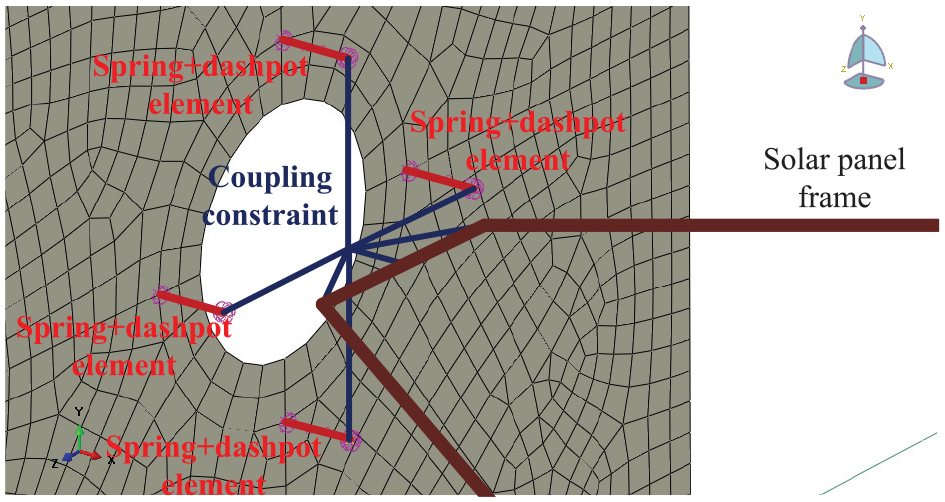
Finite element model of the satellite solar panel with a root spring-damper interface.

Fundamental frequency–spring stiffness curve of the satellite solar panel with root spring-damper interface.

Variation of root spring compression with its stiffness when a vertical displacement constraint of
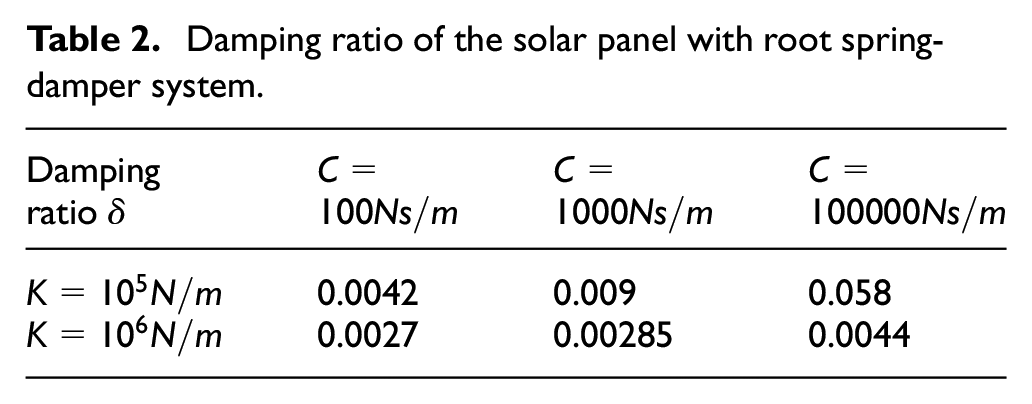
Applying different damping coefficients

Predicted vertical displacement time histories of the solar panel free end after installing a rotational root spring-damper interface: (a) C = 100 Ns/m, (b) C = 1000 Ns/m, and (c) C = 10,000 Ns/m .
Damping ratio of the solar panel with root spring-damper system.
Passive vibration control of spacecraft solar panel based on translational root mounting method
Theoretically, to increase the energy dissipation of a damper in a certain amount of time, the working stroke and vibration frequency of the damper should be increased simultaneously. However, discussion in the last section indicates that the conflict between the working stroke of the damper and the vibration frequency is inevitable. The acceleration time history presented in Figure 3 indicate that the high frequency vibration decays in a relative short time. As a result, for suppressing the low frequency vibration via a spring-damper system, the valid vibration frequency of the damper cannot exceed the fundamental frequency of the solar panel with fixed root, which is 0.477
In this study, a passive method termed as translational root mounting method is proposed. The principle of translational root mounting method is illustrated in Figure 9. The translational root mounting method also applies spring-damper system for the vibration control. Different with the conventional method illustrated in Figure 4, the lateral translation stiffness of the solar panel root is reduced instead of the rotational stiffness. The solar panel root is connected to the spacecraft main structure by lateral spring-damper system, while the rotation of the solar panel root is restrained.
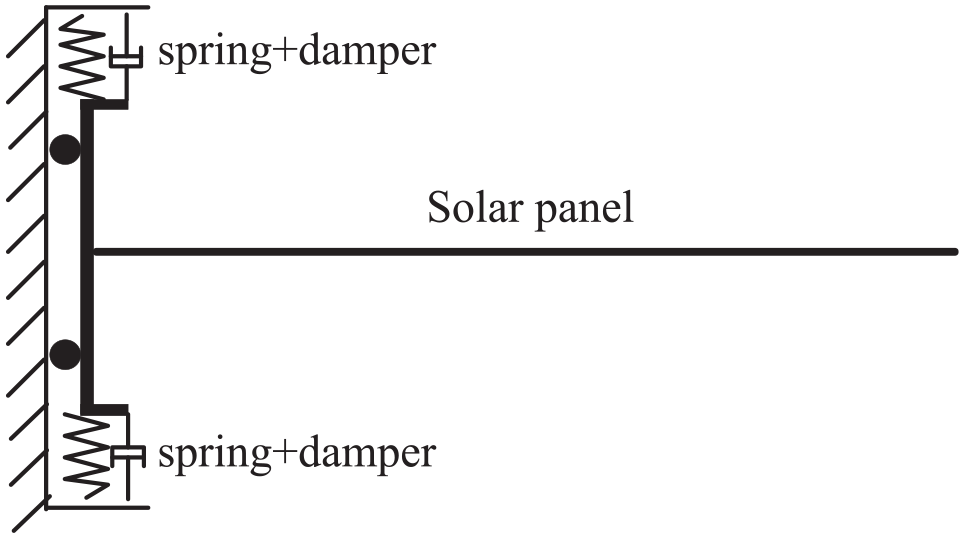
Equivalence principle of translational root mounting method for low frequency vibration control of solar panel.
The finite element model of solar panel controlled by translational root mounting method is established, as illustrated in Figure 10. The root of the solar panel is connected to the satellite’s side plate in

Finite element model of the satellite solar panel controlled by translational root mounting method.

Modified fundamental mode shape of the satellite solar panel (lateral spring stiffness

Fundamental frequency of the satellite solar panel versus lateral spring stiffness.
Applying the finite element model, the effectiveness of translational root mounting method is verified by predicting the free vibration responses of the solar panel. In FEA, a vertical displacement constraint of

Predicted vertical displacement time histories of the solar panel free end after installing the lateral spring-damper system (damping coefficient

Predicted lateral displacement time histories of the solar panel root after installing the lateral spring-damper system (damping coefficient
To investigate the influence of damping coefficient
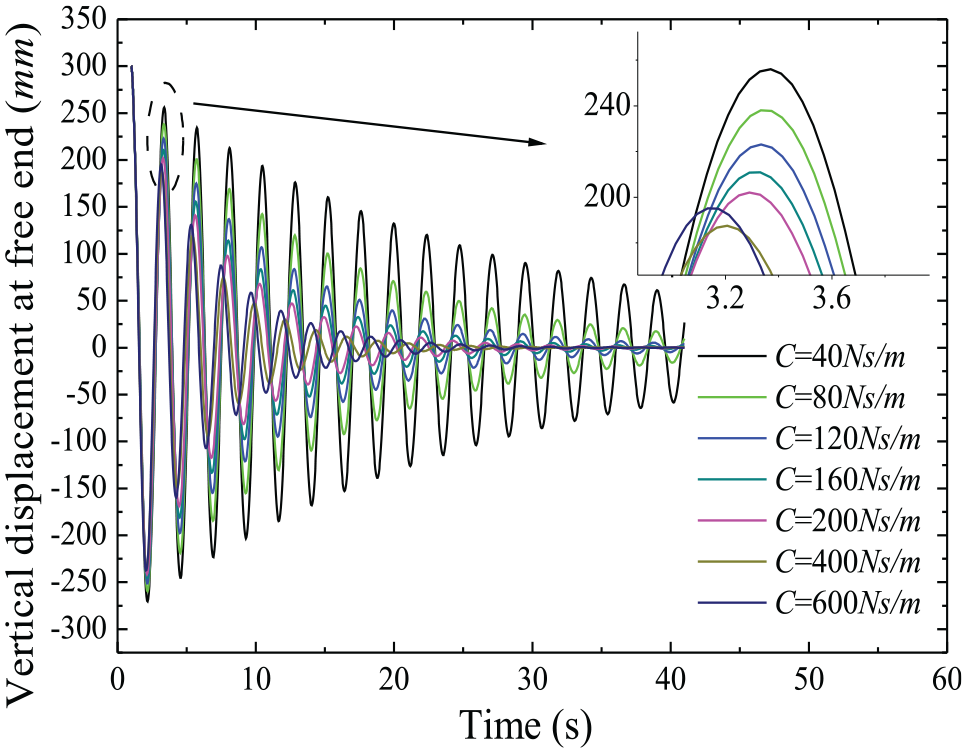
Comparison of vertical displacement time histories of the solar panel free end with different damping coefficients (lateral spring stiffness
Theoretical analysis and discussion
As the fundamental mode of solar panel dominates the flexible vibration, the solar panel can be simplified to a cantilever beam with concentrated mass, and the whole solar panel system can be simplified to nonlinear one-degree of freedom systems, according to the mounting method at the root, as illustrated in Figure 16. In the equivalent nonlinear one-degree of freedom system, the mass

Equivalent nonlinear one-degree of freedom model of the solar panel controlled by translational root mounting method and rotational root mounting method: (a) translational root mounting method and (b) rotational root mounting method.
The force equilibrium equations of the equivalent nonlinear one-degree of freedom system with rotational root mounting take the form:

and the force equilibrium equations of the equivalent nonlinear one-degree of freedom system with translational root mounting take the form:

By eliminating

The third-order differential equation of

Comparing equation (3) with equation (4), the only difference between the two dynamic equations is the coefficient
Assuming

and substituting equation (5) in to equation (4), a cubic characteristic equation can be derived:

Equation (6) can be rewritten as:
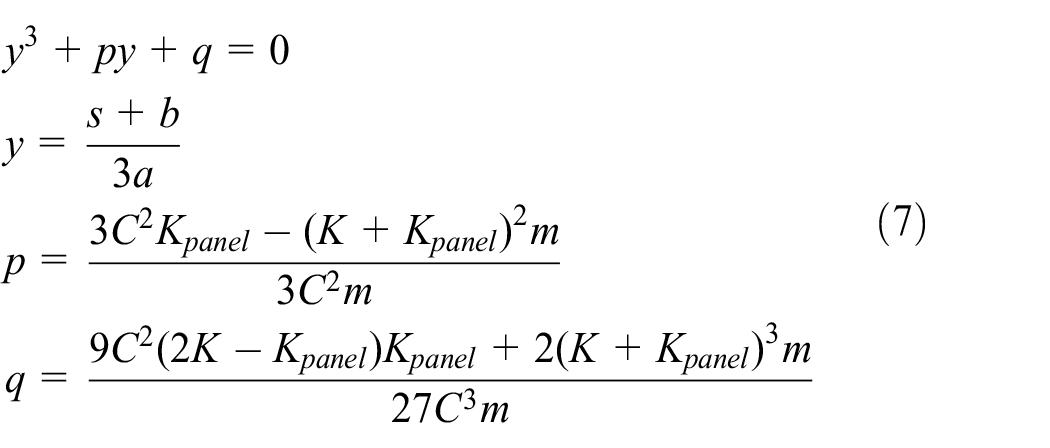
Equation (7) can be solved using the Cardano method, and three solutions are derived:

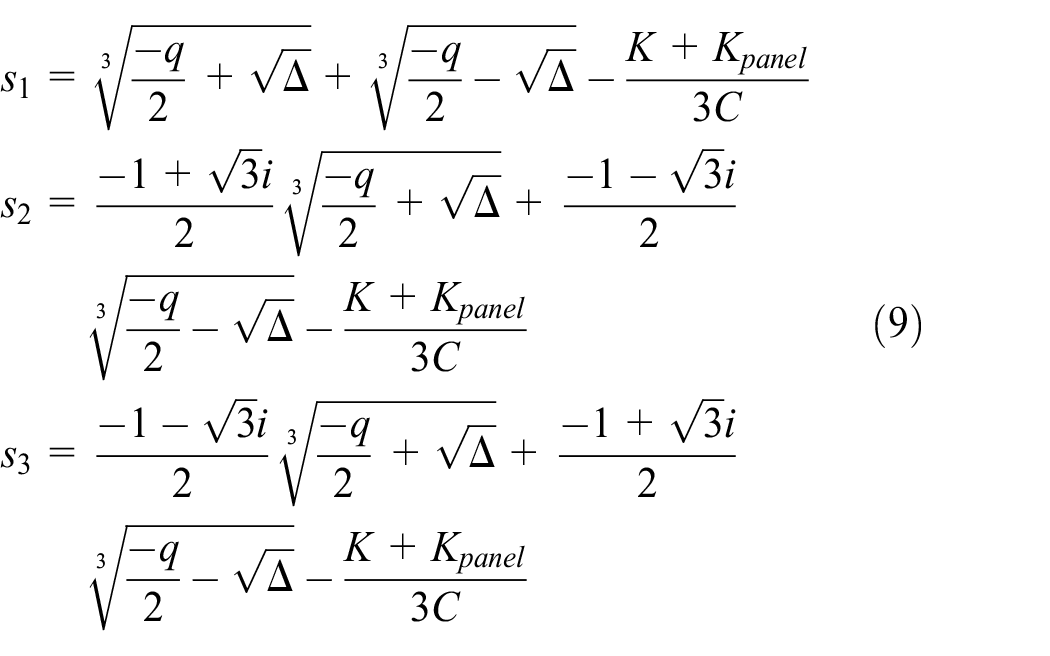
Substitute equation (8) into equation (7), three solutions of
Substitute equation (9) into equation (5), the expression of
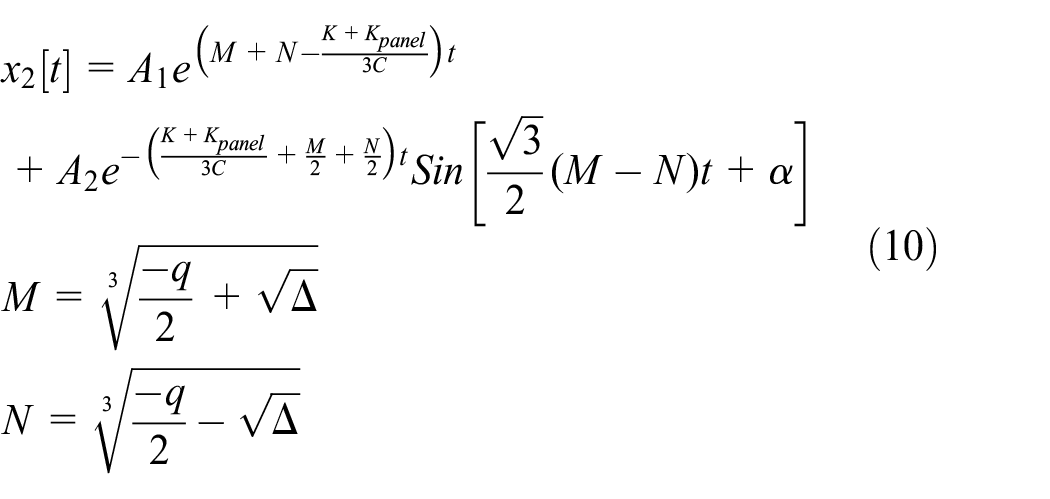
In equation (10),
FEA indicates that if the solar panel presented in Figure 1 is fixed at its root, the vertical effective mass of which is

Applying identical lateral spring stiffness and damping coefficient, the analytical solution equation (11) is compared with FEA results in Figure 17. Note, the FEA result is the vertical displacement time history of the solar panel free end. The initial value

Comparison of analytical and FEA results on free vibration of the satellite solar panel controlled by translational root mounting method (lateral spring stiffness
Applying the analytical solution of equivalent nonlinear one-degree of freedom model, that is equation (11), the damping ratio of the solar panel controlled by translational root mounting method can further be derived. As

In equation (12),

Note, equations (5)–(13) are derived for the rotational root mounting method. For the rotational root mounting method, similar analytical solution can be derived, simply by substituting the parameters

Variation of damping ratio of the whole satellite solar panel with lateral damper’s damping coefficient
Applying equation (13), the optimum damping coefficients and the maximum damping ratios of the whole solar panel system corresponding to different spring stiffnesses (
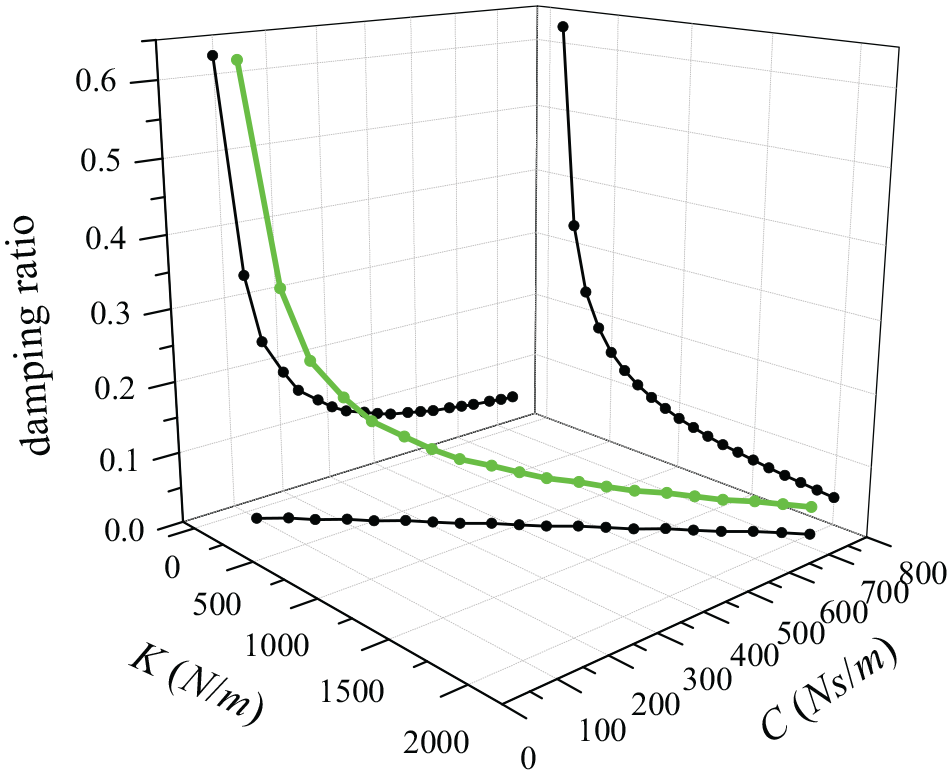
Variation of the maximum damping ratio of the satellite solar panel controlled by translational root mounting method with lateral spring stiffness
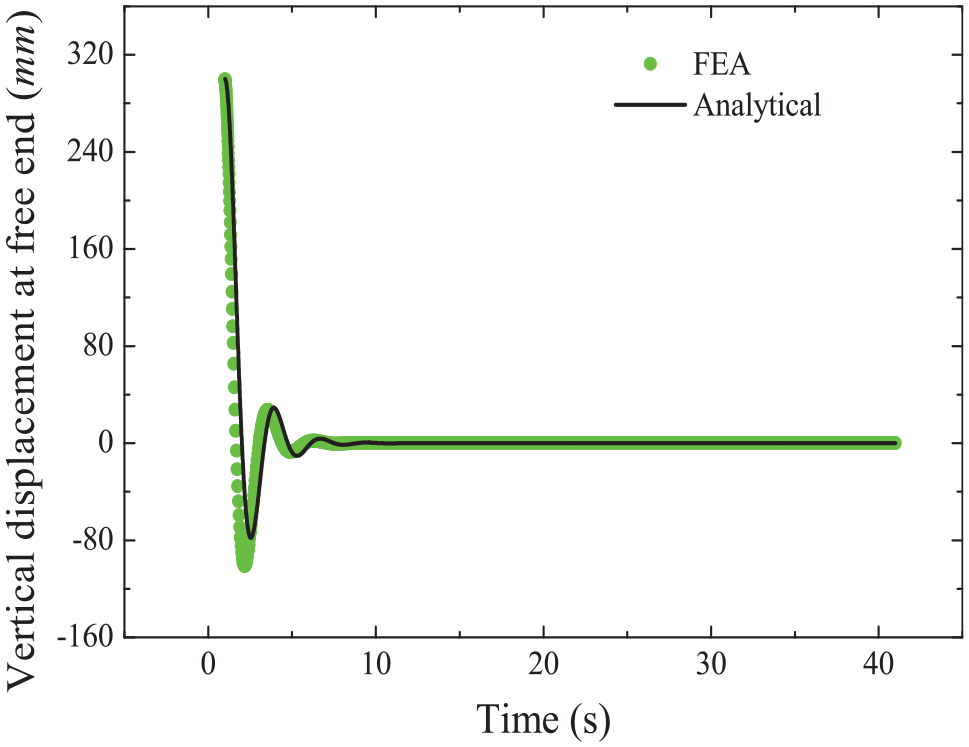
Comparison of analytical and FEA results on free vibration of the satellite solar panel controlled by translational root mounting method (
The translational root mounting method is further verified by predicting the dynamic response of the solar panel which experience the thermal snap disturbances during eclipse transitions. The solar panel is installed on a cube satellite of

Predicted dynamic responses of the cube satellite-solar panel system experiencing eclipse transition: (a) vertical displacement time history of solar panel free end and (b) attitude rotation time history of the cube satellite.
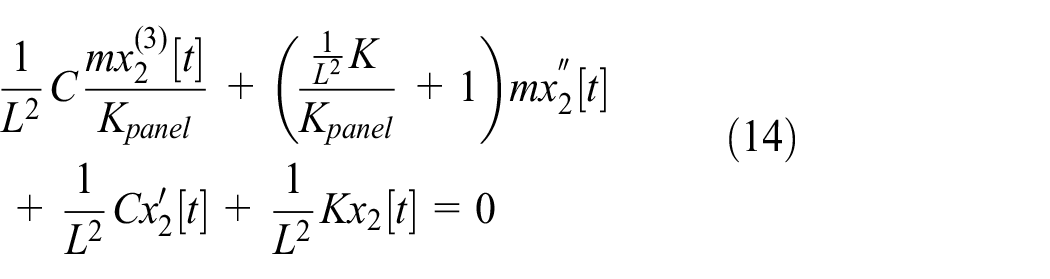
If the rotational root mounting method is applied, to accomplish identical response for this solar panel system, the corresponding root spring stiffness
in which
Conclusion
In a conventional passive method for suppressing the low frequency vibration of spacecraft solar panel, a rotational spring-damper interface is usually installed between the spacecraft and the solar panel. The conventional method inevitably meets the conflict between the working stroke and working frequency of the damper, and a damper with quite large damping coefficient is required. In this study, a novel passive method for suppressing the low frequency vibration of spacecraft solar panel is proposed. The novelty of the proposed method is that the mode shape of the solar panel is modified, by releasing the lateral translation freedom of the solar panel at its root. The mode shape modification enables the solar panel root have obvious translation if the solar panel vibrates. After connecting the solar panel root to the spacecraft by a lateral spring-damper system, large working stoke of damper can be achieved due to the mode shape modification of the solar panel. As a result, the dynamic energy can be sufficiently dissipated by the damper.
In this study, finite element model of a satellite solar panel with the length of
Footnotes
Handling Editor: Chenhui Liang
Declaration of conflicting interests
The author(s) declared no potential conflicts of interest with respect to the research, authorship, and/or publication of this article.
Funding
The author(s) disclosed receipt of the following financial support for the research, authorship, and/or publication of this article: Xiaohong Wang sincerely acknowledges the financial support from Innovation Team Project of Heilongjiang Institute of Technology, Grant No. 2018CX10, Doctoral Foundation Project of Heilongjiang Institute of Technology, Grant No. 2016BJ03, and Leading Talent Incubation Program of Heilongjiang Institute of Technology, Heilongjiang Province, China, Grant No. 2020LJ02.
