




Abstract
At the conceptual stage of product design, simplified automobile body frame constituted by thin-walled beams can effectively be used to predict global performances, including weight, rigidity, and frequency. These performances can be improved by optimizing their cross-sectional shapes (CSS) of thin-walled beams. However, it is difficult to optimize the CSS while satisfying multiple performances, because this is a multiple objectives and design variables optimization problem. The gradient-based optimization algorithms are difficult to obtain the global optimal solutions for the automobile structures. Therefore, this paper proposes an innovative multi-objective optimization method to design the CSS of automobile body by using the non-dominated sorting genetic algorithm (NSGA-II) combining with the artificial neural network. Firstly, the mechanical properties of the CSS are summarized, including open-cell, single-cell, and double-cells. These mechanical properties determine the performances of the automobile structure. Then, the multi-objective optimization model is created by using the NSGA-II while considering the weight, stiffness, and frequency, which is implemented in the self-developed CarFrame software. Finally, the proposed method is verified by optimizing the CSS for the A-pillar of automobile frame.
Keywords
Introduction
Because of the fierce competition in the automobile industry, designers have been shortening the design cycle as soon as possible to increase market share. The conceptual design stage is significant in product development process, which can shorten the design cycle and improve product performance. 1 In automobile engineering, reducing weight can improve power, reduce fuel consumption, and exhaust pollution. Meanwhile, the stiffness and frequency are the main concern for static performance, 2 which can evaluate the global static deformation and ensure the safety of the automobile structure. The large deformation leads to friction and collision between components in the process of driving and affects the global performance of the automobile body. The frequency is the evaluation index as crucial as the stiffness. Through the structural modal analysis, the vibration characteristics of each mode of the automobile frames can be obtained to evaluate the performance. Thus, it is greatly important to reduce the weight and improve the static and dynamic stiffness.
The detailed model and beam frame model are widely adopted at the conceptual design stage. The detailed model has high accuracies and long solving time. It is worth noting that for the frame model the computational costs are greatly reduced and the accuracies meet the requirements of conceptual design. Therefore, the frame model is widely used at the conceptual phases of product design 3 to save computational time on the premise of less accurate loss.4,5 For example, Donders et al. 6 utilized the frame model to predict the rigidity and frequency of automobile frame. The effectiveness and accuracies were also confirmed. Generally, this simplified frame is composed of thin-walled beams, 7 which are manufactured by welding together the stamping sheets, as shown in Figure 1. Thus, the CSS of thin-walled beams are very complex. According to the number of cross-sectional chambers, the CSS can be classified into open-cell, single-cell, double-cells, and multi-cells. The CSS determines its geometrical performances 8 and further affects the global performances of automobile frame. 9 Therefore, by optimizing the CSS, the global performances can be effectively improved and decreased for the automobile frame structure at the conceptual design stage. 10

Automobile frame with complex CSS by extrusion of aluminum.
Structural optimization is very important for lightweight design of the automobile structure.11–13 Currently, some important progresses have been achieved in the lightweight design of the automobile body structure by using the frame model. At the earliest, Yoshimura et al. 14 proposed a cross-sectional shape optimization method for the automobile frame structure. Cross-sectional shapes were represented using the coordinates of the control points were treated as design variables. Cross-sectional shape generation problems were formulated as multi-objective optimization problems and solved using genetic algorithms. This method is of great utility to conduct the shape at the conceptual design stage. Moreover, Bai et al. 7 applied the complex cross-sectional optimization method to design the front beam structure considering the crashworthiness by using the genetic algorithm. Also, a sensitivity analysis method was introduced to reduce the weight and constraint the stiffness and frequency for the bus frame structure with the rectangular CSS. 15 Torstenfelt and Klarbring 16 adopted the size, shape, and topology optimization method to design and optimize the conceptual automobile product, which is composed of rectangular shapes. Duan et al. 17 proposed a lightweight design method of the automobile body frame combining Pareto set tracking algorithm, implicit parameterization, and global sensitivity analysis. Furthermore, Zuo and Bai 18 proposed the optimization method of the CSS to minimize the cross-sectional area and constraint the geometric properties. The global performances are improved when the optimized CSS is used to create the thin-walled frame structure. Furthermore, a two-step design method was proposed to optimize the complex shape section of the automobile body. 9 In the first step, the frame model composed of rectangular beams was optimized by taking the stiffness and frequency as constraints and the minimum weight as the objective function. In the second step, the complex CSS is designed by considering the geometric properties according to the rectangular section size. This method simplifies the optimization process of the body section shape and facilitates the optimization design of the complex shape. Besides, Li et al. 19 also proposed an equivalent substitution method of aluminum for steel to design the automobile body frame. Based on Zuo’s research, Qin et al. 20 improved the genetic algorithm to optimize the CSS of automobile frame structure considering the stiffness, frequency, and manufacturing constraints. The scale vector method was introduced to reduce the number of design variables. Recently, Bai et al. 21 proposed a novel optimization method to design the thin-walled frame structure. Firstly, the frame structure is created from the optimized topology results. Then, the initial CSS is designed by considering the geometry properties and manufacturing process. Finally, the thin-walled frame structure is optimized to minimize the weight while maintaining the structural strain energy. Cui et al. 22 proposed a design method of multi-material automobile body structure with thin-walled frame structure, which realized the lightweight design and improved the performance. The above automobile structure design methods are mainly the optimization problems with single objective and multiple constraints. The multi-objective optimization method has not been used to optimize the point coordinates of the CSS for the thin-walled frame structure.
The gradient-based 9 and meta-heuristic 23 optimization algorithms are widely employed to solve the optimization model of the automobile structure. For the gradient-based optimization algorithm, it has faster convergence rate but may be stuck in local minima. For the meta-heuristic optimization algorithm, it does not need the sensitivity information of the structural response and can deal with almost any kind of design variables and any type of design problems. Therefore, the meta-heuristic optimization algorithms, mainly including Genetic Algorithm, 24 Particle Swarm Optimization, 25 Simulated Annealing, 26 and Artificial Bee Colony, 27 are widely introduced in large-scale engineering problems. Yıldız et al.28–35 made outstanding contributions with the application of these meta-heuristic optimization algorithms in the design of automobile structures. Especially, the non-dominated sorting genetic algorithm (NSGA-II) combined with the artificial neural network has achieved excellent results in solving the multi-objective problems in many fields.36,37
Therefore, the aim of this paper is to combine the NSGA-II with the artificial neural network to realize the multi-objective optimization for the CSS of automobile frame structure simultaneously considering the weight, stiffness, and frequency, which is implemented in the self-developed CarFrame software.
Mechanical properties of the CSS
The automobile frame model is composed of thin-walled beams, and its mechanical properties affect the overall performances, which is fabricated by spot welding of several press-formed sheets along two flanges. Figure 2 shows the double-cell CSS, which is widely used in automobile frame structure. The CSS has two chambers, including Cell I and Cell II, made up of three sheets. Every sheet comprised of rectangular segments. The mechanical properties of the CSS are calculated in the global coordinate system oyz. Accordingly, the area of the CSS can be represented as


Typical shape of the automobile frame.
where
The centroid of the CSS is the weighted average of the centroid of each segment, in other words,


where
The bending moments of inertia



where


The torsional moment of inertia depends on the type of the CSS. The corresponding torsional moment of inertia

The single-cell CSS consists of two sheets, shown in Figure 3, in which L1 and L3 are respectively the length of the two sheets and t1 and t3 are respectively the thickness of the two sheets. The corresponding torsional moment of inertia


The CSS of a single cell.
The CSS of the double-sells is shown in Figure 4, and the corresponding torsional moment of inertia


The CSS of the double-sells.
where
Multi-objective optimization model of automobile frame
Structural performances
Since the automobile frame model is simplified from the detailed model by cutting the CSS from different positions. The coordinates of the end points of the beam elements are determined according to the position of the joints. When the CSS of the thin-walled beam are determined, the weight can be calculated. Which can be calculated as

where
The static stiffness of automobile structure includes the bending stiffness and torsional stiffness. In this paper, the torsional stiffness is only selected as the stiffness objective function, as shown in Figure 5, whose condition is that when one of the front wheels jumps over a pothole, The automobile structure is twisted. The torsional stiffness is generally defined as


Torsional load condition for automobile frame.
where
Modal analysis is also an essential index of automobile performance evaluation. The free modal analysis of the automobile frame can obtain the frequencies, and the first one is the most important to design the automobile frame. The structural frequency

where
Optimization formulation
The mathematical expression of the multi-objective optimization problem considering the weight, stiffness, and frequency for the CSS of the beam frame structure can be written as
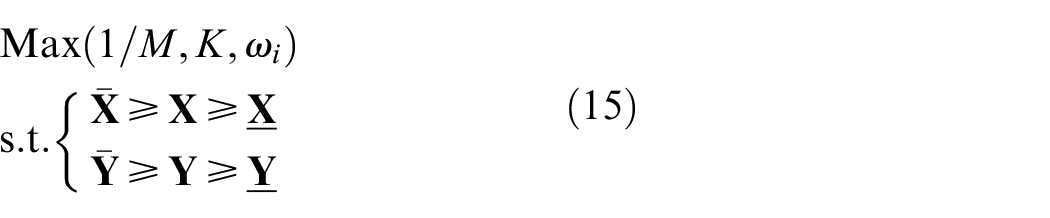
where
In the optimization model, the weight is an explicit function of the design variables for the CSS of thin-walled beams. However, the equations for torsional stiffness and frequency are very complex with respect to the design variables of point coordinates. Therefore, this paper applies the non-gradient-based artificial neural network method to simplify the complex multi-objective optimization problem. The neural network can be used to obtain the weighted quantity and threshold through the known data and repetitive training so that the error is minimized between the calculated output signal and the expected output signal. The artificial neural network is also an excellent data fitting method due to the self-learning and adaptive ability. For the complex finite element model with design variables, the all-factor experiment method is applied to collect samples, whose accuracies can be accepted in engineering. In addition, the artificial neural network is suitable to calculate that several typical CSSs of the automobile frame are optimized simultaneously.
The genetic algorithm is a random search method, which is especially useful for the non-linear, global, discontinuous, and parallel combinatorial optimization problem. The improved NSGA-II method, which applies the non-idiomatic principle, is stratified according to the dominant relationship between individuals before executing the selection operator. Output Pareto optimal frontier can be obtained after the optimization model converges. It is impossible to improve the objective function value in these solutions without weakening at least one other objective function value. The multi-objective optimization code and the artificial neural network code are edited in self-developed CarFrame software.
Numerical example
The numerical example is used to confirm the effectiveness of the multi-objective optimization algorithm, only the CSS of the A-pillar is optimized from the automobile frame structure, as shown in Figure 6. The A-pillar is an important thin-walled structure to carry the front windshield. Therefore, the upper sheet on the outside of the A-pillar is optimized, which has a significant impact on the global performance of the automobile frame. Furthermore, Figure 7 shows the optimization procedure of the CSS, which can be divided into four steps:
Step 1: To create the frame model, the CSS cut from the detailed model and the two end points of beam elements determined by the positions of joints are respectively created in the HyperMesh pre-processing software. In addition, the frame model with the more CSSs can enhance the accuracies of the results. Figure 8(a) shows the frame model created in CarFrame software. During the optimization, the design variables for the coordinates of the CSS are changed to update automobile frame model, which is solved in the CarFrame software. These design variables are constructed by the all-factor experiments.
Step 2: The initial shape of the CSS satisfying the design boundaries of coordinate points needs to be determined from Step 1 firstly. The artificial neural network method is used to establish the multi-objective optimization model, in which each objective is normalized. The objective function can be obtained, while the solution accuracies are satisfied. Otherwise, the CSS needs to be changed to continue with the optimization design.
Step 3: The design variables are set as the initial population, and the objective function obtained in the second step is set as the target value. The maximum number of iterations, population size, cross-over probability, mutation probability, and elitism probability are determined according the optimization model, which can be adjusted to improve the optimized results. If the solution conditions are met, the Pareto front will be output; if not, the fitness value will be obtained, and the elite, crossover, mutation, and other operations will be carried out to obtain the next population.
Step 4: The output Pareto solutions are standardized, in which the optimized solutions are selected. Finally, the optimized automobile frame structure can be obtained by using these selected cross sectional shapes.

The CSS of A-pillar.

Multi-objective optimization procedure of the CSS.

The graphical user interface of CarFrame software: (a) frame design and (b) the CSS design.
Due to the manufacturing process, the motion of the points for the upper sheet from the middle sheet is constrained during the optimization, so the points A, B, and C of the upper sheet can only move along the Y direction, whose displacements are combined in different manners. For the optimization model, the total number of experiments using the all-factor method is 125 times. The weight, torsional stiffness, and frequency of the automobile frame with the different CSS A-pillar are calculated by using the CarFrame software. Figure 8 shows the graphical user interface for the design of thin-walled frame structure and the CSS. The optimization for the CSS contains many design variables of the point coordinates, so it needs a long time to calculate the sensitivity information. Meanwhile, for the optimization design of the automobile structure, the optimized design variables using gradient-based optimization method is easy to fall into local optimum. Therefore, the artificial neural network method is introduced to predict those three performances in this paper.
The neural network is applied to fit the corresponding weight, torsion stiffness, and frequency by using 125 groups of data of three variables, in which the training data, validation data, and test data are 93 groups, 19 groups, and 13 groups, respectively. After setting the number of neurons in the hidden layer to 50, the training can be completed through the Levenberg-Marquardt training algorithm. The principle is shown in Figure 9, where w and b are the weight vector and the bias, respectively. For three groups of training results, the average difference is less than 10−16 between the outputs and objectives. Therefore, the simulation results are excellent, and it can be used to calculate the objective function values of the CSS.

Fitting principle of the artificial neural network.
The 125 objective function values are collected using the all-factor experimental method. The variation precisions of the three objective function values are inconsistent, so the normalization method is adopted to keep four significant digits. The corresponding formulation can be expressed as follows:

where
Each objective value retains four significant digits after normalization. Three normalized objective function values are fitted into function by an artificial neural network. The average squared difference between outputs and objectives is less than 10−16, so the solution accuracies can be guaranteed. The three functions, including the weight, torsional stiffness, and frequency of the automobile body structure, can be calculated when the different CSS are formed by changing the point coordinates within the design domain. After design variables and objective function values are determined, the NSGA-II can be used for the multi-objective optimization. The upper and lower of the design variables and their precisions are shown in Table 1. In the optimization process of the genetic algorithm, the design points can move along the Y-direction. A population can be randomly generated, and the Pareto optimal frontier is obtained after 1000 generations of evolution, as shown in Figure 10(a). Meanwhile, the relationship between the Pareto optimal frontier solutions of every two objectives is shown in Figure 10(b) to (d). As can be seen from these figures: (1) In the Pareto optimal front, there is no reasonable method to reduce the weight without decreasing the torsional stiffness and frequency. (2) According to the design requirements, the designers can choose the solution that meets the requirements above. The solution of the red point in the optimal frontier is taken as an example. The weight, torsion, and frequency can be obtained by standardizing the objective function values. According to the corresponding design variables, the optimized CSS can be acquired, as shown in Figure 11. Therefore, this method can be used to effectively solve the multi-objective optimization problem of the CSS considering the global performance of the automobile frame structure. In addition, this numerical example mainly presents the multi-objective optimization design procedure, the automobile structure example is very complex, so the more detailed results are not provided. The comparison between the multi-objective and single-objective optimization methods will compare in the future for the automobile frame structure. Besides, this CSS is optimized on the laptop of Lenovo with a 10 GHz Intel Core i7-8000 HQ CPU and 8 GB memory after changing different genetic parameters. The calculation time for 1000 iterations is only 24 s, so it can be acceptable in automotive practice.
Design variables and their precision (mm).


Pareto optimal frontier. (a) The relationship between frequency, torsion and weight, (b) The relationship between torsion and weight, (c) The relationship between frequency and weight and (d) The relationship between frequency and torsion.

The optimized CSS of A-pillar.
Conclusion
In this paper, an innovative multi-objective optimization method is proposed to design the automobile body frame structure composed of thin-walled beams with complex CSSs by using the non-dominated sorting genetic algorithm combining with the artificial neural network. The mechanical properties, which are used to determine the global performances of the automobile structure, are firstly summarized including cross-sectional area, bending moments of inertia, and torsional moment of inertia of the CSS. Then, the multi-objective optimization model considering the weight, stiffness, and frequency is created to comprehensively design the complex CSS of thin-walled beams. Finally, the numerical example demonstrates that by optimizing the CSSs of thin-walled beams the weight is reduced and the torsional stiffness and frequency are enhanced for the automobile frame structure in the self-developed CarFrame software. Therefore, the proposed method can effectively be used to predict the global performances and reduce the design risk of the automobile body structure at the conceptual stage of product design.
Footnotes
Handling Editor: Chenhui Liang
Declaration of conflicting interests
The author(s) declared no potential conflicts of interest with respect to the research, authorship, and/or publication of this article.
Funding
The author(s) disclosed receipt of the following financial support for the research, authorship, and/or publication of this article: This research has been supported by the National Natural Science Foundation of China (Grant No. 12172148) and the Plan for Scientific and Technological Development of Jilin Province (Grant No. 20210101058JC).
