




Abstract
Why do international organisations die? Their causes of death deserve attention and analysis. Europe in the 20th century with its plenitude of international organisations provides a rich ground for studying why some of them died, why some lived, why some were resurrected from near-death and why some survive as institutional shells, or zombies. The introduction to this special issue summarises the cases that follow in order to discern a pattern or logic of institutional death in modern European history. A pattern is elusive because causal and conditional factors are almost impossible to separate in cases of institutional death. Yet they show that, in contrast to state collapse, international organisations more often die from without – that is, for external, contextual reasons – than from within. However powerful some external factors, such as war, can be, institutional death is rarely predetermined. In one form or another international organisations possess a strong will to live.
In his history of European states, Vanished Kingdoms, the historian Norman Davies has suggested an almost arbitrary rationale for why some polities live while others die. That rationale coexists with inevitability, as all states do eventually collapse. To illustrate the paradox, he quotes some lines from Wordsworth:
Davies does not add much of his own interpretation of the poem appearing at the end of his book. But the invocation of the Venetian Republic leaves the reader with an image not only of decadence with respect to Venice's form of government but also literally one of sinking, either under a rising tide or from the weight of its past glory. Yet Davies says more than that with his study of states. Rather than be satisfied with the usual four-part typology of causes – ‘external, internal, voluntary, and involuntary’ – he gives ‘at least five’ explanations for the demise of states: ‘implosion, conquest, merger, liquidation, and “infant mortality”’. 2
The categories of causation may well rest in the eye of the beholder, but here we pose a different set of questions about the dying subject itself: if all states eventually die, what about non-states, namely international organisations (IOs)? Why do they cease to exist? And what happens after their discontinuation? Are their deaths and afterlives seemingly just as arbitrary, or is there a significant historical lesson to be learned from them? So far, we lack systemic historical analyses of the death of IOs, including of the causes of lethal crises and the consequences of an organisation's demise. Major historical turning points, such as 1945 and the end of the Cold War, provide obvious reasons why such organisations were discontinued in the past. Still, it is important to distinguish between causal and conditional factors, and also between various forms of afterlife, because both determine not only the historical significance and legacy of particular IOs but also the evolving nature of the international system in which they live and die. Examples include the fascist international movement as well as the Warsaw Pact, which ended without obvious successors. Others, such as the League of Nations, were discontinued, but immediately replaced by new forums, in that case the United Nations. Continuities are even stronger at the level of some of the League's sub-organisations: the League of Nations Health Organisation morphed into the World Health Organisation (WHO), while the International Labour Organisation (ILO) did not even change its name. Our own selection of institutional trajectories here stands somewhere in between the conditioned and the willed where institutional death and, by implication, rebirth, are concerned. This collection of articles aims to determine more precisely what such trajectories meant in the circumstances of Europe's 20th century, and also what the nature of institutional demise suggests about the international system of that era. We find that, on balance, it encouraged both institutional death and survival.
Beyond the legal and formal declarations, diagnosing the sheer fact and moment of death is more difficult than one might think at first. Continuing with the organicist metaphor of death, it is possible to distinguish different causes and forms, such as suicide, murder and misadventure, along with death as an effect of sudden or protracted illness; moreover, there are comatose patients (formally alive, but unable to take action, ranging from temporary desuetude to paralysis and, finally, to formal death), 3 zombies and near-death experiences from which organisations are able to recover, either unchanged or after a metamorphosis of sorts. 4 For the latter, NATO's survival is an obvious example. Moreover, some organisations seem to drop off the face of the earth, but continue to live on with a different name or after having been merged with or integrated into other entities. Finally, there are some for which no organicist metaphors may suffice: these organisations simply expire, having been established by contracting states only for a finite period, as in the example of the European Coal and Steel Community. However, the body-state analogy and, transposed to our topic, biologistic or organicist metaphors remain important for two reasons in particular: for one thing, actors in and relevant for modern IOs and their legacy often built on these narratives; they are ubiquitous in the primary sources as well as in the recent research on IOs. 5 For another, they have a certain heuristic value and help to summarise processes in an illustrative way that are often highly technical and abstract.
Assessing institutional death ought not to be a nostalgic act of venerating the deceased. Understanding how and why institutions die also matters to living, not least in Europe, where the EU, NATO and other international organisations like the OSCE are today facing serious challenges to their power and authority. By reconstructing institutional death in historical context, we aim to lessen the impression of arbitrariness, but also to speak directly to the nature of international cooperation more broadly and to the institutional history that has made it possible. This helps to move the analysis beyond the dominant focus on individual forums and raises some more general concerns, as outlined below.
International organisations, their termination and legacy
Most scholars agree that modern international organisations were mainly established after the Napoleonic Wars, with the Central Commission for the Navigation of the Rhine presumed to be the oldest such forum. 6 We define an IO as a fixed institutional framework with a stable set of norms and rules, meant to facilitate exchange between states and other entities in the international system and to coordinate and govern their behaviour. IOs can be based on treaties or instruments governed by international law and be legal personalities in their own right. For a long time, intergovernmental organisations (IGOs), the core pillars of internationalism and a sub-type of international organisation, were seen as particularly robust due to their institutional features: beyond the general definition of IOs, IGOs can be characterised as organisations made up of at least three states (or state organs or organisations of states) that have their own organs and hold regular plenary sessions. 7 For IGOs, we have the most precise figures; hence, it is useful to focus on them in order to examine long-term and overriding trends. From the early 19th century, the number of IGOs rose almost continuously, before skyrocketing to more than 350 globally in our own time (Figure 1).
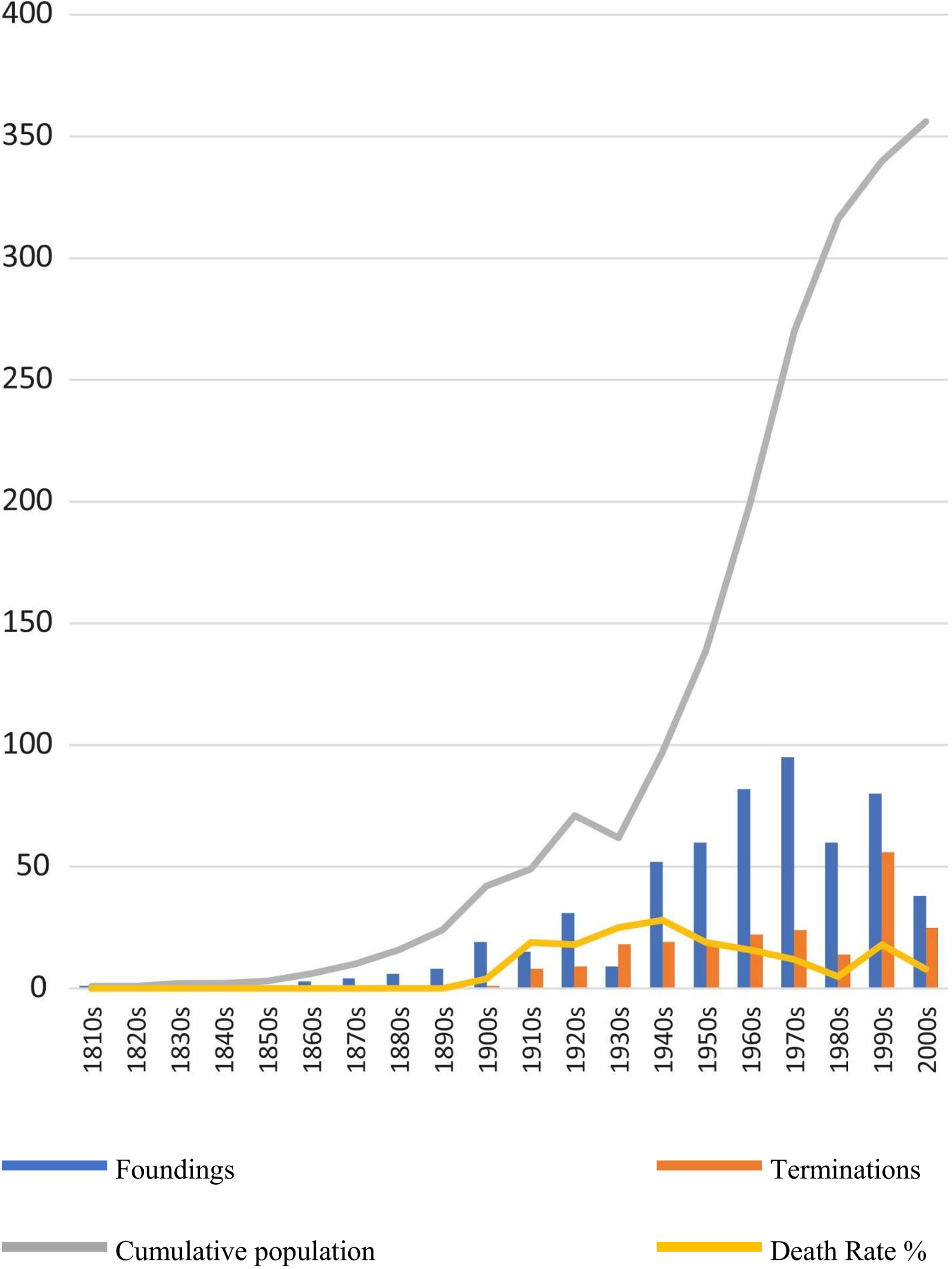
IGO foundings, terminations and population growth, 1815–2006. 9
For this reason, the public and scholars have paid little attention to the demise of IGOs, and even less to their legacies and links to other forms of (international) governance. 8 Not a single IGO was terminated before 1900, but then things started to change. No less than 39% of the IGOs established since 1815 (218 out of 561) have been formally discontinued. 10 Spikes in such terminations happened particularly during the 1910s, the 1930/40s and the 1990s/2000s, broadly in line with major turning points in contemporary (European) history (Figure 2).
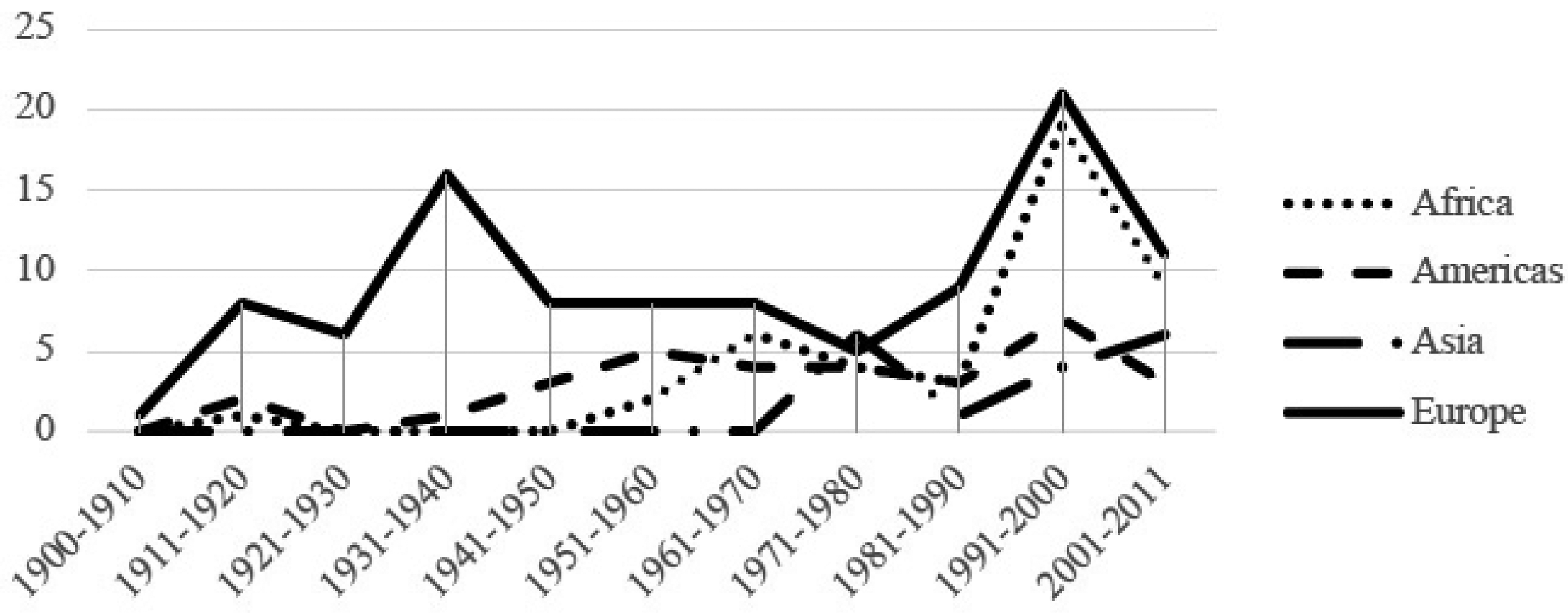
IGO terminations in absolute numbers, selected world regions. 11
In line with this trajectory, the various contributions to this special issue survey the period since the 1910s and highlight phases following the aforementioned spikes in IGO terminations and IO liquidations more generally. Doing so enables us to move research beyond the preoccupation with particular cases and to highlight some broader issues of chronology and causation. We address the question of why general turning points in the political history of contemporary Europe were also crucial moments for ending IOs. With regard to our main research questions, the combination of case studies spread over the course of the period since the 1910s allows us to discern wider trends in IO terminations and legacies, along with their impact on other forms and forums of (international) governance. This open approach sets our work apart from classical research designs in history: it helps us to overcome the specialisation (and fragmentation) characteristic of international history, where most studies zoom in on individual organisations and specific time periods. At the same time, the emphasis here is less on the comparison of cases for its own sake and more on establishing and describing institutional death itself as an important and rich subject of historical inquiry.
The articles collected in this special issue examine the history of European international organisations, broadly conceived. Historically, Europe is the world region with the densest concentration of international organisations. The first modern organisations falling into this category were created there, including the aforementioned Central Commission for the Navigation of the Rhine. For long periods during the 19th and 20th centuries, the number of regional IGOs with a European focus exceeded the total for all other world regions, and the majority of such organisations were based in Europe. 12 Moreover, European states such as France, the Netherlands and Italy have always been amongst the most integrated in IGOs, as reflected in the number of their IGO memberships. 13 Furthermore, the termination rate in Europe was substantially higher than in other world regions and exceeded that of global IGOs during the 20th century (in the 19th century, no widely recognised IGO was terminated, as mentioned above). 14 Hence, Europe was not just a laboratory of international organisation, as the literature has often argued. 15 It was also – though this has largely gone unnoticed – a particularly dynamic laboratory for ending such forums. Even more important for our context: given the densely networked character of the continent, legacies of discontinued IGOs had a high chance of living on and impacting on other forms of (international) governance.
Geographically, our case studies encompass Europe's East and West, North and South. They situate Europe in a global setting, building on recent advances in the field, 16 and argue that some European IOs were in fact global affairs, not least due to the role of empires. The special issue therefore also asks how IOs intersected with processes such as (de-)colonisation, thus reflecting the long-neglected history of trans-imperial cooperation amongst European powers. Recent research has demonstrated how European colonialism and its legacy have affected the history of (European) international law as well as European IOs; hence, 20th-century European internationalism cannot be understood without considering its imperial and colonial dimensions. 17
Our understanding of ‘Europe’ also goes beyond conventional notions in another way. The articles in this special issue do not just describe organisations that consisted (mostly) of European member states. We also consider internationalist and globalist organisations that in fact had a strong institutional and epistemic anchor in Europe, 18 such as the League of Nations or the Warsaw Pact. For all their global aspirations and internationalist rhetoric, both had a strong European bent. But to be ‘European’ in the 20th century also meant contending with a powerful imperial vocation and legacy, which intersected with the formation and development of IOs. 19 As recent studies have shown for other international forums, Europeans were highly effective in cloaking their specific concerns as not only international but universal, recalling Bismarck's comment that he ‘always found the word “Europe” used by those politicians who demanded from other powers something they did not dare call for in their own name’. 20 This special issue sees itself as part of an innovative wave of publications that probes such claims. 21 Or, to state the point as another paradox: addressing the Eurocentric core of some allegedly internationalist or global IOs is a prerequisite for a less Eurocentric perspective on the past – a perspective that makes it necessary to also bring in non-European voices in order to discuss how contemporaries perceived these forms of Eurocentrism, which nevertheless provided the basis for modern international relations, starting with its organisations. 22
Overall, therefore, we examine the discontinuation and legacies of international organisations with a focus on global Europe. We seek to transcend divides within the continent and start from the assumption that some European IOs were implicitly or explicitly global or quasi-imperial efforts, just as ‘globalism’ in this period had a strong if sometimes obscured European pedigree. Finally, the transatlantic dimension of European forums often deserves special attention inasmuch as ‘Europe’ in the 20th century also involved North America, namely the United States, as a prominent actor. 23
Methods and comparisons
Although all the articles in this special issue relate to the 20th-century history of Europe, they do not present a self-evident basis for direct comparison as regards institutional death. Rather, they at best suggest a theme with variations and not a precise typology, the theme being the organic capacity of organisations to define their own death for a number of reasons, including, in some cases, to frame or determine a particular type of institutional afterlife in response to fluctuating external demands and pressures. The articles that follow for the most part concentrate their analysis on IGOs as the most robust type of IO, that is, the least likely to die or hardest to kill. This focus serves to emphasise a general contextual, rather than intrinsic, set of factors explaining their death. That is the case whether the organisation itself had a mainly political, military, economic or cultural mission, or a combination thereof, even though it is self-evident that the nature of such organisations implies different levels of state control, which is certainly higher in security organisations than others, for example. Finally, from the point of view of ideology, the articles cover most of the political spectrum, from fascist to liberal-democratic to state socialist; and within the each ideological type, there is another spectrum ranging from nationalist to internationalist, which the authors were also asked to take into account as another factor explaining institutional death.
In their discussion of the League, Karen Gram-Skjoldager and Haakon Ikonomou emphasise the ambition of the League and its international staff amidst a paradoxical set of legacies – of European colonialism on the one hand, and of a (partially) post-colonial European ‘identity’ on the other. When international politics stood in the way of the League and its nascent efforts to transcend conflict with technocratic orientations and practices, those efforts, again paradoxically, fell victim to political circumstances in a manner that continued during the post-League careers of some officials. However universalist the ambitions of its founders may have been, the League died a largely European death. It has had many different afterlives – most obviously in the case of the aforementioned sub-organisations such as the ILO and the WHO, at an emphatically global level in the form of the UN, 24 and in more hidden form in various postwar Western European organisations. 25
If the League suffered from a surfeit of roles, the fascist movement, along with the Axis, discussed by Daniel Hedinger, died by simple division and defeat, which followed the piecemeal attempt to universalise fascist ideology. This article is the only one here that focuses on a movement rather than on an organisation per se. The autopsy of fascism is rather straightforward, but beneath the surface there are a number of anomalies having to do with its ideological appeal in various contexts, contradicting what would otherwise seem to be the natural death of a movement, its attending organisations and its underlying ideology in wartime. In fact, international fascism, if it ever really existed, came closer than any of the cases discussed in this issue to being stillborn.
The fascism case is followed by Florian Wagner's study of another organisation bound by an ideology, the International Colonial Institute. The ICI, formally an intergovernmental organisation, was a large and prominent think tank focusing on colonial matters. During postwar decolonisation, it simply reinvented itself with a new name and (ostensible) purpose, and so managed to survive for several more decades, albeit without much notable activity. Wagner describes this zombie organisation as being engaged in a clever attempt to ‘fake its own death’ in order to survive, chiefly by redefining the discourse of its existence from colonial to ‘civilisational’. Its Eurocentrism lingered on, even after it accepted some non-whites into its ranks. Claims to universality preserved the organisation, at least for a time – a strategy deployed in vain by both the League, and, still less successfully, some fascists. Ultimately, the zombie organisation was confronted by the reality that such dissimulation was its own form of death, and the ICI's post-colonial reincarnation also eventually folded.
This account of ambition, defeat and dissimulation is followed by Tobias Witschke's happier history of the natural death of the European Coal and Steel Community. It is happier in the sense that the institutional death was boring and planned rather than violent or prolonged. However, Witschke challenges the naturalness of this case by asking whether the ECSC ‘died’ because it reached its anticipated (and legally binding) sell-by date, or whether it actually lives on in a different guise by way of its incorporation into the European Union. On the surface, the case of the ECSC seems to be an easy death by way of irrelevance – which is a different quality to fulfilment, although in this case there were elements of both. Yet on another level, the case once more raises the question of politics, namely the extent to which the pro-integration politics of most Western European states were what enabled both the fulfilment and irrelevance, and then the demise, of its founding postwar organisation.
Finally come four Cold War cases: two articles on the dissolution of Eastern bloc organisations – Suvi Kansikas's and Jun Fujisawa's study of the Council for Mutual Economic Assistance, and Mark Kramer's study of the Warsaw Pact; a case of apparent institutional survival following a ‘near-death’ experience in Seth Johnston's study of the North Atlantic Treaty Organisation in 1966; and another case of an institutional ‘might-have-been’ in Matthew Broad's study of the attempt of the European Free Trade Association to reinvent itself through assisting and advising Central and Eastern European states at the end of the Cold War in anticipation of their integration with Western Europe. The case of the CMEA demonstrates a death by diversion, as some states, with help from EFTA, inter alia, sought well before the formal end of the Cold War to explore new and closer ties with the European Community and other non-Eastern bloc organisations; while the example of the Warsaw Pact is a more straightforward death by inflexibility, with the rigid and Soviet-dominated military alliance ceding its capacity to innovate well before it lost its main political rationale. By contrast, the continual flexibility and adaptation of both EFTA and NATO have been held responsible for the survival of these organisations during and beyond the Cold War, especially the latter, whose founding treaty's Article V obligates members to common defence but does not specify how that should take place. Even in the case of the Warsaw Pact, some elements of death by diversion may be salutary, as in the acquisition by NATO following the alliance's enlargement of personnel who were familiar with NATO bases and related sites, and with Western European languages. Their familiarity and fluency came from the fact that they had previously mastered their targets as members of the Warsaw Pact. Therefore, one could tell the history of NATO's near-death experience as a story of denial or refusal as much as one of seizing new opportunities. Yet Johnston demonstrates that the case was not quite so simple, and that NATO's near-death experience in 1966 may have easily lost the ‘near’ had political leadership allowed what then appeared to be a natural set of events to take their course.
There is an obvious normative element in our selection of cases. Few people today will argue that the international fascist movement of the interwar years ought to have survived, however much it might have adapted; perhaps an equally small number of people would mourn the death of the Warsaw Pact and the CMEA. It is convenient to conclude that these particular organisations, as well as the International Colonial Institute, were justified failures. Yet the articles show that the ‘success or failure’ narrative is something of a historical hindrance, even if it is probably unavoidable when assessing significance. The tendency to approach institutional death normatively relates, of course, to the abovementioned discussion of rhetorical expectations: to argue that organisations will survive or die, as the case may be, is sometimes little different from arguing that they ought to live or die. 26 Yet to show that an organisation exists is different from showing that it needs or deserves to exist. The same holds for an organisation's death. The second, related point to be considered here is the general correlation of life with success, and death with failure. As readers will see, that correlation is not always correct in the subjective judgment of both contemporary actors and historians.
The normative point also applies to institutional dysfunctionality. It has sometimes been said that the best empires were those with large, inefficient bureaucracies, although this point has never been tested comparatively to exhaustion. It may well be true for multilateral organisations that are not traditional empires, but it may not be true universally. The authors here only make it by examining the gaps between what organisations say they do (or must do) and what they actually do, and then correlating those differences with their respective deaths. In other words, the nature and function of organisations may coexist with different parameters and presumptions about life and death. Some organisations, like the European Coal and Steel Community, may have lived on in order to function barely or not at all; others, in order to function, may have needed to die. By contrast, institutional adaptation also resides to a large extent in the eye of the beholder. This question goes to whether there are inherent qualities besides the ones usually cited – creativity, stamina, independence, willpower, etc. – that explain why some organisations do not die, or are reborn soon after they die. As illustrated in the following articles in everything from the flowcharts of secretariats to the evolving missions and even the names of organisations, adaptability falls along a spectrum that does not necessarily run parallel to the one by which institutional survival is charted in growing budgets, staff, responsibilities and so on. In other words, measuring adaptability in institutional life and death may well result in this quality being depicted as both strategically and tactically beneficial over time to an organisation's capacity for survival – or, depending on the organisation, as the opposite. Being adaptable does not always mean adapting in a good or the ‘right’ way.
Conclusions
The life and death of European international organisations differ from those of states in that they play out in the opposite way to how states usually collapse. In most of the examples that follow, the organisation dies (or is reborn) in response to a significant change in political and related circumstances; whereas the death of a state – while also bound to circumstances – may have as much or more to do with the state in question determining those circumstances than the other way around. In other words, the deaths of states and I(G)Os are due to a combination of ‘external’ and ‘internal’ factors; but whereas narratives of the death of states tend to place their emphasis on the latter, accounts of IOs stress the former. The death of IOs may also appear more arbitrary than that of states. That is because, generally speaking, IOs possess fewer or greater powers than most states do. Their capacity to compel behaviour from member states suffers from their simultaneous need to transcend state power. When they die, therefore, they do so not so much from an apparently natural process of internal, functional decay – a loss of power, as it were – than from a process of contextual irrelevance as other organisations, including states, make their authority redundant. Establishing the historical context of institutional demise is, naturally, the first step to gaining an understanding of these processes. For example, if several colonial organisations disappeared during decolonisation, that process must be the obvious reason. Similar logic may be applied to the organisations that lived and died during the Cold War. However, the conflation of causal and conditional factors can reduce historical explanation to a tautology. Or, to modify Norman Davies's argument for states: the death of an organisation may seem inevitable under various circumstances, but when, how and why it dies is never predetermined.
That is why the following articles aim to work against such conflation. For it goes without saying that some organisations have developed a strong life of their own. They have grown beyond their original purposes, as defined in their charters and as planned by their member states; they have acquired new roles and functions. These dynamics are often driven by actors within the IOs – that is, not in national capitals, but in these organisations’ secretariats, and if they have them, in their assemblies and courts. Sometimes they do this out of a sense of mission; sometimes in the interest of institutional self-preservation; sometimes in cooperation with non-state actors such as businesses and expert communities; and sometimes in collaboration with (some of) the very member states whose powers they would appear to supplant. In other cases, new international governance needs appear – for instance, the natural environment in the 1970s and the digital world in various forms over recent decades. Still, it is important to remember that IOs may be dynamic, quasi-independent bodies and not mere extensions of states. 27 Thus, a comparison of state and non-state patterns of demise is not necessary to understand either set of processes. But considering inter-institutional relationships and potential comparisons does serve to remind us that the modern IO depends on (the idea of) the state for its existence, and not the other way around – even if many IOs have survived the death of some of their member states, with the Central Commission for the Navigation of the Rhine, as already noted, as the oldest, most obvious example. 28
These rather basic points of causation apply not only to events and discrete historical periods, but also to trends in international organisations. They do so in the same way, both directly and counterfactually. And one may extend that line to ask about multilateralism itself: if globalisation saw a peak of multilateral activity in the 20th century, only to be followed by episodes of ‘de-globalisation’, can one say that the counter-trends of nationalism, unilateralism and related expressions of chauvinism are directly responsible for the eclipse and in some cases the death of IOs? If so, how? If not, what has taken their place? In the example of the European Union, which would not exist but for the presumptive death, or to use Davies's preferred term, ‘liquidation’, of some (but not all) of its predecessors – the European Coal and Steel Community, the European Economic Community and so on – this line of argument does not suggest that there is a natural law of institutional redundancy; in fact, the number of instances where organisations and their mandates overlap, merge and proliferate would appear to demonstrate the opposite. 29 For this reason, NATO has so far survived the end of the Cold War, perhaps as a different organisation, but not one that has been encumbered by the existence or demise of related groups such as the Organisation for Security and Cooperation in Europe, the Western European Union and NATO's own North Atlantic Cooperation Council and Partnership for Peace. 30
Nor does offering a rationale for institutional survival suggest a simple or natural logic of post hoc ergo propter hoc. Rather, it implies that extending the linkage between death and rebirth further back into senescence is another way of asking about the degree to which the nature of institutional decay affects life and death. The extension of this question also offers a reminder that institutional death takes place within a larger, multi-institutional context in which nearly all organisations relate to, and are affected by, other organisations, including states. The article on EFTA demonstrates this organic point particularly well in tracing how this organisation's efforts to midwife the adaptation of other groups in turn had adaptive effects on EFTA itself. Whether or not the death of some organisations advances or prolongs the life, or death, of others, and in what circumstances, is a question worth further examination. It certainly appears to be the case here in several of the articles, notably in the relationship between the League and some of its successor organisations.
It may be fair to say that some organisations die so that others may live; but proving the fact of dependence is another matter. Besides the usual element of historical uncertainty, it might also be noted once more that organisations spend a great deal of time defending the reasons for their existence and adapting to survive, sometimes above all other purposes, as discussed in the articles on the International Colonial Institute and NATO. To go back in time in order to understand why some organisations lived and others did not requires a rigorous disaggregation of rhetoric from practice with regard to survival and adaptation. In other words, if, in retrospect, it is difficult to take a dead organisation at its word, then devising near-death indicators is also made more difficult by inconsistencies between rhetoric and reality, notably when an organisation like the Warsaw Pact appears to be in denial of its own imminent death.
However, making a counterfactual case for survival would require us to flip the above process one more time on its head: that is, to say, firstly, that some organisations should be taken at their word when they elaborated a rationale for survival; and that, therefore, their death was possibly or probably accidental. For all that the League was unable to adapt to the international setting by the early 1930s, its own death probably should not have happened, as is demonstrated by the survival of many, if not most, of its missions after 1945. 31 Proving that a death was accidental is almost always more difficult than proving that it was intentional, or at least highly likely. To assess likelihood would demand a study of alternatives, which some officials in these organisations, notably the CMEA, considered at the time. Yet, in contrast to the counterfactual logic mentioned above, an alternative set of expectations need not be written in order to ask why actual expectations were defied. Defying them may just be part of an organisation's nature. Instead, the more difficult task is to disaggregate, once again, the rhetoric of expectation-setting from the reality of outcomes. When it comes to institutional death, there are actually three main types of expectations: realistic, unrealistic and willfully delusional (i.e., self-deceptive).
So, did 20th-century Europe need some organisations to die because death/rebirth is necessary for the viability of European society? If not, why do Europeans seem to care so much about them? What, in other words, does all this tell us about Europe, beyond suggesting that Europe is known as much for IOs as for states? Historically, I(G)Os were born as instruments of European power – first within the continent, then globally – just as international law was awash with European ideas, interests and institutions. This is not to deny the contribution of non-Europeans. 32 Still, it underlines that there is a lot of Europeanness in the history of international organisations, not only in the rise of such institutions since the 19th century but also in their various forms of death, and afterlife since the beginning of the 20th century – which may simply be another way of saying that IOs and their standards, practices and cultures extended the lifetime of European power beyond its physical expression. This legacy can be seen in the counter-example of the United Nations, which carried, at least by the 1960s, much less European baggage than the League of Nations, its predecessor organisation. The less the UN met European needs, the more it was seen as dysfunctional, especially in Europe – even though it can just as easily be argued that the UN increasingly adopted more of the interests and perspectives of what has now come to be called the Global South. 33
While this special issue concentrates on IGOs as the most robust cases in the history of international organisation, the picture would become even more complicated if other, more fragile and ephemeral forums were added. Widening the canvas in such a way would only further emphasise Europe's role as a fascinating laboratory in modern international history and highlight hitherto overlooked dynamics and hidden links connecting different regions, temporalities and political orientations.
Jean Monnet famously remarked that ‘nothing is possible without men, but nothing lasts without institutions’. If so, how can institutional death be anything other than a rejection of permanence? The following articles demonstrate that, in some instances, it may not be at all, but survival may be too much against the odds – the odds being a factor of politics. For states and institutions alike, politics determine – we now use that word deliberately – their course of life and death. International organisations are at once extensions, illustrations and sometimes, through their own semi-independent efforts, refutations, of political realities. The point is obvious but it bears repeating. The supporters of the League attempted to supersede politics but in the end fell victim to them. With international fascism, as with the Warsaw Pact, the situation was only ostensibly reversed: a transnational effort crystallising in international organisations was almost bound to die when its political rationale and ideology were gone, or at least eclipsed. By contrast, the CMEA, like the ICI, may have been reinvented on a putatively non-political or even apolitical basis, but here, too, in both instances, the politics – specifically postwar, post-colonial European politics in the late 20th century – were not conducive to such reinventions. A contrast is offered by NATO, one of two organisations examined in our special issue that still nominally survives. Ever since its founding, it has been adaptable, flexible and ‘resilient’, as its response to its worst crisis, in 1966, demonstrated. But it too survives as an international body mainly due to politics, which are always impermanent.
If the role of multilateral diplomacy is to invert in practice the usual relationship between causes and conditions, in that it seeks to create new sets of conditions through deliberate action, then the task of the historian is to reconstruct the causal significance of past conditions in order to understand why historical agents – in this instance, IOs – lived or died in particular circumstances. Moreover, blurring the lines between life and death by emphasising the legacy of discontinued institutions challenges some of the alarmism about the crisis of the international order: if an organisation withers away, its roles are often taken on by others. This reveals an overlooked strength of some IOs – a strength, it should be added, that is not specific to liberal international organisations but also characterises their illiberal contenders. Some organisations may die; long live organisations.
Footnotes
Declaration of conflicting interests
The authors declared no potential conflicts of interest with respect to the research, authorship and/or publication of this article.
Funding
Kiran Klaus Patel received funding from the ERC Advanced Grant 'Hidden Legacies: How Discontinued International Organizations Have Shaped European Governance since the 1910s (InechO)' (ERC Grant Agreement No. 101096005).
