




Abstract
In the 20th century, Sweden distinguished itself as one of the most organized and participatory democracies in the world. But in the late 19th century the situation was much the opposite – Sweden had for Western Europe a low degree of suffrage, and low political participation. To explain the turnaround, this paper explores the evolution of a democratic political culture in the final third of the 19th century, in opposition to the oligarchic system. The empirical material consists of digitalized newspapers from the south of Sweden in the period 1866 to 1900, studying about 2700 articles that mention ‘popular meetings’, folkmöten, which was the contemporary description of political meetings. In the 1860s and 1870s a farmer-centred democratic critique dominated, combining proposals for widened suffrage with criticisms of banks and the bureaucracy. In the 1880s and 1890s, the social base was widened as urban workers – socialist and antisocialist – took a greater part and the ideological composition became more heterogeneous. The paper suggests that the folkmöten constituted an important arena for democratic socialization in a country with an oligarchical political system, creating a road forward for democratic reforms and a democratic society.
In the 20th century, Sweden became a paragon of stable democracy, with high degrees of political participation. However, it was not always this way. Sweden had a tradition of parliamentarism, but over the 19th century, it had become one of Western Europe's most exclusive polities in terms of suffrage and participation. In the 1890s, Sweden had the lowest degree of suffrage in Western Europe – only 24% of adult men could vote for the second chamber of parliament – and the lowest degree of voter turnout. In the 1896 election, only 45% of those who could vote bothered to do so, in contrast to 60% of the electorate who voted in Denmark in 1898, 70% in Norway in 1898, and 61% in Great Britain in 1897. 1 On the local level, the municipal election system was what Thomas Piketty has called ‘the most extreme hyper-inegalitarian proprietarian system’: votes were allocated in accordance with the amount of tax one paid, so the higher the income or wealth, the more votes. In addition, corporations had the right to vote. 2
Sweden's democratization was late (the key reforms came in 1907, and they were implemented in 1909, 1918 and 1921) and rapid. 3 This is a puzzle: why did democratization finally come quite rapidly, and lead to a highly participatory culture, as shown by high voter turnout and party mobilization from the 1940s and the 1950s onwards? 4 This article suggests that the causes should be sought in the broad popular opposition to the previous oligarchic regime. The paper studies so-called folkmöten, ‘popular meetings’, from the 1860s to 1900, from the oligarchic representation reform of 1866 to a situation in the early 1900s when the pro-suffrage movement was strong, and electoral contestation was high. 5 Folkmöte was a loosely-used term for extra-parliamentary political meetings of various kinds, and I will show that through such meetings, in conjunction with more or less lasting civil society and political organizations, a democratic political culture emerged in the undemocratic country of Sweden in the final decades of the 19th century.
A rich literature in political science shows that a legacy of electoral competition, even in oligarchic systems, strengthens the resilience of a democratic system that was installed only later. 6 Similarly, research in sociology and political science suggests that the evolution of a proto-democratic civic sphere in an undemocratic society has the effect of socializing citizens into democratic ways of acting and thinking. 7 This paper shows that by broadening political participation and the notion of politics, the folkmöten created this kind of democratic social sphere in Sweden: by the 1880s and the 1890s, Sweden had a lively civil society with many competing political visions, even if the actual representative institutions were plutocratic. This democratic political culture, decades in the making, helped to turn Sweden into a stable democracy in the 20th century.
The Swedish context and a road to stable democracy
In the final third of the 19th century, Sweden had a low-suffrage, low-participation political regime. 8 In 1866, the Swedish four estates parliament was abolished, and a two-chamber system was introduced. Suffrage to the second chamber was conditional on male sex and a certain level of income or wealth; this excluded four-fifths of adult men from the right to vote. Election to the first chamber was much more exclusive: only 2% of adult men had this right. 9 In 1909, universal manhood suffrage was introduced for the second chamber, and in 1921, Sweden became a democracy as universal and equal suffrage were introduced for both chambers. When the Great Depression spread over the industrialized world after the Wall Street crash of October 1929, democracy (defined as universal and equal suffrage) in Sweden was only eight years old. Nevertheless, Sweden, along with its Scandinavian neighbours, was among the few European states where no serious threat – neither Fascist nor Communist – troubled the democratic order in these years. 10 Why was this so? The political scientists Cornell, Møller and Skaaning have recently argued that a legacy of democratic rule – using a minimalist definition such as electoral competition – was an important determinant of democratic survival in the 1920s and the 1930s. 11 Democracy survived in only three countries out of their 30-country sample in the interwar period despite not having at least a ten-year legacy before World War I, and Sweden was one of those three.
The purpose of the present paper is to contribute an important piece to the puzzle of why Sweden was able to democratize rapidly 1909–1921 and establish a stable democracy in that short time. The explanation offered here is that a vibrant political society developed in Sweden in the decades after 1866: the formal political institutions were plutocratic and participation in elections was low, but among the disenfranchised, political activity was flourishing especially starting in the 1880s and the 1890s. 12 Thus, the Swedish people was socialized into democratic ways even in a formally undemocratic polity. Recently, the sociologists Kadivar, Usmani and Bradlow have argued that ‘one of the most consistent explanations of variation in substantive democracy is the length of unarmed pro-democratic mobilization prior to a democratic transition.’ 13 Kadivar, Usmani and Bradlow points to three reasons why the intensity of mobilization before democratization affects post-democratization outcomes. One is that community organizing creates competent activists: the experiences of mobilization and within-organization democracy shape expectations and practices of how the future democratic system should work. 14 The second reason is that mobilization creates ‘movement veterans’ who can become pro-democratic politicians in the democratic system. The third reason is that ‘activism begets activism’, that movements create a positive spiral of popular political participation. 15 As we will see, all these mechanisms were present in late-19th century Sweden.
Furthermore, the holdings of elections, even under very exclusive suffrage rules, can matter. Even with very limited suffrage, as in Sweden between 1866 and 1909, regular elections led to a cycle of expectations and mobilization. Elections provide a venue for mobilizing opposition and channel political energies, and civil society organizations may improve their functioning by such work. 16 Sweden had an oligarchic regime in the decades from 1866 to 1909, but it did have elections for the second chamber of parliament every third year, and as we will see, an impressive degree of pro-democratic mobilization.
Following these insights on how stable new democracies can be created, the task is thus to describe and explain politicization under the Swedish undemocratic regime before 1921. Previous explanations of increasing political participation have focused on the pre-democratic context of the tariffs election of 1888 when participation – among the small minority with suffrage – doubled 17 , and on the proliferation of particular social movements and political parties, especially the liberal suffrage movement founded in 1890 and the Social Democratic party founded in 1889. 18 These factors will feature here too, but this contribution is to set these events and movements into a broader context and show how they add up to just such a broad pro-democratic mobilization before democratization, which, according to the arguments of political science and sociology discussed above, matter for substantial and lasting democratization.
Previous studies of Swedish politics in the 1866–1900 period have to a high degree focused on within-parliament parties and issues, or certain elections, or a certain party or movement. In contrast, to capture the broad popular mobilization during the period, this study starts with the catch-all concept of folkmöten. The folkmöten have previously been treated in a fragmented way in the literature: Thermaenius talks of a short-lived ‘movement of popular meetings’ in the late 1860s but also plays down the influence of the meetings and their prevalence outside of the cities. 19 In addition, periodic contemporary, disparaging views of the folkmöten as organising ‘plebeians’ and ‘loose people’ (löst folk) unfit for influencing politics have likewise cropped up. 20 Going beyond such scattered mentions of folkmöten, this paper presents the first systematic study of the meetings and their role in establishing a democratic political culture in Sweden.
Studying folkmöten with newspaper sources
To study the prevalence and politics of the folkmöten, I use newspaper materials. Newspapers are especially important as sources since they are not connected to a specific party or organization and are not dependent upon organizational survival: newspapers are preserved in libraries even if they are long-defunct, and the movements that they might have been associated with, have been forgotten.
The further advantage with newspaper materials is the digital availability. The newspapers come from the Royal Library's (Kungliga Biblioteket) database of Swedish newspapers, tidningar.kb.se, an ongoing project that was started in 2018, and which, in the end – the current projected end date is autumn 2023 – will include every printed page of Swedish newspapers until 1906. 21 A search for ‘folkmöte’ in the KB newspaper database from 1866 to 1900 gives more than 32,000 articles. For reasons of tractability, I choose to study half of the years (1866–1870, 1876–1880, 1886–1890 and 1896–1900) and will focus on one region, the southernmost region Scania (Skåne). Scania is attractive since it is a populous and internally heterogeneous region, with industrial cities such as Landskrona and Malmö, a university town in Lund, and wealthy agricultural areas with the best soil in the country, as well as forested, poorer areas in the north of the region. Attempts to explore geographic differences in 19th-century Swedish politics and explain patterns by means of economic structure or so have been unsuccessful, and I take it as a positive that it has been difficult to pin down Scania politically: the diversity of this large region, which accommodated 12% of the country's population in 1900 22 , means that this study of folkmöten will not include more than one type of political locality. How Scania's politics relate to those of Sweden in general cannot be pursued here; in this regard, the present study should be seen as an exploratory one and should ideally be complemented in the future by studies of other areas and newspapers.
Figure 1 shows the temporal pattern of the 32,000-plus articles in Swedish newspapers mentioning folkmöten from 1866 to 1900. The peaks are 1869–1871, 1881–1887 and 1890–1893. The first of these peaks and the lull in the late 1870s is as expected, given that the late 1860s was the time of a New Liberal campaign (which will be discussed below) and the 1870s are recognized as a period of stagnation in Swedish politics. 23 The causes of the 1881–1887 and 1890–1893 peaks are less obvious. The decline at the end of the period is as expected; the term folkmöte became less important in the late 1890s and, as a political term, it was successively replaced by ‘demonstration’, ‘meeting’ and other more familiar terms. 24
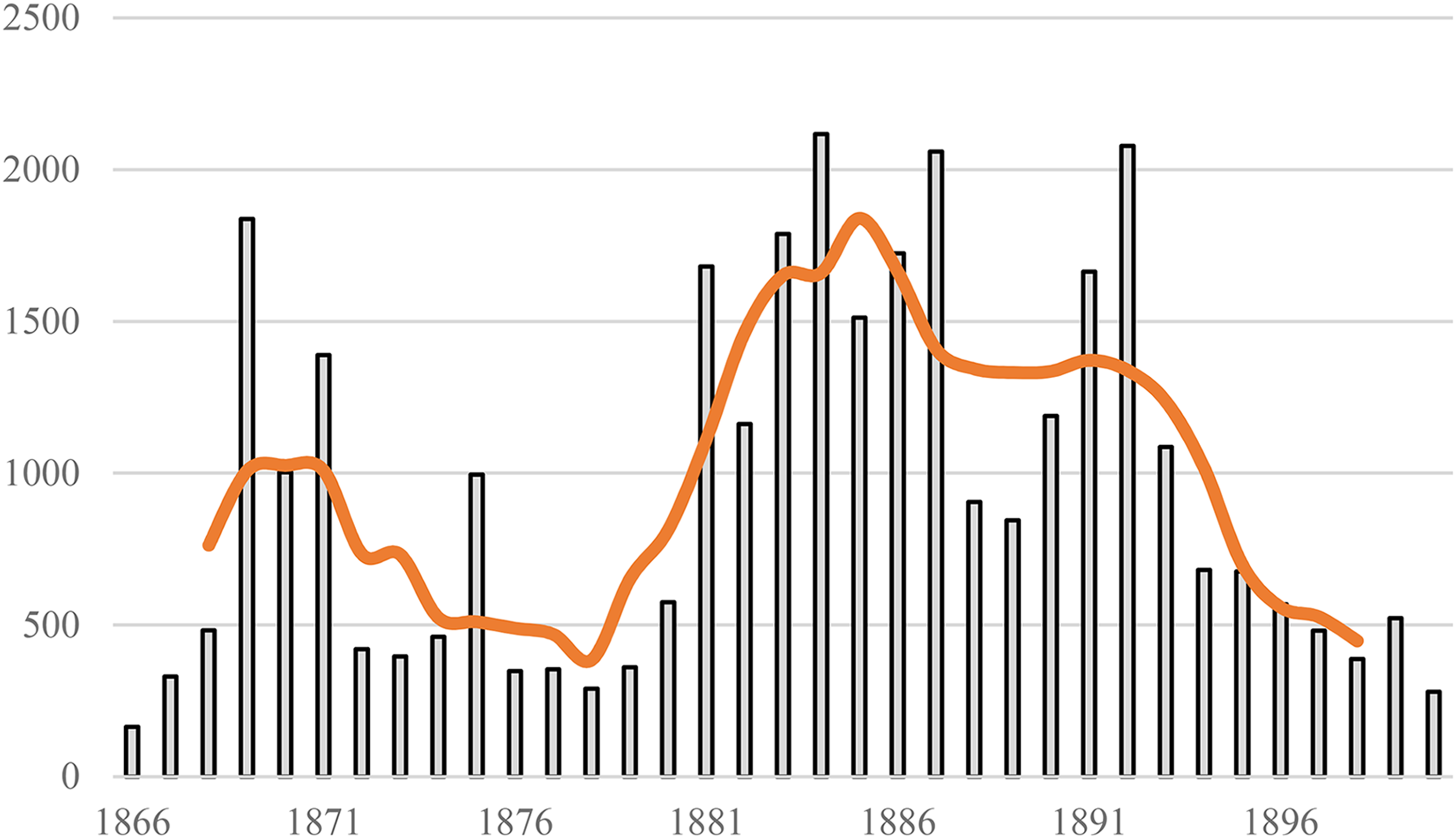
Newspaper mentions of ‘folkmöte’ in Sweden as a whole, 1866–1900.
Figure 2 counts the 5913 articles published in Scanian newspapers in the period. The pattern over time is very similar to that of the country as a whole.
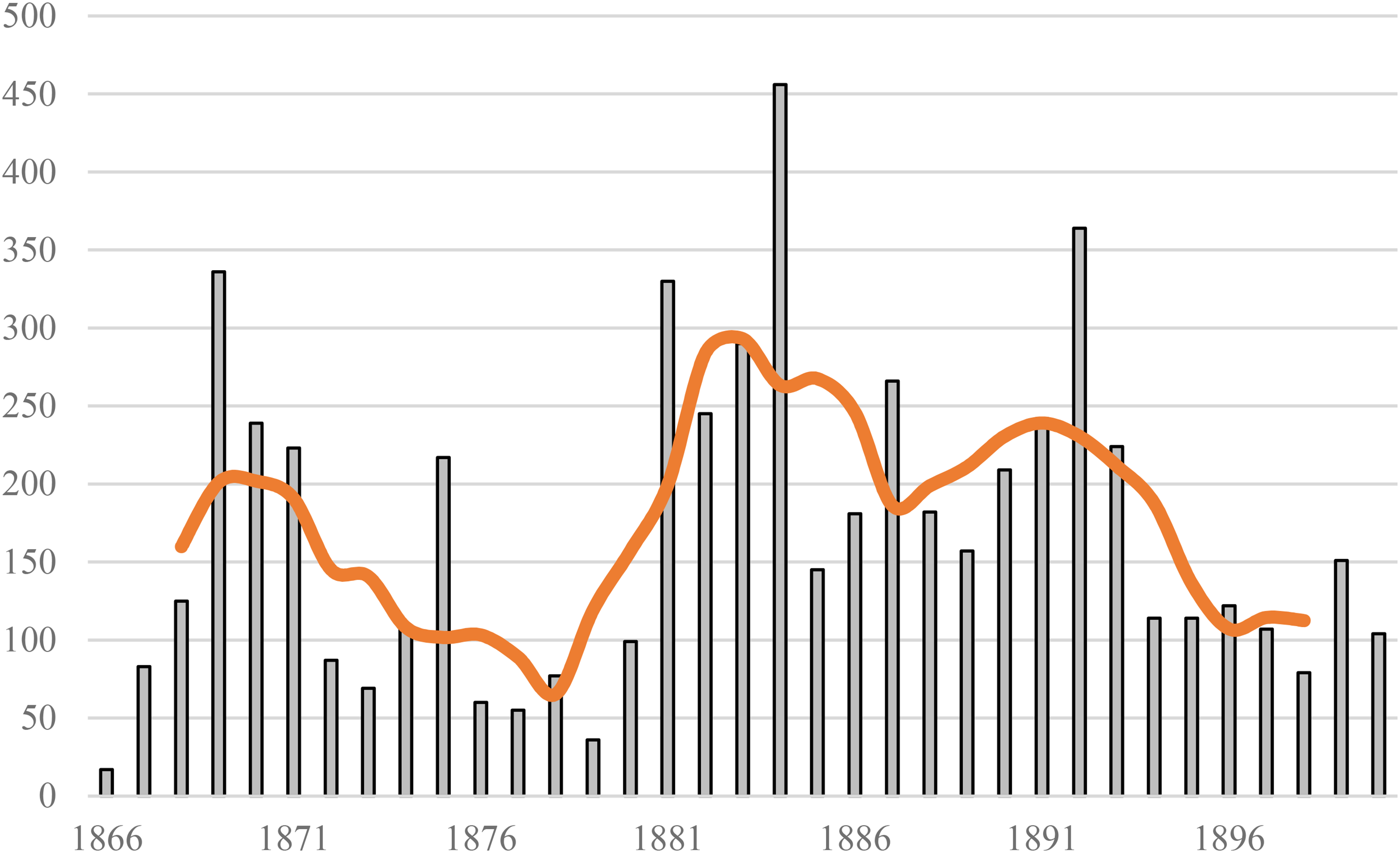
Newspaper mentions of ‘folkmöte’ in Scanian papers, 1866–1900.
Given the strong political tendencies of newspapers in this period, it is crucial that the studied papers should provide variety over the political spectrum. The Scanian articles are dominated by nine papers: Öresundsposten (1033 articles), Sydsvenska Dagbladet and its previous incarnation Snällposten (538 + 73 articles), Folkets Tidning (513), Kristianstadsbladet (463), Arbetet (325), Helsingborgs Tidning/Dagblad (270 + 232, name change in 1884), Skånska Posten (254), Korrespondenten (229) and Malmö Handels- och Sjöfartstidning (211). This covers the entire political spectrum, since ÖP, FT and MHST were papers of the radical-liberal tradition; SydD and HT were conservative; KB, K and SkP were liberal, and in some cases, they were close to the free churches and temperance movements; and Arbetet, started in 1887, was one of the first socialist newspapers in Sweden. 25 Thus, the newspaper sample covers the political spectrum of Sweden at the time and the biases of the various papers balance out those of the others. 26
Liberal and radical disappointment with the conservatism of the 1866 representation reform, as well as with the ‘rule of money’ (penningavälde) in the municipalities, was articulated via a wave of folkmöten in 1868–1870. 27 While the meetings constituted a new wave, they also referred back to some predecessors: reform meetings in the 1840s, before the hopes for a more liberal constitution were dashed at the end of that decade, and a few scattered meetings between the late 1840s and the late 1860s. Swedes were also influenced by what was going on in Europe, with the upswing of National Liberalism.
By National Liberalism, I refer to a moderate kind of liberalism, not necessarily committed to universal suffrage, which was heavily influenced by a fear of the Great Powers such as Prussia and Russia (who also symbolized authoritarian political systems), and which was supportive of Denmark in their struggle against Prussia in the 1860s and Poland in its struggle for independence. 28 The National Liberal tendency can be exemplified with a large meeting in the village of Stehag in the summer of 1867. On 8 June 1867, Korrespondenten reported that ‘a large folkmöte for the whole province of Scania is supposed to be held this summer in Stehag to express an opinion against the unreasonable municipal suffrage’. The meeting was pan-Scandinavian, and Stehag was chosen as a village on a railway line, accessible from Denmark as well as for the Swedes. The time for the meeting was chosen to be between the hay harvest and the rye harvest. While Korrespondenten – a liberal paper – emphasized the struggle for extended suffrage, it is also very clear from the sources how important the issues of national rejuvenation were for the meeting's organizers and participants. Öresundsposten reported in extenso on the speeches in Stehag, and from this reporting, it is clear that the tenor of the meeting combined Scandinavian nationalism with strivings for more inclusive polities. 29 The meeting attracted about 20,000 people, which is quite impressive for a rural political meeting in 1867. The late 1860s was a period of national unification in Europe and it is telling of the wider European context of some of the folkmöten when a report from an 1868 meeting stated that the opening psalm singing of 10,000 participants ‘was a ‘Polish prayer for freedom’, sung in Sweden!’ 30
The connection between liberalism and proposals for constitutional reform – widened and more equal suffrage in municipalities and the country – is also clear in meetings arranged by the New Liberal party. (The ‘new’ in their name referred to their distancing from what they saw as the ‘old’ Manchester liberalism. 31 ) According to Folkets Tidning, a New Liberal paper, the chairman of a meeting in 1869 stated that ‘if the Swedish people should see its future safe from outer and inner violence and its independence, its freedom and its nationality not extinguished from the soil, which hides the dust of our fathers, then we must rise up as one man from our long stupor and agitate through meetings, associations, petitions and the like to be able to fight for our civil rights’. 32 Here, we see very clearly how Swedish Liberal rhetoric of the late 1860s combined the idea of national rejuvenation with demands for civic reform.
In October 1867, the New Liberals arranged an important meeting in the small town of Eslöv. The meeting was held under the label of folkmöte and ‘reform meeting’ (reformmöte) and was arranged partly by the people who had been behind the Stehag meeting the same summer. Ola Jönsson in Kungshult, a radical farmer and MP, opened the meeting and addressed the participants as ‘Ye honest and nationally minded men’. The speakers were not completely united; an MP argued against the principle of the man-one vote, arguing that ‘the so-called lower classes would elect recklessly’ and claimed that a graded voting on a scale of 10 would be best, but he was not able to convince the others. The meeting agreed that every adult citizen who decided for himself and his property and paid any tax to the municipality should have municipal suffrage, and that the inequalities of the voting scale should be reduced to three steps. 33 To adopt meeting resolutions was very typical of the folkmöten; this was before the existence of national continuous political organizations and the resolutions were key to putting forward political demands vis-à-vis society at large and the politicians, as well as to uniting the participants themselves. 34
The Eslöv meeting also decided to organize a new large outdoor meeting in the summer of 1868, and this meeting took place on 26 July 1868 in the village of Attarp. The meeting, according to the organizers, attracted 8000 to 10,000 people (the sceptical Kristianstadsbladet stated 6000) and began with a clergyman who, in opposition to the graded suffrage current in Swedish municipalities at this time, quoted the Bible: ‘If ye set the coin as valuation of the man, ye make an evil difference and God cannot suffer it’ 35 The conflict between the ‘rule of money’ – people with larger incomes and wealth being awarded more votes in the municipalities – and the ideal of universal and equal suffrage was the crucial issue at the heart of these meetings of the late 1860s. The Attarp meeting took a stance for equal municipal suffrage for all who paid taxes, and it accepted the New Liberal party program.
While municipal suffrage was the foremost issue of the folkmöten 1866–1870, there were five other recurrent issues. One was national suffrage. The second was schooling: six years of school had been made mandatory in 1842, but schools had low pedagogical ambitions and a strong Christian tendency, and the New Liberals wanted more comprehensive and ambitious schooling with less religious teaching. 36 The third was army reform, often complaining about the expensive army and sometimes advocating for a people's militia model instead. The fourth was banking critiques and a desire for a stronger National bank (Riksbank). 37 The fifth was a critique of the bureaucracy and alleged waste of public funds. 38 The folkmöten of the late 1870s were essentially about the same issues as in 1866–1870: especially municipal and national suffrage, and the reforms of taxation and defence, which in Sweden were connected at the time, since the army absorbed such a large share of the state's outlays. The liberals who wanted these reforms had had no success in the 1866–1870 period, so perhaps it is not surprising that they kept going back to the same issues. The lack of success was also plain to see for the radicals themselves. In one of the few Swedish folkmöten of 1879, a farmer proposed a resolution for universal suffrage. However, he was immediately met with the statement that such a radical resolution would be useless since parliament has not accepted even a modest increase of enfranchisement. Instead, the meeting settled for a suggestion for a voting threshold to the second chamber of 400 kr. 39 As Figure 2 reveals, the folkmöte activity in 1876–1880 was a pale shadow of the radical wave of 1869–1871.
To understand the social and ideological character of the folkmöten of the 1860s and the 1870s, the two final issues mentioned above – the banking issue and the critique of the bureaucracy – are key. They are indicative of the strong basis of the folkmöten among the farmers: mid-19th-century farmers often had quite large debts, so they had a strong interest in lower interest rates, and the demands for cuts to the public sector were combined with demands for land tax cuts – also an issue of obvious relevance to farmers. 40 The anti-bureaucratic line and thrift with public funds were ever recurrent, with constant calls for lower wages and pensions for public servants and fewer jobs in the civil and military bureaucracy; the ‘bureaucrats’ were typically portrayed, together with the ‘money men’, as the enemies of all reform and progress. 41 Some folkmöten challenged the established order in demanding that the office of bishops and county governors – traditional symbols of authority in Swedish society – should be abolished; the populist streak in this critique is also clear in the demand to abolish the Royal Dramatic Theatre in Stockholm. 42
The critiques of banks and the bureaucracy show the similarity of the radical Liberals in Sweden in the 1860s and the 1870s to the American Populists of the time. Like the Populists, the folkmöten also had their social basis especially in the farmer class. There are very few mentions of manual workers in the 1860s and the 1870s: a unique article in Snällposten in 1869 reported on a carpenters’ strike where the striking workers organized ‘a kind of folkmöte’. 43 The class basis of the folkmöten of these years is also indicated by the (non-)treatment of the economic crisis of the late 1860s. These were difficult years when harvests failed from 1867 to 1869, but when the problems of vagrancy and begging appeared in the folkmöten, the framing of the issue focused on which demands one could make on those who ‘could work but refuse to’ and the hassle that vagrants exposed honest people to. 44 In the north of the country, there was outright starvation, but this was very rarely a topic in the folkmöten in Scanian papers in these years.
As reported in Folkets Tidning, when the subject was brought up in a meeting in central Sweden in 1869, it was part of a wider argument on the unjust politico-economic order in the country. This meeting was actually chaired by an estate owner, who introduced the meeting with a harsh attack on the ‘leeches’ (bureaucrats), and the tone of the meeting remained hostile: in a speech, a freeholder described a country on its way to slavery, where the government had allocated 198,000 riksdaler for the princess on her wedding and the bureaucrats lived in luxury, ‘while people here and there in the country starve to death’. 45 After explicitly putting forth the question, ‘what are the roots of the suffering in society?’, he proceeded to name the main causes as the luxury surrounding the palace, the throne and the bureaucracy.
In these years, the folkmöten rarely ventured into a purely economic critique and, as this example shows, even when they did, they tended to allocate much explanatory power to the state: the monarchy and, above all, the bureaucracy. The radicalism of Swedish folkmöten in the 1860s and the 1870s was focused on constitutional issues and not much concerned with political economy; it is telling that Adolf Hedin, the leading New Liberal ideologue, knew of Karl Marx but thought that the German was an ‘over-rated’ thinker. 46
The folkmöten were, however, associated with the liberal side of politics, and they faced strong criticisms from the conservative camp. The mockery from the conservative paper Snällposten is typical, when it claimed that the opinions expressed at folkmöten should not be taken very seriously, because the participants ‘with their state of education lack the capacity to penetrate the issues deeply’, and therefore sometimes yell ‘bravo’ to one speaker, and then the next one too, even though the two speakers contradicted one another. 47 The somewhat condescending and ironic manner of the critique is also exemplified by a satire of ‘a radical-New Liberal Stockholm democrat from Eslöv’ (as we have seen, there was an important meeting in Eslöv in 1867) acted out by students of the university town of Lund in 1869. 48
A more direct debate between reformers and defenders of the established order took place at a meeting in Lund in 1870. In the debate, the radical newspaperman Bülow stirred emotions when he claimed that the current system was a ‘money men's’ mockery of the people – exemplified by the fact that Malmö city had 25,000 inhabitants but only 800 who had the right to vote in the municipality. Conservatives also participated in this debate, which was rare for a folkmöte of these years. Count von Essen argued that suffrage reform was unnecessary, since any industrious labourer could save up to 1000 riksdaler and get the right to vote, and Professor Hamilton 49 argued that we must expect capability and independence of an MP – and could we know if a man had that, without a certain level of income or wealth? 50 The debate became heated, but the meeting decided in favour of the New Liberal policy of universal suffrage, against the protests of von Essen and Hamilton. This outcome awoke a sharp critique in the conservative Snällposten: the meeting had been rigged! 51
This debate goes to the heart of political change in Sweden in this period. The official political system built on an ideology of independent men as politicians: wealthy, tax-paying, with no obligation to take instructions from or take heed of the views of their constituents (still less of those without suffrage). The New Liberal meeting campaign of the late 1860s and the early 1870s challenged this ideal by issuing instructions from party headquarters for the same issues – municipal suffrage, national suffrage, taxation – to be discussed at every meeting, and for each meeting to adapt a resolution in favour of the New Liberal policy proposals. This kind of politics – centralized, coordinated and including people without suffrage – clashed completely with the official mode of politics. For the radical newspaper Öresundsposten, the folkmöte campaign meant that people ‘have begun to understand that the only way to accomplish a better order of things in this country is to discuss their issues among themselves’. 52 Looking at it in hindsight, we may say that with the New Liberals, a political culture of popular mobilization was created that would commit democrats and expectations of democracy of the kind, which would then facilitate a transition to democracy. 53
However, the New Liberal movement faded away in the early 1870s, and the folkmöte campaign of the period did not achieve any reforms. In the 1870s, which was condemned by radicals as ‘the meaningless decade’, parliamentary politics was a slow-moving affair. 54 Swedish politics of the 1870s can be characterized with a citation from Kristianstadsbladet in the summer of 1870: the two major political parties, the rurally-based Country Party and the more urban Intelligence Party, were in fundamental respects the same, defending the oligarchic system: ‘a representation that is “grey in grey”’. 55
A new opposition: the 1880s and the 1890s
There was much continuity in the folkmöten into the two final decades of the 19th century – indeed, the continued use of the term folkmöten, which was used, for example, by socialist organizers in the 1880s, itself denotes such a continuity. However, there was also a streak of change. Wage labour and the working class played larger roles as themes for the meetings, while workers contributed more significantly as participants. A larger share of meetings were held in towns and cities, accompanying not just the greater participation of workers, but also the growth of civil society organizations with their own buildings, which could host meetings. 56 This produced, in my interpretation, a new sense of ideological continuity to the meetings, which had been more loosely joined around a populist and liberal social critique since the breakdown of the New Liberals in 1871. By the early 1890s, a suffrage movement was founded in Sweden, mobilizing hundreds of thousands of Swedes, often those without suffrage. 57 In other words, the political scene in the country in the 1880s and the 1890s changed fundamentally. The folkmöten were an important part of this process.
The first year of the 1880s already shows the new element in the folkmöten. In August of this year, Sydsvenska Dagbladet reported that a ‘reform society’ had been established in Malmö – the largest city in Scania, but which until then had had no folkmöten, according to the materials studied here – with the aims of ‘political and municipal progress’. 58 In the paper the day after, the society issued an invitation to a folkmöte where the well-known Positivist medical doctor Anton Nyström from Stockholm would speak, and where three issues would be debated: municipal suffrage, national suffrage and defence policy. 59 Around 1000 people took part in the meeting, which was chaired by Malmö's newly-elected MP, the printer Andersson – the fact that the city had elected a worker as MP was also indicative of a new era. 60 The meeting began with a speech by Nyström, who argued for universal suffrage. In Stockholm, a reform society that had been set up a year before, now decided to organize folkmöten all over the country to ‘express opinion, which could act as a driving force’, and to collect as many meeting resolutions as possible to present to the government on 1 November. The bookkeeper Mattson and editor Westenius argued that this action was too hasty and that it would be better to work for a lowering of the income census (for the second chamber) to 400 kronor. They were loudly jeered, as people shouted ‘Down with the census!’ (Bort med strecket!) The decision of the meeting was that every adult that was a well-behaved (välfrejdad) person should get the vote. On the municipal suffrage, the discussion was started by Westenius who advocated a 5-step scale. Bookkeeper Nilsson recommended 10 steps and Nyström, the doctor, agreed with both. The meeting decided on a 5-step scale. In the third issue of the debate, defence policy, voices were heard both for disarmament and for more defence spending, and no consensus was reached. The discussion ended with a speech from the chairman, Andersson, that praised the current system and condemning conscription, and with which the meeting expressed agreement.
The second half of the 1880s shows further examples of the new urban and working-class tendencies. The first socialist agitation meeting in Sweden was held in Malmö in November 1881. It was arranged by the 32-year-old tailor August Palm, who had learnt about socialism during ten years working in Germany and Denmark, from which he just arrived back to Malmö in his home region of Scania in 1881. 61 Scania, close to the continent and perhaps especially receptive to impulses from abroad, became one of the strong spots of the Swedish labour movement, and in January 1886 (i.e. when my sample begins again), the socialist labour movement immediately – and for the first time in the newspaper material used here – appears, when Sydsvenska Dagbladet reported that the ‘Socialist leader’ August Palm called a meeting in Malmö about temperance and socialism. 62 About 700 to 800 people attended the meeting and most of them shared Palm's views. Palm, the most important Socialist agitator in Sweden in the 1880s, was a stalwart in the newspapers in this decade. In June 1886, Sydsvenska Dagbladet reported on another meeting in Malmö, ‘with both scum and respectable people’ participating, where Palm ‘in his usual way bellowed against the “upper class”’, warned people about a financial crash and attacked farmer MPs. When he was interrupted by police officers, he replied only with ‘Soon! Soon!’ 63 Equally interesting is when striking workers in Helsingborg organized a folkmöte in August 1886, much to the chagrin of liberal Öresunds-Posten, which found the language of the meeting's organizers ‘raw and uncouth’ and their politicization of the strike a hindrance in resolving it. 64
By the late 1890s, the socialist labour movement was very well established in Scania – indeed, it had also had its own paper, Arbetet (‘Labour’) since 1887. An example from 1896 shows a combination of continuity and change in the folkmöten. In May of that year, Arbetet reported on a large meeting in Stockholm on Norway's national day, 17 May, at which the Social Democratic party leader Hjalmar Branting spoke. V. Andrén from the people's parliament also gave a speech against militarism, where he stated that people received not suffrage from the riksdag, but ‘only guns and rifles with prayer books attached’. 65 The elites, said Andrén, can no longer argue that ‘we’ don’t pay any taxes: the latest evaluation shows that those without suffrage pay 44 million SEK in taxes every year (presumably mostly indirect taxes), while those with suffrage pay no more than 18 million. Instead, they now blame ‘us’ for being immature. The socialists Thorsson and Palm defended the use of a general strike as a pressure weapon for suffrage: by then, the suffrage question had been the main mobilizing issue of the folkmöten for three decades, but the idea of using a general strike as a political weapon emerged with the labour movement of the 1880s.
The shift in political life, which occurred when working-class people – and people who claimed to speak for them – started to take a leading role in folkmöten, is related to another shift: a broadening of the conception of the economy. Much of the folkmöte debates in 1886–1887 centred on the economic situation. In January and February 1887, Sydsvenska Dagbladet reported from a Socialist demonstration in Stockholm, with August Palm among its speakers who protested the high rate of unemployment and demanded the creation of public jobs. 66 More than 2000 people participated in this meeting. The labour movement and other meeting organizers all shared the view that the economy was in a desperate state, and various reforms were discussed with a striking frequency the lowering of interest rates and the abolition of private banks. Again, we see the combination of the new and the old – the concept of ‘the unemployed’, as opposed to ‘beggars’ and ‘vagrants’, but also the scapegoating of private banks and the complaints about interest rates, inherited from the farmer-centred political economy that dominated the 1860s and 1870s. 67
A further crucial shift in Swedish politics and in the folkmöten in the late 1880s is the appearance of the protectionism issue. In Swedish political history, the turn to protectionism in 1887–1888 and the political strife around it is seen as an epoch-making event that gave rise to a modern party system with oppositional and competing relationships between the parties, and where electoral participation (among those with suffrage) grew from a quarter to about a half from 1884 to 1887. 68 From the viewpoint of the folkmöten, protectionism still appears as a very important issue, but that it emerges at the same time as the labour movement also highlights the underlying, broader change of a broadening politicization of the economy and an admission that social and economic circumstances are a matter of politics. This aside, the customs issue appears in several folkmöten articles in 1886: for example, a report of a meeting in Åkarp, which was attended by about 200 persons, stated that the farmer MP Ivar Månsson i Trää had argued for customs tariffs and convinced the participants. At least this was the case if we are to believe the (conservative) Sydsvenska Dagbladet; conversely, Kristianstadsbladet reported that ‘some spoke for grain customs duties, others against, and the importance of the meeting was therefore zero’. 69 The spring of 1887 was completely dominated by the election and the protectionism issue; the Socialist Palm made an enraged speech against such protectionism (or rather against the politicians who proposed it), while the farmers were mobilized into free trade societies or protectionist meetings. 70 The extent to which the rise of the labour movement and the rise of the protectionism was intertwined, is highlighted by the fact that the first Socialist mass demonstration in Sweden was led by August Palm in February 1886 under the slogan ‘Against the starvation tariffs!’ (Mot svälttullarna!). 71
In the years after 1887, Swedish politics were polarized between the Left, which was identified broadly as free traders (Liberals as well as the Socialists), and the Right, which was broadly identified as protectionists. The new polarization was related reciprocally to the greater participation in politics: broader participation meant a wider array of interests represented that were polarizing, and polarization in itself probably also increased interest and participation in politics. The Left of the late 1880s was much broader than the Social Democrats per se; in June 1886, Helsingborgs Dagblad reported that a meeting with about 5000 participants had been convened over Pentecost by some ‘workers and peace communities in southern Scania’. 72 Two major issues were up for discussion. The first was the relationship between ‘peace, sobriety and workers’ issues’. The meeting agreed that all three issues pointed to the same goal: ‘human improvement’. The second issue for discussion was ‘why are crafts, agriculture and the working class in distress?’ Axel Svensson, a schoolteacher, argued that the cause was the unequal distribution of taxes. The meeting ended with a hurrah for humanity, and the participants extended their evening on two dance floors and a carousel. The recurring ‘peace movement’ was a response to imperialism of the time as well as the aftermath of the national settlements in Europe of the 1860s and the 1870s; from the 1870s onwards, the newspaper articles on folkmöten frequently related to the national question and to Empire and reported on Romania, Greece, Bulgaria and the Balkans. Beyond the best-known ‘social question’ and protectionism issues, then, Swedes also mobilized politically in the 1880s and the 1890s for peace; a movement arose with the aim of establishing an international tribunal that would arbitrate for peace. 73
The final comment I want to make on the folkmöten of the 1880s and the 1890s concerns the very basic question: who could participate? The reader may have noticed that no women have been mentioned so far in relation to the folkmöten. This is because until 1889, women were not named as speakers, organizers or functionaries of the meetings. The first woman to play such a role was Elma Sundkvist, who made a speech in favour of universal suffrage at a Socialist meeting with a few thousand participants in Sätofta woods in the summer of 1889. 74 This is a further indication of the broadening of the folkmöten of the 1880s and the 1890s. The theme of who could participate and who should participate in folkmöten was also explicitly debated.
In 1880, Öresundsposten reported on a meeting where a schoolteacher argued for the importance of folkmöten precisely because they gave ‘the politically disenfranchised … the same freedom of speech as the enfranchised’. 75 Similarly, the chairman at an 1887 meeting asked the participants whether those who had no right to vote in elections to the second chamber should have the right to express themselves at the meeting; the question was universally answered in the affirmative. 76 In the 1860s and the 1870s, farmers dominated the meetings and they were still a central element in the 1880s and the 1890s, but participation over time became broader and attracted derision or praise from the newspapers, depending on their view. Some descriptions of the participants include ‘many stupid tenant farmers, who have seldom left their parish and can neither read newspapers nor any other book than a religious one’ 77 , ‘common people’ 78 , ‘both scum and honest people’ 79 , ‘of various social classes’ 80 , ‘Sunday-dressed workers and other interested people’ 81 , and ‘diligent workers’. 82 Establishing the precise social composition of the meetings is, of course, impossible – there are by definition no membership rolls from these elusive events – but the coverage does indicate that the disenfranchised – workers, and, rarely, women 83 – could find a political venue in the folkmöten.
In the 1890s, a new theme, which underscored the opposite of the right of lower-class people to participate in folkmöten, also appeared: the presence of very elite people. In the late 1880s, the radical papers complained that only one Swedish government minister had ever taken part in a folkmöte, and they contrasted the country unfavourably with Norway, where ministers were more open to participation. 84 However, in 1890, it happened that the marshal of the court, Reutersvärd, visited a folkmöte – and it did not end well. The 300 agricultural workers and blacksmiths present spoke about universal suffrage in such a way that Reutersvärd demanded that the local police should dissolve the meeting; this call to the police, along with Reutersvärd's contemptuous dismissal of the participants as ‘a band of thieves’ became a cause célèbre in the radical press. 85
However, the wind was blowing in the direction of the folkmöten. The final folkmöte article in the materials here, taken from the last of December 1900, is a very telling one about the subsequent development of Swedish politics. This report in Kristianstads Läns Tidning on a meeting in the north of Sweden stated that those who complained about the ‘irresponsible rhetoric of the folkmöten’ had mostly been enthroned at home and were thus unaware of Swedish reality. Yet, the report concluded the following: ‘Maybe we will learn also in Sweden at some point, that if you want something, you need to work for it, even if the theoretical reasons for what you want are clear as day’. 86 By this point, even moderates – those who believed that it was obvious that their policy positions were correct – had accepted that in politics, you need to organize and argue publicly for your positions.
Democratization in Sweden
The empirical study of this paper ends in 1900, while the country became democratic in 1909 and 1921. However, in many ways, the outcomes of 1909 and 1921 were already on the cards by 1900. Staffan Runestam's careful research on the conservatives of Swedish politics in the early 1900s shows that they were already consciously fighting a rear-guard action by 1900: they knew that suffrage extensions would be impossible to avoid. Thus, their discussions circled instead around how the damage, so to speak, of universal suffrage could be minimized. Solutions included changing the electoral system from majority to proportional, raising the age of suffrage, introducing more conditions for voters for complete tax payments, implementing the need to fulfil military duty, and so on. 87 Runestam is not precise on the causes of the conservative resignation, but it seems fair to explain it through the formidable organization of the pro-democracy groups: the suffrage movement had grown strong in the 1890s, and the Liberal party grew out of this in 1902 88 ; the Social Democratic party and its associated trade unions were making significant organizational advances 89 ; and the national women's suffrage movement was formed in 1902 and became influential in the coming decades. 90 Among the clearest indicators of a massively popular opinion for suffrage reform were the Liberal-dominated petition for universal suffrage in 1897, which collected 363,638 signatures, and the political three-day general strike for universal suffrage in May 1902 that involved 120,000 participants. 91
A Liberal government proposed a suffrage reform in 1906 but failed and was replaced by a Conservative government led by Arvid Lindman. In 1907, this government jammed through a reform in reaction to the obvious popular support; as reported by the political scientist Rudolf Kjellén from outside the Riksdag building on the evening of the decision, the small crowd gathered outside had simply fallen silent when they received news of the decision. 92 The reform can be seen as a post-hoc admission on behalf of the Conservatives that there was now a widespread expectation of popular participation in governance. Concurring with the analysis of Runestam, Lindman's biographer Leif Lewin says that ‘the big thing’, general suffrage, according to Lindman's judgment, was lost for the Conservatives: there would be universal and equal suffrage in the end, and the Conservatives should just see to a favourable shaping of the process, including a change of the electoral method from majority to proportional elections, which the Conservatives saw as conducive to their interests. 93
The 1907–1909 reform was still quite conservative in some respects: voting for the first chamber was very limited, a person could have 1 to 40 votes to the municipality, and women had no vote in elections to parliament. Thus, the democratic movements could continue to mobilize around the issue of suffrage reform. The 1918–1921 reform would become more thorough and celebrated than the 1907 reform. Reform was created in the heated context of World War I, and the years 1917 and 1918 have been discussed as the closest that Sweden came to a revolution. 94 However, the constitutional reform, which meant universal and equal suffrage, was not hailed so much as a big victory as seen as a foregone conclusion: it had been more or less universally acknowledged – in private, if not in public – across the spectrum of the political elite, that there would ultimately be universal and equal suffrage. On 17 December 1918, Prime Minister Nils Edén from the liberal party stated in his speech in connection to the reform of the municipalities, that the reform was not the work of one day, but that ‘democracy's own maturation though years and decades in the inner conscience of the Swedish people, [is] now hastily completed in the stormy winds of the shaking world around us’. 95 The expression of ‘years and decades’ is apt: Swedish democratization was late, but it was in response to a decades-long process of popular mobilization – in the folkmöten, in the popular movements, and from the late 1880s onwards in political parties with a life outside of parliament.
Conclusions
When the Great Depression spread over the industrialized world after the Wall Street crash of October 1929, democracy (defined as universal and equal suffrage) in Sweden was only eight years old. Nevertheless, Sweden, along with its Scandinavian neighbours, was among the few European states where no serious threat – neither Fascist nor Communist – troubled the democratic order in these years. 96 The argument of this article is that while actual, formal democracy in Sweden was very young by 1929, the country had had decades of comprehensive pro-democracy mobilization, and that this mobilization mattered for the stability of the country's democratization. The folkmöten constituted one crucial arena for democratic socialization in oligarchic Sweden: the empirical investigation of this paper has demonstrated that a multitude of meetings was held in Scania between 1866 and 1900, often with a multitude of participants: 20,000 in Stehag in 1867, 8000 to 10,000 in Attarp in 1868, 1000 in Åsadal in 1870, 1000 in the suffrage meeting in Malmö in 1880, 5000 in the workers’ and peace meeting in Löfvestad in 1886, 2000 in Gärsnäs in 1886, 2000 in the peace meeting in Glimminge forest in 1887, 7000 in the Socialist-led suffrage demonstration in Malmö in 1887 and so on. The meetings display a fascinating variation in terms of locality and social composition, but all constitute a growing participation in politics. As in more recent episodes of democratization, the popular mobilization under a pre-democratic regime supplied a group of ‘movement veterans’ and committed pro-democracy activists who continued to play a role once formal democratic rules had been put in place. 97
Thus, on the social level, by 1921, there was a large group of people in Sweden who were politically schooled in pro-democracy movements and were capable organizers, administrators and politicians. 98 Furthermore, the long and persistent fight for democracy, from the late 1860s to the early 1920s, also meant that, on the ideological level, a broad array of actors – liberals and socialists, populists and peace movements, trade unionists and teetotallers – had been able to unite around the simple but fundamental goal of achieving universal suffrage, and that democracy had become a very cherished state of affairs for many Swedes. 99 The Social Democratic party leader Hjalmar Branting gave voice to this sentiment and attitude: in a public meeting in October 1919, in the middle of the parliamentary decision process for universal suffrage, he condemned Bolshevism and its criticism of ‘bourgeois democracy’. ‘We have’, said Branting, ‘fought for a generation [mansålder, literally life span of a man] for democracy. No one can fool us that we have fought for a worthless illusion.’ 100 The long and contested struggle for democracy meant that for many Swedes, it was a very cherished achievement by the early 1920s.
Of course, the present investigation leaves many questions open. To start with, the ideologies of the folkmöten have been sketched only roughly and deserve further exploration. Covering one-third of a century, the analysis of politico-ideological change here could only touch the surface of the topic; a shorter time-frame would have afforded more detail and depth. I have suggested that there were elements of National Liberalism and radical Liberalism in the late 1860s, with partly overlapping agendas based on a loosely ‘populist’ critique of taxes, bureaucrats and banks that spoke to a farmers’ interest, along with constitutional liberalism and a focus on suffrage. These issues were still very much present in the 1880s and the 1890s but were then combined with questions about the conditions for the working class, protectionism and grain duties, and war and peace. It would be of special interest to study the continuities of radicalism from the 1860s to the 1900s among their well-known Liberals and Social Democrats; studies from other countries as well as a few studies of Sweden have already indicated that there can be more of such continuity than is obvious from studies that take one particular party or organization as their object. 101
A second route for further research would be to connect the folkmöten to the formal political institutions and elections in a systematic way. Given its centrality to the political history literature 102 , a focus on the 1880s and the early 1890s, namely a comparison of the situation before and after the protectionism row of 1887, would be interesting; my expectation is that it would show, as Figures 1 and 2 indicate, that political interest was already heating up when the tariffs issue exploded in 1887, and that the importance of the tariffs controversy in itself has therefore been overstated in the previous literature.
The present paper has examined the opposition to the oligarchic regime of the late 1800s, the pro-democrats; the conservatives and opponents of democratization have mostly figured as counterparts, interlocutors and discussants. Hence, a third way forward for further research would be to study the opponents of democratization more comprehensively. We know that acceptance of democracy, even from those who are not pro-democracy activists, is an important factor in shaping a stable democracy. 103 There is already a brilliant study by Stefan Olsson on the Swedish Right's hesitant acceptance of democracy 104 ; however, Olsson's study focuses on the later phase of democratization: the relative weakness of far-right paramilitary corps in Sweden in 1917, the acceptance of the suffrage reform of 1918, the similarly reluctant acceptance of cut-backs on defence expenditure in 1923 and so on. This study shows that with decades of pro-democracy mobilization, Swedish democratization was long in the making, and this highlights how interesting it would be to study Conservative elites, their varying strategies and ideological shifts during this period, especially after the intensification of Socialist and other activism in the 1880s.
A fourth way forward for further research would, of course, be to broaden the geographical scope of the investigation. While the newspapers used in my study report Swedish news in general, it can be assumed that there is a slant towards news from Scania, and coverage of meetings in Scania.
