




Abstract
World War I and its aftermath produced a particularly vulnerable group of child victims: war orphans. This group included children whose fathers had fallen in battle, who had disappeared, or who had not (yet) returned home. Most of Europe’s war and postwar societies witnessed the massive presence of these child victims, and responded in various ways to rescue them and secure their future survival. This article offers an exploration of the ways in which the Hungarian part of the Austro-Hungarian monarchy, and then later the post-imperial Hungarian state, became invested in providing care and relief to Hungarian war orphans. In contrast to other groups of child victims, whose parents were blamed for neglecting their parental duties, war orphans as the offspring of ‘war heroes’ profited from the public appreciation of their fathers’ sacrifice for the war effort and the Hungarian nation. The public discourse in the contemporary Hungarian media offers a glimpse into the emergence of a new public visibility of these child victims and of a new recognition of the societal obligation to care for them. Exploring World War I and its aftermath as a telling example of political transformation in the 20th century, the article showcases how war orphans were taken to personify essential notions of war- and postwar destruction, while also capturing visions of postwar recovery. It furthermore examines how welfare discourses and relief practices for Hungary’s war orphans were embedded in contemporary gender norms, notions of proper Christian morality and ethnic nationalism. On this basis, the article assesses the ways in which the case of Hungary’s war orphans not only mirrors the professionalization but also the fundamental transformation of child welfare in the aftermath of World War I.
In 1916, a contemporary journal article drew attention to the cause of Hungary’s war orphans, whom it described as ‘defenceless souls, who are unable to advocate for their own destiny’. 1 The state, the article insisted, had the duty ‘to provide for their lives, their education and their future just as much as a father who had lost his life on the battlefield for the future of the nation’. 2 Although the Hungarian state had been involved in the care for orphans officially since 1898, 3 it was the period of World War I and its aftermath which triggered a new scale of abrupt orphanhood. During this period of political rupture and transformation, the Austro-Hungarian Empire was not alone with facing the massive challenge of orphaned and unsupervised children. Most of Europe’s post-war societies were confronted with this particularly stressing social challenge: the need to care for hundreds of thousands of war orphans. 4 Tammy Proctor for instance speaks of 1 million orphans in post-war France. 5
The reasons for children’s orphan state during and after the war were manifold. The most frequent cause was the death of soldiers in battle, their captivity as prisoners of war (POWs), or their disappearance in the turmoil of war. While the violent conflict killed soldiers, who were often fathers, in all combatant countries, also population displacement both during and after the war tore families apart and left children to be cast off from their birth families. In those tumultuous war and post-war years, it was rarely easy to identify the causes of children’s orphanhood. Furthermore, all those children were considered ‘war orphans’ (hadiárvák) in whose families the head of the family had died or disappeared and could no longer provide the family with an income. Even ‘temporarily abandoned families’ and their children, where the father had been drafted to the war, were often treated the same as those families and children where the father had died or disappeared permanently. 6 This meant that the majority of the so-called war orphans were in fact either half-orphans, as most mothers were still alive and around, or just temporarily fatherless. Some war orphans were indeed full orphans, who had lost both parents during the war and post-war years.
In Central and Eastern Europe, it was not just warfare which caused the death and disappearance of fathers. More specifically, the abrupt and violent dissolution of the Austro-Hungarian, the Russian, and the Ottoman Empires in the postwar years produced masses of unsupervised and orphaned children. 7 The dissolution of the multi-ethnic Austro-Hungarian Empire produced between 400,000 and 450,000 Hungarian refugees, 8 who left the territories that Hungary lost to Austria, Slovakia, Romania, and Yugoslavia. Years before the signing of the Treaty of Trianon on 4 June 1920, the Hungarian authorities had already been challenged by the abrupt and massive migration of large parts of its population from the occupied territories, which was caused not only by the war but also by the threatened or real loss of one’s home, withdrawal of one’s citizenship, forced displacement, and the threat of unemployment. Hungary also went through several political crises: a Bolshevist Revolution led by Béla Kun in spring 1919 and a period of White (antisemitic) Terror between 1919 and 1921. On top of this, Hungarians had survived an economic blockade, which lasted until 1919 and a post-war hunger crisis. The combination of these events, together with Hungary’s defeat in the war, exacerbated children’s destitution. In addition, especially the civilian population of Budapest, Hungary’s capital city, had to cope with large unemployment, a housing crisis, and the Spanish flu in the post-war years. This historical constellation of events both triggered and laid bare children’s particular vulnerability in times of war and during fundamental political transformations.
In the midst of this global conflict, war orphans were essentially becoming the war’s ‘indirect victims’, 9 as they were not directly involved in the violent conflict. It was due to the death, wounding, disappearance, or absence of their fathers that they had become victims at all. Abruptly orphaned or half-orphaned, these children were left to face major challenges, yet they also gained a new public visibility, which was essential for assigning increased and long-term responsibility to the Hungarian state to provide welfare for the war’s victims. Hungary’s war orphans furthermore gained a new symbolic value, as they testified to the fact that their fathers had sacrificed their lives for the national cause. The state saw it as its moral duty to care for the descendants of its ‘war heroes’. However, it was also driven by fears of the decline of the nation. If the state would not care for those orphaned children, pronatalist notions that were widely circulating at the time altered the way war orphans were perceived and incorporated into emerging welfare state’s considerations.
A Hungarian article from 1918 described the war as a ‘terrible storm [which] took its toll on the fittest and healthiest human material’. 10 Although it was indeed an economic burden on the state, rescuing war orphans was considered to be both necessary and worth the effort. Count Pál Teleki, who served in 1919 as a Hungarian delegate to the Paris peace conference and who became in 1920 Prime Minister of Hungary, argued in 1918 for the rescue of ‘as many’ war orphans and children of war invalids, ‘as are necessary and useful to the country’. 11 This new approach to orphans, which judged orphans as valuable and not detrimental to the state, was shared by many European states at the time. This shifting approach to orphans uncovers how the state was becoming increasingly involved with the care of those segments of its civilian population that had suffered from the direct and indirect effects of the war.
Engaging with contemporary notions of the war orphans’ particular ‘deservingness’ and the state’s obligation to provide relief, this article offers a case study of how World War I altered the way in which European societies dealt with their child victims.Through the lens of a study of war orphans in Hungary, this article contributes to research on the impact of war on children 12 and on the role of the war’s victims for the expansion and professionalization of the modern welfare state in post-war Europe. 13 In concrete terms, the article analyses why and how the Hungarian state (both imperial and post-imperial) shifted its attention to the country’s war orphans, a group of children to which it felt a special responsibility to offer relief and care in this period of political and social transformation. It asks how these children gained such particular social significance in contemporary public discourses. It argues that these orphaned children had great symbolic value in highlighting the destructive effects of war on Europe’s civilians. 14 Furthermore, they were employed to envision the recovery of the harmed collective body of Hungary’s post-war population through the professionalization of welfare. To demonstrate how the orphans’ social value was publicly brought out and how their destitution was practically addressed, the article explores various relief measures for the orphaned children. Relying on contemporary Hungarian discourses, the article investigates the ways in which the destitution and relief of Hungary’s innocent ‘children of the war’s heroes’ was used to publicize the fragile constitution of Hungary’s civilian population.
1. Embodying the post-war
The condition of Europe’s war orphans is the quintessential representation of the war’s invasion into private lives and how it compromised futures. Contemporary eyewitness reports testified to the frailty and poverty of war orphans in Central and Eastern Europe. In his monograph War’s Aftermath (1940), the American soldier William R. Grove, who went to Poland as a relief worker, recalled the appalling fragility of children in the aftermath of World War I. He was incensed that ‘certain children should have to suffer as did those in the war-torn areas, while others should have all of the comforts in the world’, finding it hard to accept. And yet, he observed, ‘there they were, these orphans of the borderland, hungry and cold, with inadequate resources in their own country to save them’. He confessed that people like himself who made frequent inspection trips to the distressed regions—in particular to the borderlands—would ‘always be haunted, in our memories, by the pathetic sight of these children’.
As an example, he recalled an encounter with orphaned children in Central Europe: They looked like little old men and women [. . .] Many of them seemed to carry the troubles of the years on their grave little faces. There were no smiles—only silence. [. . .] These little fellows had gone through more suffering in their short years than most men endure in a lifetime. That is what war did to the children. It was not through neglect by the parents. On the war’s borderland men starved to death that their wives might live a little longer and sustain a child or children. To have food for their children, women went so long with little or no food that they finally succumbed. Parents on that borderland struggled, suffered and died for their children. Imagine the feeling of a mother who sees her children wasting away without a morsel of food obtainable by any possible sacrifice.
15
While the borderlands in Central and Eastern Europe especially saw a growing number of orphans, towns and cities in the region were also challenged by fatherless children roaming the streets. They witnessed the presence of children whose physical appearance captured the war’s and the post-war crises’ impact on civilians. In May 1919 ‘hordes of old-world children’, meaning those children whose families had once belonged to the great European empires, ‘dressed in the fragments of an old shirt, or a piece of gunny-sacking’, homeless, diseased, and hungry could be found on the streets in Serbia. 16 Most post-imperial states shared this destiny. In Hungary, already by the end of May 1915, there were 13,395 war orphans registered, 17 of whom 98% could remain with their families, while the others had to be institutionalized. 18 In January 1916, the number was 24,644, of which approximately 93% could stay with their mothers and 3% came to be placed in institutions. 19 By March 1917, one article speaks of 82,000 war orphans. 20 In 1922, the National Military Welfare Office (Országos Hadigondozó Hivatal) registered more than 100,000 war orphans in Hungary. 21
As Hungary lost two-thirds of its territory, Hungary’s cities and especially its capital became the destination point for many uprooted and disrupted families. In the post-imperial Hungarian state of 1920/1921, there were ‘more than 50,000 young vagrants on the streets of Budapest’, who were considered a serious social problem. 22 Many of these child vagrants were war orphans whose fathers had died in battle, while others had fled from lost Hungarian territories. 23 The physical appearance of war orphans on the streets of Budapest was nothing particular in the Central and Eastern European region. Also in the Union of Soviet Socialist Republics (USSR), newly founded in 1922, one could encounter various types of homeless children out and about, ranging from ‘displaced children, abandoned youths, juvenile delinquents, [and] foundlings’ to ‘orphans, strays, hooligans, tramps, vagrants and vermin’. 24
Yet, these disadvantaged children did not go unnoticed. They played their part in altering the way care and welfare were newly conceived and implemented. Mischa Honeck and James Marten argue that both World Wars manifested the ‘complex and seemingly contradictory relationships between children and armed conflict’: as children, on the one hand, they were supposed to be sheltered from the war; on the other hand, they were actively drawn into the war effort and directly and indirectly affected by the violent conflict. 25
When it came to the impact of the war on children’s need for additional care, Lydia Murdoch argues in the case of Britain that the Great War ‘not only brought a different population of children into state and charitable institutions’, namely, orphaned children who had often belonged to the better-off families but also those who had lost (parts of) their families. It also ‘precipitated a transformation’ not only ‘in the public perception of all poor parents’, but also of disabled, displaced, disappeared, and absent parents, no longer demonizing them but instead recognizing their contribution to the war effort. 26
Consequently, as Pierluigi Pironti argues, the Great War uncovered an emerging ‘nexus between the warfare state and the welfare state’, in so far as the ‘necessity to assure the efficiency of production and to safeguard the home front increased the public role in the field of social relief to include a much wider range of citizens’. 27 Eve Colpus writes that the war had ‘diverted [. . .] a dormant spirit of social service into the causes of patriotism and peace’ while ‘expanding [. . .] professionalized approaches to social work’. 28 Although prior to the ravages of war Hungary had been far from backward in the field of children’s protection, the war simultaneously triggered immense suffering among the child population, incapacitated the existing child protective institutions and triggered the creation of new welfare institutions for war-affected civilians, including child victims.
With the increasing visibility of war orphans’ daily suffering, a new awareness was spreading throughout Europe, which saw it necessary to care for Europe’s war orphans as an important part of the larger issue of providing for the ‘masses of individually affected war victims’ who were ‘the visible relics of destruction’. 29 Not only were disabled veterans considered relics of destruction, 30 but also Europe’s war orphans mirrored how the war had destroyed families and compromised children’s private lives. Unlike most other social groups, they could not fend for themselves, and so, as Michael Geyer argues, a new peace order had to be made in such a way that the victims of the war could feel welcomed home and cared for. 31 Consequently, victim status was not only confined to the war-disabled veterans but also to all those widows who had become sole breadwinners for their families, and all those children who had lost their fathers or mothers, or both.
2. Envisioning relief
The war’s orphans as indirect war victims embodying the endangered future of most European states were considered worthy of rescue. On their behalf, widespread solidarity for these victims was shown through fundraising among most war and post-war populations. For instance, in 1917 the American Red Cross called upon the American people to help her French allies, claiming that ‘it is our first duty to help them rehabilitate themselves. We must help their orphans, their widows’. 32 To help France’s orphans, in June 1918 each unit of the American army abroad ‘adopted’ one French orphan, ‘so to have a little French child as a mascot’, using the children as a means of ‘very slight restitution to France for all that we [the US] owe her’. 33
The junior division of the American Red Cross also raised money among school children in the United States to help feed and educate the thousands of children whom the war had left orphaned. 34 The Swiss Red Cross delivered 200 kg of condensed milk and 100 pairs of winter shoes to Hungary’s orphans. 35 Other European states felt obliged to replace the orphan’s fathers and families. This was not an entirely selfless endeavour because as Pierluigi Pironti writes, ‘securing adequate support for war orphans meant possibly providing them with the means to restart the national economy at the end of the conflict’. 36 Helping Europe’s war orphans to physically recover mirrored the attempt of various states to help their economies and populations to recover from the war and its aftermath.
In Hungary, the care for the ‘orphaned and unsupported children of those fallen in the war’ and the ‘families of the more seriously injured invalids’ became one of the principal duties of child protection during and after the war. 37 Already in 1915, Dr Béla Kun, a contemporary child welfare worker of the same name as the Hungarian revolutionary, had drawn attention to the condition of Hungary’s war orphans. 38 Kun recommended that the state provide relief in three ways: first, it should see to the orphans’ material needs; second, it should invest in providing a moral and healthy upbringing for them; and third, it should help them become financially independent by training them for a profession. 39 He argued that orphans should be entitled to child welfare benefits. If the state saw it as its duty to take over the care of waifs, then war orphans’ rights to governmental protection should be even more comprehensive. 40
Kun even differentiated between the waifs from the ‘questionable elements’ of Hungary’s society and the war orphans who had a background of ‘proper family circumstances’ that had only been ruined by the war. 41 Provisions for war orphans should include ‘a healthy place to live, rich and nutritious food, adequate health care, schooling, religious-moral education and education for work’. 42 From the ‘perspective of the future of the entire nation’, these provisions should ultimately be extended to all children, orphaned or not. 43 Due to the material and economic suffering of the post-war state, the Hungarian government was not yet ready for such a large-scale undertaking. But it could start with care for the war orphans. 44 This would establish institutions and social structures that would serve as a foundation for the extension of the peacetime welfare system. 45
By 1916, the ‘care for the war’s orphans’ was deemed a task of paramount importance that should be a central concern of the Hungarian state. It was argued that such a task could not be left to society. 46 The rescue and care of orphans was turning into ‘one of the most important and most pressing issues for society’. 47 In that same year Dr László Zombory, a Catholic priest, wrote a booklet on the question of ‘Child Protection during the War’ and concluded that the war had turned the protection of abandoned and orphaned children into a great social task that the state should urgently address. When fathers were absent on the front or had died from diseases or on the battlefield, state and society had a ‘moral duty’ to see to their children. 48 By 1917, it had become clear that ‘the longer the war lasted’, the ‘more widows and orphans in the country’ and ‘the more the price of any food and other basic commodities [would] [. . .] rise’. 49 Yet, it was criticized that Hungary’s ‘high society’ was ‘hardly concerned with the future of war orphans’, despite its great involvement in war-related charity. 50 Still in 1918, a newspaper article insisted that the Hungarian state and society at large should make up for this great loss ‘by properly [. . .] caring for the abandoned’. They had a duty to rescue the neglected and impaired war orphans. 51 In response to ‘the great loss of human life’, contemporaries held the state accountable for taking up the ‘double duty to ensure the physical and mental development of the younger generation’. 52 Thus, the state was called on ‘to fill the gap which the fathers’ deaths had created’ lest ‘the moral and social development of a whole generation be damaged for good’. 53
3. Initiating relief
On 8 March 1917, the Hungarian government established the National Military Welfare Office. 54 It was considered the ‘honorary duty of the nation’ to provide for those who had ‘sacrificed their physical integrity and lives on the battlefield’ and those they left behind, namely, all war invalids, widows, and war orphans. 55 It was headed by Count Pál Teleki and was established to oversee the relief of invalids and their families, which also included the care of war orphans. 56 Teleki was able to cooperate with the Ministry of the Interior and make use of social structures and institutions that had already been established for the care of waifs. 57
While the care of orphans had been organized since the early nineteenth century through the orphanage system, the árvaszék, the war-related orphans were handled by the National Military Welfare Office. What remained important was the close cooperation between this new type of welfare organization, whose establishment had been triggered by the war, and charity organizations. An article from March 1917 claimed that the creation of such national public health, welfare, and charity institutions would also need to be widely supported and ‘deeply rooted in society’ if they were to function in the long run. 58 This understanding of care for those in need was based on the conviction that it would remain ‘soulless’ if it was not supported by the personal and financial involvement of all those who had the means to do so. 59
In 1918, Pál Teleki explained in his book Social Politics and War Relief why the expansion and coordination of war-related welfare were so necessary. Such welfare, which included the relief of invalids, widows, and war orphans, had to become an urgent, untested ‘mass experiment’ that was absolutely essential due to the increasing numbers of war victims. 60 As the war had ‘greatly increased the number of people in need’, Teleki wrote, and as ‘charitable aid had been largely unorganized’ before the war, the country needed a more centralized approach to war-related welfare which would organize relief countrywide. 61 The reason for the need of a national welfare infrastructure was not that ‘the misery caused by war is no longer a charitable problem in its own right’, according to Teleki, but that it had become ‘a problem of the national economy’, which is why it would need to be solved by the state. 62 This joint effort should utilize ‘all state or municipal institutions and agencies, all associations for various purposes’ to work together. 63 And it was up to the state ‘to provide the big guidelines and solid foundations’ for this welfare institution, which would then divide its work into ‘a million smaller tasks’ that comprised infant care for war orphans, dairy kitchens, day care homes, kindergartens, cloth and shoe deliveries, employment for war widows [and] health care for the disabled’. 64
Due to the difficult economic situation of Hungary at the time, Teleki was also driven by the conviction to change the character of aid. Instead of just providing money, which would only help temporarily, he imagined war-related welfare to have longer lasting effects on the recipients. 65 Pursuing these new notions, the National Military Welfare Office organized and coordinated war-related welfare. Still, this new, emerging type of welfare was closely intertwined with existent types of charity. When it came to the war’s victims, there was a widespread ‘affection for orphans in every section of society’ (but especially individuals of the better-off classes) and philanthropic associations were in a position to support in various ways. On 1 October 1920, for instance, a charity event was organized in Budapest’s English Park for the benefit of veterans, which Budapest’s orphans could attend as pupils (Figure 1). 66 Archduchess Magdolna, the youngest daughter of Archduke Joseph, attended the event and joined the orphaned children, thereby creating a direct connection between Hungary’s imperial elite and the country’s afflicted youngsters. Visuals of such events were printed in the contemporary media, publicly acknowledging the elite’s donations and encouraging further financial help from those who could afford it. Donations for Hungary’s war widows and war orphans were even collected in Austria. On 12 January 1918, a large concert was held in Vienna and 100,000 crowns were collected to be sent to the Hungarian Prime minister Sándor Wekerle for the benefit of Hungary’s war widows and orphans. 68
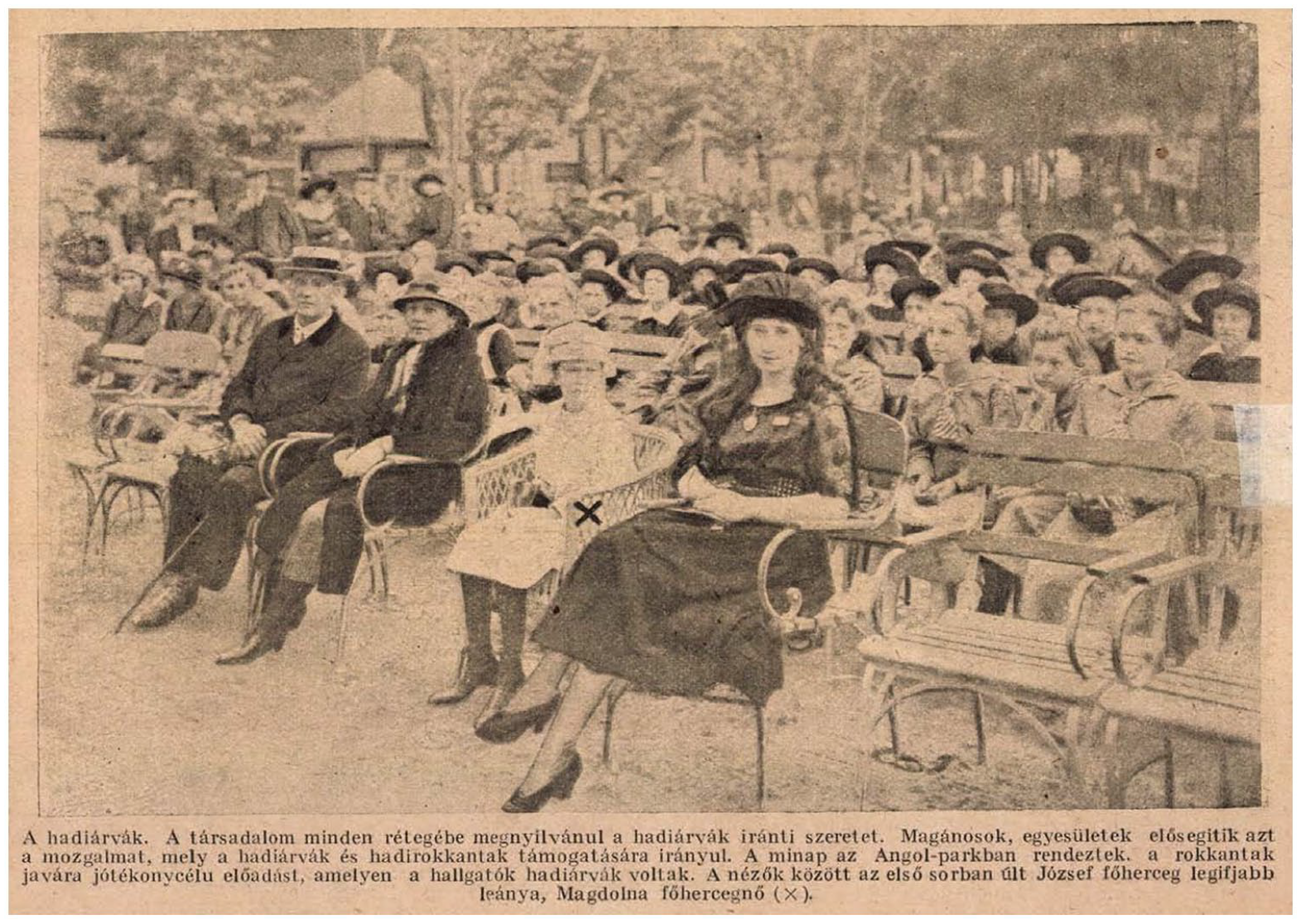
‘The war orphans’ [‘A hadiárvák’], in: Tolnai Világlapja XX (October 1, 1920) 23, 4. Image is in the public domain. 67
Another initiative came from the National Association of Veterans, Widows and War Orphans (Hadirokkantak, Hadiözvegyek és Hadiárvák Országos Nemzeti Szövetsége), which had been newly established in 1920 by the Minister of Interior. Serving as a new governmental body that represented the state’s effort to centralize and professionalize the relief of the war’s victims, this association still relied on private funding and called up on all ‘socially and financially qualified individuals’ who could help this association to achieve its major goals. 69 National festivities in particular were seen as an ideal moment to raise funds for such relief endeavours. On 7 December 1920, it made a public appeal to all pupils and parents of one particular school, asking them to donate Christmas presents of ‘clothing, food, books, toys and money’ for the ‘sick war orphans and the children of disabled veterans’. 70
The Hungarian League of Child Protection (Országos Gyermekvédő Liga), one major child welfare organization at the time, also joined efforts with already existing philanthropic and child protection associations to explore ways of caring for the war orphans. 71 By 1920, the League was providing financial support, foodstuffs, and clothes for 1400 war orphans living with their mothers. 72 Relief for war orphans was often combined with relief for war widows and war invalids. Joint relief collections were also organized for these groups. 73 Contributions also came from individuals. In 1922, Endre Liber, the metropolitan governmental refugee commissioner in Budapest, personally arranged a 25,000-crown grant to Budapest’s József boys’ orphanage to support orphaned children of refugees from the cut-off regions. 74 The League was prepared to invest much of its own effort and the effort of its various associations into the care of war orphans, support which was welcomed by Hungary’s prime minister at the time. 75
4. Healing bodies
As it was a time of warfare, destitution, and the spreading of epidemic diseases, war orphans were particularly prone to physical destitution and illnesses due to their often precarious living standards. Assisting the children’s immediate physical recovery was typically the first concern of their relief. Pál Teleki considered it in 1918 an essential task of the National Military Welfare Office to ‘take care of the treatment of war widows and especially war orphans by trying to provide them with places in existing medical institutions’, paying for their care and increasing the number of beds in institutions. 76 Sanatoriums were established and were judged as ‘perhaps more important, [and] more human than educational institutions’ because they rescued the ‘thin and diseased children’ 77 who only after recovery could ‘be guided towards their future life path’ and ‘become useful to society and the country’. 78 Even years later, in 1930s Poland, ‘war orphans and widows were patients on equal terms with disabled ex-servicemen’, indicating how important the physical recovery of orphans was to the post-war states and how instrumental in pushing for the institutionalization of public welfare. 79
Back in September 1917, the Sophia National Sanatorium Association (Zsófia Szanatórium Egylete) opened the first children’s sanatorium for war orphans in Balatonszabadi by Lake Balaton (Figure 2). It cared for 225 sick war orphans. 80 Its financial appeal stressed how these orphans ‘surely deserve[d]’ public backing to ‘whiten the dark bread of their orphanhood’ and relieve them of feeling ‘the war’s horrors’. 81
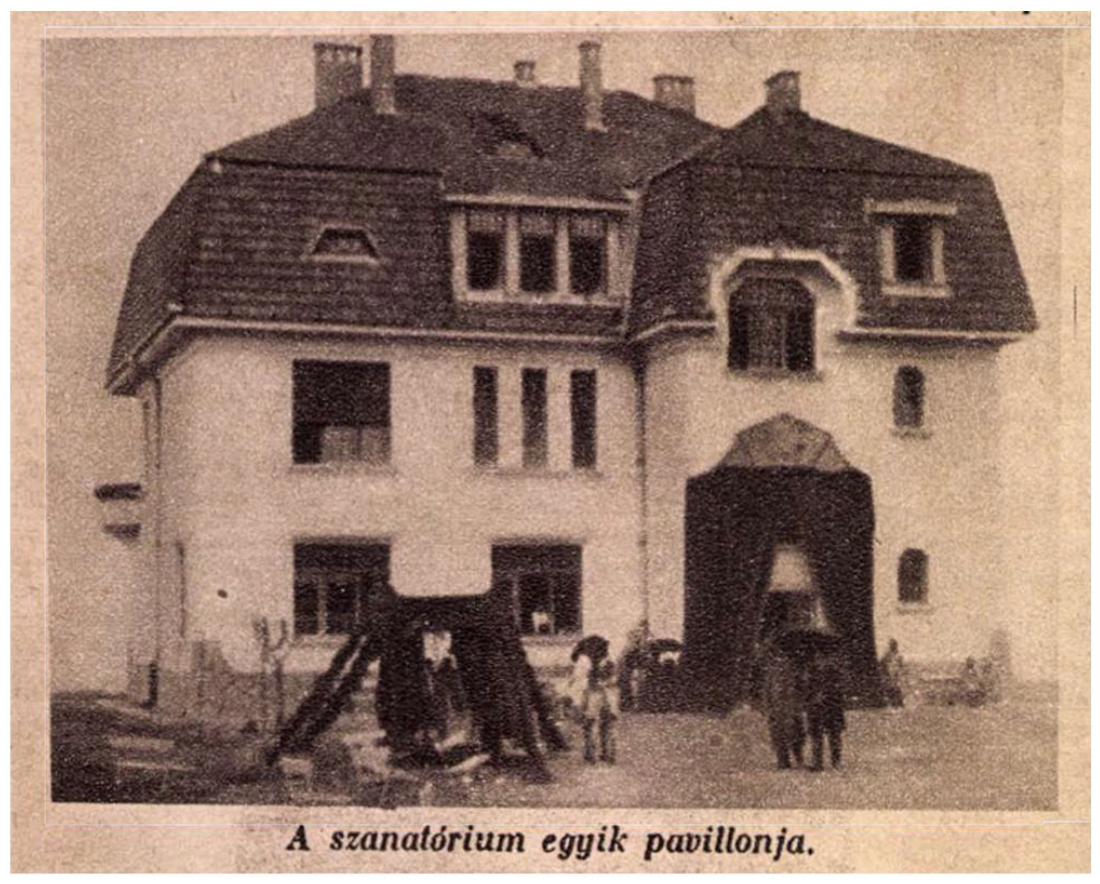
‘One of the pavilions of the first sanatorium’ [‘A szanátórium egyik pavilonja’], picture taken by János Müllner, part of the article ‘The first sanatorium for war orphans’ [‘Az elsó́ hadiárva-szanatórium’], in: Az Érdekes Újság V (September 9, 1917) 36, 1–2, 2. Image is in the public domain. 82
Contemporary media captures the importance laid on this new type of care institution by the Hungarian imperial state and its governing elite. At the ‘glistening opening ceremony’, the minister of the interior Gábor Ugron read out a speech written by the king. Catholic dignitaries gave similar public speeches, welcoming war orphans to institutions where the children’s care was a joint venture of church and state. One image of the ceremony (Figure 3) captures the arrival of a group of war orphans supervised by a Catholic nun. The image mirrors the extensive involvement of the Catholic Church in the orphans’ physical recovery and care.
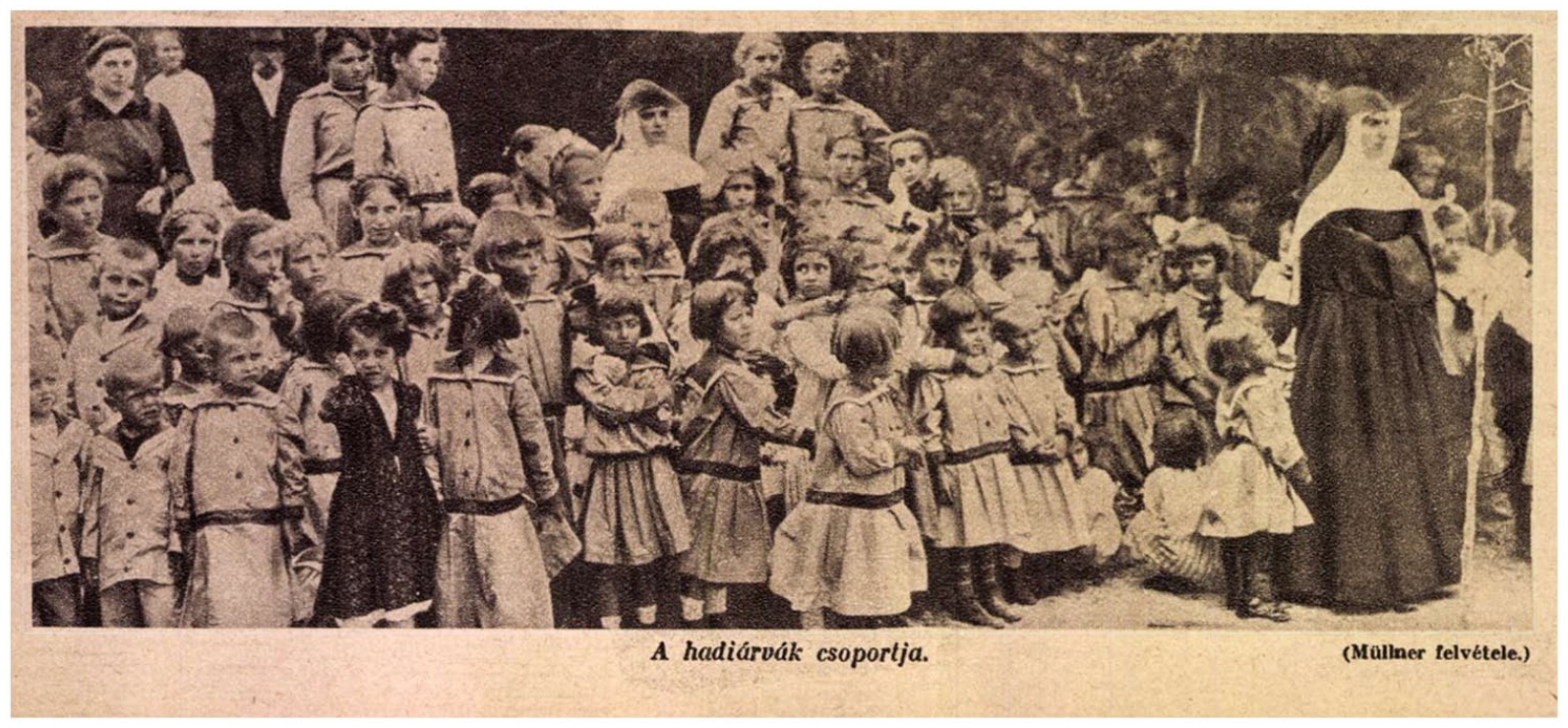
‘A group of war orphans’ [‘A hadiárvák csoportja’], picture taken by János Müllner, part of the article ‘The first sanatorium for war orphans’ [‘Az elsó́ hadiárva-szanatórium’], in Az Érdekes Újság V (September 9, 1917) 36, 1–2, 2. Image is in the public domain. 83
As more children entered the sanatorium for care, ethnic nationalism rhetoric became more common. A journal article from 17 June 1917 complained about the placement of German-speaking children ‘who flooded the country’ and thus prevented the sanatorium from hosting Hungarian children: at all times and under all circumstances, we must think first and foremost that our own children are in need of our cherishing love, and only from our excess love can we give our guest children something that must never be forgotten.
84
In a similar vein, Gyula Noé, a catholic chaplain of the city of Pápa, complained in Magyar Kultúra that the war orphan sanatorium was ‘taking up very few war orphans’ but instead ‘children whose parents were enjoying a holiday in Karlsbad’. 85 He berated the sanatorium’s leadership and nurses, who were Jewish, for prioritizing ‘the seedlings of the mostly Jewish vacationers’ instead of taking the ‘real’ ‘starving and thirsty orphans’ roaming the streets of the nearby city of Siofok. 86 The author’s claim that the state’s caring for its heroes’ children was being undermined by a wealthy vacationing Jewish elite was supported by a ‘denominational statistic’ identifying 47.2% of the children as Catholic, 12.7% as Protestant, and 38.4% Jewish. 87 Rather than acknowledging that the probable cause of the high percentage of Jewish children was anti-Semitic persecution in Hungary together with an influx of Jews fleeing from Galicia, the author resorted instead to the antisemitic stereotype of the Jewish profiteer. Péter Bihari has argued that such antisemitic authors thought that the war was completing ‘the process by which a triumphant Jewry came to usurp the place of the declining Hungarian middle class’. 88 The discourse about children’s welfare fed into such antisemitic ranting.
One other provision supplemented the sanatoriums. In 1918, together with General Ottokar Landwehr, Charles IV, the last king of Hungary, developed an action plan to improve the health of the country’s most disadvantaged children. ‘Weak and tired’ children, often orphans, were to have respite from the ‘smoke-filled cities and industrial areas’ and enjoy a 6-week holiday with families in the villages. It was hoped that the village people, ‘although they had suffered deprivations due to the war’, would understand, ‘how much it [would mean] to the urban children, who for many months had not been given milk, butter and green vegetable stew’. 89 The scheme aimed to ‘restore [the children’s] health’ and ‘strengthen’ the countries of the monarchy. 90 An article entitled ‘The King for the Children’ in Pesti Hírlap called on its readers to ‘donate for the benefit of the widows and orphans of the fallen heroes![. . .] Let us donate to the Red Cross Society! Let us help the families of those who went to war and the relatives of those who have fallen’. 91
This new welfare movement aimed to support Hungary’s childcare institutions through private donations. In the meantime, Hungarian society, especially the better-off, responded to the call to provide the children with temporary placements. By April 1916, ‘thousands of letters from warm-hearted ladies and married couples’ were reaching the League of Child Protection. Showing the ‘most beautiful human compassion’, 92 these people were willing to take a child into their home for several weeks. However, Lydia Kovács, who authored the article, also had harsh words for ‘those men’ in politics who expected such voluntary efforts when the state should be doing more against child disease and poverty: ‘we respectfully ask the government: are social organizations really sufficient to fight and overcome this menacing threat?’ 93
5. Placing orphans
Once the orphans had physically slightly recovered, they were to be moved to their long-term placement. Kun believed that the state should take over the care of war orphans in cooperation with remaining family members. If mothers or close relatives were still alive, the child should remain in the family; otherwise they should be placed in institutional care. 94 In a meeting held in 1916, Count István Tisza, Prime Minister at the time, responded to Count Edelsheim-Gyulay Lipót’s question on the issue of war orphans, saying that the ‘orphans should grow up in the living conditions they would grow up in if their caregiver had not been killed, and second, they should receive at least the education they would have received if their fathers had survived’. 95
Much of the contemporary dialogue harked back to ideal notions of children’s upbringing before the war—‘the warmth’ and ‘invigorating, blissful softness’ of family life with ‘parental love and affection’, all now abruptly destroyed. 96 To prevent emotional neglect and degeneration, all efforts should be made to ‘raise orphans in a family context, preferably within their own family’. 97 Others were to receive their own ‘guardians’, providing care not in a ‘general, hazy way’, but with defined responsibilities. 98
The building and staffing of orphanages was not only a costly burden on the state, it was also criticized by contemporary pedagogues who insisted that ‘the orphanage is not a home, only an institution’. 99 For children at their ‘most receptive, frail age’, it could never provide the education and upbringing ‘a conscientious, serious educator’ could offer. 100 The children would be forever disadvantaged. A newspaper article from January 1917 also shared this feeling. The orphanages’ ‘four brick walls’ and the ‘many orphan brothers around’ would continuously remind the children of their abandonment and that they would have to struggle through life without anyone’s care: 101 they deserved to be raised in the ‘intimacy of family life’. 102
Official adoption was therefore seen as the most advisable resort. 103 For this, it was necessary to establish which parents might adopt and to ascertain their financial situation, what their family life looked like, and whether that family suited the child. 104 In 1918, the National Military Welfare Office agreed, for instance, to support an elderly childless couple with the purchase of a dilapidated house, with the condition that they would adopt a war orphan. With this example, Pál Teleki wanted to show a way towards simultaneously solving the housing crisis, ‘the case of fatherless and motherless orphans’ and of ‘childless war invalids’. 105 Childless parents used the contemporary media to actively search for war orphans for adoption. In January 1917, a childless school director and his wife were searching for a two- to three-year-old female, full orphan from a family of workers, merchants, or clerks. Another couple, two ‘good-spirited’ landowners, were looking for two 9-year-old male war orphans from peasant families to live with them in a ‘wealthy, happy and warm home’. 106 Such adoptions, especially the ones for children with a specific family background, were not always driven by emotional and empathetic considerations, but reflected clear economic concerns tied to the children’s potential labour contribution at home, in the field or in a workshop.
Hence, such adoptions did not always mean that the actual placement fulfilled basic requirements or secured a stable upbringing. The placement of orphans in foster families carried the risk of the child’s exploitation. In 1922, Selskar M. Gunn, an officer of the Rockefeller Foundation, reported from an exploratory trip to Hungary that the boarding of fatherless children among peasants in the Hungarian countryside had become severely impaired. 107 Because of ‘inadequate remuneration paid by the State’, peasants were no longer willing to foster children, and the situation was aggravated by the large numbers needing placement. 108 Gunn believed that the state should make it its primary task to care for the orphaned children and thus rescue ‘the future generation’. 109
The Ministry of Welfare institutions aimed to fulfill these expectations and offer the children a home One institution alone had admitted ‘no less than 16,000 children’. 110 But many orphaned children remained in the dreadfully ‘unhealthy’ flats in the outskirts of Budapest, 111 where many unsupervised, ‘shabby children’, especially young girls, congregated around the barracks for convalescent soldiers. 112 The supervision of neglected children was a high-priority social task: if nothing was done, it was believed that the children would quickly turn criminal. The state was called upon to act fast for the offspring of ‘war heroes’ who ‘[had given] their lives for their country and for us!’ 113
Both in response to the lack and the quality of foster families from the later years of the war onward, orphanages and institutions for boys and girls were established throughout Hungary under the supervision of the Ministry of Public Welfare and Labour. Sites included Tokaj, Székesfehérvár, Nyíregyháza, Ikervár, Vác, and Budapest. 114 An Erzsébet Girls War Orphan Home (Erszébet hadiárva leány-otthon) was opened in Budapest and a war orphanage in Makó. Boys’ homes were opened in Cegléd and Pápateszér. 115 The National Military Welfare Office collaborated closely with local orphanages. When orphans, who could not remain with their mothers or be placed with relatives, had to be placed in the capital’s state orphanages or had to received special education, it was the National Military Welfare Office’s responsibility to cover the costs. 116 For instance, in July 1918 it reserved 100 places in the capital’s state orphanage at no cost for war orphans between 6 and 12 years old. 117 They had to be of Hungarian nationality and from Budapest, 118 and there was a gender bias: 94 places went to boys and only 6 to girls. The National Military Welfare Office also supported war orphans elsewhere. 119 The creation of small ‘family orphanages’ was promoted as a ‘radical solution’ to avoid anonymous, collective herding. Located in villages and small towns, which had clean air and suffered less from food crises, 120 these family orphanages were run by childless middle-aged couples and housed around 15–25 children each.
Already before the war, as Tara Zahra points out, ‘orphans seemed to offer the ideal raw material for nationalist movements’. Continuing a nineteenth-century tradition, orphanages saw it as their task to ‘save children from the perceived threat of denationalization in public orphanages [. . .] of the national enemy’ and pursue nationalist social work through the nationalization of these foreign children. 121 Just as the care for orphans was ‘the nation’s honourable duty’, 122 so was it their carers’ duty to promote ‘the engagement of children with the nation through propaganda, heroism, and symbolism’. Thus, concern for the ‘hypothetically universal category of “children”’ could not transcend ‘the particularism and ethno-religious differentiation that characterized the political landscape’. 123 Due to massive post-war population displacement and the dissolution of empire in Central and Eastern Europe, orphans and juveniles became especially promising ‘targets for radical propaganda’ if they ended up in newly nationalizing states. 124 By integrating war orphans from different ethnic groups into its welfare experiment, the Hungarian nation would, it was claimed, experience a ‘rejuvenating and refreshing empowerment’ 125 —a ‘big step’ forward for the ‘nationality issue’—achieved through a needful pedagogic undertaking. 126
However, this was not always the case. To diminish the influence of the majority society on ethnic and religious minorities, religious and philanthropic organizations opened private orphanages for their adherents. The National Catholic League, for instance, opened a war orphanage for the education of Roman Catholic boys. 127 Jewish communities too established orphanages and relief institutions for Jewish war orphans. On 4 May 1916, during a meeting of the National Israelite Patronage Society (Az Országos Izraelita Patronage Egyelet), Rabbi Simon Hevesi called ‘upon all Hungarian Jewry to hasten to help the orphans, the most desperate victims of the war’. Although they ‘stood the farthest from the war itself’, they were the ones who had ‘lost the most’. His proposal to set up the first Jewish war orphanage was unanimously accepted. All those who attended the meeting ‘departed with the uplifting feeling’ that they knew ‘their duty towards the orphans of the dead heroes’ and that ‘there will never be a Jewish war orphan who will suffer any special needs’. 128
6. Gendering relief
Beyond the ethnic and religious dimensions of relief, contemporary media also mirror how gendered the approach to the war’s child victims was. In September 1917, for instance, a war orphan scholarship of 1000 crowns was advertised to be given ‘to the most beautiful war orphan’. 129 The contest was open to ‘female orphans of Hungarian heroes’ who had died in the Great War. In the days leading up to 31 March 1918, the widely read illustrated Interesting Newspaper (Az Érdekes Újság) invited submissions of photos of orphaned girls in the age range from 6 to 20 years old. The photographs were to be reviewed by a special jury. The photos of the most promising ‘beauties’ were then to be published in a ‘real beauty album of Hungarian war orphans’. 130 Using the female orphans’ unharmed and appealing physical appearance as a selection criterion for a financial scholarship was intended not only to rescue the girls from social downfall but also to display that the war had not destroyed the state’s future ‘human material’. This beauty context was to exhibit the bodily quality of the heroes’ female descendants.
This wartime beauty contest was understood as a contribution to the Hungarian state’s new ‘social endeavour’ and humanitarian mandate to help families ‘affected by the war’—especially families of ‘invalid soldiers’ and ‘fallen heroes’. 131 On the one hand, it was willing, as many other beauty contests throughout the twentieth century, to ‘promote certain traditional ideas about women’s roles and to reward women who pursue beauty and try to please men rather than competing with men in other areas of life’. 132 On the other hand, reminders of the unharmed physical beauty of the girls whose fathers had died or had become severely wounded was a strategy to remind a war-fatigued society of the value of life and of the beauty of young and healthy human bodies.
While the war was still raging, female beauty pageants like this helped ‘to deflect attention away from things [society and the state] preferred to hide’ 133 —the bodies that had been killed or damaged by the war, the minds that were shell-shocked, and the families that were disrupted. The photographs of the ‘beautiful’ war orphans, who as children embodied the future of the nation and as girls would one day be the nation’s future mothers, helped to preserve morale and remind readers of the country’s well-being and future. The girls’ physical beauty, still intact, was presented as a rebuttal to the war’s corporal destructiveness and the social disruption caused by territorial reconfigurations.
In contrast to the girls who were portrayed as innocent and unharmed, their widowed mothers received far more ambiguous media coverage. Their public depiction shifted between images of widows as destitute yet valuable members of society to denunciations as careless mothers and ruthless profiteers. Widowed mothers figured prominently in the discourse because relief for the war orphans could not be delivered directly to the orphans but had to go through their mothers or relatives as caregivers. An academic publication from 1915 on the ‘Protection of War Orphans’ shows that the war orphans were divided into ‘urgent’ and ‘less urgent’ categories when assessing their relief needs. 134 When ‘urgent’ relief was given, it was checked whether the mothers actually used the welfare provisions as intended ‘in the interest of the war orphans’. 135 Widowed mothers were warned not to become ‘easy women’ (könnyelmű nő) falling into prostitution, which was considered a step down ‘the road of criminality’ (bűnözés útjára) and would ‘cause the ruin of their family’. 136
In post-war Germany, too, widows faced ‘economic hardships, social stigma, and a scarcity of child-care options [which] discouraged many single mothers from raising their children’. 137 While war orphans, of which there were 1.2 million in Germany at the time, were watched closely, home funds were paid ‘dependent on limited widows’ pensions and their single mothers’ meager earnings from low-paid work’. 138 Yet, as ‘primary caregivers for war orphans’, widows were often considered valuable members of society as they ‘helped shape the nation through their children’. 139
At other times, widows were portrayed as ‘social leeches’. Instead of reporting on the difficulties widowed women faced when raising their children alone, Hungarian print media tended to give undue attention to women who were allegedly exploiting the newly emerging welfare regime. Some contemporary articles elaborated in detail on stories of women’s organized theft and cheating where people had abused the ‘cause of the war orphan’ for personal financial gain. They suggested that ‘many mothers’ misused what they received, and sent their small children out to beg. 140 ‘[M]any urban mothers’, one journalist maintained, were ‘immoral’ in their behaviour and were spending their children’s welfare money on themselves, thereby committing a ‘terrible sin’. 141 It was claimed in 1917 that there could be ‘a lot of talk’ about such widowed mothers who ‘spent even that little war relief on their own clothing’ while exposing their orphans ‘to the cold of god’. 142 Other reports spoke of women from the poorer classes who took their children out of school to assist with ‘heavy physical work’. 143
Widowed mothers who were unwilling to give their children away and expected them instead to work were portrayed as being driven by ‘greed for profit’. 144 Other mothers condemned by the press were those who would prefer to suffer and starve with their half-orphaned children, ‘let[ting] these innocent children [. . .] become physically stunted’ rather than place them in institutional care. 145 Such negative stereotypes of widows not caring properly for their children drew attention to the fact that it was due to conservative family notions that widows and their half-orphaned children even found themselves caught between social stigmatization and heroization. The stigma remained even until after World War II, when it continued to be difficult for widows to raise half-orphaned children alone because it did not fit the ideal notion of an intact family centred around a male breadwinner. 146
Such notions were widespread in post-war Europe. Young-Sun Hong argued about the German, contemporary public discourse that the ‘collapse or failure of the family crystallized on the fear that the mother-child-bond—which was viewed as the best and most natural basis for child-rearing—was breaking up’. 147 While the war contributed to the actual emancipation of women, and especially of widows due to their necessary integration into the labour market and their role as sole caretakers, there emerged simultaneously social fears about the long-term implications of such altered gender roles for the coming generations.
Pronatalist family policies of the later interwar period can be viewed as a conservative backlash to this reconfiguration of the family. If mothers were judged unable to properly care for their half-orphaned children, the new post-war states themselves became involved with welfare measures and provisions. Fearing that children might turn towards delinquency and moral degeneration, European states invested in the development and implementation of state care. What followed was the ‘intense and rapid intrusion of state authority’ into the private sphere of the family and/or of the surviving orphans, which went hand-in-hand with a politicization of these parts of society. 148 Following the country’s defeat, in December 1918 Friedrich Ebert considered it for instance the new German government’s ‘principal duty’ to take responsibility for the ‘welfare of war victims, including orphans’, thus shifting responsibility for these children from families to national and local authorities—from parental care to state protection and interventionist welfare. 149
Beyond the fear of mothers’ asocial behaviour, reading contemporary media also reveals how the expansion of children’s welfare went hand-in-hand with emerging fears of economic exploitation through ‘fake’ orphans. In Hungary, attention-seeking stories referred to restaurants and coffee houses apparently visited by well-dressed children collecting money as war orphans. One such story began with an incident on 6 July 1916 when a handsome young woman in an Austrian spa city was reportedly caught by the police as she ‘pretended to be a war orphan’. 150 This was expanded into an ‘amusing’ fictional tale entitled I’ll be right back!, which appeared in the Hungarian journal Tolnai Világlapja. Appealing to the wealthier classes, the woman in this story had apparently collected substantial sums that should have gone to the ‘valuable and respectable issue’ of the true ‘lamentable war orphan’ to whom the public was eager to donate money. Instead, it ‘went into her Cossack skirt and her straw hat’. 151 Even the story’s author fell into the trap, the tale continues, when one day he was approached by this attractive lady during his lunch at the train station. After joining him at the table and having consumed several dishes and drinks, she simply disappeared after exclaiming, ‘I’ll be right back!’. 152
Stories like this reveal the country’s deep-seated fears that the new welfare measures which were meant to help orphaned children would be open to abuse by the ‘wrong’ elements of society. The authorities felt that strict controls should be introduced to prevent women from abusing the financial aid and from exploiting their half-orphaned children. Awkwardly and tentatively, both society and the state were starting to define criteria of ‘deservingness’ for welfare recipients.
7. Educating and lobbying for orphans
Driven by fears of the orphans’ and the country’s potential physical and moral degeneration, contemporary pedagogues in Hungary believed that the state should also take over the responsibility for the education of those children who had become disadvantaged due to the war. It was in the interest of the state itself to raise children to become ‘real, serious, working’ individuals, ‘useful and noble citizens of the state’. 153 The state should provide orphans with a proper education up to the age of 12 and it should be the same education they would have received if ‘their fathers had not died or not become invalids’. 154
Smooth integration into the labour market was also considered important. Orphans and waifs over the age of 15 years were usually denied any further education and simply being assigned to factory work. This was harshly criticized, not only because of the loss of talent it meant to the Hungarian state. With deep irony, in 1916 an article in Magyar Pedagógia congratulated the authorities for turning these young people into resigned, unscrupulous, disinterested and ignorant proletarians who would neither have the motivation nor the knowledge to run their own businesses in the future, or even worse, who would drop out of work and become vagrants. 155
Contemporaries sensed the necessity to address the educational neglect these disadvantaged children suffered because Hungary’s ‘social life need[ed] to be renewed’ and the gap between the intellectual class and ‘the people’ bridged. 156 The National Military Welfare Office was particularly invested in supporting the war orphans’ secondary and tertiary education. In 1917, it advertised a scholarship of 400–800 crowns for continuing secondary schools, lower vocational schools, secondary vocational schools, and colleges. Yet, the scholarship was not only bound to age and residence but also to ‘appropriate behaviour and diligence’. 157 It also advertised the same scholarship in 1918 to war orphans of Hungarian citizenship who had demonstrated academic achievement that was worth investing into for their further education. 158
Orphanages also emphasized the social value and importance of vocational training. Skills were taught in leather-making, shoe-making, gardening, the making of artificial limbs, dressmaking, and weaving. 159 In both family settings and institutions, orphaned girls were expected to ‘become accustomed to profitable work, especially to home-based work activities’ that were ‘well-suited to their inclinations’. 160 The Royal Hungarian Institute for Female War Orphans in Tokaj (Magyar Királyi Leányhadiárva Intézet) offered female students training and employment in ‘white embroidery and the sewing of underwear’. Boys, on the contrary, were taught ‘basket weaving, wood carving or other cotton industries’. 161 Some of the state institutes aspired to be like ‘a large family, in which you can pursue your own home-based work’. 162 If such a practice spread, with the right staff and right materials, it was thought that orphanages might become ‘a guide for cottage industries in their entire neighbourhood, or possibly even the entire country’. 163 The war orphans’ education and subsequent employment in cottage industries was expected to help defray the costs of their institutional care as well as bringing other sectors of the local populations into profitable training and employment.
Ideally, the children were to have free choice regarding their own vocational training according to their own talents. The creation of useful citizens for the Hungarian state would require ‘that the future of these children should not be influenced by anything other than their personal aptitude and inclinations’. 164 While it was clear that education was important to prevent delinquency, a differentiation was made between the education of the orphaned girls and orphaned boys. Writing in 1915, László Zombory argued that Hungary should give ‘particular priority’ to orphaned boys: ‘purposeful training’ to turn them into mentally and physically healthy men was crucial for Hungary’s ‘national existence and future’. 165
The upbringing of some of the orphaned girls, however, was believed to be better managed in an institutional framework or orphans’ ‘home’. Girls who were exposed to the dangers of moral degeneration but had not become morally ‘debauched’ (leromlott) were to be placed in such a home, staying there until reaching the age of 18–20 years old. They could learn all the skills that would make them useful as future housewives. 166 Another suggestion was that orphaned girls should be placed in ‘family orphanages’ in the smaller cities, where they could receive commercial or industrial training, or else become kindergarten assistants or teachers. 167 Social isolation and a steady occupation were used as instruments to protect the girls’ virginity and thus secure them for the marriage market.
Of course, the state also wanted ‘serious educational work’ to produce motivated and skilled workers. 168 While many of the fitter orphans were to be drafted into industrial labour, agricultural training was also very important. Work in agriculture was perceived as an ideal means to strengthen the war orphans physically while also producing food for Hungary’s population at large. The orphans’ education in agriculture was considered ‘much healthier than spending time in the sooty air of the factories’. 169 Hence, so as to secure the (re)generation of a ‘strong future generation’, 170 only those youngsters tested as medically fit and strong should go to the industrial factories, while urban children ‘with a weak body’ should be allowed to flourish ‘in the lap of nature and become [. . .] robust’. It was believed that in doing so, ‘degenerated offspring will not be that frequent’. 171 Thus ‘agricultural training’ was considered the healthiest occupation to aid the physical recovery of the war orphans. 172 In July 1918, the National Military Welfare Office also advertised agricultural training scholarships for 15 Jewish war orphans and children of war veterans. The scholarship would enable 15 boys aged between 13 and 16 years to attend a three-year agricultural training programme, which included dairy farming, beekeeping, and fruit production at the Hungarian Jewish Association of Crafts and Agriculture (Magyar Izraelita Kezmű-és Földmivelési Egyesültet). 173
The proper education of Hungary’s disadvantaged children that would turn them into the nation’s ‘people’ in a ‘renewing, regenerating movement’ was expected to lay a solid foundation for ‘the future of the Hungarian nation’. 174 On 3 March 1917, Tolnai Világlapja published a poem by Kiss Menyhért called ‘The War Orphan’. In this, the author hailed Hungary’s war orphans as ‘the richest flower of this blood-stained earth’. As their fathers’ tombs were in foreign countries and they ‘sighed in vain, “Father, help me!”’, the poem continues, the ‘nation of Hungarians’ would be their ‘sweet father’ and ‘dear Hungary will extend its thousand-year-old marble arms’. Menyhért even drew a direct comparison between the impoverished conditions into which Jesus was born and the lot of the war orphans. Under the ‘ravages of the storm’ (the war), ‘the holy star above [the orphans’] [. . .] cradles trembled just as it did above the straw crib in Bethlehem’. 175 Christian narratives and symbolism were commonly used to draw attention to the suffering of the orphans and raise money on their behalf.
A conviction that the children of World War I ‘laboured and sacrificed for the nation and provided the rejuvenating source for the nation’s future’ 176 engendered great concern and the belief that they should receive proper care and education. This had wider significance. Not only did it prevent the social decline of these disadvantaged children, it also altered expectations for the majority society. Herein, we can detect how the war’s radical intervention in children’s lives brought about social change. The children were to become their own change-makers. The care and relief to which all agreed they were entitled was part of ‘the complex issue of the war victim welfare within the larger context of [the state’s] [. . .] coping with the war’s overwhelming domestic consequences’. 177
The expectations of the war orphans were closely related to those of the veterans in the Austro-Hungarian Empire. After their return from the front, they had one clear goal: to hold the state responsible and to remind it of its moral duty, as a ‘fatherland’, ‘to express its gratitude’, and to honour their sacrifices and compensate them for their service during the war. 178 Although children could neither advocate for nor help themselves, contemporary pedagogues and politicians advocated on their behalf. By 26 September 1924, when the Geneva Declaration for the Rights of the Child was adopted by the League of Nations, the special vulnerability of orphans and the necessity to rescue them had become internationally recognized. In its second article, the declaration demanded from its signatories to do everything in their powers so that ‘the orphan and the waif must be sheltered and succored’. 179
Two weeks later, the 4th International Children’s Rights Congress was held in Vienna and Budapest. Organized by the International Save the Children Union (UISE) in Vienna from 6 to 8 October and in Budapest from 9 to 11 October, the congress was intended to advocate for the adherence to the children’s rights declaration. The congress was devoted to various discussions about the fate of children especially in Central and Eastern Europe and the Middle East. It also focused on visits to various child welfare institutions in the two post-war states, including the state orphanages, children’s shelters, and child healthcare facilities. The final aim was the signing of the declaration by both countries’ representatives. 180
On 10 October, Hungary signed the Geneva Declaration, translated by Count Albert Apponyi to Hungarian, during a formal ceremony in the parliament attended by the representatives of Hungary’s main organizations of child protection, the National Child Protection League, the Stefánia Association, and the Hungarian Red Cross. The declaration’s signing was perceived as a step towards Hungary joining the system of international child protection. In October 1924, one of the Hungarian organizers of the congress envisioned that this international declaration would serve as a common ground to ‘ensure uniformity of child protection’ in the signing countries. In the interest of a ‘common humanity’, it aimed to lay the basis for an international acknowledgement of children’s special rights and needs of protection, irrespective of children’s racial, ethnic, and religious differences. 181
Yet, the visionary character of this declaration often clashed with the reality of children’s actual relief and welfare in the respective countries. Although much was indeed achieved in local infrastructure, the development of a global lobby and various measures of relief for the war’s orphans, the issue of Hungary’s war orphans still continued to figure prominently in the mid- and late 1920s. In July 1925, an article in the Social Democratic newspaper Népszava asked, ‘Who will take care of the war invalids?’ The author denounced the fact that even though ‘the suffering of the invalids, the widows and the orphans had been well known for quite some time’, the government had admitted that ‘a defeated and largely deprived country cannot help the victims of the war as much as they deserve for their great sacrifices and sufferings’. Still, the government was called upon to ensure that the country’s war victims, ‘heroes’ and ‘survivors’ would be provided for, and especially their offspring. 182
Even seven years after the war had ended, it was still considered vital to acknowledge the fallen heroes’ sacrifice of their own lives when aspiring towards a better life for their children by taking care of them. 183 The state’s care for war orphans was believed to offer ‘a means of paying tribute to fallen heroes’. 184 The funds to provide comprehensive care were, however, insufficient, so the issue of the war’s orphans remained alive throughout the 1920s. Yet, what had changed was the establishment of a particular welfare infrastructure that felt responsible for the war’s indirect child victims and which made every effort to ameliorate the general state of destitution and prevent further impoverishment.
8. Conclusion
In its wake, World War I left many widowed women and orphaned children as ‘surviving dependents’. 185 Further long-term social consequences came with its aftermath, which included the (re-)drawing of state borders and the abrupt and permanent displacement of populations who had survived the years of conflict. Although care for orphans is as old as human society, the sheer scale of the problem greatly increased the public visibility of fatherless and parentless children in post-war Europe. As the offspring of Hungary’s ‘heroes’, hailed for having sacrificed their lives for the Hungarian nation, war orphans gained great public attention during and after the war.
Contemporary media fuelled fears about the physical degeneration of the new Hungarian state that would ensue if its future generation, most dramatically embodied by the fatherless war orphan, were to turn into socially ‘useless’ and possibly even delinquent ‘moral cripples’. Contemporary politicians and pedagogues argued that a core part of Hungary’s future society would be lost and hopes of rebuilding the shattered population and building the new nation state would be doomed forever. The orphans’ blamelessness and their social value were without question. Throughout Europe, war orphans were ‘metaphors of the past rather than of the present’. 186 It was time to build a future in which the orphaned children were key—and for that reason and purpose they would have to be properly nourished. Yet war orphans perfectly captured the ways in which the war had harmed and ruptured civilian lives and in particular families. As Tammy Proctor argues, ‘civilians are not merely confined to a separate and protected home front space in times of war’, 187 they were suffering in manifold ways from the short- and long-term implications of the war and its aftermath. The cause of war orphans demonstrates how closely the war’s battlefield and long-term implications and the children’s private lives were intertwined. Their suffering blurred the clear line between the front and the home front.
Since war orphans could no longer fully rely on their disrupted birth families, the state was challenged to take over responsibility for the war’s child victims. The masses of orphaned children amounted to so great a number that the Hungarian state started taking child protection under permanent government control. The burden of care thus shifted from natural familial relations to the emerging state welfare institutions, which undertook the placement, care, and education of the children; their well-being was no longer left to the goodwill of the surviving parent. In loco parentis, the Hungarian state was to fill the role of the dead or absent father, providing fatherless children with war-related benefits. In this way, though themselves helpless, children ‘who had been robbed of a normal family’ 188 changed the way that care for the vulnerable was conceived and implemented. Against this backdrop, World War I not only caused the disruption and destruction of familial ties. The international conflict and its ensuing years also brought about a transformation in how children’s care and welfare were conceived, generating a new welfare approach towards those children whom the war and its aftermath had left in most precarious and destitute circumstances. Both during and after the war, states also sensed that the destiny of orphaned children had great ideological potential to draw attention to the destructiveness of the war and express the need to envision and invest into a new future for the respective children and their home countries.
Footnotes
Funding
The author(s) received no financial support for the research, authorship, and/or publication of this article.
1.
I. Lajos, ‘Szemle. A hadiárvák nevelésének kérdéséhez’, in: Magyar Pedagógia 25 (1916), 289–296, 290.
2.
Ibid., 290.
3.
In 1898, the Law XXI was implemented which made the Hungarian state responsible for the care of abandoned children below the age of seven. See M. Dickmann, ‘A Fővárosi Gyermek- És Ifjúságvédő Intézet (Gyivi) Története,’ Család, in: Gyermek Ifjúság 10 (2001) 3, 4.
4.
For research on war orphans, see the work of O. Faron, ‘The Age of War Orphans: Construction and Realities of a Group of State Wards between Education and Assistance (1917–1935)’, in: The History of the Family: an International Quarterly 4 (1999) 1, 17–29; E. Ayalon, ‘Orphan Relief in the Jewish Community in Jerusalem during and in the Aftermath of the First World War’, in: Journal of the Ottoman and Turkish Studies Association 3 (2016) 1, 115–137.
5.
T. Proctor, ‘Reclaiming the Ordinary: Civilians Face the Post-War World’, in: Luc Verpoest et al. (ed.), Revival After the Great War: Rebuild, Remember, Repair, Reform, Leuven 2020, 127–140, 128.
6.
P. Teleki, Szociálpolitika és hadigondozás, Budapest 1918, 10.
7.
For further research on the particular situation of orphans in Central and Eastern Europe, see the work of A. Griffante, Children, Poverty and Nationalism in Lithuania, 1900–1940, Cham 2019; A. Purs, ‘Orphaned Testimonies: The Place of Displaced Children in Independent Latvia, 1918–26’, in: N. Baron (ed.), Displaced Children in Russia and Eastern Europe, 1915–1953. Leiden 2017, 40–69; N. Maksudyan, ‘A Triangle of Regrets. Training of Ottoman Children in Germany during the First World War’, in: B. C. Dortna (ed.), Childhood in the Late Ottoman Empire and After, Leiden 2016, 141–172; U. Üngör, ‘Orphans, Converts, and Prostitutes: Social Consequences of War and Persecution in the Ottoman Empire, 1914–1923’, in: War in History 19 (2012) 2, 173–192; T. Zahra, ‘Teachers, Orphans, and Social Workers’, in: T. Zahra (ed.), Kidnapped Souls: National Indifference and the Battle for Children in the Bohemian Lands, 1900–1948, Ithaca, London 2008, 49–78.
8.
I. G. Szűts, ‘Optálási jegyzőkönyvek mint a trianoni menekültkérdés forrásai’, in: Századok 6 (2018), 1236–1260.
9.
O. Faron, ‘Aux Côtés, avec, pour les pupilles de la nation. Les formes de mobilisation en faveur des orphelins de la Première Guerre mondiale’, in: Guerres mondiales et conflits contemporains 205 (2002), 15–33, 15.
10.
‘Hadiárvák és a kertészeti pálya’, in: A kert 8 (15 April 1918), 243–246, 243.
11.
Teleki, Szociálpolitika és hadigondozás, 88.
12.
M. Mouton, ‘Missing, Lost, and Displaced Children in Post-war Germany: The Great Struggle to Provide for the War’s Youngest Victims’, in: Central European History 48 (2015) 1, 53–78; S. Audoin-Rouzeau, La guerre des enfants 1914–1918: essai d’histoire culturelle, Paris 1993; M. Pignot, Allons enfants de la patrie. Génération Grande Guerre, Paris 2012; P. Gatrell, ‘Displacing and Re-placing Population in the Two World Wars’, in: Contemporary European History 16 (2007) 4, 511–527; N. Baron (ed.), Displaced Children in Russia and Eastern Europe, 1915–1953, Leiden 2017; O. Faron, Les enfants du deuil: Orphelins et pupilles de la nation de la Première Guerre mondiale (1914–1941), Paris 2001.
13.
P. Pironti, ‘Warfare to Welfare: World War I and the Development of Social Legislation in Italy’, in: Historical Social Research / Historische Sozialforschung 45 (2020) 2, 187–216; V. Pawloswky / H. Wendelin, ‘Government Care of War Widows and Disabled Veterans after World War I’, in: G. Bischof / F. Plasser / P. Berger (eds.), From Empire to Republic. Post-World War I Austria, New Orleans 2010, 171–191; M. Geyer, ‘Ein Vorbote des Wohlfahrtsstaates: Die Kriegsopferversorgung in Frankreich, Deutschland und Großbritannien nach dem Ersten Weltkrieg’, in: Geschichte und Gesellschaft 9 (1983) 2, 230–227; R. Wall / J. Winter (eds.), The Upheaval of War: Family, Work and Welfare in Europe, 1914–1918, Cambridge, MA 1988.
14.
The history of Hungarian orphans during and after WWI has been largely ignored in Hungarian historiography, except a few recent internet publications, such as T. Karika, ‘Az első világháborús hadigondozás Magyarországon’, 19 August 2020,  , (accessed 13 December 2020) and descriptive histories of war welfare institutions, such as C. Schutzbach, A HONSZ története, Veszprém 2017, not much secondary literature can be found on the topic.
15.
W. R. Grove, War’s Aftermath, New York 1940, 169–170.
16.
‘Junior Red Cross Begins Old World Work’, in: The Red Cross Bulletin III (19 May 1919) 21, 6. (675)
17.
I. Zombory, A Hadiárvák védelme, Kolozsvár 1915, 4.
18.
Ibid.
19.
‘Gondoskodás hadivárvák’, in: Pesti Napló 67 (11 January 1916) 11, 14.
20.
‘Országos hadigondozó szervezet’, Köztelek 12 (24 March 1917), 448.
21.
‘A Magyar háziipar és háziipar oktatás’, in: Néptanítók lapja 55 (18 May 1922) 18–20, 5–15, 14.
22.
C. G. Bowden, ‘Economic Conditions and Relief in Hungary, 1920–21’, in: American Relief Administration Bulletin 2 (1 May 1921) 12, 12. Library of Congress, Washington.
23.
An article of 1918 praises the governmental relief provided to the war orphans. ‘Százhatvanhárom hadiárva’, in: Népszava 46 (4 August 1918) 180, 7.
24.
M. K. Stolee, ‘Homeless Children in the USSR, 1917-1957’, in: Soviet Studies 40 (January 1988) 1, 64–83, 64.
25.
J. Marten / M. Honeck, ‘Introduction: More than Victims. Framing the History of Modern Childhood and War, in: idem (eds.), War and Childhood in the Era of the Two World Wars, Cambridge 2019, 15–29, 18.
26.
L. Murdoch, ‘‘Their Charge and Ours’: Changing Notions of Child Welfare and Citizenship’, in: Imagined Orphans: Poor Families, Child Welfare, and Contested Citizenship in London, New Jersey 2006, 142–161, 144.
27.
Pironti, ‘Warfare to Welfare,’ 188.
28.
E. Colpus, Female Philanthropy in the Interwar World. Between Self and Other, London, Oxford 2018, 9.
29.
Pawloswky / Wendlin, ‘Government Care of War Widows and Disabled Veterans after World War I’, 171.
30.
Ibid.
31.
Geyer, ‘Ein Vorbote des Wohlfahrtsstaates’, 230.
32.
J. Pershing, ‘Red Cross to Back the Army’, in: The Red Cross Bulletin 1 (31 May 1917) 3, 4.
33.
‘Each Unit of Our Army Abroad May Adopt and Care for a French Orphan’, in: The Red Cross Bulletin II (3 June 1918) 23, 8.
34.
J. F. Irwin, ‘Nation Building and Rebuilding: The American Red Cross in Italy during the Great War’, in: The Journal of the Gilded Age and Progressive Era 8 (July 2009) 3, 407–439, 435.
35.
‘Svéd Vöröskereszt Egylet a magyar gyermekekért’, in: Az Újság 17 (21 October 1919) 133, 5.
36.
Pironti, ‘Warfare to Welfare’, 198.
37.
A. Pettkó-Szandtner, Child Protection by the Royal Hungarian State, Budapest 1926, 14.
38.
B. Kun, Hadiárvák Érdekében Szükséges Tennivalókról, Budapest 1915.
39.
Ibid., 4.
40.
Ibid.
41.
Ibid.
42.
Ibid., 6.
43.
Ibid.
44.
Ibid., 8.
45.
Ibid., 8.
46.
‘Gondoskodás hadivárvák’, 14.
47.
Lajos, ‘Szemle. A hadiárvák nevelésének kérdéséhez’, 297.
48.
L. Zombory, Gyermekvédelem a Háború Alatt, Budapest 1916, 3.
49.
F. László, ‘A hadiözvegyek és árvák nyugdíja és az Országos Hadigondozó Hivatal’, in: Az Est (25 March 1917), 5.
50.
M. Balassa, ‘A Hadiárvák Védelme’, in: Dunántúl 7 (15 March 1917) 61, 2–3, 2.
51.
‘Hadiárvák és a kertészeti pálya’, 243–246, 243.
52.
Balassa, ‘A Hadiárvák Védelme’, 2.
53.
P. Pironti, Kriegsopfer und Staat: Sozialpolitik für Invaliden, Witwen und Waisen des Ersten Weltkriegs in Deutschland und Italien (1914-1924), Köln, Weimar, Wien 2015, 13.
54.
Its predecessor was the ‘Csonkított és Béna Katonákat Gondozó Bizottság’ [Committee for the care of mutilated and lame soldiers] which had been set up in February 1915 and was replaced in September 1915 by the ‘Rokkantügyi Hivatal’ [Office for the disabled]. This National Military Welfare Office was by the end of 1919 incorporated into the Ministry of Public Health. Parallel to the war-related welfare office, the Hungarian government also installed in June 1917 a Ministry of Labour and Social Welfare (Népjóléti és Munkaügyi Minisztérium) which centred its attention—among others—on child and social welfare.
55.
‘Országos hadigondozó szervezet’, in: Köztelek 12 (24 March 1917), 448.
56.
‘Ösztöndíj a hadiárváknak’, in: Pesti Hírlap 39 (15 July 1917) 177, 14.
57.
58.
‘A hadiárvákért és rokkantakért,’ Pesti Napló 68 (16 March 1917) 74, 2.
59.
Ibid., 2.
60.
Teleki, Szociálpolitika és hadigondozás, 4.
61.
Ibid., 6.
62.
Ibid., 10.
63.
Ibid., 9.
64.
Ibid., 100.
65.
Ibid., 6.
66.
‘A hadiárvák’, in: Tolnai Világlapja XX (1 October 1920) 23, 4.
67.
Source: Ibid., 4. Image in the public domain.
68.
‘Király a gyermekekért’, in: Pesti Hírlap 40 (31 March 1918) 77, 12.12.
69.
‘Hadirokkantak, hadiözvegyek és árvák nemzeti szövetsége’, in: Egyetértés 2 (23 June 1920) 140, 3.
70.
Csnády Frigyes, ‘Felhívás!’ 7 December 1920, Poster from National Pedagogic Library and Museum [Országos Pedagógiai Könyvtár és Múzeum], Budapest.
71.
Kun, Hadiárvák Érdekében, 8.
72.
‘Abrégé du compte rendu de l’activité de la Ligue pour la protection des enfants en Hongrie’, (most probably written by Valentin Clouzot), in: XII. Rapports de Budapest. ACICR B Mis 4.5./640 a 4.5./693. 1251-1351, 1254. Archive of the ICRC, Geneva, 1254.
73.
See on this ‘Rokkantak gyűlése’, in: Világ 11 (6 May 1920) 108, 2.
74.
‘Alapítvány árvák részére’, in: 8 Órai Újság 8 (13 January 1922) 10, 5.
75.
Kun, Hadiárvák Érdekében, 8-9.
76.
Teleki, Szociálpolitika és hadigondozás, 73.
77.
‘Hadiárvák és a kertészeti pálya’, 243–246, 243.
78.
Ibid., 243.
79.
A. Magowska, ‘The Unwanted Heroes: War Invalids in Poland after World War I’, in: Journal of the History of Medicine and Allied Sciences 69 (2014) 4, 185–220, 212.
80.
‘Az első hadiárva-szanatórium’, in: Az Érdekes Újság V (9 September 1917) 36, 1–2, 1.
81.
‘A hadiárvák’, in: Tolnai Világlapja 17 (13 September 1917) 37, 8.
82.
Source: ‘Az első hadiárva-szanatórium’, 2. Image in the public domain.
83.
Source: The picture was entitled ‘A hadiárvák csoportja’, in: ‘Az első hadiárva-szanatórium’, 2. Image in the public domain.
84.
‘Német gyermekek özönlik el az országot’, in: Pécsi Napló 26 (17 June 1917) 37, 6.
85.
G. Noé, ‘A szabadkőmíves vezetésű hadiárva-szanatórium’, in: Magyar Kultúra. Társadalmi és tudományos szemle 5 (1917) 17–18, 816.
86.
Ibid.
87.
Ibid.
88.
P. Bihari, ‘Aspects of Anti-Semitism in Hungary, 1915-1918’, in: Quest. Issues in Contemporary Jewish History 9 (2016), 58–93, 61.
89.
‘Király a gyermekekért’, 12.
90.
Ibid.
91.
Ibid.
92.
L. Kovács, ‘Pusztulnak a gyermekek’, in: Magyarország 23 (13 April 1916) 104, 7.
93.
Kovács, ‘Pusztulnak a gyermekek’, 7.
94.
Kun, Hadiárvák érdekében, 4.
95.
‘A hadiárvák ügye a főrendiházban’, in: Friss Ujság 21 (26 February 1916), 57.
96.
‘Hadiárvák kerestetnek’, in: Pesti Napló 68 (6 January 1917) 6, 5.
97.
‘A hadiárvák ügye a főrendiházban’, 57.
98.
Ibid.
99.
Lajos, ‘Szemle. A hadiárvák nevelésének kérdéséhez’, 292.
100.
Ibid.
101.
‘Hadiárvák kerestetnek’, 5.
102.
Ibid.
103.
Ibid.
104.
Ibid.
105.
Teleki, Szociálpolitika és hadigondozás, 88.
106.
‘Hadiárvákat keresnek örökbefogadásra’, Nők Lapja 51 (17 January 1818) 3, 14.
107.
S. M. Gunn, ‘Public Health Conditions in Hungary, March 20-March 23, 1922’, 1–42, 19. Rockefeller Archive Center, Collection RF, Series 100, Box 57, Folder 567.
108.
Gunn, ‘Public Health Conditions in Hungary’, 19.
109.
Zombory, Gyermekvédelem a háború Alatt, 3.
110.
Gunn, ‘Public Health Conditions in Hungary’, 19.
111.
Zombory, Gyermekvédelem a háború Alatt, 5.
112.
Ibid.
113.
Ibid., 12.
114.
Pettkó-Szandtner, Child Protection by the Royal Hungarian State, 15–16.
115.
See ‘Az Országos Gyermekvédő Liga intézményei’, in: Gyermekvédelem Lapja XV (March 1926) 1, 39.
116.
Fövárosi Közlöny 32 (5 July 1918) 29, 1263.
117.
‘Szász hadiárva felvétele’, in: Budapesti Hírlap 38 (31 July 1918) 176, 7.
118.
Ibid., 7.
119.
‘A hadiárvák tanulmányi segélye’, in: Az Est 9 (1 September 1918) 204, 7.
120.
Lajos, ‘Szemle. A hadiárvák nevelésének kérdéséhez’, 293.
121.
T. Zahra, Kidnapped Souls: National Indifference and the Battle for Children in the Bohemian Lands, 1900-1948, Ithaca and London 2008, 68 and 69.
122.
‘A hadiárvák’, in: Magyarország 24 (9 February 1917) 40.
123.
N. Maksudyan, ‘Agents or Pawns? Nationalism and Ottoman Children during the Great War’, in: Journal of the Ottoman and Turkish Studies Association 3 (May 2016) 1, 139–164, 139.
124.
P. Gatrell, ‘Displacing and Re-placing Population in the Two World Wars’, in: Contemporary European History 16 (2007) 4, 511–527, 515.
125.
Lajos, ‘Szemle. A hadiárvák nevelésének kérdéséhez’, 294.
126.
Ibid.
127.
See Pettkó-Szandtner, Child Protection by the Royal Hungarian State, 18.
128.
‘Az első magyar zsidó hadiárvaház’, in: Tolnai Világlapja 16 (4 May 1916) 18, 26.
129.
‘Az Érdekes Újság Pályázatai’, in: Az Érdekes Újság 5 (9 September 1917) 36, 17.
130.
Ibid.
131.
Ibid.
132.
V. Sherrow, For Appearance’ Sake: The Historical Encyclopedia of Good Looks, Beauty, and Grooming, Westport 2001, 80.
133.
B. Roberts, Pageants, Parlors, & Pretty Women: Race and Beauty in the Twentieth Century South, Chapel Hill 2014, 11.
134.
Zombory, A hadiárvák védelme, 2.
135.
Ibid.
136.
Ibid., 3.
137.
M. Mouton, ‘Rescuing Children and Policing Families: Adoption Policy in Weimar and Nazi Germany’, in: Central European History 38 (2005) 4, 545–571, 546.
138.
M. Mouton, From Nurturing the Nation to Purifying the Volk, Cambridge 2007, 4.
139.
E. Kuhlman, ‘Trostlose Stunden: German War Widows’, in: Of Little Comfort: War Widows, Fallen Soldiers, and the Remaking of the Nation after the Great War, 21–52, New York, London, New York 2012, 25.
140.
Zombory, A hadiárvák védelme, 2.
141.
Idem, Gyermekvédelem a háború alatt, 5.
142.
Balassa, ‘A Hadiárvák Védelme’, 2.
143.
Zombory, A hadiárvák védelme, 4.
144.
Ibid.
145.
Ibid., 3.
146.
M. Mouton, ‘Missing, Lost, and Displaced Children in Postwar Germany: The Great Struggle to Provide for the War’s Youngest Victims’, in: Central European History 48 (2015) 1, 53–78, 76.
147.
Y.-S. Hong, ‘The Contradictions of Modernization in the German Welfare State: Gender and the Politics of Welfare Reform in First World War Germany’, in: Social History 17 (1992) 2, 251–270, 253.
148.
Ibid., 257.
149.
Mouton, ‘Rescuing Children and Policing Families’, 549.
150.
‘Rögtön Jövök!’ in: Tolnai Világlapja, 16 (6 July 1917) 27, 32.
151.
Ibid.
152.
‘Rögtön Jövök!’ 32.
153.
Lajos, ‘Szemle. A hadiárvák nevelésének kérdéséhez’, 297.
154.
Pettkó-Szandtner, Child Protection by the Royal Hungarian State, 14.
155.
Lajos, ‘Szemle. A hadiárvák nevelésének kérdéséhez’, 293.
156.
Ibid., 294.
157.
‘A hadiárvák és rokkantak gyermekeinek nevelési segélye’, Kecskeméti Újság 50 (15 June 1917) 134, 3.
158.
‘Állami ösztöndíjat kapnak a hadiárvák’, in: Kecskeméti Újság 11 (7 June 1918) 120.
159.
Pettkó-Szandtner, Child Protection by the Royal Hungarian State, 15–16.
160.
‘A Magyar háziipar és háziipar oktatás’, 5–15, 14.
161.
‘A Magyar háziipar és háziipar oktatás’, 14.
162.
Ibid.
163.
Ibid.
164.
Lajos, ‘Szemle. A hadiárvák nevelésének kérdéséhez’, 294.
165.
Zombory, A Hadiárvák védelme, 9.
166.
Ibid., 12.
167.
Lajos, ‘Szemle. A hadiárvák nevelésének kérdéséhez’, 294.
168.
Lajos, ‘Szemle. A hadiárvák nevelésének kérdéséhez’, 294.
169.
‘Hadiárvák és a kertészeti pálya’, 243–246, 245.
170.
Ibid.
171.
Ibid., 245.
172.
Ibid., 245.
173.
‘Hadiárvák a kertészképzőben’, in: Magyarország 25 (31 July 1918) 176, 9.
174.
Lajos, ‘Szemle. A hadiárvák nevelésének kérdéséhez’, 294.
175.
‘A hadiárva’, in: Tolnai Viláplapja 17 (8 March 1917) 10, 9.
176.
Maksudyan, ‘Agents or Pawns? Nationalism and Ottoman Children during the Great War’, 140.
177.
K. Hsia, ‘A Partnership of the Weak: War Victims and the State in the Early First Austrian Republic’, in: G. Bischof / F. Plasser / P. Berger (eds.), From Empire to Republic: Post-World War I Austria, New Orleans 2010, 192–221, 192.
178.
Hsia, ‘A Partnership of the Weak’, 199.
180.
‘Gyermekjóléti kongresszus Bécsben és Budapesten’, in: Nemzeti Újság 6 (5 October 1924) 209, 4.
181.
‘Magyarország bekapcsolódott a nemzetközi gyermekvédelembe’, in: Magyarország 31 (10 October 1924) 213, 5.
182.
‘Kik gondoskodnak a hadirokkantakról?’, in: Népszava 53 (30 July 1925) 169, 4.
183.
Balassa, ‘A Hadiárvák Védelme’, 2.
184.
M. Healey, Vienna and the Fall of the Habsburg Empire: Total War and Everyday Life in World War I, Cambridge 2004, 221.
185.
Pawloswky / Wendelin, ‘Government Care of War Widows and Disabled Veterans after World War I’, 186.
186.
Purs, ‘Orphaned Testimonies’, 67.
187.
T. Proctor, Civilians in a World at War, 1914-1918, New York 2010, 275.
188.
Mouton, From Nurturing the Nation to Purifying the Volk, 237.