




Abstract
Although often framed as politics ultimate ‘other’, it is hard to ignore that sport and the political are intimately connected. Historians, however, have up until now hardly reflected on the nature of this connection in the postwar years, on how the politicisation of sport has actually taken shape, and how actors and institutions have delineated, navigated, and crossed the boundaries between the two. This article tackles these questions through an analysis of three vectors of politicisation: political communication, struggles over the use of space, and governance and policy making. Based on a discussion of recent work at the intersection of political history, sport history, political science, geography, and communication studies, the article unearths the relationship between sport and personalised modes of political representation, explores the role of sport spaces as sites of community building and conflict, and the instrumentalisation of sport in policy schemes of the welfare state. It shows how policy schemes and governance arrangements drew sport into the orbit of the state; maps the various actors and institutions at the intersection of sport and politics, ranging from local residents’ groups to international non-governmental organisations; and highlights the gendered, exclusionary nature of new, popular forms of political communication through sport. All in all, the article makes the case for sport as a highly relevant field to engage with for those who are interested in the postwar history of political power, representation, communication, and governance.
In June 2019, the president of the International Olympic Committee (IOC) Thomas Bach spoke at the G20 Leaders’ Summit in Osaka. In his speech, Bach stressed the unique status of the Games as a ‘peaceful competition’ between athletes from all over the world and as a symbol of the ‘unity of humanity in all our diversity’: ‘Our mission is to bring the entire world together through sport’. In order to achieve this mission, Bach argues, the IOC needs to remain ‘politically neutral’. In this very same speech, however, Bach links the activities of the IOC and sport more in general to political or politicised issues like ‘universality’, ‘sustainability’, and ‘peace-building’. 1 Although it seems hard to ignore that the IOC and the Games are in fact political and part of a political force field in which neutrality is a very scarce resource, the self-proclaimed ambition to remain above the fray of ‘politics’ has persisted since the early days of the Olympic movement. 2 Bach’s speech at the G20 summit echoes the speeches of many of his predecessors. ‘Sport . . . like music and other fine arts, transcends politics’, Avery Brundage, IOC-president between 1952 and 1972, once claimed. ‘We [the IOC] are concerned with sports, not politics and business’. 3 As (political) historians, we know this is not true, but we could do more to enhance our understanding of the complex interplay between sport and politics in the postwar years.
It is not the aim of this article to deconstruct the IOC’s claim to neutrality; others have already done so convincingly. 4 In recent years, a range of historical studies has appeared that offer a critical examination of the role sport—and ‘sport diplomacy’ in particular—has played in international relations: its use as a ‘tool’, ‘instrument’, or ‘vehicle’ in the power play between nations on the international stage often placed against the backdrop of the Cold War. 5 This includes an analysis of the role sport organisations like the IOC or the international football association FIFA have fulfilled as important actors on the international political stage. 6 As of yet, however, Jeffrey Hill’s assertion in a 2003 special issue dedicated to sport and politics that ‘mainstream’ historians—that is, historians who do not label themselves as sport historians per se—have hardly reflected on the more general question of how the politicisation of sport has taken shape, still holds true today. 7 In this article, I aim to put research on the politicisation of sport in the postwar years more firmly on the scholarly map by presenting a framework to analyse the interplay between the spheres of sport and politics and the ways in which actors and institutions have delineated, navigated, and crossed the boundaries between the two. In addition, I will apply this framework in a discussion of recent studies in the fields of political history, sport history, political science, political geography, and communication studies that deal with the sport–politics nexus, also in an attempt to stimulate interdisciplinary learning between these disciplines. By presenting various ways in which sport has been politicised in the West, with a focus on Western Europe, I hope to underline the relevance of sport as an object of study for ‘mainstream’ (political) historians.
I
Over the past decades, the field of sport history has gradually established itself in academia. 8 The field of sport history can boast a diversity of academic journals, international conferences and research networks, numerous respected scholars at the professorial level, and ambitious collaborative research projects. 9 It has, in the words of Richard Holt, grown into a ‘lively and legitimate sub-discipline of mainstream history’. 10 Already in 2009, Schiller and Young argued that ‘sports history . . . is finding its moment’. 11 Although social historical approaches have far from disappeared, particularly in British sport history, the moment sport history is now finding is to a significant extent marked by a cultural approach to the history of sport as part of a broader interest in the history of the body prompted by the cultural turn. 12 This approach has helped to push, slowly but steadily, the integration of sport history into the broader field of history.
The British cultural historian Jeffrey Hill has played a significant role in this development. Sport, Hill claims, is not ‘something reflecting or illustrating other historical processes’ but full of meaning in and of itself. It is ‘a process, a language, a system of meaning through which we know the world’. 13 Through the practice of sport, people construct, articulate, and contest identities and a sense of belonging; sport is therefore both a site of conflict and community. 14 ‘No cultural phenomenon has both united and divided groups, regions, and nations even remotely to the extent that sport has’, according to historians Christopher Young, Anke Hilbrenner, and Alan Tomlinson. 15 The shared experiences sport produces—experiences of struggle, of victories and defeats, of joy and sorrow—contribute to the formation and legitimation of notions of community and a common identity (one can think of the eagerness of nation-states-in-the-making to become a member of the IOC or FIFA, seeing it as a stepping stone towards acknowledgement by the international community): ‘the imagined community of millions seems more real as a team of eleven named people’, according to Eric Hobsbawm in his monumental study on nationalism. 16 Moreover, sport brings with it a rich set of rituals and symbolism that, too, contributes to the articulation of group identities, ranging from the waving of flags to singing the national anthem. 17 Numerous studies have indeed explored the links between sport and the construction of local, regional, national, international, and imperial identities. 18 In the field of imperial history, the work of British historian J. A. Mangan has been very influential and has inspired scholars to explore sport as a site for both the construction of imperial and subaltern communities. This has resulted in research that focuses on prominent sports people as the symbols of communal identity, the role sport played in the broader ‘civilising mission’, and sport as a practice through which indigenous elites self-fashioned a Western-inspired ‘modern’ identity. 19 Recently, researchers in the field of European integration studies have delved into the role sport has played in shaping a ‘European’ identity. German sport historians Wolfram Pyta and Nils Havemann show how football, which we normally tend to associate with the expression of national or regional allegiances, has contributed to the formation of European forms of ‘collective memory’ through sites, persons, events, monuments, and artwork that carries meaning ‘with a genuinely European dimension’. 20 Also beyond the European Union (EU), on the global level, sport has played its part in contributing to the spread, on the one hand, of cosmopolitan ideals of an inclusive global order, catalysed by the rise of global sport starts, and, on the other, to practices and mechanisms of exclusion and anti-globalism, often accompanied by violence and xenophobia. 21
Many of these studies give examples of the use of sport as a form of ‘soft power’, a concept coined by Joseph Nye to refer to the use of ‘intangible power resources, such as culture, ideology, and institutions’ in order to, in the words of Brix and Houlihan ‘shape the preferences of others, and align those preferences to your own’. 22 Although as a political scientist Nye primarily applied the concept to post-Cold War international relations, historians have put it to use as well, for cases ranging from the Nazi Olympics of 1936, to the use of cricket as a ‘symbol of imperial cohesion’ in the British Empire. 23 Others, political scientists and historians, have focused more on the meaning ascribed to sport in different political ideologies, from fascism to neo-liberalism, different political cultures and systems of rule, from democratic to authoritarian regimes, its use by politicians to ‘bolster their political ideology and/or profile’ and its use by others as a stage for political protest. 24
As these approaches to the history of sport make clear, sport has been the site for the construction of highly political communities and identities—political in the sense that sport is used in connection with political entities like the nation, with processes of inclusion and exclusion, episodes of force and violence, and claims and ideals that carry weight in the sphere of political institutions, too. This calls, so this article argues, for a more systematic reflection on the role sport has played in postwar political history and on the question why, how, and by whom sport has been politicised. Moreover, the sport–politics nexus offers a promising angle to explore the shifting boundaries and conceptualizations of the political as a distinct sphere in the postwar years.
A framework for such a reflection is offered by historians working at the University of Bielefeld. In an impressive, wide-ranging research project, they have approached ‘the political’ as a ‘communicative space’. 25 This means that instead of focusing on ‘politics’ as a ‘distinct field, function system or set of institutions’, they approach the political as a ‘specific kind of communication distinguishable from other kinds of communication by certain formal criteria, thematic foci, and reference points’. 26 The shift of focus from politics to the political triggers political historians to broaden their inquiry beyond the sphere of parliament, party, and government. By approaching the political as a communicative ‘space’, historians are invited to explore the shifting boundaries of this space and to investigate how actors, institutions, and things are drawn into it—and thereby are ‘made political’. Scholars in the Bielefeld project have investigated the ‘boundary contests’ between the political and other spaces such as the law, the economy, or the sciences. 27 A key feature of these contests is the fact that the political often acts as the antonym, at least rhetorically, in an attempt by actors to maintain the idea of their sphere’s neutrality, untainted by the political dynamics of discord, struggle, or even violence and exclusion, much like Thomas Bach was trying to do in his speech to the G20. 28 From these boundary disputes, we can infer how societies have defined the political as a distinct sphere; what they have perceived as political in terms of acts, practices, and behaviour; and how these definitions and perceptions have changed through time. 29
Interestingly enough, the sphere of sport has not been included in the Bielefeld project, but it fits easily within its framework. Sport, here understood as a domain marked by organised, physical, competitive activity (as opposed to, for instance, ‘play’), probably more than any other sphere of life, has often been framed as politics’ ‘other’ or as an escape from both the world of politics and the market. This supposedly unpolitical nature of sport was closely connected to a culture of amateurism, which defined the history of sport throughout much of the twentieth century—less in the United States than in Europe and more so in Britain than on the continent. 30 The Austrian historian Matthias Marschik has argued that the socially constructed neutrality of sports was an essential part of its functioning as a ‘floating’ or ‘empty signifier’ that could bring together under one rubric a wide range of physical practices. Moreover, its neutrality was and is a necessary condition for sport to be able to act as a projection screen or instrument for a broad variety of social, political, and economic ideals—and for the coexistence of a variety of meanings ascribed to sport by a broad range of actors; there seems to be something in it for everybody. 31 Government programmes in which sport is used to promote social inclusion—which have emerged across Europe and at the level of the EU since the 1970s—are just one example of a practice through which the myth of the neutrality of sport is reproduced. As a result, sport’s exclusionary mechanisms and the struggles, conflicts, and episodes of violence that have also shaped the history of sport often remain marginalised or ignored. 32
This article explores the permeability of the boundaries between sport and politics in the postwar years by focusing on three vectors of politicisation: three mechanisms, practices, or interventions through which sport has become ‘political’. These vectors have been inspired by recent work in the fields of political science, communication, geography, and history in which the sport–politics nexus has been approached from the conceptual vantage points of instrumentalisation (the use of sport as a tool in other domains of social life), governance and governmentality, discourse and communication, and conflict and contestation over the use of space. 33
First, the politicisation of sport can be tracked by analysing the language of politics and its communicative practices and performances more in general. In their seminal work on ‘the political as communicative space in history’, Willibald Steinmetz and Heinz-Gerhard Haupt argue that politicisation occurs through either ‘verbal acts’ that explicitly label something as political or a range of (symbolic) performances, from gathering statistical data to acts of violence. 34 For the case of football, Jean-Michel De Waele and others have shown that politicisation results both from the performances of ‘traditional’ political actors appropriating and instrumentalising practices, issues, and ideas from the sphere of sport and the other way around: actors from the field of sport appropriating and instrumentalising political practices, issues, and discourses. 35 Section II of this article is therefore dedicated to a discussion of the use of a language of sport in politics and politicians’ and athletes’ use of sport as a resource for political communication and representation.
Second, the vector of space, which invites a reflection on the ‘politically charged and contested nature of sporting spaces’, 36 on the political implications of how people use sport spaces and attribute meaning to it. 37 Sport spaces have played a prominent role in constructing power relations in society. They have been instrumentalised for the construction and articulation of social and political communities not only in the context of fascism and national socialism but also in postwar democratic states. Moreover, the angle of space brings in the political struggles over the use of spatial resources for the purposes of sport. In the 1970s, protest groups emerged that took issue with the impact of the Games and other major international sport events on the local fabric of the city. Studying such struggles over space—the topic of section III—shows us how sport has become connected with a broader political agenda that ranged from the promotion of citizen participation in local policy making to issues of displacement, poverty, and protection of the environment.
Third, sport has become political through practices of governance and policy making—a topic that already has drawn a lot of attention among political scientists and which will be addressed in section IV. 38 The second half of the twentieth century saw an increasing involvement of the state—and in recent decades supranational institutes like the EU—in matters of sport in terms of, among others, budget allocation, regulation, and the use of sport as an instrument in other policy domains, such as health and social integration. 39 Through the angles of governance and policy making, we can gain insight in the various political ideals that have been projected on the field of sport and the broad range of actors that were involved in shaping and contesting these ideals and in the making and implementation of sport policy, ranging from local sport clubs to International Non-Governmental Organisations (INGOs) like the IOC and from national government agencies to the EU.
This is, of course, not an exhaustive overview of the processes through which sport has become political. For one, much of what is discussed here still concerns the interplay between sport and more or less institutionalised forms of politics: governments, parties, MPs, pressure groups, non-governmental organisations (NGOs), and so on. More attention could be drawn to the role ordinary people have played in shaping the interaction between sport and politics from the bottom-up and the effects the politicisation of sport has had on them. Historians can build here on the recent work of political scientist Lars Rensmann in which he stresses the impact of the ‘everyday culture of local sports’ on people’s ‘citizenship conceptions, collective or cultural self-understandings, and (. . .) political attitudes’. 40 Rensmann studies the construction of collective identities in relation to local sports clubs and explores the extent to which these identities contribute to the production and circulation of (more cosmopolitan) cultural and political norms and values among citizens. His research reminds of the strong tradition among British social historians in particular, to investigate the (local) links between sport and the articulation of class and religion-based socio-political identities. 41 The postwar history of these identities, specifically the impact of social, demographic, cultural, and economic change as well as the effect of increasing government intervention on the role of local sport clubs as sites for identity and value formation, deserves to be explored further and could add a historical dimension to a field that is now dominated by social scientists. 42
Moreover, the literature discussed in this overview mainly focuses on the Western context, more specifically Western Europe; our understanding of the interplay between sport and politics could evidently highly benefit from research that explores and compares regimes and repertoires of politicisation on other continents as well. This would help us to better establish the varying impact of specific sport and political cultures on the politicisation of sport and to gain insight in the interplay between global sport events, global institutions and movements, and an emerging global public sphere in the twentieth century, which has recently been the topic of several social scientific and historical studies. 43
Taken together, the three vectors discussed here—language, space, and governance—nonetheless do represent some of the most recent advances, or turns in the field of political history, which have helped to refocus and broaden our objects of study to include new spaces, actors, and practices that together give shape to ‘the political’. Therefore, they can help us to move beyond some of the more traditional themes that dominate our understanding of the interplay between sport and politics of which the use of sport, particularly sport mega events like the Olympic Games, as a tool in or the stage for the power play of nations and political leaders is the most dominant. Furthermore, this article offers a historical perspective on the politicisation of sport which helps us to go beyond the tendency among social scientists to treat the politicisation of sport as a rather recent phenomenon that is closely connected with other contemporary developments, such as globalisation and commercialization. 44 The historical perspective, instead, invites us to explore the politicisation of sport as an ever-present (and ongoing), historically contingent, and context-specific phenomenon.
The next section discusses the ways in which sport has been used as a metaphorical and rhetorical resource for political communication. Sport sociologists have argued that sport ‘operates as [a] cultural text that symbolically represents a diverse range of social and political values’ and is often used as a ‘metaphor for life’. 45 Along similar lines, sport historian Douglas Booth has called for research on the ‘power’ of sport language ‘to give meaning to social life’. 46 This, I argue, includes the construction of political identities and constituencies around shared social ideas and values. The role a language of sport has played in political communication therefore also deserves the attention of political historians.
II
One of the most prominent ways in which sport manifests itself in the political sphere is through language and communication. Existing studies suggest that in politics, sport language has often been used as a rhetorical smokescreen to simplify the complexities of politics and reduce them to, for instance, a clash between personalities—as in ‘horse-race’ election campaigns. Such language according to literary scholar Nicholas Howe obscures that democratic politics is not about winning or losing, but about the ability to reach comprises in order to get things done. 47 Howe here echoes the argument made earlier by political scientist Richard Lipsky, who in the 1970s framed sport language as a ‘conservative device that prevents an adequate conceptualization of new policies and new directions’. 48 It was not, however, necessarily a conservative device per se. Research on the sport metaphors applied by Dutch social democrats in the 1970s, for instance, has shown that the analogies they drew between politics and a football match were part of a confrontational political strategy and of an attempt on their part to represent the political landscape as a field of struggle between progressive and conservative forces. 49
Jeffrey Segrave, in turn, has argued that sport metaphors contribute to a representation of politics as a complex endeavour that requires the commitment and excellence of exceptional men—heroes—who deserve our admiration. 50 In this sense, sport took over the role previously played by military rhetoric, contributing, in the words of the German historian Thomas Mergel, to a postwar ‘civilisation’ of politics. 51 Yet, the language of war and the military still remained an important rhetorical resource in postwar politics, and the language of sport itself had strong military connotations which makes it often difficult to tell the difference between the two. Moreover, sport was a flexible resource: politicians could tap into associations of sport with both individual excellence and team play. They used it to stress the value of loyalty to the political leader or party and the need to show perseverance in working together to reach a common goal, evoking the image of the political leader as the captain of a team in which each member accepted its role and tasks as part of a greater whole. 52 In West-Germany in the early 1960s, the Christian-Democratic CDU and social-democratic SPD presented their leaders Konrad Adenauer and Willy Brandt as a primus inter pares, as a captain of a ‘Mannschaft’: an image of political leadership that tied in with West Germany’s postwar democratic political culture, offered a clear contrast with the Nazi’s Führerprinzip and tapped into the postwar popularity of football, which again gave the West Germans a sense of national pride. 53 In the Netherlands, the social democrats evoked similar images by comparing Prime Minister Willem Drees with football star Abe Lenstra in the 1956 general election campaign. One of the party’s pamphlets described both as sensible people, team players, but also ‘captains’, in short: ‘men a small country as ours needs’. 54 Such examples show that studying the prominence of sport language in politics can help political historians to appreciate how politicians sought to make the abstract and complex world of politics concrete, relatable, and tangible for the citizens they represented. Moreover, studying it might also invite a reflection on broader changes in the culture of political communication and journalism in the postwar years. Not only politicians, also the press used the language of sport, particularly when reporters switched from sports journalism to politics or when the communicative practices of TV-politics, such as televised debates, evoked images of a sport contest.
The use of sport language in the political sphere is intimately linked with another practice through which sport turns ‘political’: its use by politicians as a resource for self-fashioning and self-representation. Inspired by the work of anthropologists like Erving Goffman and Clifford Geertz, historians have started to analyse the performative aspects of political communication such as the communicative practices through which politicians have constructed their public selves. 55 Much of this played out on the platform of the mass media, which has resulted in numerous studies about the mediatization of politics and the role of image-building and spin doctors in political communication, and in debate among historians and scholars of media and journalism studies about the power relations in the ‘political-media complex’. 56
Up until now, however, political historians have not yet fully recognised the meaning and impact of sport as a communicative space in the sphere of representative politics. Yet, an increased engagement with sport could further enhance our understanding of the self-fashioning and self-representation of politicians on the mass media stage. Sport has acted (and still acts) as an important resource for this, because it offers lots of opportunities for effective communication that politicians do not find in the sphere of politics itself: sport—and popular culture more in general—harbours plenty of Inszenierungspotenzial, to use the apt German concept. 57 It offers the opportunity to engage in various communicative practices that carry potential political value because through it, politicians can embody, display, and articulate success, physical strength, vitality, authenticity, and proximity. Through their engagement with sport, politicians can tell appealing stories about themselves, also about the person ‘behind’ the politician, and forge emotional bonds with their supporters, much like the celebrities, stars, and icons of popular culture are doing with their fans. 58 Moreover, by using the stage of popular culture and associating themselves with its icons, politicians are able to temporarily disassociate themselves from the world of politics and its negative connotations and instead tap into popular culture’s association with transparency, unity, and youthfulness. It enables them to get the attention of people who are perceived to be hardly interested in politics, particularly the younger generation of voters. 59
Scholars in the field of media, communication, and cultural studies have addressed these topics, as part of their broader interest in the interplay between politics and popular culture. They, however, tend to present politicians’ use of sport as a resource for self-fashioning as a fairly recent development, which many of them analyse in terms of a celebritization of politics. 60 A historical approach is therefore much needed, not only to trace the celebritization of politics (much) further back, 61 but also to explore the interplay between sport and politics as a historically contingent phenomenon: it has taken on different forms and meanings across time and space. The instrumentalisation of sport by those in power might go back to ancient history, Roman emperors organising gladiator fights not necessarily carries the same meaning as twentieth-century politicians jogging around the block. 62 It is thus up to historians to contextualise the instrumentalisation of sport throughout history, to investigate the practices through which it took shape and the various purposes it served.
Specifically, through a historical approach, we can get a better sense of the role sport, and popular culture more in general, has played in the postwar transformation of political representation. In his seminal study The Principles of Representative Government, the French political scientist Bernard Manin has characterised this transformation as a shift from party to audience democracy. In a party democracy, representation was based upon existing cleavages in society: political parties represented distinct socio-political communities that were forged around lines of class or religion. From the late 1950s onwards, party democracy faced increasing criticism from the press and a younger generation of politicians for its lack of transparency and inward-looking modus operandi, which supposedly resulted in a widening gap between politicians and the people. The audience democracy emerged out of efforts by politicians to close this gap, among others by using the mass media stage to present themselves—as ‘human beings’—to the public. One of its main features was a personalisation of electoral choice: the trust upon which the representative relationship was based became primarily personal in nature. Authenticity therefore was a key asset for politicians, who tried to develop connections with voters by displaying their private self. 63
Against this background, politicians recognised the Inszenierungspotenzial of the world of popular culture. Given the huge popularity of sport among—an ever-growing number of—TV viewers in the 1960s and 1970s, politicians who entered the field of sport were ensured of high visibility, be it in the stands of a sports stadium, handing out trophies after the game, or engaging in some kind of physical activity themselves. Research on the Netherlands indicates that from the late 1960s onwards, politicians recognised the potential the sporting victories of Dutch cyclists in the Tour de France or football clubs like Ajax and Feyenoord, as well as the Dutch national team, offered them to gain visibility and popularity (see Figure 1). Political parties made sure to broadcast campaign commercials in the time slots surrounding televised sport events and invited famous sports people to contribute to their election campaign. Moreover, in interviews with and portraits of politicians, sport was one of the ways through which an image of the person behind the politician was cultivated. 64 This included illustrated stories about their own engagement in sport. From the late 1970s onwards, a fitness craze broke out among politicians in Europe and the United States: running for office often indeed went hand in hand with running (‘jogging’) in the streets. Politicians evidently wanted to display that they were ‘fit for the job’, but setting the spotlight on their body and on the person behind the politician was not totally without risk. Too much preoccupation with one’s body could lead to associations with homosexuality and displays of a lack of strength and condition could result in mockery and reputational damage. 65
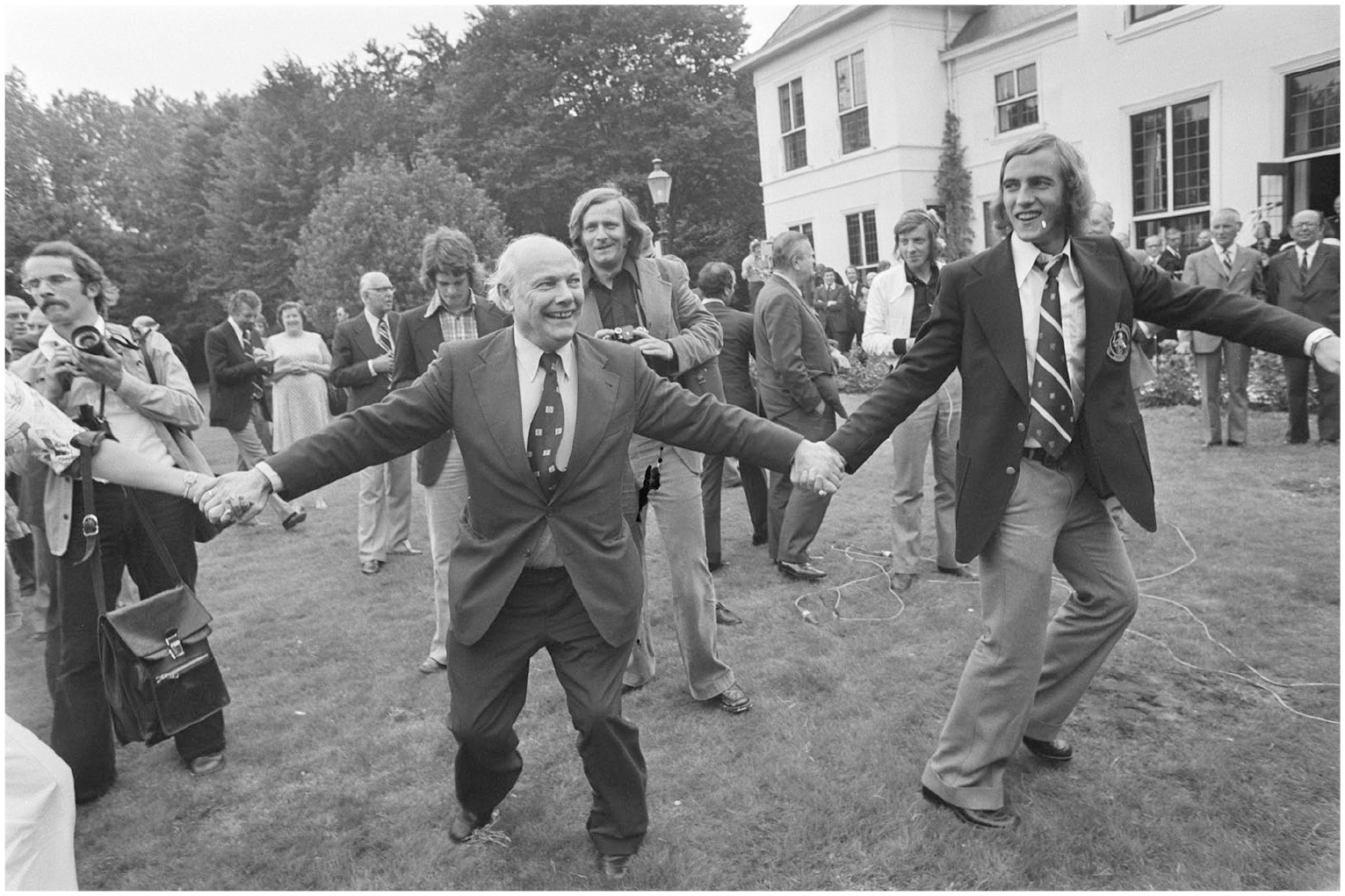
Dutch prime minister Joop den Uyl (center) celebrates the Dutch national football team’s second place at the 1974 FIFA World Cup with star player Johan Neeskens in the backyard of his official residence in The Hague, 8 July 1974.
This points to the need to take the exclusionary mechanisms into account that structure politicians’ access to and use of the repertoire of political-communication-through-sport—mechanisms that stretch out from class, race, and gender, to ability and sexual orientation. In the United States, the impact of race has particularly drawn scholarly attention, recently among others in research on how Barack Obama tried to navigate the links between sport, race, and politics in his election campaigns. 66 The highly gendered nature of sport’s Inszenierungspotenzial, too, has been subject of investigation. Sport, as Pierre Bourdieu has convincingly argued, is heavily loaded with masculine codes of conduct. Male politicians have benefitted from the association of sport with norms, values, and codes of conduct that also carry meaning in the political sphere, such as the association of physical strength with power. 67 On the pitch, in the stands, in the bar of the local club, everywhere men dominated the scene. This has necessarily limited women’s access to this domain: for them, it has been far less easy to blend in and reap the benefits of their presence in the field of sport. 68 Moreover, female politicians who used the stage of popular culture to display the person behind the politician ran the risk of setting the spotlight on the fact that they deviated from the prevailing social norms, which still ascribed to them a role in the private sphere as mothers; by zooming in on their private lives, female politicians placed themselves in a position in which they had to account for their absence as a wife or mother. 69 Gender, as well as race, class, and other axes of difference, clearly affects the kind of stories politicians are able to tell about themselves through their engagement with sport.
Politicians were not the only ones who recognised the potential of sport for political communication. Athletes, too, have used their prominence on the stage of sports to make political statements. 70 The examples are varied and range from the raised fists of Tommie Smith and John Carlos at the 1968 Olympics and Muhammad Ali’s refusal of the draft, to sport stars who used their sport celebrity to start a career in politics, like former professional boxer and current mayor of Kiev Vitali Klytsjko. Furthermore, the past half a century social and political movements have acknowledged the fame, popularity, and impact of sport stars by enlisting them as spokespersons for their socio-political causes, like UNICEF’s list of ‘high profile supporters’ and ‘goodwill ambassadors’ which currently includes the likes of the British Formula 1 driver Lewis Hamilton and Spanish NBA basketball player Pau Gasol. Athletes have also compensated their presence at politically charged events by staging protests—like the rainbow nails of athletes competing at the 2013 World Athletics Championship in Moscow in response to President Putin’s anti-gay legislation. Others, in contrast, have explicitly refused to be drawn into the political sphere; have presented themselves as victims of politicisation, for instance, in the context of boycotts; and have claimed their status as ‘neutral’ athletes whose only goal it is to compete at the highest level against competitors from all over the world. There is, however, no escaping the fact that they are operating in a space that is politicised in many ways. Although in recent years a range of studies has appeared discussing the rise of sporting celebrities, few studies have delved into the issue of politicisation, a major exception being studies that investigate the political aspects of the relationship between race and sport, particularly in the United States. 71 How sport stars in the postwar years have either tried to steer clear from the politicisation of sport, have purposefully contributed to it, or fought against it, deserves to be explored further.
III
The notion of boundary disputes between sport and politics also invites a reflection on the spatial dimension of the interaction between both fields. The early twentieth century witnessed the simultaneous rise of mass spectator sports and mass politics. Both developments intersected at the site of the sport stadiums that emerged across Europe. These arenas acted as multifunctional spaces for the construction and affirmation of group identities, be it of fans of the local football club, the people of a nation, or specific socio-political communities. 72 Sport historians have also explored stadiums as a ‘site of control and discipline’. 73 In his book on stadiums and mass society in France, Robert Lewis shows that this worked in several directions: the crowd could witness itself, which structured its behaviour—spectators could see each other behaving in a similar way—and the police could easily monitor crowd behaviour. 74 Moreover, the behaviour and bodies of sports people on the pitch was presented to the spectators as an idea and ideal: as objects of identification and comparison. Nick Piercey therefore sees sport spaces as highly politically charged locations for ‘shaping perceptions of the world, for reproducing authorised action and for the contest over the “values” which are said to represent these ideas’. In a discussion of the construction of stadiums in Dutch cities, Piercey shows how local power elites used sport spaces ‘as a technique for order and discipline’. People investing in stadiums, Piercey argues, ‘saw sport as another way to spread their discourses of values to wider society’. 75
Much of this work by Piercey and others is inspired by political geographers who use sport as a lens to explore ‘how scale, space, and identity came to life in a grounded fashion’ and to analyse the production of (unequal) power relations through sport spaces. 76 Political geographers have extensively studied the political nature of sport spaces in modern history, ranging from sport spaces that act as ‘landscapes of control’ in the context of colonialism and the colonisers’ civilising mission, to the controlled public display of sport in parades that serve to perform and communicate dominant norms and values of the state (for instance, in communist regimes in Asia and the Eastern Bloc). This is what marks a critical approach to geography: a keen interest in the disciplinary mechanisms inherent in sport spaces and in how these spaces are built to articulate, promote, and imprint identities, values, and preferred behaviour (such as the shaping of healthy, fit bodies). 77 Obviously, in much of this work, the sport stadium is at the heart of the investigation, characterised by political geographers as a ‘spatial mechanism that produces and reinforces social hierarchies’ and that is used by those in charge as a symbolic expression of power. 78
Beyond the fields of sport history and political geography, too, the role sport spaces have played in constructing, displaying, and disciplining citizens and communities has been the subject of investigation. This includes historical research on the political symbolism present in the architecture of sports facilities, the inclusionary and exclusionary implications of specific spatial structures and locations, and their use by political elites to reaffirm political identities and the socio-political order more in general. 79 Research shows that stadiums and other sport spaces fulfilled this role in both democratic and authoritarian states. For the era of party democracy—the period between the late-nineteenth century and the 1960s—with its culture of mass gatherings, stadiums allowed political movements to put their strength on display, both internally and externally. ‘The stadium’, in the words of Robert Lewis, ‘helped make possible the coexistence of festivity and control that was arguably essential to the staging of mass politics in both democratic and authoritarian contexts’. 80 Political historian Wim de Jong has illustrated this by showing how the stadium plays hosted by various Dutch socio-political movements in the early postwar years acted as practices of civic education. De Jong sees these plays as elements of a broader political rhetoric of unity and togetherness, which marked the efforts in postwar Dutch civil society to overcome the prewar political culture of division and discord (see Figure 2). 81
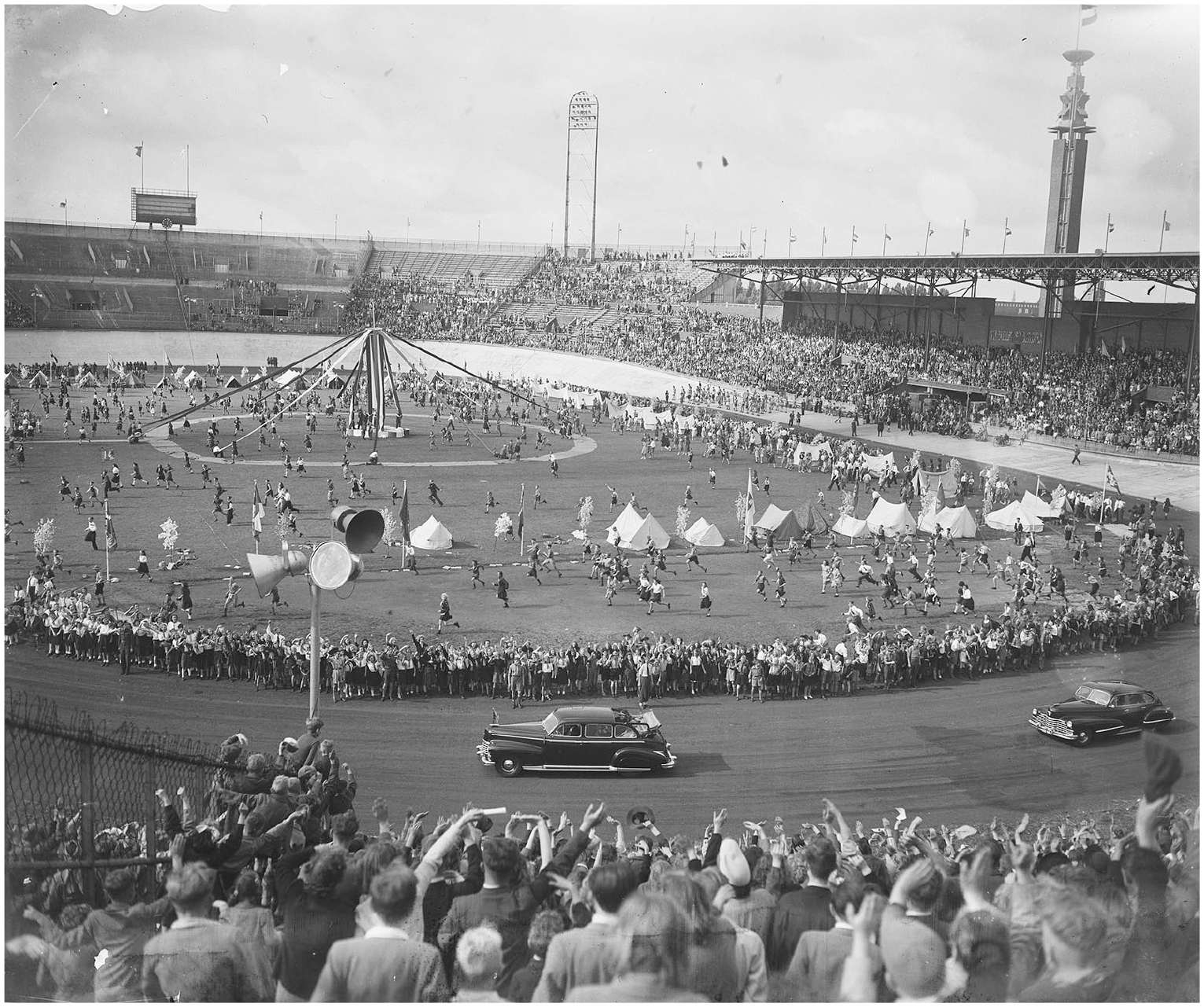
On 10 July 1948 the Olympic Stadium in Amsterdam hosted the Dag van de Jeugd (Youth Day). Children line up to welcome Queen Wilhelmine after she has entered the stadium in an open car.
Although stadiums from the 1960s onwards lost their status as the ‘pre-eminent political space of the era’ to ‘meeting halls and television studios’, they certainly did not lose their political significance and still act as arenas for the articulation of unity and belonging up until today. 82 In his book The Politics of Football in Yugoslavia, historian Richard Mills shows how, during football matches, stadiums formed the site for the expression of ethnic-nationalist sentiments, which heavily undermined the stability of the Yugoslavian state in the period before the wars of the 1990s. 83 Moreover, sport sites figure prominently in the repertoire used by politicians to boost their public prestige and gain popular support. Paris Mayor Jacques Chirac presenting himself as the champion of the construction of a new grande stade in the early 1990s is only one of several examples of politicians who built their agenda around policies of urban boosterism and (urban or national) patriotism in which sport facilities played a key role. 84
Not only these practices of boosterism and image-building, but also the struggles over city space that often accompanied these agendas, are relevant cases for research on the politicisation of sport. Such struggles direct historians towards the emergence of (trans)national social movements that mobilised against the impact international sports events had on the urban fabric, the local population, the environment, and on society as a whole. Their protests did not merely concern the authoritarian politics of some of the host countries, but also stretched out to local demonstrations against the environmental and social costs of hosting an international sport event. In several cities—ranging from Denver in the 1970s and Amsterdam in the 1980s to Berlin in the 1990s and Boston and Hamburg in more recent years—the announcement of bids for major sport events resulted in conflicts over the use of urban space which involved local and national government, private corporations, local and national media outlets, and local residents’ groups. The latter defended the right to play a role in determining the development of the urban space they lived in. 85 The city of Athens saw similar, but far more globalised protests against the financial and social costs of hosting the 2004 Olympic Games in a country that suffered increasing poverty rates. These struggles therefore also help to bring into view how social and political issues such as urban development, human rights, the environment, and poverty became connected to the field of sport. As Barbara Keys has shown, the huge amount of media attention the Games have acquired has made it increasingly difficult for organisations like the IOC to ignore or marginalise the voices of those who use the Games as a stage for political protest. In fact, over the past decades, the IOC and FIFA have adopted some of the goals advocated by protest groups. 86
This interplay between INGOs, national governments, and social movements brings me to the discussion of the final vector of the politicisation of sport: the rise of government intervention in sport through sport policy making, the discourses used by governments to motivate their involvement, and the governance structures through which policies have been shaped and carried out. These aspects will be discussed in the next section.
IV
In the past twenty years, the notion of governance has turned into a key concept in political science research. 87 The concept draws our attention away from a narrow focus on state institutions—that is, ‘government’—towards a broader understanding of the actors, networks, and institutions, at various levels and also beyond the state apparatus itself, that are involved in the process of governing. It invites us to explore which actors are involved in governing certain issues and domains, how governing takes shape and how actions are coordinated, paying attention to both formal and informal and less or more hierarchical structures and processes of decision making. 88 This ‘decentring’ of the state, however, does not necessarily imply that practices of governance curb or limit the role of the state. Working together with societal actors and institutions can also be part of state strategies of control. This brings in another key concept that has had a huge influence on the field of political studies in recent decades: governmentality, a term coined by Michel Foucault in the late 1970s and subsequently developed further by influential social scientists such as Nikolas Rose. Governmentality refers to the techniques that are used to govern in such a way that desirable conduct is not enforced directly, but is more or less nudged. 89 For political historians, research into the governing of sport and the genesis and implementation of sport policy making can contribute to a better understanding of structures and techniques of governance and governmentality. Specifically, the angle of sport invites us to delve into the issue of how social domains that were strongly rooted in civil society organisations—which, in Europe, has been the case for sport 90 —became connected with the state, legally, financially, and through other policy arrangements. It also invites us to reflect on the consequences this entanglement has had for the domain of sport and the function sport organisations have fulfilled in civil society. By exploring the relations between sport and the state and the arrangements through which both became connected, we can enhance our understanding of the politicisation of sport: the role and meaning the modern state has attributed to the field of sport and its historical development since the Second World War. Three areas of investigation stand out.
First, a particularly promising field of inquiry is the instrumentalisation of sport in specific policy schemes: the purposes ascribed to sport in different socio-political contexts. At least up until the 1980s, an ideology of welfarism characterised the policy arrangements in which sport was integrated and which resulted in a bureaucratization and professionalisation of sport. 91 Existing studies indicate that sport has been treated as a panacea for issues in other policy areas as diverse as ‘health, community safety, employment, and economic growth’. 92 A recent volume on running for instance shows how the growing popularity of recreational running from the 1970s onwards was at least in part catalysed by its promotion as a ‘health enhancing physical activity’ by national governments across Europe. 93 From the 1980s onwards, welfarism made way for an ideology of ‘consumerism’ and ‘global capitalism’, again with a profound impact on the nature of and power relations within the field of sport. 94
To a significant degree, such policy initiatives have been supported—and prompted—by sociological research in the functionalist school, which has stressed the social capital people acquire through sport. 95 Critical sociologists, in contrast, have argued that sport has been used as a ‘resource for implementing various forms of social engineering’, highlighting the disciplinary mechanisms at work in sport through which individuals are socialised according to a hegemonic system of norms and values. Historians have applied similar perspectives in their research on the role of sport policy programmes in dictatorial regimes and in Cold War politics—initially focusing on the Eastern bloc—but have increasingly also started to explore sport and social engineering within democratic contexts. 96 Although the history of sport policy has already drawn some scholarly attention, more could be done to better understand why, when, and how sport has become a means to an end in other fields of policy. 97
Second, studying governance from the perspective of sport provides insight in the role societal organisations—in the case of sport clubs often voluntary associations and their (inter)national umbrella organisations—have played in processes of policy making and implementation. 98 Moreover, it draws attention to the broad, international and transnational force field in which such governance arrangements have taken shape ranging from the local authorities of host cities, local citizen groups, private corporations, and the national government, to the IOC and other INGOs operating on a global scale like Human Rights Watch, Greenpeace, and Amnesty International. Scholars in the field of international relations and political science have recently started to investigate the political role played by ‘profit-oriented, business-friendly elite’ INGOs, to use a qualification coined by Lars Rensmann with reference to FIFA and the IOC. 99 The ability of these organisations to get the governments of host nations to change laws to fit the purpose of their organisation (for instance, market regulation to protect the interests of the sponsors of their events) is but one example of the fact that they wield political power. 100 They have met resistance from other INGOs like Amnesty International and Human Rights Watch that take issue with the political conditions under which sport mega events take place. In recent publications, Barbara Keys has shown how issues of human rights ‘infiltrated’ public debate about the Olympic Games through the activities of these organisations and how they have actually succeeded in pushing the IOC and FIFA to at least rhetorically embrace human rights goals. 101 The interplay between these actors and institutions at various levels and the political goals and ideals they have projected on the field of sport deserve to be explored further. 102
Third, the angle of governance also brings in the topic of the actual governance of these INGOs and sport organisations more in general. Questions about how these organisations are governed have been triggered by recent corruption scandals—in itself also an example of the politicisation of sport. 103 These scandals invite us to reflect on the question to what extent sport organisations, considering the influential role they play on the (inter)national political stage and the financial capital they represent, meet the standards set for state institutions in terms of transparency, accountability, and legitimacy (i.e. in terms of their representative structures and selection of executives); how the sphere of sports should be policed; and which role the government should play in such policing and monitoring of sport organisations. Such questions have recently been taken up in the field of transnational history, but rarely with regard to sport organisations. 104 Answering these questions will also allow us to assess the effectivity of the discourse of sport’s ‘neutrality’; effective in terms of the ability of institutions in the domain of sport to limit state intervention in—and public oversight of—the domain of sport.
The latter, the supposed neutrality of sport, and the persistence of this discourse throughout the twentieth and twenty-first century formed the starting point for the reflection on the politicisation of sport offered here. With this overview, I have moved beyond a focus on sport and politics that centres on the power play between nations and its repertoire of boycotts and self-aggrandisement through sport success; the politicisation of sport is more multifaceted than this. The three angles discussed here—communication, space, and governance—have shown that sport is closely connected with key aspects of, and developments in, postwar political history: with changes in political identity construction, community building, and in the perceptions of trust, legitimacy, and leadership that have cemented the representative relationship between politicians and the people (for which popular culture, and sport in particular, formed an increasingly important stage); with the construction, communication, and contestation of socio-political norms, values, ideas, and hierarchies on the local, national, and transnational level in which sports people, sport spaces, and sport organisations have played a key role; and with the rise of the welfare state through policy programmes in health and social cohesion, for which sport has been used as an instrument.
Along similar lines, the exploration of a range of boundary crossings between sport and politics has invited us to ask questions about the changing nature of the space of the political in the postwar years: about how domains of social life—like sport—were drawn into the orbit of the state; about the various actors and institutions involved in governance and decision-making processes, ranging from local residents’ groups to INGOs; about the gendered, exclusionary nature of new, popular forms of political communication (for instance, through sport); and about the spaces, beyond parliament, where political identities are shaped and hierarchies are constructed and confirmed. It exemplifies that sport is a highly relevant field to engage with for those who are interested in the postwar history of political power, representation, communication, and governance.
Footnotes
Funding
The author(s) received no financial support for the research, authorship, and/or publication of this article.

2
H. Lenskyj / S. Wagg (eds.), The Palgrave Handbook of Olympic Studies, New York 2012.
3
As quoted by J. Grix / B. Houlihan, ‘Sports Mega-Events as Part of a Nation’s Soft Power Strategy: The Cases of Germany (2006) and the UK (2012)’, in: The British Journal of Politics and International Relations 16 (2014) 4, 572-596, at 574.
4
E.g. L. Allison, The Global Politics of Sport: The Role of Global Institutions in Sport, London 2004.
5
P. Vonnard / K. Tallec Marston, ‘Playing across the “halfway line” on the Fields of International Relations: The Journey from Globalising Sport to Sport Diplomacy’, in: Contemporary European History 29 (2020), 220-231; H. Dichter / A. L. Johns (eds.), Diplomatic Games. Sport, Statecraft, and International Relations Since 1945; see also a special issue on diplomacy and sport edited by Dichter / Simon Rofe: Diplomacy and Statecraft 27 (2016) 2.
6
B. Keys, Globalizing Sport. National Rivalry and International Community in the 1930s, Cambridge, MA 2006; A. Beacom, International Diplomacy and the Olympic Movement: the New Mediators, Basingstoke 2012.
7
J. Hill, ‘Introduction: Sport and Politics’, in: Journal of Contemporary History 38 (2003) 3, 355-361; see also P. Ward, ‘Last Man Picked. Do Mainstream Historians Need to Play with Sports Historians?’, in: The International Journal of the History of Sport 30 (2013) 1, 6-13.
8
Recent overviews of the state-of-the-art in the field of sport history include: R. Holt, ‘Historians and the History of Sport’, in: Sport in History 34 (2014) 1, 1-33; P. Delheye (ed.), Making Sport History. Disciplines, Identities and the Historiography of Sport, Abingdon 2014; C. Young / A. Hilbrenner / A. Tomlinson, ‘European Sport Historiography: Challenges and Opportunities’, in: Journal of Sport History 38 (2011) 2, 181-187; F. Becker, ‘Raum und Ritual, Körper und Kultur, Politik und Presse: Neue Bücher zur Sportgeschichte’, in: Neue Politische Literatur 58 (2013), 375-388; N. Pas, ‘Grand Départ. Nieuwe uitdagingen voor sportgeschiedenis in Nederland’, in: Tijdschrift voor Geschiedenis 128 (2015) 3, 453-469.
9
E.g. the academic journals Sport in History, Journal of Sport History, and The International Journal of Sport in History.
10
Holt, ‘Historians and the History of Sport’, 26.
11
K. Schiller / C. Young, ‘The History and Historiography of Sport in Germany: Social, Cultural and Political Perspectives’, in: German History 27 (2009) 3, 313-330, at 315.
12
M. Derks, ‘Building Bodies. Transnational Historical Approaches to Sport, Gender and Ethnicities. Yearbook of Women’s History’, in: Building Bodies. Transnational Historical Approaches to Sport, Gender and Ethnicities. Yearbook of Women’s History 38 (2019), 9-23; D. Booth, ‘Escaping the past? The Cultural Turn and Language in Sport History’, in: Rethinking History 8 (2004) 1, 103-125; N. Besnier / S. Brownell, ‘Sport, Modernity, and the Body’, in: Annual Review of Anthropology 41 (2012), 443-460.
13
Hill, ‘Introduction: Sport and Politics’, 361.
14
J. Hill, Sport, Leisure and Culture in Twentieth Century Britain, Basingstoke / New York 2006, 2.
15
Young / Hilbrenner / Tomlinson, ‘European Sport Historiography’, 182.
16
E. Hobsbawm, Nations and Nationalism Since 1780: Programme, Myth, Reality, Cambridge 2001, 143.
17
J. A. Mangan (ed.), Tribal Identities: Historical Perspectives on Nationalism, Europe and Sport, London 1995.
18
A. Bairner, Sport, Nationalism, and Globalization: European and North American Perspectives, Albany, NY 2001; D. Porter, ‘Sport and National Identity’, in: R. Edelman / W. Wilson (eds.), The Oxford Handbook of Sports History, Oxford 2017, 477-489, 478; B. Kratzmüller et al. (eds.), Sport and the Construction of Identities. Proceedings of the XIth International CESH-Congress, Vienna 2007; J. Verriet, ‘Football Clubs, City Images and Cultural Differentiation: Identifying with Rivalling NEC Nijmegen and Vitesse Arnhem’, in: Urban History 46 (2019) 2, 266-287; A. Tomlinson / C. Young, ‘Towards a New History of European Sport’, in: European Review 19 (2011) 4, 487-507, at 487-489.
19
B. Stoddart, Sport, Culture and History: Region, Nation and Globe, London / New York 2008; J. H. Mills (ed.), Subaltern Sports: Politics and Sport in South Asia, London 2005; J. A. Mangan (ed.), The Cultural Bond. Sport, Empire Society, London 1992; B. Majumdar, ‘Cricket in Colonial Bengal (1880-1947). A Lost History of Nationalism’, in: International Journal of the History of Sport 23 (2006) 6, 960-990.
20
W. Pyta / N. Havemann (eds.), European Football and Collective Memory, Basingstoke 2015.
21
A. S. Markovits / L. Rensmann, Gaming the World: How Sports Are Reshaping Global Politics and Culture, Princeton, NJ 2010.
22
Grix / Houlihan, ‘Sports Mega Events’, 575; J. Nye, ‘Soft Power’, in: Foreign Policy 80 (1990), 153-171.
23
P. Vonnard / N. Sbetti / G. Quin (eds.), Beyond Boycotts: Sport during the Cold War in Europe, Berlin; Boston 2018; D. Bolz, Les Arènes totalitaires: Hitler, Mussolini et les jeux du stade, Paris 2008; Keys, Globalizing Sport; U. Balbier, Kalter Krieg auf der Aschenbahn. Der deutsch-deutsche Sport 1950-1972. Eine politische Geschichte, Paderborn 2007; B. Keys, ‘International Relations’, in: S. W. Pope / J. Nauright (eds.), The Routledge Companion to Sports History, London / New York 2010, 248-267.
24
For a comprehensive overview of these angles, see: A. Bairner / J. Kelly / J. Woo Lee (eds.), The Routledge Handbook of Sports and Politics, London 2017, quote on xxii; for political protest, see: J. Dart / S. Wagg (eds.), Sport, Protest and Globalisation. Stopping Play, London 2016.
25
W. Steinmetz / H.-G. Haupt, ‘The Political as Communicative Space in History: The Bielefeld Approach’, in: W. Steinmetz / I. Gilcher-Holtey / Haupt (eds.) H.-G., Writing Political History Today, Frankfurt am Main 2013, 11-33, 21 and passim.
26
W. Steintmetz, ‘Introduction’, in: Steinmetz / Gilcher-Holtey / Haupt (eds.), Writing Political History, 40.
27
See, for instance: N. Bulst, Recht, Raum und Politik, Göttingen 2013; T. Weidner, Die unpolitische Profession. Deutsche Mediziner im langen 19. Jahrhundert, Göttingen 2012.
28
Steinmetz / Haupt, ‘The Political as Communicative Space’, 23-24.
29
U. Frevert, ‘Neue Politikgeschichte: Konzepte und Herausforderungen’, in: U. Frevert / H.-G. Haupt, Neue Politikgeschichte. Perspektiven einer historischen Politikforschung, Frankfurt a.M. 2005, 24.
30
D. Porter / S. Wagg (eds.), Amateurism in British Sport: It Matters Not Who Won or Lost? London 2007.
31
M. Marschik, ‘Sport als “leerer Signifikant”: Die Neutralisierung des Sportes als Bedingung seiner kulturellen Bedeutungen’, Kurswechsel 2 (2004), 35-43.
32
R. Spaaij, Samen spelen, samenleven? De sociale betekenis van sport in tijden van superdiversiteit, Amsterdam 2014.
33
Bairner / Woo Lee (eds.), The Routledge Handbook of Sport and Politics, introduction and part 1; R. Spaaij et al., ‘Football and Politics: Between the Local and the Global’, in: J. De Waele et al. (eds.), The Palgrave International Handbook of Football and Politics, London 2018, 3-17.
34
Steinmetz / Haupt, ‘The Political as Communicative Space in History’, 25-26.
35
De Waele et al. (eds.), The Palgrave International Handbook of Football and Politics, 7-8; the authors are referring to: J. Lagroye, La politisation, Paris 2003.
36
D. L. Andrews / B. Carrington (eds.), A Companion to Sport, Chichester 2013, 225.
37
T. Mergel, ‘Cultural Turns and Political History’, in: Ricerche di storia politica (2017), 33-42, 40.
38
Bairner / Kelly / Woo Lee (eds.), The Routledge Handbook of Sports and Politics.
39
K. Jefferys, Sport and Politics in Modern Britain: The Road to 2012, New York 2012; J. Mittag (eds.), Europäische Sportpolitik. Zugänge - Akteure-Problemfelder, Baden-Baden 2018; J. P. Callède, Les politiques sportives en France, éléments de sociologie historique, Paris 2000.
40
L. Rensmann, ‘Sports, Global Politics, and Social Value Change: A Research Agenda’, in: Altre Modernità 5 (2015) 14, 114-133, 123.
41
G. Whannel, Blowing the Whistle. The Politics of Sport, London 1983; J. Hargreaves, Sport, Power and Culture, Oxford 1986.
42
R. Spaaij / J. Magee / R. Jeanes, Sport and Social Exclusion in Global Society, London / New York 2014.
43
De Waele et al. (eds.), The Palgrave International Handbook of Football and Politics; Dart / Wagg (eds.), Sport, Protest and Globalisation; special issue of the Journal of Global History 8 (2013) 2; Keys (ed.), The Ideals of Global Sport.
44
J. Grix, Sport Politics. An Introduction, London 2016, 24, 175.
45
J. Woo Lee, ‘Semiotics and Sport Communication Research: Theoretical and Methodological Considerations’, in: Communication & Sport 5 (2017) 3, 374-395, at 375; A. Beard, The Language of Sport, London 1998, 48.
46
Booth, ‘Escaping the Past?’, 104.
47
N. Howe, ‘Metaphor in Contemporary American Political Discourse’, in: Metaphor and Symbolic Activity 3 (1988) 2, 87-104.
48
R. Lipksy, ‘The Athleticization of Politics. The Political Implication of Sports Symbolism’, in: Journal of Sport and Social Issues 3 (1979), 28-37, at 36.
49
H. Kaal, ‘A Friendly Match: Sport and Political Culture in the Netherlands between the 1950s and the 1970s’, in: T. Riswick / P. Puschmann (eds.), Building Bridges. Scholars, History and Historical Demography. A Festschrift in Honor of Professor Theo Engelen, Nijmegen 2018, 216-236, at 229.
50
J. O. Segrave, ‘The Sports Metaphor in American Cultural Discourse’, in: Culture, Sport, Society 3 (2000), 48-60, 52.
51
T. Mergel, ‘Überlegungen zu einer Kulturgeschichte der Politik’, in: Geschichte und Gesellschaft 28 (2002), 574-606, at 599.
52
Segrave, ‘The Sports Metaphor’, 49-52.
53
P. Kasza, Das Wunder von Bern. Fussball spielt Geschichte, Berlin 2004.
54
Kaal, ‘A Friendly Match’, 222.
55
J. Corner / D. Pels (eds.), Media and the Restyling of Politics, London 2003.
56
D. Münkel / L. Seegers (eds.), Medien und Imagepolitik im 20. Jahrhundert. Deutschland, Europa, USA, Frankfurt / New York 2008; J. Lawrence, Electing Our Masters: The Hustings in British Politics from Hogarth to Blair, Oxford 2009; H. Wijfjes / G. Voerman (eds.), Mediatization of Politics in History, Leuven 2009.
57
J. Mittag / J.-U. Nieland, ‘Der Volkssport als Spielball. Die Vereinnahmung des Fußballs durch Politik, Medien, Kultur und Wirtschaft’, in: J. Mittag / J.-U. Nieland (eds.), Das Spiel mit dem Fussball. Interessen, Projektionen und Vereinnahmungen, Essen 2007, 9-30, 19; G. Spitaler, ‘Arena der Männlichkeit. Stichworte zum Verhältnis von Fußball, Männlichkeit, Politik und Ökonomie’, in: Bulletin-Texte / Zentrum Für Transdisziplinäre Geschlechterstudien 33 (2007), 45-53.
58
G. Spitaler, Authentischer Sport, inszenierte Politik? Zum Verhältnis von Mediensport, Symbolischer Politik und Populismus in Österreich, Frankfurt am Main 2005, 239-240.
59
M. Derks, ‘Competition, Sportification and Dutch Decency. Sport Ambiguities in the Netherlands in the long Twentieth Century’, in: N. Piercey / S.-J. Oldfield (eds.), Sporting Cultures: Global Perspectives, Manchester 2019, 23–42, at 37–39; C. Classen, ‘Politik als Unterhaltung. Zur Medialisierung von Politik in populären Filmen und Fernsehserien’, in: Klaus Arnold et al. (eds.), Von der Politisierung der Medien zur Medialisierung des Politischen? Zum Verhältnis von Medien, Öffentlichkeiten und Politik im 20. Jahrhundert, Leipzig 2010, 287-306.
60
J. Street, Politics & Popular Culture, Cambridge 1997; L. van Zoonen, Entertaining the Citizen. When Politics and Popular Culture Converge, Lanham 2005.
61
L. Beers, ‘A Model MP? Ellen Wilkinson, Gender, Politics and Celebrity Culture in Interwar Britain’, in: Cultural and Social History 10 (2013) 2, 231-250; B. van Waarden, ‘Appearance over Substance? Mediatised Celebrity Politics through Time’, in: Contemporanea 38 (2018) 3, 1-6.
62
H. Bonde, ‘The Great Male Cycle: Sport, Politics and European Masculinity Today’, in: The International Journal of the History of Sport 26 (2009) 10, 1540-1554, at 1550.
63
H. te Velde, ‘Authenticiteit en politiek’, in: Krisis 76 (1999) 3, 35-45.
64
Kaal, ‘A Friendly Match’.
65
Spitaler, Authentischer Sport, 103-105; H. de Smaele, ‘Een beeld van een man. Mosse en het moderne mannelijke stereotype’, in: Tijdschrift Voor Genderstudies 9 (2006) 3, 5-18, at 17.
66
M. G. McDonald / S. King, ‘A Different Contender? Barack Obama, the 2008 Presidential Campaign and the Racial Politics of Sport’, in: Ethnic and Racial Studies 35 (2012) 6, 1023-1039.
67
D. Brown, ‘Pierre Bourdieu’s “Masculine Domination” Thesis and the Gendered Body in Sport and Physical Culture’, in: Sociology of Sport Journal 23 (2006) 2, 162-188.
68
Spitaler, ‘Arena der Männlichkeit’.
69
L. van Zoonen, ‘The Personal, the Political and the Popular. A Woman’s Guide to Celebrity Politics’, in: European Journal of Cultural Studies 9 (2006) 3, 287-301.
70
R. Abrams, Playing Tough. The World of Sports and Politics, Lebanon 2013.
71
B. Smart, The Sport Star. Modern Sport and the Cultural Economy of Sporting Celebrity, London 2008; C. Lemert, Muhammad Ali: Trickster in the Culture of Irony, Cambridge 2003; K. Witherspoon, Before the Eyes of the World: Mexico and the 1968 Olympic Games, DeKalb, IL 2008; B. Carrington, Race, Sport, Politics. The Sporting Black Diaspora, London 2010.
72
J. Bale, Sport, Space, and the City, London 1993.
73
G. Crawford, Consuming Sport: Fans, Sport and Culture, London 2004, 99.
74
R. W. Lewis, The Stadium Century. Sport, Spectatorship and Mass Society in Modern France, Manchester 2017, 54, 62.
75
N. Piercey, Four Histories about Early Dutch Football, 1910-1920, London 2016, 25, 69-70.
76
N. Koch (ed.), Critical Geographies of Sport. Space, Power and Sport in Global Perspective, London / New York 2018, 1; C. Gaffney, ‘Geography of Sport’, in: J. Maguire (ed.), Social Sciences in Sport, Leeds 2014, 109-134.
77
N. Koch, ‘Sports and the City’, Geography Compass 12 (2018) e12360, 1-14, 4.
78
Gaffney, ‘Geography of Sport’, 114; J. Bale / O. Moen (eds.), The Stadium and the City, Keele 1995.
79
N. Dinckal, Sportlandschaften. Sport, Raum und (Massen-)Kultur in Deutschland 1880-1930, Göttingen 2013; D. Bolz, Les Arènes totalitaires: Hitler, Mussolini et les jeux du stade, Paris 2008; N. Rossol, Performing the Nation in Interwar Germany: Sport, Spectacle and Political Symbolism, 1926–36, Basingstoke / New York 2010; A. Köhring, ‘“Sporting Moscow”: Stadia Buildings and the Challenging of Public Space in the Post-War Soviet Union’, in: Urban History 37 (2010) 2, 253-271; R. Trumpbour, The New Cathedrals: Politics and Media in the History of Stadium Construction, Syracuse, NY 2007.
80
Lewis, The Stadium Century, 71-73.
81
W. de Jong, Van wie is de burger? Omstreden democratie in Nederland, 1945-1985, Nijmegen 2014, 74-76.
82
Lewis, The Stadium Century, 71-73.
83
R. Mills, The Politics of Football in Yugoslavia: Sport, Nationalism and the State, London 2018.
84
Lewis, The Stadium Century, 189-196.
85
P. Reef, ‘“NOlympics in Amsterdam!” De strijd over de stedelijke ruimte en het politieke krachtenveld rondom Amsterdams Olympische kandidatuur, 1984-1986’, in: Tijdschrift voor Geschiedenis 133 (2020), 659–686; M. W. Johnson, ‘Mega-Events, Urban Space, and Social Protest: The Olympia 2000 Bid in Reunified Berlin, 1990–1993’, in: Central European History 52 (2019), 689-712; J. Lauermann / A. Vogelpohl, ‘Fast Activism: Resisting Mobile Policies’, in: Antipode 51 (2019) 4, 1231-1250.
86
Keys (ed.), The Ideals, 110-111.
87
For a short overview: M. Bevir, Governance: A very short introduction, Oxford 2012.
88
T. Risse, ‘The Political, the State, and Governance. Reflections on Essentially Contested Concepts’, in: Steinmetz, Gilcher-Holtey, Haupt (eds.), Writing Political History Today, 359-367, at 366.
89
N. Rose / P. Miller, ‘Political Power beyond the State: Problematics of Government’, in: British Journal of Sociology 43 (1992), 173-205.
90
M. van Bottenburg, ‘Why Are the European and American Sports Worlds so Different? Path-dependence in European and American Sports History’, in: A. Tomlinson et al. (eds.), Sport and the Transformation of Modern Europe: States, Media and Markets 1950-2010, London / New York 2011, 205-225.
91
J. Horne et al., Understanding Sport. A Socio-Cultural Analysis, 2nd edition, London / New York 2012.
92
J. Hoberman, ‘Sport and Political Doctrine in a Post-Ideological Age’, in: The Oxford Handbook of Sports History, 37; Grix, Sport Politics, 18.
93
J. Scheerder / K. Breedveld (eds.), Running across Europe. The Rise and Size of One of the Largest Sport Markets, Basingstoke 2015, 4.
94
Horne et al., Understanding Sport, 126.
95
Grix, Sport Politics, chapter 6.
96
Hoberman, ‘Sport and Political Doctrine in a Post-Ideological Age’; Tomlinson et al. (eds.), Sport and the Transformation of Modern Europe; U. A. Balbier, Kalter Krieg auf der Aschenbahn: Der deutsch-deutsche Sport 1950-1972. Eine politische Geschichte, Paderborn 2007.
97
K. Jefferys, Sport and Politics in Modern Britain: The Road to 2012, New York 2012; I. de Haan en Jan Willem Duyvendak, In het hart van de verzorgingsstaat. Het ministerie van Maatschappelijk Werk en zijn opvolgers (CRM, WVC, VWS) 1952-2002, chapters by Maarten van Bottenburg.
98
C. Sobry (ed.), Sports Governance in the World: A Socio-Historic Approach, Paris 2011.
99
L. Rensmann, ‘Sports, Global Politics, and Social Value Change: A Research Agenda’, in: Altre Modernità 5 (2005) 14, 114-133, 117.
100
Grix, Sport Politics, 130.
101
B. Keys, ‘Harnessing Human Rights to the Olympic Games: Human Rights Watch and the 1993 “Stop Beijing” Campaign’, in: Journal of Contemporary History 53 (2018) 2, 415-438, 416; Keys (ed.), ‘The Ideals of Global Sport’, 218-225.
102
Rensmann, ‘Sports, Global Politics, and Social Value Change’, 117.
103
A. Masters, ‘Corruption in Sport: From the Playing Field to the Field of Policy’, in: Policy and Society 34 (2015) 2, 111-123; J. Sugden / A. Tomlinson, Football, Corruption and Lies. Revisiting ‘Badfellas’, the book FIFA tried to ban, London 2017.
104
Rensmann, ‘Sports, Global Politics, and Social Value Change’; B. Houlihan, ‘Politics and Sport’ in: J. Coakley / E. Dunning (eds.), The Handbook of Sports Studies, Los Angeles 2000, 213-227, 222; P.-Y. Saunier, ‘International Non-Governmental Organizations’, in: A. Iriye / P.-Y. Saunier (eds.), The Palgrave Dictionary of Transnational History, Basingstoke 2009, 573-580.