




Abstract
In his renowned Political Parties. A Sociological Study of the Oligarchical Tendencies of Modern Democracy (1911), Robert Michels described two routes to political leadership in the socialist workers’ movement. The most direct route was reserved for scientists, artists, or even politicians from the ‘bourgeois’ camp who converted to socialism. Many of them easily became party leader or elected representative because of their intellectual qualities and practical skills, their prestige in society, or an aura of revolutionary martyrdom. The second route entailed ‘climbing through the ranks’, often facilitated by professional training. As the socialist party and the trade union movement gained influence and strength, they developed their own training institutes, intended to provide the movement with a sufficient number of qualified personnel from the proletarian constituency, who could eventually grow into leadership positions. 1
While the Dutch astronomer and Marxist Anton Pannekoek had been teaching at the Zentrale Parteischule in Berlin since its foundation in 1906, such a training institute was still out of reach for the Dutch social democrats in the period covered by this article. 2 The Dutch Social Democratic Workers Party (SDAP) was founded in 1894 and quickly established itself as the largest socialist party in the Netherlands. 3 Paid positions, however, were scarce and seldom offered much chance of a rapid advancement to become an elected politician or a salaried functionary in early Dutch social democracy. Ambitious party members who could not boast of a social career outside the party or who had acquired their fame elsewhere responded in great numbers to the scarcely advertised vacancies. Michels rightly remarked that the early socialist movement was a bad employer. Yet idealism, the pursuit of one’s own development, and the hope of a political career could outweigh the often meagre financial rewards.
In 1906, the SDAP created a new position for a ‘manager’ of the party’s publishing department, someone who would be responsible for the publication and distribution of socialist pamphlets, brochures, and books. To many, this would appear to be a key position, if only because written propaganda was of vital importance to the social democrats. 4 In order to organize the propaganda department, the party had already employed typographers in the party printing department or newsboys who delivered the daily social-democratic newspaper. These humble party employees were usually socialists, but conditions and power relations on the work floor were not substantially different from those of their colleagues in the capitalist outside world. The future manager of the newly reorganized Brochurehandel, however, would carry out his or her activities from the heart of the movement: The business would have its own office space and storage located in the national party office in Amsterdam. In this way, for ambitious applicants, the vacancy opened up a short cut to the place from which their movement was led.
The professionalization and institutionalization of the publishing department in 1906 laid the foundation for a large-scale publishing company that from 1916 until after World War II would serve as an important instrument of the Dutch social democratic movement. 5 Studies on (international) socialist publishing activities are often limited to private companies that specialized in socialist literature. 6 In contrast, the Dutch Brochurehandel was a true and durable party enterprise. The applicant who got the job in 1906 quit after 4 years. This did not result in the discontinuation of the position, as was so often the case in the early socialist movement, but instead a new application round was opened. By a happy coincidence, the letters of application from 1906 and 1909 have all been preserved in the SDAP party archive, housed in the International Institute for Social History in Amsterdam. 7
In this contribution, we explore the hopes and motives of the applicants in both application rounds. We look at their geographical origin, age, previous occupations and the reasons they gave for applying for this position. As far as possible, we also examine their further careers within the socialist movement, including both ‘winners’ (W. H. Meijer and J. J. Bos) and ‘losers’ (such as Jan Kennedij). This will help us to better understand the challenges of ‘climbing through the ranks’ and answer the question of what political capital was needed in order to successfully obtain a political position within the early social democratic party. Max Weber (and his followers) looked at this process of professionalization mainly from an organizational point of view. However, with our unique source, we are able to understand this development from the viewpoint of the rank-and-file militants who were looking for access to a salaried political function. The examples are taken from the context of Dutch early twentieth-century social democracy; yet they encourage international comparisons and broader reflections on the sources to reconstruct political careers and the access to party institutions from the perspective of below.
The candidates
In August 1906, 91 people applied for the position of ‘manager’ of the newly created Brochurehandel. Among the applicants of whom we know their age, the youngest was Jan Kennedij (1886–1966), who turned 20 that month. The oldest applicant was former shoemaker and socialist veteran Willem Cornelis Jacobsen, then 59 years old. In 1909, 84 people submitted an application letter. The age span in this second round was more limited and had shifted slightly towards a younger cohort (Figure 1). This could indicate an increased professionalization of the job: The position apparently became more attractive for people who started their career.
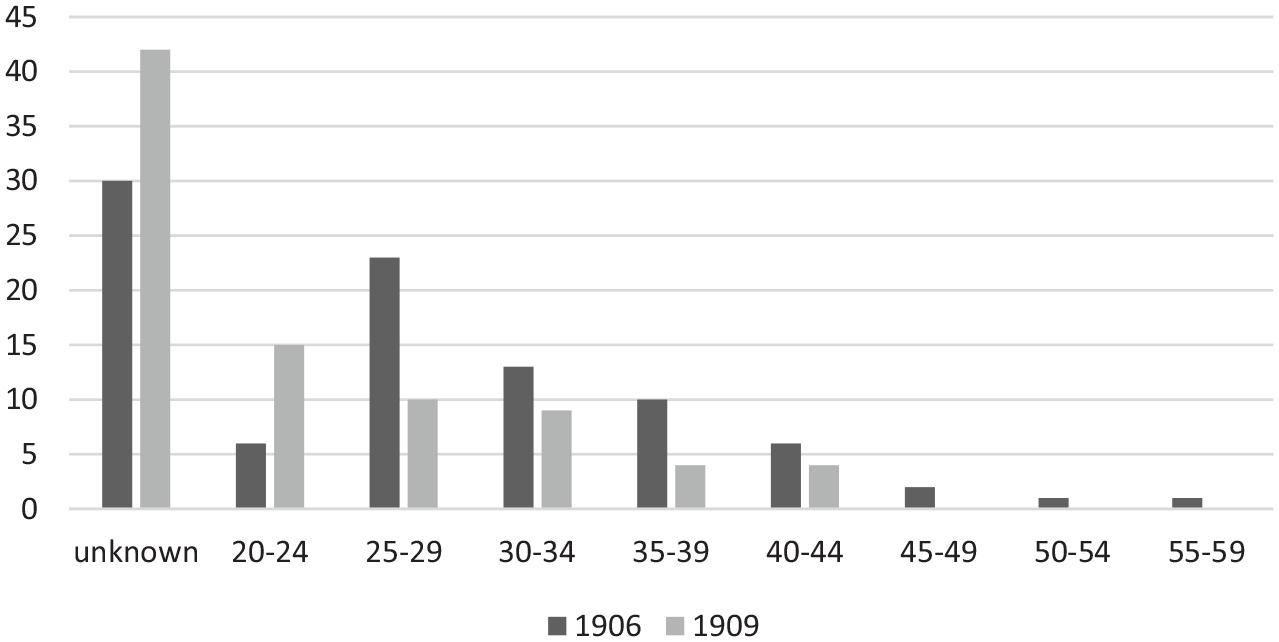
Age of the applicants in 1906 and 1909, as mentioned in the application letters or reconstructed from the population records.
Among the entire group of applicants, we identified only two women, both applying in 1906 (Figure 2). One of them was a schoolteacher on sick leave, the other the spouse of a local party propagandist whom she was divorcing. The latter prudently asked the board whether or not the vacancy was open to females. From the perspective of political career opportunities at the beginning of the twentieth century, this does not seem remarkable: In the Netherlands, it was not until 1917 that women were eligible for political office, and for a long time the majority of political-administrative positions were filled by men. From a socialist viewpoint, however, this uneven balance seems more surprising: Within the socialist movement, women intervened in political discussions at an early stage, including the struggle for (women’s) suffrage. For example, the first female member of the House of Representatives, Suze Groeneweg, had been an active member of the SDAP for many years. 8 It seems, however, that salaried functions within the party-apparatus remained a male privilege in these years.
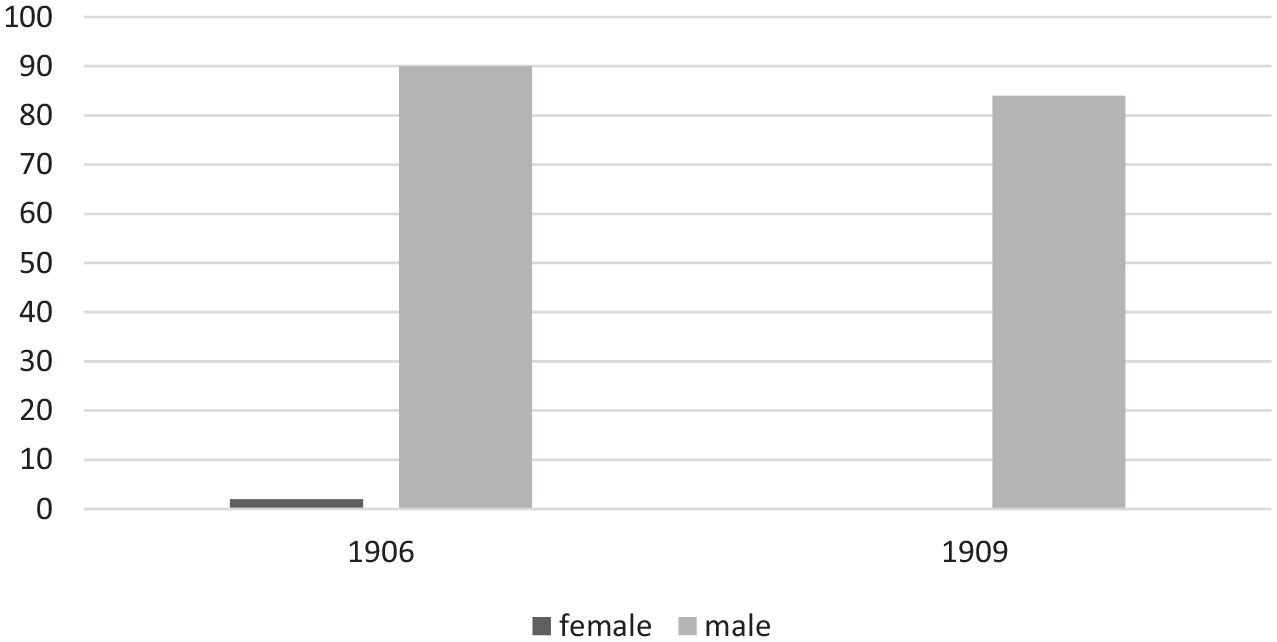
Gender of the applicants in 1906 and 1909.
Most of the applicants were part of a socialist network in one way or another. However, not all of them were party members and some were clearly only looking for a job. The professional background of the applicants was diverse and influenced the motivations to apply. Some of them were already active in the socialist movement in addition to their formal job, for example, as agent of the socialist newspaper or as treasurer of the local party branch. Others presented proof of their commitment as an argument to obtain the job as a quid pro quo. This could be done with tales of personal hardship suffered as a consequence of militancy, or by referring to past employment in the navy or at the railways, since in the years before 1906 these had become notorious for laying off and blacklisting unionized personnel. A striking difference between the first and the second vacancy round is that the professional background of the applicants became less diverse (Figure 3). For example, we counted more candidates in 1909 with a background in the administrative sector or in bookshops and publishers (from booksellers to typographers). This could indicate that not only the job profile had become clearer, but also that the Brochurehandel itself had become better known.
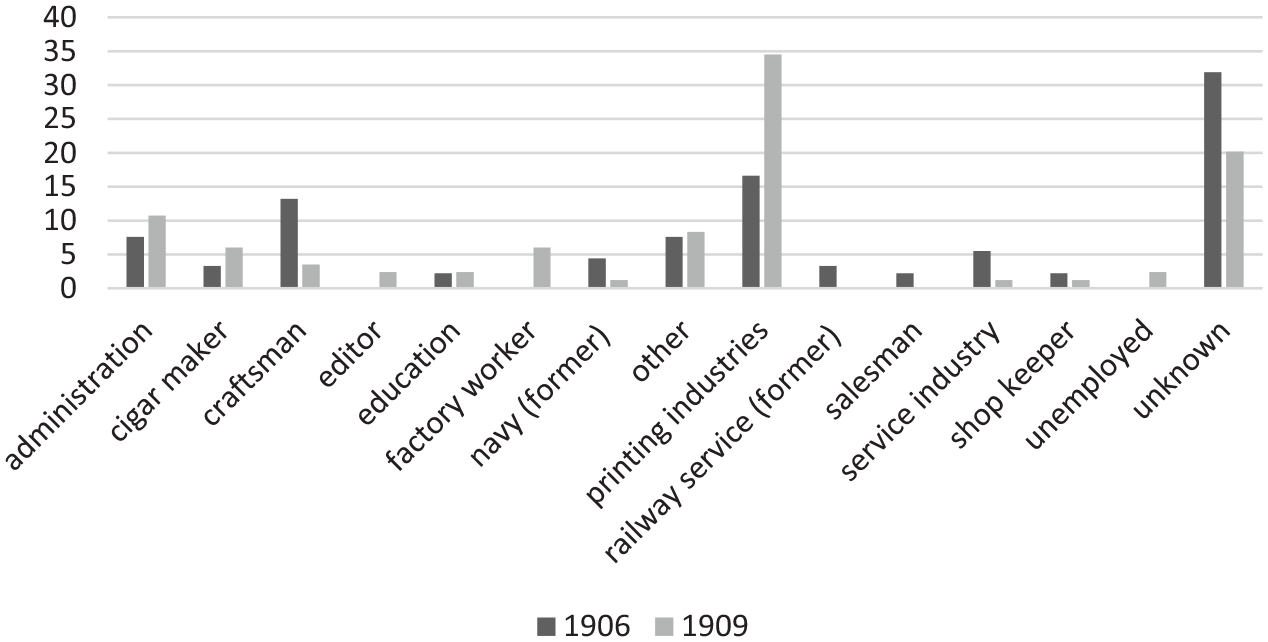
Professional background of the applicants in 1906 and 1909, in percentages.
The geographical background of the candidates shows a clear overlap with prominent socialist areas in the Netherlands (Maps 1 and 2). In both years, most of the applicants came from Amsterdam that served as the centre of Dutch social democracy. Next in order were other large cities in the west of the country (such as Rotterdam, The Hague, and Utrecht), but potential candidates were also located in the more rural province of Friesland, which had always been a stronghold for the labour movement, and the area around Zwolle, where the SDAP had been founded in 1894. 9 Some of the applicants saw the vacancy as an opportunity to move from peripheral areas to Amsterdam as the centre of Dutch social democracy. For example, C. Lambeck, a 34-year-old typesetter, wrote about how he and his family fell victim to continuous harassment in their home town Hoogeveen (Drenthe) because of his socialist convictions: ‘therefore an exchange of this clerical nest with Amsterdam, the focal point of the workers’ movement, as a place of residence for me would be very welcome’. 10
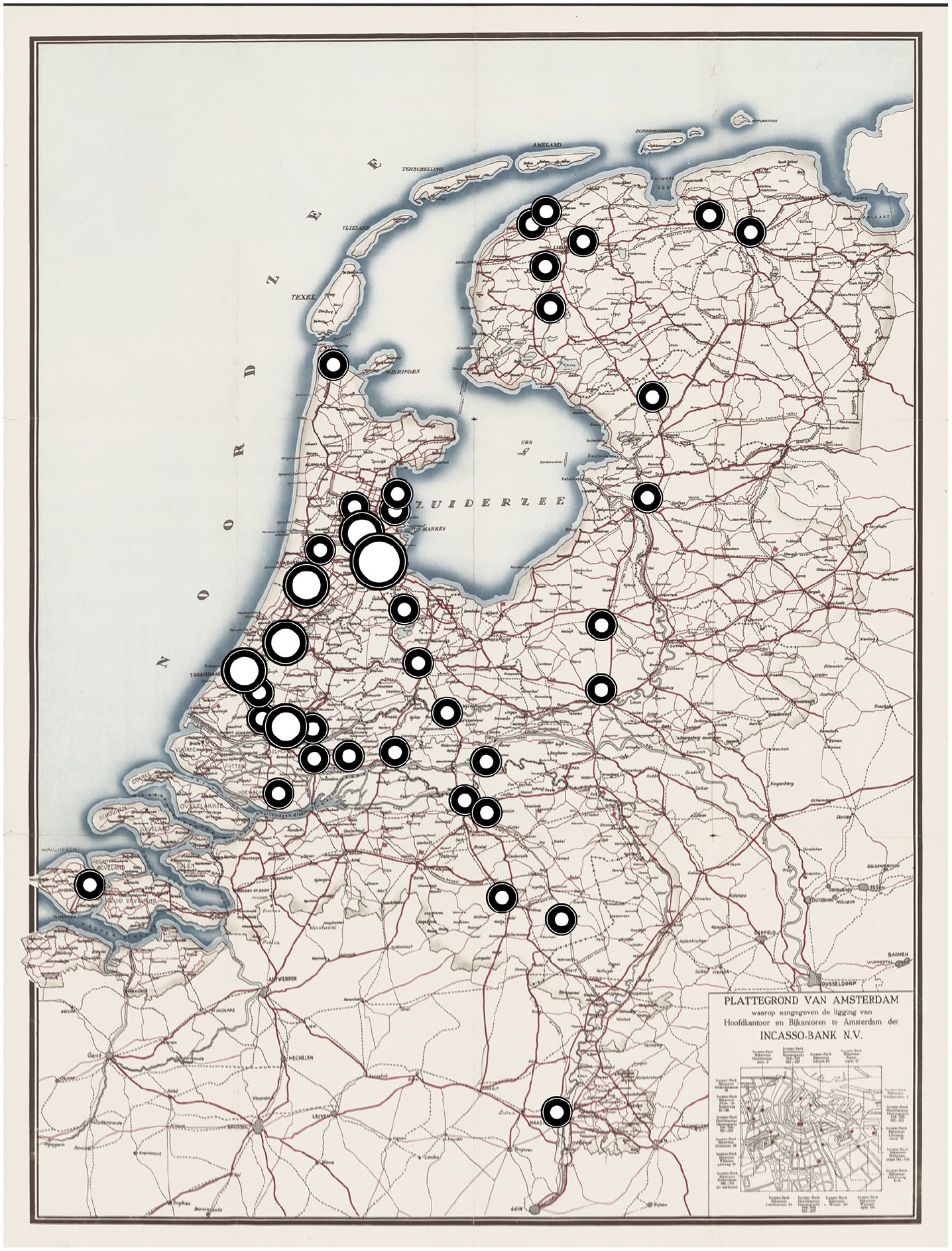
Geographical background of the applicants, 1906.
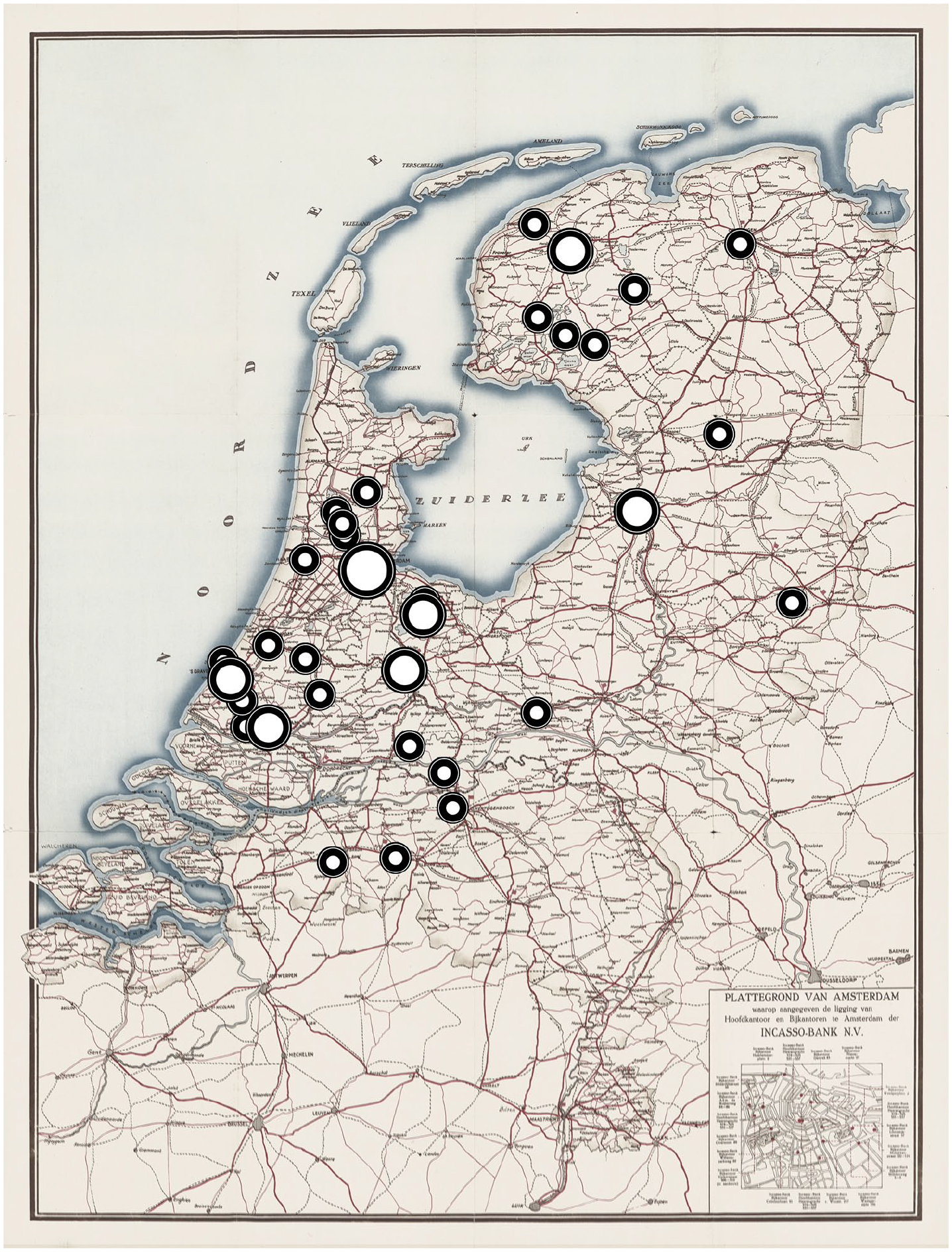
Geographical background of the applicants, 1909.
Planning a political career
The candidates were connected by a strongly felt need for political self-realization: They wanted to shape and articulate their ideological convictions by being active in the socialist movement. In order to reach that goal, it was crucial to get access to the party structure. The party offered them an ideological home. Most of the applicants, however, lacked a proper education, had little to no political experience, and could not rely on an extensive political network. They were ambitious yet in the end proved unsuccessful in their application. This did not imply that they were completely unsuitable for a political career. In the following years, their names would show up in other parts of the socialist movement. They performed as speaker at political meetings, became secretary or treasurer of local party branches, and no less than 5 applicants from 1906 and 15 applicants from 1909 stood candidate for local, provincial or even national elections (and some of them actually received enough votes to take their seat).
One of the applicants who tried to obtain a political position was gardener Jan Kennedij (1886–1966). Undeterred by his first unsuccessful attempt at age 20 in 1906, Kennedij again applied in 1909, writing two(!) application letters in which he showed how he desperately wanted to contribute to the party’s cause. Kennedy had started working as a farmer’s employee at the age of 13 and now held a job as gardener. Yet he envisioned another future for himself by applying for the position in the Brochurehandel, writing about himself in the third person: This appointment would place him in a better position to develop himself and because of that become more militant in the service of the struggling proletariat. Also, he would be able to afford himself to move to [the local town of] Purmerend, which would definitely benefit the movement over there. In the case this would happen, after some time (1 year) he would also be eligible as representative in the City Council.
11
Kennedij’s ideas about his career path were crystal clear: first, he needed to get access to the party structure; this would help him to give shape to his political ambitions. Next, he could move to the town in his region of birth that had an active socialist movement. And finally, he would become a municipal council member.
Although Kennedij’s qualities and ambitions were confirmed in a supporting letter from the chair of the local SDAP branch of Purmerend, he did not get selected for the job. Yet two years later, his name appeared on the list of candidates for the 1911 municipal elections in Purmerend. The number of 240 votes turned out to be too small to claim a seat, and for a moment it looked like Kennedij’s political career ended then and there. But in 1912, he moved to Amsterdam in a deliberate effort to settle as a socialist organizer and militant, applying (again in vain) for an administrative position in the renowned Union of Diamond Workers (ANDB). In this open application letter, he emphasized once again his political ambitions, explaining how he had moved to Amsterdam to educate himself as a socialist. 12 It was not until 1917 that Kennedij reappeared in the archives, when he had established a local branch of the communist party in Purmerend. When the communists won a seat there in 1923, it was not Kennedij, but his cousin by marriage who would occupy it. 13 Kennedij remained active as a communist organizer among farmers and farmhands until the middle of the 1930s. By that time, he lost the farm that he had started in 1928 and became unemployed. In 1935, Kennedij was a candidate for a small ‘Trotskyist’ party competing in the municipal elections of Purmerend, and with this group, he was active in the support of illegal immigrants from Nazi Germany. After the war, Kennedij got a job at a local printing company that was not affiliated with the movement. 14
Successful applicants and their networks
Becoming part of the professional political apparatus was for a long time the only way to successfully pursue your political ambitions. The applicants who did not manage to obtain a paid position within the party or to be elected as political representatives were usually condemned to an ordinary working life, and had to earn their living somewhere in the province with a job that they perceived as hardly attractive.
The 1906 vacancy was filled in by the former navy sailor Willem Hendrik Meijer (1877–1951). The documents in his dossier show that he did not just write a formal application letter, but also remained in close contact with the party’s secretary who had led the Brochurehandel until then and who played a crucial role in the procedure to find his own successor. 15 It might have also been helpful that Meijer’s fiancée worked as a resident maid in the household of the three Tilanus sisters who, with their husbands, belonged to the intellectual and artistic elite of the social democratic movement. In his memoires, Meijer would later disclose that he never felt very happy in his job as publisher and bookseller. After 3 years, he saw a chance to switch to the offices of an insurance company that was associated with the labour movement. Here, he would make a career as office director, which enabled him to move to the ‘Gooi’ area outside Amsterdam. There he lived among the party-elite and was a council member for the SDAP from 1923 to 1941. 16
Meijer’s successor Johannes Jacobus Bos (1876–1948) boasted an impressive service record when he started at the Brochurehandel. Already at the tender age of 6 or 7, he assisted his father who became something of a local hero as the first street vendor of socialist newspapers in Amsterdam. After his father’s death in 1899, Bos continued the family bookshop, publishing and selling socialist pamphlets and booklets as a self-employed entrepreneur just like his father. The enterprise was not flourishing when Bos first applied for the job of managing the Brochurehandel in 1906. By the time he got the job in early 1910, his own shop had gone bankrupt. By this time, the position as a salaried functionary of the movement must have looked like a safe refuge. It turned out to be a nightmare. Within months, Bos became entangled in personal conflicts and office intrigues within the party headquarters for which he was clearly not equipped. 17
A year after Bos’s appointment, the party leadership provided him with an assistant, who was to report regularly behind his back on Bos’ administrative and managerial shortcomings. These reports, together with a series of letters written mostly by former navy sailors and other acquaintances of his predecessor Meijer, made it possible to fire the new manager 3 months later in March 1911. 18 For the next 10–15 years, the Brochurehandel remained a snake pit, managed by a succession of idealists who had to face up one after another to the bitter realities of office politics.
Although professional inadequacies and personal flaws played a significant role, there was a political aspect to the drama. To be sure, the new manager often showed more self-confidence than justified by his talents and position, constantly reminding his superiors that he had more years of service as a socialist than any of them. But what probably sealed his fate was his critical stance on the party’s reformist course. After his dismissal, Bos returned to the precarious existence of publishing and selling socialist literature from his own living room. In this capacity, he would successively serve the left wing of social democracy, the early communist movement, and a variety of Trotskyist and other radical currents in the 1920s and 1930s. His advanced age did not prevent him from becoming involved with the clandestine socialist press during the Nazi occupation.
Conclusion
This case study uses a unique source—letters of application—to gain insight into the political ambitions and political capital of party members at the bottom of the career ladder. Of course, this genre carries the risk of window dressing. In some instances, application letters were clearly more motivated by the need for job security than political zeal. From the perspective of the SDAP, we see a growing tendency towards bureaucratization and more official party functions. On the other hand, they still pursued an activist socialist ideology that wanted to reform society in a radical way. As a result, it seemed that the political capital of an (informal) social network, family ties and reputation within the movement—rather than managerial qualities—were the deciding factors in the application process.
From the perspective of the applicants, political ambitions played an important role. It is striking how consciously many of them, like Kennedy, tried to build a political career and were able to formulate their political zeal in eloquent and convincing ways. It would be useful to further investigate whether this group of ambitious amateurs was typical only for the socialist movement, or if a similar phenomenon occurred in the build-up phase of other parties.
Footnotes
Funding
The author(s) received no financial support for the research, authorship, and/or publication of this article.
1.
R. Michels, Zur Soziologie des Parteiwesens in der modernen Demokratie. Untersuchungen über die oligarchischen Tendenzen des Gruppenlebens, Stuttgart [1957], 24–25, 48–49.
2.
A. Pannekoek, Herinneringen, Amsterdam 1982, 112–178.
3.
A. van Veldhuizen, De partij. Over het politieke leven in de vroege S.D.A.P., Amsterdam 2015.
4.
J. Loreck, Wie man früher Sozialdemokrat wurde. Das Kommunikationsverhalten in der deutschen Arbeiterbewegung und die Konzeption der sozialistischen Parteipublizistik durch August Bebel, Bonn-Bad Godesberg 1978; D. Bos, ‘Praktisch nut en de kracht van een symbool. Socialistische brochures in Nederland’, in: J. de Kruif et al. (eds.), Het lange leven van het pamflet. Boekhistorische, iconografische, literaire en politieke aspecten van pamfletten 1600–1900, Hilversum 2006, 114–126.
5.
F. de Glas, Nieuwe lezers voor het goede boek. De Wereldbibliotheek en ‘Ontwikkeling’/De Arbeiderspers vóór 1940, Amsterdam 1989. In 1911, the Brochurehandel became NV Ontwikkeling, which in 1929 became part of the De Arbeiderspers publishing house.
6.
C. Baudet, Grandeur et misères d’un éditeur belge. Henry Kistemaeckers (1851–1934), Brussel 1986; B. Emig / M. Schwarz / R. Zimmermann, Literatur für eine neue Wirklichkeit. Bibliographie und Geschichte des Verlags J.H.W. Dietz Nachf. 1881 bis 1891, Berlin/Bonn 1981; A. Graf, J.H.W. Dietz 1843–1922. Verleger der Sozialdemokratie, Bonn 1998; D. A. Lincove, ‘Radical Publishing to ‘Reach the Million Masses’: Alexander L. Trachtenberg and International Publishers, 1906–1966’, in: Left History 10 (2004) 1, 85–124.
7.
Internationaal Instituut voor Sociale Geschiedenis, Amsterdam (IISH), Archive SDAP, inv.nr. 2825b-c (1906) and 2825f-g (1909).
8.
M. Leyenaar / J. Oldersma / K. Niemöller, De hoogste tijd. Een eeuw vrouwenkiesrecht, Amsterdam 2019; U. Jansz, Vrouwen ontwaakt! Driekwart eeuw sociaal-democratische vrouwenorganisatie tussen solidariteit en verzet, Amsterdam 1983.
9.
H. Buiting / S. van Schuppen, ‘The Implantation of the Social-Democratic Labour Party in the Netherlands’, in: Tijdschrift voor sociale geschiedenis 18 (1992) 2–3, 313–332.
10.
IISH, Archive SDAP, inv.nr. 2825f, Letter C. Lambeck, Hoogeveen, 8.12.1909.
11.
IISH, Archive SDAP, inv.nr. 2825f, Letter J. Kennedij, Beemster, [received] 7.12.1909.
12.
IISH, Archive ANDB, inv.nr. 3045.3, Letter J. Kennedij, Amsterdam, 20.2.1912.
13.
J. Otsen, ‘Jan Kennedij, pionier van het communisme in Purmerend’, in: Vereniging Historisch Purmerend 15 (2002), 30–38.
14.

15.
IISH, Archive SDAP, inv.nr. 2825b.
16.
W.H. Meijer, Terugblik. Herinneringen van een sociaal-democraat, Amsterdam 1981. Van Veldhuizen, De partij, 202–203.
17.
Van Veldhuizen, De partij, 124–125.
18.
IISH, Archive SDAP, inv.nr. 22 (minutes of the political board) and 2826 (dossier on J.J. Bos).