




Abstract
The benefits of interdisciplinary research teams are well-known; however, there can be challenges due to differences in how disciplines approach knowledge construction. To better understand how interdisciplinary research teams navigate these differences in thinking, we used tools from ethnography to discover the cultural knowledge created and used by an engineering education research team and individuals on the team. We then used approaches from constructivist grounded theory to interpret these insights and transform them into a preliminary model of how interdisciplinary engineering education researchers navigate differences in thinking. This methodology paper outlines our process and the benefits of combining approaches from ethnography and constructivist grounded theory to simultaneously explore group culture and individual perceptions. We describe how and why we combined approaches from these two methodologies to develop our preliminary model. The aim of this paper is to provide an example of how qualitative researchers can be creative with their methodological approaches to comprehensively explore their social reality under investigation.
Keywords
Introduction
Beliefs about knowledge and knowing (i.e., epistemology) are fundamental to how people make decisions and approach learning. These beliefs are especially important in higher education spaces because of the focus on learning and knowledge generation. Within fields of study that are interdisciplinary in nature, like engineering education, disciplinary norms around the generation and application of knowledge can vary significantly, creating a rich environment for epistemic negotiations. Since epistemic beliefs can shape how individuals approach challenges and develop alternative solutions (Jonassen, 2014), understanding epistemic tendencies is critical for the effective navigation of differences in ideas. Additionally, because individuals’ epistemic beliefs can shape a group’s collective culture, there is a need to understand both the epistemological views of those individuals who comprise groups and the collective group culture around knowledge generation, application, and expression (or epistemic culture). This need to study both individual perceptions and group culture requires a combination of methods. In this paper, we describe our methodological approach for integrating methods from ethnography and constructivist grounded theory (CGT) to explore the epistemic culture of interdisciplinary engineering education research (EER) teams and the epistemic identity of individuals.
Studies that seek to understand culture often use ethnography – a methodology aimed at ascertaining rich descriptions of participants in a particular context to understand a group’s culture. Ethnography was particularly appropriate for our study, as we focused on how EER teams navigate differences in thinking to make research decisions – their epistemic culture. We used the Critical Contextual Empiricism Model (Longino, 2001) to explore teams’ epistemic cultures, and epistemic identity (Osbeck & Nersessian, 2017) to understand the approaches, values, and points of view of individual researchers toward knowledge construction. We applied approaches from CGT to generate a preliminary model of how EER teams negotiate differences in thinking.
Although Spradley (2016) notes that “ethnography offers an excellent strategy for discovering grounded theory” (p. 15), existing research that leverages approaches from ethnography and CGT are limited (FitzGerald & Mills, 2022; Mattarelli et al., 2013). Adams et al. (2025) provided a high-level overview of blending one particular ethnographic method with two others, CGT and critical realism, while White and Devitt (2021) demonstrated a more systematic and detailed integration of ethnographic methods with grounded theory. However, Bamkin et al. (2016) provide a robust example of why and how they chose to combine approaches from ethnography and CGT in their study of children’s interactions with mobile library units. There is also a small body of research on what some scholars refer to as “grounded theory ethnography [which] gives priority to the studied phenomenon or process-rather than to a description of a setting” (Charmaz, 2006, p. 22). Several scholars have explored the evolution of this hybrid approach (Babchuk & Hitchcock, 2013), argued the benefits of using this hybrid approach (Charmaz, 2006; Pettigrew, 2000), and described how it can mitigate the weaknesses of the individual approaches (Khiabani & Partovi, 2021). Yet, there remains a dearth of literature that details how to practically integrate the methods.Our integration of ethnography and CGT is further supported by Spradley (2016) who cites decision making in organizations as one of the “taken-for-granted cultures of the world” (p. 15) that can benefit from grounded theory that is informed by approaches from ethnography.
Given the lack of example studies, we took a pragmatic approach (Morgan, 2013) to our work, prioritizing our desire to capture the social reality (Walther et al., 2013) of epistemic culture. In this paper, we outline our methodological approach and identify how the integration of ethnographic observations with approaches from CGT supported the purpose of our study. While other researchers will be able to adapt aspects of our methodological approach, we hope our work also serves as an example of how qualitative researchers can be creative with their approaches and use the research tools that will best allow them to explore their social reality under investigation.
Study Context
Ultimately, we sought to answer the research question: What are the epistemic cultures of individual EER teams? This culture is affected by and impacts individual’s epistemic identities and is manifested through teams’ negotiation of research decisions.
We used the Critical Contextual Empiricism (CCE) Model (Longino, 2001) and the epistemic identity descriptive tool (Osbeck & Nersessian, 2017) to provide depth to our analysis. Longino’s (2001) CCE Model defines four norms of an idealized knowledge generating community that foster critical interactions and lead to the development of theories, methods, and ideas that are not based solely on the idiosyncratic thinking of individuals or communities. The four norms are (1) providing venues for criticism, (2) uptaking criticism, (3) recognizing public standards, and (4) maintaining tempered intellectual equality. Venues for criticism includes forums where methods, ideas, assumptions, and reasoning can be evaluated and critiqued by the community. It is important that each community uptake criticism and allow theories, beliefs, and ideas to change over time, making criticism a constructive and justifiable practice. Achieving a goal is determined by evaluating an outcome with respect to the public standards of the community. Equality of intellectual authority allows for diversity of perspectives and epistemically effective discourse where ideas, approaches, and theories are exposed to the broadest range of criticism. These norms can be partially satisfied resulting in communities that are less effective as knowledge producers. See Faber, Treffert, and Boyd (2024) for descriptions of these four norms in the context of our study. We employed CCE as a lens for exploring how the EER team we observed leveraged – or did not leverage – the four norms of an ideal knowledge generating community.
Osbeck and Nersessian’s (2017) descriptive tool of epistemic identity was used as a lens for examining how participants considered and made meaning of their identities as knowledge generators within an interdisciplinary team context. The four interconnected components of this tool – belonging and differentiation, perspective, values, and affect – provide a frame of reference for analyzing individuals’ epistemic identities. An individual's epistemic identity is shaped by their feelings related to being part of a community and their distinct role within it (belonging); their perceptions of their own, as well as others’ work (perspective); their ideas about what constitutes quality research (values); and their feelings related to values (affect). See Faber, Treffert, Boyd, and Gillmore (2024) for an example of how we used epistemic identity to guide our analysis of data.
For this study, we selected “ideal” EER teams based on their approaches to collaboration and their use of Zoom for project meetings, providing us with convenient access to recordings of their meetings. At the time of our “observations,” the teams had been working together for multiple years. We observed these teams as they completed a variety of research activities, including planning data collection, disseminating their work, developing grant proposals, and training new researchers. For the purposes of this paper, we focus on the methods we used to analyze data collected from Team A, one of the several teams we studied.
Our data included video and audio recordings of Team A’s weekly research meetings as well as interviews with individual team members. We collected recordings of team meetings that occurred across four consecutive months (total of 11 recordings) and two recordings of meetings that happened one year later. The team met virtually and shared the video and audio recordings of these meetings with us. Each meeting was approximately 60 minutes long. During meetings, Team A discussed topics such as data collection and dissemination, as well as future grant proposals. The team included multiple faculty members at different stages in their academic career as well as student researchers. The team members came from a variety of disciplinary backgrounds: engineering education, traditional disciplinary engineering, engineering science, and geology.
Our Epistemological and Theoretical Perspective
In line with our aim to be flexible and creative with research methods and tools and calls from other scholars (Case & Light, 2011) to provide more transparency around the connections between their theoretical perspectives, methods, and research questions, we present our own epistemological and theoretical perspectives as well as important contextual information about our methodological choices – ethnography and CGT – and why each is appropriate for the current study.
We took a pragmatic approach to our work, keeping our objective of exploring the epistemic culture of EER teams as our priority (Morgan, 2013). This epistemological perspective was used in parallel with the theoretical perspective of symbolic interactionism. In symbolic interactionism, the self, situation, and society are constructed through human actions. Language and symbols play a role in forming and sharing meanings and actions. This perspective acknowledges that people act in response to how they interpret their situations which places emphasis on the meanings, actions, and events in the contexts being studied (Glaser, 2005). Symbolic interactionism aligned with our desire to learn about the people, places, actions, and accomplishments as the individuals in our study understood them.
The combination of pragmatism and symbolic interactionism led us to integrate aspects from ethnography and CGT to answer our research question. Symbolic interactionism is the major theoretical perspective associated with CGT (Charmaz, 2014) and ethnography (Spradley, 2016). Both CGT and ethnography include methods that support the development of theory. For our work, we used methods from ethnography to inform how we collected data and methods from CGT to inform our analysis of the data and initial theory construction.
Background on Methodological Approaches
Ethnography provides approaches to examine a shared system of meaning that is developed, learned, and used by a group of people (Spradley, 2016) through the immersion of the researcher into a specific context. Ethnographers argue that cultural knowledge is acquired by an iterative and interpretive process of interacting with a group, observing their behaviors, engaging with individuals, and making cultural inferences based on this knowledge (Blumer, 1969). By studying the behaviors, interactions, and choices individuals make in natural social settings, the researcher comes to understand and develop a rich description of the culture. As the researcher conducts observations, they create a research record of data collected during their fieldwork, which typically includes fieldnotes, audio and/or video recordings, photographs, and artifacts. Fieldwork often occurs over several months to years and generates a significant amount of data. Ethnographic research is appropriate for studies that seek to examine specific social contexts, as they occur naturally, with the goal of describing culture.
Ethnographers begin by clearly defining the scope of the culture and social situations they intend to study. The scope depends on the purpose of the research and can range from drawing inferences based on a single social interaction to conducting a comprehensive examination of a complex society (Spradley, 2016). Ethnographic researchers follow a cyclic process of asking questions about the culture (e.g. who are the people involved in this culture, what do they do) and then answering these questions by collecting and analyzing ethnographic data (see Figure 1). This analysis, which typically involves exploring the essential components of a culture and the relationships between them, often generates additional, more focused ethnographic questions. The cycle continues with the ethnographer answering these new ethnographic questions until they have a rich understanding of the culture. Simplified ethnographic research cycle (based on Spradley’s developmental research sequence (Spradley, 2016)
CGT provides approaches to create theory directly from data that describes a particular social process. This inductive approach is particularly beneficial when existing frameworks are insufficient for the phenomenon or social process at the heart of a study (Charmaz, 2014). In employing CGT, context is critical, as the lived experiences of participants vary in different social settings, underscoring the importance of grounding new theory in the data. The researcher is an integral part of studies that use CGT. They iteratively collect and analyze data, making sense of participants’ experiences and extracting meaning that goes beyond individual experiences. A simplified depiction of the process of conducting a CGT study can be found in Figure 2. Simplified constructivist grounded theory research cycle based on (Charmaz, 2014)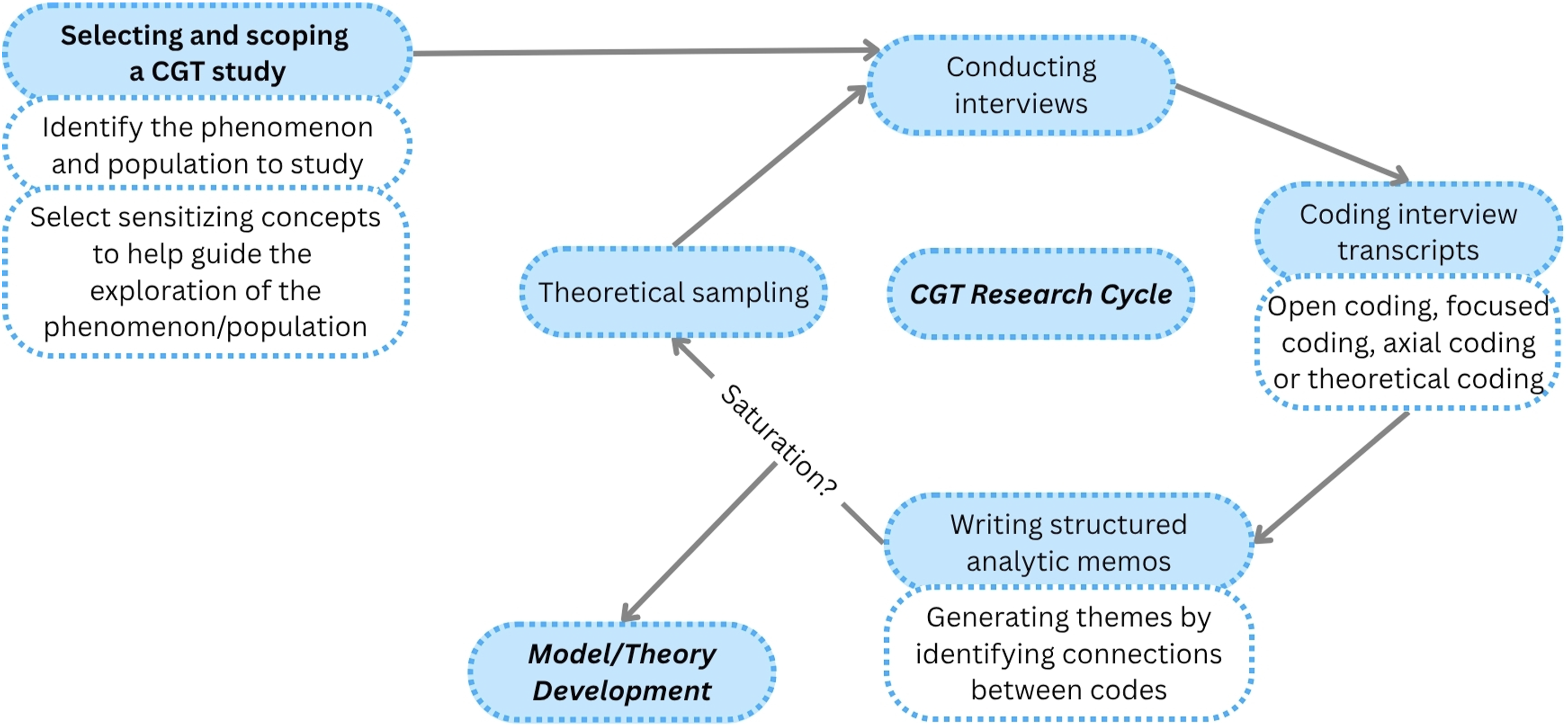
There are multiple methods associated with CGT that support the development of a theory grounded in data. These include theoretical sampling, coding, and memoing. Theoretical sampling is an iterative process that informs the collection of new data to explore emerging concepts and connections within the developing theory (Charmaz, 2014; Glaser & Strauss, 2017; Spradley, 2016). Coding interview transcripts allows the researcher to identify ideas and concepts central to the study. Throughout the coding process, the researcher compares new codes with existing ones, facilitating the refining of code categories. Memoing provides a way for the researcher to make sense of the data; identify connections across participants; and compare the emerging theory to existing theories. In CGT, memoing is a core part of the analysis process.
CGT’s flexible approach to analysis enables the researcher to focus on the processes, actions, and interactions they have observed, while considering possible relationships between various factors or components of frameworks used, social processes, or phenomena being studied. Although a conceptual model or theory is the intended outcome of CGT, Charmaz notes that the result is a subjective, small “t” theory of the phenomenon or social process within the context studied (McCall & Edwards, 2021).
Research Methods
In this paper, we focus on our process to develop a preliminary model (see Figure 3). In future work, we will expand and refine this preliminary model by conducting additional interviews with 20-30 individual researchers who are part of EER teams that we did not observe in this study. Our ethnographic grounded theory method process. The elements in yellow are drawn from ethnography, the elements in blue draw from constructivist grounded theory, and the elements in green draw from both methodologies
We organize our methods into four key phases: (1) Study Scoping, (2) Observation Data Collection and Analysis, (3) Interview Data Collection and Analysis, and (4) Synthesis of our Findings. In Phase 1: Study Scoping, we defined the social reality under investigation (SRUI) and selected sensitizing concepts to guide our exploration of that SRUI. Once we defined what we wanted to study, we moved to Phase 2: Observation Data Collection and Analysis. In this phase, we conducted observations of Team A’s weekly meetings, constructed fieldnotes, identified critical instances of our SRUI, and coded the data for the critical instance. Finally, we created structured analytic memos for each critical instance (Critical Instance SAMs). Once we were not learning anything new about the team’s culture through observations (i.e. reached saturation), we moved to Phase 3: Interview Data Collection and Analysis. In this phase, we interviewed each team member, coded the transcripts, and wrote a structured analytic memo for each team member (Individual SAMs). In Phase 4: Synthesis of our Findings, we analyzed across the Critical Instance SAMs and Individual SAMs to develop a preliminary model, an ethnographic description of culture, and an interview protocol to expand our dataset in our future work.
Phase 1: Study Scoping
We used approaches from ethnography (i.e. identifying and mapping out the social situations we intended to study) to ensure that we were able to capture the social reality aligned with our research question and approaches from CGT to identify theory that could be used as a lens to deepen our understanding of this social reality (i.e. selecting sensitizing concepts). We discussed our sensitizing concepts in detail earlier in “Study Context”.
Researchers must navigate experience-near and experience-distant terms and concepts as they go between academic literature and the execution of their research (Pickering, 2008; Schwandt, 2007). As researchers embedded in the context we are studying (EER teams), we have knowledge of experience-near concepts through our own experience on EER teams and experience-distant through our reading of academic literature. Experience-near refers to using language that is close to an individual’s personal understanding or experience. For ethnographic observations, experience-near focuses on the interactions, people, and places that can be observed by the researcher. Experience-distant refers to the analytic interpretation of the personal lived experiences of individuals using academic language that connects to theories. For ethnographic or CGT research, experience-distant is present in research questions and in the abstraction done in analysis that makes connections between individual experiences and the broader statements about culture.
When collecting and analyzing qualitative data, like ethnographic observations or interviews, it can be challenging to identify and/or stay focused on the social reality (experience-near) that aligns with the research questions (experience-distant) (Pickering, 2008; Schwandt, 2007). To support this process, we used the Pro-Qual Institute’s Experience-Near Mapping method (Morelock et al., 2023) and the Qualifying Qualitative Quality (Q3) Framework for interpretive research (Walther et al., 2013) to first illustrate the social system we are studying and then select the SRUI. These methods encouraged us to put ourselves in the place of the members of an EER team and reflect on what they see, feel, and think when engaging with their epistemic culture. We constructed a pictorial systems map of the people, places, activities, structures, and artifacts a team might engage with when making research decisions. Our first iteration of this map can be seen in Figure 4. More details about how we constructed this pictorial systems map can be found in our previous paper (Faber & Treffert, 2023). From the pictorial systems map, we identified our SRUI – how interdisciplinary engineering education teams negotiate to make research decisions. This SRUI includes how the team members interact with each other and how their perceptions of their team and teammates are influenced by these interactions. We further defined that the interactions we were most interested in capturing included brainstorming new ideas, discussing methodologies, and debating projects to pursue because these would allow us to examine the negotiation of ideas. Clearly defining the SRUI showed us that we needed both observational data to capture the interactions between team members and interview data to capture individuals’ perceptions. This clear definition also allowed us to determine if we were capturing the SRUI in the team meetings we observed. Pictorial systems map of an EER team from (Boyd et al., 2023)
Phase 2 – Observation Data Collection and Analysis
Phase 2 followed a six-step, cyclic process (see the numbered steps in Figure 3): (1) asking ethnographic questions, (2) conducting ethnographic observations and constructing fieldnotes, (3) identifying critical instances of our SRUI, (4) constructing an ethnographic record, (5) coding the ethnographic record, and (6) constructing structured analytic memos (SAMs). As shown in Figure 3, Steps 1, 2, and 4 align with approaches from ethnography; Steps 3 and 6 integrate approaches from ethnography and CGT; and Step 5 aligns with CGT.
Step 1: Asking Ethnographic Questions
We used three levels of questions to guide our ethnographic observations: (1) research questions, (2) broad ethnographic questions, and (3) ethnographic domain questions. We began by centering our study’s overarching research question: What are the epistemic cultures of individual EER teams? While this question helped frame our study, it is not communicated in experience-near terms nor is it granular enough to tell us where to focus our observations. We wrote broad, descriptive ethnographic questions using experience-near terms to help us understand the members of the team, how the team members interact with each other, and the purpose of the team and the projects they work on. These questions were simple and focused on learning general information about the team: Who are the members of this team? What are their backgrounds? What kind of research does this team do? and What are the team’s goals?
As we became more familiar with the team and its members, these questions evolved to become more detailed and targeted toward our SRUI. These more targeted questions were focused across three domains (i.e. an ethnographic category of meaning): discussions held by the team, interactions between team members, and the roles individuals play on the team.
Step 2: Conducting Ethnographic Observations and Constructing Fieldnotes
In alignment with ethnography, we observed the recorded team meetings and constructed fieldnotes based on these observations. Each meeting recording was observed by two members of our research group. These researchers co-constructed the fieldnotes for that meeting. The fieldnotes provided a description, in experience-near terms, of what was happening in the video. We also incorporated screenshots from the video to provide context to the team’s conversations. These screenshots were typically of a document one of the team members was sharing and discussing. This step was critical because the team used multiple online collaboration tools during their meetings and many of the conversations occurred through multiple modalities.
We developed and used a fieldnote template, shown in the Appendix, to support consistency in the construction of the fieldnotes (Boyd et al., 2023). Throughout the fieldnotes, we documented instances of (1) discussions that focused on research approaches, project planning, and applying knowledge; (2) interactions between team members that added to our understanding of their relationships; and (3) evidence of individuals’ roles. We also captured our initial impressions and inferences to begin making connections with our theory and previous observations. We noted these impressions and inferences in colored text with each researcher on the team having their own color. At the end of the template, we answered four reflection questions. • Which interactions and discussions felt most significant to how the group negotiates epistemic differences? o Are these topics new, previously discussed, or emergent from prior discussions? o How have these interactions compared to prior observations? o Are there any patterns emerging or are there exceptions to the observed patterns? • How would you characterize each team member and their roles on the team? How has this observation affected your characterization of them (e.g. affirmed, altered, expanded, etc.) • What are your impressions of relationships between the team members? How does this compare to prior observations about their relationships? • What additional observations, impressions, or feelings would you like to note?
The fieldnotes were reviewed by all members of our group to ensure that they adequately captured the meeting. During this review, we responded to one another’s impressions and inferences by expanding on what was stated, expressing agreement, questioning, and asking for clarification. See Figures 5 and 6 for examples. Example of the body of our fieldnotes with how we documented our impressions Example of the reflection section of our fieldnote template with how we documented our impressions

Step 3: Identifying Critical Instances of Our SRUI
Both CGT and ethnography have tools to help researchers narrow the focus of their study and/or help ensure they are seeing their desired phenomenon. In ethnography, researchers will elect to focus on a particular social situation (e.g. a team meeting) or a particular domain of that social situation (e.g. the ways team members express disagreement) based on a theoretical interest. In CGT, researchers will employ strategies such as purposeful sampling to ensure that they are selecting participants who will have experienced a particular phenomenon.
We focused our study by identifying instances of our SRUI – the team engaging in the generation, evaluation, and negotiation of ideas and/or making research decisions – throughout our fieldnotes. We called these “critical instances.” Each possible instance was discussed by our group to determine if they were representative of our SRUI and should be analyzed.
Step 4: Compiling Our Ethnographic Record
We compiled an ethnographic record for each critical instance. In ethnography, an ethnographic record is used to document the social reality being studied; it is composed of fieldnotes, researcher impressions, photographs, artifacts, and anything else captured or constructed by the researcher during the research cycle (Spradley, 2016). Ethnographers analyze these records to compose a description of a culture. Our ethnographic record included a two-column document with our fieldnotes on the left and the transcript of the meeting’s audio on the right for each critical instance. We aligned the content from the fieldnotes with the transcript based on timestamps. These ethnographic records of each critical instance were used as the subject of our analysis described below in Step 5.
Step 5: Coding the Ethnographic Record
At this point, in a traditional ethnographic study, we would conduct a series of analyses to develop a rich description of the team’s culture. However, we wanted to prioritize our exploration of our phenomenon of interest – how the team navigates epistemic differences within their culture – rather than generating a holistic description of their culture itself. Therefore, we used tools from CGT to make connections between our ethnographic data, existing theory, and our emergent theory of how teams navigate epistemic differences.
In alignment with CGT, at least two researchers deductively and inductively coded each ethnographic record; our coding process with examples is shown in Figure 7. The deductive coding focused on identifying segments of data related to the four norms from the CCE Model – venues for criticism, uptake of criticism, public standards, and tempered intellectual equality. We developed working definitions for each of these norms based on the work of Longino (2001). We used Charmaz’s (2014) initial coding approach that focuses on staying close to the participants’ words (experience-near terms) and coding for actions. We deviated slightly from Charmaz’s approach by connecting these action codes to the CCE norms. These initial codes took the form of “CCE norm – action code” (see Figure 8). We also inductively coded for any actions that did not clearly fall into any of the four CCE norms but still seemed significant to the team’s epistemic culture or how they negotiated epistemic differences. Coding process with examples Example of an initial code

Once at least two researchers had individually coded an instance, they met to discuss their coding, check for alignment, and reach consensus on any areas of disagreement. Next, each member of our research group analyzed the ethnographic records with a focus on one or more of the CCE norms to identify larger category codes that encompassed multiple initial codes. Through this process, we collaboratively developed our codebook with the CCE norms as root codes, manifestations of the CCE norms as category codes, and the action codes as examples; see the last section of Figure 7 for an example codebook entry with this format.
Step 6: Constructing Critical Instance Structured Analytic Memos
In alignment with CGT, we constructed a structured analytic memo (SAM) for each critical instance. Memoing is a crucial step in CGT as it allows researchers to explore connections between data, codes, theory, and our thoughts and impressions (Charmaz, 2014). Through these Critical Instance SAMs, we transformed our data from experience-near terms to experience-distant terms to make connections between our data and our sensitizing concept – the CCE norms. The Critical Instance SAMs were collaboratively constructed by at least two researchers. These memos sought to answer the questions: (1) how does the team negotiate to make this research decision? (2) how are the CCE norms showing up? and (3) what is not being captured by CCE but is important to the team’s negotiation? The memos included four sections. Section 1 provided a general overview of what the conversation in the instance was about and who participated. Section 2 included a description of how each norm showed up throughout the instance. This section was divided into four subsections – one for each CCE norm. Section 3 was made up of a discussion of takeaways and overall norms that emerged for the team. Lastly, Section 4 included a description of factors present that were important to the team’s negotiation but did not necessarily show up in the CCE norms.
Phase 3 – Interview Data Collection and Analysis
By the 12th and 13th meeting we observed, we were no longer gaining new insights into the team’s culture and had reached saturation with the observational data. Analyzing the observational data allowed us to clearly illustrate how the EER team interacted as a group; however, we also wanted to explore how individual team members’ epistemic identities influenced their team’s culture.
Interviews With Team Members
Ethnographies often include a combination of formal and informal interviews with participants. These interviews aim to explore participants’ backgrounds, perceptions of situations, and insights related to the culture (Spradley, 2016). Ideally, these interviews would occur periodically across the full time of observations. However, due to the context of our study and participants’ availability, we conducted two interviews with each team member after completing our observations.
The focus of Interview One was on capturing participants’ perceptions related to three broad areas: (1) views of research within and outside of the project, (2) role on the project specifically with respect to knowledge, and (3) views of the team’s epistemic culture. We took a visual approach to structure our interview protocol to better support transitioning between the three broad areas (Figure 9). We also incorporated specific questions related to the instances of research decisions we observed. Each interview lasted about one hour. In total, we interviewed four faculty researchers, one graduate student researcher, and three undergraduate student researchers. Interview one protocol for interviews with individual team members
After we completed a preliminary analysis of the observation and Interview One data, we determined that follow-up interviews with the four faculty researchers were needed. Interview Two focused on clarifying discrepancies that were observed between data collected from our observations and Interview One. The interview protocol focused on individual team members’ perceptions of conflict within the group; how they negotiated decision-making; and the impact of psychological safety on the team’s progress. We also included several questions specific to each team member based on our preliminary analysis.
Interview Data Analysis
Each Interview One transcript was coded with two levels of codes – deductive, theory codes and inductive, category codes. Two members of our research group coded each transcript independently and compared their coding to ensure agreement. Our coding primarily focused on identifying segments of data related to our sensitizing concepts of epistemic identity and CCE. Under these theory level codes, we defined specific category codes in experience-near terms under these dimensions (i.e., role on team, making research decisions).
Once the remaining transcripts from Interview One were coded, the two members of the research group who coded the interview transcripts collectively wrote an Individual SAM for each team member. These SAMs consisted of a general description of the individual; an initial draft of the individual’s epistemic identity; a cross-individual analysis of team members’ epistemic identities; a description of how the CCE norms manifested for each individual in Team A’s meetings; and connections between the sensitizing concepts. The other members of our research group reviewed the interview transcripts and initial descriptive memos before providing feedback on the SAMs. Once we collectively confirmed that the SAM captured the core categories, the SAM was condensed and shared with the individual members of Team A for member checking before Interview Two. We analyzed the Interview Two transcripts using the same approach described for Interview One and updated our Individual SAMs to reflect the additional insights and context.
Phase 4 – Synthesis of Findings
After constructing SAMs for each critical instance and each of the team members, we synthesized the insights from this analysis into three key outputs: (1) an ethnographic description of the team’s culture, (2) a preliminary model, and (3) a grounded theory interview protocol.
Ethnographic Description of Epistemic Culture
To develop our ethnographic description of Team A’s epistemic culture, we conducted a cross-case analysis of the Critical Instance SAMs to generate an Overall CCE Memo focused on how each CCE norm showed up across the critical instances and developed a list of propositions (e.g., conceptual relationships extracted from the data). To support this analysis, two members of our research group created a spreadsheet to document which category codes for each CCE norm were present in the individual critical instances. Our group then reviewed both the quantity of each norm’s presence and the quality of the examples that highlighted the pervasiveness of each norm to ensure that the Overall CCE Memo appropriately captured the essence of our observations. Three researchers drafted the initial list of propositions based on their knowledge of the data. These propositions highlighted the key conceptual relationships across the categories identified through our coding analysis. Our group critiqued the list of propositions to develop a final set. We combined the Overall CCE Memo and list of propositions into a single document, which served as our ethnographic description of Team A’s epistemic culture. This document was shared with Team A for member checking.
Preliminary Model
After conducting the cross-case analysis and creating the ethnographic description, we began the process of co-constructing our preliminary model. First, each member of our group reviewed the ethnographic description and the Individual SAMs. We individually created potential structures for a model to represent Team A’s epistemic culture and how they negotiated to make research decisions. After this individual brainstorming, we sat down as a group to discuss our individual model ideas. Through this discussion, we selected aspects from our individual models to incorporate into the preliminary model and worked together in Canva, an online collaborative visualization tool, to co-construct it. After the meeting, one member of our group made clarifying edits and then presented it to the group for feedback.
Grounded Theory Interview Protocol
We developed a grounded theory interview protocol that will be used to refine our preliminary model by further exploring how individuals negotiate and activate their epistemic identities within their EER collaborations. We used the knowledge we gained through the ethnographic observations to develop questions with experience-near terms that will be meaningful to our participants. Had we developed the protocol without the observation data, we likely would have had questions that were more theory-centric and used experience-distant terms that might not elicit the data we need to develop our grounded theory model.
We matched each interview question to one of our project’s core research questions: (1) How are epistemic differences negotiated among members of EER teams? (2) How do researchers present their epistemic identities on an EER team? (3) How do researchers navigate the epistemic identities of others? We also categorized the protocol into four sections to ensure that we capture the type of stories and data we hope to elicit: (1) who the interview participant is as a researcher; (2) the composition of the EER team and their overall project goals; (3) who the participant is within this team; and (4) how the team approaches collaboration and decision making. To refine our list of interview questions, we each reviewed the protocol and indicated with a different color asterisk the two questions in each section that we thought were the most important to include. Through this process, we generated a final interview protocol that was appropriate for a 60-90 minute interview. We generated multiple versions of the protocol and our research group’s willingness to engage in an iterative design process enabled us to generate a concise and purposeful protocol.
Combination of Approaches From Ethnography and Constructivist Grounded Theory: Challenges and Limitations
In this paper, we argue that marrying approaches from ethnography and CGT can provide researchers with novel ways to explore both group culture and individual team members’ perceptions. Additionally, we present the details of our methodological approach to provide an example of how to integrate tools from two qualitative traditions. While our methodological approach has many strengths in allowing us to answer our research questions and providing a methodological example to other researchers, we want to recognize the challenges we faced, the challenges we expect other researchers may face, and the limitations of our work below.
The primary challenges we faced were related to handling large amounts of data, staying focused on our SRUI, and navigating the theoretical complexity associated with our research objective. Although ethnography provided the tools we needed to analyze the observation data and extract meaning related to team’s culture, ethnographic studies remain time-consuming and somewhat unwieldly to carry out due to the immersive nature of data collection as well as the sheer breadth of data available to our research team. The ability to observe the same team meeting multiple times allowed us to capture significant amounts of detail, but it also meant that we had to define when we had sufficiently captured the essence of the meeting in our fieldnotes. We also had access to the transcript for the meeting that provided additional context but proved to be insufficient on its own for analysis because it did not allow us to capture the essence of the meeting especially since the EER team documented ideas in writing on a collaborative document during the meeting. This example represents one of the times in which we had to decide what data to use and how to use it to meet our research objective. Ultimately, as described above, we created a two-column document that includes the fieldnotes and transcripts for the critical instances we identified.
In any qualitative research study, it can be difficult to stay focused on the SRUI because data collection approaches allow for the collection of data that can be outside of the researchers’ core goals. While these “tangents” can offer unique insights, they can also be distracting and prevent researchers from meeting their core objective. From the beginning of our work, we identified our SRUI to guide both our data collection and analysis. We expected that our SRUI would be present in most research team meetings; however, our initial observations of EER team meetings revealed that not all teams use meetings to have discussions about research approaches because they use a divide-and-conquer approach to their work. As we discussed earlier, this realization led us to recruit additional teams and not use some of the data that we had collected. It was challenging to recruit teams that were comfortable with us observing and analyzing their weekly meetings. We used our professional networks and collaborated with the teams to identify how we could support their efforts through our work.
Our research integrates two theoretically dense spaces, epistemic culture and epistemic identity, that have not been fully operationalized in the context of EER teams. It was important for us to gain an understanding of these two theoretical spaces while capturing the nuances of the EER team context. To support this process, we used coding and memoing approaches from CGT. Due to the theoretical complexity of this work, we defined 130 initial codes related to CCE norms and 50 related to epistemic identity. These were consolidated into 140 category codes. We faced many challenges related to navigating the coding process (e.g., connecting relevant codes, managing the logistics of coding, and holding effective coding discussions). To support our analysis, we used multiple forms of Structured Analytic Memos. The process of memoing helped us make connections across instances and with our sensitizing concepts, which led to a preliminary model that we will explore and expand in future research.
We acknowledge that our methodological process is complex and anticipate multiple challenges that other researchers will need to navigate when adopting these guidelines. While we developed steps and templates that others can use to streamline their own research process, the analysis approach was complex, requiring strong qualitative research skills. The multi-step process may limit the researchers who can use this approach as well as the amount of data that can be analyzed. Furthermore, both CGT and ethnography are somewhat ambiguous endeavors and can be challenging to teach researchers who are new to employing these types of methodologies. While we describe our steps and provide examples of our research tools, this type of qualitative research cannot be reduced to a series of linear steps that can be directly followed by other researchers.
Our approach does not mirror the linearity and order that is often used to present qualitative research processes in introductory qualitative methods books (e.g., Tisdell et al., 2025) or are expected by normative research practices. Instead, we took a more fluid approach to our research design and used tools that were appropriate to capturing our SRUI. This approach required us to use what Koro-Ljungberg (2016) defines as “triangulaxivity,” which is “pausing and stopping during research activities to consider the choice regarding multiple methodological techniques and commitment to action-oriented self-inspection for gathering and/or handling researchers’ own thoughts and activities within a single study” (p. 37). Our collaborative approach to research combined with our use of the Q3 Framework (Walther et al., 2013) supported our individual reflection and integration of various research methods. It can be challenging to combine tools from different qualitative traditions and allow for creativity and fluidity in qualitative research because of ambiguity and uncertainty. Like other recent scholars (e.g., Kara, 2020; Konecki, 2019; Wiles et al., 2013), we encourage researchers to be creative with their approaches and use the research tools that will allow them to explore their SRUI.
We believe that our methodological process led to a robust understanding of a specific context and the development of a preliminary model that lays the foundation for future work. The combination of ethnographic data and approaches from CGT provided the tools we needed to move toward a contextualized theory and allowed for insights that we may not have investigated had we singularly used CGT with interviews. The quality of our work is grounded in the Q3 Framework (Walther et al., 2013), our emphasis on the SRUI, and a pragmatic approach to selecting tools from two qualitative traditions. Our experience with qualitative research gives us the knowledge and confidence to justify the quality of our methodological approach. We recognize that not all researchers will feel permitted to justify the use of a fluid methodological approach due to the culture of their discipline or their own scholarly background.
As with any research, there are limitations to our work. In this paper, we represent our process as linear and well-defined due to the expectations of journal publications and to allow others to follow our approach. This representation does not show the true nature of our path that was marked with uncertainty, trial-and-error, and a few missteps. Prior to starting this work, our group read and discussed method books on ethnography and CGT, so we were familiar with these two methodologies. Despite this familiarity, some of the specific connections to ethnography and CGT that we present in this paper were determined upon reflecting on our approaches and added to support other researchers’ understanding of our process. Our reflection was supported by the documentation of our methodological choices in a methods audit trail to ensure that we appropriately remembered and evaluated our decisions. The methodological approach presented in this paper was developed to study a specific and singular SRUI. While we believe aspects of our approach can be translated to study culture and individual perceptions in other contexts, we recognize that our approaches are not generalizable, and their transferability may be limited due to the nuances in SRUI.
Conclusions
We used approaches from ethnography and CGT to allow us to fully capture our SRUI. Ethnographic observations and analysis provided the necessary tools for us to capture the epistemic culture of an EER team. Approaches from CGT gave us tools to explore individual perceptions and construct a preliminary model. This integration of approaches required us to have a strong knowledge of both methodologies and to take an iterative approach to the development of our specific processes for data collection to ensure alignment with the methodologies and our research goal. In outlining our experience and processes for doing so, we trust that we have demonstrated the value of employing our approach to combining ethnographic and CGT methods to simultaneously explore individual perceptions and group culture.
We do not expect or want other researchers to directly adopt our methodological approach for their own research. Our approach was developed to investigate our specific SRUI in our research context. Instead, we hope that our approach to integrating approaches from two major qualitative traditions serves as an example of the value of methodological fluidity and offers researchers a framework to think about how they might combine methodological approaches from different traditions and create templates or systems to support data analysis. The description of our methodological approach is a critical contribution to the literature as there is both limited work that does so and even less that outlines how to carry out such studies. Our future work includes disseminating both the ethnographic description and our preliminary model with members of the EER community to learn which parts of the model resonate with them and which do not. This step will ensure that as we refine the model, it will provide the support to our disciplinary community that has always been our goal. Beyond this intended contribution to the EER community, we hope to share this approach with research teams in other disciplines to continue assessing its transferability, widen its reach, and enable its application to other contexts.
Supplemental Material
Supplemental Material - A Flexible Guide for Using Ethnography + Grounded Theory: An Example From Studying A Research Team’s Decision-Making Culture
Supplemental Material for A Flexible Guide for Using Ethnography + Grounded Theory: An Example From Studying A Research Team’s Decision-Making Culture by Courtney Faber, PhD, Lorna Treffert, Danielle Lewis, PhD, Isabel Boyd in International Journal of Qualitative Methods
Footnotes
Acknowledgments
We would like to express gratitude to the research groups who participated in this study and for their willingness to open their meetings to us and provide feedback on the initial drafts of this paper. We thank the undergraduate researchers who contributed to the data analysis – Aaron Alexander and Amelia Fuller and graduate researcher, Alexis Gilmore. We also thank our Methods Consultant Dr. Nicola Sochacka, Director of ProQual Institute for Interpretive Research Methods.

Ethical Considerations
The study received ethical approvals from the University at Buffalo IRB (STUDY00007657 and STUDY00008970) in October 2023 and January 2025, respectively.
Consent to Participate
Participants on teams that were observed provided written consent, and interview participants provided verbal consent before data collection.
Funding
The authors disclosed receipt of the following financial support for the research, authorship, and/or publication of this article: This material is based upon work supported by the National Science Foundation under Grant Numbers 2346868 and 2144698. Any opinions, findings, and conclusions or recommendations expressed in this material are those of the authors and do not necessarily reflect the views of the National Science Foundation.
Declaration of Conflicting Interests
The authors declared no potential conflicts of interest with respect to the research, authorship, and/or publication of this article.
Data Availability Statement
Certain deidentified data are available to other researchers upon request. We will not be able to share all types of data as some of it cannot be appropriately deidentified (e.g., video recorded observations).
Supplemental Material
Supplemental material for this article is available online.
References
Supplementary Material
Please find the following supplemental material available below.
For Open Access articles published under a Creative Commons License, all supplemental material carries the same license as the article it is associated with.
For non-Open Access articles published, all supplemental material carries a non-exclusive license, and permission requests for re-use of supplemental material or any part of supplemental material shall be sent directly to the copyright owner as specified in the copyright notice associated with the article.
