




Abstract
The “What’s the Problem Represented to be?” (WPR) approach, developed by Carol Bacchi, is widely used in qualitative policy analysis for its capacity to interrogate how policy problems are constructed rather than assumed. While WPR’s guiding questions offer a useful framework, published studies often provide limited insight into the interpretive decisions through which those questions are enacted in practice. As a result, the analytical labour involved in operationalising WPR frequently remains implicit, posing challenges for researchers seeking to apply the approach rigorously and reflexively. Drawing on a worked example from doctoral research analysing preconception health policy in England, the paper demonstrates how WPR can be operationalised in ways that preserve its poststructuralist commitments while making analytical judgement visible. Through the use of interpretive decision documentation, reflexive memo-writing, and structured analytical tools, the paper shows how researchers may navigate tensions between guidance and proceduralism, transparency and critical openness. By making visible how analytical choices are made, justified, and constrained, the paper contributes to ongoing debates about methodological rigour, reflexivity, and quality in critical qualitative research. It invites further dialogue on how WPR and other poststructuralist approaches can demonstrate rigour through transparency while retaining their critical intent across diverse empirical contexts.
Keywords
Introduction
Qualitative researchers working with critical and interpretive methods face an ongoing tension: how to provide guidance for methodological practice without reducing complex, theoretically-grounded approaches to procedural checklists. This tension is particularly acute for methods that explicitly aim to disrupt conventional thinking and challenge taken-for-granted assumptions. Too rigid an operationalisation risks undermining the critical intent; whilst too little guidance can leave researchers, especially those new to an approach, uncertain about how to enact its principles in practice.
These tensions are not unique to any single method but reflect broader debates within qualitative methodology about the relationship between process and product, rigour and flexibility, transparency and creativity. Ethnographers, for instance, have long grappled with how to teach ethnographic practice while resisting the notion of a singular “ethnography recipe” (Pink & Morgan, 2013). Similarly, discourse analysts navigate between providing analytical tools and maintaining interpretive openness
Making methodological choices visible allows both researchers and readers to examine how theoretical principles have been enacted through the researcher’s interpretive practice. This is especially important for poststructuralist and critical methods, where epistemological coherence (the alignment between a method’s theoretical foundations and how it is operationalised in practice) matters as much as technical rigour (Bouzanis, 2017). When researchers articulate their operational choices, they make it possible to assess whether their approach genuinely engages with the method’s critical intent.
The “What’s the Problem Represented to be?” (WPR) approach, developed by Carol Bacchi, exemplifies these tensions particularly well (Bacchi, 2009). Grounded in poststructuralist theory, WPR provides a framework for interrogating how policy ‘problems’ are constructed. It draws on poststructuralist thinking: that problems are not natural or inevitable but produced through specific discursive practices (Bacchi, 2009; Foucault, 1972; Weedon, 1997); that language actively constitutes fields of meaning, subject positions, and possibilities for action (Foucault, 1970); that power operates through the production of particular kinds of subjects and knowledge (Foucault 1978, 1980); and that the task of critical analysis is to examine how particular representations come to seem true and what effects they produce (Bacchi & Goodwin, 2025). Originally developed for policy analysis, WPR has been extended across diverse contexts from public health discourse (Pringle, 2019) to educational curricula (Mullet, 2018) to institutional discussions about open access (Flinn & Openo, 2024) demonstrating its versatility in exposing power structures and underlying assumptions.
WPR Questions (Bacchi, 2009, 2025)

The Value of Operational Transparency
While WPR is widely cited as an analytical framework, published studies often provide limited detail on how the approach was enacted in practice. I should note that this observation is based on my experience engaging with the literature rather than a formal review. Using the reference list curated by the WPR network as a starting point (available here: https://www.kau.se/en/political-science/forskningsprojekt/welcome-wpr-network), along with additional articles encountered in my reading, I found that relatively few studies provide step-by-step accounts of how the WPR questions were applied or how analytical decisions were made, often stating only that the “WPR approach” was used. This reflects a common challenge for emerging researchers: methodological transparency is often limited, making it difficult to see how WPR is operationalised in practice. This concern was echoed at a WPR panel held in 2025 (https://www.ippapublicpolicy.org/conference/icpp7-chiang-mai-2025/panel-list/21/panel/using-post-structural-policy-analysis-to-disrupt-knowledge-and-power-hierarchies/get-panel-pdf-full/1648) attended by many early career researchers, who highlighted the same difficulty in accessing detailed accounts of operationalisation.
A Worked Example: Operationalising WPR in Preconception Health Policy Analysis
Within this paper, I provide an account of how I operationalise WPR in my doctoral project analysing “preconception health” within England’s health policy. Context is central to any WPR analysis, as problem representations are always shaped by specific social, political, and institutional settings. At the same time, the operational strategies I describe are transferable to other contexts. Whether applied in education, social policy, governance, or other fields, these steps offer a structured yet flexible approach for interrogating problem representations, surfacing underlying assumptions, and making interpretive decisions visible, while remaining responsive to the particularities of the data and context. My research explores how preconception health is problematised in policy, whose responsibility it is positioned as, and what effects these problematisations produce. This worked example focuses on one of my key findings to illustrate the analytical process: the construction of healthcare professionals as authoritative voices in preconception health.
The following eight steps demonstrate how I operationalised WPR in this study. While WPR does not require researchers to address all six guiding questions in every project (analytical emphasis is often appropriately shaped by the aims, data, and focus of the research), in this doctoral study I engaged with all six questions to support an interrogation of the problem representations. The interpretive decision boxes included throughout the analysis are used deliberately as a methodological device to surface moments where analytical judgement was required, contested, or provisional, making visible the interpretive work that is often rendered invisible in published WPR studies.
Step 1: Familiarisation With Policy Texts
I began my WPR analysis by carefully reading and re-reading the policy documents identified for the study. A complete list of the documents analysed is provided in Supplementary Material 1. This familiarisation phase allowed me to engage deeply with the contextual, linguistic, and institutional contours of the material. While WPR does not explicitly prescribe familiarisation as a formal step, its emphasis on reading texts as discursive practices implies the necessity of such immersive engagement. In my own practice, familiarisation unfolded through an initial reading for general orientation, followed by subsequent readings that focused on language, tone, and rhetorical strategies. I annotated the texts to note puzzling passages, tensions, and unanswered questions.
For instance, one policy document (PHE, 2019) recommended “Providing training” for frontline professionals to support the delivery of preconception care but the document did not clarify what specific skills or knowledge the training should cover, how it would be tailored to different professional roles, or how systemic barriers might affect implementation. It also left unclear which frontline professionals were being targeted. I wrote memos via the annotation tool in NVivo to capture these emerging questions and reflections (see Figure 1). Example of Annotations Made via NVivo During Familiarisation Phase
This process was critical for sensitising myself to nuances, implicit meanings, and discursive constructions embedded in the texts. Familiarisation aided the discernment of not just what the policies said, but how they said it and what that might reveal about underlying assumptions. Similar practices are well-established across qualitative traditions (Braun & Clarke, 2019), recognising that interpretive depth requires moving beyond surface-level content to examine how language shapes meaning and constructs social realities.
Although this step might appear straightforward, I found the repetition indispensable. Early readings typically centred on content, whereas later readings helped to identify discursive patterns I had initially overlooked. The process of memo-writing proved especially valuable for tracking my evolving interpretations and initiating the reflexive work that WPR demands.
Step 2: Identifying Problem Representations (WPR Question 1)
To address WPR’s first question: “What’s the problem represented to be?”, I focused on identifying the problem representations embedded within the texts. Following Bacchi’s (2009) guidance to “work backwards” from proposed solutions, I attended not only to the problems explicitly named but also to those implied by interventions, recommendations, or policy directions.
Take the extract in Figure 2 from PHE’s Health Matters, using NVivo I marked text segments where proposed solutions implied problems, using codes such as “implied problem” and “proposed solution” as organisational devices rather than analytical categories. I did this to collect instances where problems were being constituted (Figure 2). Using NVivo to mark Implied Problems and Proposed Solutions
As Silver and Lewins note, qualitative data analysis software offers utility that extends beyond thematic analysis to support diverse methodologies, including discourse analysis (Silver & Lewins, 2017). In this instance, qualitative data analysis software supported organisation and documentation rather than driving interpretive logic. A problem representation appearing only once could be analytically significant; what mattered was not frequency, but the discursive work it performed.
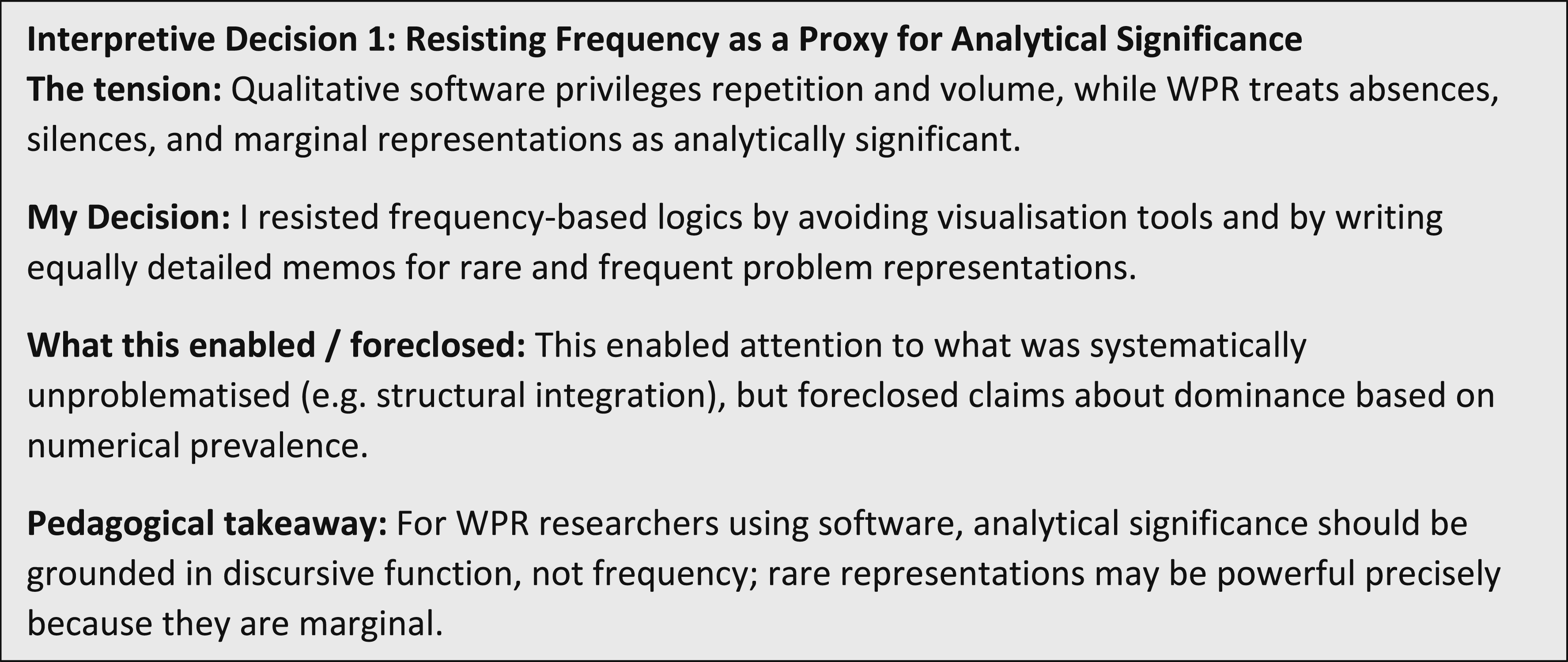
Taking the following recommendation, one can “work backwards” to identify problem representations: “[Health professionals should] take opportunities to ‘make every contact count’ for contraception and preconception care….” (PHE, 2018).
The implied problem representation here is that health professionals are not currently fulfilling their role in promoting preconception health. This conceptualisation places responsibility for addressing preconception health primarily at the level of healthcare providers, and implies that the problem of preconception health arises from missed opportunities by health professionals to intervene or that healthcare professionals do not use their contact time effectively.

Step 3: Identifying and Interrogating Underlying Assumptions (WPR Question 2)
To identify underlying assumptions and presuppositions, I examined both the conceptual logics that render this problem representation intelligible and the more proximate assumptions required to sustain those logics in practice. Interrogating the recommendation that healthcare professionals should “take opportunities to ‘make every contact count’ for contraception and preconception care” using WPR Question 2 reveals assumptions that healthcare professionals are sufficiently trained, knowledgeable, and motivated to provide preconception advice, and that they have adequate time within routine appointments to do so. It also assumes that healthcare encounters are flexible enough to accommodate opportunistic interventions, and that organisational or structural constraints—such as staffing pressures, resource limitations, or competing clinical priorities—will not significantly impede this work.
These assumptions reveal a dominant responsibilising logic, in which improving preconception health is conceptualised as a matter of individual professional action rather than as a systemic or structural issue. This logic rests on an implicit belief that change is most effectively achieved through modifying professional behaviour within existing service arrangements, thereby positioning healthcare professionals as the primary agents of improvement.

In addition to examining what is present, I attended carefully to how the language of the recommendation conceptualises the problem. Phrases such as “make every contact count” convey urgency and place responsibility squarely on healthcare professionals, positioning them as the primary agents of change. At times, the wording implicitly represents the ‘problem’ as one of individual professional behaviour rather than as arising from systemic or structural factors. I also tracked binary oppositions embedded in the discourse, such as “responsible versus irresponsible” or “proactive versus passive,” which serve to reinforce normative assumptions about what constitutes appropriate professional conduct and patient engagement. These assumptions and logics render the healthcare system itself largely unproblematic, while also implicitly minimising the effects of broader social, economic, and structural determinants of preconception health.
Throughout this process, I used annotations to document the thinking process for Q2 (Figure 3). This approach allowed me to distinguish between assumptions that were explicit and those that were implied, and to identify recurring patterns across multiple problem representations. Example of How NVivo Annotations Were Used to Support Analysis Using Q2
Step 4: Tracing the Emergence of Problem Representations (WPR Question 3)
Question 3 asks, “How did this representation of the ‘problem’ come about?”. In the context of my research, I addressed this question through a combination of bibliographic tracing and historical contextualisation, making deliberate choices about scope that were feasible within the constraints of my project.

Bibliographic tracing involved examining references within the policy documents to identify influential sources such as academic research, previous policies, and reports from other jurisdictions or organisations (Gaddis, 2002). This process helped to reveal which knowledge sources and discourses had informed the policy’s development, and how particular framings of the problem had travelled across contexts.
Historical contextualisation entailed reviewing key policy documents and institutional reports from the preceding ten-year period to trace how problem framings had evolved. This more contained timeframe made the analysis manageable while still allowing insight into discursive shifts and continuities. I also attended to the institutional and political context, noting significant events, policy changes, or public debates that may have influenced how the problem came to be framed.
This approach yielded valuable insights. Continuing with the previous example, the recommendation that “[Health professionals should] take opportunities to ‘make every contact count’ for contraception and preconception care” (PHE, 2018) can be linked to the selective uptake of research highlighting individual-level interventions. By examining related policy documents and government reports, I observed that studies emphasising structural determinants of preconception health were mostly absent, while findings supporting clinician-led interventions were consistently cited. Additionally, elements of public health discourse from broader preventive care policies, such as “making every contact count,” had migrated into the preconception health context, shaping how the problem is defined and addressed. This phrase itself carries connotations of efficiency and opportunism, positioning every healthcare encounter as a potential site for intervention and implying that failure to intervene represents a wasted opportunity.
In this way, we can identify how “problems” have shifted in response to political pressures, how certain research findings have been taken up while others have been ignored, and how discourses from other policy domains have migrated into this context. At the same time, I remain aware of what this bounded approach could not reveal—namely, longer historical trajectories, deeper genealogical roots, or more distant influences that may have shaped the discursive landscape.
Making these boundaries explicit serves several purposes: it manages readers’ expectations about the scope of the analysis, it demonstrates that meaningful engagement with Question 3 is possible without undertaking a full genealogy, and it invites reflection on alternative strategies for addressing this question within the practical limits of a research project.
Step 5: Grouping Problem Representations - Finding Discursive Affinities
After identifying the problem representations and examining their underlying assumptions, I conducted an additional layer of analysis to explore what Bacchi (2009) describes as “nesting”—the ways in which some problem representations are embedded within or connected to broader ones through shared discursive assumptions. To do this, I revisited the identified problem representations and looked for discursive affinities: instances where distinct policy statements or issues appeared to rest on common underlying logics, presuppositions, or rationalities.
This was not thematic grouping in the conventional sense of identifying recurring topics or frequently mentioned issues. Instead, the focus was on discerning connections among representations that, although articulated differently or appearing in separate sections of the policy documents, shared fundamental assumptions about the nature of the problem, its locus, and the types of interventions deemed appropriate to address it. Through this process, I developed categories that captured shared rationalities across multiple policy documents. One such category, “Healthcare professionals are authoritative voices essential for improved preconception health,” encompassed several statements that all reflected similar underlying problem representation: that healthcare professionals are primarily responsible for improving patients’ preconception health outcomes. These statements were grouped together because they consistently positioned healthcare professionals as the central actors responsible for identifying needs, providing advice, and supporting behaviour change. For example, statements such as:

These statements all emphasise the agency and responsibility of healthcare providers, demonstrating the shared conceptual logic underpinning this problem representation. Notably, the policy documents remained deliberately vague about which healthcare professionals bear this responsibility, suggesting that it becomes everyone’s responsibility and therefore potentially no one’s priority.

This analytical step served several purposes. It revealed the dominant discourses and policy paradigms operating across documents, made visible how particular rationalities were sustained and reinforced, and provided a means to examine the effects of shared assumptions—such as the subject positions they offered, the responsibilities they ascribed, and the silences they produced. It also helped to manage analytical complexity when working with multiple interconnected problem representations.
It is important to distinguish this approach from conventional thematic analysis. The organising principle was not topic or frequency, but discursive affinity—connections among policy statements linked by common forms of problematisation. This distinction was essential to maintaining epistemological coherence with WPR’s poststructuralist foundations.
Step 6: Analysis Using a Matrix
Example of Completed Matrix to Address Q4-6. I Provide This as an Example as to How One can Address Q4-6 Using a Matrix to Organise WPR Thinking and Analysis
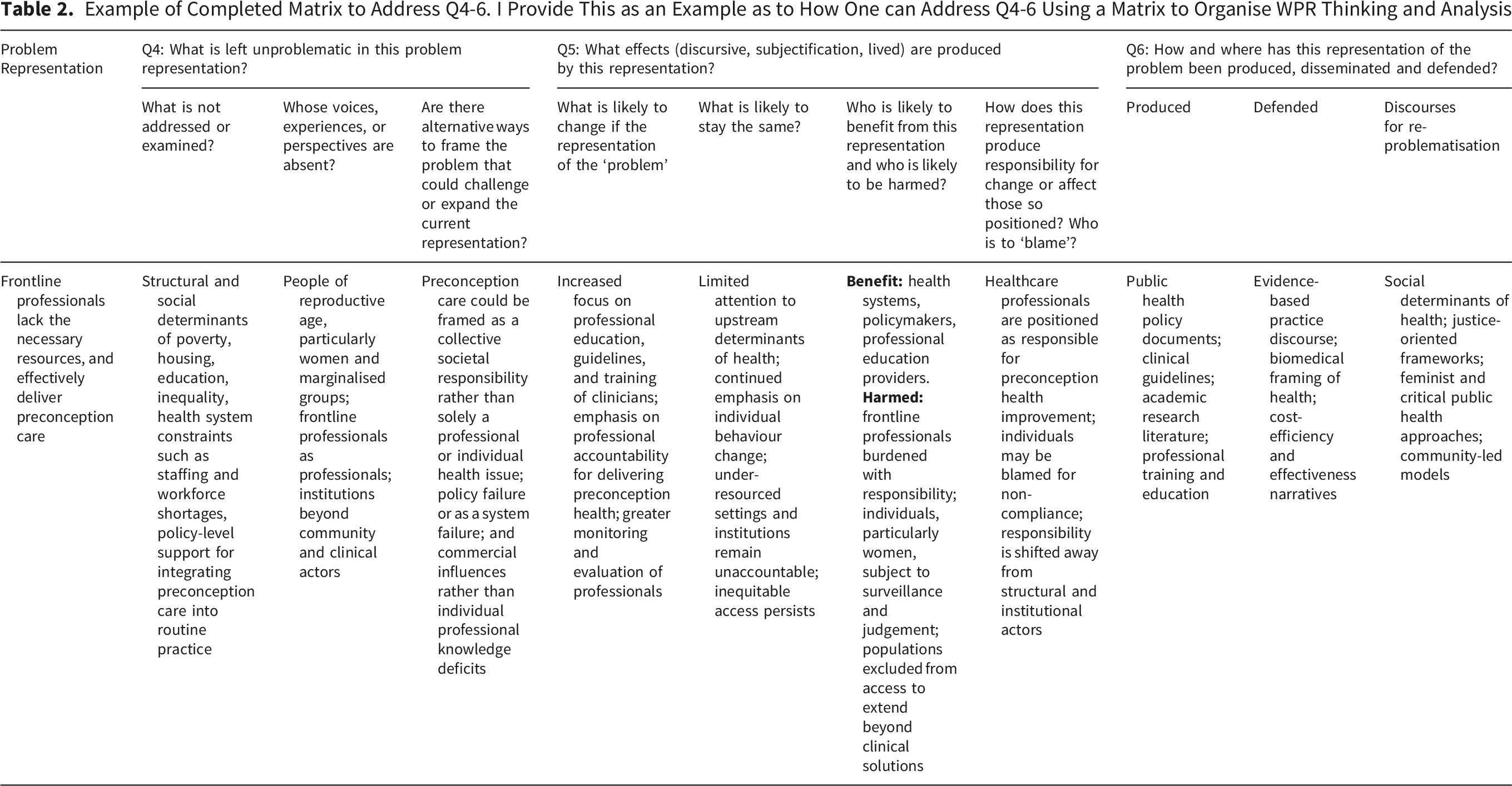
One of my identified problem representations emerging from the policy solutions was that frontline professionals are assumed to lack the necessary knowledge, resources, and training to deliver effective preconception care. By working through the matrix, I was able to first identify how this representation positions healthcare professionals within policy discourse. Although framed as a deficit, the representation constructs healthcare professionals as authoritative holders of knowledge and as the primary agents through whom preconception health improvement is expected to occur. The matrix prompted explicit consideration of how responsibility is allocated, making visible how responsibility is centralised within frontline practice rather than distributed across policy, systems, or social structures. The matrix was also useful in tracing the effects produced by this representation. It prompted explicit reflection on unintended consequences, including the exclusion of those without regular service contact, the overestimation of professional capacity, and the under-recognition of the training, time, and resources required to deliver effective preconception care. Importantly, the matrix aligned to WPR’s questions, encouraging attention to what is left unproblematised and explicitly asking whose voices are absent and what alternative problem framings are possible. In this way, the matrix functioned as a practical mechanism for operationalising the WPR questions, enabling both the opportunities and limitations of the problem representation to be traced in a transparent and systematic manner.
While the matrix is valuable for interrogating policy-as-discourse, it also highlights a key consideration for the WPR approach: its engagement with lived effects. WPR excels at revealing how problems are represented but is less able to capture how these representations are enacted and experienced in practice (Tawell & McCluskey, 2022). In a previous paper, my colleague and I have tried to address this limitation by adapting WPR analysis to include co-analysis involving affected communities, ensuring that lived experiences inform and challenge dominant policy representations (Hickman & Muir, 2025). I also recognise a matrix may not be best suited to all researchers and that others might find different tools more suitable. Some might prefer to work within NVivo’s framework features, others might use narrative or discourse-based approaches without tabular organisation, or entirely different structures. The matrix represents my response to a specific set of analytical challenges—it is one possible approach rather than a prescriptive method.

Step 7: Reflexive Application of WPR to My Own Work
WPR’s final step directs the analytical gaze inward. Step 7 involves critically reflecting on my own role as a researcher and how my framing of the “problem” is constructed, maintained, and potentially challenged within the analysis (Bacchi & Goodwin, 2016). It requires attention to my interpretive choices, assumptions, and the ways my positionality shapes both the identification of problem representations and the conclusions drawn from them.
Reflexive Prompts Used for WPR Analysis
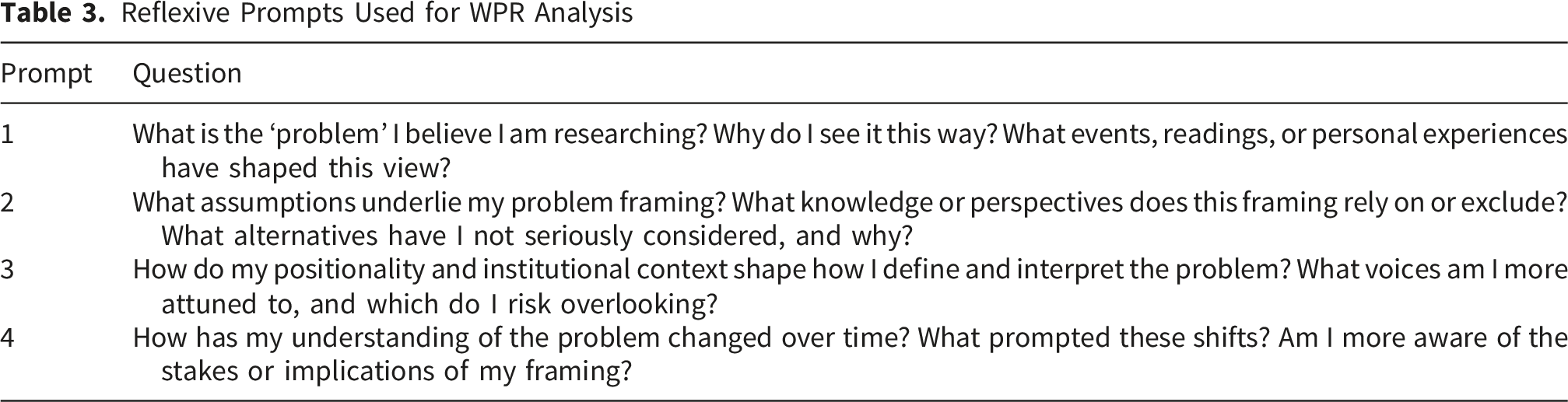

Engaging in this reflexive practice was sometimes uncomfortable, as it required confronting blind spots and taken-for-granted assumptions. However, it was crucial for maintaining epistemological coherence: if WPR’s premise is that problems are constituted through discourse rather than existing objectively, then my own framing of the problem must undergo the same critical scrutiny applied to policy texts. The journal also plays a key role in enhancing transparency. When writing up the research, I can draw on these reflections to demonstrate not only what I found, but also how my positionality and analytical choices shaped the findings that were possible.
Step 8: Writing the Analytical Narrative
While the process has been presented as a series of “steps,” it is important to note that WPR is rarely linear. Researchers often move back and forth between different stages revisiting earlier steps as new insights emerge (Bacchi, 2009). The final task in a WPR analysis is to write the analytical narrative, synthesising your findings and reflecting on your research questions. How the narrative is written depends on your research project, in my project I consider how problem representations operate, whose responsibilities they construct, and what effects they produce.
For the purposes of this paper, I do not present my final analytical narrative, as it forms part of my doctoral empirical findings that I intend to publish separately. However, numerous published studies illustrate how WPR analyses can be written up as analytical narratives (e.g., Aavik et al., 2023; Adami and Lyngbäck, 2024; Stoor et al., 2021). These works provide concrete examples of how problem representations and their effects can be translated into coherent, interpretive accounts. I encourage readers to consult the WPR Select Reference List to explore the diverse ways researchers have approached writing up their findings and to identify approaches that align with their own analytical style and research project.
Discussion
Beyond offering a worked example of WPR in practice, this paper makes a methodological contribution by foregrounding interpretive decision-making itself as an object of methodological reflection. While existing WPR scholarship has focused primarily on the questions analysts should ask of policy texts, relatively limited attention has been paid to how researchers make and justify interpretive judgements as they move through analysis. By explicitly documenting analytical tensions, decisions taken, and their consequences, this paper advances a way of operationalising WPR that preserves its critical intent while rendering the labour of interpretation visible. In doing so, it contributes to pedagogical accessibility and to methodological debate about how poststructuralist analysis can demonstrate rigour without resorting to proceduralisation. Although the empirical example presented here is drawn from health policy, the methodological strategies illustrated are not domain-specific. The practices of documenting interpretive decisions, using matrices as heuristic devices, and maintaining reflexive journals are transferable to WPR analyses in education, governance, and social policy, where researchers confront similar challenges of complexity, abstraction, and interpretive responsibility. What does not transfer wholesale are the substantive institutional logics embedded in health policy, such as assumptions about professional authority or clinical responsibility. These domain-specific features shape the content of problem representations rather than the analytical process used to interrogate them. Distinguishing between transferable analytical practices and context-bound problem representations helps avoid overgeneralisation while supporting methodological learning across fields.
Between Guidance and Prescription
Literature on critical and qualitative methods highlights how rigid procedural frameworks can diminish interpretive openness essential for critical social inquiry (Sinsky et al., 2021). Overly prescriptive standards risk encouraging procedural compliance rather than critical engagement, turning methods into checklists that lose their transformative power. Such standardisation may accommodate critical methods within conventional academic expectations but at the cost of their disruptive potential.
However, I argue that this tension can be productive rather than paralysing. Structure and criticality need not be opposed if the structure is flexible, provisional, and reflexive. The key lies in understanding what kind of structure we provide and for what purpose.
The steps I outline function as interpretive scaffolds—practical supports that help navigate WPR’s conceptual demands without prescribing how analysis must unfold. This distinction matters both theoretically and practically. Interpretive scaffolds resemble what other qualitative traditions call “thinking tools” or “sensitising concepts.” In grounded theory, sensitising concepts provide flexible, interpretive starting points for analysis rather than fixed categories (Blumer, 1954; Charmaz, 2006). They guide researchers to notice relevant patterns without imposing rigid frameworks, preserving openness to complexity and context-specific nuance (Bowen, 2006). Similarly, heuristic devices in ethnography orient attention and interpretation while allowing adaptation to evolving field conditions (Mills & Birks, 2017). These thinking tools enable researchers to grapple with complexity by providing provisional guidance that supports emergent understanding rather than constraining analysis through prescriptive coding schemas.
My operational steps work in this same spirit. The analysis matrix, for instance, does not predetermine what counts as an “effect” or “assumption”—it provides a structured space for interrogation while remaining open to unexpected insights. Moreover, the reflexive journal prompts create opportunities for researchers to examine their own interpretive practice. This approach aligns with feminist and participatory methodological traditions that advocate for reflexive engagement to prevent the domestication of critical inquiry (McArdle, 2022).
Heterogeneity as a Strength
The diversity in how researchers apply WPR should be celebrated rather than resolved. Heterogeneity in qualitative approaches enables important discussions about links between methodological process and research product (Lester & O’Reilly, 2021). This insight is particularly relevant for understanding how WPR can be operationalised across different contexts and research questions.
The fact that researchers apply WPR differently reflects the approach’s adaptability and the diversity of research contexts, questions, and epistemological commitments they bring. Some researchers work primarily with policy documents, as I did; others analyse interviews, media texts, or institutional practices (Pringle, 2019; Nnamani & Lomer, 2024). Some focus intensively on Questions 2 and 5, examining assumptions and effects in depth (Trygg et al., 2022; Iliffe and Manthorpe, 2025); others pursue genealogical investigations through Question 3 (Egbobamwonyi-Bedaux, 2025). Some integrate WPR with other analytical frameworks such as intersectionality or critical discourse analysis (Van Aswegen et al., 2019); others use it as a standalone approach. This heterogeneity is productive rather than problematic — it demonstrates WPR’s capacity to travel across contexts while being enacted in contextually-appropriate ways. Methodological openness creates space for collective learning. By sharing diverse operational approaches alongside their rationale and consequences, researchers contribute to a richer methodological conversation. This conversation can explore how different operational choices serve different analytical purposes, support different kinds of insights, and remain coherent with WPR’s critical intent in diverse ways.
Implications for Quality and Transparency in Critical Research
The worked example presented in this paper contributes to ongoing debates about what constitutes quality and rigour in critical qualitative research. These debates often centre on a fundamental question: if we reject positivist criteria such as reliability and replicability, what takes their place? How do we distinguish between rigorous critical analysis and impressionistic interpretation?
Traditional quality criteria emphasise consistency, systematisation, and the potential for replication. Yet these standards sit uneasily with poststructuralist methods that prioritise interpretation, reflexivity, and the recognition that knowledge is always situated and partial. Epistemological coherence matters as much as technical rigour for critical approaches (Bouzanis, 2017). The question is not simply “Did you follow the steps correctly?” but “Did your approach genuinely engage with the method’s critical intent by remaining faithful to its core assumptions?”
This shifts the ground for assessing quality. Rather than seeking procedural conformity, we can evaluate whether operational choices maintain epistemological coherence with poststructuralist principles. Does the analysis treat problems as discursively constructed rather than pre-given? Does it examine how language constitutes rather than merely describes reality? Does it trace how power operates productively rather than only repressively? Does it remain reflexive about its own role in problem construction? Transparency becomes central to this alternative understanding of quality.
Quality in qualitative research should focus on the worth of the product rather than technical conformity to procedures (Morse, 2021). But assessing “worth” requires understanding how analytical choices shaped what could be known. This returns to the poststructuralist foundations articulated earlier: if problems are constituted through discourse rather than existing objectively, then the researcher’s analytical practices are themselves constitutive. They do not simply reveal pre-existing problems but participate in constructing what becomes knowable.
This understanding of quality has pedagogical implications. Teaching critical methods becomes less about transmitting correct procedures and more about cultivating interpretive sensibilities, analytical judgment, and reflexive awareness. Students learn to ask not “Am I doing this right?” but “Does this analytical choice align with the method’s critical intent? What does it enable me to see, and what might it obscure? How does my positionality shape this interpretation?” The worked example offered here supports this pedagogical approach by demonstrating how such questions can be navigated in practice.
In this way, transparency serves as both quality assurance and methodological development. It allows assessment of individual studies while contributing to collective understanding of how critical methods can be rigorously enacted across diverse contexts. It acknowledges that there is no single “right way” to operationalise WPR while maintaining that not all operational approaches are equally coherent, rigorous, or critically engaged. The challenge, and the opportunity, lies in making our practices visible enough that these distinctions can be meaningfully discussed and debated.
Conclusion
This paper contributes to WPR scholarship by demonstrating how interpretive decision-making can be documented as part of the analytical process, rendering visible the epistemological labour through which WPR’s critical questions are enacted. The worked example illustrates one way of operationalising Bacchi’s WPR approach that remains epistemologically coherent with poststructuralist foundations while offering practical guidance. For researchers seeking to apply WPR in their own work, the example invites attention to the visibility of interpretive choices, the documentation of analytical tensions and trade-offs, the contextualisation of operational steps to specific data and fields, and ongoing reflection on the implications of these decisions for knowledge claims.
A central contribution of this paper lies in demonstrating how transparent documentation foregrounds interpretation as constitutive of knowledge. Documenting memo-writing, reflexive journaling, analysis matrices, and analytical decisions provides a reflexive means of engaging with poststructural tensions. It allows researchers to examine how particular interpretive choices shape what becomes knowable and to consider how alternative analytical paths might have been pursued. Interpretation is always happening; transparency redistributes epistemic authority rather than claiming neutrality.
Supplemental Material
Supplemental Material - Making WPR Visible: A Worked Example of Operationalising What’s the Problem Represented to be?
Supplemental Material for Making WPR Visible: A Worked Example of Operationalising What’s the Problem Represented to be? by Merissa Elizabeth Hickman in International Journal of Qualitative Methods
Footnotes
Acknowledgements
I would like to thank my supervisors for their invaluable guidance and support throughout this work. I am especially grateful to Nicola Mackintosh for encouraging me to explore this methodology and for her thoughtful guidance and feedback on this manuscript. I also thank Natalie Armstrong for her constructive feedback, which greatly improved the quality of the work, and Gemma Hughes for her specialist insight into discourse, which helped to expand and deepen this piece.

Funding
The authors disclosed receipt of the following financial support for the research, authorship, and/or publication of this article: This research was supported by Wellcome Trust training programme in Genomic Epidemiology and Public Health Genomics under Grant [218505/Z/19/Z].
Declaration of Conflicting Interests
The authors declares no potential conflicts of interest with respect to the research, authorship, and/or publication of this article.
Supplemental Material
Supplemental material for this article is available online.
References
Supplementary Material
Please find the following supplemental material available below.
For Open Access articles published under a Creative Commons License, all supplemental material carries the same license as the article it is associated with.
For non-Open Access articles published, all supplemental material carries a non-exclusive license, and permission requests for re-use of supplemental material or any part of supplemental material shall be sent directly to the copyright owner as specified in the copyright notice associated with the article.
