




Abstract
Design-led social innovation projects often begin in a fuzzy front end, where problem definitions, researcher roles, and criteria of success are fluid, and conventional qualitative approaches are ill-equipped to capture the affective and relational pressures of practice. In response, this study explores how collaborative writing can work as a caring assemblage in this context, highlighting its generative role. We conducted two qualitative case studies of rural social innovation projects in China, in which design researchers and students experimented with collaborative writing during their cooperation with village communities. Following the writing experiment, we collected shared digital journals, comments, and follow-up interviews generated by the teams, which we analysed using reflexive thematic analysis. By employing the caring assemblage as a theoretical lens, this study shows how flows between human and non-human actants in collaborative writing gave rise to four entangled dynamics: caring interruptions, care across screens, emergent knowledge, and care for subjectivity. These dynamics did not directly produce design “solutions,” but assembled an immanent plane where care, responsibility, and power could be continuously negotiated in the face of uncertainty and perceived failure. We argue that treating collaborative writing as a socio-material infrastructure enables design teams to transform confusion, fatigue, and conflict into shared inquiry, while supporting ethical self- and other-care. Drawing on theories from broader disciplines, this study contributes to qualitative methodology in the field of design by reframing collaborative writing as a generative way of knowing and intervening within complex, design-led projects, rather than a retrospective add-on.
Keywords
1. Introduction
In the past century, design has gradually shifted from modernist design emphasising the fusion of art and industry towards contemporary practices oriented towards social innovation. Throughout this transformation, design research has consistently sought to emulate the objectivity and systematic approach of the natural sciences to gain disciplinary legitimacy, yet in doing so has continually suppressed the inherent creativity and improvisation within the practice itself (Koskinen et al., 2011). However, in the field of social design innovation, researchers often encounter problems that are deeply entangled and difficult to unpack. Such problems are typically termed wicked problems that are deeply entangled and shaped by complex institutional structures and plural stakeholder values (Buchanan, 1992; Van Bueren et al., 2003). Such projects start from what is termed the fuzzy front-end stage: objectives remain unclear, information is highly fragmented, and both the researchers’ roles and the criteria for project success are subject to ongoing negotiation (Takey & Carvalho, 2016). Designers frequently employ qualitative and ethnographic methods such as interviews and observation to understand existing conditions and identify potential new directions for innovation. Yet these methods struggle to capture the subtle shifts in emotional and power dynamics within real-time, rapidly evolving practices (Lunenfeld, 2003; Meyer & Willis, 2019).
This situation also reveals a profound epistemological divergence between design research and ethnography. According to Smith et al. (2016), traditional ethnography is documentary, with the goal of describing established realities. Design studies follow a teleological and generative epistemology. They strive to shape an unimagined future through present interventions (Celikoglu et al., 2020). When designers simplify the innovation process to linear workflows, they frequently overlook critical backstage dynamics in design practice. These fleeting bodily sensations, inarticulate intuitions, and emotional fluctuations are, in fact, the catalysts that drive the design process and innovation (Bofylatos & Pérez, 2025). There is thus a need for qualitative method that can attend to these embodied, affective dimensions without abandoning analytic clarity.
In response to such challenge, some design researchers have recently begun to argue that autoethnography can serve as a more contextualised social design research method. This is because it allows researchers to emphasise emotions and intuitions that are frequently overlooked in practice, thereby capturing ethical tensions and power dynamics (Schouwenberg & Kaethler, 2021; Xue & Desmet, 2019). Collaborative Autoethnography (CoAE) extends this tradition by introducing a multivocal structure in which researchers co-write, share and collectively analyse their accounts, emphasising identity, relationality and reflexivity (Chang et al., 2016; Lapadat, 2017; Lyndon & Edwards, 2022). At the same time, autoethnography itself has long been marked by tensions between analytic and evocative orientations. On one side, scholars have responded to pressures for “scientific” accountability and neo-positivist standards by strengthening analytic framing and verifiability; on the other, narrative, and evocative traditions, inspired by interpretive anthropology, seek to make the everyday lives of oppressed, silenced and forgotten groups sensuously present through writing (Lather & St. Pierre, 2013; Xue & van Kooten, 2023). We argue that design research sits precisely at this crossroads: thoughtful designers move back and forth between analytic/logical and sensorial/existential modes, rather than treating “analysis” and “evocation” as mutually exclusive.
Some studies argued that when concepts of embodiment, emotion, and narrative from autoethnography are imported into design, they are often reduced to techniques, checklists, workshop, or tools (Catoir-Brisson & Paixão-Barradas, 2025; Kimbell, 2011). This tendency is not unique to design but echoes broader debates in qualitative inquiry about the difficulty of moving from positivist notions of objectivity to more embodied, relational forms of knowing under institutional pressures for standardisation (Akama, 2015; St. Pierre, 2014).
Accordingly, we do not present this work as a full example of collaborative autoethnography; rather, we draw on CoAE-inspired collaborative writing, together with assemblage thinking, as a design-embedded methodological experiment for attending to the fuzzy front end of social design projects. We propose a framework we term the Caring Assemblage framework. This framework is developed through three theoretical lenses. The first is building on Mol’s (2008) concept of the logic of care. Care is understood as an ongoing, adaptive process of tinkering rather than a one-time choice. Through collaborative writing, care extends into material and epistemic domains, positioning researchers as emotionally and ethically responsible in knowledge production (de La Bellacasa, 2017). The second lens is assemblage thinking, which allows us to conceptualise practice as a provisional gathering of human and non-human elements—researchers, villagers, digital platforms, sticky notes, emojis and affects—characterised by openness and emergence (Deleuze & Guattari, 1987; Tsing, 2015). Third, following Wyatt and Gale’s (2013) notion of assemblage/ethnography, we treat collaborative writing itself as a caring assemblage on an immanent plane of composition, where the boundaries between “self” and “other” become less stable and subjectivity is continually re-positioned (Wyatt et al., 2011). This flow does not remove power or bias. It opens a space for them to be voiced and reflected on, while capturing bodily pains and confusions. We aim to magnify those everyday experiences suppressed by traditional design research, including moments of hesitation, reluctance, and perceived powerlessness, transforming them into indispensable thick descriptions that carry projects forward.
We ground this framework in two qualitative case studies of design-led social innovation projects in rural China. Across these projects, the research team collectively generated 842 diary entries, peer comments and follow-up interviews, documented through shared Miro boards and collaborative writing. Through thematic analysis, we identified four interrelated dynamics constitute a Caring Assemblage. We argue that under conditions of uncertainty, such caring assemblages can move beyond a purely reflective function to operate as a generative design inquiry method. By keeping the assemblage “sensitive” to embodied pain, confusion, and sensory litter (Hare, 2020), collaborative writing transforms what might appear as noise or failure into thick experiences that challenge existing power relations and open new possibilities for action.
2. Theoretical Background
2.1. Collaborative Autoethnography
Autoethnography is a qualitative method that draws on the researcher’s own lived experience as data, using personal narrative to reflect on one’s relationship with broader cultural phenomena (Ellis & Bochner, 2006). Scholars caution that if limited to one’s “comfort zone,” it can fail to confront deeper epistemic and embodied tensions (Norwood, 2018). In response, collaborative Autoethnography (CoAE) extends this tradition by introducing a multivocal structure, where multiple researchers co-write, share, and collectively analyse their autoethnographic accounts. This dialogic process allows for a more layered and reflexive understanding of complex social issues (Adams & Holman Jones, 2011; Karalis Noel & Minematsu, 2023). Through mutual critique and collective reflection, CoAE helps participants move beyond the anecdotal (Chang, 2016), enabling a more flexible and socially grounded form of inquiry. While reflexivity requires attending to one’s positionality—such as race, gender, class, or disciplinary background (Bundy et al., 2023)—Meaningful reflexivity emerges when researchers bring their lived experiences into dialogue with participants’ realities, fostering ethical and emotionally grounded research relationships (Finlay, 2006). In this way, the researcher becomes not just an observer but a co-participant in shared meaning-making.
Within design research, however, concepts of embodiment, emotion, and narrative from autoethnography are often translated into a narrow repertoire of methods and tools. Designers selectively borrow autoethnographic language to legitimise familiar user-centred routines, rather than engaging with its more demanding commitments to sustained writing, vulnerability, and political critique (Kimbell, 2011). Catoir-Brisson and Paixão-Barradas (2025) shared how they employed autoethnography to address anxiety, fatigue, and moral burden within healthcare projects, arguing against designers’ simplistic use of autoethnography to analyse users. Recent work in design has begun to push back, using (collaborative) autoethnography to surface backstage negotiations, ethical tensions, and local power relations in social design projects (Bofylatos & Pérez, 2025; Miller et al., 2025). Yet CoAE is still mostly treated as a retrospective strategy for documenting and justifying decisions, rather than as a situated practice that actively re-orients judgement and alters a project’s trajectory as it unfolds.
2.2. The Immanent Plane and Assemblage Thinking
This study takes Deleuze and Guattari’s concepts of the immanent plane and assemblage to rethink collaborative writing within design research. The notion of an immanent plane describes a virtual, open field with no outside, where forces, affects and connections constantly form and dissolve rather than being organised into stable hierarchies (Deleuze, 2001). On such a plane, difference is not noised to be eliminated but the very condition of creativity. Assemblages, in turn, bring this plane into concrete configurations. Deleuze (2007a, 2007b, p. 177) describes assemblages as involving both material components, such as bodies, objects, and their contingent arrangements, and expressive elements, including utterances, modes of expression, and symbolic regimes. Bennett (2010) expands on this by encouraging attention to “the whole swarm of vitalities at play” and the relational constellations that emerge through these entanglements. In social-ecological research, assemblage thinking has been used to emphasise open-endedness and emergence, attuning to “partial, fragile and situated” formations rather than stable systems (Tsing, 2015). Recent qualitative work further suggests that knowledge does not simply represent assemblages but emerges through their ongoing reconfiguration (Croft, 2025).
Building on Deleuze and Guattari, Gale and Wyatt’s work on assemblage/ethnography shows how collaborative writing itself can be understood as an assemblage on an immanent plane, where subjectivities are continually repositioned and writing “works in-between” rather than stabilising fixed authorial identities (Gale & Wyatt, 2013; Wyatt et al., 2011). More recently, they ask whether the force of collaborative writing lies less in the “two” writers and more in the “between” of relational space, arguing that writing is an immanent doing that re-orient thought rather than merely representing experience (Gale & Wyatt, 2025). In our study, this between is concretely inhabited through shared digital spaces such as Miro boards. Digital collaboration intensifies these dynamics. Platforms such as Zoom, Miro and other shared online workspaces reshape how dispersed teams meet, see each other, and leave traces. They host interaction but also privilege forms of contribution—short, visual, fragmented posts rather than slow, linear narratives (Hohti & Tammi, 2024; Pink et al., 2016). From an assemblage perspective, such tools become non-human actants that modulate participation, visibility and caring, co-becoming the immanent plane on which, our Caring Assemblage takes shape.
2.3. Caring Theory
The ethics of care emerged as a distinctive moral philosophical perspective with the publication of In a Different Voice by Carol Gilligan in 1982 (Gilligan, 1993). Before this, dominant models of moral psychology were heavily influenced by Lawrence Kohlberg (1981) and grounded in Kantian or utilitarian frameworks that prioritized rights, justice, and universal principles. This ideological shift marked a turning point in moral philosophy, moving ethical attention away from abstract rules toward concrete responsibilities, relationships, and actual practices of care. This orientation has been further developed by scholars such as Joan Tronto, whose feminist political ethics of care define care as both a disposition and a practice (Zakharova & Jarke, 2022). Tronto and Fisher describe care as “everything we do to maintain, continue, and repair our world so that we may live in it as well as possible” (Tronto & Fisher, 1990, p. 34). Tronto later proposed five phases of care: caring about (recognizing the need for care), caring for (taking responsibility and planning a response), caregiving (performing the concrete acts of care), care receiving (recognizing and evaluating the response to care) (Tronto, 2020), and caring with (embedding care in practices of justice, democracy, and peace) (Tronto, 2013). Although different strands of care ethics emphasize its importance as a form of social reproduction—highlighting its emotional, gendered, and often invisible dimensions—care ethics is not a unified theory. More recent work draws on Actor-Network Theory (ANT) (Latour, 1996) and relational ontologies to reconceptualize care beyond human-centered frameworks. For example, Johns-Putra characterizes care as “a means by which agency occurs,” suggesting it is a dynamic and situated process that unfolds within relational entanglements (Johns-Putra, 2013, p. 134). Drawing on Latour’s notion of actants, she describes caring as part of a network composed of both human and non-human entities (Latour, 2005).
This post-humanist and new materialist turn reframe care not merely as a moral position but as a mode of collective world-making grounded in ontological plurality. Mol and her collaborators argue that care is a collective accomplishment, brought into being through specific material practices (Mol, 2008). They describe care as “persistent tinkering in a world full of complex ambivalence and shifting tensions” (Mol et al., 2010, p. 14). Similarly, Winance (2010) presents care as a meticulous process of composition, involving testing, adapting, and refining arrangements—whether material, emotional, or relational—until mutual coordination is achieved. These perspectives invite us to understand ethnographic research itself, especially when it engages with technologies, bodies, and objects, as a situated and collective practice of care.
In this study, care is treated as a situated practice of ongoing tinkering (Mol, 2008), enacted through collaborative writing where responsibilities and tensions are negotiated and repaired over time. This ongoing caring manifests in micro-actions such as a timely reminder, a word of encouragement, or an emoji, which continuously mend the team’s relationships, emotions, and working rhythm. In this model, care is not a static moral principle but an active process of ‘maintaining, continuing, and repairing’ (Tronto & Fisher, 1990) the social and material web of the project. Specifically, we focus on the ‘caring with’ phase (Tronto, 2013), which assembles an immanent plane through collaborative autoethnography to facilitate the flow of power, relationships, and care among all involved entities.
3. Methodology
This study adopts a qualitative case study method, understood as “an empirical inquiry that investigates a contemporary phenomenon in depth and within its real-life context” (Yin, 2009, p. 18). It enables us to answer ‘how’ and ‘why’ questions regarding the application of CoAE in the messy, emergent practice of social innovation. Within this case study framework, we focus on the role and function of CoAE-inspired collaborative writing as a central practice employed by the research teams. Our analysis of the collaborative writing process allows us to investigate the practical development of what we term the ‘caring assemblage.’ This method aligns with interpretivism and constructivism, which view knowledge as co-created by researchers and participants within situated, relational contexts (Denzin & Lincoln, 2011; Ellis & Bochner, 2006). The research team acted simultaneously as investigators, participants, and subjects in this study. Through daily reflective journaling, collaborative Miro board activities, online discussions, and interviews, the team generated rich qualitative materials. Throughout this process, research questions, analytical strategies, and representational modes were collectively discussed and adjusted (Karalis Noel et al., 2023).
3.1. Research Setting: Projects, Participants, and Roles
This study is based on two design-led social innovation cases carried out in rural China. Unlike independent ethnographic research, these cases were part of institutional arrangements that included university and local government funding, local government/village committee oversight of access and collaborative boundaries, and student course assessments/research assignments. Case One was a teaching-oriented project with one tutor and 32 undergraduates; Case Two was a research-oriented project started by a PhD candidate in design and expanded to include eight interdisciplinary participants. Within this context of coexisting hierarchies and constraints, collaborative writing emerged as an embedded methodological practice initiated by research teams, rather than being mandated by funders. Drawing on the first author’s prior experience with reflexive autoethnographic writing (Lin & Wu, 2025) and ambitions for collaborative autoethnography, both cases used collaborative writing throughout. Miro and online docs were set up as parallel infrastructures, deliberately disconnected from formal assessment/external deliverables: diaries were explicitly excluded from grading, remained inaccessible to external bodies, and allowed for peer commentary while preserving disagreements. This helped the teams document and negotiated tensions, manage conflicts, and navigate emotional labour under institutional pressures. The first author initiated and maintained this writing arrangement; the second and third authors were case study participants; and the corresponding author provided methodological support and contributed to developing writing principles.
3.2. Two Cases Context
This study analyses two cases sharing three common characteristics, providing a comparative foundation for analysis (Stake, 2013; Yin, 2009). Firstly, in the context, both projects are rooted in rural China, with participants primarily comprising design discipline tutors and students, thus offering a relatively consistent practitioner perspective. Secondly, both design projects commenced within the “fuzzy front end” phase research stage where initial problems and directions remain unresolved (Sanders & Stappers, 2008). Teams continuously refined problem definitions and iterated research direction throughout the process. Thirdly, throughout the project, Collaborative Autoethnography and collaborative writing were both key methods employed.
Case One is a rural social innovation project on a small island off China’s eastern coast, where fishing and small-scale tourism are the primary sources of income. In 2024, a design tutor led 32 undergraduate design students in a 2022 follow-up study, this time without a fixed problem statement, asking them to identify locally relevant issues and propose situated solutions. Students were given a brief introduction to collaborative writing and field journal writing method, worked in eight groups, and shared observations, group discussions, and the tutor’s field notes on a shared Miro board (Figure 1). Miro in Case 1, all eight groups of designers’ research data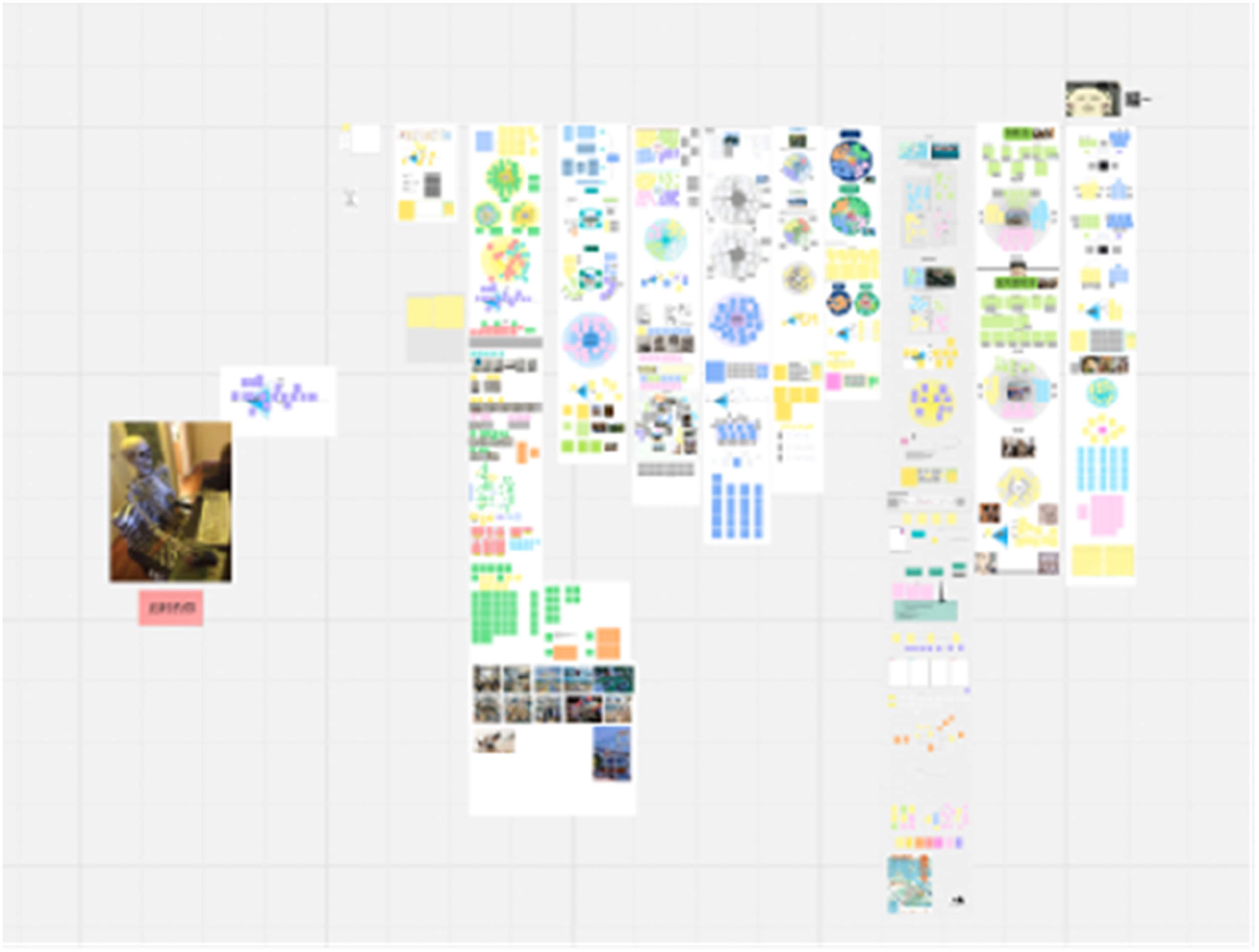
Case Two began in 2024 as a rural research project initially led by one design PhD candidate. Over time, the team expanded to eight members including designers, anthropologists, and curatorial practitioners. This project gradually evolved into a series of social innovation interventions as the team became more embedded in the community. Due to logistical constraints, one researcher was unable to participate in the initial fieldwork on site. To ensure continuity, two field-based members posted observations and reflections to a shared Miro board. The three core researchers conducted ongoing analysis and reflection using document review, sticker-based commenting, and weekly online meetings (Figure 2). This collaboration was the first time the three researchers worked together. They used collaborative writing to clarify individual research goals and establish a working rhythm. Case two working Miro (includes collaborative writing, observation data, draft report, records of meetings, etc.)
3.3. Data Collection and Analysis
Overview of Evidentiary Sources Achieving Triangulation Across Cases (Adapted From Yin, 2009)


The reflexive thematic analysis process in this study
The first and primary dataset consists of collaborative writing data, specifically participant diaries that reflect on their daily experiences and observations. In Case One, a large, co-located team (33 members, including the tutor) established a shared journaling system using Miro whiteboards and online shared doc links. Each student and tutor contributed at least one journal entry per day, documenting key events, emotional responses, emerging thoughts, and project reflections. Peer commenting was encouraged. In Case Two, the team used a Miro board for journaling, but the format was more varied. In addition to written reflections, participants occasionally shared field photos, sketches, or voice recordings. All logs were made available on the Miro board for collective access and review.
The second dataset consists of peer comments and dialogues among participants. A key feature of collaborative writing data in this study is the frequency with which members read and respond to one another’s narratives. Accordingly, we included Miro-based comment threads and response interactions as part of our data. In Case One, students often read each other’s journals outside class time and left brief comments such as “I felt the same” or “I disagree with A’s self-assessment—I think they’re doing great.” In Case Two, where asynchronous collaboration was the norm, Miro’s comments became a central communication channel. These interactions became richer during moments of project difficulty, when sticker comments layered over one another, revealing emotional lows, encouragement, and disagreement. Such dialogues provided valuable insights into the emotional contours of collaboration.
The third dataset contains selected design outputs and background documents from both project teams. For Case One, we gathered eight final rural planning proposals from the 32 students in Team B, along with their corresponding collaborative writing records. We also reviewed’ Team A’s original 2022 planning report. These materials allowed us to examine how collaborative writing contributed to project development. For Case Two, we collected community intervention proposals, event documentation, and internal project summaries. These artifacts allowed us to track how insights gained from collaborative writing were integrated into project implementation and outcomes.
The fourth dataset emerged from our reflexive engagement with the previous three data sources. To further explore findings, we conducted semi-structured interviews with nine participants, inviting them to reflect on the role of collaborative writing within their projects. This participatory member-checking process was designed to enhance the complexity and richness of the study (Lapadat, 2017), while also reflecting our ontological commitment to a view of knowledge as continually becoming.
To illustrate each theme, we included short vignettes from participants’ diaries and team discussions, all of which were anonymised and approved. Some are written in first person to maintain an autoethnographic tone. This narrative choice is not merely a stylistic consideration but is grounded in the principles of sensory ethnography (Pink, 2001; Stoller, 2004). It rejects Cartesian mind-body dualism, instead treating the researcher’s embodied experience as the primary field of cognition (Ellingson, 2006). This process demands a deep reflexivity and treats feelings and emotions as central to critical insight (Burkitt, 2012). By capturing knowledge known through the body, fleeting sensations, emotional surges, and intuitive discomforts, we argue that this method not only enhances the ‘clarity and force of ethnographic representations’ but also deepens the ‘social analysis of power relations-in-the-world’ (Stoller, 2004, p. 820). Therefore, these vignettes are not treated as mere illustrations of our themes, they are the core, embodied data of our analysis.
3.4. Positionality & Reflexivity
As qualitative researchers, we acknowledge that research is not neutral but profoundly shaped by the researcher’s identity and power relations (Denzin, 2014). We do not claim that introducing autoethnographic or collaborative writing removes “colonial” or representational risks (Poulos, 2017). Rather, we treat caring assemblages as a way of rendering these dynamics visible and workable, enabling them to be documented, negotiated rather than obscured.
Across the two cases, the authors occupied different positions within the institutional arrangement. These cases were embedded in formal settings, university teaching/research requirements and locally sanctioned access, which shaped participation, accountability, and the boundaries of what could be documented (Chou & Wong, 2015).
Power asymmetries were present at three levels. First, researchers–community relations were mediated by local gatekeepers and existing governance structures, shaping entry, agenda-setting, and what counted as legitimate knowledge. Our presence sometimes created uneven burdens and could unintentionally legitimise certain voices over others. Second, assessment pressures and teacher-student hierarchies shaped researcher-student relationships, potentially incentivising performative writing and silencing dissent (Malacrida, 2007). We took note of the situation. Tutor-emphasized diary entries were explicitly excluded from grading, and the tutor used diary entries marked by vulnerability and self-doubt to disrupt authoritative postures. Third, power existed within the research team, with disciplinary authority and field-based versus remote participation influencing who observed and whose interpretations were consistent.
Rather than treating collaborative writing as a neutral add-on, we envisioned it as a reflexive infrastructure. The asynchronous, text-based format served as a buffer against immediate interpersonal pressures, allowing discomforts, disagreements, and justifications to be expressed on an immediate plane of writing rather than only face-to-face (Wyatt et al., 2011). It set practical conditions for noticing, documenting, and negotiating them in the field, particularly when conflict, fatigue, or perceived failure arose (Crowley et al., 2025).
4. Thematic Findings of the Caring-Assemblage Collaborative Writing
4.1. Trust Through Caring Interruptions: Generating Trust on the Immanent Plane
Vignette 1 (Case One):
The lights in the dormitory had already been switched off, leaving my screen as the sole source of light in the room. I stretched my stiff shoulders and realised it was already one o'clock. Yet on Miro, my teammate's cursor was still moving; he was still working. I placed a sticker next to his text saying, “Take a break.” He replied with a skeleton emoji, then wrote on another sticker, “This is me right now.” I couldn't help but laugh out loud, suddenly realising this was a team assignment where we could rely on each other. Subsequently, we divided the task into two parts, agreeing to sleep once this portion was completed. The sticker remained affixed, like a hand resting on one’s shoulder.
In the fuzzy front end of design projects, uncertainty often imposes heavy psychological pressure upon teams. If this pressure remains unrelieved, the team may become rigid or collapse. Within this smooth space composed of Miro whiteboards, emotions are permitted to flow. Within this space, both human and non-human actors engage. These nonhuman agents (moving cursors, digital sticky notes, and skull emojis) act as active mediators, carrying and transmitting emotion. The sticky notes also become “a hand resting on a shoulder,” completing the flow of caring. It helped members refocus on their emotional and physical rhythms. Such subtle interventions are consistent with Mol’s (2008) logic of care, which emphasises that care is not grand decision-making, but rather a continuous act of mending in a world full of complex contradictions and shifting tensions (p. 14). Similar vignettes can also be found in diaries and Miro boards. One participant in Case 2 mentioned in an interview, “With remote work, you miss out on a lot of the on-site. However, I can pick up on teammates’ feelings through their diaries, especially from their use of interjections, emotional language, and expressions of doubt.” The authors shared their experiences of being in different geographical locations, their sense of the project, and their encounters with culture. Small but consistent acts of care foster connections, build confidence, and propel both individual and collective growth (Bragg, 2024).
4.2. Care Across Screens: Collaborative Writing as Socio-Material Assemblage
Vignette 2 (Case One):
Exploring Miro whiteboards from 2022 felt like archaeology, discovering this island’s past. Our attention was drawn to a sticker surrounded by exclamation mark emojis. ‘Each high tide inevitably deposits new rubbish on this beach—this is the main issue.’ It reminded us of the shards of glass we found on the beach today. Are those tidal debris? They are still around from 2022 to 2024; will they last into 2025? “What can we do in 2024?
This moment illustrates how the shared Miro journal functions as a temporal and relational assemblage (Tsing, 2015). A 2022 sticky note, marked with emojis, acts as a non-human actor that carries the earlier team’s concerns into 2024, linking past and present. This socio-material assemblage, which included emotional, material, and social elements, quickly refocused the students’ attention on the specific issue of beach litter in China’s rural areas. The activation of emotions led to additional caring actions: students and villagers began mapping the distribution of tidal debris and launching litter clean-up actions. According to Huybrechts et al. (2024), such practices can be understood as “social-material documentation and data exchange” in social innovation teams. Through the lens of assemblage thinking, we can see how the elements on this Miro whiteboard, diaries, sticky notes, dialogues, and sketches, all contribute to a social material constellation that shapes collective meaning-making. Sticky notes and emojis not only store information but also convey emotion, allowing knowledge to travel across ‘fragmented temporality’ (Tsing, 2015; Williams, 2021) between disparate teams.
However, as Pink (2020) reminds us, technologies are never neutral. The materiality of the Miro platform also shapes the contours of collaboration. As a platform designed for visual collaboration, Miro favours fragmented and image-based modes of expression. While this can foster creative emergence, it may also marginalize longer, more reflective forms of writing. In Case Two, we observed that lengthy diary entries often received little engagement, whereas shorter, more specific posts were more likely to elicit responses. This demonstrates that the infrastructuring of the caring-based organisation remains perpetually fragile and incomplete, requiring continual tinkering and adjustment (López Gómez, 2015; Mol, 2008).
4.3. Emerging Knowledge: Collaborative Writing as Generative Infrastructure
Vignette 3(Case One)
As dusk fell, tourists left the island on their coaches, leaving the area quiet. We sat on roadside stone blocks, hoping for a stroke of luck to catch a taxi back to campus. The pungent scent of dried fish and the tide filled the air, and I longed to return to my dormitory. A villager, his gaze sweeping over my head, said, ‘They used to stay lit until nine.’ Following his line of sight, I noticed a row of dark streetlamps. I asked him, ‘Will they come on later?’ He shook his head and replied flatly: ‘The lights won’t turn on.’ When I pressed him further, he waved his hand dismissively, gesturing in a specific direction, and told me, ‘I can’t discuss this with you.’ I felt somewhat deflated. I assumed we were already familiar faces among the villagers, but I couldn't figure out why the lights weren’t turning on. This felt peculiar, as did the timing of the blackout. I was curious as to what was causing this strange feeling.
This peculiar sensation is precisely what Hare (2020) refers to as sensory litter. In conventional documentary design reports, such feelings would be discarded as researcher bias. Yet within our caring assemblage, these moments of bodily perplexity are regarded as “resilient weed” sprouting between the paving stones, a resilience that demands cultivation (Wyatt and Gale, 2011, P32). Further questioning by researchers revealed that this abnormal power outage incident exposed multiple rounds of negotiations concerning public management fees between the island’s local government, village committees, and residents, laying bare the unspoken power dynamics within the locality. In this case, collaborative writing offered a space. Reflective writing allowed participants to capture and share fleeting impressions, bodily discomforts, subtle hesitations, or momentary instincts, establishing a new starting point for exploring innovation opportunities (Lin & Wu, 2025).
From the perspective of Caring Assemblage, collaborative writing embraces multiplicity, forming a collection of forked, divergent, and chaotic “lines” (Wyatt and Gale, 2011). For example, in Case Two, one collaborative writing practitioner observed that the local village committee and residents’ project innovation method was to search for keywords on platforms such as TikTok. This observation revealed that their innovation model was based on “imitating” the practices of other villages, which led to a lack of innovation capability. Although the first author also attended the same meeting, she admitted that her perspective failed to capture this crucial detail. Collaborative writing puts authors working in-between (Wyatt and Gale, 2011, P25), their writing and actions felted together. In this process, authors must relinquish the illusion of control, and this relinquishment of control in turn sparks the emergence of further uncharted and unknown realms. Ultimately, within the project, these unknown contents provided crucial input for the designers’ subsequent communications with the local government.
Moreover, collaborative writing also functions as a living infrastructure that supports continuity and knowledge emergence. In Case One, 32 students took on different roles, such as teaching local children, chatting with peers their own age, and joining fishermen at sea, creating a multifaceted portrait of village life. The dialogic nature of collaborative writing allowed these disparate impressions to coexist and reinforce one another, reducing the risk of a single, dominant narrative about how “others” innovate. Case Two involved the addition of new collaborators over the course of several months. For new members, collaborative writing provided a vivid entry point into what Boll (2024) refers to as the “three selves”: sensing ‘I’ in the field, writing ‘I’ at the keyboard, and reflecting ‘I’ on rereading. As Tsing (2015) argues, assemblages are still open systems in which previously overlooked ideas can be reactivated and integrated into future action.
Collaborative writing is not merely a tool for reflection, but rather a generative, participatory process. It is slow and nonlinear, yet deeply sensitive to context, care, and emergence.
4.4. Caring for Subjectivity: Expression, Conflict, and Repair
Vignette 4(Case two):
Yesterday, I overheard a colleague tell a village committee worker: “This is methodological colonialism. Fifty people participated in our Western-style game last night, demonstrating that it is completely unsuited to rural China.” Honestly, those words hit a nerve. I know how difficult the villagers’ meeting was. Last night, only a few of us remained on the streets, and every sound and emotion seemed exponentially amplified. I could tell the air was thick with disappointment. When you asked me questions yesterday, I just yawned and nodded, unable to speak for fear of bursting into tears. However, as of today, I believe this experiment has not failed. No one has ever tried this method before, but someone must be the first to do so, right? I should not have set such high expectations for the host from the beginning of the project. But why can’t we acknowledge the project’s positive aspects? The villagers told us numerous stories and shared their visions, and now an entire wall displays their hopes and dreams. Shouldn’t these be viewed as encouraging signs? Today, I will return to the villagers to thoroughly assess the experiment’s strengths and weaknesses.
Wyatt et al. (2011) described collaborative writing as a practice of “working in-between” rather than unifying authors. The conflict captured in this vignette reflects a critical moment in the design process: different interpretations coexist, and it is precisely these discrepancies that keep the text alive. Collaborative writing ‘s asynchronous, text-based nature allows expression to take precedence over consensus, allowing teams to confront disagreements more honestly. In this context, linear design reports risk flattening the complexity of practice, whereas a polyphonic collaborative writing account offers a more “thickly described” and ethically attentive way of engaging with heterogeneity. Writing plane provided a low-risk channel for silent members to transform their embodied pain into structured, restorative reflections. This act of writing, as noted by Hernandez et al. (2017), exemplifies collaborative writing ‘s democratic potential: each member serves as both narrator and analyst, collectively constructing interpretations of common experiences.
Furthermore, collaborative writing also proved vital in restoring a sense of self-worth after facing external power imbalances. In Case One, when the students’ proposals were rejected by local officials on grounds of insufficient resources, they felt profoundly disheartened. One wrote: “They have no money, no people. They think we’re just kids. If all they give us is one room to exhibit in—what was the point of all our research?”
This captured an instance of lost subjectivity. In contexts with limited resources and institutional authority, innovation projects face high risks of perceived failure. However, students began to document other forms of value, such as shared meals with villagers, new perspectives on rural life, and observations that went beyond the scope of the project. These reflections taught them that, even when formal outcomes are limited, their lived experiences and emotional engagements are still valid. The project may not have yielded tangible benefits for the villagers, but the experience and knowledge they gained throughout the process are truly unique. It becomes more than just a research method; it is also a medium of care—for oneself, others, and the fragile but necessary work of collaboration.
5. Discussion
This study proposes a caring assemblage framework for collaborative writing in design-led social innovation projects. Drawing on Mol’s (2008) logic of care and assemblage thinking (Marcus & Saka, 2006; Tsing, 2015), we reconceptualise collaborative writing not simply as a retrospective reflective tool, but as a generative infrastructure that supports design in the fuzzy front end. Building on Denshire and Lee’s (2013) concept of autoethnography-as-assemblage, our case study demonstrates that when multiple voices in collaborative writing, knowledge, emotion, and material actions interweave to collectively construct a state of becoming. Rather than dismissing designers’ “chaos and bewilderment” in the ambiguous early stages as noise to be eliminated, the caring assemblage transforms these affective states into productive rhythms that promote innovation.
Firstly, we contend that on this plane, caring constitutes the primary condition enabling the realisation of this “voluptuous collaboration” (Wyatt et al., 2011, p. 51)— a state where multiple researchers’ affective and sensory experiences overlap and merge to create something new, moving beyond mere interpersonal communication or functional cooperation. In this heightened sensorial state, care is manifested through a variety of subtle gestures, such as sticky notes, brief annotations, and emoticons, which represent ongoing tinkering. These actions help teams reset their rhythm and legitimise vulnerability, fostering trust (Mol, 2008). Caring serves a dual role: it is both a strategic tool and an ethical commitment. As a strategic tool, reflexive journaling helps novice researchers look back to move forward, enabling more strategic responses to field challenges (Meyer & Willis, 2019). As an ethical commitment, it provides necessary emotional care and support for team members engaged in emotionally demanding work, mitigating the risk of emotional ‘fallout’ (Malacrida, 2007). This is critical because social innovation research, which includes field interventions, carries relational and epistemic risks. The conflict in Case Two provides a direct example. The asynchronous, low-risk nature of collaborative writing provided a channel for repair and collective reorientation, transforming a potential project failure into an opportunity for deep, collective learning. Without collaborative writing as a space for self-reflection and buffering, the team and project might have collapsed.
Secondly, the power of creativity stems from assembling mediators. These mediators may be living or inanimate objects. In our case, a digital sticky notes on Miro, an emoji, or even an archived file (such as Vignette 2) all served as pivotal mediators, co-creating novel moments alongside human researchers.
Finally, this study emphasises that the purpose of these caring assemblage writings is not to define a fixed “self/subject”, but rather to serve as devices for feeling haecceities. Wężniejewska et al. (2020) describe this process as resulting in an ‘unstable self’. In collaborative writing practice, authorship becomes unstable because the “I” is constantly “repositioned” through interactions with others (p. 336). This ongoing positioning process aided self-care in the current cases. This embodied presence is caused by of the transient convergence of “percept’s” (such as the “fishy smell” in Vignette 3) and “affects” (such as the “peculiar sensation”). These moments of embodiment are precisely the aspects that designers must amplify through collaborative engagement. Hare (2020) proposed the concept of “sensory litter,” which refers to fleeting bodily sensations, inarticulate intuitions, and surges of emotion. The diaries brought this project-irrelevant ‘litter’ to the forefront of analysis, promoting care, the development of new knowledge, and self-care. For example, Case One’s ‘sense of loss’ and ‘goosebumps’ in the field, as well as Case Two’s ‘tightness in the chest’ during the team conflict, all contributed to the project’s progress. We argue that it is only through reflective grappling with these seemingly chaotic embodied experiences that further interrogation and exploration of the project emerge. In this regard, we echo Jones et al. (2016), who argue that autoethnography is not merely a method, but a way of being, an epistemic, ethical, and affective orientation to the world.
7. Limitations & Future Work
We acknowledge that this study narrative bias and the representation of the “other”. The selection of stories is never random; it is shaped by the author’s values and positionality (Bergson, 1988). Participants often gravitate toward episodes that are emotionally charged or symbolically resonant (Al-Saji, 2004), using narrative emphasis to foreground topics they deem important. While this may enrich the emotional texture of field data, it can also compromise narrative rigour—or even mislead subsequent project decisions. In our case studies, emotionally charged narratives, such as one participant’s portrayal of a social enterprise as ‘outsider invaders’, risk reinforcing prejudices and effectively ‘Othering’ the group being described. We recognise that knowledge production in case studies remains primarily focused on researchers, making representations of villagers and students inherently descriptive. In response to traditional ethnography’s ethical limitations, we propose Caring Assemblage collaborative writing, a progressive alternative. Rather than creating a single, authoritative narrative, CoAE-inspired collaborative writing takes a polyphonic approach, allowing multiple, even opposing, perspectives to coexist. It does not seek the objective truth about the “other,” but rather promotes a process of tentative, mutual understanding. To represent more ethically ‘the other,’ future collaborative writing projects could explore more radical forms of collaboration, inviting community members as equal co-authors in the writing process, rather than merely being subjects of observation and description.
Secondly, consider the distinction between sensuous writing and embodied methods. We attempted to instil sensuality through vignette narratives, following the principles of sensory ethnography (Stoller, 2004). However, we must acknowledge a deeper limitation: while our representation is partially sensuous, our initial data collection methods did not consistently use embodied, sensuous ethnographic approaches such as walk-through interviews or sensory diaries (Vannini et al., 2012). We primarily used text-based logs, which are inherently difficult to capture nonverbal, bodily, and embodied knowledge. We propose that future research combine reflective writing with sensory ethnographic field methods to capture and analyse embodied knowledge emerging in practice more comprehensively.
A third limitation lies in the inherent complexities of applying our theoretical concepts. The two design projects central to our study were initiated and sanctioned by institutional bodies (a university and local government), and collaborative writing was introduced as a structured component of these projects. This procedural framing appears to be at odds with the Deleuzian ideal of a smooth space, where power flows immanently, and bodies without organs (Wyatt et al., 2011), which resists fixed, hierarchical identities. Acknowledging this, we do not claim our work to be a perfect translation of these theories. Instead, we frame it as an experiment inspired by the democratic and relational possibilities of assemblage thinking. We contend that navigating such unavoidable power asymmetries is part of the messy reality of methodological innovation, and that acknowledging the tension between the ideal power dynamics of theory and the inherent inequality on the ground is, in itself, an act of caring. Future work could more radically address this by co-designing the entire research process, including the writing methods, with community members from the outset, thereby moving closer to a truly immanent and de-centralized practice.
8. Conclusion
This study proposes the Caring Assemblage framework and applies it to the design practice of collaborative writing. In this study collaborative writing is conceptualised as an immanent plane of composition: a conceptual space in which authors’ language, affects and thoughts become “felted together” (Wyatt & Gale, 2013). On this plane, designers move beyond individual viewpoints and inhabit a shared, relational subjectivity, which opens possibilities for more relational and participatory forms of design. Collaborative writing does not directly invent solutions but instead constructs an immanent lane. Upon this plane, human and non-human actors (such as digital sticky notes and emotions) intertwine and co-become. As Poulos (2017) writes: “I am writing—for myself, and for the community.” Through writing, we come to know ourselves, reflect on our roles, and care for our emotional presence. And through writing, we can also continually bring about change (becoming).
Footnotes
Acknowledgments
We are grateful to all collaborators who contributed to this collective autoethnographic project. We are also grateful to the three anonymous reviewers whose thoughtful and constructive feedback significantly strengthened the conceptual clarity and overall argumentation of this article. We extend our sincere thanks to editors Vallabhi Sawan, Dr. Dave Yan, and Dr. Linda Liebenberg for their careful guidance, supportive encouragement throughout the revision process.

Ethical Considerations
This study received ethical approval from the London College of Communication (LCC) Research Degrees Subcommittee, University of the Arts London. The application was reviewed on 20 June 2024 and deemed to represent minimal ethical risk. All required modifications were completed, and a revised consent form was submitted as confirmed by the committee.
Consent to Participate
Informed consent was obtained from all participants involved in this study.
Consent for Publication
Consent for publication of the research data and narratives was obtained from all relevant participants or their legally authorised representatives.
Funding
The authors disclosed receipt of the following financial support for the research, authorship, and/or publication of this article: We gratefully acknowledge partial logistical funding support from the Social Work Department of Pujiang County, Chengdu, Sichuan Province, China.
Declaration of Conflicting Interests
The authors declared no potential conflicts of interest with respect to the research, authorship, and/or publication of this article.
Data Availability Statement
The data generated and analysed during this study are not publicly available due to confidentiality agreements and the personal nature of autoethnographic material. However, de-identified excerpts may be made available by the corresponding author upon reasonable request, subject to ethical approval and participant consent.