




Abstract
This manuscript proposes a three-dimensional method of narrative analysis grounded in the dimensions of time, sociality, and place, providing narrative inquirers with a structured and systematic approach to deriving meaning from story data. This manuscript offers examples showcasing the application of the three-dimensional method for the purpose of interpretation, adaptation, and reproduction. The original research that served as the impetus for the application of this approach explored the stories nurses tell to describe experiences of professional identity formation and transition to practice using narrative methodology to guide the inquiry. An analogy of three-dimensional glasses is used to explain how generating a unique analytic frame and three-dimensional lenses of interpretation may be used to analyze narrative data. The proposed method includes a combination of characteristics inherent in holistic, structural, and thematic approaches to analysis. This approach analyzes findings holistically in that each participant’s story is preserved as its own whole entity; structurally, in that for each participant stories are extracted and analyzed in pieces, or plotlines; and finally, thematic analysis is represented by a culminating analysis presenting themes as narrative threads. Expanding and clarifying our understanding of narrative analysis is enriched by the exploration of new ways of seeing storied data. The proposed three-dimensional method of narrative analysis seeks to derive meaning while preserving, valuing, and respecting the voices and stories of the individuals and phenomena we seek to understand.
“The voyage of discovery is not in seeking new landscapes but in having new eyes.”
– Marcel Proust
The following paper presents a unique approach to narrative data analysis grounded in the three dominant narrative dimensions of time (past, present, future), sociality (personal and social interactions), and place (situation) (Clandinin & Connelly, 2000). This innovative approach is presented on the premise that expanding and clarifying our understanding of narrative analysis is enriched by the exploration of new ways of seeing storied data. The proposed method includes a combination of characteristics inherent in holistic, structural, and thematic approaches to analysis. This approach suggests findings be analyzed holistically in that each participant’s story is preserved as its own whole entity; structurally, in that for each participant stories are extracted and analyzed in pieces, or plotlines, as well as for their connections; and finally, thematic analysis is represented by a culminating presentation of narrative threads. Narrative inquiry calls for ways to engage in sociality, temporality, and place (Pino Gavidia & Adu, 2022). The proposed three-dimensional method was developed and implemented out of a desire to employ a structured and systematic approach to analysis for a doctoral research project exploring the stories nurses tell about their experiences of becoming and being nurses, with the aim of understanding professional identity formation in the context of nursing practice (Halverson, 2020; Halverson et al., 2024). This manuscript proposes the three-dimensional method of narrative analysis provides narrative inquirers with a structured and systematic approach to deriving meaning from story data and offers examples showcasing its application for the purpose of interpretation, adaptation, and reproduction.
Background
Embarking on my first narrative inquiry as a novice researcher with an interest in applying an authentically narrative approach, the concept and theoretical underpinnings seemed clear enough, but the existing literature lacked a systematic and structured approach to narrative analysis, or at least one that seemed to preserve and honour story data in a way that stayed true to the underpinnings of narrative inquiry while also generating research findings with the potential to advance knowledge. While the study of narratives is well established in the literary sense, the use of narrative inquiry as a research method seemed to generate more questions than answers. The arising question: “How do I analyze narrative data in a structured and systematic way that stays true to the principles of narrative inquiry?” inspired the proposed approach of three-dimensional narrative analysis.
Summary of Doctoral Research Exploring the Experience of Professional Identity Formation Among New Nurses
This manuscript is based on the doctoral research of the author which explored the stories nurses told to describe experiences of professional identity formation and transition to practice (Halverson, 2020). Narrative inquiry was selected as the design for this research for its positionality in understanding that the evolution of the self is an intricate web of contextual knowledge and identities (Clandinin, 2013). The dissertation includes an autobiographical reflection of the researcher's own journey of becoming and being a nurse. The findings include the stories of five nurses who shared their unique experiences across two in-person interviews, with each nurse presented as an independent case with their own chapter of data and corresponding narrative analysis. Consecutive interviews approximately 4 weeks apart were conducted to prompt reflection and interpretive insight to elucidate underlying deeper themes and experiences (Read, 2018; van Manen, 1997). Data was analyzed using the novel three-dimensional method of narrative analysis presented in this manuscript. This approach fulfilled the purpose of conducting the research using a systematic and structured process consistent with the narrative dimensions while optimizing the opportunity to understand multiple facets and implications for nursing. Each story was organized by temporal position around the plotlines of beginning, becoming, and being nurses. Resonating narrative threads emerged across narrative accounts and are included in the dissertation as a dedicated chapter. The resonating narrative threads include entering into the world of nursing, the journey to become a nurse, learning alongside others, and embodying nursing.
Getting Lost in the Woods: A Story of Orientation, Disorientation, and Inspiration
As a novice researcher, I set out into the woods on a path created and inspired by the narrative researchers who had gone before me. I had a map and a compass, and the path started smoothly and with great anticipation. It was with great privilege and enthusiasm that I walked alongside my research participants, excited to learn from the stories they shared. To hear their stories took little effort and was a tremendous gift. To see them was more difficult. At this point, the path became less travelled, the trees were poorly marked, and I found myself reaching into my backpack to pull out the map and compass I hadn’t anticipated relying on to forge a new trail. I felt motivated by a desire to see the stories shared with me in a way that respected the path I had travelled leading up to this point and the responsibility I felt to do this “right”. I sought to honour the path created and cared for by the narrative researchers who had come before me by respecting the legacy and origins of the methodology that guided me to this path in the woods in the first place. This demanded breaking new trail for the researchers who will come after, and I hope may inspire others to seek opportunities to do the same as we all navigate the woods together. The contribution of this work accentuates what has been established in the field of narrative inquiry by offering a new tool for our brave narrative explorers: three-dimensional glasses. These magical glasses will help us see all the authentic beauty that lies within the stories we hold, and those we have yet to hear.
The Map and the Trail: Why This Was the Way
Narrative inquiry appeared in the field of education in 1990 through the work of Connelly and Clandinin with a central focus on lived experience (Clandinin et al., 2007). In the quest for knowledge intended to advance our understanding of the experiences of people across place and time, researchers are prompted to identify stories through elements of temporality, sociality, and place (Clandinin & Caine, 2008; Dewart et al., 2019). My interest in narrative inquiry for the purpose of exploring professional identity formation stems from the relationship between narrative identity, professional identity, and narrative methodology. In addition to a paradigmatic position, theoretical and philosophical perspectives inform and guide the framework within which the inquiry was conducted. I followed a narrative inquiry approach to understand individuals’ experiences as a way of honouring lived experience as an important source of knowledge (Clandinin, 2013). Narrative analyses reveal discourse between story and experience, with a focus on devices used to make meaning in stories (Sandelowski, 1991). The conceptualization of human beings as narrators and their stories as texts to be interpreted is a critical opportunity for scholars, as it presents solutions for analytic problems typically disguised by debates about objectivity and validity (Sandelowski, 1991).
Related to the research question and phenomenon of interest, Clandinin (2013) states who we are, and who we are becoming, is an idea thought of as a set of complex relationships among knowledge, contexts, and identities, thus allowing us to think about identity relationally. Clandinin’s interpretation is consistent with the central research question of this inquiry and lends itself well to exploring the stories new nurses tell about professional identity formation and transition to practice. Related to the method and informing the proposed three-dimensional method of narrative analysis, Clandinin and Connelly’s (2000) approach emphasized the narrative dimensions of time, personal and social, and place. While the authors did not propose a systematic method of data analysis, their interpretation of narrative inquiry was instrumental in informing the design and customization of an analytic frame which served as a lens of interpretation, informed by what we know about how the dimensions contribute to our ability to interpret stories. The frame of analysis and lens of interpretation offered a consistent way to view the unique stories of the nurses and better understand temporal position and the unique and shared contexts of people and place.
Narrative analysis should accommodate the data as it presents itself and not be fixed and determined from the outset (Holloway & Freshwater, 2007). Flexibility was maintained to allow the method of analysis to shape itself to the data as it presented from the participants in their interviews and journal entries, thus allowing the researcher to remain open to illuminating insights (Holloway & Freshwater, 2007).
The Compass: What I Knew About Where I Was and Where I Was Going
Ricoeur’s (1984; 1991; 1992) narrative theory, in addition to his introduction of the idea of narrative identity, informs the theoretical and philosophical foundation of the doctoral research for which this method was developed. Ricoeur’s narrative theory was influenced by the principles of phenomenology, specifically the work of Husserl, Heidegger, and Gadamer, which shaped Ricoeur’s ideas related to phenomenology as well as interpretation of experience, time, and temporality. Ricoeur believed human lives become more “readable” when interpreted through stories that people tell about themselves, or “life stories” (1991, p. 73). Temporal position, as it is described by Ricoeur (1984), is the ability to pass from the subjective to the objective, or to apply characteristics of the present, past, or future to unique lived experiences. Ricoeur (1984) states it is by “disentangling” the identity of the temporal position from the identity of the object that we reach the problematic of objective time, or a fixed position in time (p. 84). The concept of temporal position is closely related to narrative theory and aligns very well with this inquiry which explored the stories new nurses tell about the events and experiences related to professional identity formation and transition to practice. With an inherent implication of experience over time, narrative theory informed interpretation of professional identity from the participants’ stories.
The perspective of Polkinghorne (1988) is useful in understanding the early formation of ideas surrounding narrative theory. Polkinghorne (1988) describes narrative as the “primary form by which human experience is made meaningful” (p. 1). Kerby (1991) states narrative articulates what is of value to us and why, for it essentially defines who we are and what we want. Narrative is a function of the relational processes of the realm of meaning that is displayed through language, and organized and expressed in story form (Polkinghorne, 1988). Ricoeur (1991) states that we equate life to the story we tell about it, adding that the act of telling or narrating appears to be key to the type of connectedness we evoke when we speak. Kerby (1991) agrees, stating it is the narrated past that best generates our sense of personal identity; adding narration in the form of story gives both a structure and degree of understanding to the content of our lives. Ricoeur (1991) claims the question of identity is deliberately posed as the outcome of narration, whereby the character of the individual, or their narrative identity, is constructed as the protagonist in the story. Polkinghorne (1988) describes narrative as a drawing together of individual experiences, specifically actions and events, to create meaningful discourse. It is through interpretation of the plot where we must search for the intersection between permanence and change to establish the narrative identity of the character in relation to the story itself (Ricoeur, 1991). Data collection results in a collection of stories, with the goal of analysis being to uncover the common themes or plots in the data (Polkinghorne 1988). How we uncover plotlines and themes from within and between stories and lives is the overarching question born of the literature and left up to the narrative inquirer to answer and execute.
Ethical Considerations
The Queen’s University Health Sciences and Affiliated Teaching Hospitals Research Ethics Board approved the study in January 2019 (approval #6025635). Participants were provided with a written consent for review and signature before starting interviews. All participants chose pseudonyms.
Seeing Ourselves: Our Eyes, Our Positionality, Our Story
As qualitative researchers, it is critical that we learn to see ourselves and become attuned to how our own stories have shaped us. Clandinin et al. (2007) emphasize the importance of justifying with authenticity why our research endeavour is important personally, practically, and socially. We must reflect on our positionality and worldview and, for the purpose of this work, how our eyes have been trained to see and how our ears have been trained to hear the stories shared with us as narrative researchers. Before I can put on the three-dimensional glasses I will describe in the next section I must first be honest and transparent about who I am, and how I see.
As a Registered Nurse in Canada for almost 20 years, I have spent most of my career as a nurse educator. In this role, I have spent most of my time at a computer, in meetings, and in the classroom. I do not hold the hands of dying patients, I do not pass tissues to people moments after they are diagnosed with a life-altering illness, I do not give medications that take away someone’s pain or cause them to lose their hair and their identity. I was a new nurse in the hospital once, and I found it too hard. Nursing is part of my identity, but not in a way I feel deserving of. When I saw myself in relation to the nurses who shared their stories with me, I saw everything I was not and could not be twenty years ago. I saw resilience, courage, persistence, passion, and confidence. I saw everything I wished I had had, and plenty of the same fear, uncertainty, grief, frustration, and concern I knew so well. I longed for a structured approach to mitigate this bias. I needed to put something between my eyes and their stories that would allow me to focus on their experiences and avoid falling into the trap of making their experiences my own. Focusing on deriving meaning based on the three narrative dimensions of time, sociality, and place allowed me to stay in their stories and not my own.
Methods: Listening to the Stories
Data Collection: Gathering
The most common methods used in the narrative process are interviews and conversations (Joyce, 2015). Stories were gathered through a combination of two sequential in-person interviews with five participants and supplemented with field notes and reflective journals completed by participants between interviews and by the researcher throughout the process of data collection and analysis. Journalling is a method of creating field text which can be a powerful way for participants to provide personal accounts because they provide “a way to puzzle out experience” (Clandinin & Connelly, 2000). Documented participant journal entries were discussed at the subsequent interview, scheduled approximately four weeks following the initial conversation. This allowed the journal entries to inspire the nurses to describe and elaborate on what they had noted, and served to move this data into the transcripts to facilitate analysis. Each interview was audio recorded and transcribed verbatim. The researcher listened carefully to each conversation to ensure accuracy of the transcription and to familiarize themselves with the data, including the verbal tone and other nuances not accessible in the transcripts. Corrections were made to the transcripts as needed to ensure accuracy, correcting errors and inaudible markers. During this early stage of the analysis process, notes were made in the researcher journal, and comments were added to the transcripts. Transcripts from the first interviews were read and reviewed prior to the second interviews to inform those conversations, and also served as an opportunity for reflexivity.
The researcher began the initial analysis by reviewing the study research questions, the aim and purpose of the study, and the definitions of professional identity. The purpose of this step was to serve as a reminder of the research questions the inquiry was hoping to answer , as it is easy to become distracted by, or curious about, something interesting but unrelated to the specific inquiry. Next, the researcher engaged in a holistic reading of the transcripts, then as selections of descriptions and stories, and finally in detail as phrases and words. The researcher carefully considered the stories, phrases, and words that aligned with the study as they had emerged in the initial conversations. The researcher used the data from the initial conversations to shape questions designed to elicit stories (e.g. “can you tell me about a time when…”) and expand details or reflections on stories (e.g. “can you tell me more about when…”) presented in the initial conversation. The following is a specific example of a follow-up question posed by the researcher in the second interview with participant Josh:
You mentioned your sense of self can sometimes feel lost because as nurses we tend to focus on the other. Can you think of a particular time when you have felt lost, or challenged to maintain your sense of who you are?
Data Collection: Assembling
Interviews provide a format for participants and researchers to “organize their temporal experience into meaningful wholes and to use the narrative form as a pattern for uniting the events of their lives in unfolding themes” (Polkinghorne 1988, p. 163). As each of the second interviews was completed, the audio recordings were transcribed verbatim. Again, the researcher played back the audio recording of each conversation and listened carefully to ensure accuracy of the transcription, made corrections, documented notes, and added comments. Transcripts from the first interviews were read and reviewed to recall stories and consider the chronological sequence of stories. Where possible, the transcripts from each interview were assembled into stories that resembled a plot, possessing a beginning, middle, and end, often combining data from the first interview and the second. Next, the data from the two interview transcripts was integrated and merged into a single file, maintaining chronological sequence where possible, attending to temporal position to the best of the researcher and storyteller’s ability, and merging stories that were a continuation of, or expansion on, a single and evolving story presented across interviews.
Seeing the Stories: The Glasses
Multiple forms and frames of narrative analysis are used to move from story or narrative (as data) to analysis (Clandinin, 2023). The analogy of a pair of three-dimensional glasses (see Figure 1 for an artistic illustration) will be presented to explain the proposed method of narrative analysis. The narrative researcher will build their own unique pair of glasses, beginning with the frame, and then the three-dimensional lenses. The frame will create a box around what data we will include and exclude, informing what we will see. The frame is inspired by the research question(s). The lenses of interpretation will be designed based on the three narrative dimensions of temporal position (time), social/personal, and place, and is designed based on the commitment to narrative inquiry and its corresponding dimensions. The lenses will inform how we see. Three-dimensional glasses for narrative analysis: An artistic representation
Building the Frame: Positioning What We Will See
The research questions are used to construct the frame for our glasses. This will inform what is seen in the stories we have heard. The frame is built and designed around the complexity of our phenomena of interest, and our interpretation of the literature in relation to our subjects, or who and where they are in relation to what we are studying. This is important because it ensures the data analysis is focused and helps us sort through the data we have gathered and assembled, or what we have heard. The researcher must be careful at this stage to acknowledge positionality and the potential for bias in the construction of the frame of their glasses. They must also allow for flexibility in re-constructing the frame based on an evolving understanding of our subjects, our phenomena of interest, and how they might see and describe things differently than the literature or our previous points of reference. The frame must allow for an expanding and evolving interpretation of our object(s) and subject(s) of focus.
Analytic Frame: Sample Reference Point for Data Analysis and Interpretation by Narrative Dimension

Note. The analytic frame was used to guide the application of the three-dimensional approach in the case of the aforementioned narrative inquiry and has been tailored to the context of nursing, specifically transition to practice and professional identity formation in accordance with the phenomena of interest.
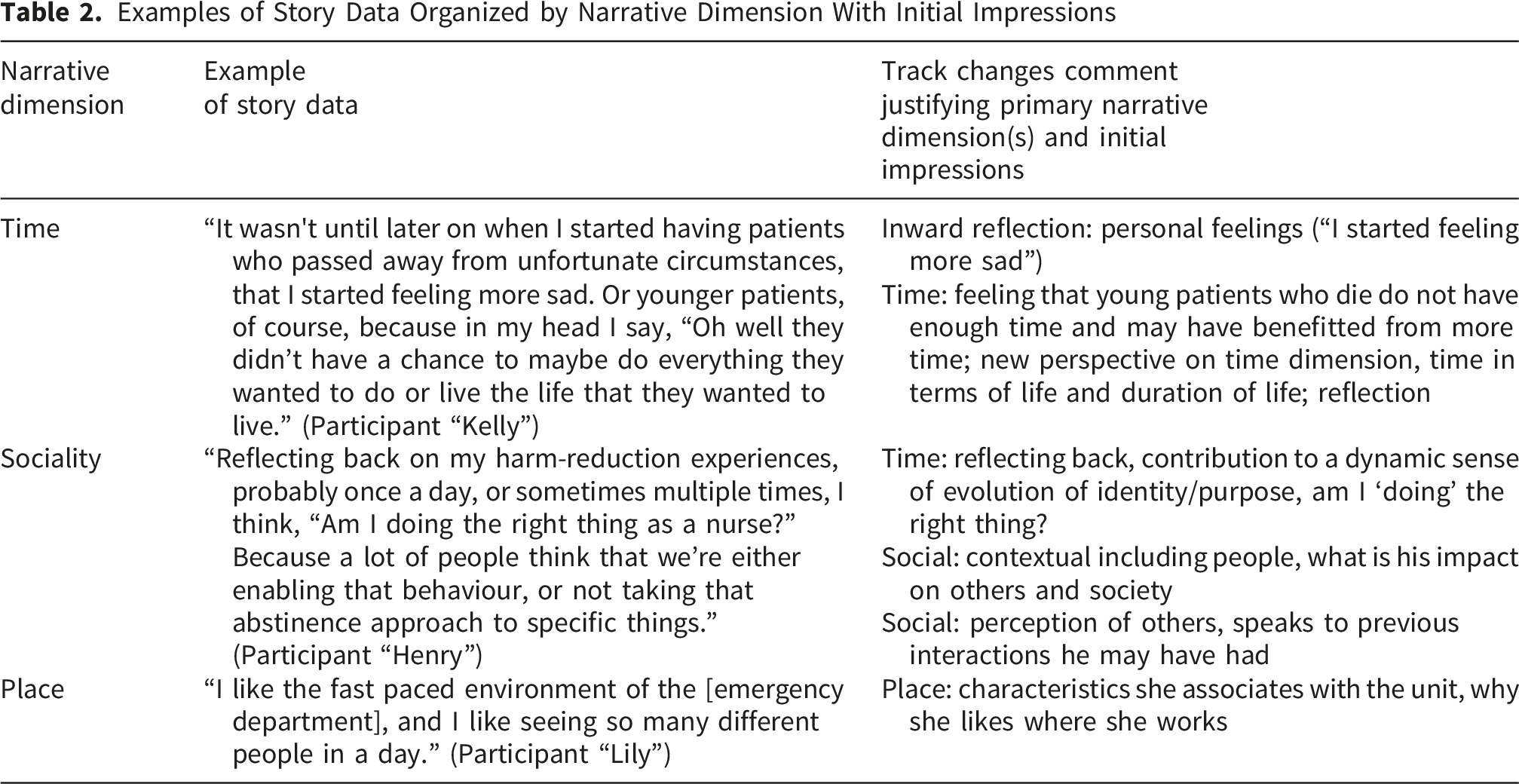
Examples of Story Data Organized by Narrative Dimension With Initial Impressions
Building the 3-D Lenses: Seeing the Narrative Dimensions
After reflecting on our positionality (who is wearing the glasses), and building our frames, we can then start to build the lenses that will be specific to the inquiry, our research questions, and our chosen method(s). Narrative analysis refers to a family of methods for interpreting texts that have in common a storied form (Riessman, 2008). Analysis of data is only one component of the broader field of narrative inquiry, which serves as a way of conducting case-centered research (Riessman, 2008). Each participant’s transcript was analysed holistically according to the narrative dimensions of time, sociality, and place (Clandinin & Connelly, 2000). Mishler (1996) argues case-based methods respect the unity and coherence of individuals as subjects with both histories and intentions.
Referred to by the researcher as an “analytic frame” a template of the three dimensions was created (see Table 1). The analytic frame included language that would support interpretation of the dimension and justification for placement of pieces of data within the dimension of best-fit. The dimension of time included temporal position, becoming, reflections on past events, future projections, turning points, transformation, change, and evolution over time (Clandinin, 2007; Clandinin & Connelly, 2000). The social and personal narrative dimension included perception of self, inward reflections on personal feelings, interactions of self and other, socialization, and relational practice (Clandinin & Connelly, 2000). The dimension of place included context and situation beyond people, including stories specific to practice settings, and sequences of places (Clandinin, 2007; Clandinin & Connelly, 2000). Each dimension was considered by the researcher in relation to the research question and phenomenon of interest, in this case, related to professional identity formation in nursing. Existing definitions and key understandings of the phenomenon of interest as they related to understanding of the three dimensions were married together in the development of the analytic frame used for interpretation of the interview data. If a story or excerpt aligned with more than one dimension, it was situated in the dimension of best-fit until all interview data was partitioned into one of the three narrative dimensions. Comments were added for each of the stories, using track changes in Microsoft Word, to justify how the data aligned with that dimension, and the others if applicable, and to record preliminary interpretations and reflections for the next phase of analysis (see Table 2).
Findings: Meaning Making
Holistic Analysis: The Whole Story
According to Riessman (2008), a good narrative analysis invites the reader to think beyond the surface of the text through and toward a broader commentary. The quotes and corresponding analysis in Table 2 demonstrate how story data, or findings, were interpreted by the researcher using the analytic frame. Quotes are accompanied by the researcher’s corresponding interpretation included to illustrate the process of “meaning making” (see Table 2). In the dissertation, there is a weaving back and forth between each nurse’s assembled narratives, organized by temporal position to provide insight into their identity formation, and the researcher’s interpretations which are presented holistically as an independent chapter for each of the five nurses. Also during this phase, a summary description of each participant was generated.
Example: Time
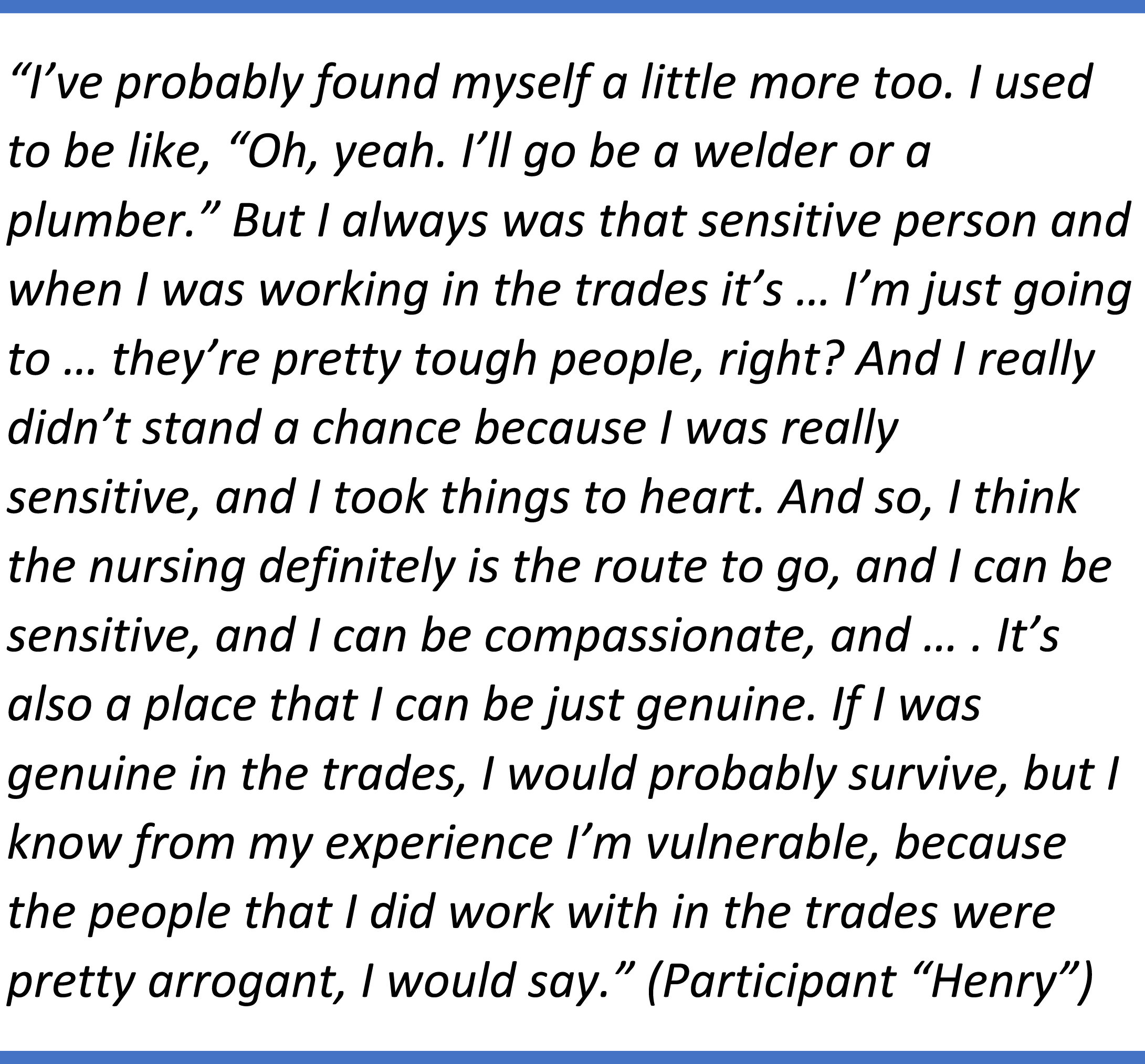
Deriving Meaning (researcher’s interpretation of Henry’s comment): Henry’s comment about “finding himself” suggests a feeling of authenticity, feeling less lost, less uncertain, and more self-aware compared to his earlier expressions of not knowing where he belonged. This relative transformation presumably has a temporal dimension with contributing factors such as context, maturity, and life experience. Henry’s feeling that he has found himself offers a personal and inward reflection on his own evolution and becoming of his genuine and authentic self. Henry reflects on the social context in the trades and how his sensitivity made him feel vulnerable working with people in the trades he describes as tough and arrogant. This reflection suggests Henry perceived a discrepancy between his personality and theirs, which may have made him feel not only vulnerable, but like he was different from them and didn’t belong. He reflects with great insight on how his feelings of sensitivity and compassion are a good fit for nursing. His honest reflection on nursing being a “place that I can be just genuine” is interesting, as he refers to nursing as a “place” in this statement. I wonder if he imagines nursing as a shelter or a home within which he can be Henry, that nursing is a place that offers sanctuary for his sensitivity and vulnerability, where he can feel safe and a sense of belonging.
Example: Social/Personal Dimension

Deriving Meaning (researcher’s interpretation of Jay’s comment): I am struck by the fact that this single sentence comes close to summarizing his entire story. It is how his first interview began, and comes full circle to the end of his subsequent interview. This one sentence summarizes both his inspiration and his greatest tension and struggle. It is why he is a nurse and why he struggles to be a nurse. Jay also talks about witnessing great rewards, suggesting his mom may have shared positive stories or examples of how the care she provided benefited others, and maybe also herself. His positioning of himself as “witness” to these rewards suggests he was watching and observing, possibly from a young age. Witnessing not only what his mom did for her career, and when she was gone and home, but actually acknowledging what she was gaining from, or achieving by, the work that she did.
Example: Place

Deriving Meaning (researcher’s interpretation of Kelly’s comment): Kelly reflects on a significant turning point that occurred for her when she worked in a summer student job between her third and final year as a nursing student. This was her first introduction to the intensive care unit (ICU), and she instantly felt a personal connection to the “place.” She reflects on the temporal position of this turning point and considers it the point in her nursing school career that she felt assured that she was “in the right field,” referring to it as the eye opener she needed to propel her through her last year of school. Reflecting back on this summer job, she feels gratitude toward her clinical instructor for suggesting it to her. She remembers learning about teamwork from her interactions with colleagues. She felt this “place” offered a different acuity and more opportunity to do skills, which was something that was very important to her at this time. After her first day, she remembers she “went home that day and [her] world was completely changed.” ICU was a place that transformed her personally, generating a feeling of passion as well as transforming her perception of nursing and her sense of belonging.
Structural Analysis: Seeing Plotlines
Plotlines

Each nurse’s story was rewritten following an approach that van Manen (1997; 2014) refers to as an artistic activity, and which allowed me to go back and forth between the whole story and its parts to create new meaning in response to the research questions. Themes and thematic statements (presented as plotlines in Table 3) at the level of each participant were used to interpret the narratives and to create meaning of the nurses’ experiences of becoming and being a nurse. Structural analysis is an approach that emphasizes the way a story is told by drawing out meaning relevant to the spoken language (Nasheeda et al., 2019; Riessman, 2005). The plotlines presented in Table 3 are all derived directly from the language of the nurses. Individuals have their own style of communication and it is important to understand how participants speak so that meaning can be constructed from their narratives (Nasheeda et al., 2019). The process of rewriting each nurse’s story created an opportunity for me to reflect on my experience as a nurse and a nurse educator and illuminated my understanding of the experiences and reflection shared by the nurses.
Thematic Analysis: Emergence of Narrative Threads
Researchers can attend to narrative structure in varying degrees and structural analysis can be combined with narrative analysis (Riessman, 2008). Although narrative analysis is case-centered, categories or general concepts can be generated (Riessman, 2008). In the case of this project, the conceptual inferences are regarding the formation of professional identity among new nurses. Looking within a story for plotlines is most consistent with Riessman’s (2008) approach of keeping a story intact and theorizing from the case rather than categories across cases. For this project, both approaches were used. Each case has its own chapter in the final dissertation, examined “intact” and from within in accordance with the analytic frame (see Table 1). This analysis was supplemented by the examination of consistent themes emerging across narrative accounts, referred to as narrative threads, as a catalyst toward contributing to practical inferences and ultimately knowledge and understanding of the topic of interest, which in the case of this inquiry was professional identity formation in nursing.
In thematic analysis, content is the exclusive focus, making it the most common, straightforward, and appealing method of narrative analysis (Riessman, 2008). The proposed three-dimensional method of analysis invites the researcher to consider the content in the context of the narrative dimensions of time, sociality, and place for the purpose of enhancing meaning-making. Throughout each stage of data analysis, beginning with listening to the audio recordings and reviewing the transcriptions, the researcher documented trends (e.g. traumatic experience with death, incivility from colleagues, role models, family support, etc.) and noted experiences and reflections in a researcher journal. In addition, all decisions about data analysis were recorded in a process journal. The resonating patterns, referred to as “narrative threads”, emerged through the iterative process of analysing, organizing, sorting, merging, and redefining the data and were triangulated by comparison with notes in both the researcher and process journals. A master table of narrative threads was created as an extension of the process journal.
After checking with Jay, Henry, Magda, Kelly, and Lily to ensure that I represented their experiences in ways that made sense to them, I looked across their narrative accounts to discern what I learned about their experiences of professional identity formation. Narrative inquiry supported a process for engaging with the nurses and exploring their unique transitions, through life and through nursing, in a manner that allowed them to reflect and share their stories in a way that resonated with them. The stories are interpreted in a three-dimensional narrative inquiry space using the dimensions of time, social/personal, and place to discern meaning and to facilitate reflection in a manner consistent with the methodology (Clandinin, 2007; Clandinin & Connelly, 2000).
Thematically analyzing resonances across the nurses’ narrative accounts revealed four narrative threads that support understanding of professional identity formation across the five stories: entering into the world of nursing; the journey to become a nurse; learning alongside others; and embodying nursing (Halverson, 2020; Halverson et al., 2024). These resonating narrative threads are presented in their own chapter in the final thesis, with an additional chapter summarizing implications related to the findings of the inquiry (Halverson, 2020).
Discussion: Reflections
Narrative inquirers study individual experience that is storied, both in the living and telling, by listening, observing, writing and interpreting texts (Clandinin & Rosiek, 2007). Beginning this narrative inquiry with Jay, Henry, Magda, Kelly, and Lily, I wondered what stories they would tell about the events and experiences related to their becoming and being nurses, and how I would construct my own inquiry procedure and process (Ollerenshaw & Creswell, 2002). The freedom and autonomy afforded by using a narrative approach for this study allowed the nurses to speak freely and openly about anything they felt was relevant to their experience of becoming and being a nurse, and also afforded the opportunity to develop and employ the systematic three-dimensional method of narrative analysis presented in this article. There is no single process or procedure of narrative analysis with various ways of presenting narrative data used across different disciplines depending on how the researcher chooses to represent the gathered data (Clandinin & Connelly, 2000; Kurtz, 2014; Riessman, 2008). Researchers are prompted to identify stories through the emergence of elements of sociability, temporality, and place, the recognition of which can be situated within social, cultural, economic, and institutional narratives (Clandinin & Caine, 2008).
Narrative methodology as an evolving approach contributes to knowledge development in a meaningful way which can inform future practices for issues of great social importance (Bruce et al., 2016). Understanding the meaning of stories through the analysis of the three dimensions of time, sociality, and place affords researchers the opportunity to remain attentive to the temporal position, relationships with self and others, and the social and environmental conditions in which people live and experience the world. The proposed method of three-dimensional narrative analysis offers researchers a systematic and step-by-step process combining elements of holistic, structural, and thematic analysis which may make embarking on narrative analysis less intimidating for novice researchers and contribute to greater consistency and rigour. Understanding story data through this lens of interpretation may elevate the opportunity to generate findings with relevant implications for policy, research, education, and practice by naturally focusing on the contextual elements of greatest significance based on the research question(s) and phenomena of interest deemed suitable for narrative inquiry.
Conclusion
The three-dimensional method of narrative analysis seeks to achieve an enhanced understanding of a phenomena of interest through attention to the dimensions of time, sociality, and place, while preserving and valuing the voices and stories of the individuals who experience them. In the case of this research, our understanding of how professional identity is formed and embodied in nurses is understood through employing the structured and systematic approach to the three-dimensional analysis of the stories new nurses tell of their beginning, becoming, and being nurses. The International Council of Nurses emphasizes that a strong and well-supported nursing workforce is more critical than ever to address global health challenges, emphasizing the current nursing shortage is a global health emergency exacerbated by the failure to retain nurses or attract new nurses to the profession ([ICN], 2025). To introduce meaningful transformation, the profession as a whole must understand what needs to be changed and allow the voices of new generations of nurses to guide this tide. The narrative inquiry method described in this paper weaves the emotional, relational, and temporal dimensions of the nurses’ experiences in this study to provide a comprehensive understanding of the transition to practice experiences of new graduate nurses. This flexible and iterative methodology may be used to understand alternate phenomena in diverse practice settings and populations, contributing to the understanding of human experiences and the contexts that define them.
Footnotes
Acknowledgements
The author would like to thank Drs. Deborah Tregunno, Pilar Camargo-Plazas and Rosemary Wilson for their guidance, insight, support, and mentorship as the thesis committee for the doctoral research that was the impetus for this work. Thank you to Logan Michaelson, illustrator of  and a promising nurse, artist and future researcher. The author would also like to extend gratitude to the nurses who shared narrative accounts of their experiences as this research data was crucial to the development of this approach. There is no greater privilege as a researcher than to bear witness to another’s story.
Ethical Considerations
Ethical standards were followed in the conduct of the study with formal approval granted from the Queen’s University Health Sciences and Affiliated Teaching Hospitals Research Ethics Board (#6025635).
Consent for Publication
The author consents to the submission of the article and confirms the manuscript is not currently being considered for publication by any other journal.
Funding
The author received no financial support for the research, authorship, and/or publication of this article.
Declaration of Conflicting Interests
The author declared no potential conflicts of interest with respect to the research, authorship, and/or publication of this article.