




Abstract
In this manuscript, the author provides insights about the data management approach and offers guidance on giving meaning to dissertation research findings through autoethnography. It describes a dramatic shift in the pragmatic mindset of the author toward a constructivist worldview. The manuscript is autoethnographic, detailing the journey of the author to identify a relevant research methodology that describes and explores the struggle and transformation during and after a mass layoff. The author proposes three main approaches to supporting data management in autoethnography: (1) inferring practical and theoretical assertions related to identified conceptual themes, (2) framing findings within a theoretical context, and (3) making relevant connections by comparing and contrasting her experiences with existing literature. Additionally, the author identifies and explores ways to incorporate structure and pragmatism to provide meaning and purpose in autoethnography related to the phenomenon being reflected upon.
My Journey From Pragmatism to Storytelling to Autoethnography
I have been fascinated by numbers ever since I was a little kid. I enjoyed counting and adding numbers in my head, sometimes to unwind and other times to prove I could do it without a calculator. Later, I discovered statistics. I learned about probabilities, weighted averages, and normal distribution when I was eighteen. A few years later, I learned the importance of statistics in business analytics. Numbers have driven me, and the statistical significance has had a tangible value; emotions and how people interact with each other were the least important.
I also liked structure when approaching or learning new concepts, and I had a practical mindset. I engaged in projects that made sense and had a tangible outcome. Being from an Eastern European country and growing up in a repressed educational system due to communism, my exposure to history was limited and, most of the time, distorted to align with the system’s mindset. Controversy was prohibited, and so it was out of the ordinary. In that close-minded society, I became an introvert, preferring solitude. A lack of trust also began to form in my mind at those times. We could not open up to our peers, even relatives. We never knew who would hear our perspectives. Most likely, this is why I preferred numbers, as emotions were perceived as fake and false back then. People were afraid to express their feelings towards the system. Numbers were thus easier to understand and work with.
I left my native town when I was eighteen. I experienced a tremendous sense of freedom when I left home, not because of my parents or my roots, but because of a system that would limit my perspectives. I did not understand why I felt so good and relieved at the time, but in retrospect, I can see how the system’s lack of emotional intelligence affected my behavior. I did not know how to communicate or express my feelings. I was careless about how others felt about my actions and felt entitled to everything I had, including intelligence, clothes, food, and shelter. Leaving home was a relief and a challenge as I had to learn to integrate into a new environment. Although my emotional skills were limited, I adapted to a new city and with my peers. Most likely, we were all suffering from the same emotional issues, and somehow, our lack of empathy skills surfaced because we were so alike.
I have managed to attend college and have had a decent job while in school. I continued to focus on numbers, data, and statistics, and I was successful in these areas. Emotions were still far beyond my comprehension, although I was more social and had more friends. By the age of thirty, due to personal circumstances, I decided to leave my country and come to the United States. It was a big move for me. My first job here was around data analytics, continuing my pattern of crunching numbers and disregarding emotions and emotional behavior. Slowly, I noticed a stagnation in my career growth, and I began to understand that it was related to my behavior. I would pay more attention to how others feel, but I did not know where my lack of empathy came from. I had to adjust my approach to interacting with others. I needed a change. Thus, I decided to continue my education and applied to a Master’s program, and later was admitted to a PhD program at the same university.
I knew it was a huge undertaking, given that I had two young kids at home and a demanding job. My pragmatic mindset remained essentially unchanged for the first two years of the program. I firmly believe that knowledge and truth are grounded in facts and statistically significant data. My mindset was data-driven and evidence-oriented, aiming to confirm hypotheses, determine the appropriate sampling type, or ensure I remained neutral and unbiased. That way, finding my researcher mindset to align with Burkholder’s (2020) definition of pragmatism as “emphasizes practical consequences as the primary criterion in determining the meaning or truth” (p. 233), and how pragmatists, according to Morgan (2013), “focus on the outcomes of action” (p. 28).
I would hear senior students discuss constructivist approaches, which still did not make sense to me, and for a while, I even thought I was wasting my time and money in this program. Coming from the corporate world, the constructivist perspective was new and did not align with how we practiced business. Again, with that practical mindset, these ways of seeing the world were too profound and sometimes irrelevant. That is how I thought back then.
Now, in retrospect, I see how my mindset changed during the program to one of caring about and understanding others and their values and behaviors through different lenses, depending on their background, cultural beliefs, or personality types. My transformation happened gradually, and with every course in the program, my perception of life and knowledge evolved as I sought patterns of meaning in the world. I delved deeper into the stories of others behind a phenomenon, exploring the patterns that emerge from one story to another. At that point, I found alignment with the perspective of Creswell and Creswell (2018) about social constructivists who “believe that individuals seek understanding of the world in which they live and work” (p. 8) or how Leavy (2017), mentions that researchers with constructivist worldview value people’s subjective interpretation and how they understand their experiences and circumstances (p. 13).
All my surroundings had to have a sense of meaning and purpose until I registered for a new class in our program. It was an Ethnography class. It was an elective class, and I did not have many expectations for it. I was not prepared to shift to a constructivist lens for seeing the world. Before that course, I was skeptical that the essence of research would stem from the stories of others or from observing their cultural behaviors and values.
Our professor introduced autoethnography in that course. We were halfway to class, and, with the work of Creswell (2018), Burkholder (2020), or Leavy (2017) in mind, I kept finding flaws in autoethnography. I found it challenging to comprehend how a researcher could employ such a method to investigate a phenomenon. I grew up with a realistic worldview and a pragmatic ontology, finding it puzzling that autoethnography lacked research participants or sampling techniques to “purposefully select participants that will best help the researcher understand the problem” (Creswell & Creswell, 2018, p. 54). At that time, I believed that research participants would help you find the answers based on their experiences.
Although some researchers perceive autoethnography as a research method that “values researchers’ personal experiences as a way of studying the culture” (Leavy, 2017, p. 37), I found it hectic and lacking structure. At the same time, I found autoethnography intriguing and wanted to learn more about it. Thus, I read Evocative Autoethnography: Writing Lives and Telling Stories by Bochner and Ellis (2016) to prepare and better understand how to approach and write autoethnographically. I was captivated the moment I read the book, and I said to myself, “Wow, this is deep!” I found myself in Bochner & Ellis’s (2016) remark, “The work I published was statistically significant. But was it humanly significant?” (p. 40). I had a profound moment of reflection while reading their book, and I found it relatable to my practical mindset.
The candid approach of Ellis (2004) to storytelling, along with her perspective that our stories are rooted in our life experiences and the way we perceive the world, also touched me. “As human beings, we live our lives as storytelling animals. We are born into a world of stories and storytellers, ready to be shaped and fashioned by the narratives to which we will be exposed” (Bochner & Ellis, 2016, p. 75). “This is so real,” I said to myself. I had not read about the inner voices of researchers or authors —their struggles and insecurities — before, and that was captivating—the ability to delve deep into how we feel and to be genuine.
There was something about autoethnography that none of the other research methods had, and that was the telling of the story of the researcher. If the purpose of narrative inquiry is to tell the story of an individual, or, like in phenomenology, the research looks for themes along the individual stories (Burkholder, 2020; Leavy, 2017) in autoethnography, the focus is on the personal experience of the researcher and the relationship with culture, “exposing that way vulnerability to self and the way culture impacts one” Ellis (2004, p. 37).
As researchers, we are so caught up in the “danger” of bias that we overlook where the researcher has been and what they are. Nevertheless, autoethnography is a qualitative research method that uses storytelling to connect the personal experiences of the researcher within a specific culture and examine them through self-reflexivity (Johnson & Parry, 2022). So, I gave autoethnography a try, but I was still not convinced. I read more autoethnography books, e.g., Adams et al. (2021), Bochner and Ellis (2016), and Herrmann (2020), trying to make connections with traditional research methods, such as ethnography or action research. My biggest challenge was likely figuring out how to analyze an autoethnography and give it meaning, which stemmed from my pragmatic mindset.
Struggling to Write My First Autoethnography
One day during the Ethnography course, I wrote my first Autoethography. I had to find something powerful. One thing I never discussed was something both challenging and intriguing. I thought of the moment I got laid off a few years ago. I have not discussed it before because I refused to feel bad about myself. I did not want any pity or attention. I tried to use that pain to transform myself. “It is time to reinvent myself!” I thought back then. I choked up and got angry many times, thinking how unfair that layoff was for me and others, but I would stop myself with, “You are not going back!” I escaped into exercising, and I remember jogging on the treadmill faster, as if running away from my anger. I did not want to let myself down.
Nevertheless, that day, I sat down at my laptop, afraid to return to the past and relive those painful memories. “It has been a while since that layoff,” I told myself. “You suppressed your emotions and memories for so long. That is not going to work.” These thoughts had been in my mind for a good couple of minutes. I pulled my head into my hands, cried with anger but also a sort of relief, and decided to give writing about the layoff experience a try in an autoethnographic manner.
On a blank sheet of paper, I started writing. It was a quiet fall morning before the COVID-19 pandemic. Our headquarters were in San Francisco, with two subsidiary offices in Los Angeles and one in the state of Bluebonnet. It was a friendly, family-oriented culture. I served as the project manager for several years and thoroughly enjoyed my work. Although most initiatives had tight timelines, I learned the systems and how others performed in their positions. Mostly, I figured out ways to excel in these conditions and produce results promptly and efficiently. (Rada, 2023, p. 1)
I wanted to be safe in my story. It was too emotionally intense to be mad and make myself vulnerable. Thoughts still chased me: “Why do you let it go?” “Who cares?” “Are you going to remember what happened?” Then I returned to my writing and remembered how optimistic I had been before the mass layoff. I let myself be carried away by my memories and slowly lowered my guard, embracing the vulnerability of the situation. That morning, I recall leaving my office and seeing a guard at the entrance. It was awkward, but I minded my own business and walked into the hallway to check the mail, as I did every morning. My mind rambled for a bit after seeing the guard. Perhaps there was an issue involving an employee being in trouble with the law. A few years ago, an employee filmed someone in the bathroom, which was a significant issue. As I thought about this, I would understand if a security guard was escorting someone out of the building. (Rada, 2023, p. 1)
The memories became intense. I began to recall the fear and anger I had experienced that day. Back then, being let go could significantly impact one’s future career, and people did not talk about these experiences. A sense of insecurity took over my thoughts. “What if other employers read my stories? Will I still be employable?” Then I said, “Just let it go and keep writing. Who cares who will read it? Maybe others can relate to it.” What I was about to write and unleash from my mind was painful, but therapeutic at the same time. Storytelling has a therapeutic effect, and the intent is not only to share our emotions selfishly but also to allow others to relate to and learn from them (Ellis, 2004). I realized the importance of sharing that story with others, which led me to continue recalling the mass layoff experience. There was dead silence everywhere. That hallway, once full of vibes and people cheering up, was now quiet and dark. There was no light coming from the offices with the doors open. The lights from the hallway bulbs had a soft, warm glow. I had not noticed the colors of those lights before, as at least one office door on that side of the hallway was open. I felt cold suddenly. A sort of coldness that came from inside. I was not afraid but somewhat disoriented. (Rada, 2023, p. 3)
An enormous sense of relief suddenly entered my mind. At this point, I could not stop writing. I ended up with a good ten pages of recalling memories and experiences about my friends being escorted, how I was one of the few left in the company, and the guilt, anger, and fear I experienced. I lived in this state of mind every day for one year until the day I was let go. After that mass layoff day, I began to detach myself from the company and the people who had left. My trust was zero, and I was focusing heavily on my education. Over time, I became emotionally detached and could no longer see a future with the company, which had once been a friendly environment. (Rada, 2023, p. 21)
I became excited about sharing my experience and the courage it took to write about it. It felt like therapy. My doubts vanished, and I felt free and stronger. However, there was still much to recall and tell the story until the end. What I thought would be the end of it at that time—the moment I was let go a year later—was probably one of the most challenging and intense moments to put on paper. I understood, however, the importance of taking the story through every corner, regardless of how painful that could be. My boss stopped by my desk and asked if I could talk. He took me to the HR director’s office, where we all sat down. Then, I heard my boss say, “How was your day?” I smiled and mumbled, “A good day…” He said, “You know you are a great company employee. You have provided so much support for our team.” The human resources director, trying to help my boss with his statement, continued, “But unfortunately, you see, we must eliminate your position. We are trying to have only a technology team in the San Francisco office.” I started smiling and said to myself, ‘It is happening.’ It is over! From that point forward, I got numb, and everything became blurry in my head. I was prepared for this, but when things like that happen to you, it is different from hearing it from others. They explained some paperwork, but I ignored it as my brain started rumbling in different directions. My boss took me to my desk to pick up my belongings and asked if I needed to take anything from my computer. No, there was nothing because I never stored personal material on a company’s computer. I did not trust them. My boss escorted me to the office exit. He was smiling, trying to show compassion, but he was so fake. I kept smiling, and I was faking it too. (Rada, 2023, p. 23)
When I presented my first autoethnography to the class, I felt vulnerable as I discussed my experience of the mass layoff. Some of my colleagues were intrigued by my story; others shared similar experiences. I felt judged and heard some of them making remarks about how I should have reacted, but people will judge anyway (Ellis et al., 2011), and that only encouraged me to tell the story. The experience of sharing was also therapeutic. It helped me heal. The layoff experience was about exploring myself in the context of a dramatic organizational culture change. I choked so many times, evoking my story. I realized that I lived through a trauma with that mass layoff, and modern psychology makes reference to the therapeutic potential of storytelling in trauma recovery, allowing individuals to process and recover from the traumatic event faster (Schauer et al., 2011).
Developing a Framework and Data Management to Support the Meaning of My Autoethnography
Ultimately, I realized the importance of sharing my story with others. How many were in my place and never talked about it? How many employees have been impacted by layoffs? Returning to my pragmatic mindset, I searched for the layoff numbers and found that, on average, there were 1.8 million layoffs per month nationwide across several industries before 2020. 1 The layoffs culminated with 22 million employees being let go due to their companies’ downsizing in March and April 2020. 2 Layoffs occur when organizations undergo downsizing, yet there is limited research on how employees adapt to new or transformed cultures while still in the workplace. There is literature that discusses the layoff phenomenon from different perspectives, such as how to communicate bad news in the context of downsizing (Richter et al., 2016) or how layoff survivors manage their work-life balance (Virick et al., 2007). However, many employees impacted by the layoffs do not share their experiences due to concerns about confidentiality or because they are too preoccupied with recovery and finding new employment (Cascio, 1993).
Furthermore, there is a notable absence of self-reflection among layoff survivors and victims regarding the layoff phenomenon and its effects on their emotional well-being and career growth opportunities. I felt compelled to share my experiences, hoping that others who have faced layoffs can find solace and inspiration in my stories. The intent was to reflect on my experience as a survivor of the mass layoff and, later, as a victim of it, by revealing the intensity of the experience and my perception of the layoff’s impact on my motivation, performance, career growth, and personal transformation.
My worldview was pragmatic, structured, unbiased (I thought), and objective. Ontologically, my philosophical belief system and my perception of truth are realist. Realists believe there is only one truth based on observable facts, whereas relativists believe that contextual circumstances determine knowledge (Burkholder, 2020). On the other hand, epistemologically speaking, the way of knowing about the world and what counts as knowledge is through introspection (Burkholder, 2020). Discovering autoethnography opened my mind to the relativist paradigm of constructivism, in which the researcher makes sense of the meanings others or the self ascribe to the world by generating a pattern of knowledge (Creswell & Creswell, 2018). In my case, adding value to the layoff phenomenon involves highlighting the struggles others can relate to when facing that situation, including fear, insecurity, burnout, and emotional distress, all of which affect self-esteem, confidence, and, ultimately, family and relationships.
As I began writing the autoethnography, I hesitated about using this method when elaborating on my findings. I recall discussing this research methodology with other faculty members at our institution, and they expressed reluctance to do so. What about bias? How do you manage being impartial? However, I soon learned that, as an autoethnographic writer, the storyteller is embedded in the story and the research (Adams et al., 2021). It is my story, my experience. On the other hand, there should be more to it than just the story. How do you discuss literature, theory, and other research?
Theoretical Framework

The “self” was my primary data source, and I used evocative writing, self-reflection, and introspection to write about my experiences with the mass layoff. Yet, given my inherent practical mindset, I looked to give some structure and purpose to my stories and, similar to the perspective of Anderson (2006) about the analytical autoethnography, used the self-narrative process to “define and refine generalized theoretical understandings of social processes” (p. 385).
My goal was to apply concepts of ‘traditional’ data management to identify patterns, themes, and categories that would align with the theoretical and conceptual frameworks. Data management in analyzing my autoethnography involved organizing, analyzing, interpreting, and structuring the writing of my experiences during and after the mass layoff as a layoff survivor and later on a layoff victim. In the paper (Rada, 2023), I began by inferring practical assertions, framing my findings within theoretical frameworks, and establishing connections with the existing literature on layoffs, as described in the conceptual framework below (Figure 1). Conceptual framework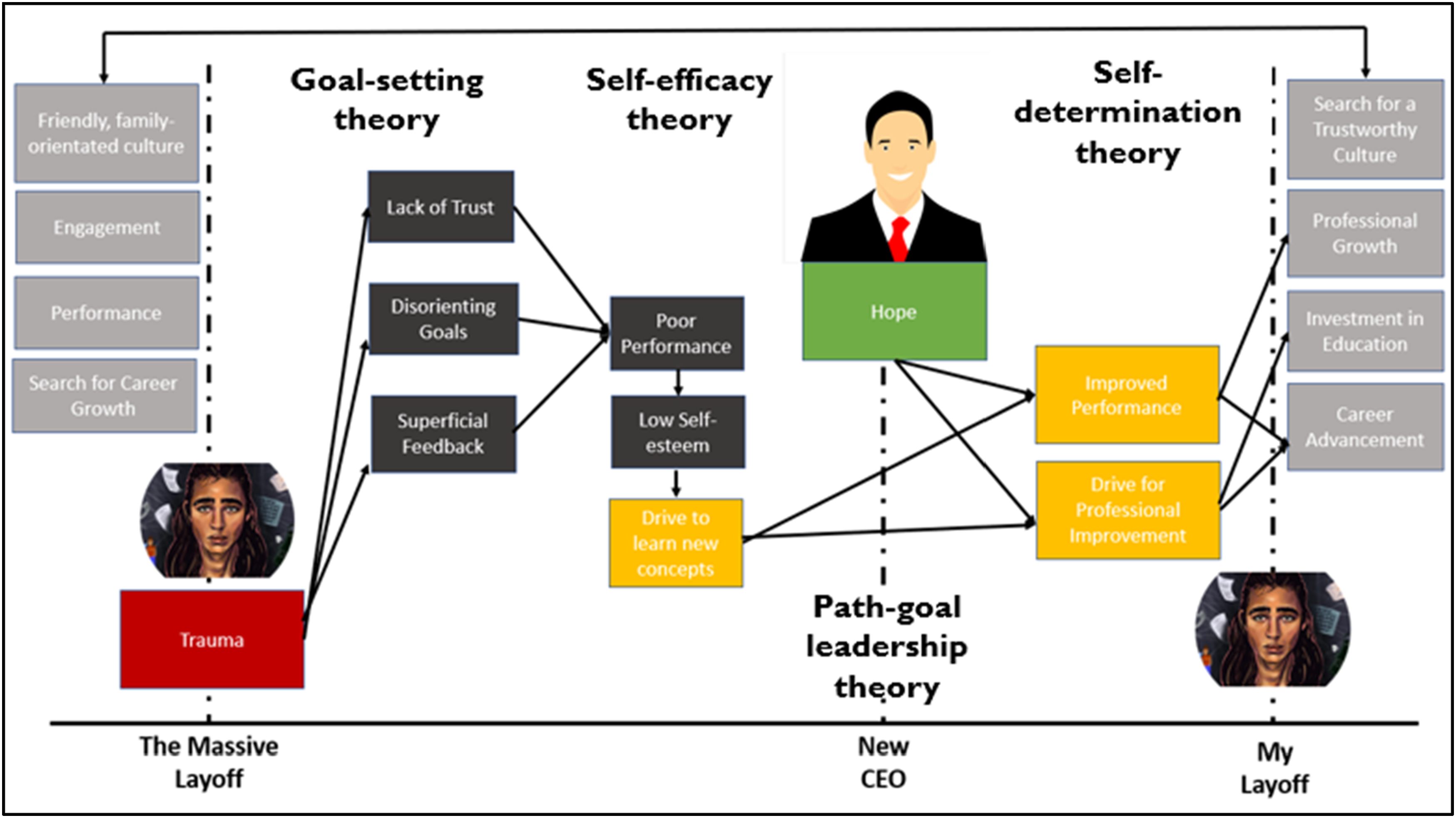
First, I followed Saldana’s (2021) approach of inferring practical and theoretical assertions. Although I could not formulate a theory due to the limited observational data, I looked to infer assertions for practice, research, and theory. After writing my stories, I analyzed my perceptions using the theoretical framework and conceptual coding practices to identify the major themes of my experiences throughout the mass layoff, where, according to Saldana’s (2021) coding model, “all categories and concepts become systematically integrated around the central/core category, the one that suggests a theoretical explanation of the phenomena” (p. 314). The process involved comparing and contrasting themes to identify standard conceptual connections, emphasizing the impact of organizational culture transformation on employees’ emotional well-being, involvement, and performance. I defined the feelings and experiences that stood out as codes to support each finding category and developed a “Coding Matrix” for each identified theme. I thus provided a coding structure that displayed the theme’s name, its categories, and the codes assigned to each category.
When I presented my findings, I drew inferences from the practical and theoretical assertions related to the identified conceptual themes. I could draw on my personal stories, other relevant experiences, and related theories to support my approach and findings on the impact of mass layoffs on personal and professional lives. The stories accompanying this research were not meant to portray the events in chronological order but rather to outline the emotional intensity of my perceptions throughout my transformation.
Coding Matrix for One Theme and Related Categories, and Codes


Secondly, I framed my findings within a theoretical context following the strategy proposed by Chang (2008) of choosing theories that can “guide the process of data organization, analysis, and interpretation, and the structure of writing” (p. 137). I was passionate about several motivational theories (as mentioned above), and I began developing a theoretical framework that aligned with my research purpose and the problem statement. I analyzed my story and experiences through those lenses. The chosen theories guided my data organization, analysis, interpretation, and writing structure. I quickly learned that autoethnographic research is an iterative process and “not linear in the sense that one activity leads to the next one” (Chang, 2008, p. 121). It involves revisiting and rethinking the data, which, in autoethnography, is an unconventional term embedded in our stories (Chang, 2008). Although I could initially recall the experiences during and after the mass layoff, which were a rollercoaster of emotions and very therapeutic, I had to keep my head straight and focus on the events and stories pertinent to the layoff. For instance, upon reviewing the recall of the mass layoff, I remembered personal events from my life. Although I regret not including those stories and their impact on my personal life, I had to ensure that the stories and reflection aligned with the scope of the research and the cultural organizational setting.
Lastly, I made relevant connections to the existing literature on the layoff phenomenon in my case, as Poulos (2021) suggested. I reflected on and analyzed the stories by connecting them with existing literature on the topic and drawing on insights from human behavior and my values. I am compassionate and adhere to the principles of integrity, teamwork, and respect for others as essential values in my work. My findings and self-reflection were compared and contrasted with the existing literature and personal experiences of others by connecting them to ongoing cultural, academic, and theoretical approaches to human life. I experienced intense emotions during the mass layoff that day and in the days that followed. During the downsizing process, I had hoped for leadership to acknowledge the significant emotional distress experienced on the day of the mass layoff. Feelings like fear, anxiety, insecurity, and guilt are what I have experienced. They significantly shaped how I perceived the downsizing process and its consequences for my well-being and others’. These thoughts align with Noer’s (2009) insights on mass layoffs, which show that those who remain in organizations after layoffs often experience anger, fear, anxiety, and distrust. Noer proposes a four-level organizational intervention model after the downsizing. The model begins with intervention, followed by grieving, empowerment, and systems intervention. However, this model, as well as other research, does not describe how best to manage the emotional side of layoff survivors or the motivational mechanisms employers should engage to maintain employees’ commitment and productivity.
Although this manuscript outlines the data management strategy for analyzing my autoethnography, it would also be beneficial for anyone interested in using this approach to understand its main limitations, starting with the dual role of the storyteller and researcher and the recollection of stories. Being the storyteller and researcher simultaneously added complexity to the research process, requiring a different mindset for writing and reflection. As a storyteller, I delve into memory to convey the intensity of my perceptions of the prolonged layoff. As a researcher, I had to detach from the emotional side of the stories and conceptually codify and categorize the meanings and findings, aligning them with the research questions and the theoretical and proposed conceptual frameworks. That is a limitation I acknowledge of the possible juxtaposition of roles throughout the research process.
Additionally, my autoethnography was highly based on memory recollection of the events. My access to factual data sources was limited. For confidentiality reasons, I have not disclosed the organization, the characters, or the layoff date, which could limit the credibility of this research. Nevertheless, I stayed committed to describing and bringing to life the intensity of the dialogue and events as clearly as I remember them.
My Concluding Thoughts
Choosing autoethnography as a research method for my dissertation was a journey, like choosing any other method. Writing the story about my trauma with the mass layoff triggered a major personal transformation. Revealing what had happened during and after the layoff made me reflect deeply on my behavior and on my perceptions of cultural organizations in crisis mode. The transformation was so powerful that, in writing this autoethnography, I embraced storytelling and self-reflection, dramatically changing my pragmatic view of life and how we gain knowledge. To this day, I seek knowledge from my experiences and the stories of others, not solely from facts and numbers as I did before discovering autoethnography and self-reflection.
As I continued to reflect on my experience with autoethnography and the meaning-making process behind this work, I realized that my journey was not only personal but also methodological. Through this process, I found that pragmatism and constructivism can coexist in qualitative inquiry rather than stand in opposition. Structure and reflexivity, once viewed as incompatible, have become complementary tools for exploring lived experience. This alignment offers a pathway for researchers with quantitative or pragmatic backgrounds to engage meaningfully in qualitative research without losing analytical rigor. In this sense, my evolution as a researcher mirrors the flexibility that qualitative methods can embrace when both logic and reflection inform the search for understanding.
Equally transformative was the development of a structured data management process for autoethnography. By applying coding and categorization to my self-narratives and framing my findings within established theoretical frameworks, I learned that traditional analytical techniques can enhance the transparency and credibility of autoethnographic research. This structured approach provides a foundation for others who seek to balance personal narrative with methodological precision, demonstrating that organization and creativity can work hand in hand to strengthen qualitative inquiry.
Autoethnography also reshaped how I perceive the role of the researcher. The process became both therapeutic and transformational, positioning reflexivity not simply as a reporting style but as an instrument of discovery. Through vulnerability and introspection, I found that emotional awareness and analytical reasoning can coexist to generate new knowledge. This reinforces the idea that researcher transformation is itself a valid and meaningful outcome of qualitative inquiry.
Developing a data management framework and coding matrix for this type of research offers future scholars a practical model for analyzing personal experience across various qualitative traditions—whether autoethnography, narrative inquiry, or arts-based research. This framework supports the ongoing evolution of qualitative methods by providing a flexible yet systematic approach to organizing and interpreting reflective data. It also addresses one of the enduring challenges of self-reflective research: maintaining authenticity while ensuring analytical depth.
Beyond its methodological implications, this work contributes to the pedagogy of qualitative research. It offers guidance to emerging scholars and practitioners navigating issues of bias, credibility, and theoretical integration in reflective writing. By demonstrating how theory can be operationalized within personal narratives, this study provides an instructive model for conducting autoethnography with transparency, purpose, and rigor.
Ultimately, this paper reinforces that rigor and reflexivity are not opposing forces but intertwined elements of meaningful qualitative research. The framework and insights presented here invite researchers to see autoethnography not as an unstructured form of storytelling but as a disciplined and evolving practice that blends emotional truth with theoretical understanding. In doing so, it contributes to the continued advancement of qualitative methods, showing that through structure, reflection, and vulnerability, we can produce research that is both methodologically sound and deeply human.
Footnotes
Acknowledgements
My sincere gratitude to my dissertation chair, Dr Norman St. Clair, for his guidance and expertise throughout the dissertation writing process. His thoughtful direction, methodological rigor, and commitment to ethical and systematic data handling were instrumental in shaping the quality and integrity of this research. I am deeply appreciative of his mentorship and support, which strengthened both the process and the outcomes of this dissertation. I also extend my appreciation to Dr John De La Garza, who introduced me to autoethnography and supported my reflective process throughout this research. His guidance in navigating reflexivity, meaning-making, and scholarly self-inquiry was foundational to the development of my dissertation and the inspiration for this manuscript. I am grateful for his encouragement, intellectual generosity, and thoughtful mentorship, which enabled me to engage deeply and authentically with the autoethnographic method.

Ethical Considerations
This manuscript presents a reflective analysis of an autoethnography that did not involve interaction or intervention with living human subjects. The referenced dissertation received an Institutional Review Board determination of “Not Regulated Research” (IRB #2023-1285-NRR). To maintain confidentiality, all individuals and organizational entities were pseudonymized, a limitation acknowledged by the author.
Funding
The authors received no financial support for the research, authorship, and/or publication of this article.
Declaration of Conflicting Interests
The authors declared no potential conflicts of interest with respect to the research, authorship, and/or publication of this article.