




Abstract
Researchers increasingly acknowledge the importance of material and spatial elements in knowledge generation. Interview research incorporating spatial and material elements is often limited to what is available near the interview location. Virtual reality (VR) technology, with its unique combination of affordances such as immersion, visualization, and interaction, allows for the creation of virtual environments that are difficult to access or nonexistent in physical settings, providing novel multimodal stimuli for participant reflection. We draw on an exploratory VR intervention with graduate students reflecting on challenges during their thesis work, using the multi-space coaching protocol “Clean Networks” to discuss the potential of VR in reflective interviewing. We found that the virtual environment was supportive of participants’ reflection and sensemaking. Moreover, we found that knowledge emerged through participants’ entanglement with different virtual-material stimuli, which prompted us to rethink our intervention as an intravention, drawing on sociomateriality perspectives. We discuss the potential and challenges of using virtual reality technology to support participants’ reflection through the availability of multisensorial inputs and describe the process of emergent knowledge through sociomaterial entanglements. We contribute to a growing body of research on multimodal interventions in interviewing by illustrating the role of new technologies in advancing the potential of interview-based research.
Introduction
Interviews have increasingly been recognized as a site of intervention (Langley & Meziani, 2020; Roulston, 2010) because they support and influence participants’ sensemaking (Nardon et al., 2021), may have therapeutic effects (Rosetto, 2014), support reflexivity (Cassell et al., 2020), and make new understandings possible (Nardon & Hari, 2021). Interventionist interviews “intentionally [aim] to challenge and change the understanding of participants” (Roulston, 2010, p. 220) and come in many forms (Nardon et al., 2021). We focus on a particular kind of interventionist interview, reflective interviews (Nardon et al., 2021), which aim to facilitate participant reflection with the intent of increasing social impact during the research process. Reflective interviews use a variety of methods to support reflection and sensemaking, including imaginative metaphor elicitation (IME) to support participants in making the experience tangible and less threatening (e.g., Nardon & Hari, 2021), arts-based methods to provide a non-verbal, expressive platform for participants to convey their experiences (e.g., Vacchelli, 2018; Nardon et al., 2025), and language-based interventions to support the exploration of a person’s inner world (e.g., Tosey et al., 2014). Increasingly, researchers are acknowledging the importance of material aspects in knowledge generation and purposely employing artifacts in the co-production of data (E.g., Harrison et al., 2024; Nordstrom, 2013) and embracing spatial elements and embodiment through walking interviews (e.g., Kuntz & Presnall, 2012; Stiegler, 2021).
Existing interview research incorporating spatial and material elements is limited to what is available near the interview location, such as participants’ or researchers’ workspaces or nearby public spaces. Virtual reality (VR) technology, with its unique combination of affordances such as immersion, visualization, and interaction (LaValle, 2023; Shin, 2017; Steffen et al., 2019), allows for the creation of virtual environments (VE) that simulate physical settings that are difficult to access or nonexistent, such as historical or imaginary settings. VR has been used extensively in research to simulate environmental characteristics of interest to researchers, such as in architecture and urban development (e.g., Silvennoinen et al., 2022), archeology (e.g., Morgan, 2022), or library use (Mathysen & Glorieux, 2021). Despite previous research suggesting that VR can support wellbeing and cognition (Hawes & Arya, 2021), its use as a support for reflective interviewing is underexplored, a gap we address.
We draw on an exploratory VR intervention with graduate students reflecting on challenges during their thesis work, using the coaching protocol “Clean Networks” (Dunbar, 2017; Wilson, 2017), which was designed to support the emergence of knowledge through space navigation. We found that navigating VR environments supported participants’ reflection by providing multisensorial inputs, which otherwise are hard or impossible to offer, allowing novel thoughts and emotions to emerge. However, using VR interviewing is a resource-intensive process accompanied by technological challenges, requiring careful consideration of the value of this approach for specific projects and populations.
Through our engagement with the data, we came to understand that the way the virtual environment influenced participants’ reflective process was not linear nor causal, but a phenomenon in which different social and material elements were involved in a dynamic co-production. This realization led us to reconceptualize our intervention as an intravention, drawing on sociomateriality perspectives (e.g., Barad, 2007; Camiré, 2023; Kuntz & Presnall, 2012), which see social and material elements as inseparable and entangled within a dynamic phenomenon. Departing from the idea that the intervenor acts on an external system to instigate change (in this case by exposing participants to virtual environments to facilitate reflection), intravention operates from within the entangled relationships that constitute the intervening situation, in ways that are unpredictable and irreplicable (Camiré, 2023; Kuntz & Presnall, 2012). We discuss the implications of this perspective shift for the design and application of VR in research interviews. Our research contributes to the field of reflective and multimodal interviewing by introducing VR as an interviewing tool and proposing a phenomena-based understanding of VR-based reflective processes.
This paper is organized as follows. We start with a brief review of virtual reality and its potential to support reflection and interviewing. We then describe our study with graduate students, discussing our data collection and analysis approaches and our findings regarding the potential of VR in reflective interviewing. We conclude by discussing the implications for using VR to support reflective interviews.
Virtual Reality
Virtual Reality (VR) is a three-dimensional computer-generated experience that allows users to interact and feel immersed in a simulated environment representing a physical counterpart or an imaginary setting (LaValle, 2023). VR technology can use mobile/desktop displays or head-mounted, fully immersive ones. While recent literature on VR has used the term to describe all display types, this paper uses the more traditional definition of fully immersive VR with head-mounted displays, as it offers a stronger sense of immersion and a feeling of presence (Steffen et al., 2019).
VR has been used to expose people to different environments and experiences for various purposes. Some researchers have focused on the potential of simulating environments to learn about them. For example, research on architectural design and urban development uses VR as a tool to see how people interact with an environment (Jamei et al., 2017; Liu, 2020; Portman et al., 2015; Silvennoinen et al., 2022). Archeology researchers have used VR to simulate archeological sites and artefacts to help them investigate the role of different objects, visualize environments, and offer training and education (Gaugne et al., 2014; Morgan, 2022).
Many VR researchers have directly investigated the effect of virtual environments on thinking and learning. Rizzo et al. (2019) discuss the effect of VR in clinical situations and how it can be used for cognitive rehabilitation. Other researchers have explored the uses of VR as an experiential learning tool (Chan et al., 2021; Scavarelli et al., 2021). For instance, Hawes and Arya (2021) highlight the role of context priming in preparing learners by arranging the virtual learning environment (VLE) and virtual objects in different ways to prime learners for increased focus and performance. Most of these examples focus on specifically designed environments that assist with the primary tasks given to the users, such as a virtual science lab that allows students to practice different tasks in a safe and customizable setting (Chan et al., 2021). Less attention has been given to the effect that generic environments (not specifically designed for a task) can have on thinking.
A different stream of research focuses on the influence of virtual environments on human behavior, cognition, and emotional states. This stream of research suggests that immersive visualization in soothing environments, such as nature, can contribute to well-being and a sense of responsibility (Andreucci et al., 2021; Chan et al., 2023; Stepanova et al., 2019) and has the potential to encourage empathy for other perspectives or social groups (Bujić et al., 2020; Herrera et al., 2018; Ventura et al., 2020). Exposure to generic natural scenes is shown to have the potential to positively influence the mood and have affective and cognitive advantages, both in physical and virtual environments (Frost et al., 2022; Mostajeran et al., 2023). This resonates with a large body of research that highlights the effect of environment on cognition and emotion (Orlikowski & Scott, 2008; Paul, 2021; Suchman, 1987).
The use of VR in research interviews is limited. A notable exception is Mathysen and Glorieux’s (2021) use of VR as an interview tool to study the behavior of library visitors. They interviewed participants while visiting a virtual simulation of real-world libraries to understand their perceptions and experiences. In this case, the virtual environments were specifically designed to simulate the subject of the study. Knorr et al. (2010) compared participant interaction for in-VR and face-to-face interviews during research on a teacher training program. They used a generic “virtual room” and observed the length, spoken words, and interview quality in both cases. They had no specific investigation into how the material aspects of the VE affected the interviewees.
As a research tool, VR has been used primarily to simulate environments under investigation. In this study, we draw on previous research suggesting that VR can support wellbeing and cognition (Hawes & Arya, 2021) to explore the potential of VR to support reflective interviewing through multisensorial inputs.
Our Study: Supporting Graduate Students’ Reflection with VR
To explore the potential of VR to support reflection and sensemaking, we adapted the facilitation protocol Clean Networks (Dunbar, 2017; Wilson, 2017) to the virtual environment. We chose the protocol Clean Networks because, as explained below, it aims to support the emergence of knowledge through space navigation. This feature matches and can be extended by the affordances of VR. Using VR allowed for the availability of diverse virtual material contexts to support graduate students’ reflections on their theses. We describe our approach below.
Clean Networks
Clean Networks is a facilitation protocol developed by Psychotherapist David Grove to support coaching and development (Dunbar, 2017; Wilson, 2017). In his later years, David Grove expanded the linguistic focus of his previous work on clean language (Grove & Penzer, 1989) – language free of assumptions or presuppositions – to incorporate physical and perceptual spaces, developing a series of protocols that came to be known as Emergent Knowledge (EK) processes. Grove was inspired by chaos and network principles, which emphasize how things emerge through connections.
Grove believed that material objects in the space of facilitation have co-inspiring properties, becoming psychoactive and providing symbolic material for the release of new information. Grove argued that different spaces hold different information, and viewing an issue through different spaces allows for creating a new network of information (Grove, 2003). Clean Networks invites participants to move through space, identifying six consecutive locations that “feel right” to explore their topic. Once the participant is in a space, the facilitator asks, “What do you know about [your topic] from that space there?” following up with “Is there anything else?” if deemed appropriate. After six rounds, the participant is invited back to the original location and asked, “What do you know NOW about [topic]?”
Clean Networks seeks to allow participants to form new networks of thoughts by seeking associations and recalling information through engagement with different physical locations. In Grove’s theorizing of emergent knowledge, the facilitator aims to stay outside the client’s perceptual space, process, and content, limiting their interference by not adding, commenting, discussing, or analyzing any of the client’s content. The facilitator’s engagement with the process is at the “operating system’s level,” asking questions that are independent of the content provided and aimed at facilitating the exploration process (“Find another space that feels right,” “What do you know from that space?”, “Is there anything else?”) (Dunbar, 2017; Wilson, 2017).
Clean Networks processes are usually conducted in a facilitator’s office or through audio or video conferencing tools (e.g., Zoom, Teams) as participants navigate their own personal spaces. These spaces are limited in terms of the variety and richness of material cues available for participants. A virtual environment affords a much wider range of stimuli and, as such, has the potential to enrich the experience of the clean networks process.
In research, Grove’s work with Clean Language has been increasingly applied in interviewing through Clean Language Interviewing, which promotes the use of clean questions to limit influencing participants’ responses. Clean questions are neutral, simple, and brief and make maximal use of the participants’ exact words (Cairns-Lee, 2015; Cairns-Lee et al., 2021; Langley & Meziani, 2020; Tosey et al., 2014). To our knowledge, emergent knowledge processes have yet to be adapted to research settings.
Data Collection
The first author is trained as a clean language and emergent knowledge coach and trained the research team in the application of this protocol. Both authors are experienced faculty members teaching and supervising graduate students. Our familiarity with graduate students’ experiences and needs for support motivated the design of this exploratory study. We recruited graduate students in our university who were facing challenges with their thesis projects, following the ethical guidelines of informed consent. The nature of the challenges was purposefully left open and ambiguous to allow participants the freedom to reflect on what mattered to them. We engaged with 16 graduate and five undergraduate students who were experiencing similar issues with large research projects. 13 of our participants identified as women, and eight as men. Some of these students had taken classes with members of the research team, and others were unknown to us. All students were assured of the voluntary nature of this engagement. Two participants were experienced with VR, and the others had limited experience.
The VR experience took place in a meeting room at the authors’ university. Upon arrival, participants were greeted by the research team and invited to share the topic they would like to explore in more detail. They were then invited to use the VR headset and explore the environment to get familiar with the technology. We used the Meta Quest 3 VR headset and the Nature Treks VR app, available on the Meta Quest Store. We chose a nature-themed application because exposure to nature has been shown to positively influence the mood and have affective and cognitive advantages, both in physical and virtual environments (Frost et al., 2022; Mostajeran et al., 2023). In addition, the Nature Treks VR was suitable for this exploratory study because it does not require development, and it provides 15 high-quality virtual environment options for navigating, ranging from quiet meadows and tropical beaches to stormy and frozen landscapes, including an imaginary Jurassic world and outer space. These environments varied in the season and time of day, as well as the kinds of audio and visual stimuli (nature sounds, objects, plants, and animals). The variety of environmental characteristics provided us with rich material to explore the ways in which the VR influences reflection.
Once participants were comfortable navigating the virtual worlds using the Quest controls, they were invited to start the reflective process in the virtual main menu, which acted as an access hub to all environments (See Figure 1 showing some of the environments in the main menu). The main menu represented the starting point for the Clean Networks exercise described above. The participants were invited to choose one of the available environments, navigate the environment, select a space for reflection, and answer the question “What do you know from that space there?” (with possible follow-up “Is there anything else?”). The process was repeated six times. Participants were invited to find a different location within the same environment or change environments. After six rounds, participants returned to the main menu for a final reflection: “What do you know about [topic] now?” At the end of the exercise, after participants had left virtual reality, we asked about their experiences and gave them the opportunity to provide feedback and ask questions. Nature Treks VR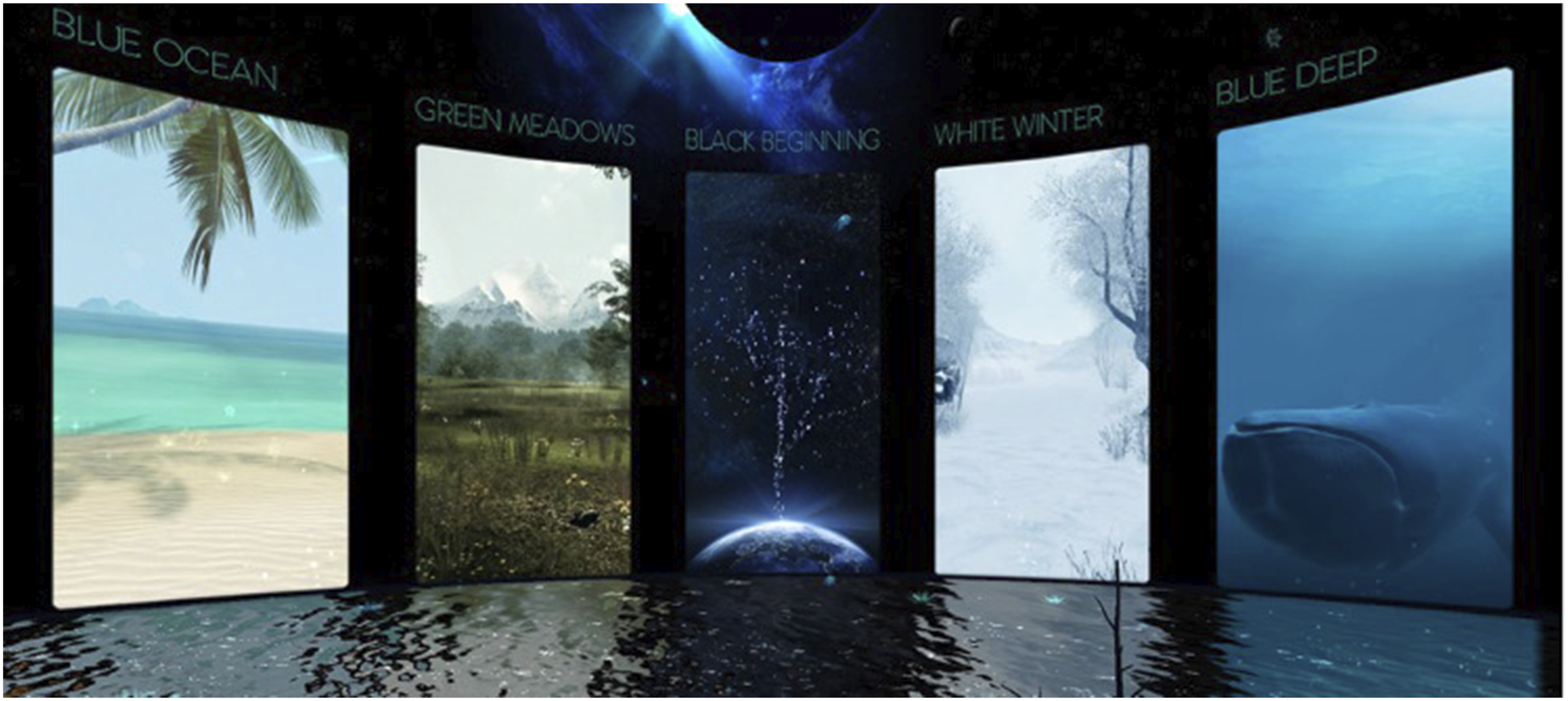
Data Analysis
Our data analysis process was iterative and evolved as we engaged with the data and literature. At first, we conceptualized our approach as an interventionist interview in which we would simultaneously learn about students’ experiences and explore the potential of Clean Networks in VR to support their reflection and sensemaking. Following existing VR literature that seeks to identify optimal VR characteristics for particular goals (Chan et al., 2021; Hawes & Arya, 2021), we were initially interested in understanding which VR characteristics would be most supportive of reflective interventions. We started our analysis by coding the reflective outcomes of each round of questioning (e.g., articulating a problem, identifying a desired outcome, identifying an action) and the characteristics of the environments in which participants were immersed (e.g., which environment they selected, characteristics of the environment, such as the presence of moving elements). Findings from this first level of analysis are described below, followed by a discussion of our realization that our goal of identifying causal relationships between environmental characteristics and outcomes was misguided.
The Potential of VR to Support Reflection
Participants were able to draw on the rich symbolism of the environment to better articulate their problems (25 instances), identify resources (48), and possible actions (40 instances). For example, Alice drew on the image of two rocks to explain how she felt about her research topic. In this space, I know that I'm kind of stuck between two rocks. That one, maybe, represents my kind of vision of what I want my research to be. And the other rock sort of represents what's realistic, given the time and scope. So, it's kind of like I'm stuck here having to figure out how to get unstuck while also maintaining my, I guess, core values.
The embodied metaphorical experience of being stuck between two rocks allowed her to articulate her feeling of stuck-ness and eventually define a desired outcome, find resources to meet these outcomes, and craft a plan of action. In a later iteration, she reflected on what really mattered to her: … I guess it may make me take a step back to think about, I guess, like the research as a whole and potential to have greater impacts beyond, I guess, like the four walls of the building. I guess that's the dream ... So I guess this gives me perspective in that, although we are out here, I guess what we're doing really does matter.
Identifying a desired outcome (research that matters) helped her focus on what she wanted, and as she continued through the process, she felt more hopeful and confident: From the space, I know that there are still, I guess, mountains to climb or barriers. But, like, I assume it's a lighthouse, that there is kind of this, like, beacon of hope at the end that everything will work out and that all the challenges will be worth it.
As Alice continued her process, she started to feel unstuck and imagine a more hopeful future in which she felt happy with her research: I know that the grass will be greener on the other side. That's very peaceful in this meadow. I would like to reach a place like this, hopefully soon, where I feel content and happy, and satisfied with where my research question is. And maybe solidifying it will give me this sense of peace and comfort. That will make things less crazy.
The experience in the virtual environment was accompanied by emotional responses, which were at times soothing and calming but also informative. As the quote above suggests, Alice felt peaceful in the meadow, which helped her identify possible actions (solidify her research question) to give her an equivalent sense of comfort.
Through our preliminary data analysis, we found that the significance of environmental elements (e.g., the presence of rocks or buildings) is relational and contingent, not fixed or universal. In other words, the meaning attributed to elements is not inherently positive or negative but emerges in the present moment as the participant and the environment interact. To illustrate, upon meeting virtual dinosaurs, Daniel recalled a positive memory of his son and observed that dinosaurs are now extinct. Daniel: Wow, nice, the Jurassic! Okay. Definitely a hostile place to be in with all the dinosaurs roaming around. My son, not anymore, but he used to really love watching dinosaurs. And he used to even like teach me about the names of different dinosaurs. What a memory… Researcher: And what do you know from this space? Daniel: What I know very past now, because there are no dinosaurs anymore…
Meeting the same virtual dinosaurs, Darlene reported feeling anxious and reflecting on her desire to avoid anxiety. Darlene: Oh, oh, okay. This is giving me anxiety. [laughter] Researcher: You can leave if you don't like it. Darlene: But I feel like, well, just that guy's giving me anxiety. Because if he's like, am I gonna witness something happening? Okay, but I mean, I feel like, if I keep picking serene environments, I will keep thinking, I won't be finding something that makes me think of my challenge… Researcher: And what do you know from that space there? (20s silence, thinking) Darlene: Okay, well, these two dinosaurs are kind of far from that one. [laughter] And they're together and they're kind of not caring. And they're wandering together, and it kind of makes me think, like I guess, to focus on my thesis and graduate on time. You know, I just have to keep going. Even if you know, the threat of not graduating on time, or little things like that, gives me anxiety, I can, you know, I still have to keep living and surviving and moving.
The realization that the meaning attributed to elements, such as dinosaurs, is unpredictable and irreplicable and emerges in the interaction between space, time, and matter led us to reconceptualize our intervention as an intravention, as discussed next.
From VR Intervention to Intravention
We came to draw on sociomateriality perspectives (Barad, 2007), which posit that people and materials are entangled and inseparable. While sociomaterial perspectives were originally developed based on the physical world, our study suggests that the virtual material may have properties of entanglement with social elements similar to those of their physical counterparts. Building on the work of Karen Barad (2007), sociomaterial research proposes the concept of intra-action as an alternative to interaction. The prefix “intra”- (within) displaces “inter”- (between) to highlight that meaning and phenomena are generated within relations, not between discrete entities (Barad, 2007; Hultin, 2019; Kuntz & Presnall, 2012; Mazzei, 2013). Intra-action suggests that relations and the meaning associated with entities emerge within phenomena as opposed to pre-existing or external to the phenomena (Barad, 2007; Kuntz & Presnall, 2012).
Following the same logic, scholars have argued for the notion of intravention as an alternative to intervention. Unlike traditional notions of intervention that imply the intervenor acts on an external object or system to instigate change in individuals or situations, intravention suggests an intervention from within the entangled relationships that constitute the intervening situation (Camiré, 2023; Kuntz & Presnall, 2012). Conceptualizing our intervention as an intravention means that the virtual environment is not merely a backdrop but an active participant in the reflective process, where meaning and knowledge emerge through the dynamic and non-linear interplay between the participant and the virtual world. This perspective suggests that the reflective process is relational, becoming within the experience (Kuntz & Presnall, 2012) through ongoing practices and intra-actions (Hultin, 2019). We will elaborate on the implications of such a perspective for understanding and incorporating VR as an interview tool later in the paper.
To allow us to understand the role of VR in this intravention, we turned our attention to the “experience” of reflecting in VR, as a temporal phenomenon in space, moving away from generalizable causal explanations and embracing the unpredictable and irreplicable nature of interactions between space, time, and matter (Camiré, 2023). Specifically, we engaged in a process of re-enacted storyboarding guided by the question, “What is the role of VR in this experience?” as described below. Our research process leading us from intervention to intravention, is summarized in Figure 2. Research process: From intervention to intravention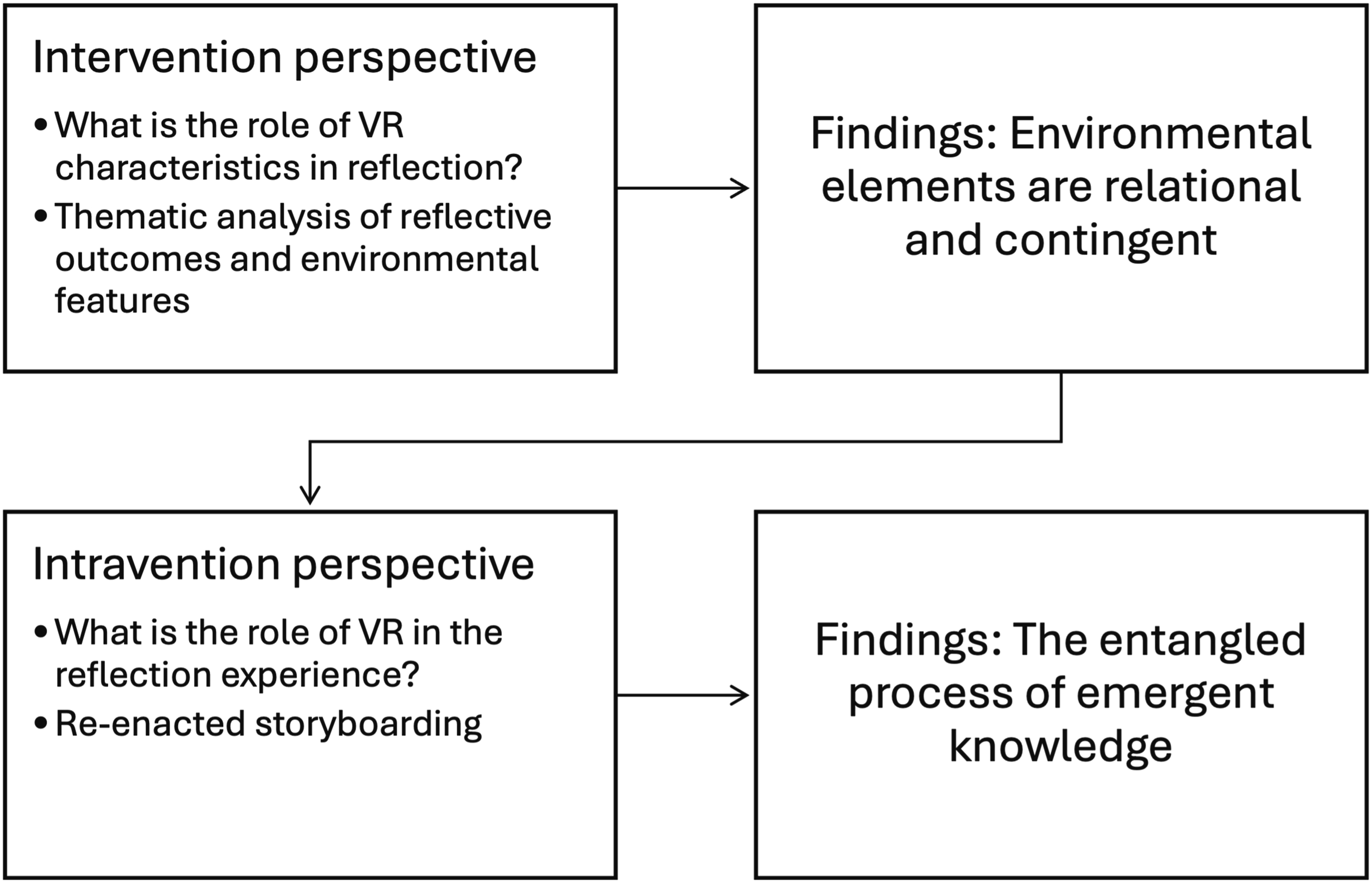
Re-Enacted Storyboarding
Storyboards have been widely used in film and animation production as a pre-production and pre-visualization tool, as well as in visualization and data analytics (Walker et al., 2015), and as a collaborative design tool when creating videos with or about participants (Labacher et al., 2012). Visual storyboards allow for integrating multiple data sources (textual and visual) into coherent and accessible multimodal narratives, allowing for the visualization of critical points, facilitating interactions, and supporting spatiotemporal jumps. We built on these ideas to develop our approach of re-enacted storyboarding – a visual representation of participants’ experiences in VR created through re-enactment.
We re-enacted participants’ experiences by listening to the audio recording while navigating the virtual environments following the participants’ steps, which we had noted at the time of the interview. The re-enactment allowed us to develop a felt sense of the phenomenon. As participants commented on elements of the environment (e.g., I see a turtle), we took pictures for further analysis. During the re-enactment, we also noted observations and ideas that emerged (e.g., this reminds me of…).
We then identified turning points or “flickers of transformation” in the participants’ narratives (Way et al., 2015). Turning points were moments in which they identified an insight, or an “aha” moment, a change in the logical direction of the narrative (“I realize I was looking at this the wrong way”), or a marked change in emotional tone (“I feel more confident now”). We paid particular attention to the final insight (“What do you know now?”) and the “takeaway” participants got from the experience.
We then reconstructed their experience in the virtual environments by assembling a storyboard including text and images that narrated their trajectory toward their final insight. To prepare the storyboards, we revisited the text, sound, and images multiple times to explore their interactions and reconstruct the experience as a spatiotemporal process. Figure 3 displays the storyboard created to illustrate Daniel’s experience in the virtual environment. The central text was his main insight, which we traced to different encounters. Daniel’s storyboard
The process of re-enacting participants’ virtual trajectories and storyboarding allowed us to see and embody participants’ experiences by listening to their narratives and repeating their navigation in the virtual environment. While the re-enactments did not reproduce participants’ experiences, they allowed the research team to get a sense of the process of co-production of knowledge and gain insights by being exposed to these images and sounds. The storyboarding process was essential in visualizing the temporal aspect of the experience, tracing their insights, and identifying patterns, as discussed below.
The Entangled Process of Emergent Knowledge
We found that engaging in the Clean Networks process in VR allowed for knowledge to emerge through a process of entanglement – a dynamic process of mutual co-construction through relationships (Barad, 2007) – between the virtual-material and social worlds. The relationship between the virtual environment and the participants’ words was not a direct, linear relationship (dinosaur images cause X) but an entangled, non-linear, emergent process in which earlier wonderings were embedded and connected with current experiences. Entanglement, according to Barad (2007), refers to the non-separability of phenomena, where boundaries between elements are neither fixed nor defined in advance but shaped through dynamic practices. In other words, dinosaurs (or any other virtual element) are not inherently good or bad, scary or soothing. Rather, dinosaurs become meaningful at a particular point in time within the relation with a participant. The participant’s journey through different VR environments demonstrates a temporal process that shapes emergent knowledge, as described below. The temporal nature of this process illustrates the concept of spacetimemattering, which highlights the co-producing properties of space, time, and matter (Murris, 2021). Daniel’s experience exemplifies these concepts.
At the end of the Clean Networks process, Daniel came to the realization that he needed a nurturing environment to be more productive in his thesis work (see Figure 3).
As we traced his insight through re-enacted storyboarding, we realized that his realization emerged from his engagement with various virtual “life” conditions, indicating a non-linear and temporally extended process of meaning-making in which multiple situated concepts emerged through the process and were connected into an overarching insight. First, his encounter with turtles brought up a notion of survival. Then, when experiencing a storm, he reflected on hostility. When he encountered dinosaurs, he reflected on extinction and hostile environments. The freezing scene connected the notions of life and hostile environments (“despite being hostile, there is life”). Finally, he discovered an “optimal place” where he could be happy, a place full of life, not hostile, yet alone and focused. We came to think of the ideas of life, hostility, and the optimal environment as situated concepts, ideas that emerged from his entanglements with the virtual-material world. Combined, these situated concepts allowed for the emergence of his insight into ideal work environments (this process is illustrated in Figure 4). Daniel’s emergent knowledge
The process by which insights were generated varied among participants. For example, while Daniel’s insight emerged from a connection between different life forms and environmental conditions, Darlene’s process was more emotional and evolutionary. Her stated problem was a need to leverage time to do her thesis and launch her career. She started by noting a dichotomy between her present moment of calm exploration (a lake) and the challenge of looking for a job upon graduation (a mountain). She then reported feeling anxious (when seeing dinosaurs) and reflecting upon her feelings of anxiety. Over time, across different environments, she started to identify resources (other people have done this, finding joy in research) that led her to feel “more comforted” and confident that her experience was normal and that she was building something through her research that had inherent value. Her ending insight was that she should not think of her thesis as a “chore” but as the foundation for her career, eliminating the original problem of managing two independent demands (thesis and career).
While these examples suggest a temporal progression, this progression is neither linear nor follows a constant pace. Rather, the emergence of situated concepts ebbs and flows at different paces and trajectories for each person. For example, during her first three stops, Cassandra merely stated what she already knew about her challenge (applying for a Ph.D. in a different city) without any observations about the environment. The virtual-material entanglement came as a revelation at the fourth and fifth stops, where she noticed the freezing environment and the mountains. They motivated her to consider the weather and the overall lifestyle associated with different locations as situated concepts. She excitedly stated, “Now I see what is happening here,” reflecting on the insight that her choice is not just academic but about a life experience.
Emergent Knowledge Process

The process of emergent knowledge starts with sociomaterial encounters, as individuals have embodied experiences (sight, hearing, and feelings) based on their entanglements with virtual-material elements. Participants’ ability to engage with the virtual environments through simulated actions like climbing, entering bodies of water, or being with animals provided a felt sense (such as fear of height or delight in being surrounded by water) that was integral to their experience. In this sense, the virtual environment becomes an assemblage (Mazzei, 2013) that enables experiences at an embodied level, contributing to the emergence of knowledge and understanding through direct material engagement rather than abstract thought alone. For example, Susan describes her encounter with the environment: Yes! This guy… Wow, also nice! What if I trip? It's okay, this is very dark. It's darker than I expected. Oh, nice little tree bird! [excitement] two little birds, a butterfly. That's very nice. Yes, I like it here!
These encounters with material elements facilitated the emergence of thoughts and feelings in time and space, which we came to think of as situated concepts or provisional “data points” to be collected for potential use in the future. The abundance of symbolic and novel material and sensorial inputs in the virtual environment allowed for the emergence of thoughts that might not emerge in everyday situations. Susan’s observations of the relationships between different elements of the virtual environment (birds and insects) prompted her to consider her own connections with her peers. Feels like all these guys are connected [birds and insects]. And I think that's nice. I feel like that's something that I really love about our cohort. It feels like we're all like, on our own little flower and doing our own little things. But there are some commonalities. And there are some connections there, which are very special. And something I want to explore in the coming years is to work together.
In this particular time and space, Susan identifies the ideas of connection and collaboration, which were later called upon for further elaboration. As illustrated with Daniel’s narrative, ideas of life, extinction, and environmental hostility were later drawn upon to establish a relationship between environmental conditions and work productivity. Through encounters and identification of situated concepts, many participants arrived at an insight, which we defined as reframing the issue, identifying a new perspective, connections, or knowledge. Darlene reflected at the end of the exercise: I didn't think about it like that before…I think when I think about, like, “Oh, you just have to finish your thesis”, you just have to, it's like, you just have to finish your thesis, right? Like, once that's out of the way, then my life can move on, then I can build my career, but it's not like that, because working on the thesis will help me to build my career and will help me to graduate on time…
These insights also provided emotional comfort, as Darlene explains: It makes me feel more confident, in you know, just doing what I was supposed to do… I'm so focused on what other people are doing, but by just focusing on my thesis, I know that I can achieve my career goals.
The importance and magnitude of the insights varied. For some (like Daniel and Darlene), the insight was a clear reframing or idea of how to approach their problems. For others, it was fuzzier. For example, John reflected at the end of the process: I think maybe enjoying the process more is what I'm going to take out of this. Enjoying the, I guess the journey of getting there in the first place. And not being in too much of a rush to complete it. But enjoying the getting there.
While these participants’ insights may have been less obvious, it is important to note that the process of connecting different “data points” or situated concepts into an insight may happen later, outside the reflection exercise, or may be subtle and difficult to articulate. For example, John’s realization that he needs to enjoy the process could hypothetically lead him to change the topic of his thesis to something more enjoyable.
Discussion: Virtual Reality as a Multimodal Interview Tool
Our goal in this article was to explore the potential of Virtual Reality (VR) in reflective interviewing. We invited graduate students to reflect on their academic challenges within varied and novel virtual environments following the Clean Networks coaching protocol. We found that performing Clean Networks in VR allowed for a process of becoming within a complex network of human and non-human forces, which supported participants’ reflection. Virtual reality technology and virtual environments emerged as promising tools to support reflective interviewing by affording rich environments in support of sensemaking and enhancing researchers’ ability to move beyond text-based analysis by supporting the production of multimodal artifacts (recordings, textual inputs, images).
VR technology affords the possibility of creating multiple and varied stimuli to support thinking through co-inspiring elements. A growing number of studies emphasize the active role of material objects and their effect on human experience (Frauenberger, 2019; Orlikowski & Scott, 2008), but the investigation of virtual environments has been mostly limited to objects and settings that are controlled and planned for specific studies. For example, in Mathysen and Glorieux’s (2021) study of the behaviors of library visitors, participants visited a virtual simulation of real-world libraries. In our study, we extended the literature exploring the potential of VR in interviewing by exploring the potential of general rich environments simulating natural and imaginary settings. In line with previous research suggesting that exposure to natural scenes has affective and cognitive advantages, both in physical and virtual environments (Frost et al., 2022; Mostajeran et al., 2023), we found that the virtual nature scenes supported participants’ emotional well-being and reflection. The virtual environment can act as a material component within the research, potentially triggering new connections and insights that might not arise from purely discursive methods and supporting a move beyond an over-reliance on words as the primary source of meaning.
The virtual environment also affords the opportunity to move beyond textual accounts by facilitating the re-enactment of participants’ experiences throughout the analysis process and a focus on the phenomena of the experience. Stiegler (2021) discusses how a go-along interview allowed him to entangle with the everyday life experiences of participants who were very different from him in gender, age, and ethnic background. He argues that the co-created experiences were effective in helping him better understand the participants’ thoughts and emotions but admits that his presence altered those experiences. Our re-enactment process was inspired by and extends this body of work by allowing the researcher to get as close as possible to the experience of participants without altering them. We had the opportunity to visit the environment multiple times to see what participants were seeing and “feel” their experience while listening to their narration. Unlike physical environments, virtual environments do not change over time, and the light and presence of elements remain constant across multiple visits. While it is not possible to feel what the participant felt in the world, as experiences are specific to a moment, the researchers’ re-enactment supports the data analysis by creating an embodied experience that goes beyond the flattening of the text. The constancy of the virtual environment allows for repeated embodied engagements that can reveal the significance of elements that might initially seem like “noise” in textual analysis. Re-enactment was critical because we found it important to stay outside the environment during participants’ experiences to give them absolute freedom to navigate as they see and minimize the presence of the researcher. However, it was essential to cast the virtual experience on the researcher’s screen to allow for observation and note-taking (for example, when Susan said “these guys” in the quote above, we were able to see and make a note that she was referring to birds and insects).
Through our study, we learned that it is important to conceive of reflective interventions in VR as a phenomenon that is unpredictable and irreplicable and evolves through the interactions of people through space, time, and matter (Camiré, 2023; Murris, 2021). We demonstrated how sociomaterial encounters supported the emergence of unique situated concepts that, over time, contributed to the emergence of individualized insights. This realization requires a processual way of thinking through the design of the VR intervention (multiple varied environments and freedom of navigation) and analysis of interventionist processes (as a temporal process that needs to be re-enacted multiple times).
Using VR for interviewing comes with its challenges, however. First, virtual environments need to be built or sourced for specific research goals and require the availability of VR headsets, which can become resource-intensive and limit accessibility. Unlike other technologies that may allow for virtual interviewing, VR interviews require using a headset with its own inclusion and accessibility issues (Yong et al., 2025), limiting the pool of participants to those who can comfortably use the technology and have access to it or can participate in person at the location of the research team. Second, simulated environments may not represent what the participants expect to see, thus introducing bias or undesirable material artifacts. The VR technology’s focus on visual and audio modalities could also result in sensory mismatch and potentially negatively affect the participants’ experience. Third, as with any technology, the process is exposed to technological failures and glitches, which can be distracting. We found it essential to have two facilitators in the room, one attending to technological issues (recording, casting, battery replacements, addressing sound or image problems) and one focusing on the participant and holding the process. The team approach allowed for a seamless experience for the participants as one researcher would talk to them and support their reflection, while the other engaged in technological setup and troubleshooting.
Using VR is a resource-intensive endeavor and is not suitable for everyone or every question. In our study with graduate students grappling with the challenges associated with thesis work, using VR was beneficial because it allowed for novel ways of thinking to support students and our understanding of their issues. However, in situations where different perspectives are not necessary, the population may not be comfortable with the technology or may have difficulty accessing the headsets, other reflective interview approaches may be more suitable.
In addition to highlighting the potential of VR for interviewing, our study also has implications for the emergence of knowledge in reflective interviews. We found the emergent knowledge protocol Clean Networks to be powerful in supporting reflection. We believe this protocol has the potential to support interviews and interventions by facilitating the emergence of knowledge of various topics of interest to researchers, even if VR technology is not available. Clean Networks builds on the extensive use of Clean Language Interviewing (e.g., Cairns-Lee, 2015; Cairns-Lee et al., 2021; Tosey et al., 2014) by bringing in material and space considerations in the process of knowledge production. We encourage researchers to experiment with this protocol with or without VR by supporting participants in reflecting while navigating rich environments.
Our study has implications for research interviews in general. In line with sociomaterial perspectives, Kuntz and Presnall (2012) suggest a shift from interview to intraview to emphasize the relational, affective, and material aspects of a knowledge encounter and production. An intraview emphasizes that meaning emerges from a complex dynamic and relational encounter of human and non-human elements. As we demonstrated, the virtual and material elements in which the research interaction occurs matter and play a role in knowledge generation. Researchers using traditional interview protocols must be mindful of the role of different socio and material entanglements in knowledge creation. We echo Brinkmann’s (2016) call for the denaturalization of the interview process as a neutral data collection instrument. Researcher’s actions, including the research methods employed, are not neutral tools but active forces that shape the emergent phenomena (Hultin, 2019; Kuntz & Presnall, 2012; Mazzei, 2013). In this context, the researcher is not merely describing or analyzing social phenomena but actively participating in their curation, provocation, or even generation (Marres et al., 2018).
Our research also contributes to the field of virtual reality studies in general. The concept of “virtual materiality” proposed as a counterpart to materiality in the physical world (Arya et al., 2025; Sondergaard, 2013) provides a framework for understanding how digital environments exert influence on individuals. Our study provides support for this idea and demonstrates that virtual environments exhibit similar agencies and entanglement akin to physical materials, suggesting that VR phenomena can be studied and designed through the lenses of sociomateriality and agential realism, extending these theoretical perspectives beyond their traditional application in physical contexts.
This exploratory study has important limitations. First, this was an exploratory study using a small and homogeneous sample of graduate students from one university. Our sample allowed for an exploration of the entanglement between virtual, material, and social elements, but more research is necessary to fully understand the challenges and opportunities of using VR in reflective interviewing. Second, we used a commercial VR platform with particular characteristics. More research is needed to fully understand the role of VR elements in the interview and reflection process. Third, while the protocol we used is designed to minimize the influence of the facilitator on the reflection process, we acknowledge that the researchers’ presence in the physical environment may have had an influence on the outcomes of the reflection process.
Conclusion
In this paper, we explored the role of Clean Networks in VR to support reflection and sensemaking. VR affords important benefits to research, given the ability to simulate environments that are otherwise not accessible. We invite researchers to critically consider the role of material and human entanglements in the participants’ experiences and the data being produced. We hope our study will encourage further engagement with multimodal approaches to interviewing and experimentation with new technologies. We call for deeper and continuous dialogue around processes, approaches, and techniques to support participants as active agents in the sensemaking process.
Footnotes
Acknowledgements
We are grateful for the support of Dr. Anthony Scavarelli and Dr. Daniel Hawes for assisting with data collection and analysis. We are also grateful to Dr. Sheryl Hamilton for helpful comments in earlier drafts of this article. Above all, we are grateful to all students who shared their experiences with us.

Ethical Considerations
This study was approved by the Ethics Committee of Carleton University. Carleton University, Ethics Clearance 121271, on July 19, 2024.
Consent to Participate
All participants were provided with written informed consent prior to enrolment in the study. Participants received a written informed consent prior to the interview and were requested to reply by email if they consent to participate. Additionally, at the time of the interview, they were asked to verbally confirm their agreement.
Consent for Publication
Participants agreed to have their data used for publication.
Funding
The authors disclosed receipt of the following financial support for the research, authorship, and/or publication of this article: We are grateful for the financial support provided by Carleton University through the Chair of Teaching Innovation program.
Declaration of Conflicting Interests
The authors declared no potential conflicts of interest with respect to the research, authorship, and/or publication of this article.
Data Availability Statement
Given the sensitive nature of our data, the data is not available in a public repository.