




Abstract
This article provides guidance on Front-Loaded Phenomenology (FLP) in qualitative research, an approach where researchers use phenomenological concepts and conceptual distinctions during initial research planning to shape how a study is designed and conducted. FLP studies have precise conceptual foci and enable the generation of nuanced findings that may be difficult to obtain using other qualitative approaches. Further, FLP does not require complex and controversial philosophical methods (e.g., bracketing, epoché, reductions) that are endorsed in other phenomenological research approaches. Shaun Gallagher initially proposed FLP to guide experimental research in the cognitive sciences, with the explicit use of FLP in qualitative research being a more recent development. However, limited guidance is available to help qualitative researchers decide when and how to use this approach. This article addresses this gap by consolidating and expanding upon available literature. We start by clarifying what FLP is and when it is an appropriate qualitative research approach compared to other phenomenological approaches. We then discuss qualitative studies that have used FLP, providing illustrative examples. Subsequently, we introduce a taxonomy of Applied Phenomenology, which helps distinguish FLP from other applied approaches, including Retrospective Phenomenology and the work of Amedeo Giorgi and Max van Manen. We also delineate three FLP subtypes. Building on this foundation, we provide guidance on how to conduct FLP in qualitative research and discuss potential benefits. We address two common misconceptions about FLP and conclude with future research areas. Overall, the label of FLP offers a name for what many researchers are already implicitly doing, and we argue that making the role and function of phenomenological concepts explicit will improve transparency and facilitate more constructive and critical engagement across studies. This article adds clarity and consistency to previously fragmented and inconsistent terminology and helps advance theory-informed phenomenological qualitative research that is rigorous yet pragmatic.
Introduction
Phenomenological concepts and methods are widely applied in empirical research, with various qualitative research approaches 1 developed across psychology, education, nursing, and other disciplines (e.g., Ashworth, 2003; Dahlberg et al., 2008; Giorgi, 2009; van Manen, 2023). These approaches typically draw from a pool of concepts and methods in the philosophical works of Edmund Husserl, Martin Heidegger, Maurice Merleau-Ponty, and more contemporary phenomenologists.
Despite drawing from the same literature, there are important differences in these approaches, and they generate different types of data. An approach that employs a highly focused interview and analysis will differ from one using a more exploratory or open-ended interview and analysis. The former often generates nuanced data in a pre-selected conceptual area, whereas the latter tends to generate findings that cover a wide range of topics or those most salient to participants. Knowing these differences can help researchers select the most appropriate approach or sequence of approaches given their research question or study aim. For instance, a more exploratory phenomenological approach may be chosen to understand the general landscape in a broad topic area, followed by a more focused study in a particular area.
In this article, we introduce a phenomenological qualitative research approach that has received limited attention in the existing literature, and we differentiate it from other approaches by focusing on when and how phenomenological concepts are applied. Building on past work (Gallagher, 2003; Gallagher & Brøsted Sørensen, 2006; Gallagher & Zahavi, 2021), we refer to this approach as Front-Loaded Phenomenology (FLP) or simply front-loading. While front-loading has been a popular way of integrating phenomenological concepts into the experimental cognitive sciences, the explicit use of FLP in qualitative research has been a more recent development (Gallagher & Zahavi, 2021).
FLP studies have precise conceptual foci and enable the generation of nuanced findings that may be difficult to obtain using other approaches. Further, they do not require the complex and controversial philosophical methods endorsed in many other phenomenological qualitative research approaches. 2 These features make FLP a valuable approach in many research contexts, including pragmatic health research aiming to target knowledge gaps or challenge existing assumptions. FLP may, for instance, advance understandings of specific aspects of patients’ experiences of illness and treatment, enabling more precise research and tailored clinical care. However, limited methodological guidance is available to help qualitative researchers decide when and how to use FLP. This article aims to help fill this gap.
We begin by clarifying what FLP is and discuss when it is an appropriate qualitative research approach compared to other phenomenological approaches. We then briefly review qualitative studies that have used this approach, providing illustrative examples. We place a particular focus on two studies to demonstrate FLP’s potential to challenge and extend existing knowledge. Next, we distinguish among three recent subtypes of FLP in qualitative research. We then provide guidance on how to conduct this kind of qualitative research, discuss potential benefits, and address two common misconceptions. We conclude by considering areas for future research.
This article is primarily intended for qualitative researchers, but we also touch on implications for quantitative researchers and scholars interested in theory. Given our backgrounds and interests, our examples come from health-related literature; however, FLP can be used in both health and non-health research contexts.
What is Front-Loaded Phenomenology, and When is it Appropriate?
What Does it Mean to “Front-Load”?
At its core, front-loading simply refers to doing something at the beginning rather than the end or to put more emphasis on the front end rather than the back end. In the case of FLP, it refers to the use of phenomenological concepts or conceptual distinctions – such as embodiment, selfhood, temporality (lived time), or spatiality (lived space) – at the start of a study. But why is this important to stress? Don’t many phenomenological qualitative studies already incorporate these concepts and distinctions? References to such concepts are ubiquitous, both in methodological texts and published qualitative studies (Ashworth, 2003; Dahlberg et al., 2008; Giorgi, 2009; Smith et al., 2022; van Manen, 2023). The key feature of FLP, however, is not that such concepts are used – it is when and how they are used.
Before defining and illustrating what FLP is in the context of qualitative research, it is helpful to have some background on the origins of the approach. Front-loading was originally proposed by Shaun Gallagher as a way of incorporating phenomenology into the experimental cognitive sciences (Gallagher, 2003). He contrasted this approach with two existing approaches: (1) neurophenomenology, which typically involves the training of research participants in a form of self-reflection; and (2) retrospective phenomenology, which involves the analysis or reanalysis of existing case studies or empirical data. One advantage of FLP, in contrast with the other approaches, is that experiments are designed within a theoretical or conceptual frame that can more precisely test phenomenological hypotheses or refine phenomenological theory.
While Gallagher draws these methodological distinctions within the cognitive sciences, similar distinctions can be identified in qualitative research. To illustrate these distinctions, we clarify how some popular phenomenological qualitative research approaches differ from FLP. As a starting point, consider how Amedeo Giorgi discusses the place of theory in his approach, writing that the researcher “brackets or disengages from all past theories or knowledge about the phenomenon” (Giorgi, 1994, p. 206) to focus only on the described experience (Giorgi, 2009). This, at least on the face of it, suggests an approach in opposition to front-loading, where prior theoretical concepts have no influence on how the study is designed and carried out. In contrast, FLP embraces theory and does not require the specific philosophical methods (e.g., bracketing, epoché, reductions) endorsed by Giorgi and others to set aside or exclude past theory or knowledge.
Similar characterizations to those in Giorgi’s approach are found across many phenomenological qualitative approaches, although they vary in how strictly theory is bracketed and which kind of theories may be allowed in. Max van Manen, for instance, despite taking a strong stance on the importance of using methods to bracket prior theory, also suggests that phenomenological concepts, such as relationality, corporeality, and spatiality, may provide a helpful guide when analyzing data (van Manen, 2023). Peter Ashworth also developed an approach where interview data are analyzed by considering a set of concepts that he refers to as fractions of the lifeworld (Ashworth, 2003). In Ann and Peter Ashworth’s study of living with Alzheimer’s disease, for example, they analyzed the reported experiences through the phenomenological concepts of self, sociality, embodiment, temporality, spatiality, project, and discourse (Ashworth & Ashworth, 2003).
It is difficult to distill the specific features of existing approaches considering ongoing debates and inconsistencies in how approaches are depicted, interpreted, and applied (Høffding et al., 2023). However, for our purposes, what is most important to highlight is that, despite van Manen’s and Ashworth’s explicit use of phenomenological concepts, neither approach should be understood as FLP. To appreciate the distinctiveness of FLP, we again need to consider when and how the concepts are used. Both van Manen and Ashworth deploy phenomenological concepts primarily, if not exclusively, in the phase of data analysis. As such, their strategy is similar to the retrospective use of phenomenology. In their methodological work, there is no explicit guidance to use these concepts earlier in the study (e.g., to inform the research or interview questions or the overall study design). In fact, considering their commitment to bracketing theory or past knowledge, their approaches, like Giorgi’s, may be opposed to the very idea of front-loading because it intentionally brings in theory and knowledge via phenomenological concepts at the start of the study to obtain specific, theory-driven data.
Interpretative Phenomenological Analysis (IPA) (Smith et al., 2022) also differs from FLP. IPA is situated within a phenomenological paradigm that contains certain philosophical commitments (i.e., hermeneutic, idiographic). However, this is not the same as front-loading specific concepts as we outline in more detail below. Rather, IPA is typically more exploratory, and Smith and colleagues clearly state that it “explores experiential meanings through the interpretative work between the researcher and the participant rather than being a theory-driven examination” (Smith & Fieldsend, 2021, p. 147) and that it “produces an account of lived experience in its own terms rather than one prescribed by pre-existing theoretical preconceptions” (Smith & Osborn, 2015, p. 41). Thus, IPA, along with Giorgi and van Manen’s approaches, do not front-load, as we define it. That said, qualitative researchers commonly adapt and mix approaches. For instance, a study may be labeled as IPA, yet front-load specific concepts or theory in ways that are similar to FLP (e.g., Ng et al., 2025).
These differences are crucial, as these approaches serve different purposes and result in different types of data. Again, knowing these differences can help researchers select the most appropriate approach given their research question or study aim. To assist researchers with decision-making, the following sections outline the defining features of FLP and when it is appropriate to use.
What are the Defining Features of Front-Loaded Phenomenology in Qualitative Research?
Building on the differences in approaches outlined above, FLP qualitative research is characterized by the use of concepts or conceptual distinctions that (1) are derived from the phenomenological literature or from closely related philosophical traditions (e.g., enactivism) and (2) shape how the qualitative data is collected or generated (e.g., by framing the research focus or informing an interview guide or plan for conducting observations). Both features are required to be considered FLP qualitative research. In practice, the specific concepts or distinctions used to frame the study’s design will typically continue to play a role in later phases of a study, including in data analysis (Gallagher, 2003; Gallagher & Brøsted Sørensen, 2006); but this is not a defining feature of front-loading.
At this point, relatively few phenomenological qualitative studies are explicitly characterized as FLP. But the approach is more common than it might initially seem. Many researchers, once steeped in the phenomenological literature and concepts, will naturally formulate research projects informed by phenomenological concepts. But this often remains implicit. It may be clear that a specific phenomenological concept was used in a study, but exactly when and how it was used is rarely reported. For instance, articles often have a section describing the theoretical framework that was used and mention how the study was informed by specific concepts, yet it remains unclear if and how these informed their data collection or analysis. Limited reporting (e.g., not providing the interview guide or sample questions) makes it even more opaque for readers. We believe that making the role and function of concepts and distinctions explicit will improve the quality of research and facilitate more constructive and critical engagement across individual studies. Therefore, the standardized label of FLP offers a name for what many researchers are already doing (implicitly or explicitly) and makes it easier to differentiate among phenomenological qualitative studies and approaches.
When is Front-Loaded Phenomenology an Appropriate Qualitative Research Approach?
FLP is best suited to target specific gaps in knowledge, typically after exploratory or open-ended work has already been conducted. Front-loading nuanced concepts and distinctions can enable a highly focused and in-depth semi-structured interview and analysis. Other data, such as observational notes and participant diaries, may also be collected to support the researcher’s targeted focus. In contrast, more exploratory or open-ended approaches may be better suited than FLP when investigating novel phenomena with unclear initial directions or foci. These more open-ended approaches may include Giorgi and van Manen’s approaches described above, as well as other popular approaches such as IPA (Smith et al., 2022).
FLP may also be appropriate when researchers aim to study experiences that are pre-reflective (Fernandez, 2022; Gallagher & Zahavi, 2023; Køster & Fernandez, 2023). That is, researchers may be interested in experiences that participants may have not explicitly reflected on or described before. 3 Guided by nuanced phenomenological concepts related to pre-reflective experience (e.g., the minimal-self highlighted in the next section), FLP can enable specific questions and prompts to help participants describe such experiences. More exploratory qualitative approaches are less likely to obtain descriptions like those obtained in FLP studies, since without the more directive and focused orientation, participants are likely to describe experiences that are more salient to them, or that they have ready-made words to express.
Researchers might want to avoid FLP in some circumstances because the use of established concepts might be methodologically or ethically problematic. For instance, front-loading in an understudied area may risk imposing preconceived frameworks on certain participants’ experiences, potentially overlooking or marginalizing unique perspectives that could be difficult to capture within the chosen theoretical frame and a focused interview. This suggests that even when using FLP one should carefully consider what categories of experience might be excluded or misconstrued by any initial selection of concepts or design.
Examples of Front-Loaded Phenomenology in Qualitative Research
With the defining features of front-loading in hand, we can look to some examples of qualitative studies that explicitly front-load phenomenological concepts. In this section, we summarize and reflect on examples of past qualitative studies, including some of our own work. The purpose is to give readers a sense of the characteristics of these types of studies and to provide a basic methodological template that researchers can draw from.
Characteristics of Six Examples (A-F) of Front-Loaded Phenomenology Qualitative Studies
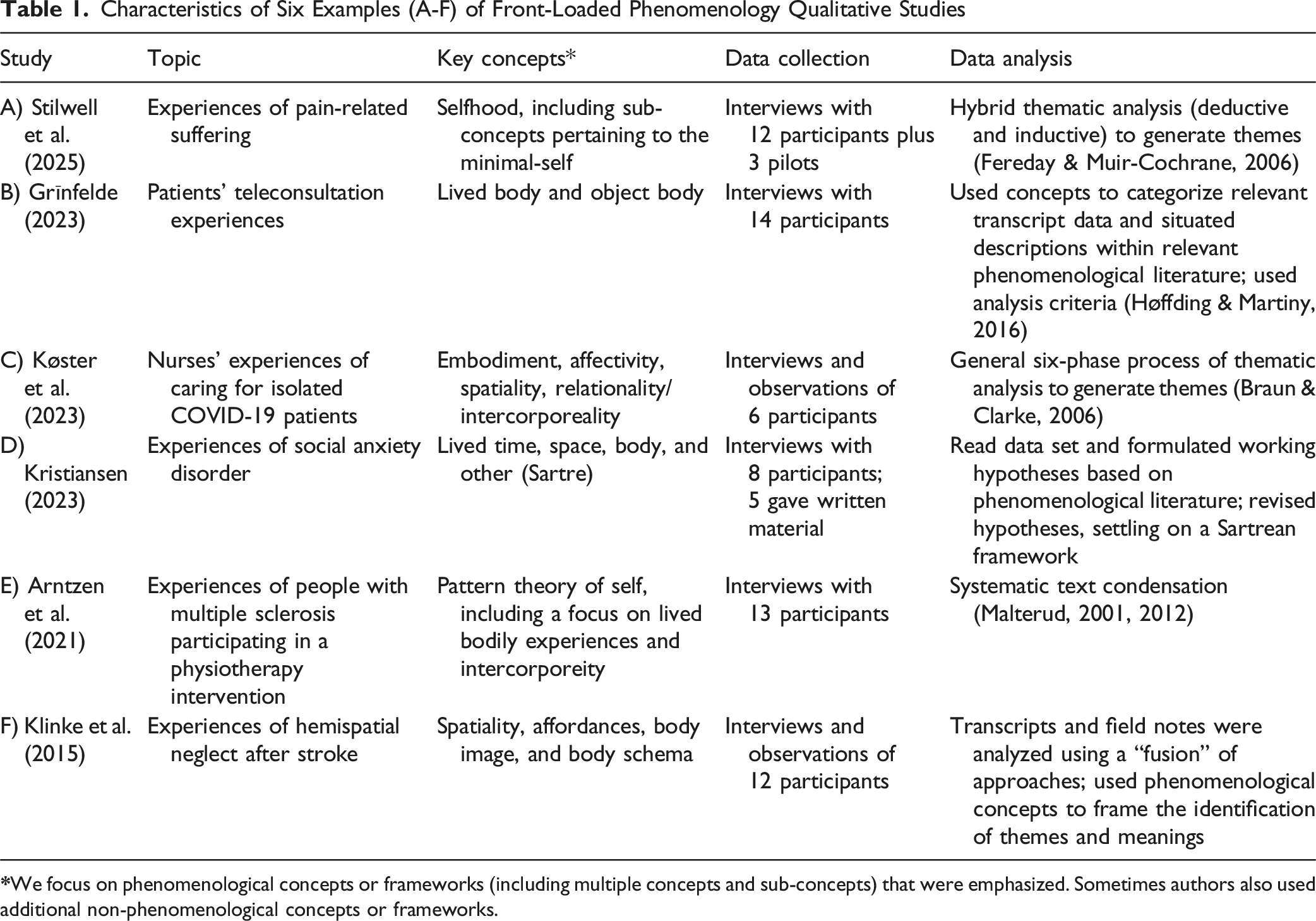
Front-Loaded Phenomenology Commonalities and Differences
Commonalities and differences are apparent across the six FLP studies (A-F) in Table 1. A clear commonality is that they used phenomenological concepts and distinctions in the initial study design and qualitative interviews to better articulate aspects of experience (e.g., the lived body in social anxiety or the body schema in hemispatial neglect). Typically, concepts and distinctions were also explicitly integrated into data analysis. The contexts surrounding the targeted experiences were also often discussed, consistent with contemporary approaches to phenomenological qualitative research (Pienkos et al., 2023). In addition to interviews, studies C (Køster et al., 2023) and F (Klinke et al., 2015) integrated observations, and study D (Kristiansen, 2023) used written materials (e.g., diaries) from participants. Regarding important differences, the studies had sample sizes ranging from 6 to 14 participants and used different strategies for determining the sample size. The studies also differed in how they analyzed the data to generate themes or new insights. These analysis strategies included different types of thematic analysis that are common in a variety of qualitative research approaches, as well as more tailored or mixed analytical approaches. This included methods that were deductive (theory-driven), inductive (data-driven), and hybrid (deductive and inductive). Later, we briefly discuss how these differences reflect important areas for future research.
Below, we expand on studies A (Stilwell et al., 2025) and B (Grīnfelde, 2023) to further illustrate what FLP studies can entail, including background context. We selected these studies because we argue they reflect the potential for FLP study designs to generate findings that challenge and extend prior knowledge. We focus on the concepts that are front-loaded and their contributions to the study design rather than the granular methodological details. Throughout the rest of this article, we revisit these studies and the others in Table 1.
Example Study of Pain-Related Suffering
The aim of Stilwell et al. (2025) was to gather data on a new potential way by which people living with pain can suffer. The team conducted in-depth, qualitative semi-structured interviews with people living with pain that focused on understanding the moment-to-moment experiences of their worst episodes of pain. Below, we provide context for this study and details about the value of using a FLP approach to challenge and expand existing understandings of suffering.
There is general agreement in the literature that pain-related suffering involves disruption to one’s sense of self (Stilwell et al., 2022); however, the field of pain has not clearly conceptualized what this means. Thus, the authors looked to the phenomenological selfhood literature that uses the helpful distinction between the minimal-self (in-the-moment, pre-reflective) and narrative-self (developed over time, reflective) (Gallagher, 2000, 2024). Using this selfhood framework, they were able to recognize that the current conceptualization of pain-related suffering in the field of pain is exclusively anchored to the capacity to construct a narrative-self and to reflect on valued aspects of one’s life that are threatened or disrupted, such as important roles, relationships, or aspirations. However, this framing fails to account for pain’s immediate, disruptive impact and denies the potential for suffering among individuals without self-reflective capacities (e.g., infants and people with advanced dementia); widely-cited authors, such as Eric Cassell (2013), declared that these populations cannot suffer.
Further, qualitative researchers in the field of pain tend to use more exploratory approaches and the relations between pain and selfhood remain understudied. Even when the self is a focus in qualitative studies, it is rarely operationalized and findings tend to focus on disruption to the narrative-self, aligning with Cassell’s view (Stilwell et al., 2022). This narrative-self emphasis and lack of theoretical precision reinforce the narrow view that both the self and pain-related suffering require explicit self-reflection. No empirical pain studies had explicitly challenged this view.
Thus, Stilwell and colleagues targeted potential disruptions to the minimal-self, including alterations to senses of agency and ownership (Gallagher, 2000). They recognized that their conceptualization of one’s sense of self and sub-concepts are situated within a broader embodied-enactive framework (Gallagher, 2023, 2024). Further, consistent with pain research recommendations (Haroutounian et al., 2023; Health Canada, 2019, 2021), they used broad participatory frameworks on the integration of patients and the public in research. These broader frameworks shaped the study, but the authors’ use of the selfhood framework in the initial planning and interview guide is what aligns with the defining features of FLP outlined above. Later, we further discuss the features of this and other FLP interview guides.
Results revealed that pain can overwhelm thoughts and self-reflective capacities and even disrupt foundational aspects of self-experience, including senses of agency, bodily ownership, and time. In extreme cases of overwhelming pain, the pattern of findings was remarkably similar to first-hand accounts of torture. Findings supported the understanding of a new mode of pain-related suffering that does not require self-reflection and is characterized, instead, by an immediate, disruptive impact on one’s sense of self (i.e., minimal-self disruption with disconnect from one’s reflective, narrative-self). The findings challenged historical conceptualizations of suffering and offered support for the idea that populations with more limited capacities for self-reflection may suffer. Subsequently, the findings contributed to the development of the first theoretically-informed and evidence-based definition of pain-related suffering to help advance pain theory, research, and practice.
Pointing to the unique value of FLP, this study demonstrated how it is possible to generate novel findings and insights by front-loading aspects of selfhood that have been neglected in the existing pain literature.
Example Study of Teleconsultation Experiences
The aim of Grīnfelde (2023) was to understand changes to patients’ experiences of objectification in the context of online clinical encounters (teleconsultations). To achieve this aim, she conducted semi-structured interviews with people who had at least one video teleconsultation. Below, we provide context for this study and details about the value of using a FLP approach to challenge existing assumptions that online encounters negatively impact the patient-clinician relationship.
Healthcare teleconsultations using audio-video platforms are now widely offered by health professionals for patients with chronic conditions; however, little is known about the potential impact of this technology on the quality of the patient-clinician relationship. In the context of in-person consultations, there is a large body of research on the patient-clinician relationship and patients’ experiences. Grīnfelde (2023) specifically outlined how health professionals often view the patient as an object to be examined and fixed, and that this can negatively impact the patient (e.g., citing work by Svenaeus, 2023). Health professionals’ dehumanizing “gaze” has been identified as a main source of objectification, and patients feel a sense of alienation as they are treated as a disease entity rather than a human being.
When preparing for the study, she looked to the phenomenological literature that uses the helpful distinction between the lived body (Leib) and object body (Körper). Drawing from Husserl (2000/1954) and others, Grīnfelde conceptualized the lived body as the “experience of the body-as-it-is-lived-through” (p. 338) and noted that the body is typically experientially absent in one’s everyday life. In other words, our attention is directed to the environment rather than our body. In contrast, the object body refers to the experience of one’s body as an object. Interviews drew on the phenomenological distinction between the lived body and the object body to illuminate potential impacts of teleconsultation.
Results revealed that the gaze of health professionals is weakened in the context of teleconsultation and offers new possibilities for clinical interaction. Specifically, Grīnfelde reported that objectification is decreased for two reasons. First is the lack of a medical environment during the teleconsultation, since the patient is typically in their own home. Patients perceived their health professionals as less intimidating, allowing them to be more open about their problems and form a closer relationship. Second is the absence or unavailability of the patients’ bodies for physical examination during teleconsultation. Teleconsultations drove health professionals to focus on the story of the patient and their lived body (illness experience) rather than the object body (disease).
Grīnfelde’s findings suggest that teleconsultations may help cultivate an empathetic attitude toward the patient and decrease their sense of alienation. Thus, somewhat paradoxically, the absence or virtualization of the physical body in teleconsultation may, in some cases, improve the care of people seeking help for bodily issues. These findings challenge the claim that the lack of physical presence in online clinical encounters negatively impacts the clinical relationship (e.g., Bizzari, 2022). Overall, the study suggests that the clinical encounter can undergo a significant transformation when it moves online, and the findings advance knowledge of the possible styles of healthcare interaction that can be employed to improve the care of patients both online and in-person.
Pointing to the unique value of FLP, the scope and conceptual framework of Grīnfelde’s study enabled a nuanced interview and findings that challenged past research and the widespread assumption that online consultations are detrimental to the clinical relationship.
Overall, this section demonstrates some of the concepts and methods employed in FLP in qualitative research, commonalities and differences in such studies, and implications for research and practice that these types of studies can produce.
Introduction to Applied Phenomenology and Subtypes of Front-Loaded Phenomenology
The taxonomy in Figure 1 is our attempt to add clarity and consistency to previously fragmented and inconsistent terminology. To situate FLP in the phenomenological literature and help qualitative researchers select an appropriate label for their research, it is important to briefly “zoom out” to appreciate that FLP sits within the broad camp of Applied Phenomenology (Zahavi, 2021, 2023) and to “zoom in” to consider examples of FLP subtypes that focus on specific concepts or conceptual frameworks. Taxonomy of applied phenomenology
Applied Phenomenology can be understood as the application of phenomenological theory or methods to empirical research or other practical activities. As visualized in Figure 1, all FLP approaches fall under the umbrella of Applied Phenomenology. However, not all applied phenomenological approaches (research or otherwise) can be considered FLP, as they often do not align with the defining features outlined above. For instance, approaches within Applied Phenomenology may introduce concepts only in the analysis stage or retrospectively rather than front-loading them.
Below, we briefly summarize the three examples of FLP subtypes in Figure 1. Each subtype offers granular guidance, setting parameters on what concepts to front-load and how the research is conducted. For present purposes, we focus on the concepts that are front-loaded rather than the granular methodological details. We discuss FLP and its subtypes in the context of research; however, in principle, similar approaches might be applied in non-research contexts (e.g., clinical assessment and treatment). Some studies may also align with more than one subtype, and we do not present an exhaustive list of potential subtypes.
Phenomenologically Grounded Qualitative Research (PGQR) places a focus on “existentials”, which are typically deemed by phenomenologists to be essential features of experience or subjectivity (Fernandez, 2017; Fernandez & Køster, 2019; Køster & Fernandez, 2023). Existentials include concepts such as intentionality, selfhood, empathy, embodiment, temporality, spatiality, and affectivity. PGQR uses one or more existentials as a conceptual framework that front-loads (grounds) the qualitative study. The researcher then aims to identify potential modes (alterations) of the targeted existential(s) with particular attention to pre-reflective experience (Klinke & Fernandez, 2023; Køster & Fernandez, 2023). For example, in study C by Køster et al. (2023), it was decided in advance that part of the study would focus explicitly on how the nurses experience their own bodies and the bodies of their patients. In this respect, the study front-loaded the phenomenological concept of embodiment and associated theory. The study did not, however, presume which modes of embodied experiences would be reported by the study participants.
Enactive Phenomenology (Stilwell & Harman, 2021) also uses existentials as a conceptual framework but adds concepts stemming from enactive and ecological theory rooted in phenomenology. For instance, a study may front-load concepts such as affordances and sense-making that cut across or transcend multiple existentials. Study A by Stilwell et al. (2025) aligns with this approach by using a selfhood framework derived from the enactive-ecological literature. The study also aligns with PGQR given the focus on selfhood, which is an existential. However, there may be situations where enactive theory informs a phenomenological study but there is not a strict focus on existentials (i.e., not PGQR), such as Dahl et al. (2025) who center on affordances and sense-making.
The Examination of Self Patterns approach (Daly et al., 2024) also draws from enactive literature and is not limited to existentials. Specifically, this approach relies on the Pattern Theory of Self, a non-reductive account of the self that encompasses numerous concepts rooted in phenomenology (Gallagher, 2013). The Examination of Self Patterns is a new approach, so there are no available studies based on this specific approach at the time of writing. However, past qualitative studies have used the Pattern Theory of Self (e.g., Arntzen et al., 2021; Knutsen et al., 2024) and generally align with the Examination of Self Patterns approach described by Daly et al. (2024).
Overall, FLP represents a general research design as well as a group of more granular, heterogeneous research approaches (subtypes). We suggest that researchers can use the general FLP label when they desire to have the most flexibility regarding the phenomenological concepts and qualitative methods they might select. In other situations, pursuing a FLP subtype may add precision. For instance, if a study aims to front-load specific existentials, then PGQR may be a precise and accurate label. Study B (Grīnfelde, 2023) used this targeted approach to focus on the existential of embodiment which included two sub-concepts: the lived body and the object body. However, in contrast, if a study primarily front-loads non-existentials or broader phenomenological frameworks, then PGQR may not be the best label. Further, front-loading a particular mode of an existential (e.g., a study aiming to characterize boredom experiences, rather than a broader exploration of moods and affective states) is also inconsistent with PGQR.
Guidance on Conducting Front-Loaded Phenomenological Qualitative Research
In this section, we provide high-level guidance and reflections, including practical considerations and potential benefits.
Practical Considerations: Knowledge, Preparation, and Skills
In addition to meeting the front-loading criteria outlined above, conducting a high-quality FLP qualitative study requires specific knowledge, preparation, and skills. Regarding knowledge, the nature of front-loading requires researchers to have sufficient theoretical understandings of the concepts at play. Good, pragmatic front-loading requires the right balance between superficial and overly orthodox or excessive engagement with philosophical concepts (Gallagher & Zahavi, 2021). Our experience is that having an interdisciplinary team with members with relevant content and methods expertise is ideal; however, there are also examples where a single researcher has the relevant expertise, such as studies B (Grīnfelde, 2023) and D (Kristiansen, 2023) in Table 1.
Regarding preparation, FLP qualitative studies typically use semi-structured interviews and research participants need to be oriented to the nature of the study. Specifically, these types of interviews can be incredibly challenging and time-consuming (Køster & Fernandez, 2023). Researchers can prepare the participants by stating that it may seem like lots of probing, repetition, or unusual questions and that this is all intended to help them articulate an experience they may not have verbalized before. In some cases, repeat interviews are warranted as done in studies D-F (Arntzen et al., 2021; Klinke et al., 2015; Kristiansen, 2023). Repeat interviews may be conducted not only to follow up on previous interviews, but also to allow for a specific conceptual focus for each interview (e.g., one interview on embodied experiences followed by one interview on affective experiences). Further, when feasible, conducting interviews temporally close to the event or intervention of interest may facilitate experiential descriptions as done in studies E (Arntzen et al., 2021) and F (Klinke et al., 2015).
FLP studies do not require participants to be aware of the technical concepts being front-loaded for researchers to obtain relevant and rich data. For instance, FLP studies front-loading selfhood theory do not typically use terms like the “minimal-self” in the interview guides (Arntzen et al., 2021; Knutsen et al., 2024; Stilwell et al., 2025). Instead, accessible interview questions are designed to get at nuanced aspects of experience that correspond to concepts like the minimal-self and pertinent sub-concepts (e.g., senses of agency and ownership). This same strategy is used with other phenomenological frameworks and concepts. For instance, study C by Køster et al. (2023) front-loaded the concepts of embodiment, affectivity, spatiality, and relationality/intercorporeality; however, these specific terms were not used with participants.
Regarding skills of the researcher, they need to be able to elicit detailed descriptions and potentially use data collection methods beyond interviews. In addition to general qualitative interviewing skills, the interviewer requires the ability to sufficiently probe and evoke descriptions of experiences that may not have been previously reflected on or described (Køster & Fernandez, 2023). In doing so, participants will inherently use metaphors to make their abstract experiences more concrete (Stilwell et al., 2021; Stilwell & Stilwell, 2024). Facilitating the creative use of metaphor may be helpful. Further, in some cases, arts-based methods (e.g., drawing, painting) may be a useful supplement or even replace interviews to help participants express their experiences (Harasymchuk et al., 2024; Johnson et al., 2023). For instance, researchers may front-load the concepts of selfhood, embodiment, and affectivity when instructing participants to draw their bodies and how they feel when experiencing pain. Similarly, behavioral observation may be a useful supplement or certain behaviors may be triangulated with interview data or discussed during interviews as an elicitation technique (Klinke et al., 2015; Stilwell & Harman, 2021). Further, behavioral observation may even be required when interviews are not possible or appropriate (Klinke & Fernandez, 2023).
It is also important to recognize that there may be instances where experiences are found to be ineffable and, as such, might not fit within front-loaded concepts. For instance, see Gallagher et al. (2015) regarding the experience of awe. Such inexpressible experiences may be indicated by participants’ pauses or the inability to find the right words, even when provided with adequate time, prompts, and follow-up interviews.
How Many Concepts Should You Front-Load?
Our experiences conducting FLP research led to an important question: how many concepts should we front-load in a single study? We identified two main issues that arise when attempting to front-load too many concepts or complex concepts with multiple sub-concepts. In this section, we discuss these two issues and offer some guidance on how to navigate them.
The first issue is that front-loading too much can be logistically challenging. For instance, in preparation for study A in Table 1 (Stilwell et al., 2025), the authors initially piloted interviews with equal focus on the minimal-self and narrative-self and their various sub-concepts. However, they found that gathering nuanced data within the scope of these concepts and sub-concepts would clearly exceed the time allotted for each participant. The guide was not feasible, so they narrowed their focus. They ended up placing most of their focus on a single phenomenological concept (minimal-self) with three sub-concepts (senses of agency, ownership, and time). To obtain sufficient and contextualized data, they needed participants to complete an initial screening and introductory interview (approximately 30-min), followed by a two-part interview (each part lasting approximately 1-h).
There is no universally agreed upon number in response to the question of how many concepts to front-load, as many factors are at play that are unique for each research team and study. Therefore, we recommend that researchers consider the time and resources available, the complexities of each concept, and the knowledge and skills of the research team. Conducting a study within the framework of a single, complex concept may require several rounds of interviews to elicit rich and nuanced descriptions, allowing participants enough time to reflect on and describe their experience. Thus, similar to study A, we recommend pilot interviews to gauge the feasibility of the selected concept(s) and the functionality of the initial interview guide. Like many other qualitative approaches, we suggest that the interview guide can be revised and adapted as needed. Further, similar to study C by Køster et al. (2023), FLP studies can integrate short-term observational methods to help select concepts that may be most relevant for the interviews.
Relatedly, a second issue is that front-loading too much can sacrifice depth in the absence of allocated resources for sufficient follow-up interviews and analyses. Here, we can view concepts like the windows of a house (Klinke & Fernandez, 2023). By looking in through each window, you gain a different view on what is going on inside. Trying to initially look in-depth into too many windows may not be feasible and can result in a superficial view. Therefore, in some cases, a quick initial glance through many windows could be a valuable starting point to gain an initial panoramic view, followed by the more focused investigation that we are emphasizing in this article. The focused approach involves looking in-depth through one or a few windows, acknowledging that you can always come back to the other windows later, systematically piecing together a more complete picture.
What is the Role of Broad Frameworks in Front-Loaded Phenomenology?
The two potential issues noted above led to another crucial question: what is the role of broad theoretical and conceptual frameworks in front-loaded studies? Again, if front-loading a whole framework with multiple concepts, sufficient time and resources are needed to obtain adequate depth. For instance, front-loading the whole Pattern Theory of Self in the Examination of Self Patterns interview would be a significant undertaking, although, as the authors suggest, it could provide a comprehensive data set covering many factors (Daly et al., 2024). However, for other researchers it may be more appropriate and feasible to have an overarching framework (e.g., Pattern Theory of Self) in the background, but the interview front-loads only one or a few carefully selected concepts within this framework. Further, the overarching framework could play a role in data analysis and interpretation and prompt future research using concepts within the framework that inherently came up but were not the focus of the study. For instance, although it was not a specific aim in study A by Stilwell et al. (2025), pain-related disruptions to the narrative-self were consistently described by participants. Thus, the authors called for more granular research on the narrative-self to better clarify its domains, disruptions, and relations to the minimal-self and its disruptions.
What about the role of non-phenomenological frameworks? While considering all the above, we acknowledge that non-phenomenological frameworks can be integrated with phenomenological concepts and distinctions. Non-phenomenological and mixed frameworks, in addition to selected phenomenological concepts, can shape the study design and methods. For instance, study A incorporated broad participatory frameworks alongside a phenomenological focus on selfhood. Overall, we suggest that researchers clarify the concepts and frameworks used and their role in the study, while also considering logistics and the desired study depth.
Potential Benefits of Front-Loaded Phenomenology
FLP in qualitative research offers various potential benefits. As a starting point, phenomenological concepts and distinctions provide a vocabulary and nuanced understanding of experience that may be novel in the field of application or overlooked in other types of studies that use either exploratory or constrained check-list-based methods. For instance, studies B (Grīnfelde, 2023) and D (Kristiansen, 2023) in Table 1 used the distinction between the lived body and object body, which enabled a precise research foci and findings that may have been difficult to achieve using other, more exploratory approaches.
Further, FLP has the potential to generate nuanced findings that challenge, expand, or refine past literature and existing concepts or distinctions. FLP’s concentrated and targeted scope facilitates engagement with literature related to very specific theoretical debates and concepts. This contrasts with more exploratory approaches that do not have this goal or an a priori theoretical or conceptual focus. Specifically, in the context of health, FLP study findings may challenge or expand existing clinical definitions or diagnostic categories, resulting in research and practice implications. For instance, studies A (Stilwell et al., 2025) and D (Kristiansen, 2023) challenged and expanded historical conceptualizations of pain-related suffering and social anxiety disorder, respectively. Alternatively, study F (Klinke et al., 2015) demonstrated how nuanced findings may refine and strengthen past literature by adding depth to the description of patients’ experiences that were already known through more exploratory research (e.g., lack of insight into own difficulties post-stroke, strange bodily perceptions, and the failure to recognize the left side of the body and space). Specifically, Klinke et al. (2015, p. 1632) reported that front-loading phenomenological concepts “enabled a more dynamic, nuanced picture of the embodied appearance of neglect” than past exploratory work and they emphasized that the new findings related to “the impact of changes – and loss – in interpersonal relations and spatial freedom” lead to more precise therapeutic considerations.
FLP qualitative findings may also inform quantitative research with clinical implications. The purpose of applying phenomenological findings in quantitative health research may include the development of more precise questionnaires and constructs that capture various kinds or aspects of experience. Such sequential work can have implications for experimental research, diagnosis, and more tailored clinical interventions. For instance, Køster (2022) conducted a study that led to the development of the concept of “world-distancing” in grief, which informed an item that is integrated into an ongoing large-scale survey on grief. Similarly, the qualitative findings on pain-related suffering in study A (Stilwell et al., 2025) may inform the development of quantitative measures that can reliably assess specific experiences (e.g., disturbances in time or the degree to which one experiences a loss of agency) using binary categories or Likert scales.
Such measures of world-distancing and suffering could lead to more precise quantitative and/or experimental research and treatment. For instance, new constructs that help classify different experiences might be found to correlate with distinct neural processes. Further, qualitative findings from FLP studies could inform non-self-report quantitative data collection. For instance, potential biomarkers could be identified that are hypothesized to relate to different aspects of selfhood. Of potential therapeutic value, identified neurobiological differences associated with different forms of selfhood disruptions may be uniquely receptive to different interventions. This work might inform clinical decision-making to provide more tailored treatment with the aim of improving health outcomes. Indeed, past work, especially in psychiatry, has demonstrated the value of incorporating phenomenology in quantitative and mixed methods clinical research (e.g., Henriksen et al., 2021; Moskalewicz et al., 2023; Nordgaard et al., 2021; Parnas et al., 2005; Raballo et al., 2025; Stanghellini et al., 2022).
Overall, FLP can play an important role in mutually beneficial interdisciplinary exchange among philosophers, qualitative researchers, quantitative researchers, patients, and clinicians (Gallagher, 2003; Kyzar & Denfield, 2022; Martiny et al., 2021; Nordgaard Frederiksen & Henriksen, 2019). Established mixed methods guidelines and reporting recommendations can help researchers clearly delineate the role of FLP; the purpose, priority, and sequence of methods; and the level and nature of integration (Edmonds & Kennedy, 2017; Fetters et al., 2013; Morse & Niehaus, 2016; O’Cathain et al., 2008).
Front-Loaded Phenomenology: Misconceptions
This section introduces and clarifies two misconceptions: FLP in qualitative research is (1) biased and (2) not open to new ideas during the research process.
Misconception 1: Front-Loaded Phenomenology is Biased in a Bad Way
Based on past interactions (e.g., peer review of manuscripts and grant applications), we have noted the misconception that FLP is problematic because it is biased. Specifically, the concern is that front-loading predetermines the research findings or conclusion. Køster and Fernandez (2023) addressed this common misconception. They clarified that front-loading interviews need not predetermine the content of the interviewees’ descriptions. Rather, they noted there is a significant difference between predefining the focus of an investigation (here, we call this “good, theoretical bias”) and predefining what will be generated from this focus (“bad, confirmation bias”). A predefined focus using specific phenomenological concepts and distinctions does not dictate the experiences that participants disclose. For instance, front-loading a study to examine experiences of time sets the scope of the study; however, it does not predetermine which time-related experiences participants will describe or how they might describe them (e.g., time felt like it slowed down versus sped up). Here, the concept of “bounded openness” from Klinke and Fernandez (2023) is helpful. That is, FLP sets boundaries for the scope of the study but remains entirely open regarding the content within this scope.
Many qualitative approaches align with the idea that bias is not always bad because existing knowledge and theory can be productively harnessed (good, theoretical bias) rather than set aside or “bracketed”. Indeed, no methodological approach to studying experience is neutral; all approaches inevitably introduce an interpretative framework, whether the researchers realize it or not. Front-loading appreciates this inevitability and aims to be transparent in the frameworks and concepts that are employed.
Misconception 2: Front-Loaded Phenomenology is Not Open to New Ideas
A second misconception, related to the first, is that FLP closes itself off to new ideas during the research process. However, when used appropriately, this is not the case. FLP maintains an open-minded attitude and is not entirely constrained by the initial concepts and distinctions that are selected. Specifically, it remains open to new concepts, revisions, and directions throughout pilot testing, data collection, and analysis. For instance, in study D in Table 1, Kristiansen (2023) made a data-driven decision to integrate a Sartrean framework in addition to a priori (front-loaded) concepts that shaped the study. In FLP, a study scope is set but the semi-structured interview guide allows for some flexibility to pursue potentially important but unforeseen descriptions, or the researchers can take note of findings that are more tangential to the current study but warrant future, dedicated investigation.
When appropriate, researchers may need to revisit the study scope and make substantial revisions (new boundaries) to adequately illuminate new ideas. For instance, new insights during data collection may prompt researchers to front-load a new concept, create a new interview guide, and re-interview participants (e.g., see Køster, 2020, 2021). However, if a study is revised to the extent where it no longer aligns with the defining features of FLP outlined above, then another label would be more appropriate. Regardless of the label used to characterize a study, we suggest authors be clear as to when and why they introduced or refined phenomenological concepts and distinctions.
Importantly, FLP does not mean uncritically accepting the phenomenological concepts and distinctions used. In fact, phenomenological qualitative studies may challenge or refine existing concepts and distinctions (Ravn & Høffding, 2017), as reflected in Figure 2. Front-Loaded Phenomenology (FLP) feedback loop where concepts inform empirical research, and this research informs conceptual advancements. Description: The dashed arrow represents the potential for FLP research findings and related philosophical work to challenge or refine existing phenomenological concepts and conceptual distinctions. This feedback mechanism can play an important role in interdisciplinary exchange that advances theory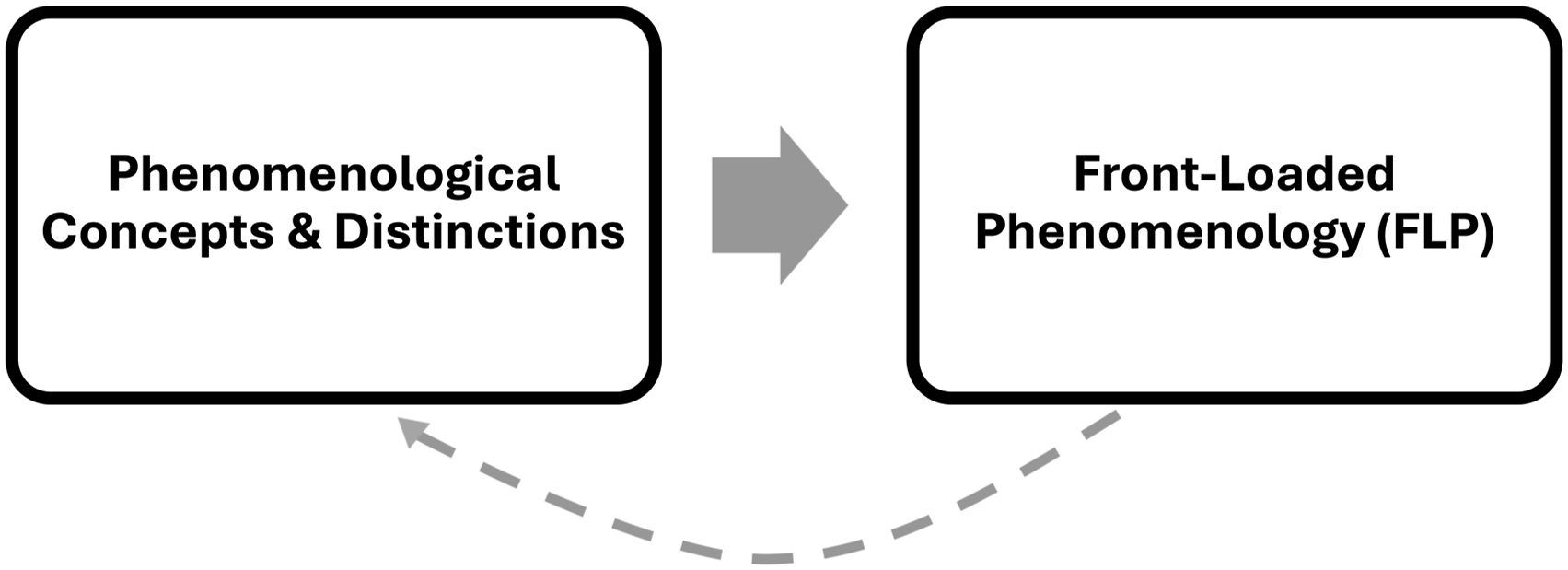
Outstanding Questions and Future Research
This article provides methodological guidance for qualitative researchers interested in conducting FLP. However, there are many outstanding questions and areas for future research, some of which we identify here.
We offered a general taxonomy (Figure 1) to help clarify FLP, including its placement within the broad camp of Applied Phenomenology. However, more granular conceptual work is needed to further clarify the characteristics and roles of the many potentially heterogenous approaches that fall under the labels of Applied Phenomenology and FLP. This includes qualitative, quantitative, and mixed methods research approaches, as well as non-research (e.g., therapeutic) applications.
Within FLP, the demarcation between phenomenological and non-phenomenological concepts and distinctions remains notably fluid, raising potential questions about the criteria by which we determine their phenomenological status. We use broad and flexible criteria for now: concepts and distinctions are phenomenological when they are derived from the phenomenological literature or from closely related philosophical traditions (e.g., enactivism). For instance, concepts and distinctions may come from phenomenological philosophers or from more contemporary analyses or empirical work stemming from processes like in Figure 2. Again, good front-loading strikes the right balance between superficial and overly orthodox or excessive engagement with philosophical concepts. We encourage others to judge the value of future FLP research by its novel insights and implications.
The role of theory in shaping sample size and data analysis has been an ongoing topic of discussion in the methods literature (e.g., Malterud et al., 2016), and future work is needed in this area in the context of FLP. Specifically, dedicated work is needed to understand sampling and data analysis strategies that best align (and clearly do not align) with the nature and aim of FLP in qualitative research. Further, work is needed on how researcher position, theoretical investments, and disciplinary allegiances are documented and critically negotiated throughout FLP studies, and if there are unique considerations in FLP compared to other qualitative approaches. Such work would require careful consideration of the different topics, standards, and practices among the diverse disciplines that use FLP.
Finally, further work is needed to better understand how FLP can be best integrated into research designs that might require significant conceptual flexibility and revisions throughout the study. This might include longitudinal qualitative research, focus group studies, and participatory action research where participants’ ideas and experiences shape the initial research focus and direction. Future work is also needed to better understand the role of FLP when mixing qualitative designs (e.g., combinations of phenomenological, ethnographic, and narrative/biographical approaches) and methods (e.g., combinations of qualitative, quantitative, and arts-based methods) (Bjorbækmo et al., 2022; Martiny et al., 2021; O’Reilly et al., 2021).
Overall, we argued that there is a need to make the role and function of concepts explicit when they are used in phenomenological qualitative research. We consolidated and expanded upon existing literature to help researchers conduct rigorous yet pragmatic theory-informed studies.
Footnotes

Funding
The authors disclosed receipt of the following financial support for the research, authorship, and/or publication of this article: This work was supported by Marie Skłodowska-Curie Actions [MSCA-Horizon Grant Number 101107891]; Social Sciences and Humanities Research Council [SSHRC Grant Number 430–2023-00716].
Declaration of Conflicting Interests
The authors declared no potential conflicts of interest with respect to the research, authorship, and/or publication of this article.