




Abstract
This methodological insight into critical feminist polyethnography demonstrates an expansion of critical feminist autoethnography to include queer and decolonizing theories, and reflexive praxis for social justice and transformative research with an interconnected culture group. Through critical feminist polyethnography, the researcher demonstrates a responsive and consent-based relationship with the culture group of study participants, feminist counsellors and therapists, as an insider/outsider to the research topic. A visual model of the methodology, inspired by the nautilus, assisted the participants and the researcher to engage with each theoretical chamber, ensuring consent and accountability were breathed into each step of the research. The research was reflective, responsive, and iterative, exploring how feminist counsellors and therapists engaged in learning about feminism, applied a feminist lens to psychotherapeutic modalities, and experienced peer and clinical mentorship and supervision. Using critical feminist polyethnography, the researcher was able to make ontological connections between the participant’s stories of feminist learning and transformative learning theoretical revisiting. Using a visual model as a pedagogical tool, the researcher and participants engaged with the research questions, transcriptions, and recommendations for emergent, transformative action.
Keywords
Many of us live in borderline zones that have yet to be socially acknowledged or defined. Each situation demands and/or emphasizes different identity markers so that one is constantly encountering an array of possible “selves” (Silverstein, 1999, p. 70).
In “Beyond Selves and Others: Embodying and Enacting Meta-Narratives with a Difference,” Cory Silverstein (1999) describes that living an experience that is both in “binary opposition” and “the meta-narrative of colonialism,” feminists can become “fragmented” by conceptualizing their identities through both their differences and in wholeness (p. 71). Over the past decade, I have researched and worked with survivors of sexual and gender-based violence, offering public and psychoeducation, developing community-based research, engaging with peer-led models of feminist counselling, and managing feminist therapists as a leader. During the COVID-19 pandemic, I felt “fragmented” (Silverstein, 1999) and was suffering from Complex PTSD. In an act of hegemonic resistance, I returned to graduate studies to explore the socio-cultural, legislative and systemic inequities that staff, volunteers, survivors and I faced in the sector. The resulting study explored adult learning through a feminist therapeutic lens, informed by the voices of those who have studied and identify as feminist counsellors or therapists, most of whom have worked in, or currently work in, the feminist anti-violence sector. The purpose of this study was to determine how feminist counsellors and therapists developed their practice within and beyond formal psychotherapeutic pedagogy. Developing an expanded and adapted version of critical feminist autoethnography (Edwards, 2018), called critical feminist polyethnography, I interviewed nine practitioners individually and five practitioners in a group interview to better understand how they learn about feminist theory, learn and practice feminist therapy and counselling, as well as learn from peers, mentors, and clinical supervisors through an andragogical framework. In order to contextualize my study, I conducted field notes, a document analysis of Ontario-related political and policy briefs and funding pathways, as well as an environmental scan of the post-secondary programs that credential feminist counsellors and therapists to work in the field (e.g. Bachelor of Social Work, Master of Social Work, Master of Counselling Psychology) and qualify those individuals to gain membership to provincial professional associations. I looked specifically for courses and syllabi that provide feminist theory, instruction on feminist therapeutic practice, and/or anti-oppressive/anti-racist education. As an insider/outsider to this work, and as a former executive director and supervisor at a sexual assault centre with a Masters of Adult Education, I hypothesized that little instruction in those modalities has been taught at the post-secondary level.
In Canada, like other colonial nations, psychotherapy and psychiatry are steeped in a long legacy of eugenics and oppression in the medical industrial complex (Withers & Ben-Moshe, 2019). The embodiment of feminist praxis in the field of carework, including counselling and psychotherapy, continues to be fraught with trauma exposure, medical gaslighting, and silencing of advocacy through patriarchal and hegemonic harm (Bonisteel & Green, 2005; Withers & Ben-Moshe, 2019). It is a field where herstories are shared and the feminist lens is mentored to subvert the ongoing erasure of its own existence. Therefore, I used the critical feminist polyethnographic approach to exemplify interconnectedness on the research topic, lead the research through rigorous consent with the participants, ground my data collection, and conduct self-reflection. I reminded myself, as a trauma-survivor and practitioner, to honour the expertise and lived experiences of the study participants and critique hegemonic socio-cultural and institutionalized norms, again and again. My study addressed the restrictions of neoliberal credentialization and professionalization in the field of feminist counselling and therapy, and offered recommendations for feminist learning in Ontario’s post-secondary social work and psychotherapy programs, a Canadian framework for feminist clinical supervision, and a call for local, low-barrier feminist therapy communities of practice across the nation for greater collaboration and knowledge dissemination.
Positionality
Prior to doctoral studies, I identified within a group of feminist counsellors and therapists in my role as an Executive Director at a sexual assault centre where I supervised staff and volunteers, held directorial status on the executive of an Ontario provincial coalition addressing sexual violence, and also provided peer crisis support (which aligns with definitions of feminist-identified counsellor) in direct service to clients. With a Master’s of Adult Education, I also provided anti-violence, trauma-informed public and psychoeducation to youth and adults, in client, educational and professional settings. Additionally, I have received over 15 years of feminist counselling and feminist therapy for my personal experiences of sexual and gender-based violence; an experience I share with many practitioners in the field of feminist carework. Through my ongoing work in the field as an academic, I had access to the key informants of this culture-sharing group, and together, we explored the patterns of feminist learning and mentoring using critical feminist polyethnography to query how we learned about and practiced feminism in counselling and therapeutic contexts.
In both my master’s research (Trefzger Clarke, 2022c) and doctoral studies, I have been exploring the intersections of my feminist and trauma-informed community-based work with academic literature in Education, Gender and Social Justice within Canadian Studies. My interest in andragogy was ignited by Elizabeth Ellsworth (1989) and her foundational article on teaching critical pedagogy as a white woman to racialized adult students. Her question of “Why doesn’t this feel empowering?” (Ellsworth, 1989) has informed how I see learners as experts in their own lives, and my role as facilitator of that embodied knowledge. I also am inspired by transformative learning theory (Mezirow, 1991) and its emancipatory potential when connected to feminist, anti-oppressive, and liberation theories. The work of feminist theory, to me, has always been an opportunity for imaginings beyond the cis-heteronormative, white privileged and hegemonic ideals that reinforce systemic oppression and marginalization. Caught up in the movement towards a trauma- and violence-informed framework in professional practice, I am increasingly concerned with the framework’s depolitical and degendered movement, with little recognition of its intersectional and feminist foundations (Trefzger Clarke, 2025). In reflection, following this study, the works of Karen Barad (2014) build on the sentiments described by Silverstein (1999) – as suggested by the reviewers of this text – to help me describe the moral injury I experienced in front line service straddling the borderline zones (Anzaldúa, 1987; Silverstein, 1999) of funding, legislation, feminism and healing from trauma.
As a methodology to explore these tensions and juxtapositions, I believe that critical feminist polyethnography is self-evolving towards a more equitable researcher-participant relationship that is, by its nature, feminist activism; a struggle described eloquently by Monique Guishard (2009) as she returned to her community to explore critical consciousness using participatory action research. One peer reviewer of this paper reminds us that “we must check in with the communities we work with” – a core tenant of emancipatory learning – and that in order to elevate care, respect, and dignity in the ethics of our research work, we must push against and disrupt the “colonial logics” through a greater understanding of co-created and consent-based stories of our human experiences (personal communications, October 2025). By queering and decolonizing my study methodology, inspired by the nautilus and nature’s iterative behaviours, I contend the research honours the study participants’ intersectional feminist knowledge, professional identity, and stories of personal agency to address gender-based trauma (McNamara, 2009). In order to describe the culture and learning of feminist counselling and feminist therapy in Ontario, Canada, I used formal interviews, field notes, group interview, and document analysis, but as importantly, I engaged with ongoing theoretical and self-reflexivity, and consent-based review by participants, to support the findings and convey the sociocultural patterns of this group (Merriam, 2009). The participants’ stories and recommendations (Trefzger Clarke, 2025) were powerful testimonies to how and why these practitioners care for survivors’ and community healing, and the ways ethics in feminist praxis can create complexities and tension with rigid, liability-focused professional standards.
Rationale for Research Approach
To explore how feminist-identified counsellors and therapists engage in their identity, learn about feminist theory and pedagogy, and apply these epistemologies to practice, I used a transformative framework (Creswell & Creswell, 2018) of critical feminist polyethnography as my study methodology. Traditionally, an ethnography explores a cultural or social group to describe and interpret its values and practices (Bloomberg & Volpe, 2012; Creswell & Creswell, 2018; Davis & Craven, 2023; Merriam, 2009); in the tradition of feminist ethnography (Davis & Craven, 2011, 2023; Lather, 2001), the researcher is also a participant-observer in this process. I sought to build on Jane Edwards’s structure of the critical feminist autoethnography (2018), where she explored past, present, and future possibilities within higher education, to develop a critical feminist polyethnography (Trefzger Clarke, 2022a; 2022b) in which I. 1. demonstrate the importance of feminist, intersectional, critical race, critical disability, queer and transfeminist theories to ethnography (Ahmed, 2017; Bettray, 2021; Davis & Craven, 2023; Hill Collins & Bilge, 2020; Hooks, 2015; Piepzna-Samarasinha, 2018) and secure this methodology within feminist theory (Ahmed, 2017; Hooks, 2015); and 2. describe the ways in which autoethnography (insider/outsider), intersectionality (Hill Collins & Bilge, 2020) and decolonizing (Green, 2017; Silverstein, 1999; Simpson, 2014; Tuhiwai Smith, 2012) frameworks develop a more equitable and ethical methodology for myself and the participants to tell the story well (Tuhiwai, Smith, 2012).
In using the prefix poly to encompass ethnographic research beyond the participants and inclusive of the auto, or self, I have queered the methodological structure from linear to expansive (Edwards, 2018; Patterson, 2016). By this, I mean the methodology is more responsive to insider/outsider dynamic complexities of intersecting identities. In addition, analyzing the data using intersectional feminist lenses of critical race theory and queer theory helped to better explore the gaps in a workplace sector largely populated by white, cis-heterosexual women. A peer reviewer of this paper also believes that poly represents more than multiple sites or methods, “but about the fundamental interconnectedness and mutually constitutive nature of knowledge, communities, and ways of being” (feedback that I feel humbled and grateful for, from personal communications, October 2025).
The term critical feminist polyethnography is a response to Schrock’s description of the problematization of feminist ethnography through the 1980s and 1990s in feminist literature (2018), as well as the calls from Junqueira (2009), McNamara (2009), and Simpson (2014) for reflectivity in the methodology. Bhavnani and Talcott (2014) also offer recommendations from the perspective of feminist global ethnographers working in development. To be accountable and ethical, I followed Schrock’s analysis of the core imperatives of feminist ethnography, honoured Edwards’s (2018) use of autoethnography, and responded to the attention Craven and Davis (2013) require for diversity and relevancy of participants and researchers, and the ongoing examination of power dynamics. The reviewers of this text have also assisted me in making connections to similar goals explored by Black and racialized feminist ethnographers and anthropologists in the United States and the Global South, including Irma McClaurin (2001); Zenzele Isoke (2018); Ashanté Reese (2018), Savannah Shange (2022), Aimee Cox (2015), Gwendolyn Mikell (1997), and Christen Smith (2022).
Regarding OCAP (First Nations Information Governance Centre, n.d) in the Canadian context (traditionally known as the northern area of Turtle Island), I addressed the OWNERSHIP, CONTROL, ACCESS and POSSESSION of the Indigenous knowledge disseminated by Indigenous-identifying study participants through consent in participation, data storage, the ability to use their own names or a pseudonym, change their confidentiality status at any time during the research, and ongoing feedback and member checks before publication (Canadian Institutes of Health Research et al., 2022). This has been built into the design of this methodological adaptation and is echoed by Silverstein (1999).
The Story of Critical Feminist Polyethnography
I understand myself to be a radical and intersectional feminist seeking transnational feminist perspectives. Although my feminist identity continues to evolve beyond this study, at the time I took the graduate course, “Discovering Feminist, Decolonial Research” with Dr. Karleen Pendleton Jiménez, I thought I had intersectional feminism completely figured out. The humbling of graduate studies is overwhelming and liberating.
I felt confident when first describing my research focus back in 2021, that I would use a feminist ethnography for my research methodology; in my master’s research I used a case study approach of a culture group of feminist-identified public sexual consent educators. I understood that anthropology is ripe with feminist critique (Bhavnani & Talcott, 2014; Davis & Craven, 2023; Junqueira, 2009; Lather, 2001; Pillow & Mayo, 2014; Schrock, 2018), and that I would need to connect some critical and reflective practice synonymous with intersectionality and critical feminist theory. Pendleton Jiménez pushed me to consider how to address the critiques of feminist ethnography from the 1980s and 1990s. And … I had to demonstrate my research methodology to her as part of my coursework in a non-traditional format (See Appendix). I wrote down my goals: I am looking to study a culture group–Ontario-based feminist counsellors and therapists who have worked in the VAW sector–to better understand how they learn about feminism. I am an insider/outsider to this group. This group has multiple, intersecting and complex identities (Trefzger Clarke, 2022b).
As I explored the critiques of feminist ethnography (Bhavnani & Talcott, 2014; Davis & Craven, 2023; Junqueira, 2009; Lather, 2001; Pillow & Mayo, 2014; Schrock, 2018), I, too, concluded that I needed a more reflexive, decolonial, and ethical framework. On a walk with my friend and scholar, Dr. Nona Robinson, we discussed how insider/outsider positionality is not captured by autoethnography or ethnography alone. She suggested that I add the prefix poly in order to connect feminist ethnography with critical theories that support an intersectional framework, such as critical social theory (Finlayson & Rees, 2023), critical race theory (Hill Collins & Bilge, 2020), queer theory (Bettray, 2021), critical feminist theory (Ahmed, 2017, hooks, 2015), intersectional theory (Hill Collins & Bilge, 2020), critical disability theory (Piepzna-Samarasinha, 2018), decolonizing theory (Green, 2017), and transfeminist theory (Bettray, 2021). Dr. Robinson also joked that the prefix poly is a fun nod to queer theory (i.e. being in multiple consensual relationships simultaneously).
The expanded nature of the methodology felt overwhelming at first. In my research, I would need to consider the process and context of my participants’ learning. I sought to understand how they learned about feminism, how they applied feminism to their practice of counselling and therapy, and how they mentored and evolved their understanding of feminist counselling and therapy over time. As a visual learner myself, and an educator, I developed a visual explanation of my methodological journey (Appendix A) and designed visual prompts (Figure A and B). I sought, in this expanded methodology, to be. Critical = an intersectional examination and resistance to white, EuroWestern, patriarchal and hegemonic power structures; Feminist = an analysis and active movement towards gender and race equity and parity; Poly = a prefix for connecting radical, queer, and trans approaches to research (putting myself into the work); and Ethnography = Ethno (culture) graphy (writing), exploring and representing humanity and human cultures through writing.
Despite this expansion, I felt the methodology needed a more conceptual and visual framework that considered a decolonial analysis, consent, reciprocity, and community consensus (Green, 2017). My wife, scholar Dr. Rachael Nicholls, reminded me that this methodology would be a dissertation in itself. My mother, Marlene Herbst Loth, MSc, who is an artist and scholar, gave me a lesson in theoretical physics and chaos/complexity theory so that I could describe my methodology through organizational change in space and time, as well as through a visual cue. This helped me to visualize being an insider/outsider to this research, as my positionality had changed through leaving the sector and entering graduate school. In exploring the terms bifurcation and iteration (Bartlett, 2019; 2017), I was able to see how perspectives change not only over time, but through changes of social location, privilege, and external factors (like politics). By connecting this methodology to chaos theory in nature and social organizing, as described in the work of adrienne maree brown and the Emergent Strategy Collective (2017) and Karen Barad’s intra-actions and diffractions (2014), critical feminist polyethnography felt complimentary to perspectives of my colleagues’ work in ecofeminism (Hillock, 2024) and social justice theory (Niblett, 2017). But was it decolonial or activist?
Sitting with my Anishinaabekwe friend, scholar, and nurse practitioner, Lesa Fox, the final analysis came ashore. Lesa encouraged me to think beyond linear static research, and to delve into Indigenous methodologies to prioritize consent, storytelling, and ongoing feedback of researcher and participant knowledge at multiple stages (Green, 2017; Kimpson, 2005; Simpson, 2014; Tuhiwai Smith, 2012). She encouraged me that through this process, I would build trust, consent, reciprocity, and iteration with the participants. I also looked to Article 7 of the United Nations Declaration on the Rights of Indigenous Peoples (United Nations, 2007), and the Truth and Reconciliation Commission of Canada’s Calls to Action (2015) regarding child welfare, education, health, and research to better understand how to evolve this methodology parallel to the ethics framework of the Tri-Council Policy Statement (Canadian Institutes of Health Research et al., 2022).
And so, I experienced critical feminist polyethnography as one of the most beautiful experiences of feminism in action, as these incredible friends and family members gathered together to dig me out of the sand and propel me towards my methodology assignment for Pendleton Jiménez’s class. What happened next, regarding the non-conventional visual design of the methodology (see Figures 1 and 2) and its potential for activism through growth and evolution by peer reviewers and future researchers, became an exciting opportunity to frame process and context through nature itself. Critical Feminist Polyethnography. Note: This Visual Representation of Critical feminist Polyethnography Demonstrates the Centring and Reflexivity of the Culture Group in the Decolonial and Intersectional Process of This Ethnographic Methodological Adaptation. This Approach Returns to the Culture Group, at Minimum Three Moments, to Explore and Discuss Different Aspects of the Research, and to Build Consensus. (Trefzger Clarke, 2022b) [See Appendix] Crocheted Representation of Critical Feminist Polyethnography. Note: This Three-Dimensional Crocheted Representation of Critical feminist Polyethnography Allows Participants and the Researcher to Engage Somatically With the Design and Purpose of the Methodology. Like a Nautilus Shell, This Artistic Representation Creates an Interactive Tool that Stimulates Deep Thinking Through Sensory Input Like Sight, Touch, and Play. Artist: Lisa Trefzger Clarke, 2025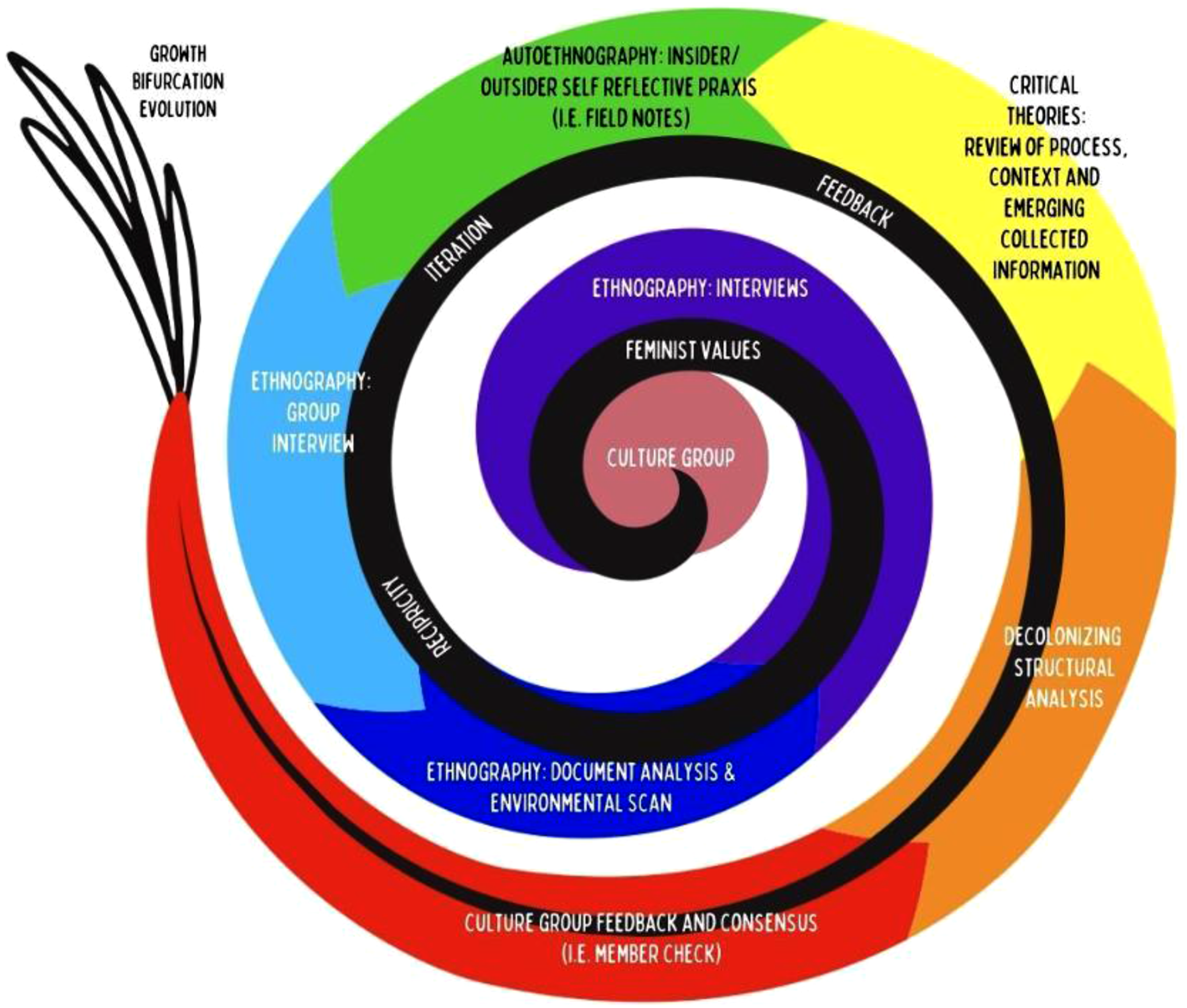

I was inspired by the nautilus, a three-dimensional shape that represents, to me, poly-dimension and critical aspects of adaptation. The nautilus, itself, is an incredible sea creature that represents that golden ratio or divine proportion that occurs throughout nature and is replicated in the human world (Barlett, 2019). This creature propels itself through the sea by managing the pressure of water and air through its chambered shell structure, creating ongoing feedback and movement through space and time (described philosophically by Barad, 2014). The nautilus is a growing, living creature that is responsive to the evolution of its environment and is in constant relationship with its changing seascape. It feeds back into itself and iterates to propel itself forward through time; its golden ratio represents the exponential possibilities of equity (Barlett, 2019). To survive and thrive, much like the experience of survivors of sexual violence and the feminist careworkers who support their healing, the nautilus must be in constant equilibrium and consent with its embodied self. To me, this visual model was deeply feminist, intersectional, multi-dimensional, embodied, and inclusive. Through this visual model, I could envision, for instance, the ways that the four waves of feminism are dynamic and in constant feedback and iteration. An anonymous peer reviewer of this article queried if “the ‘borders’ of these ‘chambers’ [are] porous in ways that evoke relational understandings of the methodological practices utilized?” (personal communications, August 2025). My response is absolutely … that is the beauty and complexity of intersectional theory embodied in this methodology. Through the relationship between and through chambers of participant process and theoretical context, I could better conceptualise, for instance, the ways that Black feminism (hooks, 2015; Lorde, 2007; Benn-John, 2021) and transfeminism (Bettray, 2021) have bifurcated from white liberal feminism and trans-exclusive radical feminism. During my own journey into intersectional feminist solidarity, I have come to understand an expanded transnational feminist theory (Enns et al., 2021) that can be integrated with this methodology to better honour a culture groups’ geography, and beliefs and values, beyond colonial, North American and EuroWestern whiteness. The participants, through the research process, could also articulate their own epistemic and embodied growth through feminism; like added chambers of knowledge and self-reflective praxis returning to their core values at the centre. Interestingly, the model also assisted me in the analysis of participant growth based on intersectional experience, for example, a cis-male feminist therapist articulated different feminist learning patterns than the Black and disabled feminist therapists or a young two spirit feminist counsellor. This nautilus metaphor became what Silverstein (1999) describes as a meta-narrative “with difference” for how we “enact,” “inscribe,” (p. 82) and re-imagine feminist phenomena.
Epistemically, it is well understood that visual and manipulative tools assist in thinking, learning accessibility, and co-creation. I developed this methodology and its visual cues in the hope that it would guide me and the study participants to engage in an embodied and reciprocal experience towards cultural consensus. With visual and manipulative tools, the participants were invited into the methodological process for researcher transparency and accountability. Feminism, and its research, is responsive to ongoing feedback and change; I believe that is its greatest possibility.
Critical Feminist Polyethnography in Reflection and Iteration
It was challenging to embody intersectional, feminist ideals while working in feminist non-profit charitable models (partially funded through governmental mandates) in an era of credentialing care work; I truly resonated with Silverstein’s (1999) description of embodied fragmentation. Gloria Anzaldúa also reminds me that “[i]t’s not enough deciding to be open” (Anzaludúa, 1987, p. 164), as a white woman, to transform myself and my understanding of the world. Leaving community-based work to reengage with academia, I committed myself to a deeper opening that was anti-racist, decolonizing, and intersectional. I witnessed these intersections as the most liminal and oppressed in the field (Benn-John, 2021; Bonisteel & Green, 2005).
During my graduate studies, I looked to feminist ethnography for an orientation of “body, space and social structure” (Silverstein, 1999, p. 71) to research a culture group of feminist counsellors and therapists registered to a professional college and practicing in Ontario, Canada; a group with whom I have worked and hold in high regard. Having worked as a researcher, public educator, peer counsellor and leader in this counselling space for survivors of sexual violence, I witnessed the ongoing oppression of race, Indigeneity, disability, 2SLGBTQIA + identity, and class through legislation, government funding, and by personnel. In my most recent research study, “Widening the Lens: Feminist Learning in Counselling and Psychotherapy” (Trefzger Clarke, 2025), I designed the methodology of critical feminist polyethnography to challenge this oppression while exploring the formal, informal, and non-formal ways feminist-identified counsellors and therapists, who work with survivors of sexual and gender-based violence, engage with feminist identity and feminist pedagogy in Ontario, Canada. My research question came from a personal experience of managing a white clinical supervisor who was racially bias while training a Black-identified social worker she was mentoring.
As a survivor of sexual violence myself, I have always experienced what Anzaldúa describes as la facultad (1987, p. 38), an ability to see beyond surface socio-culture realities to deeper structures and meanings. Importantly, though, as a white woman with socio-economic and educational privilege, intersecting with queerness and disability, I must be vigilant to my positionality for authenticity and accountability in my research analysis and narration. In order to reflect on both the learning experiences of feminist practitioners (the study participants) and share my own stories from the field, I developed this adapted methodology of feminist ethnography inspired by intersectionality (Crenshaw, 1991; Hill Collins & Bilge, 2020) and feminist theory (Ahmed, 2017; hooks, 2015) to better navigate critical and liminal spaces in feminist work, including race, class, ability, gender and sexuality, and colonization, that I had witnessed... Through the modification to feminist ethnography, and its contentious foundations in anthropology, (Creswell & Creswell, 2018; McClaurin, 2001; Merriam, 2009), I sought to contribute a decolonizing analysis (Silverstein, 1999; Tuhiwai Smith, 2012) of this qualitative research tool. More importantly, as Silverstein inspires, I endeavoured to reorient the experience of feminist therapy in its differences and wholeness, in its dimensions and iterations (Barad, 2014).
An ethnographic study describes “human society and culture” (Merriam, 2009, p. 27). Zenzele Isoke elaborates and clarifies: “It is loaded with the heavy cargo of slave ships, military invasion, and cultural annihilation” (Isoke, 2018, p. 3). As I explored the opportunities of feminist ethnography, as more intersectional in theory and process, my intention was to be rigorous about the ethical and equitable structures it could address. Anishinaabekwe scholar Leanne Betasamosake Simpson (2014) describes the need to explore both the “process” and “context” (p.7) for the study participants as well as for my own learning. I had witnessed racism, ableism, classism, homophobia, transphobia, xenophobia and colonial bias in the field; it was imperative to use a research methodology that would keep me, as the researcher, transparent and accountable to stories of inequity. To be self-reflexive and intersectional in this methodology, I introduced the term critical feminist polyethnography (Trefzger Clarke, 2022a, 2022b) (See Figure 1) to clearly acknowledge feminist theory (Ahmed, 2017), intersectional theory (Hill Collins & Bilge, 2020), critical race theory (Hill Collins & Bilge, 2020), queer theory (Bettray, 2021), and autoethnography (Edwards, 2018; McLaurin, 2001; Merriam, 2009) for my insider/outsider perspective. I also recognize that this methodology could include other important anti-oppressive theories and evolve for other researchers engaged with deep reflexivity. Through this process, my experiences of fragmentation began to heal through the shared stories of feminist struggle and resilience.
In the peer review of this paper, I welcomed beautiful critical feedback that, I believe, is part of the process of this methodology’s intention of poly. Poly is queer, poly includes autoethnography, poly includes different critical theories I believe are relevant to the self-reflexive goals of this study, and poly includes peer feedback for iteration. The reviewers asked me to describe how critical feminist polyethnography embraced multiplicity of ideas, experiences, and stories as imperative to the research narrative versus the colonial tradition of anthropology and ethnography as racist observation (McClaurin, 2001). In pointing me to the work of Savannah Shange (2022), for instance, I resonate as an insider/outsider researcher with “listening deeply, bearing witness, and challenging the inevitability of the state” (p. 188) as a disruptive tool of anthropology. Equally, I understand that critical feminist polyethnography, as a tool of the Master’s House (Lorde, 2007), will not be as transformative as abolishing the systems that have credentialized feminist carework, for instance. Earlier in this study, during my dissertation defence, there were over 30 attendees, many of whom were feminist counsellors or therapists; this too was part of the poly methodology to offer ongoing feedback for the study results beyond a dissertation and examining committee. Knowledge dissemination, as part of ethnography, can continue to be reciprocal, especially when I share study results in the professional sector itself. Do the voices of study participants represent all voices and all experiences? Of course it cannot and should not. From my position, I see this as queering the research (Bettray, 2021); I seek to be intersectionally feminist and deeply open to the bifurcation of ideas and experiences beyond my own. Additionally, there must be space for critical feedback, especially critical race theory and standpoint theory (Hill Collins & Bilge, 2020; McClaurin, 2001), as a process of decolonizing research (Tuhiwai Smith, 2012) to be living, breathing, and a place for multiple human realities.
When I began my doctoral studies, my queer Chicana doctoral advisor, Dr. Karleen Pendleton Jimènez, required that I read “This Bridge Called My Back,” edited by Cherrie Moraga and Gloria Anzaldúa (1981) in order to set the tone of my self-reflective praxis. The reviewers have brought me back to these foundational voices who have led the critical, anti-racist feminist movement in anthropology and ethnography, such as Davis and Craven (2023), McClaurin (2001), and Shange (2022). In Dionne Brand’s novel “Theory” (2018), she describes an interaction with a “deplorable man” (p.213) who critiques her for “describing a world that they don’t recognize.” What a powerful reflection of our global political stage today. In my own positionality, I understand what it means to feel unseen by them – as queer, disabled, and with the tension of both German and German-Jewish ancestors on both sides of the Holocaust – yet, as an emerging scholar, self-reflexivity reminds me of the racist and oppressive privilege I hold as a white settler in Canada. Bell hooks names them the white-supremacist capitalist patriarchy (2015); and although I feel unseen by them in many ways, I am also a part of them in many ways. Through the design of critical feminist polyethnography, and its visual representations (see Figures 1 and 2), I am better able to trace my position, reflexivity, and those of the cultural group I am researching, to ensure that we are moving together, with consent, towards ideation and innovation of complex gender-based issues.
Reviewers asked me to return to Black and racialized feminist ethnographer and anthropologic voices of Irma McClaurin (2001); Zenzele Isoke (2018); Ashanté Reese (2018), Savannah Shange (2022), Aimee Cox (2015), Gwendolyn Mikell (1997), and Christen Smith (2022), whose works have informed racial and cultural activism (Craven & Davis, 2013) and changemaking in North America and the Global South. My gratitude comes with, once again, a deeper opening that includes the call from Anne-Maria Makhulu and Christen Smith (2022) to #CiteBlackWomen and resist citation oppression. Yes. And this reflection has helped me to better frame my intentions in the development of critical feminist polyethnography: was it for activism or was it for stories of truth? Again, yes.
The leadership dilemma, as an executive director at a sexual assault centre, that led me to leave my career, enter into doctoral studies, and develop this methodology was a quote from the racialized training social worker: “My clinical supervisor is not asking me the right questions to reflect on my client work. Does she not even have any Black friends?” Using critical feminist polyethnography, I endeavoured, as a white woman, to return again and again, like the breath of the nautilus, to the centre, a reminder of the consent, process and context of this study (Simpson, 2014). Although I see myself as a radical and intersectional feminist activist and scholar, the purpose of critical feminist polyethnography is about the resonant truths of the culture group I studied, including myself. The participants were an engaged group of practitioners, seeking to highlight the sector, celebrate the work of feminist counselling and therapy, and address inequity within the field. Their activism leads this methodology through their stories of learning and recommendations for the field of feminist carework. Without their ongoing participation, consent, and commitment, critical feminist polyethnography would remain a colonial tool of the Master’s House.
Summary
Critical feminist polyethnography, as a methodological expansion, assisted me as a researcher, and my study participants, to engage in deep, reflective and more equitable storying of feminist learning in counselling and therapy. The intent of this methodology was to challenge my own bias as an insider/outsider while in relation to the study participants; I sought to deconstruct the research hierarchy towards a living, breathing relationship with the stories and learning processes of a culture group. This methodology journeyed through “borderline zones” (Anzaldúa, 1987; Silverstein, 1999) of professionality steeped in white-supremacist capitalist patriarchy (hooks, 2015) that challenges social work and psychotherapy accreditation; these were represented by considering theoretical perspectives in different chambers of the visual model while acknowledging the connection (breathing) between all steps of the study (and beyond). Walking with participants, we developed recommendations that honour herstory of feminist care, including the foundations of trauma- and violence-informed care, and resurge knowledge sharing and mentorship in feminist praxis. These were iterative, including the participants’ feedback on their interview transcripts, during the focus group, review of their transcriptions in context, and the final dissertation pre-defence. These moments of connection and collaboration disrupt and reorient traditional ethnographic standards. The opportunity in critical feminist polyethnography is, as a peer reviewer described, “researching/working with feminist and trauma-informed methodologies without collapsing or homogenizing experiences and working with ‘data’ beyond binary classifications” (personal communications, August 2025).
The complex phenomenon of credentialing and legislation of feminist therapy has occurred in many hegemonic EuroWestern institutions and governments (Brown, L., 2006; 2018; Enns et al., 2021), but the real-time experience of that professionalization in Ontario has not been well described. As a survivor, I must ongoingly punk hope to address my own trauma exposure and moral injury caused by the hegemonic and medical gaslighting of feminist carework; it has been feminist counsellors and therapists who have been central to my own healing journey. Using critical feminist polyethnography, I was able to augment the voices of those brilliant practitioners who shared their experiences, individually and as a culture group, about coming-into-feminism and applying it to their professional and activist work. The methodology allowed me, as the researcher, to also share a self-reflective journey through critical and decolonizing theories that challenged 50 years of feminist rape crisis and shelter work in Canada (Benn-John, 2021; Bonisteel & Green, 2005; Ready, 2016; Rebick, 2005), and millennia of women’s carework globally (Trefzger Clarke, 2025). The process brought me full circle to my early inspirations in the writings of Ellsworth (1989) and Guishard (2009). I used the metaphor of a breathing nautilus to describe feminist learning, feminist self-reflective praxis, and the value of feminist mentorship. At its heart, critical feminist polyethnography is a living process of consent, relational and with self, at every chamber of this methodological practice and beyond. It is my hope that it continues to grow and iterate, with critique, through the care and activism of transnational and intersectional feminist scholars. It is therefore appropriate to place its potential with a reviewer’s final words so that critical feminist polyethnography continues to journey beyond my study into the hands other feminist careworkers: This could also illuminate how feminist resistance is not just personal or narrative, but also spatial, temporal, and epistemic emerging from contexts of ongoing colonial and patriarchal violence and responding through adaptive and regenerative modes of knowledge-making (personal communications, August 2025).
Supplemental Material
Supplemental Material - Out to See: A Journey to Critical Feminist Polyethnography
Supplemental Material for Out to See: A Journey to Critical Feminist Polyethnography by Lisa Trefzger Clarke in International Journal of Qualitative Methods
Footnotes
Author’s note
It is my intention for critical feminist polyethnography to benefit feminist scholars as they journey through intersectional and transnational feminist learning; it will grow, it will reorient, it will bifurcate beyond my study. Although the peer reviewers of this article must remain anonymous, according to scholarly convention, they have deeply influenced and supported my ongoing journey with this methodology. I am so grateful for their care, and I hope I have honoured their voices well through citation and acknowledgement. May we continue to resist well and lift up each other’s voices #CITEBLACKWOMEN.

Funding
The authors received no financial support for the research, authorship, and/or publication of this article.
Declaration of Conflicting Interests
The authors declared no potential conflicts of interest with respect to the research, authorship, and/or publication of this article.
Supplemental Material
Supplemental material for this article is available online.
References
Supplementary Material
Please find the following supplemental material available below.
For Open Access articles published under a Creative Commons License, all supplemental material carries the same license as the article it is associated with.
For non-Open Access articles published, all supplemental material carries a non-exclusive license, and permission requests for re-use of supplemental material or any part of supplemental material shall be sent directly to the copyright owner as specified in the copyright notice associated with the article.
