




Abstract
The Other Is Always Angry is an interdisciplinary autoethnography situated within Flemish Belgium, charting the embodied realities of migrant precarity through personal narrative, reflexive ethnography, and artistic research. This pivot paper revolves around a lived encounter with institutional exclusion during an academic jury process—an experience that crystallizes the pervasive, often invisible, dynamics of Othering faced by non-European migrants navigating western academia. Drawing from a hybrid methodology that merges reflexive ethnography and a practice the author terms “artistic immersion,” the narrative excavates how everyday rhetoric and institutional actions produce affective and structural marginalization. Anchoring emotion—particularly anger—as a generative epistemological resource, the author reclaims this emotional truth not as an obstruction to scholarly inquiry but as a catalyst for critical reflection, artistic production, and sensitivity. Through the strategic use of archived email correspondences, theoretical analysis, and personal reflection, the paper interrogates the dichotomy between the “local” and “non-local”, highlighting how systemic imbalances of power manifest in mundane organizational decisions. The work resonates with and extends the scholarship of Lorde, Baldwin, and Ahmed by insisting on the legitimacy of migrant anger as both a symptom and a site of resistance. Ultimately, this article calls for an expansive view of scholarly knowledge-making—one that embraces situatedness, emotional truth, and radical accountability. It posits that institutions championing inclusion must grapple not only with policies and representation but also with the emotional economies that shape who feels welcome, and who must always explain their presence.
“Why are You Always Angry?”: Anger Comes a Long Way
I remember being dumbstruck after hearing this question. I was at a performance workshop back in Helsinki around 2016, when I was still doing my first MA in Live Art and Performance Studies. From memory, I was showing a performance idea to the class. The performance idea was to make a graveyard in a space, using the bodies of willing spectators. After realizing that my spontaneous idea was too heavy, a classmate 1 asked: “Why are you always angry?”. I did not know how to respond. By then I was in a different head- and life-space 2 .
Throughout my stay in Europe, the question seemed to fluctuate from being strongly present to being peripheral. Sometimes I experience it strongly, while most of the time I would entirely forget the necessity of the inquiry. Regardless, it clung to my being. The question became a constant anchor of reflection every time I found myself in a disposition of (or close to) being angry.
I must admit that I used to see myself as an angry person. I grew up in a meager family and saw my father always frustrated over everything. As I grew older, I understood that his anger was about the inability to make ends meet (in an economic sense) for his family–for his children. I accepted his authoritative tendency as a father-figure departed from both “warmth and control” (Lansford et al., 2025, p. 218). Regardless, I promised myself to become a better person compared to my childhood memory of an angry father-figure. It was difficult, though. Even at a young age, I got used to working and studying at the same time to maintain scholarships, both my consciousness and corpus forced to do well at school, social life, career, art-making/doing, and so on.
Later as an adult, the decision to study and move to Europe triggered several moments of internal anger. I had to work various part-time jobs to sustain myself (and my family back in the Philippines) all while following full-time studies 3 . Between 2015-2019, I lived in Helsinki, where I studied a two-year art master’s program (which I eventually finished in three years). My fourth and last year in the northern-European city was spent trying to find job opportunities, which proved to be extremely difficult for migrants whose Finnish language skills are poor. I saved up enough money working in fast-food restaurants and cleaning companies when I saw a one-year advanced master’s in social science in Belgium. I applied to the program and eventually got in. This was in the latter part of 2019.
The struggle of supporting myself while studying at the same time was further highlighted in Belgium because this time, I was a full-time paying student. There were numerous times that I felt like a “cash cow” (Robertson, 2011; as cited in Yan & Poole, 2024, p. 2896), or a smart street rat 4 hustling during collective rest days or unholy hours of the day to earn and keep on going. One of my proudest moments was finishing my advanced master’s degree in exactly one year (with outstanding academic results) given all the emotional, social, and economic hardships I went through (including the coronavirus global pandemic). I knew the implications of trying to stay further in Belgium. But I was determined–mainly because I discovered how resourceful I had become over the past years. I had a vision that I–as an existence–still had something to do, to achieve, to become (Albaos, 2020).
While applying for jobs, I applied simultaneously for doctoral programs in artistic research and interdisciplinary theories/methods. I wanted to delve deeper into my art-making/doing while utilizing the new tools I learned from social sciences. Proposing along the tropes of performance, lived experience, precarity, and migration, my doctoral plan and candidacy got accepted at the Associated Faculty of the Arts 5 by the LUCA School of Arts 6 and KU Leuven 7 . The other great news was that I did not get internal funding, nor the coveted FWO funding 8 provided by the Flemish Belgian administration. I was there yet again: foreseeing a rigorous PhD with a high possibility of not getting any funding at all.
Briefly recounting these personal life-experiences and revisiting the question “Why are you always angry?” establishes that anger is elicited by multi-dimensional sources–it derives itself from many directions/circuits governing the approaching behaviors toward a goal regulated by a reward system (Williams, 2017). Anger is an adaptive repertoire exhibited by humanity–especially of/by peoples who are in constant states of precarity, like migrants.
Methodological and Conceptual Tropes: Thinking/Doing Tools to Unpack Anger
Intersectionality and interdisciplinarity hold together my conceptual thinking. I always go back to Dwight Conquergood’s refusal of a linear manner of abstraction and an insistence on turning towards/returning to the crossroads—to which he calls “radical” research (Conquergood, 2002). Intersectionality, then, is not fearing the intersections but acknowledging them as a site of knowledge production. There is no such thing as absolute knowledge or way of knowing, but an abundance of “places of epistemological doubt” (Hamlyn, n. d. as cited in Mjaaland, 2013, p. 60).
In my practice, I tread along epistemological lines of anthropology and artistic research. I balance my work(s) both with theory and practice; I am comfortable at the crossroads. Contemporary approaches posit that theory is in the way of making rather than outside it (Schneider & Wright, 2020, emphasis mine), and in this paper I want this to come through: thinking, doing, and anything emergent in-between these two are equally urgent.
Anthropologists (and anthropology as a field of scientific research) follow the people, the thing, the metaphor, the plot/story/allegory, and conflict (Marcus, 1978, as cited in Ganti, 2014). Artistic researchers (and artistic research as a field of research) practice a burgeoning set of cultural techniques, which are operative processes of reproducing, handling down and passing on whatever remains of life: traces, patterns, artefacts (Elo, 2017).
Treading along the personal life snippets that I will recount in this article, I establish my usage of reflexive ethnography as one of my methodologies in engaging with and conducting research. Reflexive ethnography requires the researcher to turn back to oneself and self-reference (Davies, 2008), to integrate their positionality into the research process. This approach does not confine inquiry to personal narrative but situates the researcher within a broader lived experience, shaping the study’s epistemological and ethical dimensions (Albaos, 2020). Rather, it is accounting, acknowledging, and referencing the researcher’s position as part and parcel of a bigger (communal/shared–to various extents) lived experience. Reflexivity even recognizes positional multiplicity in and process of shifting from one position to another: the “turning back” to and from personal, communal, social (and even institutional) standpoints. Within the context of my performative academic writing, I simultaneously tread along being a researcher, an active participant in the academic structure I am writing about, a body being studied (the researched), as well as an artist. This exposition is no different—especially that I am in the vague first years of my PhD trajectory.
For this paper, I take a fragment of my lived experience to relate and write about the themes I engage with. I will use this fragment as a conceptual reference. I would call this specific fragment a “pivot”, not an end point–but a site of reflection paradigms, which are status quo (or even those which are perceived perpetual). The lived-experience text will find as deeply personal, but I prefer to emphasize that it does not end as “first-hand”. Rather, I propose to take the text as a momentary junction towards reaching out for openings and collaborative possibilities in the future. It was a huge decision to go entirely personal in this pivot of my research, realizing the need to assess (and keep on assessing) my corpus and the position I am privileged with as well as privileges which are kept away from me. I complement the life-experience with theorization and an objective manner of thinking–forging a way to scholarly unpack precarity.
Reflexive ethnography’s complications derive exactly from its tendency to encompass numbers of nuances–it deals with a lot of layered contexts and concepts almost instantaneously. This can lead to ambiguity, which can impede the possibility of social research (Davies, 2008). But I agree with the social anthropologist Davies (2008) that it is through reflexivity—or incorporating varying standpoints—where an ethnography can expose the intellectual tyranny of meta-narratives and the recognition of how authority forces bodies/consciousness to abide its voice. I present–along with the fragment of my lived experience in academia–a documentation of an event which underlined my research of migrants-in-precarity by experiencing the position first-hand. This documentation will come as email snippets intentionally censored to not reveal names nor identities apart from myself (unless the concerned/involved individual gave their permission to be revealed in the text). The aim of the article is not to humiliate, but to forge a focus on (dis)proving and unpacking paradigms which are conducive to migrant precarity.
Indigenous practices of exercising censorship are driven by the idea of community and communal relationality. My decision of censoring the names follows my vision that instead of pointing fingers at certain bodies, paradigms should be tackled on a more specific yet wider spectrum–which, with my paper, is rhetoric and the systems that enforce and benefit from it. This manner of exercising relationality is complex accountability (Wildcat & Voth, 2023). Relationality becomes a mode of critical thinking set to understand nuanced communal dynamics—its efforts are meant not to dishonor but to pin down relations of power and hopefully dismantle the despotic facets.
To complement reflexive ethnography’s complexity, I deployed a method I called “artistic immersion” (Albaos, 2018, p. 19). Artistic immersion’s goal is to foster artistic innovation through fieldwork and performance with principles of inclusivity and collectivity (Albaos, 2018). Artistic immersion was brought about through my processes of interaction/collaboration with migrant communities. From such interactions, varied artistic projects came about, influenced by the multitude of bodies/ideas/parties/concepts/stories/visions involved in each respective project. Apart from being immersed (or involved) in a specific environment, the researcher also ingrains artistic possibilities as part of the epistemological pursuit. Artistic possibilities refer to art projects that further heighten the theoretical work involved in the research.
Artistic immersion is an emphatic engagement that, first, acknowledges positionalities (whether in communal or individual settings) while putting art-making central to its agenda. It is a way of doing that asks: what kind of art-form comes out from specific collaboration/encounter/exchange? How will that art-form speak for itself along with the voices that created it? In artistic immersion, I emphasize that “art-form” is nuanced and is not limited to conventional art forms (painting, dance, etc.). Rather, the art-form within artistic immersion hybrids, twists, and constantly vicissitudes–thanks to its point of departure that is the nuance.
In this article and in the light of artistic immersion, the “output” presented is a documentation of the relationship between me and the representatives of the academic institution. The communication archive not only provides orientation but also offers an opportunity to address precarity artistically through rhetoric and affective evocation. By immersing in and including personal anecdotes in the conceptual process and writing, I posit an honest attempt of creating an intimate relationship (and hopefully a certain understanding) with migrant precarity and its nuanced discourse.
Intersecting reflexive ethnography and artistic immersion in this paper echoes with Harshad Keval’s questioning in his (western) academia decolonisation work: What power structures am I involved in, more often than not roped into, where decolonising is actively ignored, can I help to dismantle (Discoversociety, 2019)? The upcoming parts of my article follow a straightforward structure: Section III offers the autobiographical encounter with an academic figure (this comprises narrative and archived email exchanges) within the academia. The narrative will become a crucial reference for later theorization and making-sense-of-things in the article. I ask the reader to gaze at the characters in my life-experience as case studies: figures who carry undertones of systemic predispositions that reflect contemporary migrant precarity discourse. Section IV delves into the internal conflict after being confronted with the position of being a migrant in precarity. Section V is an attempt to take a few steps back to theorize and contextualize feelings of anger within topical discourse of migrant integration precarity situated in Flemish Belgian academia.
“You are not Invited, but Mostly Welcome”: Anger (Yet Again) Comes to the Surface
I was at a conference/workshop in Lisbon last May 2022 when I received a call from the LUCA School of Arts. The situation was about (by-then) the indefinite sick leave of my promoter, Dr. Esther Venrooij 9 . By that time, the Master students under her guidance were a couple of weeks away from their MA juries 10 and defences 11 , relatively. Esther’s absence meant two things: (1.) that some Master students had inadequate support–given that she is one of the very few people in the school who has an interdisciplinary background in material art, theory, performance art, and curation; and (2.) that LUCA School of Arts needed to find another Master Jury Leader 12 to replace Esther’s role, on top of her being a supervisor to MA students’ works. Since my interdisciplinary practices and theories in performance and Esther’s find similarity, LUCA thought I might be interested in helping “supervise” 13 the students—if the students ask and/or accept 14 my presence in their ongoing (respective) MA works. Immediately, I said yes because I wanted to help Esther and her students. There will be due remuneration, as per the call (and an email that ensued).
Once the students accept LUCA’s offer about me as an extra “supervision”, I should immediately meet and talk with them and as often as needed. During the call, I was told that I could also attend the Master Jury for Esther’s jury—which I did not confirm because of my work schedule 15 . When the phone call happened, they did not set the exact date yet for the Jury Day. I told LUCA that it was perfect; I will come back to them as soon as I get to fix my schedule. At the end of the call, they kindly asked me to write a couple of sentences about my background and practice—to which I provided.
Eventually, Esther’s advisees responded to LUCA’s communication. Out of all the MA students, only two saw the need to (at least) meet with me and to see if in the end they would need my presence for their respective MA works. We laid out plans (respectively) to meet, brainstorm, and prepare for their upcoming Master Jury. With due respect, each process with the students stands on its own; I will not elaborate on them indicatively.
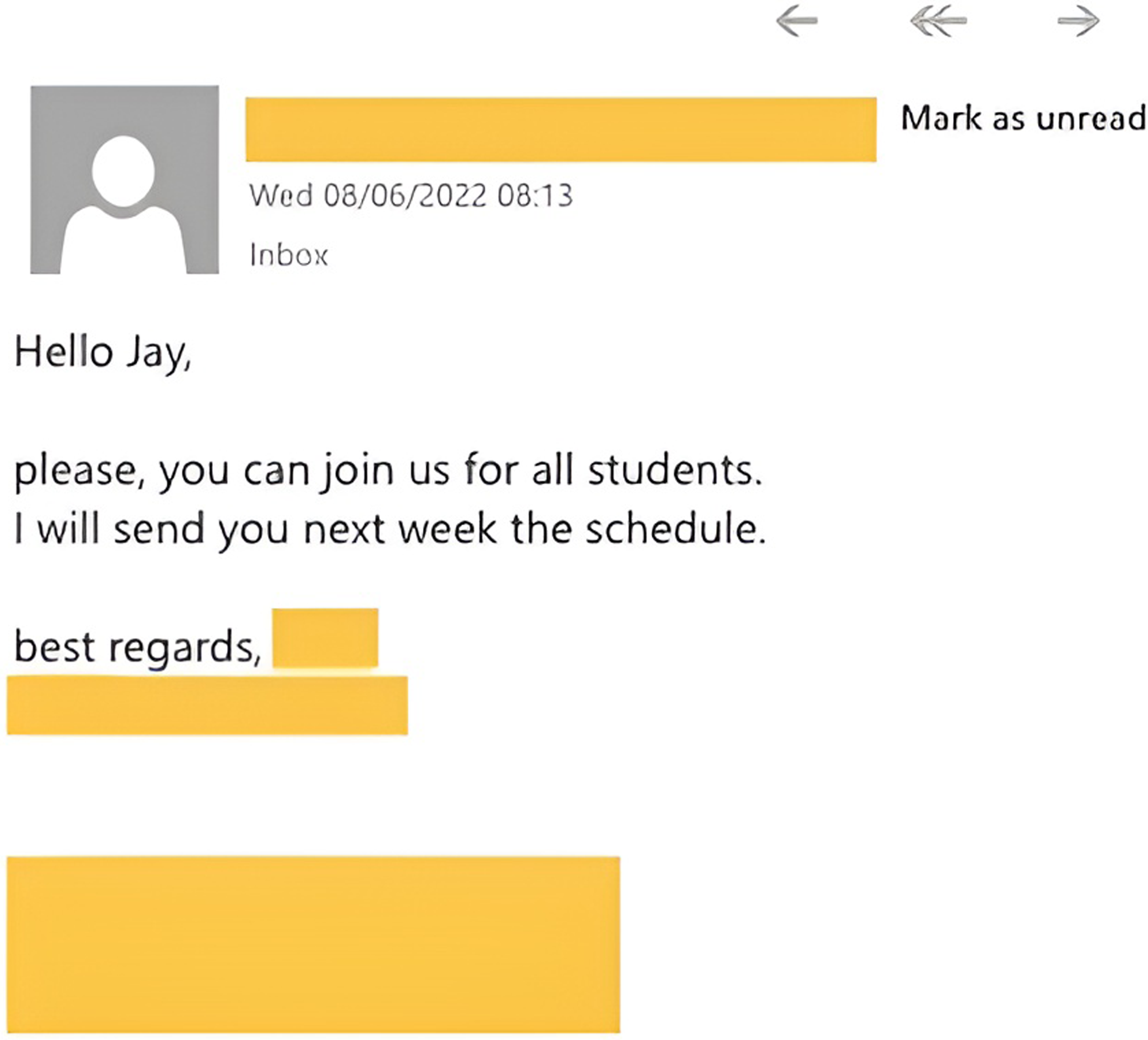
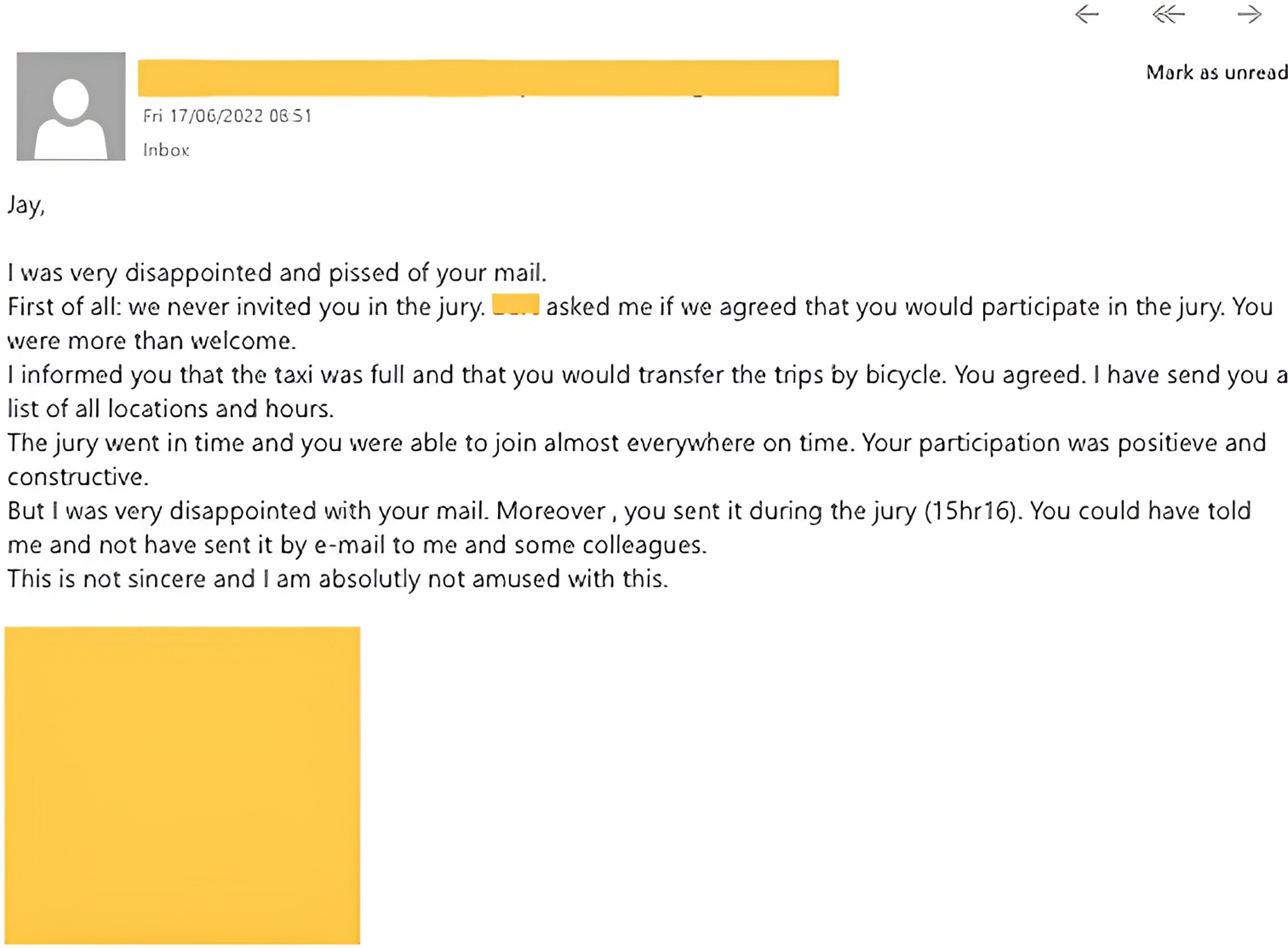
Finally, LUCA set the jury date after a series of emails between an administrator and the new Leader of Esther’s Master Jury. From this series of emails, I arrived at an archive of “screenshots” which serves two important purposes: 1. to offer a timeline of events; 2. to provide a textual and visual substantiation to my narrative (especially Screenshots 1-10). Email Exchange With the New Master Jury Leader Dated June 7, 2022. Censored by the Author Email Exchange With the New Master Jury Leader Dated June 7, 2022. Censored by the Author Email Exchange With the Master Jury Leader Dated June 8, 2022. Censored by the Author Email Exchange With the School Administrator Dated June 8, 2022. Censored by the Author Email Exchange With the New Master Jury Leader Dated June 8, 2022. Censored by the Author (a) First Part of the Email Exchange With the New Master Jury Leader Dated June 14, 2022. Censored by the Author and (b) Second Part of the Email Exchange With the New Master Jury Leader Dated June 14, 2022. Censored by the Author Email Sent to LUCA Colleagues Involved in the Master Jury Dated June 16, 2022. Censored by the Author Email Exchange With the New Master Jury Leader Dated June 17, 2022. Censored by the Author Email Exchange With the New Master Jury Leader Dated June 17, 2022. Censored by the Author

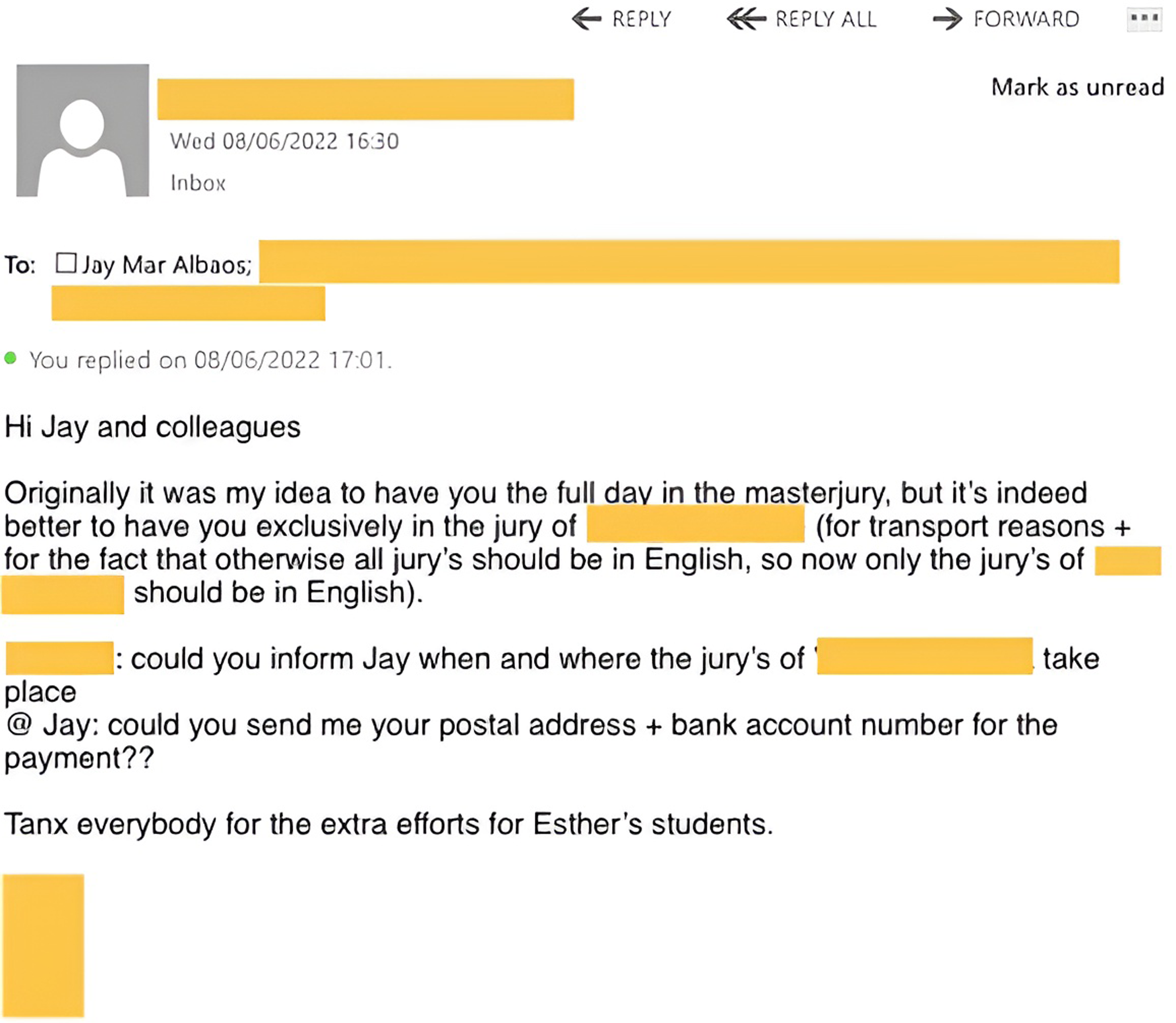



As stipulated in the email, there was an issue with the transportation: the taxi could only fit eight passengers, and the jury members were composed of nine people. By then, nobody knew the respective locations of the Master Exhibitions, though there was initial information that “the students of Esther are on the campus or very close to the campus”. To which I responded.
I confirmed my attendance at the Master Jury after arranging a day off 16 from work. In the email, I clarified if I should be present for the entire jury or if they only expected me to appear according to the students’ timeframes (those who I helped “supervise”). I confirmed that since I had a bike, I could move from one place to another during the Master Jury Day—given that they considered my travelling time in the plan. By then they had already identified me as the “person who must bike “–a detail which I did not pay that much attention to.
Eventually, I received a response from the New Master Jury Leader—a confirmation that I can join the jury for all students involved in the schedule.
The school administrator also responded—leaning towards the idea that I can just be present to the juries of the students I worked with. My response leaned towards being open-ended, but my email was also at the point where I accepted spending the entire day for the jury. I already fixed everything on my end, so there should be no further problems.
Regardless, the organizers completed the dates, and I am already “part” of the Master Jury. The subsequent emails provided information about the jury day’s program. On my end, I did not focus on the schedules because I assumed that there was an agreement between the jury organizers and me about the distances.
June within the Belgian HoReCa 17 is one of the hectic months. My job was a chef. I spent the weeks involved in this paper doing long shifts at a restaurant. I remember I would just arrive home to sleep and wake up the next day to work again—even on the night before the Master Jury. This meant that I could not check the (by-then recent) emails from anybody (see Screenshot 6 and the corresponding English translations).18, 19
On the Master Jury Day, I arrived 10 minutes ahead of the day’s program. Everyone was already there, all of whom were talking while drinking coffee/tea. My eyes wandered as I entered the LUCA common researchers’ room, seeking the New Master Jury Leader, whom I have not met in-person yet. A bit of awkward smiles greeted me. I felt awkward too since I did not know anybody in the group. The Master Jury Leader approached me and introduced themself. Smilingly, they asked how I was and then also asked if I printed a copy of the jury schedule. I told them “No” since I did not have any printer at home. They handed me a printed jury schedule and asked me if I could copy what was on the paper. “Please return it to me. It’s the only copy I have,” they said before heading to another member of the jury. I was still hand-copying the information from the paper while the New Master Jury Leader gave quick information to the jury group, especially about the first half of the students-in-jury. There was an emphasis on time before we started the day: the students-under-jury were all present, and the schedule was tight (as stated in the email they sent to the jury members on the 14th of June).
The first part of the day was relatively fine: the morning sun was pleasant. The locations were indeed within or close to LUCA; only Verffabriek was the farthest—3.5 kilometers from the school. It was a 12–13-min one-way bike which was decent. After the students’ presentations and some questions from the jury, the latter moved back to the school for lunch. When I arrived, food was already being served, and the jury members were discussing the morning group or scribbling through their notes. The supposed lunch time was one hour—to which was spent nicely. At that point, the group had already warmed up with each other and started asking questions about each other’s art practices/careers.
Ten minutes before the start of the day’s second half, I used the toilet. When I came back, none of the Jury colleagues were in the vicinity anymore. The taxi arrived earlier, apparently. So, I checked the schedule I hand-copied earlier: Roderoestraat. A kilometer away from LUCA. I arrived at the site earlier than the taxi. Back then, the idea of biking alone did not appear a bad idea. After another round of the student’s Master work presentation, the jury hurried to get into another taxi (which also arrived promptly, if not early). I checked my paper and Google Map: Lucas De Heerestraat. The location was 10 minutes away. I rushed to the site on my bike. Eventually, I got lost because I missed a turn—hence rendering me late for at least another 7 minutes. The afternoon sun intensified, that I was sweating when I arrived. By then, the student was already responding to questions from the jury members. I had to sit and listen for a while to get hold of what and where everyone was already at. As they were still exchanging questions and answers, I went to the student’s Master work on exhibit (which engulfed itself with the house’s structure). While I was still on the second floor taking the work in, I heard seats moving: a sign that bodies were about to leave. The jury were off to the next venue. I came down and bumped into one of the jury members while the rest were heading to the new taxi, which arrived outside. Upon seeing me, they said (non-verbatim): “We are moving to the next venue.” To which I replied (non-verbatim): “We’re done already? I just arrived.” They responded: “We are tight on time; we have to move to the next one.” While hearing them say this, I was already on my phone, checking Google Maps: Brusselsesteenweg. From where we were, it was 24 minutes by bike. I told this to another fellow jury and helplessness crossed their face. “I’ll tell everyone to wait for you a bit.” And then all of them rode in the taxi and went off.
I collected myself before biking off to the next venue. The sun’s heat was at its peak at that point of the day 20 . The traffic 21 was bizarrely hectic that time as well: pedestrians, bikers, and four-wheeled vehicles. My bike’s chain came off twice as I cycled as fast as I could past all the traffic. I could smell myself as I biked—like the corn my grandmother would grill after her visit to the local Sunday market. When I arrived at the venue in Brusselsesteenweg, I was sweating as I tried to catch my breath. The student was still doing their piece: live painting a model in the middle of an empty swimming pool. The jury and the student’s housemates/friends gathered and/or moved around the space. I saw people give me the side-eye but avoided making eye contact with me. I tried to keep my cool as I kept wiping the sweat off the bare parts of my body. Deep inside, I was fuming (I assume by then I did not hide my demeanor).
After the student’s performance piece, the New Master Jury Leader approached me. The following (non-verbatim) conversation ensued:
Master Jury Leader: Jay, are you okay? Jay: I am exhausted from all this travelling by bike. Master Jury Leader: (gets flustered) Oh oh. You can also stop now, you know. You do not have to join the rest of the jury. Jay: I cannot do that. One student in the last group is my advisee. Master Jury Leader: Oh (looks around, trying to think). Maybe you can exchange with somebody with the biking? Jay: Did anybody apart from myself bring their bike with them this whole time? Or travelled with a bike? Did you know my bike broke down twice already on my way to this venue alone? It is not possible to lend another person with my bike either. Master Jury Leader: Oh oh…
Then they moved on—it was time to have a conversation between the jury and the Master student. While listening to the conversation, I started scribbling down an email. I tried to ask questions in my head and assessed how horribly I felt about how I was treated logistically in the jury. I made sure that I re-read the email draft twice and only sent it to internal 22 jury members and administrators involved with my “issue”.
In less than 10 minutes afterwards, somebody from the jury softly called out that the taxi was already outside, awaiting for its passengers. The rest of the jury members started heading out of the venue. I thought they were still avoiding eye contact with me. As they got in the taxi, I could hear them still discussing the Master student’s work. I stood there next to my bike, wondering how many times the chains will fall off on my way to the next venue: Nieuwe Vaart. I checked Google Maps again. It said 24 minutes by bike from where I stood. I let go a violent sigh and cursed under my nose.
This juncture in my day’s recollection hopes to show certain thought points. To cut this retelling short, the jury accomplished its role in deliberating the works and deciding how many points to give to students (the deliberation occurred at LUCA, Alexiainenplein). There were just three moments worth mentioning from my fellow jury members. (1) One member asked me how I felt after biking all day, and I gave them an honest response. They said that if they knew they could have also biked with me. (2) One member said (jokingly) how amazed they were after realizing it was their first time riding seven taxis around Gent in just a day. (3) One jury member approached me after everyone left the school building. They said that they read my email and that they apologise if the entire logistical planning made me upset. They said what a difference it would’ve made if they’d only hired two taxis to accommodate everyone on the jury.
The next day, the New Master Jury Leader responded to my email.
To which I responded.
And to which they replied.
After receiving this response (Screenshot 10) from the New Master Jury Leader, I ended the exchange by not responding to the latter. Email Exchange With the New Master Jury Leader Dated June 18, 2022. Censored by the Author
I Am Angry. But Why? Internalizing Anger
I had to process the life-experience on my own before finally arriving at a point of conviction. In the earlier part of this article, I wrote I wanted to be a better person (irrespective of the nod to the parent-figure that my mind painted itself with). The reminiscing about the life-experience with the academic figure at the Master Jury convinced me: I am angry. Reading the Master Jury Leader’s texts (repeatedly, for this article) constantly made my blood boil, my muscles tense, my eyelids burn. Oh, the joy of being treated less–I could not help but ponder.
Yan et al. (2025), an Asian immigrant who kept trying to get professional and permanent opportunities within New Zealand academia for twelve years, provided perspective. Yan conveyed his position as a migrant in a constant state of revision to situate himself in a space (home country, host country, academia, and so on) that is conflicted. By doing so, he found himself in a rut where invisible wounds need to be inflicted first before getting an offer to be healed–on the condition that such a body survives. I relate to the concept and feelings of frustration that Yan’s autoethnography posited–a more-than-a-decade odyssey of trying to have an opportunity at the western silver tower, of going through multiple people who have exercised their authority to make him feel vulnerable and especially small (Yan et al., 2025). The migrant’s experience as they integrate in new (mostly western/foreign contexts) are cloaked with silence, enduring, and fear (borne out of confusion) not only caused by figures who deliberately intimidate migrants and relative communities but also the spaces and institutional structures which (consciously or not) support/enable/encourage such figures.
The combination of figurative and institutional intimidation creates insecurity born from a fear of being judged as somebody who is unqualified or insufficient. Xu navigated her position as a doctoral PhD student in Australia with fear that her cultural/linguistic literacy was not enough for figures in her institution who were heralding western ways of knowing and learning templates (MacKinnon & Manathunga, 2003; as cited in Xu, 2023). The existence of the prevailing western-centric perspectives (Pu and Pawan, 2013; as cited in Xu, 2023), academic socialization difficulties, biased attitudinal and operational practices dominating the host educational context towards international students in Xu’s autoethnography led her to name herself an “invisible English lecturer”.
Adegbola et al. (2018) conducted a study of African international students in the US locating their identities who are strongly tied to collectivist societies (Triandis, 1989; as cited in Adegbola et al., 2018) versus their American student counterparts who come from individuated sense of identity (McLachlan & Justice, 2009 as cited in Adegbola et al., 2018). Since the African students were enmeshed in a dissimilar system of race and race relations (Baofo-Arthur, 2014; Mitchell et al., 2017 as cited in Adegbola et al., 2018) on top of their nuanced daily socio-cultural negotiations, the participants echoed feelings of inhibition, fear, uncertainty, and exclusion.
Yan’s poetic narration, Xu’s autoethnography, and Adegbola et al.’s interviews posit relevant emotional truth – something which is geared towards reassuring that minority group’s feelings (e.g. anger) are valid and appropriate. Anger as an emotional truth is stressed by Lorde (2017) in her essay, The Uses of Anger: Responding to Racism. Lorde unapologetically stated that anger is an appropriate reaction to racist attitudes, as is fury when the actions arising from those attitudes do not change. Framed powerfully and beautifully within race-forward feminist contexts, Lorde’s writing reverberates through the experiences of anger within migrant communities (as to my life-experience shared in this article). I look in and stare at the eyes of my anger from this life-experience: I want to speak it, to let it through, to release it. If it is an experience of racism, then I do not want to accept it as an “immutable given in the fabric of [my] existence, like the evening time of the common cold” (Lorde, 2017, p. 112).
My positionality seemed clear: I was (and still am) an outsider 23 . The incidents during the Master Jury were a symptomatic manifestation of racism and inequality, revealing contemporary society and institutions’ racism/inequality positionalities altogether. In the next section, I will specify what made me angry about the Master Jury as well as analyze it and follow through its theoretical progression. I will use my anger as an inequality detector (Kleinman & Copp, 1993) as I flesh out the life-experience at the Master Jury with a few steps taken back, looking at the event through a relatively objective lens.
The Othering: Reasoning Anger out
Othering is the performative act of subjecting something/someone towards categorical otherness: “perceived differences in lifestyle, culture, skin colour, religion, sex or gender, sexual preference, wealth and even food” (Feidenreich, 2011 as cited in Jesse, 2021). Framed in my entire article as an action, Othering is further translated into an experience. Leistle’s (2015) phenomenological lens posits that: “experiencing means becoming part of a selective order; an order that includes a sphere of what belongs to us, of ownness, and excludes a sphere of otherness, of what is alien to us. The process of inclusion and exclusion are intertwined with each other, co-emergent; none is prior the other” (Leistle, 2015, p. 295). Note that Leistle (2015) underlines two spheres of relation: one that includes those which are relevant/familiar (owning) and one that excludes those which are irrelevant/unfamiliar (othering). The two spheres of action are central to the imperative that experience is embodied (in this case, the human body). Such embodiment of experience identifies humanity as a selective species. Eventually, this means that humans are innately, complexly, and simultaneously an owner and a non-owner.
The poet Rimbaud (Rimbaud, n. d., as cited in Horváth, 2016, p. 5), said: “I is another”. There is an unnerving presence and non-presence of proprietorship within the Self as it embarks on an impossible quest to fulfill itself. Contextualizing the owner/non-owner dichotomy in my research paradigm, I will call it local (owner) and non-local (non-owner). I underline the local/non-local dichotomy to unpack the consequentially nuanced relationship and performativity between the local and the non-local.
While I agree with Leistle (2015) that experiencing localness and non-localness reveals that none is prior to the other, there is more to the in-between-ness of these concepts. For example, the time in-between intervals that being the Other and doing the Othering take. While the local and non-local oppose each other, they can either happen simultaneously, one after the other, or totally one-sided. I see this visualisation fitting to describe a personal struggle—the reflection of the Self towards itself.
Unfortunately, this visualisation takes a drastic turn when put within the performative arena of the Self among other Selves—within a society that is nuanced in its individual (and eventually communal) experiences. The local and the non-local witness a transition from its philosophical underpinnings towards splintered literal, visual, bodily, linguistic (to name a few) 24 demarcations.
The email exchanges (especially Screenshots 7, 8, 9, and 10) between me and the New Master Jury Leader reveal a precipitous relationship between local/non-local positionalities. For the New Master Jury Lead to say: “We never invited you in the jury,” posits the existence of a world 25 where a handful of people are part of (apparently by invitation). Those who are not invited do not have any business being part of such a world. Those who show up uninvited are simply trespassing. I was initially speculated as a trespasser, yet oddly I also gained access because there was a decision from the local-party that I could 26 be there. In the end, I was a tolerated trespasser: allowed but not invited, not invited but welcomed. Regardless, I was a non-local altogether. Placed within Eszter Horváth’s theories of difference and multiplicity (or Othering), the non-local (which is interconnected to its local counterpart) “turn around and around the breach opened by it, trying to understand, to give a form to [the] 27 metaphysical event [of Othering] 28 , the split of identity” (Horváth, 2016, p. 187). The contrasting phrase “We never invited you […] but you are mostly welcome” becomes a poignant locus where we scrutinize the local/non-local relationship. The local, who illicitly flaunt their access and power within a specific context, asserts its authority, authenticity, and access towards/against its anti-thesis: the non-local.
Going back to the idea of Othering as a process of subjecting something/someone into categorical otherness, I underline that a lot of these processes subjecting to categorical otherness comes from the local’s place(s) of insecurity (ies) as well—a paradigm which behaves uneasily towards responsibly being part of/entangled with the non-local’s narrative(s). In my article, I insinuate a sharp connection and furthering of the theorization of precarity to that of migrant precarity–one that challenge not only paradigms of “labor regimes, political-economic structures but especially those of material conditions which constitute psychological subordination, subjectivity, and lived experience” (Hung et al., 2024, p. 4). I will tread/unpack anger through migrant precarity’s underscoring of “Othering”–specific lived insecurity and instability on social, economic, political, cultural, and existential facets endured by migrants.
The Other Is Always Angry
“Emotions, the product of the mind, can be separated, at least at the level of theoretical discussion, from feelings, rooted in the responses of the body; cold and pain are feelings, love and envy are emotions”. (Stanley & Wise, 1993, p. 196)
I depart from the thought plane of anger as an emotional response to stimuli. While I agree with Stanley and Wise’s (1993) theoretical positing that emotion is separate from feelings, I press on that there is a fragile line between the two. Anger as an emotion emerges from the mind as the latter scrutinizes the subjects that it sees, hears, experiences. Whereas feelings are physically experienced, feelings go hand in hand with emotions–nothing is a priori between the two. Crucially, the Other’s anger-stimuli need to be highlighted: what factors trigger the Other to respond emotionally and physically? In this exposition, the stimuli are characterised by situations and rhetoric undermining existences simply because certain individuals/groups are labelled, positioned, and related to as an “Other”, an outsider, a gatecrasher. Once a body crosses foreign borders, that body becomes identified by the local as its categorical antonym. Perhaps one of the many daily stimuli triggering anger from the vantage point of the non-local is the nuanced process of Othering. Regardless of its institutional and socio-cultural nuances and spectrum, Othering is a limitation. “People get angry when they are systematically oppressed, and they develop many ways of escaping repression (Monga, 1996, p. 8)”.
“Just as observation directs, shapes and partially defines emotion, so too emotion directs, shapes and even partially defines observation. Observation is not simply a passive process of absorbing impressions or recording stimuli; instead, it is an activity of selection and interpretation. What is selected and how it is interpreted are influenced by emotional attitudes (Jaggar, 1989, p. 160)”. Once triggered and bound to react to exclusion stimuli, the Other confirms a critique (among many others) towards its dispositions: the non-local is always in states 29 of irrational anger. Sen (2018) writes that anger is the useless emotion of people with grievances. Civilized people, superior people, capable people manage anger through reason, televised town hall meetings, logic gates, strategic planning, branding exercises, op-eds, and fireside chats with tea and sherry (Sen, 2018). Uncivilized people, inferior people, incapable people, the non-local, drown in uncontrollable anger that the only way to appease/control their rage is for the local to step in and manage them - to put non-locals in their places.
When the non-local speaks up about their Othered positions within the western frame, accusations of self-victimization, ungratefulness, and even violence are thrown towards the Other. The case of this auto-ethnography even prepends the notion of the “amusing”: that the Other is expected to embody/provide/bring amusement. In the words of the New Master Jury Leader: “[…] I am absolutely not amused.” Such a response implied that my plea for justice has no place to be heard and that the act of speaking up for my plea is not “amusing”. My position as a non-local should not complain, nor feel any discomfort altogether. Instead, I should be thankful for the opportunities that are given to me (or spaces/instances where my existence is tolerated) by/from the “welcoming” 30 local.
“Why are you always angry?” when asked of a non-local can evoke traumas caused by structural/institutional selection. In 1970, James Baldwin responded to a “surprise” street interview in Paris from “white” filmmakers and was asked: “What exactly do you think we think you are?”. To which Baldwin sharply articulated: “I think you think that I’m an exotic survivor. […] I am still, for Europe, a savage.” (as interviewed by Dixon, 1970)
The Other is seen as a savage, an exotic entity, a body of difference that’s meant to be treated with false and/or patronizing empathy.
The Migrant Is an Angry Other
Continuing with his “surprise” street interview in 1970, Baldwin’s disposition of himself 31 as an “exotic survivor” and at the same time a “savage” within the European context resonates strongly in the performative rhetoric of the jury event. We see a malicious unpacking of the Other’s dichotomy: the exotic survivor who deserves a certain space within the local’s perimeters and the savage who deserves control and taming. Survivors of what? Savages from where? A quick glance at migrant and non-European paradigms in Europe can reveal insight.
Contemporary EU paradigms of migrant accommodation and integration follow specific tropes 32 on migrant accommodation/integration and return/deportation. Drawing from this policy complexity, the correlation of why and how the local develops a conflicted position towards how it should relate to the survivor-savage non-local is imminent, almost ingrained within the contemporary European socio-politico-cultural fabric. The positional conflict is underlined by the rhetoric contention that “[…] ‘they’ would live ‘among us’ […]” 33 (Jesse, 2021, p. xx). The very act of migrants and citizens coming together to share spaces and privileges is a disruption of normality. Normality needs to be restored; immigration needs to be curbed. These sentiments are not new. In fact, the emigration, immigration, and integration of those settling into a new environment seldom occur without certain friction against the residing population. It is unsurprising that anger sweeps in on both local and non-local parties: the former defensive and vindictive over the other for taking up space/disrupting order, while the non-local offensive and frustrated for being treated less.
The migrant’s perspective as the non-local pays a painstaking cost of being interesting while that same migrant body is put into a void of in-betweenness, indefinable if acceptable. Similarly, when the New Master Jury Leader framed my presence as uninvited but mostly welcome, I was not trespassing anymore. I was begging - I insisted myself into the invitation-based world. Being invitation-based implies conditionality in schemes of acceptance and integration. On one hand, it is understandable to put certain parameters to implement cohesive and safe social constructs, but on another hand this ordering creates hierarchies and walls–most of which are negligent and/or oppressive towards the non-, the un-, the Other. Once labeled by the system as an Other (a non-local), the former pays the cost of constantly being scrutinized (politically, socially, culturally, socially, economically, etc.) for existing. While contemporary societies claim that we have moved forward past the paradigms of Othering (the local vs. the non-local and vice versa) my paper reveals rather a contemporary status quo: the local vs. non-local positional dichotomy remains in the clefts of non-negotiation.
Negotiating (?) Otherness
Othering happens every day, not only within topical dichotomies (i.e. Europe-migrant, and so on). We see it between nations, people, things–ubiquitously. One of the unsettling facts within othering is not just the implications that comes out because of it, but how deep the devaluation of certain individuals, communities, and even nations, while privileging those who are members of the dominant group, class, or country […]” (Jesse, 2021, p. xxii) is ingrained within our contemporary life.
My paper’s case shows such devaluation through performative documentation of rhetoric 34 . My earlier thesis work posited the notion of rhetoric, and a particular violence (through governmentality tactics) embedded within the academia (Albaos, 2020). Contextualized during the Coronavirus pandemic, my MA research saw the western university’s academic violence through its assertion of academic year deadlines given the global mental and social breakdowns especially among non-European students trapped in pandemic Belgium. My MA research’s assertions re-affirmed ingrained western institutional attitudes of dominance on knowledge, ways of knowing, and knowledge production. Academic violence is a collection of practices within the academia that places the bodies it victimizes into harm: trauma, physical infliction, verbal abuse, blackmailing, bullying, and so on.
While my recent master’s thesis focused on the academia as a power-composite, I contextualize academic power in this essay on the people running the academia as agents of power
35
. The New Master Jury Leader, as an agent of power, emphasized their privileged position by writing: “[…] Concerning my professionalism, I have been teaching for more than 30 years. But of course, you couldn’t have known that. […]
36
”
While intended to defend their decision as an authoritative figure, the New Master Jury Leader’s rhetoric discloses the act of signifying their equally contestable performative position and power as a local, an insider, of tenure, security, network, lingua franca, artistic dominance, and so on. Unfortunately, this figurative agent of power does not see the practical core of my concern: logistical mishap; a space in a car; easiness of access to spaces which were integral to the event and to my function as “an uninvited but welcomed” entity in the Master Jury.
What this specific agent of power saw was my ungratefulness, my disrespect to their authority, my ignorance of their career (and my witlessness), my shameless demand to be treated as an equal. This confrontation between the local and the non-local affirms the relational and performative disproportion between the two–obviously to the favor of the one who has leverage within relative social/economic/political/epistemological/artistic paradigms.
Academic violence resurfaces alongside the agent of power’s assertion of their dominance over my positional fragility. At the onset, academic violence seems too broad to grasp because of the factors that make it up and because of the manner that it manifests (i.e. psychological manipulation, harassment, etc.). But at the core, academic violence is bare discrimination–one that stems from power imbalances. To further such discrimination, consider situating discrimination within western and racialized contexts. Academic violence is synonymous with bullying (Miller et al., 2019): intentional, repetitive, negative actions directed at an individual which underlines a power imbalance between a perpetrator and a victim 37 (Mishna, 2012).
There is no room to negotiate intellect- and empathy-requiring theses like ‘otherness’ or ‘equality’ within institutions and/or with figurative agents of power that are sparse with bigotry.
Telling My Story Angry, Regardless
In the case of Yan’s (2024) text, he furthered his autoethnographic work with a fellow migrant academic, Adam Poole. Poole is of British roots who is based in Hong Kong. Departing from the concept of an “academic outsider” (Reyes, 2022; as cited in Yan & Poole, 2024), Yan elaborated on being a body in a liminal space of waiting to become admitted to New Zealand academia. This experience was fraught with futility and disappointment–one source of it was the exertion of finding an academic willing to guide and support him in his efforts to secure a doctoral candidacy. I strongly relate to Yan’s anger-inducing academic applications experience, as the doctoral process in Belgium also requires the applicant not only submit a high standard dossier to get into a doctoral program, but also find a “promoter” 38 who would support the PhD tenure until its completion. In this aspect, I am “fortunate” not to have spent such a long time finding a promoter. I can assume that my significant history of acquiring a European-standard education became a substantial badge for clinching a certain access to the European ivory tower.
Yan and Poole’s (2025) collaboration highlight the fact that even if the other is of Asian-descent and the other is of British-descent, they could connect their worlds and works through an important red thread: they are both non- in the host countries they are based in 39 . In a recent work, they mapped their “physiological and psychological reactions to certain life events in [their] environment [s], producing situated knowledge of beings across various places” (Yan & Poole, 2025, p. 1). A part of Yan’s and Poole’s collaboration speaks about my decision years ago to always keep within me a considerable amount of courage to recount my narratives as a migrant and collaborate out of them/share them–a task not short of being difficult.
I cannot help but often wonder if I am alone in feeling affected and angry about certain experiences as a migrant. For instance, describing the specific experience of my academic othering left me not only frustrated but also feeling isolated. Yet, I keep finding grounding in/through my community—gathering regularly with friends and colleagues who share migrant backgrounds, both from academia and from those trying to navigate life as non-Europeans in Belgium. I see this grounding and gathering with similarly situated individuals and communities as mapping. It is an attendance to memories attached to various places, where each story does not simply oscillate between hope and despair but allows both emotions to exist at once (Yan & Poole, 2025). This sense of shared experience is echoed in the work of Yan and Poole (2025), who also highlight the emotional toll of acceptance/integration processes. One recurring theme that emerges—both in reading Yan’s work, in his collaboration with Poole, and in my own exchanges with fellow migrants—is this: to be involved in the grueling western systems of integration and acceptance as a non-local is, at the onset, deeply frustrating.
Unpacking relevant aspects of the rhetoric exchange between the New Master Jury Leader and me reaffirms an earlier conviction in this article: I was (and still am) angry towards the entire situation on different layers: a. that I was sidelined and othered, positionally; b. that I was put in a place of obscurity; that I exist while I do not; c.) that this specific encounter evoked deep traumas in me as an academic/professional migrant: all these years of explaining/asserting myself and my historicity, as well as (almost) pointless efforts to assert my position and agency (whatever “position and agency” means in the diplomatic Belgian context); and d. that my presence was expected to be that of amusement.
I consider these documented emails the artwork complementing this pivot article. The artwork’s “exhibition” is the publication of these upsetting emails–a conscious opening-up to show a point while nurturing an opportunity of thinking together. By sharing these email screenshots along with my narrative, we see art operating as a “portal, an access point to another world—our world experienced differently” (O’Sullivan, 2001, p. 135). By contextualizing Sullivan’s affective experiencing of the world in this paper, I underline affect’s undeniable relativity to positions (for example, who the reader of this text is, what their state of realities are, where they are connected to, what their relationships to migration-precarity-art are, and so on).
Using documentation of rhetoric and the interdisciplinary lens of ethnography and performativity, I tried to unpack personal feelings of anger in this entire paper while exerting an effort towards an objective attitude in the process of fleshing the anger out. This detachment was signified by the efforts of intersectional theorization (Delaporte et al., 2022) (i.e. through anthropology and performance) as well as reflexivity (Holmes, 2020) through the researcher’s position in the narration and elaboration of contexts. I made sense of my anger–where it is coming from, how it came up, where it is directed, how can I transcend above it–by laying out the materials I gathered and feeling/thinking along with the specific Jury event and eventually unpacking/analyzing its underlying themes.
Acknowledging the persistence that “descriptions of reality are arbitrary” (Zerubavel, 1994; as cited in Trepagnier, 2001, p. 141), I tried to use my anger “not as an anathema in art-making/elaboration, but rather a crucial source of creative energy” (Marcus, 1978, p. 94). As I described my arbitrary reality in this documentation work, I also established that rhetoric–as much as part of the everyday–anchors to itself the performativity of emphasizing and reinforcing lines of otherness: the local and the non-local. Unlike emotion and feeling, which technically can go hand in hand in their delivery, the local/non-local stays in its dichotomic positions–mainly because of the systems and agents of power which validate/enforce it. These systems shape societal, cultural, and academic experience/attitudes/rhetoric/performance.
What my narrative disclosed was just a fragment of the effects of such systemic exclusion–especially within institutions that “uphold” diversity, inclusivity, sensitivity (and figures who are affiliated to such institutions)–all endearing rhetoric which when encountered in real life come as fragmented and superficial.
Is Justice Possible?
This pivot article is a testament of my ability to speak up, to talk back, to complain as a precarious migrant body. Ahmed (2021) provides a reasoning why one makes a complaint: there is an intense and difficult situation that one is in, and it is imperative that one must get out of that situation. Ahmed further notes that the effort to get out of a tense/difficult situation can even worsen the tension. To complain is to be in the thick of it, to be in the situation where it’s intense and crowded (Ahmed, 2021). I did not wait until the Jury was done. I sent my complain in the moment, when I was experiencing what was unfair. And the email exchanges which ensued after I sent my complaint reveals relational precipice: that the non-local should not just control their anger borne of systemic and socio-hierarchical inequality/othering/racism but not have a prerogative to become angry altogether.
The last email (Screenshot 11) that I sent to the internal LUCA Master Jury accentuates a decision to claim back what I know: figurative tangents where bodies-in-precarity direct their expressions of anger to (among many other valid expressions) becomes futile at a certain point. True to how the idiom goes, “we are barking at the wrong tree”. Where do we direct our anger, then? Email Sent to Relevant Administrators and Internal Jury Members Dated June 19, 2022. Censored by the Author
I propose that readers view anger as a tool for reflection and action—one that allows us to decenter and recenter ourselves. By “decentering,” I mean shifting focus away from dominant perspectives to include marginalized voices. By “recentering”, I mean claiming spaces/privileges that are meant to be equal and communal. Anger can also help us reintegrate our emancipated identities within the still-stunted frameworks of western epistemologies. Emancipated selves are individuals who have freed themselves from oppressive systems (Ratner, 2019; Steinberg & Kincheloe, 2010). I do not advocate anger as a justification for harm or violence toward anyone. Instead, I encourage readers—especially those with non-local backgrounds—to sit with their anger and thoughtfully deconstruct it. This process can reveal practical and artistic ways to express collective rights: to be acknowledged, respected, and regarded as equal. For instance, collective anger has historically fueled movements for civil rights and decolonization, transforming frustration into advocacy for justice and equality. These examples show how channeling anger can open paths for accountability, solidarity, and inclusive paradigm shifts.
I suggest that non-locals, whether migrants or academics, direct their anger toward the West understood as a structure which “replicates neoliberal, colonial, and patriarchal dynamics” (Talhouk & Syed, 2023, p. 197). We should also examine and call out the actions of those who perpetuate the idea that anything outside western norms is unacceptable or should merely be tolerated. More importantly, we collaborate with difference-oriented emancipated bodies–peers, family, friends, communities–in imagination, creation, research, care, and policy work.
Underlining Horváth’s (2016) assertion that theories of difference and multiplicity try to understand the breaches it caused, there was no insistence of closing such “breaches” simply because this is the status quo. Difference is the backbone of societies, and the Other is not a shameful consequence of the “split of identity” (Horváth, 2016). As much as the local can and will, the non-local also will demand its right to exist among the “normative”. Within this act of demanding, feeling/being angry towards the negligence/ignorance of migrants-in-precarity’s otherness and difference is not just a natural expression of human emotional truth, but also a necessary human tool for physical and existential survival. This pivot article is a manifestation of that felt, furthered, polished, and thought-through anger at systemic injustice—anger shaped by experiences of exclusion, othering, and the denial of equal recognition. It is an anger that seeks not to divide, but to invite collaboration and the rebuilding of relations through care and empathy, nurturing the possibility of true justice for both local and non-local communities alike.
‘Why are you always angry?’ rumbles faintly in the back of my head as I recall that interesting workshop moment in Helsinki.
I could have responded: I wish that, like you, I were not. But indeed, I am angry. And being who I am, I
Footnotes
Acknowledgements
I would like to express my heartfelt gratitude to the colleagues who devoted their time, energy, and honest feedback while reading this document. I am especially thankful to Laura Puska and my supervisory committee member, Dr. Jeroen Laureyns, for their thoughtful engagement and constructive insights throughout this process. My deepest appreciation goes to Dr. Esther Venrooij, my main promoter, and Dr. Patrick Devlieger, my co-promoter. Their invaluable guidance and steadfast support have been instrumental in shaping the direction and depth of my doctoral research. I am equally grateful to my colleagues at LUCA School of Arts’ Research Unit—Image, as well as those at KU Leuven, for fostering meaningful spaces, stimulating conversations, and providing opportunities that have enriched my doctoral artistic journey. I gratefully acknowledge the Roger Dillemans Fund for awarding my artistic project the Excellence Award for PhD Candidates in the Arts (2025–2026). This support is essential to advancing the practical facets of my research. My warm appreciation to my family and friends for their unwavering support. Their encouragement continues to motivate me to persevere with kindness and determination. Nanay Peding, this is especially for you.

Ethical Considerations
The author will include a signed Consent Form as a separate document.
Consent to Participate
The author included a signed Consent Form in a separate document.
Consent for Publication
The author included a signed Consent Form in a separate document.
Funding
The author disclosed receipt of the following financial support for the research, authorship, and/or publication of this article: This study is supported by the Roger Dillemans Fund (JZU-RDAWJA-P3610) for the publication of this article.
Declaration of Conflicting Interests
The author declared no potential conflicts of interest with respect to the research, authorship, and/or publication of this article.
Data Availability Statement
The data that support the findings of this study are available from the corresponding author, Jay Albaos, upon reasonable request. Since the article is still in the consideration process for publication, the data are not yet publicly available.