




Abstract
This article proposes an analytical framework for examining emotional practices in organizations, addressing the lack of reflexive, situated, and methodologically rigorous approaches capable of integrating the discursive, symbolic, and structural dimensions of emotions. Grounded in Pierre Bourdieu’s praxeology and combined with tools from Critical Discourse Analysis (CDA) and Critical Discursive Psychology (CDP), the framework offers a practice-based lens to investigate how emotions are socially embodied, historically structured, and reproduced within organizational fields. The proposed qualitative approach integrates semi-structured interviews and participant observation as data collection techniques, enabling relational, reflexive, and context-sensitive analyses. By applying Bourdieu’s relational concepts, such as habitus, field, capital, doxa, and illusion, the framework advances understanding of how emotions are experienced, operationalized, and linked to organizational practices, and how ways of feeling, naming, expressing, and regulating become legitimized, marginalized, reproduced, or transformed through symbolic struggles. Unlike studies focusing primarily on the psychological or physiological dimensions of emotions, this proposal adopts a relational and practice-based perspective, considering people, objects, activities, experiences, artifacts, symbolism, and the relationships emerging from these interactions. The framework can contribute to organizational and critical research by addressing issues related to institutionalized emotional dynamics stabilized by norms, routines, and discourses, as well as embodied meanings that reveal how emotions are shaped by bodily dispositions and symbolic repertoires. It also facilitates the analysis of affective hierarchies that regulate the legitimacy and value of emotions across positions and groups, as well as the strategic circulation and mobilization of emotions to influence relational and organizational outcomes. This integrative approach offers both theoretical advancement and an operational pathway for studying emotions as socially embodied practices, expanding the methodological repertoire for qualitative organizational research.
Keywords
Introduction
Emotions are an integral part of social life and, as such, should not be considered peripheral to organizational research. They shape actions and experiences while simultaneously being shaped by social structures (Zietsma et al., 2019). In organizational settings, emotions are constantly present, influencing how individuals engage with their environment (Elfenbein, 2023). Traditionally, however, they have been treated as isolated internal states, secondary to cognition and detached from social and symbolic contexts (Zietsma et al., 2019). Advancing the field requires moving beyond internalist perspectives and addressing emotions as embodied, situated, and socially regulated practices (Scheer, 2012; Wetherell, 2012). As Santos and Silveira (2015) observe, practice-based studies reveal what is actually said, felt, and enacted within organizations, going beyond abstract or functionalist accounts.
The practice-based studies (PBS) approach has become a powerful ontological alternative in the social sciences, emphasizing materiality, relationality, and the embodiment of everyday life (Nicolini, 2009; Schatzki, 1996). Within this framework, various perspectives have been developed to conceptualize affects as constituents of social practices or even as practical modes of action (Zietsma et al., 2019). In critical discursive psychology, Wetherell (2012, 2013) defines affective practices as relational configurations shaped by discourses, bodies, norms, and objects. In cultural history, Scheer (2012), drawing on Bourdieu, advances the notion of emotional practices as socially incorporated performances, regulated by power relations and structured by historically formed dispositions rooted in the habitus.
While firmly grounded in Bourdieu’s praxeology, we recognize that his theory has been revisited and expanded by various scholars in different contexts. Notably, the work of Michèle Lamont, with its emphasis on “symbolic boundaries” and moral judgment, enriches the analysis of affective hierarchies within organizations (Lamont, 2000, 2009). While Bourdieu (2007a) focuses on the reproduction of symbolic distinctions, Lamont (2000, 2009) details how agents negotiate value and dignity in specific contexts, crucial for understanding how certain emotions (such as pride or shame) are legitimized or stigmatized across different organizational positions. Our proposal aligns with this extension by considering that emotional practices not only reproduce structures but also serve as arenas for moral and symbolic negotiation. Thus, we implicitly incorporate this perspective when analyzing how organizational illusio and doxa are contested or reinforced through emotional expressions.
In organizational contexts, Reckwitz (2016) describes affects as culturally coded sensibilities embedded in collective arrangements, forming an emotional economy reproduced through embodied dispositions, or an affective habitus (Heaney, 2023; Matthäus, 2017; Reckwitz, 2012; Voronov & Vince, 2012). Schatzki (2006; 2018) defines organizations as constellations of practices and material arrangements structured by shared purposes and affections, known as teleoaffective structures.
Despite these valuable contributions, gaps remain in linking emotional dispositions to symbolic structures and organizational dynamics (Zietsma et al., 2019). Wetherell’s model integrates affect, discourse, and normativity, but primarily focuses on immediate interactions, limiting its applicability to broader historical and institutional structures (Bille & Simonsen, 2021; Martinussen & Wetherell, 2019). Scheer’s approach, while theoretically robust, lacks explicit methodological tools for primary research in organizational settings, and its applications remain largely confined to retrospective document analysis (Davison et al., 2018; Thelin, 2024), leaving its empirical potential underdeveloped.
Alternative approaches for investigating affects as embodied and relational modes in organizations, such as Gherardi’s (2018; 2022) sensory and performative ethnographies inspired by post-humanism, are also noteworthy. While important for the field, these approaches are not explored here, as they exceed the scope of this work. We adopt a different epistemological and ontological direction, primarily based on Bourdieu’s praxeology and its relational concepts, aiming to provide an analytical instrument capable of integrating the practical, symbolic, and structural dimensions of emotions.
This article proposes an analytical framework grounded in Pierre Bourdieu’s praxeology, combined with analytical tools from Critical Discourse Analysis (Fairclough, 2001) and Critical Discursive Psychology (Wetherell, 2012), as detailed throughout the text. This triangulation enables the analysis of emotions as practices shaped by symbolic regularities and structured through embodied dispositions within the habitus, unequally distributed across organizational fields and convertible into capital. The framework allows for the investigation of how emotional modes of feeling, naming, expressing, and regulating become legitimized, marginalized, and reproduced through symbolic struggles. By integrating structure, agency, and practice, we respond to the demands for reflexive, situated, and methodologically rigorous analyses highlighted by Wetherell (2012), Threadgold (2020), Zietsma et al. (2019), and Elfenbein (2023). It is intended for organizational scholars, particularly those engaged in qualitative and critical research, interested in how emotions are socially incorporated, mobilized, and reproduced in situated organizational practices.
This analytical framework is of particular interest to organizational researchers, specifically those engaged in qualitative and critical inquiries into how emotions are incorporated, regulated, and mobilized within organizational contexts. By integrating Bourdieu’s praxeology with tools from Critical Discourse Analysis and Critical Discursive Psychology, the framework offers a robust, relational, and practice-based approach to examining emotions not as internal psychological states, but as socially embodied practices shaped by historical, symbolic, and structural dynamics. It is especially valuable for scholars seeking to conduct reflexive, context-sensitive, and methodologically rigorous studies on institutionalized emotional dynamics, affective hierarchies, and the strategic use of emotions in organizational power relations.
The contributions are threefold: (1) theoretical, by systematically articulating praxeology and affectivity; (2) methodological, by proposing an operational pathway for analyzing emotional practices in the field; and (3) epistemological, by reinforcing reflexivity as an essential investigative practice. The article thus aims not only to describe a model, but to provide a concrete and critical instrument for qualitative inquiry in complex organizational settings.
Practice in Bourdieu: Overcoming Dichotomies and Grounding a Relational Approach
Given the diversity of practice-based studies (PBS), which encompass multiple theories and methodologies, a substantial commonality emerges: the effort to overcome classical dichotomies in social theory and philosophy - such as structure and agency, micro and macro, conscious and unconscious - represented by two major traditions: subjectivism and objectivism (Gherardi, 2009). Early theorists of practice, such as Bourdieu (2002) and Giddens (1984), sought to escape structural realism, which treats objective relations as realities constituted outside individuals’ histories, without falling into subjectivism, which fails to address the social world’s demands by privileging truths rooted in primary experience (Lammi, 2018). Since then, various scholars have influenced practice theories, adopting diverse ontological, epistemological, and methodological positions across fields, including organizational studies (Pimentel & Nogueira, 2018; Santos & Silveira, 2015).
Our analytical framework is firmly situated within Pierre Bourdieu’s relational sociology, adopting a practical ontology that understands the social as historically constituted, relational, and embodied. Our epistemology is structuralist constructivism (Bourdieu, 2004), oriented by the need to scientifically reconstruct the objective structures and subjective dispositions that generate social practices. This positioning not only transcends classical dichotomies but also provides a solid foundation for the critical analysis of emotions as situated, embodied, and symbolically regulated practices. Below, we detail the pillars of this approach, integrating contemporary contributions and responding to recent critiques.
In this sense, we reaffirm that our analytical framework will be grounded in a theoretical perspective of practice (Feldman & Orlikowski, 2011), based on the ontological and epistemological assumptions of Pierre Bourdieu’s theory of practice (2002, 2004, 2007a, 2008, 2009) and following his methodological guidelines (Bourdieu, 2007b; Bourdieu, 2003), applied to the study of organizations (Everett, 2002; Thiry-Cherques, 2008) and their organizational practices (Nicolini, 2009).
In this context, this section provides a brief outline of Bourdieu’s theory of practice and its explanatory implications (2002, 2009). This theory, central to the French sociologist’s framework, identifies practice as the most characteristic mode of human existence and a socio-ontological instance capable of overcoming dichotomies when analyzed through relational devices such as habitus and field. Bourdieu (2004) argues that, although he avoids intellectual labels, the most effective way to analyze the social world is through what he calls genetic structuralism. This approach underpins the ontological stance adopted in this study. It conceives the social world as historically constituted and relational, requiring analysis of both the genesis of objective and symbolic structures and the formation of agents’ dispositions, understood as internalized expressions of these structures (habitus) (Bourdieu, 2004).
In Bourdieu’s terms, habitus refers to a system of durable and transposable dispositions, historically acquired, that function as generative schemes of perception, evaluation, and action. These dispositions enable agents to act appropriately, without conscious intention or adherence to explicit rules, producing objective regularity without determinism (Bourdieu, 2002, 2009). The field is the relational space where these dispositions are activated, and practice results from the interaction between embodied history and structured present, aligning objective positions with subjective dispositions (Bourdieu, 2009).
This perspective rejects the idea that social action is driven solely by external structures (objectivism) or internal intentions (subjectivism). The habitus, shaped by social conditions, inscribes history into the body and generates socially attuned yet adaptable practices within structural limits (Bourdieu, 1983, 2007a, 2008). Rather than viewing individuals as rule-followers or autonomous agents, Bourdieu emphasizes how the social is incorporated into historically formed, generative dispositions. Practice follows a practical logic, grounded in tacit and embodied schemes acquired through early socialization, distinct from formal reasoning (Bourdieu, 2004, 2009). This reveals how practices exhibit regularity without conscious regulation, overcoming classical analytical dualisms. This regularity becomes clearer when considering how habitus guides the strategic use of capital (cultural, symbolic, social, among others) within fields, forming a practical economy oriented toward maintaining or changing social positions (Bourdieu, 2009).
Essentially, according to Bourdieu (2009), practices originate in the coincident yet dialectical relationship between systems of durable dispositions (habitus) and social positions within a given field (capitals), under current circumstances and the structural regularities of historical and symbolic struggles (field). This relationship is summarized by Bourdieu (2007a) in the equation:

Studying social practices within this relationality allows researchers to uncover the successive and objective systematicity of specific practices, as habitus functions as a generative and organizing framework, operating as “structured structures predisposed to function as structuring structures” (Bourdieu, 2002, 2009). These habitus are shaped by history and, at the same time, reproduce history through the practices they generate (Bourdieu, 2009). The observable similarity between different manifestations of similar habitus results from the fact that these dispositions arise from shared social conditions and tend to be re-enacted in the actions they guide. This relative homogeneity, shaped by agents’ social and existential conditions, makes practices appear coherent, recognizable, and, to some extent, predictable within a given social universe (Bourdieu, 2009).
In recent decades, however, the concept of habitus has faced criticism and reinterpretation, notably from Bernard Lahire and Andrew King. Lahire (2002) argues that individuals possess multiple, often contradictory habitus due to heterogeneous social experiences. King (2000), similar to Archer (2011), claims that Bourdieu’s formulation makes habitus excessively stable and reproductive, underestimating reflexivity and improvisation in changing contexts. In this article, we adopt a different position, in line with Scheer (2012), whose work on emotional practices informs our framework. We argue that interpreting habitus as excessively unstable weakens the central notion of practical sense and its role as a “universal property of human practice” (Bourdieu, 2004, p. 209). This is particularly relevant given that Bourdieu’s concepts are inherently relational, and our focus is on analyzing organizations as subfields. In such contexts, as Emirbayer and Johnson (2008) observe, the relatively durable patterns of relations characteristic of organizational fields make the functioning of habitus more evident and amenable to systematic analysis, allowing us to “capture stability and change within the same structure” (p. 5).
Although these critiques have enriched the debate, we opt to maintain a reading faithful to the core relationality of Bourdieu’s praxeology, aligned with interpretations that reaffirm the plasticity of habitus. As highlighted by Lamont (2009) and Emirbayer and Johnson (2008), the concept of habitus is not static but dynamic, and its operation is particularly visible in organizational subfields, where power structures, types of capital, and affective hierarchies are clearly demarcated. In this sense, the relative stability of habitus does not negate its capacity for transformation, especially in contexts of organizational change or symbolic tension.
Without delving into the merits of alternative perspectives or engaging in ontological disputes, we return to Bourdieu himself, whose work offers important insights into the plasticity and mutability of habitus (Bourdieu, 2007b). In this sense, we align with Atkinson (2020) critique of Lahire, who sees his proposal as a misinterpretation of Bourdieu and overlooks the fact that Bourdieu already conceived habitus as dynamic and context-dependent, as shown in his early studies in Algeria and Béarn. Bourdieu explicitly states that habitus is “durable, but not eternal,” composed of numerous singular traits and experiences (Bourdieu, 2004, 2007a). He distinguishes between primary habitus, formed during initial socialization, and secondary habitus, acquired throughout the social trajectory, particularly through explicit inculcation (Bourdieu, 2004; Wacquant, 2016). He also notes that “practice has a self-correcting capacity,” through which experience can modify schemes of perception and evaluation (Bourdieu, 2004, p. 217), a point he later developed more explicitly in works such as Pascalian Meditations (2007b).
Furthermore, as emphasized by Consoli (2022), the concept of life capital, the wealth of life experiences, memories, emotional dispositions, and biographical histories, complements the notion of habitus by stressing that individual trajectories are not only shaped by structures but can also serve as analytical resources when problematized. This perspective reinforces the idea that the researcher is not outside the field but part of it, and that their own history can be reflexively mobilized in the analysis of emotional practices.
In conclusion, situating our framework within Bourdieu’s relational sociology reaffirms that understanding practice requires maintaining the dialectic between structure and agency, objective conditions and subjective dispositions, reproduction and transformation. The concept of habitus, durable and mutable, encompasses both primary forms rooted in early socialization and secondary forms acquired over the trajectory, showing how history is incorporated and mobilized in action. The notion of field reveals the relational arenas where strategies, capitals, and dispositions converge. Rejecting rigid structuralism and overly fluid ontologies, our approach emphasizes practical sense as the organizing principle of social action, capable of analyzing dimensions not easily measurable, such as symbolic models of practice, worldviews, subjective meanings, structural foundations, doxic beliefs, interests, and practical competencies (Bourdieu & Wacquant, 1992) and, as we elaborate below, the emotional dispositions through which these dimensions are lived, contested, and reproduced.
Emotional Practices: Incorporation and Reproduction in Organizations
Having established the ontological and epistemological foundations of practice according to Bourdieusian assumptions, it is coherent to build our argument on “emotional practices” based on his sociology of practice, informed by contemporary interpretations, particularly those of Scheer (2012) and Wetherell (2012). According to Smith et al. (2018), Bourdieu’s work does not explicitly articulate how he conceived emotions; although they may occasionally appear as universal psychological antecedents, he consistently treats them as durable bodily dispositions aligned with habitus (Probyn, 2004; Wetherell, 2012). As Bourdieu (2007a, p. 173) illustrates, we are always emotionally exposed and open to the world, and this exposure translates into disposition “through this permanent confrontation, more or less dramatic, but always granting an important place to affectivity and, even more so, to affective transactions with the social environment.”
This perspective enables us to understand emotions not as isolated psychological phenomena, but as historically situated, embodied, and socially regulated practices. Thus, the analysis of emotions demands a relational approach that considers how agents, objects, discourses, and symbolic structures co-produce affective meanings in specific contexts. In this sense, the notion of “emotional practice” transcends the dichotomy between emotion and reason, between the internal and the external, and is inscribed within the field as a form of strategic action, socialization, and reproduction of symbolic orders.
Consistent with this reading, Matthäus (2017), in her hermeneutic integration of emotions into habitus theory, argues that feelings such as shame, pride, or fear are neither purely individual nor spontaneous, but shaped by one’s position in the field and by the practical sense of habitus. She suggests that Bourdieu implicitly viewed emotions as “the manifestation of a practical, unconscious, and learned process of self-evaluation […] a fully naturalized social practice and, as such, endowed with a distinct power.” Similarly, Scheer (2012) and Burkitt (2018), drawing on Bourdieu, argue that emotions are acquired and expressed through socially constituted habits, incorporated as bodily dispositions. From early socialization onward, culturally structured environments provide content internalized into habitus, forming a repertoire of practices and a symbolic language that shapes perception, expression, regulation, and emotional response.
Nevertheless, Wetherell (2012) observes that Bourdieu left the role of emotions in habitus-mediated social practices largely unexplored. Oulc’hen (2014) identify an exception in his treatment of the concept of hysteresis, where emotions emerge as socially situated bodily conduct, more visible when dispositions formed under past conditions fail to align with the present field. Such ruptures, argue Wetherell (2012) and Aarseth et al. (2016), can generate acute anxiety, reinforcing pre-existing affective patterns. In this logic, for Probyn (2004) and Burkitt (2018), Bourdieu overlooks the disruptive potential of emotions, which need not merely reproduce past dispositions (primary habitus), but can also alter present practices and foster the development of a secondary habitus (Threadgold, 2020). This opens the way for new interpretations seeking to more fully integrate the role of emotions into Bourdieu’s praxeology.
Following this line, scholars have reinterpreted Bourdieu’s framework to explicitly incorporate emotions into habitus and the broader Bourdieusian theoretical structure. Emirbayer and Goldberg (2005), for example, integrate Bourdieu’s field theory with a pragmatic perspective to argue that emotions are not merely individual states, but are structured and legitimized within the relational dynamics of specific fields, functioning as resources in symbolic struggles. Although Heaney (2023) proposes a radical reconfiguration of habitus based on a process ontology, he suggests that the body, engaged in relational becoming, is shaped and reshaped through continuous affective transactions with the environment, generating standardized emotional practices. Similarly, Threadgold (2020) describes habitus as an “affective reservoir of immanent dispositions,” where emotions function as modes of affiliation and practical orientation within social fields, emphasizing that these affective dimensions are crucial not only for reproduction but also for the transformation of secondary habitus when dispositions encounter new field conditions.
Furthermore, as highlighted by Lamont (2009), emotions play a central role in the construction of symbolic boundaries, that is, in distinguishing what is valued from what is delegitimized within a field. In organizational contexts, this manifests in affective hierarchies that define which emotions are appropriate for leaders (such as enthusiasm or calmness) and which are tolerated in subordinates (such as submission or contained frustration). These boundaries are not neutral but reflect and reinforce relations of power, gender, class, and race, making emotional practices a privileged terrain for the analysis of symbolic domination.
Based on these contributions, we argue that emotions should be understood not as internal states or external responses, but as social practices shaped by bodily dispositions acquired through primary and secondary socialization and enacted in specific contexts, primarily through the relationship between habitus and field (Scheer, 2012; Wetherell, 2012; Smith et al., 2018; Vázquez Gutiérrez, 2022). In this sense, we adopt Scheer’s (2012) concept of emotional practice as a form of practical engagement with the world involving the self (body and mind), language, artifacts, environments, and other agents. Such practices are historically situated, normatively regulated, and structured by power relations, both producing and being produced by social and symbolic structures, with habitus as the organizing principle of these embodied dispositions.
These emotional practices are neither “natural” nor randomly experienced, but linked to an acquired and incorporated orientation of these actions. This does not mean that emotions are mechanical responses, as they are relational (Burkitt, 1997), making sense only in connection with other agents or objects that co-produce the content, process, and outcomes of situated activities. Anger or fear, for example, are not primary emotions residing in a biological self, but are tied to others, their histories, situational responses, and the broader world. Although they may seem “natural,” they are often subject to social regulation, as we learn early in life when and how it is acceptable to express certain emotions, with such norms becoming incorporated dispositions (Scheer, 2012).
To illustrate this point, consider a study in a technology organization. During participant observation, the researcher notes that leaders frequently express enthusiasm and “passion for work,” while technical support teams repress frustration and anxiety. In interviews, leaders justify this with phrases such as “we need to maintain energy” or “this is part of the innovation culture.” In analysis, the researcher connects these practices to leadership habitus, the organizational field marked by an illusio of meritocracy and continuous innovation, and the affective-discursive canon that values positive emotions as signs of commitment. The affective hierarchy is evident: enthusiasm is symbolic capital for leaders, while frustration is delegitimized as a sign of lacking resilience. Thus, the framework allows analysis not only of what is said, but of how affect is structured, regulated, and converted into capital or subordination.
As Hochschild (1979), Fineman (2003), and Ashkanasy (2004) remind us, organizations are emotionally charged spaces where emotions are shaped by institutional norms and organizational expectations. Based on the theoretical articulations above and adopting a Bourdieusian perspective, we can see how agents’ emotional practices are formed and reproduced within organizational subfields, as well as how they contribute to maintaining or transforming organizational structures. These practices not only express emotional states but also operate as modes of socialization, distinction, and power, making them central to understanding stability and change in organizational fields (Emirbayer & Goldberg, 2005; Vázquez Gutiérrez, 2022).
Recent empirical studies offer analytical possibilities aligned with the framework developed in the following sections, reinforcing the perspective adopted here. Cottingham and Erickson (2019) analyzed audio diaries produced by nurses in a university hospital, combining concepts of habitus, field, and capital with Scheer’s (2012) notion of emotional practices and Hochschild’s (1983) approach to emotional labor. They showed how doctors, nurses, and technicians are socialized into distinct ways of practicing emotions according to hierarchical position, gender, and cultural capital, and how these practices reproduce structural inequalities in the hospital field. Similarly, Maggeni (2021), drawing on Schatzki’s practice theory and Wetherell’s (2012) notion of affective practices, investigated affective leadership practices in a public health consortium through interviews and participant observation. The study identified affective listening, reinforcement, and containment as leadership practices through which affects are strategically mobilized to sustain relationships, coordinate actions, and reinforce leadership legitimacy, while remaining aligned with institutional norms and modes of belonging.
These studies exemplify how the researcher, by mobilizing their life capital (Consoli, 2022), can identify emotional nuances that would escape superficial observation. For example, a researcher with experience in mental health may recognize signs of burnout in healthcare professionals who present themselves as “resilient,” transforming their own history into an analytical resource. The key lies in problematizing this capital, making it visible in the analysis rather than treating it as an obstacle.
Proposed Analytical Framework
Epistemological and Methodological Foundations
To propose an analytical framework for the investigation of emotional practices in organizations, we adopt Bourdieu’s epistemological stance toward social research: breaking with preconceptions to produce “knowledge without doctrines or intellectual constraints, open to diverse influences and devoid of an a priori formula” (Scartezini, 2011, p. 26). This implies questioning established analytical categories, deconstructing prefabricated problems, and introducing robust conceptual tools for empirical analysis (Wacquant, 2002).
Our analytical framework is grounded in a relational and practical ontology, in which the social is understood as historically constituted, structured by power relations, and embodied in corporeal dispositions. This position, inspired by Bourdieu’s genetic structuralism, rejects both objectivism, which separates subject from object and subjectivism, which dissolves structure. In their place, we propose structuralist constructivism (Bourdieu, 2004), in which scientific knowledge emerges from a theoretical reconstruction of historically articulated objective structures and subjective dispositions. This epistemology demands a reflexive methodological posture, one that not only acknowledges but problematizes the conditions under which knowledge is produced, particularly the researcher’s position within the field under investigation.
In this sense, as previously noted, the ontological foundation of this proposal lies in Bourdieu’s genetic structuralism. This perspective also shapes the epistemology adopted here: structuralist constructivism (Bourdieu, 2004), grounded in a praxeological approach as its core methodological and epistemological principle. This approach seeks to understand social practices through the reconstruction of historically articulated objective structures and subjective dispositions, and requires systematic reflexivity as a central principle regarding the conditions under which knowledge is produced (Bourdieu & Wacquant, 1992).
Drawing on Bachelard (1953), Bourdieu (2004) emphasizes that scientific progress demands continuous ruptures between common sense and scientific knowledge, avoiding the formalism of scientism, challenging dominant norms, and combining diverse strategies, methods, and techniques. In this sense, we propose a qualitative approach grounded in Bourdieu’s praxeological method (Bourdieu, 2007a; Bourdieu & Wacquant, 1992; Bourdieu, 2003, 2007b) for organizational analysis (Everett, 2002; Thiry-Cherques, 2008), combined with an adapted model of Critical Discourse Analysis (Fairclough, 2001) and Critical Discursive Psychology (Wetherell, 2012, 2013). Data collection will involve in-depth semi-structured interviews (Bauer & Gaskell, 2008) and participant observation (Angrosino, 2007) of organizational practical activities (Nicolini, 2009). As Bourdieu and Wacquant (1992) emphasize, the construction of the research object is a prolonged and iterative process, in which theorization, empirical investigation, and analysis develop in an integrated manner.
A central element of Bourdieu’s reflexive methodology is participant objectification, which extends beyond the second epistemological break. The first break ruptures common sense; the second breaks with the researcher’s spontaneous vision, scientifically reconstructing the object (Bourdieu, 2002; Scartezini, 2011). Participant objectification adds a “third” stage, turning the analytical gaze back onto the researcher’s own role, revealing the objectivism produced in the second break (Bourdieu, 2002). Also known as “socio-analysis” or “objectification of the objectifying subject,” it operates through: (a) objectifying the subject’s position in social space; (b) objectifying their position within the specialized field; and (c) objectifying their belonging to the scholastic universe (Bourdieu, 2004, p. 183).
This posture is particularly relevant in research on emotions, in which the researcher inevitably mobilizes their own affective experiences. As Lamont (2009) and Consoli and Ganassin (2025) highlight, moral judgment and emotional sensitivity are central to the production of social knowledge. Thus, reflexivity should not be seen as an obstacle, but as a condition of possibility for a critical and sensitive analysis.
However, achieving full reflexivity is a challenge, as researchers cannot entirely step outside their own perspective, remaining privileged observers (Archer, 2011; Knafo, 2016). We address this difficulty differently, while acknowledging Bourdieu’s emphasis on dispositional self-analysis and epistemological vigilance (Thiry-Cherques, 2006). Based on Consoli and Ganassin (2025), we argue that, rather than claiming neutrality outside the field, the researcher’s position should be examined as situated and vulnerable, shaped by relationships, trajectories, and accumulated dispositions, including emotional ones. Reflexivity is therefore a continuous relational process that requires recognition of the social and biographical conditions structuring the investigative practice. This shift does not negate the critical imperative but expands it by incorporating into the analysis the effects of the researcher’s position in the field and its implications for knowledge production.
In this context, drawing on Bourdieu’s theory of capital, Consoli (2022) introduces the concept of life capital as the “wealth that every person possesses, […] understood as the wealth of their life experiences” (p. 122), encompassing memories, emotions, attitudes, and dispositions accumulated in the habitus that guide action. Recognizing life capital as an integral part of reflexivity allows the researcher, through participant objectification, to understand how their own histories and dispositions shape the investigative practice. Rather than maintaining a supposedly neutral stance, reflexivity involves acknowledging that social and biographical conditions - conceived as life capital - do not only structure research practice but can enrich it, serving as sources of practical wisdom (Consoli, 2022; Consoli & Ganassin, 2025). Such recognition fosters a more critical and sensitive engagement with the vulnerabilities inherent in research, the participants involved, and the complexity of reflexivity throughout the investigative process.
Steps of the Analytical Framework
Following these epistemological considerations, we outline the stages of our framework and their articulation with the proposed research strategies and techniques. As Bourdieu and Wacquant (1992) observe, these stages typically unfold simultaneously, undergoing successive refinements over time as relational concepts are tested.
The proposed framework operates as an integrated analytical device, combining Bourdieu’s praxeology with tools from Critical Discourse Analysis (Fairclough, 2001) and Critical Discursive Psychology (Wetherell, 2012). This triangulation is not merely additive but synthetic: it enables the researcher to navigate between the micro (emotional interactions) and the macro (power structures), between the discursive and the non-discursive, and between the researcher’s and the participant’s positions. The framework does not seek to confirm a pre-existing theory, but rather to offer an iterative and reflexive pathway for investigating how emotions are historically incorporated, symbolically regulated, and strategically mobilized in organizational contexts.
The first stage (Level A), “Theorization,” is the initial phase in which the research object, intended for empirical analysis, is provisionally constructed and continuously updated throughout the investigation and analysis. This provisional nature is essential, as the object must be revisited in later stages. The second stage, “Investigation” (Level B), involves data collection within the subfield using appropriate techniques. As Thiry-Cherques (2008) notes, this stage is not linear; theorization and investigation inform and refine each other. The third stage, “Critical Analysis of Emotional Practices” (Level C), adapts Fairclough’s three-dimensional model to address affective-discursive practices, integrating micro and macro analysis of the corpus. In this phase, emotional meanings in texts, their mobilization in discursive practices, and their anchoring in broader (emotional) social practices are examined through a Bourdieusian lens, considering habitus, capitals, and field, as well as concepts such as illusio and doxa.
To illustrate this process, consider a study in a public university. During the theorization phase, the researcher identifies the “anxiety of professors in institutional evaluations” as a provisional object. In the investigation phase, they combine participant observation in evaluation meetings with semi-structured interviews with faculty members. In the analysis, they connect individual anxiety to the habitus of academic competition, the university field, where symbolic capital (publications, awards) is scarce, and the doxa that “every professor must publish.” The dominant affective-discursive canon values productivity as a sign of competence, while anxiety is silenced as a “lack of resilience.” Thus, the framework enables the analysis of how an apparently individual emotion is, in fact, a deeply structured social practice.
Before detailing these stages, we briefly indicate the recommended data collection techniques: semi-structured interviews (Bauer & Gaskell, 2008) and objectivated participant observation (Angrosino, 2007; Bourdieu, 2003) of specific practical activities carried out by key informants (Nicolini, 2009).
Level B: Investigation
Phases of Investigation
As previously mentioned, a complex organization, as a subfield, represents a meso-level structure of a social field and can be analyzed as an environment of positions occupied by agents with varying volumes and types of capital competing for advantages, acquisition, or maintenance of these capitals. These agents follow structural regularities that characterize the organizational “game” and adopt postures reflecting a semiotic or cultural structure composed of statements, decisions, actions, emotions, and thus practices (Emirbayer & Johnson, 2008). Based on these factors, we propose the following steps for the methodological investigation process:
Preliminary Delimitation of the Organizational Subfield
This step provides a preliminary delimitation of the organizational subfield (Everett, 2002; Thiry-Cherques, 2008) through the analysis of apparent power relations and social legitimation regarding the distributive logic of capital. It includes mapping the positions occupied by agents, as well as objective regularities and rules of the game, such as formal norms, organizational charts, policies, reports (Jan-Chiba et al., 2021), and aspects of organizational culture (Souza & Fenili, 2016). Delimiting a field or subfield is often the most challenging stage of research (Emirbayer & Johnson, 2008), and Bourdieu did not offer direct guidance on its operationalization. Therefore, the investigation of capitals is essential for defining the organizational subfield (Brulon, 2013). Although semi-structured interviews and participant observation are central methods for these steps, the characteristics of each field may require additional methods, such as documentary and historical analysis, qualitative case studies, social network analysis (SNA), or correspondence analysis (Jan-Chiba et al., 2021).
Dispositional Investigation
This step involves analyzing the emotional and practical dispositions of agents (Bourdieu & Wacquant, 1992), with special attention to secondary habitus, which, according to Thiry-Cherques (2008), refers to strategies and behaviors adopted in the present. From an organizational perspective, it should address “practices, unconscious strategies, acts of managing, producing, organizing, and deciding, that align with the lived situation in the field or subfield under study” (Thiry-Cherques, 2008). The analysis of emotional dispositions allows the identification of subtle information, such as motor schemes and emotional automatisms (practical sense) that individuals employ when acting and feeling in emotional practices that influence their “strategies” within the organization. For example, in a study on leadership in NGOs, the researcher may observe that leaders frequently justify difficult decisions with phrases such as “we must maintain passion,” revealing a secondary habitus shaped by a social mission illusion. This emotional disposition is not spontaneous but learned in contexts of resource scarcity and high emotional pressure.
Investigation of Specific and Operational Capitals
This step focuses on the specific capitals of the organizational subfield, which are seen as “objects of contention” recognized by all agents in the field. It also considers embodied capitals and those acquired by the research subjects themselves (Thiry-Cherques, 2008). As Emirbayer and Johnson (2008) and Brulon (2013) explain, beyond fundamental capitals such as cultural and social, organizational research should investigate other forms of capital specific to each subfield. For instance, as suggested by Sieweke (2014) and Jan-Chiba et al. (2021), in bureaucratic organizations, social capital can be assessed through internal networks or mentoring relationships, cultural capital through the educational level or technical knowledge of members, and symbolic capital through markers of prestige, such as awards or honorary positions. Within emotional practices, emotional capital can also be examined, understood as emotional resources, such as leaders’ emotional intelligence, which confer distinction (Castro, 2020).
Investigation of Effective Practices and Associated Strategies
Finally, this step consists of investigating the effective practices and associated strategies regularly employed by organizational agents. It examines how organizational and managerial practices connect with ways of being, thinking, valuing, and feeling, as well as how agents act, decide, and structure their actions over time based on perceived probabilities (Thiry-Cherques, 2008). This requires translating Bourdieu’s conceptual triad into observable practices (Emirbayer & Johnson, 2008), such as management routines, leadership styles, inter-organizational or interdepartmental relations, among others (Souza & Fenili, 2016).
After completing all the above steps, we are equipped to unravel agents’ (social and emotional) practices and their action strategies within the organizational subfield. The data collection techniques adopted serve to provide an initial characterization, finalized at the last level of critical analysis, of the logics of socio-emotional practices as regular and ordered, aiming to reinforce all previous stages, such as the dialectical complicity between dispositions and positions in the subfield, the distribution, accumulation, distinction, investment, and conversion of capitals, as well as their circulation, and effective strategies and practices.
Research Techniques: Objectivated Semi-Structured Interviews and Participant Observation
Based on the points discussed above, ensuring alignment between Bourdieusian theory and the proposed research techniques requires that both semi-structured interviews and participant observation be conducted within the logic of participant objectification (Bourdieu, 2003; Wacquant, 2004). In this sense, drawing on Consoli and Ganassin (2025), we suggest that reflexivity be conceived as a continuous and relational process in which the researcher’s social and biographical conditions - or life capital (Consoli, 2022) - structure the investigative practice. Rather than undermining neutrality, this awareness can enrich the research by providing sources of practical wisdom that enhance the sensitivity and effectiveness of scientific work.
Participant Observation from a Bourdieusian Perspective
Participant observation, as discussed by Bourdieu (2003), Zahle (2012), and Jan-Chiba et al. (2021), is a particularly suitable technique for investigating emotional practices in organizations, as it allows the researcher to immerse themselves in the organizational field or subfield, capturing the nuances of daily interactions and agents’ embodied dispositions. However, this technique must be adapted to reflect the Bourdieusian specificity of observing while participating; that is, the researcher is not merely a passive observer, but someone who, by actively engaging in the field, attunes to the invisible structures that govern social and emotional practices (Moeran, 2009; Wacquant, 2004). To achieve this, we propose two specific and interactive movements based on Nicolini (2009): a. Zooming In:
This movement involves deeply immersing oneself in emotional practices as they occur. The researcher must pay attention to material aspects (what is done), discursive aspects (what is said), and emotional aspects (how agents feel and express emotions). This level of immersion enables the researcher to capture bodily and emotional automatisms that are part of the agents’ habitus, revealing how their emotional dispositions are mobilized in specific situations (Zahle, 2012). b. Zooming Out:
This movement broadens the focus to connect observed emotional practices with other dimensions of the organizational field, such as power relations, affective hierarchies, and distinction strategies (Illouz, 2008). It also involves linking places, actors, and artifacts to understand how emotional practices are embedded within a broader system of meanings and capitals, reinforcing or transforming the structures of the field (Nicolini, 2009).
Building on previous considerations about researcher reflexivity and participant objectification, Consoli and Ganassin (2025) also recommend that researchers adopt practices of emotional reflexivity during fieldwork. This involves taking systematic pauses to assess personal feelings, evaluate the emotional impact of the field, and exercise the ethical right to step back when necessary. Such strategies help address the inherent vulnerabilities of social research, particularly in organizational contexts marked by tension and power dynamics.
Semi-Structured Interviews from a Bourdieusian Perspective
Semi-structured interviews, on the other hand, should be seen as an extension of participant observation, allowing the researcher to explore more deeply the dispositions and emotional strategies of agents within the organizational subfield. According to Everett (2002), Rosa et al. (2009), and Jan-Chiba et al. (2021), Bourdieu viewed interviews not merely as data collection tools, but as opportunities to access the informants’ habitus, that is, their perceptions, feelings, and modes of action incorporated through socialization.
In the context of emotional practices, interviews should be designed to capture agents’ narratives about their emotional experiences in the organizational environment, as well as their justifications for specific emotional behaviors. As highlighted by Aléx and Hammarström (2008), Bourdieusian interviews should be flexible and sensitive to shifts in power during interaction, enabling the researcher to explore how agents negotiate their positions in the field through emotional expressions.
To ensure that interviews are aligned with the Bourdieusian perspective, we suggest the following principles: a. Focus on Habitus: Questions should be formulated to explore the emotional dispositions of informants, such as their motor schemes and automatic behaviors, and how these dispositions influence their daily practices (Costa et al., 2018). To uncover institutionalized emotional regularities, meanings, embodied capitals, affective hierarchies, and other elements of emotional practices, we recommend, based on Bourdieusian-inspired organizational literature (Jan-Chiba et al., 2021) and depending on the research object, interviewing individuals occupying different positions within the subfield, both central and peripheral (Emirbayer & Goldberg, 2005), such as leaders, managers, directors; supervisors, coordinators; technical, operational, and subordinate workers; and, in some cases, external agents such as strategic clients (Jan-Chiba et al., 2021). b. Critical Reflexivity:
As in participant observation, the researcher must be aware of their own position in the field and how it may influence the informants’ responses. This includes recognizing how their own emotional and cultural dispositions, or life capital (Consoli, 2022), may shape the interaction during the interview (Costa et al., 2018; Threadgold, 2020). c. Contextualization within the Field:
Interviews should be contextualized within the organizational subfield, considering power relations, types of capital at stake, and the emotional strategies agents use to maintain or alter their positions in the field (Aléx & Hammarström, 2008; Threadgold, 2020).
Level C: Critical Analysis of Emotional Practices
After delimiting the field of investigation, analyzing dispositions (habitus), the dynamics of capital, and effective practices and associated strategies, we are ready to finalize the structural matrix and critically address the research problem. This critical stage must be conducted based on the corpus developed from the most relevant information collected through the employed techniques. As previously mentioned, empirical investigation and critical analysis should occur simultaneously, following an iterative and dialectical logic, since we are dealing with relational concepts rather than fixed models.
The innovation of this analytical framework lies precisely in this dialectical articulation between theory and practice, between the micro and the macro, and between the discursive and the non-discursive. Far from being a mere application of established tools, we propose a critical triangulation between Bourdieu’s praxeology, Critical Discourse Analysis (Fairclough, 2001), and Critical Discursive Psychology (Wetherell, 2012). This combination enables the researcher to navigate between levels of analysis without losing sight of the historicity, embodiment, and relationality of emotions. Critical analysis, therefore, is not a final stage, but a continuous process of problematization, in which the researcher, guided by their life capital (Consoli, 2022), interprets the data with sensitivity and rigor.
To conduct this critical analysis, we propose an adaptation of the three-dimensional model developed by Norman Fairclough (2001), founder of Critical Discourse Analysis (CDA), combined with principles from Wetherell’s (2012) Critical Discursive Psychology. Both approaches emphasize the interaction between micro and macro levels of analysis, mediated by discursive practices (Fairclough) and affective-discursive practices (Wetherell). However, to explicitly integrate the emotional dimension, we incorporate theoretical contributions that articulate social and emotional practices, as discussed in the section on emotional practices.
By viewing social practices as emotional practices, the analysis must address components beyond traditional discursive aspects. In this perspective, the analysis focuses on four interconnected dimensions: (1) embodied meanings, referring to how emotions are enacted through bodily dispositions and symbolic repertoires (Burkitt, 1997, 2018; Scheer, 2012; Wetherell, 2012); (2) affective hierarchies, which regulate the valuation and legitimacy of emotions across positions and groups (Cottingham & Erickson, 2019; Illouz, 2008; Reckwitz, 2016; Wetherell, 2012); (3) institutionalized emotional practices, stabilized by organizational norms, routines, and discourses (Fineman, 2003; Ashkanasy, 2004; Hochschild, 1983; Schatzki, 2006, 2018); and (4) emotional circulation and strategic mobilization, involving the ways emotions are transmitted, amplified, or contained to achieve specific relational and organizational goals (Emirbayer & Goldberg, 2005; Maggeni, 2021; Wetherell, 2012). Together, these dimensions offer analytical foci for examining how emotions operate as strategic resources, sustain power relations, and shape belonging within the organizational field.
Adaptation of Fairclough’s Three-Dimensional Model
Fairclough’s (2001) three-dimensional model - comprising text, discursive practice, and social practice - is adapted here to explicitly include the emotional dimension, following Wetherell’s (2012) principles of affective-discursive practices. The formation of the corpus begins with social practice (macro-analytical context) and moves toward the text (micro-analytical context), while the analysis proceeds in reverse, from text to social practice. This dialectical movement is mediated by discursive practice, now incorporating specific attention to emotional practices. Below, we detail the three adapted analytical categories: a. Text: We analyze the explicit and implicit discourses present in the collected data, paying attention to embodied emotional meanings. For example, how certain emotions are named, described, or silenced in informants’ accounts. b. Discursive Practice: We examine how discourses are produced, distributed, and consumed within the organizational subfield, considering linguistic and emotional dimensions. Here, we explore how emotions are mobilized to legitimize or contest power relations. c. Social Practice: We investigate how emotional practices are embedded within the broader context of the field/subfield, considering relations of capital, habitus, and agents’ strategies.
To illustrate this analysis, consider an excerpt from an interview with an HR manager in a multinational corporation. She states: “Frustration is not well received here; what we value is resilience and positive energy.” In textual analysis, we observe the vocabulary of positivity (“resilience,” “positive energy”) and the negation of frustration. In discursive practice, we note how this discourse is reproduced in training sessions and performance evaluations, becoming a communication standard. In social practice, we connect this discourse to an affective hierarchy that privileges emotions with high symbolic capital (such as enthusiasm) and delegitimizes those with low capital (such as fatigue). The dominant affective-discursive canon naturalizes this hierarchy, while the illusio of the field (“working here is an achievement”) sustains employees’ emotional investment. Thus, the model allows us to uncover how an apparently neutral statement is, in fact, a mechanism of symbolic domination (Figure 1). Three-Dimensional Logic of Discourse according to Fairclough
Field notes from participant observation during zoom in and zoom out movements (Nicolini, 2009) are essential to complement this analysis. While zoom in captures the details of emotional practices as they occur (e.g., gestures, tone of voice, facial expressions), zoom out broadens the focus to connect these practices to the wider organizational context, revealing their relationship with power structures and affective hierarchies.
Although the operational specifics of Fairclough’s (2001) and Wetherell’s (2012) approaches require detailed explanation beyond the scope of this work, it is important to highlight that our adaptation seeks to integrate these perspectives coherently with Bourdieusian theory. Rather than merely applying these approaches in isolation, we propose an articulation that treats habitus, field, and emotional practices as constitutive elements of critical analysis.
Based on this logic, Fairclough (2001) suggests categories to be analyzed at each level of the three-dimensional model. In textual analysis, we propose examining four topics: vocabulary, grammar, cohesion, and text structure. These categories allow us to discover how emotional meanings are constructed and communicated through discourse. For example, vocabulary may reveal affective hierarchies, while grammar and cohesion may highlight how emotions are legitimized or marginalized within the organizational subfield.
In discursive practice, we suggest analyzing three complementary topics: force of utterances, coherence, and intertextuality. These should be articulated with textual dimensions to form a comprehensive analytical structure. This process considers aspects of text production, interpretation, distribution, and consumption, organized according to the specific social context in which discursive practice occurs. Here, it is crucial to recognize that emotional practices are not mere individual manifestations but are deeply rooted in social and cultural structures, as emphasized by Scheer (2012).
Finally, social practice encompasses the analysis of ideological and hegemonic foundations embedded in discursive and emotional practices. At this level, we propose explicitly integrating Bourdieu’s central concepts of doxa and illusio. Doxa refers to the naturalized and unquestionable worldview dominating a field or subfield, while illusio represents agents’ emotional and symbolic investment in the field’s rules and values, making them active participants in its dynamics (Bourdieu, 2009).
Both concepts are directly linked to emotions, as emotional practices often reinforce or contest doxa and illusio (Vázquez Gutiérrez, 2022). For example, an employee’s anxiety may reflect their internalization of organizational doxa, while enthusiasm may indicate their engagement with the field’s illusio (Houston, 2019). In such cases, illusio may sustain an ethic of sacrifice, in which agents commit to aspirational dedication, accepting discipline and frustration under the emotional expectation of future rewards, a dynamic recurrently observed in various organizational cultures and work practices (Vázquez Gutiérrez, 2022).
The analysis of discursive practice must occur at both micro and macro levels. In micro-analysis, we examine how informants generate and interpret texts based on the emotional and discursive resources embedded in their habitus. These processes are determined by “socially internalized structures, norms, and conventions” (Fairclough, 2001, p. 109), as well as by “orders of discourse and conventions for the production, distribution, and consumption of texts” formed through past practices and social struggle. Macro-analysis, on the other hand, seeks to understand the specific nature of the emotional and discursive resources informants routinely use, considering their implicit or explicit understandings of the social and emotional practices in which they are involved (Wetherell, 2012).
Specifically, at this stage, we propose adapting the model to analyze affective-discursive practices (Wetherell, 2012). As with discursive practices, the analysis of affective-discursive practices in interviews should encompass both micro and macro contexts. In micro-analysis, we suggest beginning with the embodied semiosis individuals use to produce emotional meanings. In macro-analysis, we propose examining the structural resources that guide emotional practices, such as affective hierarchies and institutionalized emotional conventions within the organizational subfield.
For this (micro-macro) analysis, Wetherell et al. (2015) propose the concept of affective-discursive canon, representing a normative and tacit common sense by which people orient their emotional practices, conferring regularity and orthodoxy. These emotional canons are patterns resulting from collective conventions that reflect power relations and domination within the field.
As Emirbayer and Goldberg (2005) argue, collective emotions play a central role in organizing social practices, especially in contexts of symbolic struggle and power. In organizations, emotions can be seen as devices that regulate hierarchical relations, legitimize positions of power, and construct professional identities. Scheer (2012) illustrates how emotions such as shame, anxiety, or respect can serve as practical expressions of symbolic domination, while Voronov and Vince (2012) and Threadgold (2020) show that emotions such as guilt or humiliation can lead actors to break with institutionalized emotional norms, becoming subversive strategies for dominated agents.
This stage is fundamental for understanding emotional expression rules and for investigating other structural aspects of the subfield, such as doxa and illusio. We propose that analyzing affective-discursive canons makes it possible to render visible and manifest what field agents take as evident and “natural.” This allows us to discover how embodied emotional semiosis is reproduced in everyday practices, influencing power relations and domination. Threadgold’s (2020) example of Google’s “social magic” shows how organizations can deliberately shape affective-discursive canons, combining valued resources and positive emotions to make certain values and hierarchies appear natural, strengthening employees’ sense of belonging and commitment to the dominant order of the field.
During this process, the researcher must exercise continuous reflexivity, questioning how their own life capital (Consoli, 2022) influences data interpretation. For example, a researcher who has worked in high-pressure environments may more easily identify signs of burnout in their interlocutors, but may also project their own experiences. We therefore recommend the use of reflexive journals, periodic supervision, and collective discussions to problematize these influences, transforming the researcher’s emotional vulnerability into an analytical resource, as proposed by Consoli and Ganassin (2025).
Finally, in the last stage of data analysis, following the adapted three-dimensional model of Fairclough (2001), we propose examining social practices, of which discourse and emotions are constitutive parts. At this stage, we suggest integrating previous analyses, linking the objective and subjective structures inherent to the forces of the analyzed subfield. For Fairclough (2001), the main goal of this analysis is to examine, through macro-analysis, the ideology present in the signification and structuring of reality, aiming to reveal how discursive practices and texts reinforce domination, reproduce doxa, and perpetuate the unequal distribution of considered capitals.
In this proposal, we suggest expanding this analysis to explicitly include the emotional dimension of social practices. We propose investigating how emotional practices express power relations and differentiation linked to emotions. As Wetherell (2012, p. 17) emphasizes, power is a crucial dimension for the study of emotions, enabling us to investigate: (a) What relations an emotional practice creates, breaks, or reinforces; (b) Who is emotionally privileged and who is emotionally disadvantaged; (c) How these privileges and disadvantages are configured; and (d) How they may be configured as a form of capital. Threadgold (2020) adds that emotions are unequally distributed across fields, functioning as “sticky affinities” that draw individuals closer to or farther from specific groups and practices, thus reinforcing symbolic hierarchies and acting as a form of capital.
After these considerations, Figure 2 visually consolidates all levels and stages discussed above. Since both proposed data collection techniques contribute simultaneously to the analysis, they are illustrated with dashed lines. Additionally, since the stages overlap, dashed lines are also used to indicate the path. Red color has been used to facilitate understanding of what will be investigated at each stage and which techniques will be considered. The final level of analysis (critical) encompasses the adapted CDA model, and it is at this level that we finalize the understanding of emotional social practices. The information collected during the investigation stage provides the data for corpus formation, while corpus analysis aims to explain these emotional practices critically and reflexively. Levels and Stages of the Analytical Framework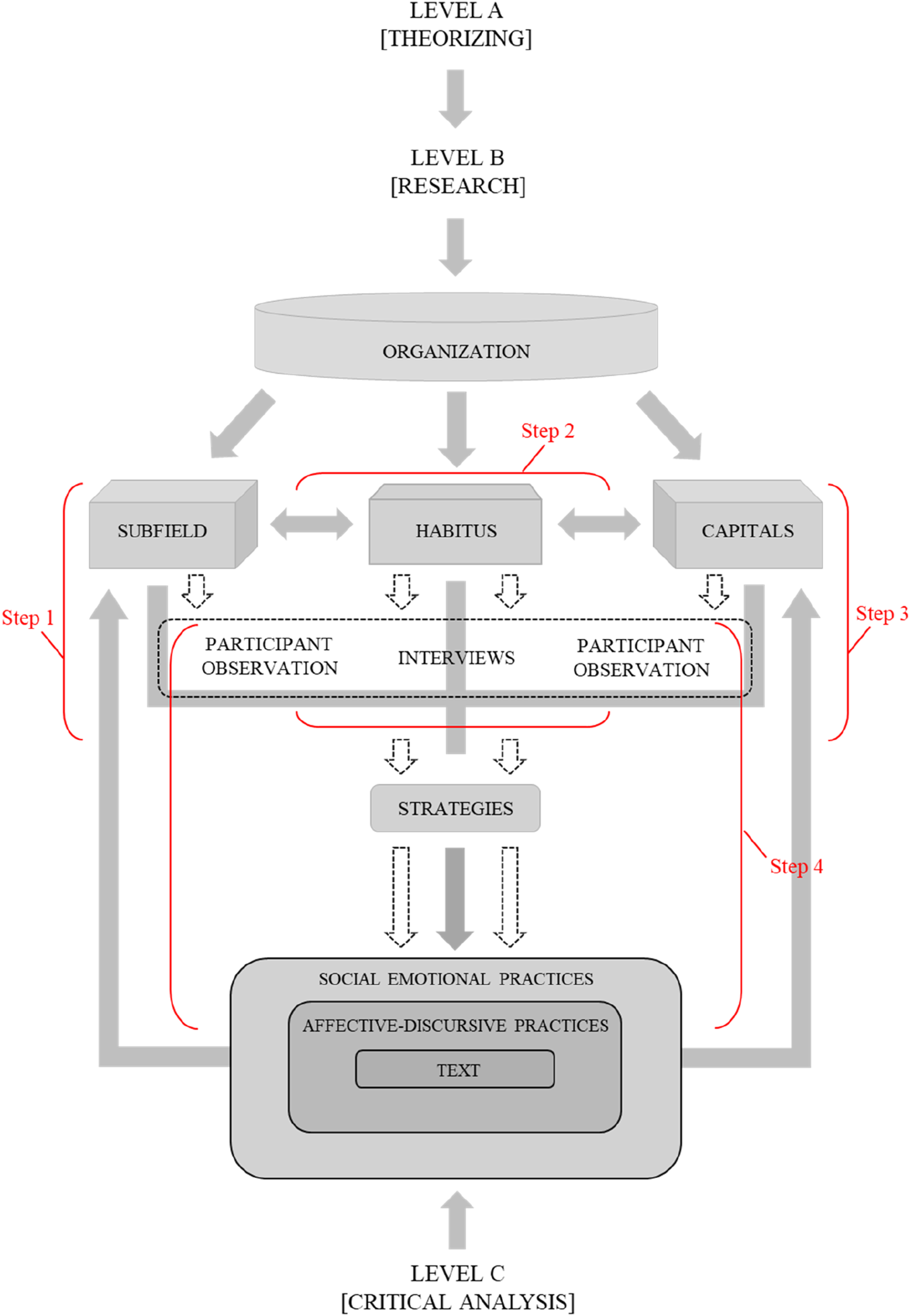
Final Considerations
This article proposed an analytical framework for the investigation of emotional practices in organizations, integrating Pierre Bourdieu’s praxeology with tools from Critical Discourse Analysis (CDA) and Critical Discursive Psychology (CDP). This integration enables the analysis of emotions as socially embodied and historically structured practices, connecting situated affective-discursive interactions to the reproduction or transformation of institutionalized emotional orders within organizational subfields. From this integration, three main contributions emerge.
First, a theoretical contribution: it advances debates on emotional practices by offering an integrative lens that connects the structural, dispositional, and practical dimensions of affect. In doing so, it expands the recent literature that incorporates emotions into Bourdieu’s praxeological framework, strengthening the analysis of their symbolic dimension and providing a more systematic articulation between micro-level affective-discursive processes and macro-level historical and organizational structures, mediated through habitus, field, and different forms of capital, as expressed in emotional practices within organizational contexts.
Second, an analytical-operational contribution: it offers a structured methodological pathway for examining emotional practices in organizations, addressing the lack of explicit methodological tools identified in existing approaches to studying affect in organizational settings. This pathway adapts Fairclough’s three-dimensional model to explicitly include emotional dimensions, articulated with Bourdieusian categories and informed by Wetherell’s concepts, such as the affective-discursive canon. By integrating practical, symbolic, and structural dimensions into a coherent analytical process, the framework provides concrete instrumentation for primary research in organizational contexts, extending the empirical applicability of current theoretical models.
Third, an epistemological contribution: it promotes a break with the dominant objectivist models in organizational studies, rejecting the idea of a rigid and universalizable explanatory model and adopting an open and flexible epistemological stance. Grounded in Bourdieu’s genetic structuralism and in a practice-based relational ontology, this approach allows for the investigation of the singularity of each emotional practice, considering the multiple dimensions that constitute it and the meanings it generates. Reflexivity, here understood through Bourdieu’s socio-analysis and complemented by perspectives such as Consoli’s life capital, reinforces this stance by situating the researcher within the field of study without reducing the analysis to a detached or purely variable exercise.
This work has inherent limitations arising from its scope and design. First, it has not yet been empirically applied, which prevents an assessment of its practical effectiveness and the extent of possible refinements. Second, its adoption of Bourdieu’s praxeology as the primary ontological and epistemological foundation deliberately excludes other contemporary approaches to affect and practice, such as post-humanist perspectives and sensory ethnographies. Third, the focus on organizational contexts may limit direct transferability to other domains without prior adaptation. Fourth, its implementation requires access to environments where embodied practices can be observed in situ, a condition that may be difficult to ensure. Fifth, combining Bourdieu’s praxeology, CDA, and CDP demands substantial knowledge and involves challenges such as capturing the interaction between discursive and non-discursive elements, sustaining immersion to identify routine and exceptional emotional events, and maintaining reflexivity as a critical posture.
Although these limitations are real, they do not invalidate the value of the proposed framework. On the contrary, they indicate future pathways: empirical application studies, comparisons with other methodological approaches, and expansions to non-organizational contexts. The fact that the framework is not a rigid protocol, but a flexible analytical device, is one of its greatest strengths, it allows for adaptation, iteration, and deepening as the researcher advances in the field.
Footnotes
Acknowledgments
The authors would like to thank the anonymous reviewers for their insightful comments and suggestions. We also extend our gratitude to colleagues who provided valuable feedback during the development of this theoretical essay.

Funding
The authors received financial support for the research from CAPES (Coordenação de Aperfeiçoamento de Pessoal de Nível Superior), Brazil, and for the publication from FEALQ (Fundação de Estudos Agrários ‘Luiz de Queiroz’).
Declaration of Conflicting Interests
The authors declared no potential conflicts of interest with respect to the research, authorship, and/or publication of this article.
Data Availability Statement
This is a theoretical essay, and as such, no empirical data were generated or analyzed during the preparation of this manuscript.