




Abstract
Understanding the lived experience of communities of people who are most affected by health inequalities has become a key focus of public health research. In this context, researchers are increasingly using creative (or arts-based) methods, but there is limited understanding about how best to facilitate these methods to qualitative inquiry that illuminate lived experience and the values that underpin this approach. This paper reports the reflections of researchers who used creative facilitation (a set of tools) in workshops, as part of a research project, which explored how children and families across England, living in poverty, experience the school holidays, including leisure during school holidays. Two professional creative facilitators delivered a two-day training course for the research team in advance of the workshops. Following the workshops, the researchers and facilitators took part in focus groups and a survey which captured their reflections on using creative facilitation. Creative facilitation was deemed to generate new insights on school holiday experiences, providing a greater depth of nuance and understanding and more meaningful and person-centred data. Three key aspects of creative facilitation were identified. First, creating a welcoming research environment, underpinned by positive relationships, where there is trust and an authentic focus on participant choice, comfort, value, empowerment, inclusion and diversity. Second, promoting unconditional positive regard and an ethics of care; the tension between adhering to ethics procedures at the start of the workshop when trying to create a welcoming environment was highlighted as a significant challenge. Third, being adaptive and responsive during the session; the level of flexibility needed during the workshops was challenging, and sometimes uncomfortable, for researchers. Researchers reflected that further experience, ongoing support, and rethinking the ‘scaffolding’ of their approach, would develop their capability in the longer term. We offer suggestions for future activity around creative facilitation for public health research.
Keywords
Background and Context
The Marmot Review (Marmot, 2010) highlighted the multiple, interacting social and economic factors that affect the quality and duration of people’s lives across England and made a strong social justice case for action across the social determinants of health. As a result, understanding the lived experiences of communities of people who are most affected by health inequalities has become a key focus of public health research over the past 15 years. The idea that people should be valued as experts in their own lives and lived experiences should inform health interventions and policy has meant that co-production, public involvement and community engagement (PICE) are key methodological considerations for public health research (Vargas et al., 2022). Public involvement is premised on a commitment to value-based research. Aligning this collaborative approach to generating qualitative data must be accompanied by an engagement with epistemological and ethical considerations about the mechanisms and values that make this possible (e.g. Filipe et al., 2017; Russell et al., 2020). However, the processes that facilitate qualitative methods yielding meaningful data about lived experiences are under-explored. This paper aims to bring further knowledge and attention to this developing field.
Creative, or arts-based research methods (ABR), are often used in research projects interested in the lived experience of children, young people and socially marginalised groups (Kara, 2015) as a way of flattening hierarchies. Leavy (2018) defines ABR as ‘a transdisciplinary approach to knowledge building that combines the tenets of the creative arts in research context’ and can apply to both the research process and the dissemination of results (Boydell et al., 2012). These methods have this potential because they are viewed as more engaging and so are often participatory methods, able to elicit new perspectives (McLaughlin & Coleman-Fountain, 2019) and bring diverse participant voices to the fore (Glaw et al., 2017). Lenette (2022) states that ‘researchers who use participatory arts-based methods do so precisely because of their commitment to challenging established, dominant, colonialist research paradigms in favour of research practices that are more ethical, collaborative, creative, and respectful of co-researchers’ unique standpoints and perspectives’. Arts-based methods in public health research therefore offer complementary knowledge focused on lived experience and work at the intersection of well-being, empowerment, education, and behaviour change. Byrne (Byrne et al., 2018, pi29). argue that ‘the use of arts-based approaches can facilitate both the production of evidence and genuine knowledge exchange between the public and decision makers’. A systematic review looking at what constitutes arts-based methods in health research found that methods focused on visual arts (e.g. photography, drawing) were the most commonly used, followed by performance arts and literary arts (Fraser & Al Sayah, 2011).
Whilst there is a wealth of literature on the opportunities and challenges of using creative methods, we suggest that there is a gap in understanding the role of the researcher as a ‘facilitator’ of these creative methods with respect to the associated challenges that such participatory methods bring. For instance, the systematic review by Fraser and Al Sayah (2011) state that no specific guidelines are provided on the application of the arts-based methods they review. Lenette (2022) advises that more focus should be given to ‘the intricacies of applying participatory principles in practice’. In Boydell et al.’s (2012) scoping review of arts-based health research, challenges reported included ethical issues around privacy and confidentiality, the potential for negative consequences to participants being asked to communicate in a more embodied or representational manner, and additional risks more widely associated also with additional time and financial pressures. Leavy (2020) notes that ‘the participatory nature of ABR, as well as the visceral, emotional way the arts can be consumed, raises particular ethical issues to consider’ (p27), and that ‘flexibility and openness are critical to the practice of ABR’ (p30), both of which call on the researcher to meet these. The disposition of the researcher is of central importance if we consider Hyde’s (2019) idea of making something creative together as a ‘social gift’, with the emphasis being on the interpersonal relationships and processes involved, rather than only the creative or visual output. The aim of this article is to reflect on the distinctive role of ‘creative facilitation’ as a set of tools and ideas that can support researchers in utilising creative and arts-based research methods to address public health challenges. The relationship between creative facilitation and creative methods in a public health research project will be explored, describing how creative facilitation techniques were used to build participant-facilitator relationships and create environments of trust and safety in which participants feel more able to contribute. Reflections from members of the research team on the use of creative facilitation in the project are also discussed.
In Heron’s influential text on facilitation (1999) ‘a facilitator is a person who has the role of empowering participants to learn in an experiential group’, referring to how ‘its validity is also, in part, phenomenological, to do with personal experience in the midst of action’ (Heron, 1999, p. 18). Much of what Heron details is adaptable to the co-production environment, as empowerment of participants to contribute is a key purpose. Heron’s (1999) work is foundational in developing a comprehensive system of dimensions and modes from which facilitators can develop their own style. In contexts of research, rather than learning or other groupwork, facilitation is rarely as well developed or foregrounded. The Creative Facilitation Unit in the Institute of Medical Humanities at Durham University (UK) is an exception. This is led by Senior Creative Facilitator and co-author Mary Robson, whose work there has developed over the last twenty-five years, from community-based arts in health projects, through to building communities of researchers on large, interdisciplinary research studies. Patton (2022, p. (2) defines creative facilitation as “the use of arts-based and experimental techniques to bring people from diverse backgrounds together to collaborate, form meaningful connections and experiment with different methodologies”. This is integral to the work of the Creative Facilitation Unit, where methods that engage with lived and ‘hidden’ experiences of health are a central concern. The facilitator’s role is seen in terms of freeing the group from everyday constraints so that they can fully participate in the process.
Mary Robson’s expertise was therefore deemed to be highly beneficial to a public health project focused on eliciting the lived experiences of families on low incomes during the school holidays. Mary Robson’s approach is founded in the arts, with a portfolio of work in theatre and community-based arts practice. Shared experience is central to community arts work and therefore the approach to creative facilitation is founded in interdisciplinarity and co-creation of knowledge, alongside a deep understanding of process. Creative facilitators are often bought into projects: ‘This ‘double location – “inside” but also “independent” – constitutes a unique vantage point from which to understand and draw out the creative potential inherent in interdisciplinary and cross-sector ways of working’ (Patton, 2022, p. 6). This paper describes how the work of the Creative Facilitation Unit informed and was incorporated into the project, both in terms of the project aims and methods, as well as from the perspectives of the project team, given that not all researchers are also trained in facilitation.
Methods
In this paper, the research team reflect on how creative facilitation was used as part of a national study to develop a good practice framework for the Holiday Activities and Food (HAF) programme; a Department for Education funded initiative administered by local authorities to provide nutritious food and enriching activities in school holidays for children from families with low incomes who would usually get a free school meal (FSM). One strand of the study aimed to engage with families, through a series of workshops, who were in receipt of free school meals but not currently attending HAF clubs, to understand their experiences of the school holidays. A key objective of the workshops was to provide new perspectives on this topic, and to gain a greater understanding of how the broader life contexts of these families may shape their leisure time during the school holidays. Creative methods were deemed appropriate for these workshops as they can provide new insights (Mannay, 2016) by giving people opportunities to express themselves through non-verbal means (Glaw et al., 2017), which was important given that tacit knowledge was of interest. Creative methods also aligned with an assets-based approach (Garven et al., 2016), valuing data that reflected families’ interests, preferences and priorities beyond their non-engagement with HAF clubs. It was also deemed appropriate to use creative facilitation when applying creative methods for these workshops as this approach can enable participants to fully contribute in the process (Heron, 1999).
Creative Facilitation Training
Although most members of the research team had previous experience in using creative methods and in research with children and young people, they came from different disciplines and only one (Florence Darling) of those who were going to be responsible for data collection had experience of using creative facilitation. Seven members (including all those responsible for data collection), who were located across England, were brought together for a two-day in-person training course ‘The Fundamentals of Creative Facilitation’, which was tailored to this specific study and its objectives. This training included an introduction to creative facilitation as an approach which can be applied to qualitative research methods, including traditional methods such as focus groups. In brief, creative facilitation involves a set of tools which can be applied to research projects to adapt the research environment for data collection and also adapt the choice and delivery of the research methods (Patton, 1999). One of the features of creative facilitation is the adoption of an intuitive and responsive approach during data collection. The training introduced the researchers to the ORID framework (https://www.betterevaluation.org/methods-approaches/methods/orid) which creates a structure that enables focused conversation with a group of people (described in more detail below). Following the introduction, the training focussed on how creative facilitation could be applied to the HAF project. The training enabled peer support in the subsequent development of the project’s methods and helped the research team to re-orientate their focus towards the disposition of the facilitator in a way that was underpinned by theory. It not only provided a set of creative tools to use in research with children and families, but also an approach to facilitating research that is applicable to a wide variety of methods of qualitative data collection with groups. Participants of the training were then given the opportunity to have a follow up session with the professional creative facilitator leading the training to provide further mentoring and support, to develop sustainable creative facilitation skills in the team.
Capturing Reflections
To better understand the impact of the creative facilitation training, not only on the project outcomes but also for the project team, attendees were invited to respond to a short survey and attend an online focus group to capture reflections on the impact of the training. This included how they understood the training to have informed the methods used in this study, as well as wider implications for their public health research. A focus group with the two practitioners who facilitated the training was carried out separately, to understand how they developed the training and adapted it for this cohort, as well as how it informed data collection. Whilst focus groups were organised to formally reflect on the use of creative facilitation using a topic guide and have been useful for selecting quotes that illustrate different perspectives, reflection and analysis was an ongoing dialogue (Pink, 2009) amongst the research team that took place throughout the process.
Throughout this paper, the co-authors reflect on the use of creative facilitation in this project, weaving in examples of how data was collected using these techniques. Quotes are used throughout and are linked to a “facilitator” or a “researcher”. These labels are imperfect as the roles in the project were fluid and levels of experience varied, but they do distinguish between those who were new to creative facilitation (“researcher”) and those who use it as an everyday and established part of their professional lives (“facilitator”). By using examples from our research with children and families on low incomes, we explore the possibilities and challenges associated with adopting creative facilitation within inter-disciplinary research teams.
Ethical Approval
Ethical approval for the workshops with families, and the post workshop survey and focus group with the researchers and facilitators (to capture their reflections on using creative facilitation), was granted by the School of Education Ethics Committee, Durham University (UK). This covered the processes of gaining informed, written consent from children and their caregivers for their engagement in the workshops and from researchers and facilitators for their reflections on their use of creative facilitation. At the start of each workshop, the information sheet and consent form for the children and caregivers was distributed to attendees. The researchers who were facilitating the workshops also verbalised this information to the group and asked that, if they had any questions, to please ask. The researchers went from family group to family group to check that attendees were content to participate and, if yes, to sign the consent form. The workshop began once the consent forms had been signed and collected by the researchers.
Using Creative Facilitation to Explore the School Holiday Experiences of Families on a Low Income
Workshop Plan

Materials: Large roll of paper, masking tape, coloured pens and pencils, name labels, scissors, blank maps, writing pens and pencils, pre-cut card squares, snakes and ladders, dice, counters.
ORID Framework adapted from Institute of Cultural Affairs (2014) Focused Conversation Method Structure. https://www.ica-uk.org.uk/ Focused-Conversation-Overview.pdf.
Members of the research team predominantly facilitated workshops in the regions where they lived and worked. This was helpful for recruitment and meant that researchers were often knowledgeable about the local landmarks and green spaces families referred to. Whilst many of the research team were parents of young children and juggling the pressures of school holidays at the time the workshops were delivered, none were experiencing the financial insecurity of the families who were taking part. Researchers were careful not to position themselves as an expert on the topic but focused on building relationships and trust, being present and active listening.
Methodology
Methodology can be viewed as a ‘contextual framework’ (Grierson & Brierly, 2009, p. 5) that is guided by beliefs and values to inform the decisions that researchers make. From the outset, we adopted an asset-based approach (Brooks & Kendall, 2013) that sought to focus on families’ experiences and hopes for the school holidays rather than their lack of awareness or engagement with holiday clubs. Much of the evidence available to policy makers to inform decisions about the most effective approaches to promoting health and to tackling health inequities is based on a deficit model (Morgan et al., 2010). Adopting an asset-based approach and viewing the topic through an inequalities lens was intentional so that we could create a research environment that countered stigmatising narratives about people living in poverty and their perceived deficits. This is influenced by Freire (1968), where the subject is conceptualised as the expert in their experience but when they are marginalised this expertise becomes disregarded. With this in mind, creative facilitation was used in this project as a way of giving families a greater degree of control over how they represented themselves, by having the opportunity to develop, reflect on, describe and explain what they had created and the meaning they were trying to convey. This approach to co-production is also about valuing different types of knowledge, so embracing issues of epistemology as well as methodology. Co-production should be viewed as an exploratory space that brings together different values and social relations and a generative process that produces new interactions and forms of knowledge and that can lead in turn to meaningful ways of shaping and taking part in health care (Filipe et al., 2017, p. 2).
This necessitated wider discussions about values and dispositions with respect to knowledge, which were accommodated in the creative facilitation training. The two creative facilitation facilitators were trained in the Group Facilitation Methods of the Institute of Cultural Affairs (ICA-UK), including the ORID framework (https://www.betterevaluation.org/methods-approaches/methods/orid), and consider this training foundational to their processes. The research team in this project, as part of their training, were introduced to the ORID framework, which creates a structure that enables focused conversation with a group of people. The framework involves four levels of questioning: Objective, Reflective, Interpretive, Decisional. Objective questions explore what is known and are easy to answer. Reflective questions elicit personal responses and deepen the level of participation. Interpretive questions invite groups to share perspectives, generate ideas and possibilities. Decisional questions identify areas for action and resolution. ORID can be applied in various situations; from a focused conversation through to participatory workshops; from planning meetings with small groups to orchestrating large events; from creating space for individual reflection through to evaluating a project. For this research project, ORID was used as an overarching framework to structure and plan the activities but necessarily invited the team into a reflection on the nature of co-produced knowledge(s).
Workshop Methods
The data generated during these workshops and subsequent data analysis is not the primary focus of this paper (a separate paper reporting the data, data analysis and findings is in preparation July 2025). In this paper, we will examine the reflections of the researchers and facilitators on the creative activities the families participated in and their engagement with them. We also describe our rationale for developing these bespoke creative activities within the context of the relevant literature and theory. It is important to acknowledge that two of the three creative activities were adaptions of creative methods that are commonly used in this type of research; the Snakes and Ladders activity was developed by the research team, led by Florence Darling.
Fifty-nine participants were recruited (22 adults and 37 children) to take part in seven workshops across three locations in England. Parents took part with their children, who were aged between 7-11 years. Workshops took place at settings that the families attended regularly so were familiar and convenient. When invited to take part, participants were given information about the study, including the focus on families receiving free school meals. However, during the workshops, families were asked questions about their school holiday experiences and not their income. This was to ensure that the discussions were not stigmatising, and positive and playful activities were used to protect participants’ emotional wellbeing.
Creative Activity 1
‘Handy connections’ was used as an ‘ice-breaker’ activity. In parent and child pairs, participants were asked to draw around a family member’s hand using their non-dominant writing hand (Figure 1). This meant that the outcome was deliberately imperfect, moving the emphasis away from the need to be ‘good’ at drawing. Participants wrote on each finger something they liked to do during the school holidays and wrote on their thumb their favourite activities. The hands were then cut out and stuck on a big piece of paper on the wall or floor so that the whole group could reflect on the similarities and differences between the responses. This helped to build rapport within the group, as participants discovered shared interests and hobbies. This ’objective’ level activity established relevant information and welcomed active participation, informed by the role of embodiment in research and body-mapping practices (De Jager et al., 2016). Handy Connections
Creative Activity 2
Children and parents within family groups then created ‘maps’ of their school summer holidays (Figure 2). The use of maps in this project was inspired by the practice of ‘counter-mapping’, which originated in postcolonial cartography and was used as a way for indigenous people to appropriate the tools of oppression and to push back against the dominant discourse. Also termed ‘community mapping’ (Parker, 2006) and public participatory mapping (Rundstrom, 2009), maps have been used as a creative tool to counter negative narratives by offering alternative representations of economically deprived areas. This typically involves ‘collecting information about community assets, making maps or new map layers that reflect these assets and aspects of personal use or mobility, and using these maps to make and justify claims for use and development of assets in the future’ (Taylor & Hall, 2013, p. 66). Such approaches can evoke information, feelings and memories that might not have emerged otherwise, or that may be hard to describe using words alone (Rose, 2016) and therefore depend on the development of a certain level of trust and rapport with participants. Each family was given a blank, folded map made of high-quality squared paper with a key in one corner. The activity was introduced with a discussion about maps and how signs, symbols and colours can be used to denote places, objects, people or emotions. Explaining how the maps were used as a metaphor, “they can show where you are and help you find where you are going” one facilitator said. This activity gave families ownership over how they represented their experience of navigating the school summer holidays. The use of metaphor was important to understand how socially connected some families were, as well as the places, activities and people that were important to them. One family represented their summer school holidays as an island surrounded by choppy seas where the experience of mother and child were completely separate. Children and parents working together revealed interesting insights as they reached agreements about what would be included and excluded. This activity was both ‘reflective’ and ‘interpretive’ as children and parents developed their maps and then decided how to present them to the rest of the group. Family Map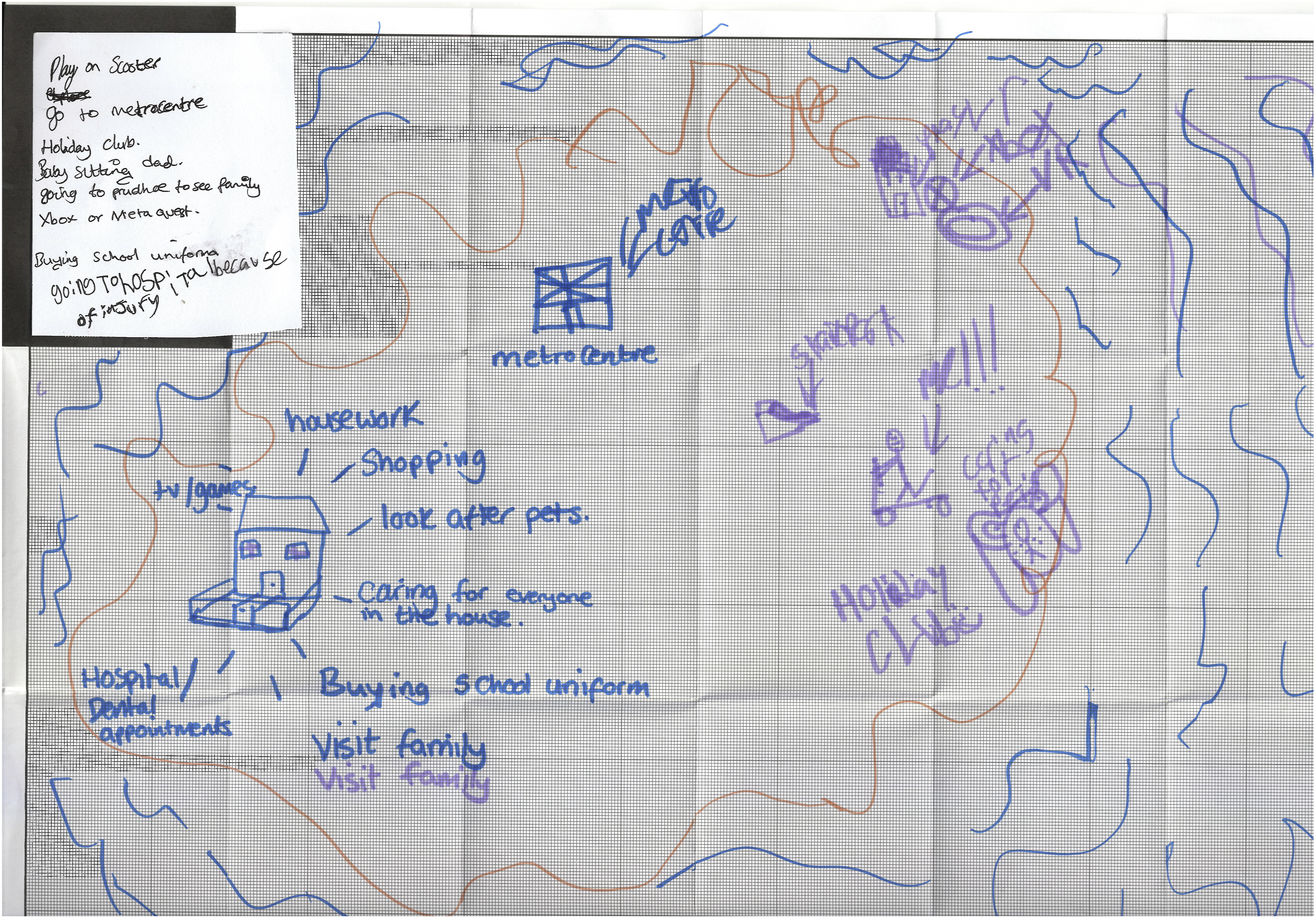
Creative Activity 3
Finally, parents and children were separated into two different groups to create the game ‘Snakes and Ladders’ (Figure 3). Children created the board by drawing pictures of the different things they wanted to do in the school holidays and then ordered them as a group from the least to the most popular. Parents made ‘ladders’ to represent all the things that helped them do the things they wanted to do in the holidays and ‘snakes’ which were the things that ‘got in the way’. The game of snakes and ladders was used as a metaphor to explore the social and structural factors that shape school holiday experience. At the end of the workshop, parents and children played the game together with dice and counters. Structuring the activities using the ORID framework meant that positioning Snakes and Ladders as the final and ‘decisional’ activity allowed participants to come up with solutions in the room, which was only possible by “starting with those thinking processes” (Facilitator). Using this framework allowed for the research team to consider how to build in incrementally more complicated and reflective activities as participants felt more comfortable. Snakes and Ladders
As these creative activities show, it is important to adapt or develop new creative methods that are relevant to the research questions, the participants and the context, which in this project we did with the benefit of the two-day creative facilitation training. Centring hands, maps and Snakes and Ladders in the creative methods that were chosen provided familiar reference points for the families taking part and fostered a sense of empowerment. Children were excited to have the opportunity to create their own game and playing it together at the end was an important way to conclude the workshops. Creative methods can be powerful in and of themselves but sometimes it is the conversations that happen around them that can generate inciteful data and how these conversations are facilitated should not be underestimated in importance. Through the incorporation of creative facilitation in this project, creativity became more about being adaptive and responsive to the context, themes and participants during the planning stages as well as in the facilitation of these methods, that is process, rather than being primarily about their content and outputs - the products (Kara, 2015; Patton, 2022). Whilst the activities that were devised for this project could be replicated in other research situations, how they are introduced, delivered and facilitated would shape how the participants interact with them and the data that is generated.
Reflections on the Relationship Between Creative Facilitation and Creative Methods (or Arts Based Research Methods)
Creative facilitation approaches were used to plan and design the creative methods that were used in this research. Prior to attending the training, participating researchers perceived creative facilitation as synonymous with creative methods (or arts-based methods). Whilst there is clearly overlap, it is useful to think of creative methods as part of the facilitators’ toolbox. The practice of the two facilitators working on this project was developed through years of running arts-based workshops in communities and they described their facilitation practice as founded in community art. An important part of community arts practice is often that is it informed by a social justice framework and the inclusion of multiple voices in the pursuit of change (Matarasso, 2019). This is done by allowing people to express their ideas in a range of ways that go beyond verbalising them. Both facilitators had a wealth of professional experience working collaboratively with artists and communities on social issues “[We were doing work] that was out to make a difference but was in it for the long haul as well” (Facilitator). Place-based working and co-production (Filipe et al., 2017) are high on the public health agenda, but these ways of working are not new. Referring to community art, one facilitator said “It existed long before there was investment in cultural venues, it took place where people lived” and “we did stuff in hairdressers, allotments, social clubs and libraries”. This work is rooted in the belief that “everybody has the right to be creative...I suppose that’s my value. That’s my starting point” (Facilitator). In this respect, art becomes a tool to have a conversation and to share complex thoughts and ideas rather than an end goal (Yoeli et al., 2020). “I want to create that space where conversations can happen, where relationships can be developed and strengthened” (Facilitator). This emphasis on process rather than output was summarised by one researcher who said that part of understanding creative facilitation was “reframing it as something that is facilitating the qualitative data, and it doesn’t really matter what is produced” (Researcher). Compared to when a researcher runs a focus group or interview by asking a list of questions, creative facilitation provides a set of underpinning theories to support the development of positive relationships, flatten hierarchies and set the tone of the workshop that can create a substantively different research encounter.
A creative facilitator guides the process by introducing activities that are relevant to the research questions and is responsive to how the group are engaging and interacting with each other. A creative facilitator, drawing from a range of theoretical approaches about working with groups, can enable or deepen participatory workshops by making space for different levels of engagement and for different voices to be heard. This is done by structuring the stages of reflection and dialogue so when an activity or question is posed, participants, firstly, have the opportunity to think individually and maybe note down their initial ideas before sharing their thoughts with the person next to them or in a small group. It works well to use arts-based methods for these initial stages, but it is also possible to use note books, post-it notes or big sheets of paper. Only after these stages, will participants be asked to respond in front of the whole group. This gives people the time and space to think and process the information and decide what they want to share, putting them in charge of their own data. Designing activities that are open and multi-layered can provide, not only responses that may be different to when asked direct questions, but also more depth and nuance as people are prompted to reflect on the meaning of what they communicate. The creative facilitator combines structure and play, using tools to promote creative thinking, build trust and deepen engagement leading to more meaningful and person-centred data.
Key Aspects of Creative Facilitation for Public Health Research
The following sections explore the key aspects of creative facilitation that informed this research along with researcher and facilitator reflections on the value, as well as the challenges, of using this approach. In other words, “These are the ingredients that we think are helpful when bringing disparate groups of people together” (Facilitator).
Create A Welcoming Research Environment
Creative facilitation prioritises the participants’ experience in co-production by aiming to provide a warm and friendly research environment in which power dynamics are actively considered, safety and wellbeing are key concerns, underpinned by positive relationships. Simple, creative and participatory activities or ice breakers were introduced at the start of the workshop to develop rapport and build connections. For some groups, it can be necessary to set up a group contract at the start to agree shared expectations. This may involve the outcomes, behaviours, resources and support that are needed for participants and facilitators to feel that the interaction has been positive and worthwhile and works as an informal ‘ethical contract’ (Facilitator). Through the creative facilitation training the research team were introduced to the idea of gentle transitions, by using a singing bowl or bubble machine for example, to prepare participants for the beginning and end of an activity. One facilitator discussed how this approach aligns with trauma-informed principles that promote environments “where people feel safe” (Facilitator) and “where there is trust, choice, empowerment and an acknowledgement of the different cultures that are in the room” (Facilitator). A trauma-informed approach seeks to avoid creating encounters that may inadvertently retraumatise people (OHID, 2022). These considerations are particularly important when working with groups of people who are experiencing intersectional disadvantage. As one researcher commented “The groups we were working with, I don’t think would have contributed or would have necessarily felt comfortable with direct questioning like in a more traditional focus group type approach”. People who have had negative past experiences of engaging in services or with people in authority may feel defensive when asked direct questions.
One researcher, who facilitated a workshop with children who had been excluded from school, said: “These young people have a really bad relationship with schools and many of them haven’t been in school for a couple of years so then being in a classroom environment maybe isn’t great”. Creative facilitation involves having an awareness of how the space informs behaviour, for example, when working in a school, it was important to create an environment that felt different from the classroom. Furniture was rearranged, teas, coffee, juices, sweet treats and fruit were provided, and participants could help themselves. One facilitator said, “that sense of warmth and welcome and attention, is absolutely crucial”. One Facilitator said that when working with “people who've had to tell their stories in different ways to different sets of professionals”, focusing on the activity rather than the questioning can bring new thoughts and ideas to light “somehow, you're all looking at the floor and you start moving bits of paper around...things can come out of that that don't come out if you're sitting with a piece of paper”. One researcher agreed that the methods and approach “helped to put them at ease and to get across some of their views” (Researcher) and another felt that “giving them an activity to do and verbalise at the same time, they’re slightly distracted by what they’re doing”, “it feels less kind of intrusive or invasive, less probing”. To summarise, another researcher said “Reflecting on the workshops in the North East, one thing I will take forward next time I do a focus group or an interview is very much about the kind of environment that you create and the time that you spend making people feel comfortable and that might be making them a cup of tea or just asking them about their day, just like building that relationship”.
Unconditional Positive Regard and an Ethics of Care
Researchers reported a potential conflict with this approach and ethical procedures in research. One researcher described “the tension between things like the consent forms and information sheets at the start when you’re trying to create this warm and welcoming space”. This included sharing complex information about the research aims and data management to ensure informed consent as well practical constraints such as organising food or materials, whilst simultaneously wanting to be attentive to participants. Co-facilitating as a pair or group of researchers means there are enough people in the room to make people feel welcomed and held but there is a need to think about “ethics beyond text-based ethics” (Facilitator) and how ethics processes may be adapted to ensure they are inclusive for disadvantaged groups. One of the facilitators agreed, “You want people to feel relaxed. You don't want them to think, oh hell, they're gonna mock me on the fact that I cannot spell and I cannot fill the form in” (Facilitator).
The researchers and facilitators agreed that the process of gaining consent from individuals with low literacy and facing structural vulnerabilities requires a modified approach to that used in positivist health research and in this project. This could involve visual aids, and alternative methods for recording consent, while also addressing the unique challenges these individuals may face in their decision-making process. Tailored methods should be used to ensure comprehension and voluntary participation. For example, the Department of Education for England (https://user-research.education.gov.uk/guidance/ethics-and-safeguarding/gaining-informed-consent) suggests using infographics, images, diagrams video clips and animations and provides a number of useful examples and case studies. There is an emerging body of research on this topic which includes the use of pictorial art for gaining informed consent in low-literacy settings (e.g. Ghotane et al., 2025). Further research on methods of gaining consent from individuals and groups with low literacy and facing structural vulnerabilities which use creative facilitation and creative methods is suggested.
Banks (2016) makes the distinction between formal ethical frameworks and ‘everyday ethics’ in reference to the effort people put into their facilitation practice, having an awareness of ethical decision-making and situated reflection. Banks (2016, p.35) conceptualises facilitators as “moral agents in context” and uses the term “work” to describe the embodied process of noticing, attending, thinking, interacting and performing. This level of attentiveness and responsiveness in research draws from Tronto’s (1993) feminist ethics of care. At the training, researchers were introduced to the importance of placing ‘unconditional positive regard’ at the centre of relationship-making during the workshop (White & Robson, 2015, p. 59), accepting all participants regardless of what they say or do, creating a space that is inclusive and non-judgemental. The importance of thought, care, planning, time, hospitality and the use of high-quality materials demonstrates that participants are valued. “You know a lot of the participants we’re speaking to in public health have really difficult lives so even if you’re not talking about a sensitive topic [being able to] sit quietly for a bit before they choose to engage, that’s a huge benefit” (Researcher). The aim was to make participants feel as comfortable as possible and for them to feel as though the research workshop had been a positive experience. This can be easier to achieve over two or more workshops when researchers can get to know the group and have a chance to reflect and adapt between sessions. “We had participants coming up to us at the end and saying they’d had a really lovely time, thank you very much for inviting me, I really appreciated the opportunity to do this” (Researcher).
Be Adaptive and Responsive
One of the facilitators described how in the training they deliver they “pay real attention to the disposition of the facilitator”. They link this to Rodenberg’s (2009) concept of ‘three circles of energy’ where first circle energy is inward, and third circle energy takes up space, is energised and controlling, imposing itself on others. To effectively connect with a group, facilitators must work within second circle, denoting presence, focus, alertness, and responsiveness. This necessitates flexibility in response to the people in the room and changing the time, pace or activities if they are not working. This is a creative process in that no two workshops will be the same. In this respect, creative facilitation is person-centred because it considers “who is in the space” (Facilitator). Methods are intentionally developed to bring people together who share a common characteristic, experience or geographical space, to prompt dialogue and reflection on the similarities and differences of their experiences. Key aspects of facilitation are inclusion, listening, and valuing contributions equally. Activities were therefore designed to be flexible and adaptive. Workshop participants had various access needs, were non-verbal or found writing challenging, but it was possible for these participants to engage in the workshop activities through drawing, through close collaboration with a family member and through play. “If some children just wanted to draw, or work with their parent or friend, it was fine” (Researcher). One researcher reflected that they observed “lovely bits of connection when you introduce collaborative activities between adults and children and some lovely moments where adults found things in common and having that space to find connection with other people”.
This level of flexibility and uncertainty was however challenging and uncomfortable for some members of the research team. “It was a really kind of like noisy, messy, chaotic experience as a facilitator” (Researcher). As this quote illustrates, researchers reflected on the challenges of working in a less structured way than they were used to: “that’s quite an opposition to focus groups where you’re all sat in a circle, and you’ve got your list of questions that you’re going through in order”. It could also present challenges when parents and children introduced topics they wanted to talk about, moving the focus of the discussion away from the research questions. This was evident in one workshop, where the families wanted to talk about their experiences of school exclusion, which overshadowed their school holidays. One Researcher said “I don’t think I would necessarily change that, it’s just about accepting it but it did make me feel a bit anxious”. This conversation provided rich and interesting data about the support these families needed and aligned with the approach of valuing co-produced knowledge. An openness to new themes and topics is therefore required and knowing “you’re going to have to change things as you go along. You have to think on your feet a bit more” (Researcher). Co-facilitation can then be an important aspect of managing the unexpected nature of group dynamics: “always communicate with each other. If something is not working, we need to give each other confidence to be flexible and change things” (Researcher).
Implications for Using Creative Facilitation in Public Health Research
“You get all excited in the room and you can see how it can work and then you step out into the world on your own and you’re suddenly like, actually, I still don’t actually feel like I have a real clue about how to do this” (Researcher).
This comment highlights a key tension in creative facilitation; it is not easily transferable without support, critical reflection and recognition of its value as a tool in qualitative research. In this study, the use of creative facilitation was not only an approach to strengthen engagement with low-income families, but a broader orientation towards a different way of doing research with groups that centres collaboration and care.
Creative facilitation describes the practice of guiding a group through a structured yet flexible process that uses creative tools to work collaboratively, explore different perspectives, generate new ideas, and build shared understanding. By thoughtfully planning activities and using appropriate creative tools, researchers can enable participants to critically reflect on the experiences they share, providing a greater depth of nuance and understanding. The role of the creative facilitator is central; as an active listener, who is responsive to group dynamics and adapts practice to support inclusion, safety and dialogue.
Creative facilitation is particularly relevant to public health research due to the focus on relationships and responsiveness, where power and lived experience are particularly salient. In contexts where more conventional approaches may feel extractive or alienating, creative facilitation offers a more accessible and person-centred research environment. This can bring hidden insights and experiences to the fore, build trust and support more equitable and participatory approaches to addressing public health challenges.
Creative facilitation, however, also raises a distinct set of epistemological and practical challenges. It requires a shift away from controlled and linear research methods to a more open, emergent approach. While some researchers appreciated the flexibility to devise new, creative activities in relation to specific research questions “it doesn’t have to involve coloured pens and drawing” (Researcher), many struggled with how to develop them and apply them to different research contexts. One researcher said “I felt a bit untethered...I don’t think I’ve got the skills to translate this into another context”. Creative facilitation as a research practice cannot be easily summarised with a toolkit or checklist but rather requires ongoing development, critical reflexivity, mentoring and theoretical underpinning.
Creative facilitation can also be challenging within interdisciplinary research teams, particularly when the relational and process-driven ethos is in tension with more positivist or outcome-focused research cultures. This presents a challenge for embedding creative facilitation more widely and highlights the need for a shared language and infrastructure to support it as a valid and valued part of qualitative research. This may involve mentoring, peer reflection or developing communities of practice that enable researchers to strengthen their creative facilitation skills over time. One researcher commented that peer support could help to “hold each other to account” and “give each other the confidence to weave it into our working lives a bit more”.
The involvement of a specialist Creative Facilitator added significant value to the HAF study, not only to co-design tailored activities that aligned with the research objectives but also to support the team in developing their creative facilitation skills. As Heron (1999) notes, knowledge is not fully transferrable without being lived. It must be felt, practiced and reflected upon in context.
Finally, it is important not to frame creativity in research as superficial or supplementary. As Kara (2015) argues, creative methods are epistemological as they expand the ways we come to know and represent subjective experience. When facilitated with thoughtfulness and care, they can offer new modes for people to express and make sense of their experiences. For public health research that seeks to centre lived experience and contribute to tackling health inequalities, a focus on creative forms of facilitation is essential for inclusive research.
Recommendations for Future Research and Activity
Future activity to support the promotion of creative facilitation in public health research should include the development of (a) creative methods to support a process to gain informed participant consent from individuals with low literacy and facing structural inequalities without the need to read formal-type documents, (b) a national centre for creative facilitation which offers training and ongoing support, (c) a network of researchers who could provide peer support in creative facilitation, and (d) a toolkit for those developing grant applications which includes a description of the additional time and resource required when using creative facilitation.
Conclusion
If co-production can be understood as an exploratory space and a generative process that leads to new and unexpected forms of knowledge (Filipe et al., 2017), then creative facilitation can provide an unrivalled set of ideas and tools to support researchers to meet the dispositional and practical demands of such exploratory research needs. Where co-production and the associated creative methods employed value alternative forms of knowledge and are concerned with the social relationships that emerge from the process of working collaboratively (Filipe et al., 2017), creative facilitation can provide a framework which directly supports the role of the researcher in foregrounding these issues in public health research.
Footnotes
Acknowledgements
This paper has been produced as part of the HAF-DEFINE study (Developing a Best Practice Framework for the Holiday Activities and Food Programme). We gratefully acknowledge the contribution of Dawn Williams, who co-led the Creative Facilitation training and participated in the survey and focus groups.
ORCID iDs

Ethical Considerations
Ethical approval was granted on 10th April 2024 by the School of Education Ethics Committee at Durham University (Ref: EDU-2023-12-14T09_25_13-hqqc43).
Consent to Participate
The data collected is not of a personal or sensitive nature as the questions asked related to reflections of (a) the research team on the creative facilitation training and using creative facilitation for the first time in a research project, and (b) the trainers. Quotes have been anonymised using generic “researcher” and “trainer” labels but, as those taking part are also participants and authors, anonymity cannot be guaranteed. Written informed consent was obtained from all participants prior to data collection.
Consent for Publication
All authors reviewed the manuscript and provided informed consent for their data being published.
Author Contributions
RJ, LMS, MP and CS wrote the grant application that secured study funding. FD, RJ, LMS, MP, MR and CS conceived the study. MR provided training and ongoing support on creative facilitation. LH, MM, MP, JT and LT provided peer support on creative facilitation. FD designed and conducted the survey and focus groups, Data collection and data analysis was conducted by FD. Supervision was provided by RJ, LMS, MP and CS. FD, LMS and CS wrote the original draft. All authors contributed to and reviewed the final manuscript.
Funding
The authors disclosed receipt of the following financial support for the research, authorship, and/or publication of this article: This study is funded by the National Institute for Health and Care Research (NIHR) School for Public Health Research (SPHR) Grant Reference Number (NIHR 204000). Russell Jago is partly funded by the National Institute for Health and Care Research Applied Research Collaboration West (NIHR ARC West). The views expressed are those of the authors and not necessarily those of the NIHR or the Department of Health and Social Care.
Declaration of conflicting interests
The authors declared no potential conflicts of interest with respect to the research, authorship, and/or publication of this article.
Data Availability Statement
Redacted transcripts of the survey responses and focus group notes are available on request from the corresponding author.