




Abstract
This paper investigates the complexities of qualitative research through the reflective narratives of four graduate students in the social sciences. Through narrative analysis, this paper highlights the unpredictable and often non-linear dynamics of empirical fieldwork, participant recruitment, and data collection processes. Despite guidance from academic supervisors, existing literature and ethics review boards, novice researchers frequently encounter challenges that diverge from established research models. The findings underscore the necessity for early-career researchers to maintain adaptability in the face of unforeseen obstacles. Drawing from the researchers’ experiences in sociology of health, anthropology, social psychology, and public health, the paper addresses critical issues encountered in sensitive research contexts, such as trust-building, ethical dilemmas, and participant recruitment. We employ Nyamnjoh’s concept of “nimble-footedness,” to offer a framework for navigating the dynamic and often chaotic nature of qualitative inquiry, while emphasising the importance of methodological flexibility and cultural sensitivity. Ultimately, this research argues that the inherent unpredictability of qualitative research enriches the research process, advocating for a transparent approach that embraces the messiness of fieldwork. As social research evolves, fostering resilience and adaptability among emerging researchers is vital for capturing the richness of human experiences within diverse and complex contexts.
Introduction
Both quantitative and qualitative research findings are usually presented in a linear fashion. Researchers usually ignore or hide the dirty, complicated aspects of fieldwork, such as how they went about data gathering, finding participants, and other logistical difficulties. Research literature and advice from professors, on the other hand, typically present a refined, uncomplicated procedure. In contrast to quantitative research, which is more objective and systematic, qualitative research involves subjectivity and a more in-depth exploration of phenomena and lived experiences that may not be as straightforward (Austin & Sutton, 2014; Bouzioti, 2023). This type of research is not only about uncovering facts but also about understanding personal, complex human experiences in an immersive and nuanced way (Austin & Sutton, 2014).
In this article, we contend that qualitative research is not a straightforward, sequential procedure. Based on the concept of nimble-footedness as proposed by Nyamnjoh (2012), we argue that qualitative research is untidy and unpredictable by nature. The process of producing findings and discoveries is not simple; rather, it entails negotiating ambiguity, uncertainty, and numerous challenges. Researchers must be flexible and adaptable, ready to respond to unexpected developments, and be willing to embrace the complexity of human experience as they gather qualitative data. This viewpoint contradicts the traditional, romanticised notion of research as a methodical, seamless process.
Developing such an understanding is particularly vital for novice researchers and graduate students engaging in qualitative research for the first time. Through illuminating the reality of fieldwork and the iterative nature of qualitative inquiry, we hope to assist them in preparing themselves for the uncertain and frequently non-linear path that lies ahead. Recognising that qualitative research requires flexibility/nimbleness to adapt to changing circumstances can better equip researchers to handle its challenges. To foster a more grounded and realistic approach, it is essential to honestly portray the research process, including its inherent messiness and ambiguity.
Literature Review
Embracing the Messiness of Qualitative Research
Empirical research, or fieldwork, has long been a cornerstone of knowledge production across academic disciplines (Vetter, 2022). While historically dominated by quantitative approaches rooted in positivist epistemologies, there has been a marked shift towards the legitimacy and value of qualitative methodologies in exploring the nuances of human experience (Park et al., 2020; Scotland, 2012). Championed by early scholars such as Max Weber and Clifford Geertz, who emphasised the interpretive, meaning-making dimensions of social life (Geertz, 2008). Their work laid the foundation for a paradigm shift in which researchers were encouraged to immerse themselves in participants’ worlds, engaging with context, subjectivity, and power. This marked a critical departure from the presumed objectivity of the positivist tradition and opened space for more adaptive, participatory, and reflexive inquiry in the form of qualitative research.
One of the most salient features of qualitative research is its flexibility. As Ugwu and Val (2023) note, this flexibility is not just a strength but a necessity when navigating fieldwork’s unpredictable realities. Qualitative researchers must continuously adapt to shifting social dynamics, logistical constraints, and evolving participant relationships. Despite the wealth of literature praising this adaptability, novice researchers are often surprised by the disconnect between tidy methodological representations in textbooks and the chaotic, nonlinear experiences encountered in practice (Clift et al., 2019; Naveed et al., 2017; Reuber et al., 2022; Rubinstein-Ávila, 2013). This discrepancy perpetuates unrealistic expectations and obscures the real work involved in qualitative inquiry.
Recognising this gap, scholars have increasingly advocated for transparency in reporting the “messiness” of fieldwork (Clift et al., 2019; Naveed et al., 2017; Reuber et al., 2022). We join these calls by reflecting on our own research experiences, which required what Nyamnjoh (2013) terms “nimble-footedness”—the ability to pivot, recalibrate, and stay attuned to the rhythms of unpredictable research terrains. Our collective work – ranging from infertility in Zimbabwe, African migrants in Cape Town, early child marriage in rural Goromonzi (Zimbabwe), to Xhosa men’s perspectives on medical circumcision – illustrates how cultural context, power, and access shape the qualitative research process we argue that fieldwork inevitably reveals blind spots that only become apparent in practice. These challenges often necessitate methodological improvisation and a heightened degree of “nimble-footedness.”
The notion of methodological “mess” has been central to poststructuralist and feminist critiques of traditional research. Lather’s (2007)’s Getting Lost conceptualises messiness not as failure, but as a generative space where new insights and ethical orientations emerge. She positions the unpredictability of fieldwork within a broader critique of research mastery, advocating instead for openness, vulnerability, and responsiveness. This aligns with the work of Cerwonka and Malkki (2007), who document the real-time correspondence between a doctoral student (Cerwonka at the time) and her advisor (Malkki as supervisor). Their dialogue captures the affective highs and lows of ethnographic work and reframes theory-building as a nonlinear, jazz-like process – marked by confusion, doubt, and discovery (Cerwonka & Malkki, 2007).
In this way, the field becomes more than just a site for data collection; it is a performative, co-constructed space where theory, self, and society intersect often in ways that are both clear and ambiguous – requiring the researcher to continually unravel, navigate and decipher these layered meanings. This conceptualisation is echoed in Ajebon et al. (2021), which foregrounds the voices of early-career researchers (ECRs) and demystifies the everyday realities of fieldwork. The collection underscores that “the field” is not fixed; it is fluid, encompassing a variety of both subtle and physical spaces (Chekero, 2023). The authors emphasise the role of positionality in shaping research encounters. Researchers’ identities – such as age, race, gender, or parental status – impact access, rapport, and interpretation. This aligns with Davies (1998) assertion that ethnographers must be reflexive about how their own social locations influence the research process. Reflexivity, defined as “a turning back on oneself” (Davies, 1998, p. 4), is not merely a methodological checkpoint but a continuous, ethical practice. Tracy (2013) similarly positions reflexivity as central to qualitative research, calling for iterative self-examination in relation to data, ethics, and evolving field dynamics.
However, Ajebon et al. (2021) extend the concept of reflexivity by documenting its emotional and psychological dimensions. ECRs recount experiences of self-doubt, isolation, and secondary trauma – particularly when engaging with sensitive topics such as violence or marginalisation. This affective labour is often overlooked in traditional methodology texts, yet it plays a critical role in shaping both the researcher, the researched, and the research output. As Lather (2007) and Law (2004) argue, emotions and uncertainty are not peripheral – they are central to the production of situated, ethical knowledge.
Law’s (2004) After Method text is particularly instructive in challenging the sanitised narratives of research as neat, objective, and conclusive. He critiques the illusion of order and coherence in traditional research reporting, advocating instead for an approach that embraces complexity, multiplicity, and mess (Law, 2004). He argues that research does not merely reflect reality – it enacts it. This performative view of method dovetails with our experience that doing research is a form of continuously navigating, negotiating, and even becoming.
Aull Davies (2012) similarly critiques the overly relativistic tendencies of some postmodern approaches, while maintaining a commitment to critical realism. She contends that while society has objective features, our understanding of it is shaped by our actions and interpretations. Her emphasis on power differentials – particularly in interviews – underscores the importance of addressing social hierarchies and structural inequalities in qualitative research. Yet she also acknowledges the difficulty of offering concrete solutions for mitigating these imbalances, reflecting the inherent tensions in ethical fieldwork.
Law makes a compelling invitation to rethink what it means to “know” in the context of social science. The central question – how might method deal with mess? — is less about finding a definitive answer and more about opening a space for alternative ways of understanding the world, especially those parts of it that resist neat categories, clear boundaries, and predictable patterns. Law argues that social science, with its emphasis on clarity, coherence, and measurable data, struggles to capture messy, ephemeral, emotional, or shifting realities. Attempting to impose clarity on these messy parts of life often distorts them (Law, 2004). This inadequate approach to researching lived experience is reinforced by gatekeepers, who have long favoured a clear, smooth, and linear presentation of research outputs, often disregarding the complex realities and challenges encountered in the field. We argue that ECRs must be critically aware of the uneven, fluid, and unstructured nature of the empirical field, and must embody nimble-footedness in order to navigate it successfully.
We point to the institutional and pedagogical gaps that compound the challenges of fieldwork as Ajebon et al. (2021) highlights the lack of context-sensitive training and supervisory support available to ECRs, who are often left to navigate ethical grey zones and methodological ambiguity independently. We call for explicitness and openness as a practical guide for ECRs preparing for fieldwork and urge scholars to be transparent about their own research journeys. No fieldwork experience is identical to another, nor can it be cast in stone or follow a fixed blueprint. For this reason, we put forward nimble-footedness as a guiding framework – one grounded in continual reflection and adaptability for navigating both the certainties and uncertainties that fieldwork inevitably presents.
The field is not simply a site of data collection – it is a shifting terrain of power, identity, fluidity, improvisation, and affect. Navigating this space with integrity requires “nimble-footedness” (Nyamnjoh, 2013), a capacity to adapt, reflect, and remain open to what emerges as essential for navigating evolving field dynamics. As we demonstrate through our own research experiences, embracing the messiness of qualitative inquiry is not only necessary but also profoundly generative.
Emotional and Ethical Challenges in Qualitative Fieldwork
The emotional and ethical complexities of conducting qualitative fieldwork, particularly with vulnerable populations, have garnered increasing attention in recent literature, highlighting the need for enhanced training, support, and reflexivity to address the challenges faced by researchers. Caretta and Jokinen (2017) underscore the inadequate preparation and training of postgraduate students for fieldwork in vulnerable contexts, emphasising the emotional toll – such as loneliness and threats of violence – experienced by early-career researchers. Their self-reflexive, intersectional approach reveals how academic privilege intersects with personal vulnerabilities, exposing a disciplinary “culture of silence” that stifles open discussion of these challenges and presents research as a smooth, linear process. This aligns with the argument we make in this paper: that embracing the messiness of qualitative research is essential, particularly for early career researchers. By being open about the unpredictable nature of fieldwork, we aim to encourage a mindset that expects the unexpected and remains attuned to change, adaptation, and the need for nimble-footedness throughout the research journey. Caretta and Jokinen (2017) advocate for mentorship and training that acknowledge diverse positionalities to foster emotional awareness and enhance academic discussions, a call echoed across the literature for more nuanced preparation to navigate subtle yet impactful fieldwork encounters.
Similarly, Thummapol et al. (2019) highlight the multifaceted challenges of researching vulnerable populations in rural Thailand, including trust-building, site selection, and researcher vulnerability. Their work emphasises the often-overlooked emotional and physical demands of qualitative research, urging formal safeguards and critical reflection to bolster ethical practices. This theme of emotional burden is further explored by Stahlke (2018), who identifies guilt, anxiety, and burnout as significant risks for researchers engaged in sensitive studies. By advocating for support structures to mitigate these impacts, Stahlke underscores the necessity of integrating researcher well-being into ethical frameworks, a perspective that aligns with Sherry’s (2013) reflections on emotional fatigue and role ambiguity in vulnerable community research. Sherry’s call for self-care strategies and enhanced ethics protocols highlights the need to balance deep participant engagement with emotional distance, ensuring researcher welfare is prioritised alongside participant protection.
The ethical intricacies of building rapport in sensitive research contexts are addressed by Schmid et al. (2024), who identify six ethical tensions in qualitative interviews with vulnerable participants. Their findings stress the need for training in empathetic communication and ethical awareness to navigate the delicate balance between intimacy and detachment in rapport-building. This complexity is further illuminated by Råheim et al. (2016), who explore power dynamics and emotional vulnerability in qualitative health research. Their emphasis on reflexivity as a tool for navigating ethical dilemmas and fostering trust underscores the importance of continuous self-awareness and team discussions to ensure ethical research practices. Similarly, Sterie et al. (2023) highlight the vulnerability of health researchers, noting reciprocity, emotional labour, and fluctuating power dynamics as key challenges. Their advocacy for reflexivity and improved support systems reinforces the need for resources to address researcher training and vulnerability across diverse contexts.
The role of structured support mechanisms, such as fieldwork supervision (FWS), is examined by Hopman (2021), who argues that FWS enhances ethical reflexivity in narrative inquiries by deepening engagement with emotional complexities and researcher-participant relationships. This structured approach complements Karcher et al.’s (2024) scoping review, which identifies peer support and reflexive journaling as critical for managing emotional impacts in sensitive qualitative research. Their findings reveal a persistent lack of training in self-reflection/reflexivity (SRR) practices, underscoring the need for proactive institutional measures to safeguard researcher mental health and enhanced training.
Qualitative fieldwork in vulnerable settings presents significant emotional and ethical challenges, revealing gaps in researcher preparation and institutional support. The fluid, unpredictable nature of such research demands flexible, reflexive approaches and comprehensive training to navigate complex field dynamics effectively. Prioritising researcher well-being through structured support systems and open discussions is essential to enhance the rigour, ethicality, and sustainability of qualitative research, ensuring researchers are equipped to handle unique encounters while maintaining the integrity of the research process (Caretta & Jokinen, 2017).
Methodology
The studies from which the data of this article is presented have all obtained ethics clearance from the respective institutions of the authors. Ethics clearance ensures research respects participants’ rights, minimises harm, and adheres to ethical standards, while fostering public trust.
Our fieldwork journals, notes, and reflections – which document our procedures and individual approaches to conducting research across various contexts – form the basis of the narrative excerpts presented in this study. These sources provide a detailed and comprehensive account of our research methods, including the ethical considerations involved in recruiting participants and obtaining informed consent. They also shed light on the challenges we encountered in the field and the strategies we employed to address them, offering valuable insights into the complex and often unpredictable nature of fieldwork in diverse settings.
We emphasise the importance of thorough fieldwork documentation, as it ensures transparency, accountability, and the potential for reproducibility in qualitative research. The study was initially conceptualised by the first author, who shared the idea with the co-authors. Following a collaborative discussion via Zoom, we collectively agreed on the direction of the study and how best to approach its writing and development. The first author then invited each contributor to submit journal entries and reflections they considered relevant to the aims of the study. These contributions were then carefully reviewed, with key excerpts extracted and analysed, as detailed in the following sections. Thorough fieldwork documentation is essential because it offers a thorough record that may be consulted for data accuracy and verification (Lim, 2024). Additionally, it makes the methodology and context understandable to other academics, which makes future research and collaborations easier (Malički et al., 2023).
Based on our documented tales we use thematic analysis to reflect on and document our experiences as postgraduate researchers, focusing on our work during fieldwork. The characteristics of tales involve sharing a personal experience with intricate details, which resonates with the listener and can validate their own experiences, helping both the listener and the storyteller to interpret real-life events both in the past and in the future (Bird et al., 2009; McCall et al., 2021; Rieger et al., 2020). Phenomenologist Maurice Merleau Ponty claimed that narrative exposes known yet unconscious knowledge, suggesting that it provides access to information not easily obtained through other methods (McCall et al., 2021). Our stories serve as both a research foundation and pedagogical tool, offering rich, first-hand accounts of the challenges and complexities encountered in diverse social science fields. The study draws on these lived fieldwork experiences, including sociology of health, anthropology, social psychology, and public health.
Data Analysis Steps
All findings reported in this study were derived from journal extracts compiled during the authors’ fieldwork experiences. The memos and journals used to record reflections and observations – both prior to and following each author’s respective fieldwork – were thoroughly reviewed.
Through ongoing dialogue and iterative review of these extracts, the first author undertook the task of identifying distinct thematic assertions, guided by a holistic or sententious approach as outlined by van Manen (2014). This involved repeated and immersive readings of the extracts, with the aim of developing a deep familiarity with the material. Once a thorough understanding of the content was achieved, the authors began to identify meaningful thematic manifestations that captured each author’s lived fieldwork experience.
This analytical phase entailed a careful search for key words, phrases, or expressions that conveyed the essence of the texts. The process was inductive, iterative, involving cycles of reading, reflecting, and rereading until the structure and meaning of the texts became evident. Upon identifying significant thematic expressions, relevant passages were highlighted, and corresponding thematic headers were formulated to encapsulate their meaning.
An Illustration of How We Identified the Main Themes in an Interview Text

Moving forward, an interactive data analysis process was undertaken, characterised by a dynamic interplay of backward and forward linkages. The initial themes, developed by the first author, were verified and refined through collaborative discussions with the other authors. At this stage, all authors were actively involved. Together, we developed a codebook based on consensus codes that reflected the essence of our data. Differences in interpretation were addressed by providing space for open discussion, allowing each author to articulate their perspectives. Through this collaborative dialogue, we resolved disagreements and updated the themes and codes accordingly.
An Illustration of How We Identified the Primary and Revealing Themes in an Interview

We repeatedly read the extracts, noting key thematic statements and tracing common threads that illuminated the topic under study. When something noteworthy emerged, we assigned a code and revisited the extract, extracting a chunk of text corresponding to that code. Main thematic statements and headings were selected through this process, aligned with van Manen’s two steps described earlier.
According to Kiger and Varpio (2020), thematic analysis involves sifting through a dataset to identify recurring patterns, then analysing, and reporting on them. While it describes information, it also requires significant interpretation in selecting codes and constructing themes (Kiger & Varpio, 2020). Van Manen emphasises that thematic analysis seeks to reconnect with the initial experience. Merleau-Ponty illustrated that engaging with lived experience phenomena involves relearning to see the world by reawakening its fundamental experience. “Being experienced” reflects wisdom gained through deep lived experience, a way of understanding the world (van Manen, 1984, p. 40).
Writing is a vital component of thematic analysis, as it not only articulates a phenomenon but also explores its potential meanings through interpretation (van Manen, 2014). Van Manen describes the researcher as “an author who writes from the midst of life experience where meanings resonate and reverberate with reflective being,” noting that “sensitive phenomenological texts reflect on life while reflecting life” (van Manen, 2014).
Nimble-Footedness as Concept and Practice
The concept of nimble-footedness, as theorised by Francis Nyamnjoh (2012, 2013), provides a compelling framework for understanding how social science researchers adapt to the unpredictable nature of qualitative fieldwork. Originally used to describe Mbororo Fulani’s ability to navigate the fluid and often hostile socio-political terrains of postcolonial Cameroon, nimble-footedness captures the necessity of mobility, flexibility, and improvisation in spaces shaped by complex power relations and unstable borders. In our study, we extend this conceptual framework to the methodological and epistemological challenges encountered in social science research – particularly in health, migration, and identity studies – and illustrate how it informs both the orientation and practice of qualitative inquiry.
Through the reflective narratives of four early-career researchers, we demonstrate how nimble-footedness is mobilised as an essential response to the uncertainties that define fieldwork. The researchers – drawing from disciplines such as anthropology, public health, sociology of health, and social psychology – encountered various forms of visible and invisible borders. These included institutional hurdles such as ethics approval processes, bureaucratic delays, and complex gatekeeping structures, as well as social and cultural boundaries shaped by stigma, language differences, and positionality. In these contexts, nimble-footedness emerged as a necessary research disposition: an ability to pivot, re-strategize, and act responsively in the face of disruption.
For instance, one researcher engaged in a study on infertility was forced to recalibrate his recruitment strategy after initial participants withdrew due to the sensitive and stigmatised nature of the topic. Building trust and navigating the silence surrounding reproductive health required not only cultural fluency but also emotional agility and ethical attentiveness. The researcher had to make day-to-day and even moment-to-moment decisions to maintain the integrity of the research while protecting participants’ dignity. Here, nimble-footedness was not an abstract ideal but a practical methodology – a tool for generating insights, reassessing trajectories, and engaging participants in ethically grounded ways.
Similarly, another researcher studying Congolese migrants in Muizenberg, South Africa, found that their initial methodological assumptions did not hold in the field. As Owen (2015) illustrates, empirical realities often reshape the research process, requiring adjustments in interview guides, the redefinition of inclusion criteria, and even the researcher’s own subjectivity. This iterative reformulation of method and meaning is a hallmark of nimble-footedness, which privileges lived experience and embodied presence in the research process over rigid adherence to pre-planned designs.
The theoretical power of nimble-footedness lies in its capacity to validate methodological fluidity. Rather than indicating failure, the necessity to adapt one’s approach during fieldwork reflects an epistemic humility—an acknowledgment of incompleteness. It casts both the researcher and the researched as dynamic, evolving, and engaged in ongoing dialogue. From this standpoint, knowledge is not absolute or static, but always partial, situated, and relational. Incompleteness encourages reflexivity, allowing researchers to remain open to being transformed by the field and to view their methodological adaptations as ethically and epistemologically valid.
In our study, the researchers’ narratives consistently highlighted how unforeseen developments in the field – such as shifts in political context, participant availability and recruitment, or emotional tensions – demanded adaptive responses. For example, in one instance, a researcher was confronted with the withdrawal of a key gatekeeper, necessitating the rapid development of new entry points into the community. In another, participants’ emotional disclosures led to a pause in data collection and the integration of trauma-informed methods. These moments underscore how qualitative fieldwork requires researchers to maintain an ongoing sensitivity to context, power, and affective dynamics.
What emerges from these experiences is a clear recognition that the field is not a passive space for data extraction but an active and dynamic terrain that shapes, resists, and redefines research practices. Nimble-footedness, therefore, becomes both a conceptual lens and a methodological toolkit that equips researchers to navigate uncertainty, complexity, and change ethically.
Importantly, our reflections align with broader calls for the decolonisation of research methodologies. We challenge dominant Western assumptions of objectivity, linearity, and control by foregrounding African epistemologies such as nimble-footedness and incompleteness. Instead, we advocate for a relational and context-sensitive research ethic that values improvisation, emotional engagement, and the co-production of knowledge. This orientation is particularly vital for early-career researchers, who must often navigate institutional expectations of methodological precision while working within deeply unpredictable and politically charged research environments.
In sum, nimble-footedness offers a vital framework for engaging with the unpredictable, affective, and nonlinear nature of qualitative research. It encourages researchers to stay responsive, flexible, and reflective throughout the research process and to embrace fieldwork’s epistemological and emotional demands as generative rather than disruptive. As the researchers in this study show, adapting to the unforeseen is not a deviation from sound research practice – it is the very essence of being a social science researcher in complex and shifting contexts.
The following flowchart can serve as a practical guide for ECRs, emphasising that nimble-footedness involves preparation, adaptability, and reflective practice to successfully navigate the unpredictable nature of fieldwork.
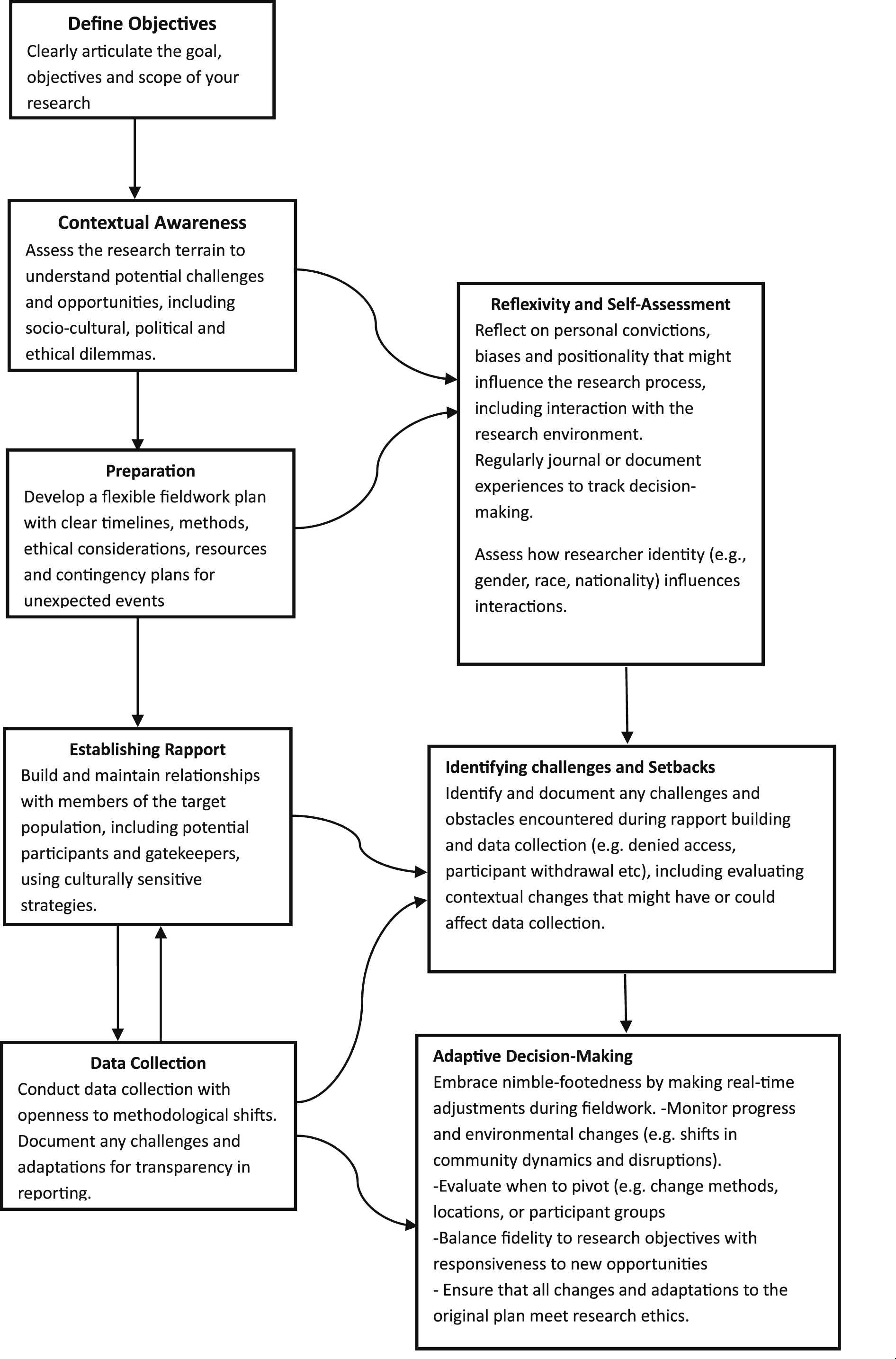

Flexibility as Strength: Embracing Nimble-Footedness in Qualitative Research
By identifying recurring themes in our findings—such as cultural sensitivities, stigma, trust and rapport building, adaptability, ethical considerations, power dynamics, and the role of gatekeepers and informal networks—we demonstrate the practical utility of nimble-footedness. This underscores the strength of qualitative research, which lies in its inherent flexibility, enabling researchers to refine their approaches and incorporate unanticipated insights as they emerge.
A total of six themes are discussed as pointed above. Across these themes, the researchers’ capacity to employ nimble-footedness was instrumental in facilitating participant recruitment, data collection, and ethical engagement, underscoring its value as a foundational principle in qualitative inquiry within complex cultural landscapes.
Navigating Cultural Sensitivities, Stigma, and Social Barriers in Participant Recruitment
Cultural norms and stigma exert a profound influence on the research process, particularly when exploring sensitive topics such as infertility and male circumcision. These issues are often deeply embedded in social taboos, making open discussion difficult, and participant recruitment especially challenging. Researcher 1’s experience in Bulawayo, Zimbabwe, highlights the complexities of conducting research on culturally sensitive issues within one’s own community. Despite initial assumptions that cultural familiarity and insider status would facilitate access, the researcher encountered significant resistance rooted in the social taboo surrounding infertility, gender, and sexuality. Reflecting on this dissonance, Researcher 1 noted: I initially assumed that being a native of the town … would make it easy for me to access my research participants... However, I soon realised that infertility and sexual and reproductive health issues are considered taboo in the community. These topics are typically confined to discussions among family elders and are treated as private matters. It is particularly unacceptable to address such issues with a woman to whom one is not related by blood and is of the opposite sex. People are often ashamed to be identified as infertile and therefore often secretive. Cultural stigmatisation and patriarchal norms further complicate engaging participants openly. Setbacks were therefore common; potential participants often declined interviews due to personal circumstances and cultural beliefs surrounding pregnancy and infertility.
Similarly, Researcher 4 encountered strict cultural codes among Xhosa men that rendered both participant recruitment and discussions about circumcision nearly impossible without breaching social norms: The cultural code of conduct among Xhosa men restricts sharing experiences related to circumcision with women, foreigners, and younger boys who have not yet undergone initiation.
These experiences underscore the critical importance of cultural sensitivity and adaptability in fieldwork. In response to the challenges encountered, we adopted a nimble and responsive approach, recalibrating our strategies to suit the distinct contexts of our research environments. This involved the use of relational language, the leveraging of social networks, and engagement with respected community figures to mediate access and build trust. Such an approach enabled us to navigate complex cultural terrains while upholding respect for participants’ values and norms. As we articulate: To mitigate participant attrition, I leveraged familial and social networks, made opportunistic use of word-of-mouth through informal conversations and dialogues, and employed relational language characteristic of Zimbabwean cultural norms
1
to facilitate recruitment, establish appropriate boundaries, and alleviate participants’ apprehensions about disclosing their infertility conditions.
Researcher 4 leveraged his social ties to connect with a traditional Xhosa healer who was also a circumcision practitioner, who acted as a point of entrée. After a month of unsuccessful recruitment efforts, I recognised the need to reassess strategies and understand the cultural significance of male circumcision within the Xhosa community. I sought advice from an uncle who had spent more than a decade in Cape Town. Through him I met a well-known traditional healer and gatekeeper in the Xhosa community. The traditional healer's observations were crucial; he clarified that traditional customs and medical male circumcision were inseparable, making it difficult for Xhosa males to distinguish between the two in discussion. The realisation that discussing medical male circumcision carried cultural weight similar to traditional practices highlighted the complexities of conducting research in culturally sensitive contexts. The traditional healer's role as a gatekeeper proved essential in facilitating access to potential participants. He introduced me to a young Xhosa man in Zola Township who became the first participant.
The adaptability, quick thinking, and willingness to revisit strategies highlighted above underscore the potential of social connections and the importance of familial ties, gatekeepers, and word-of-mouth in qualitative research. These approaches effectively mitigate participant recruitment challenges, particularly in culturally sensitive environments where the research topic may be closely tied to cultural practices and taboos.
Trust and Rapport Building: Creating Safe Spaces
Building trust and rapport is foundational to qualitative research, particularly when cultural stigma heightens participant reluctance. Establishing trust required more than ethical assurances – it demanded the creation of intimate, safe spaces for research participants. Researcher 1’s adaptability in adjusting interview settings exemplifies this: The woman clearly stated that her husband would not consent to an interview. She initially arranged for us to meet at her workplace during her lunch break for the interview. However, realising how busy her workplace was, she reconsidered. She also felt that public places like restaurants might risk confidentiality breaches while sharing her infertility journey with me. Recognising the risk of losing a hard-won participant who was willing to share her story, I proposed several location options for the interview, including public library common rooms. However, the participant expressed discomfort with these settings due to concerns about privacy. Ultimately, the interview was conducted in my car, as she feared that holding it in her office or any other public space might compromise confidentiality and the fact that she had agreed to an interview without her husband’s consent.
This illustrates the critical importance of researcher adaptability and sensitivity to participants’ concerns regarding privacy, safety, and stigma. The shift to a private and unconventional setting exemplifies a nimble and responsive approach that prioritised participant comfort, safety, and confidentiality. For Researcher 4, informal dialogue emerged as more productive than structured interviews, offering a more flexible and trust-enhancing mode of engagement. Some individuals expressed concerns about the repercussions of discussing circumcision with an outsider. I found that informal conversations were often more effective than formal interviews in collecting relevant information. This approach demanded patience and adaptability, as I navigated the ethical dilemmas inherent in the study. It was essential to ensure that the participants were fully informed and gave explicit agreement that our conversation would constitute data to be used in the study.
In these accounts, trust-building emerges not as a discrete phase but as a continuous process, requiring agile navigation of field dynamics, ethical considerations, participant safety, gender norms, and complex emotional terrains. It entailed the cultivation of reciprocal relationships grounded in empathy, attentive listening, and cultural fluency. These examples highlight how trust-building requires time, sensitivity, and methodological flexibility. Researcher 3 further emphasises the importance of clear communication to address misunderstandings: I noted that many participants, particularly women, were not fully informed about the research’s purpose, leading to misunderstandings regarding its aims. There were significant misinterpretations of the research title, with some community members assuming it was primarily focused on men. This misunderstanding necessitated a re-evaluation of the communication strategy employed during briefing sessions.
Both ethically and logistically, arranging an appropriate setting for the interview required careful consideration and responsiveness to the participant’s context. In the case of researcher 1, although the participant initially proposed meeting at her workplace during her lunch break, she later reconsidered due to the potential of confidentiality breach. Public venues such as restaurants or public library common rooms were also deemed unsuitable, as she feared they might compromise the confidentiality of her narrative, given the deeply personal nature of discussing infertility. Again, the fact that she chose to speak about such an intensely personal topic without her husband’s consent carried a quiet defiance—one that could have placed her in a vulnerable position within such a deeply patriarchal environment. This experience highlights the importance of flexibility and responsiveness in field-based qualitative research, especially when working with participants navigating sensitive cultural or familial constraints.
Adapting to Unforeseen Challenges: Methodological Flexibility in Action
Fieldwork’s inherent unpredictability demands methodological flexibility, as illustrated by the challenges discussed above. Language can pose significant barriers, while assumptions about identity further complicate data collection. For example, Researcher 2’s encounter with French-speaking migrant bouncers highlights how linguistic exclusion can shift a researcher’s role from active participant to passive observer, underscoring the need for constant adaptation in the field. I recall a memorable encounter with four French-speaking migrants at a nightclub that also served as a restaurant. I had hoped to include their voices in my study, recognising the value of every interaction when researching migrant communities—especially in urban spaces where fluid movement and shifting identities shape everyday life. But the encounter didn’t unfold as I had anticipated: the men were French-speaking migrants from Central and West Africa, and my inability to speak French proved to be more than just a linguistic barrier—it was a profound limitation to the research encounter. To move past this impasse, I turned to an interlocutor within the community who could bridge the language gap. With their support, I remained present and engaged, taking on the role of an attentive observer. I focused closely on the men’s body language, facial expressions, gestures, and tone. Their voices reached me only in fragments, filtered through translation and interpretation, yet I still sensed the emotional texture and atmosphere of the exchange. I had to relinquish control and step back. It was a humbling and instructive moment, reminding me that sometimes the field must lead us, rather than the other way around.
The above experience offered a moment of methodological clarity—it underscored the importance of listening with more than just our ears, and of learning through presence as much as through words in qualitative research.
In research contexts characterised by linguistic diversity and socio-cultural complexity – such as those involving migrant communities – each interaction with a potential participant carries significant ethnographic value. In this particular instance, the researcher’s inability to communicate fluently in French posed a considerable limitation to direct engagement with potential participants. Rather than abandoning the encounter, the researcher strategically employed interlocutors to mediate communication, while simultaneously assuming the role of a reflexive and attentive observer. This methodological shift exemplifies the adaptive responsiveness central to ethnographic praxis.
This episode of linguistic disjuncture highlights the researcher’s capacity to manoeuvre across epistemological and methodological terrains with humility and flexibility. Rather than perceiving the loss of verbal exchange as a methodological failure, the researcher reoriented his approach, privileging embodied presence, non-verbal interpretation, and collaborative meaning-making. In doing so, nimble-footedness is reframed not merely as an adaptive field technique, but as an ethical and philosophical commitment to relationality, co-production, and situated knowledge. Across diverse ethnographic and cultural encounters, the ability to adapt to unforeseen cultural, linguistic, or logistical obstacles emerges as a hallmark of qualitative inquiry, anchoring the concept of nimble-footedness as both a necessary and generative orientation in qualitative studies.
Ethical Considerations and Local Dynamics: Walking the Tightrope
The narratives underscore the ethical dilemmas and unforeseen challenges inherent in qualitative research, particularly in settings where community leaders exert influence over participant mobilisation. In such contexts, researchers must adopt a flexible and reflexive approach to negotiating access, while simultaneously respecting existing local power structures. Ethical considerations become especially salient when engaging with vulnerable populations, as tensions frequently arise in the ambiguous spaces between institutional ethical guidelines and the lived realities of fieldwork. For example, Researcher 4, conducting a study on male circumcision, encountered demands for financial compensation from participants. This scenario highlights the ethical complexities associated with the perceived extractive nature of fieldwork, where participants may feel used or inadequately supported, especially when their engagement does not result in tangible benefits. This is particularly evident in cases involving individuals facing infertility, migration challenges, or other hardships, where participants may reasonably expect some form of help beyond transport reimbursements or compensation for time and resources expended in contributing to the research. Initially, I planned to offer only transport compensation to participants, as it is ethically acceptable that volunteer research participants should not incur any costs or experience harm as a result of their involvement in a research process. However, some participants demanded payment for their contributions after the interviews.
This moment reveals the friction between the expectations of institutional ethics boards’ fieldwork environment and the lived experiences of research participants. Rather than responding with rigid adherence to formal protocol, the researcher adopted a stance of contextual pragmatism – prioritising respect, dignity, and responsiveness over normative practices. In doing so, the researcher was compelled to carefully weigh participant demands against the practical constraints of the research environment, including budgetary limitations, while also considering what would be ethically sensible and justifiable in context. This unexpected turn raised ethical questions about the appropriateness of financial incentives in qualitative research. I ultimately decided to accommodate these demands, reflecting on the need to balance research ethical principles with the realities of the research context. (Researcher 4)
Additionally, Researcher 3 observed significant misunderstandings regarding the scope of the study, particularly among women who believed the research was exclusively focused on men. This perception was reinforced by the community leadership, who expressed concern that the study disproportionately targeted men – an anxiety rooted in the broader national discourse on child marriage, which has increasingly been problematised and, in some cases, led to prosecutions. As a result, local leaders insisted on overseeing participant recruitment, a dynamic that further contributed to the misconception among women that they were excluded from the research. Conducting research on child marriage in the community presented several unexpected challenges. Early on, I realised the strong influence of local leaders could skew participation, as their approval shaped community members’ willingness to engage. To address this, I sought the support of a district administrator, who clarified that the study aimed to understand social patterns—not to criminalise or target individuals. His endorsement helped reduce anxiety among community leaders and fostered a more open environment for participation. However, another challenge soon surfaced: gendered misinterpretation. Some women were hesitant to participate or ask questions, believing the study centered on male perspectives. This misperception stemmed from the way I had initially framed the research, including the study title, which failed to clearly signal that women’s voices were central. Given the disproportionate impact of child marriage on women and girls, this was a serious concern. Recognizing this, I revisited the research design. I revised the title to reflect the involvement of all genders and convened a dedicated community meeting to reintroduce the study. Using gender-sensitive language and speaking directly with women, I clarified that their experiences were vital to the research. These efforts helped correct earlier misperceptions and encouraged broader, more inclusive participation. This experience reinforced that trust-building in fieldwork is an ongoing process. It demands humility, attentiveness, and a readiness to adapt and adjust—especially when initial approaches unintentionally alienate potential research participants.
The above narrative reflects the importance of nimble-footedness as both a methodological approach and an ethical imperative in qualitative research. Faced with the unintended consequence of gatekeeping by local leaders, the researcher demonstrated an adaptive strategy that preserved the study’s neutrality while remaining respectful of community power structures. Rather than bypassing local authority – which could have compromised access and trust – the researcher strategically engaged the district administrator to issue a formal clarification. This action exemplifies what Nyamnjoh (2012) and Chekero (2025) describe as the capacity to navigate the moral and political terrain of the field with sensitivity and responsiveness. It highlights the researcher’s ability to act tactically, akin to what Certeau et al. (1998) defines as “calculated action determined by the absence of a proper locus” – a creative improvisation within institutional and social constraints that enabled the research to proceed without bias or coercion.
Additionally, the gendered misunderstanding of the study’s purpose illustrates the kinds of unforeseen complications that ethnographic fieldwork often presents. Here, nimble-footedness was expressed through reflexive revisions, rethinking the framing of the research itself in response to community feedback. By revising the study title and convening inclusive community dialogues, the researcher addressed issues of exclusion and miscommunication, not through rigid adherence to a fixed design but by fluidly recalibrating it. This responsiveness affirms that qualitative rigor is not compromised by flexibility; rather, it is sustained by it (Demirpolat, 2021). Nimble-footedness, in this context, transcends mere adaptation – it becomes a relational and ethical orientation, attuned to power, perception, and participation in real time. It is this capacity to move with, rather than against, the social current that underpins the success and integrity of community-engaged research.
The Role of Gatekeepers and Informal Networks: Leveraging Relationships
The importance of informal networks and gatekeepers in participant recruitment emerges as a recurring theme across the findings. These narratives underscore how researchers often rely on informal strategies to navigate bureaucratic and cultural barriers that formal channels fail to address. Gatekeepers and community-based networks play a critical role in facilitating access, particularly when institutional procedures prove obstructive. This is evident in Researcher 1’s experience at one of ART clinics, where access to participants was ultimately made possible through the intervention of key gatekeepers within informal community structures. While trying to recruit participants at one of the city ART clinics, I encountered significant bureaucratic hurdles. The clinic director insisted on additional authorisation from the Ministry of Health, citing my lack of affiliation with a local university. This requirement initiated a prolonged process involving multiple visits to various health authorities, including the Ministry of Health and the City Council Health Directorate. Even after securing a letter of research support from the City Health Director, the clinic director refused to display my recruitment posters and maintained that further clearance from the Ministry of Health National Ethics Committee was necessary. In response to these constraints, I turned to informal channels and employed a combination of convenience and purposive sampling techniques. These included word of mouth, chance encounters, snowball sampling, and familial connections, which enabled me to identify potential participants, particularly individuals experiencing infertility.
Likewise, Researcher 4’s breakthrough came only after connecting with a traditional healer through a family member: Through him I met a well-known traditional healer and gatekeeper ... After explaining to me the cultural significance of traditional male circumcision – and the delicate boundary between traditional and medical practices – he agreed to facilitate introductions to isiXhosa men who had undergone traditional circumcision.
This connection underscored the significance of familial ties and word-of-mouth, affirming the centrality of relationship-based recruitment in qualitative research – especially in contexts where formal systems are either inadequate or culturally incongruent. Gatekeepers play a dual role: while they can facilitate access, as seen in Researcher 4’s collaboration with a traditional healer to reach Xhosa men, they can also restrict it, as in Researcher 1’s experience at a city ART clinic. Beyond granting access, gatekeepers often confer legitimacy, enabling researchers to navigate complex cultural hierarchies and social dynamics. The strategic shift to informal networks illustrates the researcher’s nimble-footedness in employing culturally resonant methods to overcome bureaucratic barriers. Ultimately, these examples highlight the importance of trust-building and cultural sensitivity, as strong relationships with gatekeepers enhance both credibility and participant engagement.
Discussion
The cases presented here, primarily conducted in Zimbabwe and South Africa, reveal the inherent challenges of conducting qualitative research in dynamic, culturally sensitive and often unpredictable field settings – contexts that resist fixed blueprints or standardised methods. While the findings may not be directly transferable to less culturally sensitive delineated settings, such as high-income countries, the insights generated offer adaptable lessons for researchers working in diverse sociocultural environments. Shaped by the local cultural and social dynamics, we encountered multifaceted limitations – physical, emotional, and mental – as noted by Owen (2015). Cultural taboos, gendered expectations, and sensitive issues around migration, infertility, cultural circumcision, and the practice of early child marriages, as well as family dynamics constrained open dialogue, particularly among women. This reluctance had the potential to limit participant recruitment and also impact the depth and scope of our understanding of their lived experiences. However, through nimble-footedness, these constraints were tactically transformed into points of entry and participant retention – offering valuable insights into the fluid, context-dependent nature of qualitative inquiry.
Nimble-footedness serves as a unifying framework that weaves together the key themes emerging from this research, enabling the researchers to navigate the intricate interplay of cultural sensitivities, trust-building, unforeseen challenges, ethical dilemmas, and the role of gatekeepers in qualitative research. Across diverse contexts, the researchers employed culturally appropriate and contextually responsive strategies: using relational language and informal recruitment pathways (Researcher 1), adapting methodologies to overcome linguistic barriers (Researcher 2), collaborating closely with traditional gatekeepers (Researcher 4), and revising communication strategies to correct gendered misconceptions (Researcher 3). These practices demonstrate the critical importance of flexibility and responsiveness in ensuring ethical and effective participant engagement – even when faced with stigma, mistrust, or bureaucratic obstruction.
Nimble-footedness, as both a methodological strategy and an epistemological stance, is not merely reactive; it constitutes a proactive orientation toward fieldwork, particularly in complex, multilingual, and culturally layered research environments such as those involving migrant communities. Rather than functioning as a fall-back mechanism in the face of failure or limitation, nimble-footedness anticipates unpredictability and embraces uncertainty as constitutive features of qualitative fieldwork practice. It underscores the necessity of agility, situational sensitivity, and ethical responsiveness as key capacities in qualitative inquiry.
In this view, nimble-footedness allows researchers to navigate structural and relational asymmetries with creativity and care. The field is rarely a neutral or fixed terrain; rather, it is a contested and dynamic space, shaped by power relations, linguistic barriers, and affective resonances. In one instance during fieldwork, Researcher 2 encountered four muscular nightclub bouncers – migrants from Central and West Africa – who communicated exclusively in French. Lacking fluency in the language, Researcher 2 was unable to engage with them directly. Instead of withdrawing from the situation or treating it as a failed data collection opportunity, Researcher 2 adopted the role of an attentive observer, relying on interlocutors for translation while tuning into non-verbal cues such as gestures, facial expressions, and intonation. This shift in engagement exemplified a form of both methodological and epistemological recalibration, which we conceptualise as nimble-footedness—the capacity to move with, rather than against, the grain of unfolding field dynamics, drawing on Nyamnjoh (2015) framing.
This form of adaptability is aligned with Michel de Certeau’s (1998) concept of tactics, which refers to calculated and creative actions undertaken in the absence of institutional or structural power. Certeau defines tactics as “a calculated action determined by the absence of a proper locus” (1998, pp. 35–36), distinguishing them from strategies, which typically operate from a position of hegemonic or institutional authority. In contrast, tactics are improvisational and contextually grounded; they emerge in response to immediate challenges and hinge on the ability to seize opportunities within liminal or constrained spaces. In the field, these tactics are often expressed through subtle decisions – such as altering one’s role from interviewer to observer, switching between linguistic registers, or using affective attunement in place of verbal exchange. As Demirpolat (2021) notes, such tactics are essential tools in research contexts where power is diffused, and access is negotiated rather than guaranteed.
Reflecting on the broader implications of this approach, it becomes evident that nimble-footedness is not a sign of methodological weakness but rather a marker of ethnographic depth and ethical maturity. As Chekero (2025) poignantly asserts, fieldwork is akin to a pilgrimage – an extended journey that tests the researcher’s physical, emotional, and spiritual limits. It pushes one’s sensory thresholds and compels the researcher to engage in a continuous process of reflexive self-interrogation. Similarly, Owen (2015) highlights that the field is not a site of unilateral observation but one in which the researcher is also subjected to scrutiny, destabilising the presumed distance between observer and observed. In this way, fieldwork becomes an immersive process, entangling the researcher’s biography with the lifeworlds of participants and generating what might be described as a fabric of shared experiences.
Researcher 2’s fieldwork experience underscores the ethical and methodological importance of building genuine connections with participants. It highlights the challenges of moving from mere observation to deeper understanding, and critiques extractive approaches by emphasising the imperative to engage meaningfully rather than simply collect data. Nimble-footedness, therefore, entails not only methodological improvisation but also a philosophical commitment to co-production, humility, and sustained presence. It enables the researcher to remain engaged even in moments of rupture or exclusion, whether due to language, culture, or positionality, by embracing alternative modes of knowing and relating.
Ultimately, across various themes of power, positionality, ethics, and method, nimble-footedness emerges as the linchpin of rigorous qualitative inquiry. It is manifested through relational engagement, creative problem-solving, and a deep respect for the intricacies of local contexts. Far from compromising academic rigour, such flexibility reinforces it by ensuring that data collection and analysis remain contextually grounded, ethically attuned, and epistemologically open. In this sense, nimble-footedness is not just a technique but a necessary condition for meaningful qualitative inquiry in an increasingly complex and interdependent world.
Trust is not given freely in the field; it must be tactically built, particularly when researchers are perceived as outsiders. As Goffman (1959) suggests, fieldwork involves managing performances, navigating when to be visible or invisible, assertive or deferential. Researcher 2 assumed his foreign status would enable rapport with migrant communities but found himself viewed with suspicion. This required him to tactically alter his performance, gradually building trust through the use of interlocutors and shared experiences. Demirpolat’s (2021) metaphor of the housewife navigating the supermarket – carefully balancing needs, preferences, and resources – aptly captures the improvisational nature of rapport-building, returning and recruiting participants.
Researchers 1, 2, and 4 each encountered forms of exclusion and marginalisation, illustrating that the field is not a neutral space but one saturated with borders – social, cultural, and political (Savin-Baden & Major, 2010). Our reliance on informal networks and gatekeepers, illustrates these tactical manoeuvres. While familial ties and word-of-mouth strategies were indispensable for navigating the field, they simultaneously introduced limitations by shaping the narrative scope and participant diversity. These networks, reflective of deeper cultural and fieldwork politics, both enriched our engagement with our research communities and revealed the constraints of conducting research in contested and highly cultured spaces. In this sense, our methods were not strategic in the traditional institutional sense, but rather tactical: emergent, responsive, and artistically attuned to the twists and turns that constrained our daily fieldwork lives (Demirpolat, 2021). Thus, what might initially appear as methodological or study weaknesses comes through as tactical enactment, expressions of researcher adaptability and embeddedness and forms of nimble-footedness that allowed us to infiltrate complex spaces piece by piece (Certeau, 1998), capturing insights that would otherwise remain inaccessible through rigidly planned research strategies.
Ethical research in sensitive contexts involves constant recalibration. Researchers must respect local norms while also safeguarding participant welfare and data integrity. This balancing act is tactical: rather than imposing ridge blueprints, researchers negotiate with community expectations and cultural taboos, often in real time. Requests for incentives in the Xhosa male circumcision study, as illustrated by Researcher 4, exemplify the ethical and practical dilemmas researchers face when navigating between institutional protocols and the complex realities of fieldwork. The deployment of incentives, particularly in health-related research and interventions targeting specific populations, has been widely examined (Gagnon et al., 2020; Roa & Biller-Andorno, 2022). Gagnon et al. (2020) found that incentives are often effective precisely because they “bring people through the door.” However, the study also cautioned that such approaches must be carefully managed to avoid unintended consequences. Researchers employing incentives are thus urged to implement strategies that anticipate and mitigate these potential challenges.
By embedding ourselves in the rhythms and relational dynamics of the communities we studied, and by responding thoughtfully to emergent challenges, we offer a vital set of lessons for qualitative fieldwork: that adaptability, when grounded in ethical reflexivity and cultural humility, is not only necessary but foundational to meaningful research.
Conclusion
This study presents a unique and nascent contribution to the growing body of work on the lived realities of qualitative research. It departs from conventional, idealised accounts of fieldwork, and instead foregrounds the entangled, unpredictable, and often chaotic experiences of novice social science researchers. By centring reflections from early-career scholars working across diverse contexts, the study brings into sharp relief the ethical, emotional, and methodological challenges encountered in real-time, beyond what is often accounted for in textbooks and ethical review protocols. These reflections make visible the invisible labour of qualitative research, offering rare insights into the affective and improvisational demands that shape research outcomes.
Crucially, the concept of nimble-footedness anchors this study’s epistemological and methodological intervention. As applied here, nimble-footedness is not merely a metaphor, but a critical lens through which to understand the kinds of agility, responsiveness, and ethical attunement required in qualitative inquiry. The graduate researchers’ experiences reveal that rigid adherence to pre-designed research plans is often unfeasible. Instead, the ability to pivot, recalibrate, and reimagine one’s role in the field emerges as an essential form of scholarly competence. Nimble-footedness, in this sense, is not an exception to the norm, but the norm itself – especially in contexts marked by cultural complexity, political volatility, and precarious access.
This study adds value to social science research by offering a grounded vocabulary and practical framework for conceptualising qualitative research as an evolving practice rather than a static methodology. It challenges dominant paradigms that treat research processes as linear and controlled, and it calls for an academic culture that embraces rather than erases the messiness of fieldwork. In doing so, the study affirms the importance of training and supervision models that prepare researchers not just for technique, but for the uncertain and ethically charged nature of social inquiry. It pushes for a shift in how we teach, mentor, and write about qualitative research – moving toward a more honest, situated, and reflexive pedagogy.
Ultimately, the study’s originality lies in how it elevates the experiential knowledge of novice researchers and theorises it through nimble-footedness. This theoretical framing provides a fresh vocabulary for navigating uncertainty in the field and offers a timely corrective to overly rationalised and depersonalised accounts of research. By legitimising the emotional and improvisational dimensions of qualitative research, the study opens new avenues for methodological innovation and enriches the ongoing conversation on ethics, power, and positionality in the social sciences.
Footnotes
Acknowledgments
We would like to express our sincere gratitude to our supervisors for their guidance and support, which have played a pivotal role in shaping us into the academics we are today. Gerald Mabweazara, the first author, received a PhD scholarship funded through a Royal Society of New Zealand Marsden Fund Grant (VUW1826), which supported the research reported in this study.

Ethical Considerations
The first author received ethical approval from the Victoria University of Wellington Human Ethics Committee (approval number 0000029687) on August 24, 2021. The second authors, Tamuka Chekero and Tendai Elvis Mutembedza, obtained ethical clearance from the University of Cape Town—Chekero from the Anthropology Department (reference number EARC2018-30) on May 14, 2019, and Mutembedza from the Ethics Review Committee of the Faculty of Humanities (reference number PSY2019-065) on August 13, 2020. The final author, Pakhani Mhazo, received ethics clearance from the University of Cape Town’s Sociology Department Ethics Review Committee (reference number REC2016/04) in April 10, 2016.
Author Contributions
The first author conceptualised the study, wrote the initial draft, and invited the other authors to contribute. The second authors revised the draft for publication, while the third author provided data, revised the flowchart and contributed their section of the study.
Funding
The authors received no financial support for the research, authorship, and/or publication of this article.
Declaration of Conflicting Interests
The authors declared no potential conflicts of interest with respect to the research, authorship, and/or publication of this article.
Data Availability Statement
The data for this manuscript is available from authors upon request.