




Abstract
‘I am’ Digital Stories are short, 3-5 minute videos that are co-constructed with autistic children and families to provide a more holistic, strengths-based representation of them in support of transitions within or between schools. These Stories provide counter-narratives to the often deficit-focused accounts that accompany children through their school life and are intended to help to introduce who the child really is beyond paper-based descriptions of their needs and difficulties. Inspired by Lambert’s digital storytelling tradition, the ‘I am’ Digital Stories methodology has been developed to support the diversity of voices of autistic people to be heard including those who may be ‘unvoiced and differently voiced’. As an arts-based method within a participatory research approach, the ‘I am’ Digital Stories take a strengths-based stance towards supporting understanding and awareness of children beyond the labels of difference that are attached to them. While there has been more research in health-oriented spheres that uses digital storytelling methods, there has been less within education and specifically in co-construction with autistic children and young people. A recent review of the digital storytelling literature published in this journal concluded that there is a lack of detail and description of the theories, frameworks and models that underpin research applying this method, and a lack of consideration of ethical issues. Our paper seeks to provide detail on these aspects with the aim of contributing to the strengthening of the evidence base in this area. Specifically, we frame ‘I am’ Digital Stories as a praxeological methodology that includes consideration of power redistribution, reflection and action with others, values and ethics, non-orthodox methods, and pathway to impact. We conclude that the ‘I am’ Digital Stories methodology is powerful for sharing autistic ways of knowing about the world that actively tackle marginalisation.
Introduction
Digital storytelling is an arts-based, participatory approach to enabling people to share and document their experiences and identities in supportive and empowering ways (Gubrium, 2009). Based primarily on the work of Joe Lambert and colleagues at the Digital Storytelling Centre (Lambert, 2010, 2013), the idea draws upon the ancient storytelling traditions of different cultures to share knowledge about experiences in ways that do not rely on more formalised knowledge, usually expressed via written words or reports. There is powerful history and value in these traditions as Lambert (2010, p. v) suggests: ‘In the tremendous oral traditions of African and Jewish cultures, there is an assessment of storymaking and telling that is synonymous with the value of life itself. Story is learning, celebrating, healing, and remembering.’
Weaving images, sounds, and words using digital technologies, digital stories are typically short videos around 3-5 minutes long that are curated with and by individuals to explore the meaning of (often) marginalised identities and experiences. For example, Vivienne and Burgess (2012, p. 375) supported a group of ‘queer storytellers’ to create and share digital stories about their navigation of stigma, pride, and activism; and Edmonds et al. (2016) facilitated young Aboriginal people from southeast Australia to explore their experiences and identities via digital storytelling. Described as a ‘respectful, participatory research practice’ (de Jager et al., 2017, p. 2548), digital storytelling is aimed at redressing inherent power imbalances between researchers and the researched in more traditional research methods. This is because those creating stories can contribute knowledge in a range of ways and from their own perspectives that is, the stories are self-representations told ‘from the inside out’ (de Jager et al., 2017, p. 2550), rather than determined by researcher-led agendas and assumptions. The approach to digital storytelling by Lambert and colleagues (2010) typically involves a series of full day, facilitated group workshops to support the planning, filming, editing, and screening of the digital stories, often with some preparation completed beforehand such as bringing photographs, a short summary, or video clips that could be included (Gubrium, 2009). The aim is to create a safe space where often personal and sensitive information is shared and refined into story narratives through a combination of group and more individually based activities (Gubrium, 2009). Davey and Benjaminsen (2021, p. 2) noted that ‘Digital storytelling is as much about the process as it is the product’ since it is within this supportive and group-based approach that collaboration, listening and co-creation takes place.
In systematic reviews of papers reporting digital storytelling methods closely aligned with Lambert (2010) approach, West et al. (2022) and de Jager et al. (2017) highlighted the increase in the use of digital storytelling in research and summarised some of its key strengths. For example, de Jager et al. (2017) identified 25 articles from a range of practice-based contexts including community organisations, education, and nursing. Thematic analysis showed that digital storytelling research mainly included people from marginalised groups and the method was powerful because their perspectives were ‘privilege [d]…as co-constructors of knowledge’ (p.2576). Examples included storytellers who experienced marginalisation due to ethnicity, refugee or immigrant status, homelessness, and HIV status. de Jager et al. (2017) also highlighted the ‘visceral’ and ‘sensory, audio-visual nature’ of digital stories (p.2573-4) as being particularly valuable for enabling the sharing and representation of experiences that would not be amenable or accessible in verbal interviews or text-based (i.e., more traditional) research methods, especially for people with disabilities who may not communicate verbally or in writing. West et al. (2022) identified 46 articles in their systematic review focused on the application of digital storytelling within health research including, inter alia, digital story creation about mental health, trauma and resilience, pregnancy, and cancer. They concluded that digital storytelling was ‘…an empowering and disruptive method … [that is] particularly effective at honouring local and cultural knowledge, and evoking change’ (p.4) and has the potential for ‘challenging dominant discourses and power’ (p.17).
However, de Jager et al. (2017) and West et al. (2022) also highlighted several important gaps in the emerging digital storytelling evidence-base. Both noted its limited use in knowledge translation, advocacy, and impacts on practice despite the method being ‘ready-made’ for such purposes (de Jager et al., 2017, p. 2552). de Jager et al. (2017) argued that this readiness arises because digital stories do not require lengthy analyses before being shared with an audience (academic or otherwise) that is, they speak for themselves (see also Davey & Benjaminsen, 2021). Additionally, West et al. (2022) emphasized the lack of details in the published research about the theories and frameworks used to inform and interpret digital storytelling approaches, arguing that articulating ‘…philosophical positioning is essential for advancing digital storytelling as a rigorous method with a solid theoretical grounding’ (p.18). West et al. (2022) further identified a lack of consideration of ethical issues in most of the papers they reviewed beyond mention of adherence to institutional ethics procedures, and noted that: There remain differing views on whether digital storytelling is a method, a methodology, or both. Future critical analysis should focus on a distinction and careful articulation of the method of digital storytelling and specific methodologies in which to situate this emerging, arts-based method. (pp.18-19)
The synthesis of challenges in this emerging field identified by West et al. (2022) provided the impetus for us to respond based on our own work which has been developed over several years. Accordingly, we present our own approach to digital storytelling with autistic children and young people below, discuss its development and positioning as a praxeological methodology, and critically examine the emerging ethical issues. We start with a brief overview of what we came to call ‘I am’ Digital Stories.
Our Specific Approach to Digital Storytelling: ‘I am’ Digital Stories
We call our specific approach ‘I am’ Digital Stories because the focus is on enabling children and young people to represent ‘who I am’ in their story so that they can introduce their best selves to new people or settings on their own terms (Parsons et al., 2021). Note that we capitalise Digital Stories when talking about ‘I am’ Digital Stories to distinguish them from other forms of digital storytelling reported in the literature. ‘I am’ Digital Stories are also different from digital storytelling examples which focus on the telling of stories in narrative form either about real or fictional events (e.g. Heron & Steckley, 2020; Kucirkova et al., 2014), literacy (e.g. Churchill, 2020; Doak, 2023), or sharing pedagogical practices (Guldberg et al., 2017; Parsons et al., 2015).
Inspired by Lambert (2010), we made adaptations to his method through knowledge co-construction with early years practice (Parsons et al., 2021, 2022; 2023a). With 4-year-old autistic children and their families, it was not feasible to follow a workshop or group-based approach to digital story creation, as in the typical Lambert method (see also Gubrium, 2009). Moreover, the general working principle in most digital storytelling approaches (de Jager et al., 2017; West et al., 2022) is that while individuals within the workshops are facilitated and shape and create their stories with support with story development and editing, they are ‘the narrators of their own experiences’ (Davey & Benjaminsen, 2021, p. 4). This approach would not be appropriate for young children and those who may need more support to share their views and experiences, in line with the requirements of Article 7 of the Convention on the Rights of Persons with Disabilities (CRPD, United Nations, 2006) which mandates that (our emphasis added): States parties shall ensure that children with disabilities have the right to express their views freely on all matters affecting them, their views being given due weight in accordance with their age and maturity, on an equal basis with other children, and to be provided with disability and age-appropriate assistance to realize that right.
Accordingly, our ‘I am’ approach was more individually directed, supporting children, young people, families, and practitioners in a tailored way, and embedded in the everyday practices and curriculum of the nursery or school (Parsons et al., 2021, 2022; 2023b). For example, children’s interactions and play were filmed over several months using camcorders and Wearcams in the context of their everyday activities in the nursery, and practitioners who knew the children well helped to plan which activities could be filmed to ensure a holistic, strengths-based representation of the child. Parents were involved in helping the research team to build a deeper knowledge of the child and provided feedback on draft and final versions of the Digital Stories. These were shared with some of the schools to which children were transitioning from the nursery, though this was not possible in all cases. All parents agreed that their child’s ‘I am’ Digital Story could be shared in the public domain to celebrate their child’s strengths and to promote the methodology as this was something that they experienced as very positive and empowering (Parsons et al., 2021).
The ‘I Am’ Digital Stories Strengths-Based Framework

An ‘I am’ Digital Story is typically structured around a series of ‘I’ statements, or other similar statements that highlight key strengths, interests, and capabilities of the child, interspersed with short video clips and/or illustrative photographs that show them engaged with those interests, using their skills, interacting with others, or where/how they may need support. For example, Oliver was one of the 4-year-old boys we worked with in the early years project (Parsons et al., 2021) whose ‘I am’ Digital Story is publicly available and can be viewed here: https://youtu.be/rNgePt324OE. Figure 1 shows a storyboard of the statements and stills from the video to provide an illustration of the sequence of Oliver’s story. Storyboard showing the sequence of Oliver’s ‘I am’ Digital Story.
While the storyboard shows the overall sequence of the story, the video needs to be seen to be believed as a family member said (Parsons et al., 2021). As well as the activities Oliver enjoys, we see how he initiates communication with other children, his cheeky smile, and playing to the camera. We can also see him wearing clothes with the Batman logo and (often) a baseball hat. We hear Oliver communicating in his own way, giggling, creating imaginary dialogue when playing with dinosaurs, and making communicative overtures to staff and peers. These aspects are all critical for an audience to gain more of an understanding into who Oliver is, and were noted especially by his mother who said in feedback: ‘I think it’s [the Digital Story] much better ‘cause you can get to see the child from their point of view, which is really good, and you can understand them better. From a piece of paper, it doesn’t matter what you write down it still doesn’t… you can’t explain Oliver on a piece of paper. No one ever, ever understands. So, seeing him like that on a screen, you kind of understand a bit more about him actually…’
We have subsequently extended the application of the methodology to include young people transitioning from school to post-18 education and training (Ward et al., 2024) and to adult services (Barron et al., 2024; Lewis-Dagnell et al., 2024). In an Economic and Social Research Council-funded methods-focused study in the UK (Parsons, Kovshoff, Yuill, et al., 2023), we explored the further application and development of the methodology to everyday transitions at school (Glass et al., 2024) and involving families in the creation of the stories for preparing to meet healthcare professionals for the first time. These examples have been successful in supporting knowledge translation, which we say more about below, but first we explain the praxeological framing of our work and what this means in terms of research methodology (rather than method; cf. West et al., 2022).
‘I am’ Digital Stories as a Praxeological Approach to Knowledge Co-construction
In positioning and framing our work as methodology we draw on Pascal and Bertram’s (2012) work in early childhood to argue that our conceptual framework for digital story creation is praxeological (Parsons et al., 2022). Pascal and Bertram (2012, p. 482) define praxeological research as that which: …[first] aims to produce knowledge and actions which are directly useful to a group of people. Secondly, it seeks to empower people to seek social transformation through a process of constructing and using their own knowledge.
According to Pascal and Bertram (2012), praxeological research is concerned with a values-led process of reflection (phronesis) and action (praxis) that takes place collaboratively between research and practice in a way that actively aims to address the power imbalances that arise in the application of more traditional research methods. In this analysis, and in line with Pascal and Bertram (2012), we argue that the adoption of a ‘non-orthodox’ method such as digital storytelling within a more participatory and collaborative research process enables the contribution of different forms of knowledge to the research questions being asked or problem being solved (Parsons et al., 2022, p. 1072). Pascal and Bertram (2012, p. 489) describe non-orthodox methods as those that enable a ‘…wider range of expressive activity’ compared to more traditional methods of research including interviews, questionnaires, and observations. We illustrate next how different forms of knowledge, and access to different perspectives, have been enabled through the creation of the ‘I am’ Digital Stories.
Contribution of Embodied Knowledge by Children
We argue that 4-year-old autistic children, some of whom did not use speech to communicate, were enabled to contribute their embodied knowledge to transition planning in a way that would not usually be possible via written reports, through the use of Wearcam footage (Parsons et al., 2022). In Oliver’s story, introduced earlier, we see and hear him through the Wearcam footage playing with dinosaur toys and creating a dialogue with or for them. We can see and hear him sat in the ‘bat cave’ (a small, covered space amongst the trees) with a staff member, welcoming other children into the space through hand gestures and speech. We also see and hear him struggling to get his meaning across to a staff member and initiating interaction with peers. Powerfully, we hear his communication style and attempts which, as his mother says above, can sometimes be difficult for other people to understand.
Children’s embodied knowledge was augmented by the exemplary (practical) knowledge of parents and practitioners, in conjunction with the more formal, propositional knowledge of the research team to synthesise and transform understandings of the child via the creation of ‘I am’ Digital Stories (Parsons et al., 2022; 2023a). Thomas (2012) argued exemplary knowledge is that which is based on sharing experiences with others to reflect on, and learn from, different perspectives and gain insights into practice that is reflection and action with others (another key element of Pascal & Bertram, 2012, praxeological framework). In other words, it is knowledge co-construction that is essential for the creation of ‘I am’ Digital Stories with typically marginalised children and young people. By marginalised, we mean that autistic children are amongst those whose participation rights are often undermined or ignored due to overly pathologized views of them which frequently deny their rights as agentic ‘knowers’ (Le Francois & Coppock, 2014, p. 166).
Sharing of Different Perspectives Between the Young Person, Home and School
This process of reflection and action with adults who know the child well differs considerably depending on the context, the children, and their families. In Oliver’s case (and the other children involved in that study; Parsons et al., 2021; 2023a), parents and practitioners were closely involved in the co-creation of the ‘I am’ Digital Stories and reflected on what they knew about the children and what they saw in the videos. In this way, authorship of the Stories was distributed (Doak, 2023) between researchers, practitioners and families with the child contributing through their embodied knowledge. This was a powerful part of the process, since sometimes children behaved differently in the nursery compared to at home as Oliver’s mother says: ‘And for us it is really good ‘cause at home I don’t see any of that. Like he does not do any messy play, he does not interact with anyone, he is completely opposite to what he is while he’s here and what he’ll be at school. Yeah, he keeps himself to himself… so seeing it, when you get told that on like a little report it’s’ like ‘Really? Are you really just saying that to make me feel better?’ But when you see it, you actually start believing, actually he is improving. So you get to see a reality of it which is better, which is nice.’
Consequently, the sharing of different perspectives about the same child helped to provide a more holistic view of the child than might otherwise have been available from only the researcher observing the child or only speaking to the parents or practitioners (Parsons, Kovshoff, Karakosta, & Ivil, 2023).
Other examples illustrate how flexibly the methodology can be applied depending on the child or young person at the centre of the Story and the role(s) they can take in their Story creation. In Ward et al. (2024), Lil co-created her ‘I am’ Digital Story with her father after being supported by the research team to think about and apply the ‘I am’ Digital Stories framework to the planning of her story. Lil was 18 years old and making a transition from special school to a post-16 destination over the summer. Lil’s story shows her family and her pets, what she’s interested in (e.g. her favourite TV programmes) and what she loves to do (painting, drawing, poetry). Lil’s story is accompanied by a soundtrack of a song by one of her favourite bands (for which we sought and received permission to use). One of Lil’s ‘I’ statements shown on the screen tells us about the ‘good and bad’ of her autism in her own words (see Figure 2(a)). Screenshots from ‘I am Lil’ showing her description of her autism (Figure 2a) and one of her strategies for managing healthy eating (Figure 2b) (From Ward et al., 2024). (a) The text on Figure 2a says: ‘My autism can manifest in many different ways both good and bad. Example: picking my fingers, eating inedible objects, loving music, playing on my computer load, being obsessive about things like Pokemon etc.’ (b) The text on Figure 2b Says: ‘I find access to healthy snacks helps me to not put inedible things in my mouth and also helps me to concentrate.’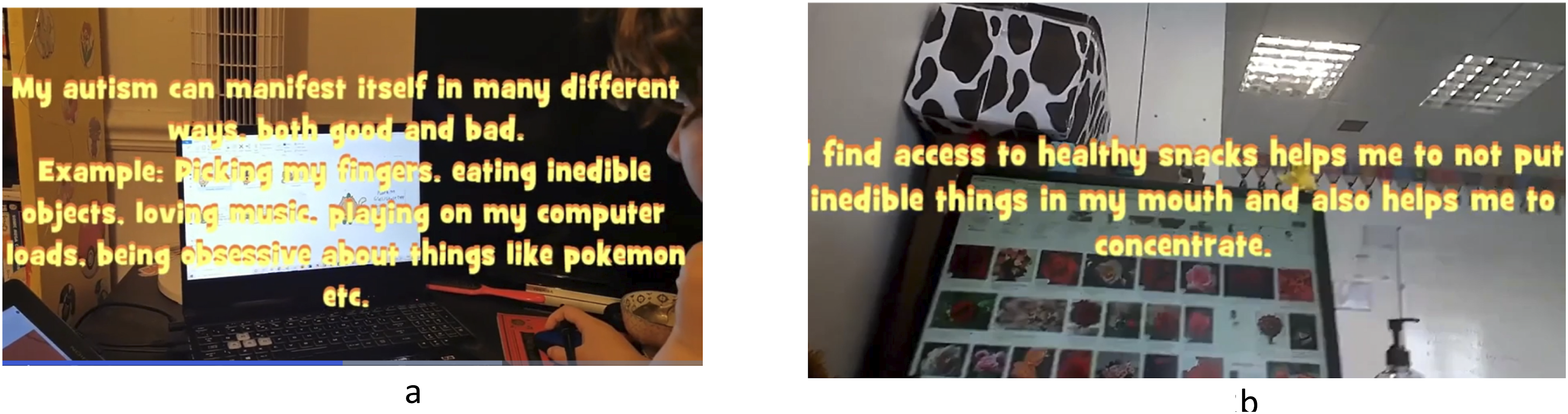
Lil also wanted to show some strategies she puts in place to help her to manage how her autism has an impact for her for example ensuring she has access to healthy snacks so that she does not put inedible things in her mouth (Figure 2(b)). Crucially, this was a carefully considered and implemented strategy by Lil and her father to convey what was important for Lil about her autism and how this can be successfully managed. The story was important to Lil because it showed her strengths and she wanted to share it, as she said in feedback (Ward et al., 2024, p. 785): ‘I think it’s also a good indication of how bold I am as well ‘cause I was never really shy, I was more reserved than anything . . . it was very good and for all its ups and downs it was pretty fun to do and it was such a cool project.’
Dominic’s ‘I am’ Digital Story (Barron et al., 2024) was different, being co-produced by his mother and teaching staff at his school. Dominic is a young man with intellectual disabilities and complex communication needs who was aged 19 years during his transition to adult social care from a special school. Dominic does not communicate via speech or access alternative methods of communication such as Talking Mats or PECS. Consequently, Dominic’s knowledge of himself and the things he likes to do were shown through his embodied interactions and activities in things he enjoys, including spending time on the swing, loving the sensory feel of water, stroking his dog, and using a tablet computer. Dominic’s story included video clips from home and school and so the involvement of his mother in the process was crucial. This co-creation of Dominic’s story enabled both the teachers and Dominic’s mother to gain insights into his strengths and preferences that would not have been available from a single perspective alone (Barron et al., 2024). His Story was also shared with social care providers who felt more prepared to welcome Dominic to their setting. Thus, reflecting and acting together in knowledge co-construction with and for Dominic was central to the creation of his Digital Story and to supporting his transition to adult services. In praxeological terms, we were aiming for social transformation for Dominic and to make a positive impact on his transition experience (cf. Barron et al., 2024; Pascal & Bertram, 2012).
Values and Ethics: ‘I am’ Digital Stories for Enabling Epistemic Justice for autistic Children and Young People
In aiming to make positive impacts on practice, Pascal and Bertram (2012, pp. 485-6) argued that: ...a central feature of praxeological research is a clear and visible ethical code with an underlying value base which is transparent, well articulated and understood by those involved in the action. This ethical code also makes the distribution and use of power within any context a central concern.
Accordingly, it is important for us to be clear about the values that we bring to this work and what motivated us in the first place. Based mainly within educational contexts, our approach to digital storytelling was co-constructed between research and practice to address two main issues. First, there are longstanding challenges in the educational transitions and trajectories of autistic children and young people (e.g., National Autistic Society, 2023; Stoner et al., 2007), for whom social, educational, and employment outcomes remain poor (e.g., Ayres et al., 2018; Reaven, 2011; White et al., 2009). Second, there are strong calls from the autism and research communities aligned with the neurodiversity movement to develop more participatory research approaches that are inclusive of autistic people such that their needs and strengths can be identified, explored, and understood in more effective ways that make a difference to everyday life (Fletcher-Watson et al., 2019; Parsons & Kovshoff, 2019). Our approach therefore involves autistic children and young people, and their carers, in the co-creation of Digital Stories that provide a strengths-based representation of who they are, what they like to do, and what they are good at, to support their transitions between contexts or settings.
As introduced above, the initial development of our methodology began with work conducted in early years settings with young (4-year-old) autistic children whose voices tend to be multiply marginalised within practice and research (Parsons et al., 2021, 2022). Autistic children’s competence to form and express a view is often challenged or undermined by pathologized assumptions and practices that position them as ‘too hard to reach’ (Franklin & Sloper, 2009, p. 4) that is, because they are children with social and communication disabilities. These assumptions mean that autistic children are rarely positioned as capable ‘knowers’ in their lives (Le Francois & Coppock, 2014, p. 166).
While autism is well established as a diverse spectrum of cognitive differences, with communication expressed in a range of ways including non-verbally, there is a stubborn lack of innovation in, and application of, research methods that define ‘voice’ broadly and inclusively, and that adequately enable such a range of voices to be heard (Lewis-Dagnell et al., 2023). Indeed, reviews on the methods used to enable autistic and other neurodivergent people to participate in research overwhelmingly conclude that most use traditional methods such as interviews and focus groups and are targeted at those who are older, more able, and more verbally fluent to the exclusion of those who are younger, have more complex needs, and may communicate in different ways (DePape & Lindsay, 2016; Fayette & Bond, 2018; Nicholas et al., 2019; Tesfaye et al., 2019; Tyrrell & Woods, 2018). The consequence is widespread exclusion in the autism research literature of the voices of younger children (Parsons et al., 2021, 2022), people with an intellectual disability (Russell et al., 2019), and those who are ‘unvoiced or differently voiced’ (Ashby, 2011, n.p.n). There is also prioritisation of bio-medical, scientific knowledge over less formal, phenomenological ways of knowing in the autism research field (Guldberg, 2017; Lawlor & Solomon, 2017). Such a prioritisation tends to position autistic children, young people, and adults as disordered and deficient in research and practice through focusing mainly on their difficulties and challenges rather than their strengths, skills, and capabilities (Pellicano & den Houting, 2022).
Consequently, some scholars argue that there is persistent and entrenched epistemic injustice for autistic people in research which translates into a lack of positive and impactful action to make meaningful changes to services and people’s experiences of them (Catala et al., 2021; Milton, 2014). Epistemic injustice describes embedded discrimination in research, practice, and society against marginalised groups based on perceptions and assumptions about their competence as knowers (Byskov, 2021; Fricker, 2007), and can be based on any personal characteristics including race, gender, disability, sexuality, communication style etc. Epistemic injustice can lead to structural and institutional practices that exclude different forms of knowledge that are considered too hard to reach, such as the ‘persistent reluctance to include autistic people’s testimonies in research or theory about autism’ (Catala et al., 2021, p. 9020). Catala et al. (2021, p. 9035) further argued that research methods based on more participatory approaches, and which enable a range of different modes of expression and interactions with the world, are ‘uniquely positioned’ for providing ‘epistemic enablement’ and, therefore, epistemic justice for marginalised groups. The conclusions from the reviews of digital storytelling methods cited above (de Jager et al., 2017; West et al., 2022) suggest that they could provide a meaningful option for providing epistemic justice for marginalised voices because they allow for knowledge to be expressed in different ways, and we argue similarly in our own work (Parsons et al., 2022).
Therefore, in taking an explicitly strengths-based approach, the ‘I am’ Digital Stories are designed to actively challenge the ‘deficit drenched’ narratives (Parsons et al., 2022, p. 1072) in research and practice that can lead to epistemic injustice for autistic people and align with the strengths-based approach prioritised through taking a neurodiversity lens (Pellicano & den Houting, 2022). This is aligned with one of the central hallmarks of digital storytelling which is to provide a counter-narrative to otherwise dominant ways of thinking about the world (de Jager et al., 2017). In so doing, the ‘I am’ Digital Stories are not just the use of ‘any digital media to tell a story’ (de Jager et al., 2017, p. 2554) but rather, they are particular kinds of video-based story, targeted at surfacing and representing particular kinds of knowledge. Accordingly, we argue that they are specific, values-led representations of the person that use visual media to enable participation and voice; as such, our conceptualisation of an ‘I am’ Digital Story actively eschews the use of video as an observational stance, undertaken with an assumed or aimed-for neutrality (Fassbender, 2021) or transparency (Kindon, 2003).
Overall, we position ‘I am’ Digital Stories as a methodology rather than a method (cf. West et al., 2022), since it is not just about how and what tools are used to create the digital story but also the (praxeological) conceptual framework that supports a participatory process of story co-creation, and a strengths-based framework (‘I am’) that supports the co-creation of the content of the digital story. This combination provides a distinctive point of difference between our approach and Lambert’s (2010) well-established method, as well as those approaches that are more focused on literacy or sharing story narratives or pedagogical practices as noted earlier. Indeed, to the best of our knowledge, our ‘I am’ Digital Stories methodology is unique amongst digital storytelling applications in general and within education specifically. For example, Wu and Chen (2020) conducted a systematic review of digital storytelling in education and identified 57 studies that met their criteria. Most of these focused on pedagogy, which was also sometimes topic or curriculum focused, rather than exploring identity as originally conceived in the Lambert approach. While nine of the 57 articles were identified as focusing on identity formation, for example in relation to race, immigration, intercultural communication, and language learning, the digital stories were mainly used as pedagogical tools for assessment and/or reflection on topic-specific learning. Moreover, none of these nine papers focused on special educational needs or disabilities or on the voices of children and young people for providing counter-narratives to common, deficit-based tropes. Therefore, our ‘I am’ Digital Stories methodology offers a distinctive contribution within the digital storytelling literature.
Redistribution of Power
The redistribution of power within praxeological research is another important feature since ‘…it is action based and transformational for the settings and the people involved in the delivery and receipt of services’ (Pascal & Bertram, 2012, p. 485). Fundamentally, praxeological research as described above requires the active consideration of the roles of different social actors in research processes, the co-construction of knowledge between them, and the use of non-orthodox methods to support the sharing of knowledge that can be expressed in different ways. This is important for our ‘I am’ Digital Stories methodology, which was developed with the aim of centring and promoting the voices and knowledge of those who are traditionally marginalised within research and practice, and recognising the epistemological validity of that knowledge, in whatever way it may be expressed or shared.
This active stance strongly aligns with Freire’s (1970) theoretical positioning that to make changes to a field of activity, knowledge needs to be co-constructed between those who have more power and those who have less. West et al. (2022) noted that some of the authors included in their digital storytelling literature review also applied Freire as a theoretical framework (e.g., Gubrium, 2009), and Low et al. (2012) suggested that Freire is often central to the theoretical framing of participatory video research more generally. Of relevance here is that Freire (1970, p. 31) argued a ‘radical posture’ needs to be adopted such that the more powerful are willing to listen to the less powerful, enter into dialogue with them, and take action. Consequently, the meaning-making we are interested in when creating, applying, and analysing ‘I am’ Digital Stories is fundamentally dialogical since we aim to put the voices of the marginalised in dialogue with others who typically hold more power within the relationship to shift the power differential towards the least powerful (Irving & Young, 2002; Kindon, 2003). In this way, we argue that autistic children and young people can contribute their perspectives to decision-making and transition processes in ways that have hitherto been denied them.
Similarly, Kim (2006) drew on concepts from Bakhtinian dialogical philosophy to explore the different voices of key actors within a case study of alternative education. In writing up the case study, Kim (2006, p. 2) placed the voices of two (typically unheard) students alongside those of school staff to promote a ‘dialogic conversation’ that revealed different tensions and differences between them. In so doing, Kim (2006) argued that the ‘…voices of the marginalised or silenced are promoted and respected’ such that counter-narratives that challenge one dominant view are promoted with ‘equal value’ and ‘compassion’ and ‘taken-for-granted thoughts are disturbed’ (Kim, 2006, p. 6 & 15, respectively). Likewise, Kindon (2003, pp. 143-144) referred to this kind of dialogical approach within participatory video making as enabling a ‘destabilization’ of the ‘conventional relationships of power’. In other words, the voices which are typically overlooked, undervalued, or ignored can be brought into alignment with others, with more power, to challenge the status quo.
In line with this dialogical framing, our own active, non-neutral stance aims to elevate typically unheard voices, however they may be expressed, to a position where they can enter into mutual dialogue with others that is, be seen and heard, with compassion (cf. Kim, 2006). In seeking to challenge the status quo – to be socially transformative in praxeological terms (Pascal & Bertram, 2012) – it, therefore, becomes imperative to show what impact on practice takes place because of more inclusive knowledge co-construction (Plush, 2012). This point comes back to the potential for impact on practice noted earlier within our praxeological framing of the methodology for ‘I am’ Digital Story creation. In other words, we aim for the viewer of the stories to think or act differently because of watching them and we say more about this next.
Knowledge Translation and Impacts on Practice
We argue that in working praxeologically there is a baked in pathway to impact since the people and settings whom the research is aimed at influencing are directly involved (Parsons et al., 2022). This transformative intent for praxeological research was signalled by Pascal and Bertram (2012) who argued that research that connects with practice should aim for, or lead to, ‘profound change’ (p.484). In other words, praxeological research aims to make a difference to practice and to identify what has changed because of doing the research that is ‘How and what knowledge is generated, with whom and with what effects…’ (Parsons et al., 2021, p. 1497). Thus, our ontological position is a relational one since we recognise that there are interdependencies in the creation of ‘I am’ Digital Stories between who is making them, where and how they are made, and with whom they are shared (cf. Evans et al., 2017; Kaptelinin & Nardi, 2012; Plush, 2012). Accordingly, the methodology of ‘I am’ Digital Stories is formed through considering a values-led framework, how that is interpreted and applied by the Story authors, and then how the Story is received, perceived, and interpreted by a viewer or audience (Parsons et al., 2022). In short, we want the viewer or audience to listen and act in response to what they see and hear.
This aspiration is very much in line with de Jager et al.’s (2017, p.2552) argument, noted earlier, that digital stories are ‘ready-made’ for ‘creating positive change’ through knowledge translation of the research into practice. However, both West et al. (2022) and de Jager et al. (2017) also noted there is considerable scope for exploring knowledge translation possibilities further. One example from Sljivic et al. (2022) reported the creation and sharing of digital stories by ten older people (aged 65-91) with 85 younger adults (aged 18-30) and showed that viewing the stories prompted empathy amongst the younger viewers and resulted in positive attitude change towards older people.
In our own research, the co-creation and sharing of ‘I am’ Digital Stories with children and their advocates led to positive changes in attitudes, awareness, and practice. Specifically, ‘I am’ Digital Stories have been embedded in the everyday practices of educational settings due to their participation in the research (Lewis-Dagnell et al., 2024; Parsons et al., 2022) such that Stories were (and continue to be) made for all children requiring person-centred transition planning. As illustrated through Oliver’s mother’s comment earlier, parents said they gained new insights into their children through watching the Stories (Parsons et al., 2021). Likewise, Dominic’s mother commented how she felt more empowered within transition processes because she knew that other people would be able to see more accurately and authentically who Dominic is (Barron et al., 2024). Professionals who viewed the Stories felt more informed in their decision-making about the children and young people (Parsons et al., 2022; Wood-Downie et al., 2021), including tailoring their practices and provision in more informed ways (Barron et al., 2024; Lewis-Dagnell et al., 2024). Children who have created ‘I am’ Digital Stories reported they could authentically represent themselves and be respected as the experts in their own lives; as one child explained ‘…it’s your own little video’ (Brinsmead et al., 2025). However, evaluating the outcomes and longer-term impact of these initiatives remains a major challenge and we agree with West et al. (2022) that a more robust and consistent approach is needed towards collating this data.
The Ethics of Listening: Where to Share and with Whom
Finally, in seeking to make a difference to practice this work inevitably comes with ethical challenges. While our own journey with digital storytelling may be unique to us, the challenges encountered are not unique or specific to ‘I am’ Digital Stories but are reflected in many accounts of participatory research approaches (e.g. Wilson et al., 2018), methods that use film or images with marginalised groups (e.g. Milne et al., 2012; Murray & Nash, 2017; Phelan & Kinsella, 2013), and the involvement of children and young people for whom it may not be feasible to provide fully informed consent (e.g. Water, 2024). In stating that ‘listening is an ethical act’, Irving and Young (2002, p. 23) underscored the power that lies with those who seek to hear what children and young people have to say. For us, the listening is a fundamental part of the creation of the Digital Story as well as where and with whom the Story is shared.
However, we also recognise that in aiming to create an inclusive, dialogical space it is not inevitable that the voices of marginalised children and young people will be recognised, valued, or heard. Indeed, adults still hold the power in terms of their response to what is seen and heard in an ‘I am’ Digital Story; it is their responsibility to hear what is said and take appropriate action (Lundy, 2007). Moreover, as co-constructors of the ‘I am’ Digital Stories framework we, as non-neutral researchers in positions of power, are also shaping and directing the parameters of what is seen and heard within the video (Papadopoulou & Sidorenko, 2022). Additionally, other powerful actors (e.g. those reviewing our work) have an influence in terms of what they consider novel appropriate, and publishable. None of these judgements are value neutral.
In acknowledgement of our own power as neurotypical adults and researchers, we recognise the importance of leadership that works ‘in communion’ (Freire, 1970, p. 114) with marginalised people, thinking with them rather than about them that is, being ‘solidary’ with them (Freire, 1970, p. 31). Here, we align with Kindon’s (2003, p.143) framing of this solidarity in participatory video research as ‘looking alongside’ storytellers rather than ‘looking at’ (more traditionally defined) research participants. More specifically, we recognise that the wielding of (research) power comes with privilege, and it is our responsibility as researchers to use that privilege in ways that promote or ‘liberate’ rather than ‘dominate’ (in Freirean terms, p.113) typically marginalised voices. This is not a privilege we take lightly or a challenge we navigate easily and, in line with others (e.g. Phelan & Kinsella, 2013) we take a deeply reflexive approach to our work. When children and young people are the focus of our efforts there are of course additional layers of ethical consideration that inevitably apply, with which many other researchers have also grappled over time, as noted above and below.
Some of these considerations can be exemplified through the highly contrasting views across different academics and outlets, that we have received about our ‘I am’ Digital Stories methodology. Positively, some colleagues have considered Digital Stories transformative for understanding and promoting children’s perspectives as indicated by those using the methodology within their practice. Contrasting appraisals of this work have considered it ‘patronising’, with some reviewers feeling ‘uncomfortable’ with the ethical implications of real first names and faces of young people being included in published papers. Other comments expressed ethical concerns around children and young people’s ability to consent to filming and sharing of the film. We understand the tensions and debates around the naming and showing of children and young people who are not able to provide their own informed consent for doing so. There are real and understandable concerns about images and videos being exploited or used nefariously (e.g. Nutbrown, 2011); of children growing up and not wanting younger images of them to endure online (e.g. Ferrara et al., 2023); and of adult lenses subverting or dominating young people’s roles and autonomy (e.g. Nutbrown, 2011; Papadopoulou & Sidorenko, 2022). We also appreciate the arguments about limitations relating to children’s capacity as knowers, and that understanding preferences may not be the same as understanding their views (e.g. Ware, 2004).
In response, we argue that the creation of the Digital Story is aimed at creating a strengths-based space for children and young people to be heard in their transitions to schools or adult services, usually in a way that is simply not possible otherwise. The ownership of the story and what happens to it is always placed primarily within the responsibility of parents or carers and so it is their decision whether and how the story is shared, and with whom (including in academic dissemination). Most ‘I am’ Digital Stories are not created for, or intended to be shared within, a wider public domain. Rather, they are produced for and with a specific child or young person, usually to support transition or person-centred planning in real time that is they are not simply research explorations or experiments. Consequently, the main fulcrum for the socially transformative potential of ‘I am’ Digital Stories lies within practice, exactly as a praxeological approach would require (Parsons et al., 2022; Pascal & Bertram, 2012).
However, as we (as researchers) have developed our ‘I am’ Digital Stories approach, and sought to share examples of implementation, evaluation, and reflection, we have used our own power to bring some Digital Stories into the academic and public domains, where informed consent is an ongoing process and specifically negotiated for different knowledge sharing opportunities. In this way, we operate with ‘shared authority’ (Frisch, 2003, p. 111) with the co-authors of the Digital Story (Doak, 2023) and consider any wider sharing of any Story on a case-by-case basis. If we are serious about challenging epistemic injustice, then we argue there is an ethical imperative on us to put some example ‘I am’ Digital Stories in dialogue with wider audiences to promote and engage in relevant debates. In doing so, we navigate a balance of risks between voice and visibility on the one hand, and vulnerability and privacy on the other (Miller & Smith, 2012), while always putting children’s safety and dignity first. In seeking epistemic justice for and with autistic children and families, we do not think it would be appropriate for us to only write about their/our experiences with this methodology and what we find out or show selected still images from the Digital Stories (cf. Phelan & Kinsella, 2013). Crucially, given all that we have said about taking an active stance within our research, it is vital to us that children and young people’s voices are seen and heard and have the power to influence change, including within research practices. Overall, in balancing the risks we ask ourselves the reflexive question: do the benefits of showing an individual within an ‘I am’ Digital Story outweigh the risks of not doing so? Given that our methodological approach inherently focuses on a strengths-based approach, and reporting on the real benefits in transition experiences and outcomes that have been evidenced, we argue that the risk to benefit ratio is weighted in the favour of the person featuring in the Digital Story. We also acknowledge that there is room for further strengthening of ethical oversight and input in this area through the inclusion of an advisory board (e.g.) that could include young people, friends and families.
Moreover, given that we argue that ‘I am’ Digital Stories are particular kinds of story, we do not feel it would be appropriate to put edited, pixelated or précised versions in the public domain (as another reviewer suggested) based on assumptions we might make about what a wider audience may find interesting, palatable, or patronising. To do this would be, in Nutbrown’s (2011, pp.8-9) words ‘a lie’ because: ‘Pixilation [sic] takes something drawn from a life truth (the face of child covered in paint, the toddler with paint all over her legs) and turns it into a lie. Images thus manipulated tell lies about the research and the researched.’ Furthermore, she argues that: …if still and moving images of children are distorted in, or even omitted from, research reports (in an attempt to protect identities), there is a danger that the potential for arts-based enquiry is closed down… (Nutbrown, 2011, p.9)
To state an obvious though important point: if we want to show what an ‘I am’ Digital Story is, we need to show examples of ‘I am’ Digital Stories when reporting on our research to contribute to knowledge production and debates about how we navigate the balance between ‘child safety, dignity and voice’ (Phelan & Kinsella, 2013, p. 89).
Conclusions
In response to the challenge from West et al. (2022) for researchers to be clearer about their philosophical and theoretical positioning in digital storytelling research, and whether the approach taken is a method, methodology or both, we have presented details of our own methodological approach for creating ‘I am’ Digital Stories which is framed in praxeological terms. This praxeological framing requires us to be explicit about values and ethics, the importance of knowledge co-construction within practice-based contexts, redistribution of power, the use of a non-orthodox digital storytelling method, and the potential for making a difference in practice. We also reflected on the ethical challenges involved in taking such a ‘radical posture’ (Freire, 1970, p. 31) and highlight the importance of balancing risks within this work. It is not easy to do, but the feedback from practice demonstrating the power and value of ‘I am’ Digital Stories for changing thinking and practice encourages us to continue to research with deep reflexivity. In so doing, we have aimed to share a theoretically informed account of what the ‘I am’ Digital Stories help us to do or know more about in both practical and research terms, thereby strengthening the claims we are able to make about this. In agreement with West et al. (2022) we also know that there is a long way for us (and the field) to go in further specifying important details of digital storytelling research including ethical considerations and data analysis, which we will aim to do in future writing.
Footnotes
Acknowledgements
Thank you to the rest of the ‘Our Stories’ research team for your inspiration and collaboration: Professor Nicola Yuill, Dr. Asha Ward, Dr. Samantha Holt, and Dr. Devyn Glass. Thank you to all of our ACoRNS team for ongoing support and allyship.
Ethical Considerations
No new empirical data is reported, but all cited and published studies that apply the ‘I am’ Digital Stories methodology have undergone appropriate, formal ethics review from relevant institutions.
Consent to Participate
The methodological protocols for informed consent, video content creation, evaluation, and analysis are available via the UK Data Service: https://reshare.ukdataservice.ac.uk/856097/. Further information about the ‘I am’ Digital Stories methodology is also available via the National Centre for Research Methods: 
Funding
The author(s) disclosed receipt of the following financial support for the research, authorship, and/or publication of this article: This work was funded by the Economic and Social Research Council (ESRC) [ES/V005286/1] whose protocol is published in the journal: Parsons, S., Kovshoff, H., Yuill, N., Glass, D., Holt, S., Ward, A., Barron, C., & Ward, R. (2023b). ‘Our Stories...': co-constructing Digital Storytelling methodologies for supporting the transitions of autistic children - study protocol. International Journal of Qualitative Methods. 22, 16094069221145286. https://doi.org/10.1177/16094069221145286
Declaration of conflicting interests
The author(s) declared no potential conflicts of interest with respect to the research, authorship, and/or publication of this article.