




Abstract
When newly qualified midwives in Germany commence work in free-standing birth centres, a setting dissimilar to the hospitals where they trained, they undergo a period of orientation in which they must broaden their skills and knowledge. Using a hermeneutic phenomenological framework, this study explored their skill and knowledge acquisition in the first 9–12 months using two methods of data collection—voice messaging and interviews. As there appeared to be important differences in what was shared using these different methods of data collection, further analysis was undertaken. This paper presents a secondary analysis of a larger study on the training of newly qualified midwives in out-of-hospital birth settings. In this secondary analysis, the aims were (a) to compare and identify distinct aspects of the same lived experience as they were revealed in different forms of data collection; and (b) to draw on philosophical inquiry to deepen our understanding of professional learning and identity formation for newly qualified midwives. Participants included fifteen newly qualified midwives who were each interviewed three times in their first year working in a free-standing birth centre. In addition to this, they also left a total of 123 voice messages, in which they shared emotionally profound experiences. Data analysis focused on exploring the similarities and differences of the same stories of attending a birth told through voice messaging close to the actual experience and again in an in-person interview up to several months later. Voice messaging captured immediate, visceral reactions. The unstructured interviews revealed reflective, contextualised perspectives, bringing social, environmental, and wider contextual factors into view. Together, these findings show how temporality and data collection method shape the disclosure of meaning in lived experience and illustrate the value of using multiple methods to expand interpretive depth in hermeneutic phenomenological inquiry. This research advances hermeneutic phenomenological research methods by demonstrating that multiple methods of data collection can provide distinct layers of meaning in lived experience accounts.
Keywords
Introduction
Skill Acquisition of Newly Qualified Midwives at Out-of-Hospital Births
In high-income countries, midwifery students primarily gain clinical experience in hospital labour wards, where technological monitoring and interventions are routine (Licqurish, 2013; Lukasse et al., 2017; Migura, 2024; Schytt & Waldenström, 2023). This reflects a highly medicalised and risk-oriented approach to childbirth, where continuous surveillance and standardised procedures are prioritised (O’Connell & Downe, 2009; Scamell, 2011). In contrast, in out-of-hospital settings, such as free-standing birth centres and home birth, client-centred decision-making and a low-intervention approach to birth are prioritised (Coddington et al., 2020; Rocca-Ihenacho et al., 2021; Stone et al., 2023; Walsh, 2010). Because the clinical training that student midwives experience in hospital labour wards shapes their professional development (Surtees, 2008), when they transition to providing care in out-of-hospital settings, they must adapt to an environment where clinical assessment and care is markedly different. Coddington et al. (2020) metaphorically described this shift in their study of experienced midwives transitioning from hospital to home birth care as learning to “see birth in a new light” (p. 3). Along with adopting a new approach to care in out-of-hospital settings, midwives must also enhance specific skills, including observational skills, hands-on techniques to facilitate empirical assessments, responsiveness to maternal cues, and intermittent auscultation of fetal heartbeats (Coddington et al., 2017; Hunter et al., 2018; Stone et al., 2024). These differences underscore the rationale for an orientation period to support newly qualified midwives in adapting to out-of-hospital care.
Despite the extensive body of research on midwifery education and transitions into professional practice, studies have focused on newly qualified midwives working in hospital labour wards (Clements et al., 2012; Hobbs, 2012; Kool et al., 2020; Skirton et al., 2012; van der Putten, 2008). Existing literature highlights common challenges, including the shift from supervised training to independent practice (Clements et al., 2012; van der Putten, 2013), the need to develop confidence in clinical decision-making (Skirton et al., 2012; Young, 2012), and the role of mentorship in easing this transition (Hughes & Fraser, 2011; Kool et al., 2020; Skirton et al., 2012; van der Putten, 2008). Research also emphasises the emotional toll (Fenwick et al., 2012), with one study identifying reality shock as a common experience for newly qualified midwives (van der Putten, 2008). However, little is known about the experiences of newly qualified midwives in their first year of practice in out-of-hospital settings. This is the first study to explore how they are oriented in their first year of practice in these settings.
While there is a growing body of work using hermeneutic phenomenology in applied research, little attention has been given to how different data collection methods shape the disclosure of lived experience. This is especially relevant in practice-based fields such as midwifery, where immediate and reflective forms of expression may reveal distinct aspects of professional becoming. At the same time, the experiences of newly qualified midwives working in out-of-hospital settings, such as free-standing birth centres, remain underexplored in the literature. This study addresses both gaps by comparing voice messages and interviews as means of accessing lived experience, offering methodological insight into how temporality and data collection method influence interpretation, and empirical insight into how early professional identity is shaped in out-of-hospital birth settings.
Historical Foundations of Phenomenology
Phenomenology originated as a philosophical tradition rather than a research methodology, with its foundations in the work of Edmund Husserl. Husserl, regarded as the father of phenomenology, aimed to create a rigorous science of the structure of consciousness that stood apart from the methods of the natural sciences. While in his early work, he was engaged with the natural sciences and mathematics, he critiqued their assumptions and emphasised the need for a different epistemological approach that focused on how phenomena are experienced in consciousness (Zahavi, 2019). Husserl ultimately integrated his early work into his development of phenomenology, not as a rejection of the natural sciences, but rather as a critique (Sokolowski, 2000). With his method, particularly through epoché (bracketing), he sought to set aside or bracket subjective-based judgements regarding the existence of the external world to examine the structure of consciousness (Zahavi, 2019).
The trajectory of phenomenology underwent a significant transformation with Martin Heidegger, a student of Husserl, who shifted the philosophical project of phenomenology from its focus on the structure of consciousness to an exploration of the meaning and structure of Dasein, a term used by Heidegger as another name for human being, which is often translated as ‘being-there’ (Dreyfus & Wrathall, 2005; Zahavi, 2019). Unlike Husserl, who examined the structure of experience by analysing how consciousness constitutes meaning, Heidegger explored the existential structure of Dasein, focusing on the ways in which meaning emerges through lived engagement with people and things in historical contexts (Heidegger, 1962/2001). Whereas Husserl approached phenomenology as a science of consciousness, Heidegger sought to uncover the ontological structures that condition human existence. Heidegger identified three key modes of existence: presence-at-hand, readiness-to-hand, and Dasein – existence itself. Presence-at-hand is how objects can be viewed objectively, theoretically, or detachedly. For example, when a tool we are using breaks, it becomes an object to be studied and mended. Readiness-to-hand relates to how things are ready or available to be used, such as using a pen, doors, windows, or tools, with no consideration of their purpose. Heidegger also describes existentials - the fundamental conditions of Dasein’s existence - such as ‘being-in-the-world’, ‘being-with’, and care.
According to Heidegger, Dasein is never separate from our lifeworld, rather we are always situated within a historical and contextual framework (being-in-the-world) with others (being-with) (Dreyfus & Wrathall, 2005). A key existential of Dasein for Heidegger is temporality. This is where time is not a succession of moments, but a fundamental structure through which we experience and understand Being. For Heidegger, Dasein does not exist in time - Dasein is time as our past, present, and future are fundamentally intertwined. These existentials are not given but always already shape how Dasein encounters meaning (Zahavi, 2019). Heidegger’s shift from a focus on consciousness to a focus on existence reflects his argument that meaning is not constructed in the mind but emerges through Dasein’s embeddedness in a world of relationships, practices, and possibilities. Heidegger employed the term Dasein as opposed to consciousness to emphasise Dasein’s location in the world, thereby setting aside notions of “inner” and “outer” (Zahavi, 2019, p. 24). Heidegger wrote in Being and Time: “When Dasein directs itself towards something and grasps it, it does not somehow first get out of an inner sphere in which it has been proximally encapsulated, but its primary kind of Being is such that it is always ‘outside’ alongside entities which it encounters and which belong to a world already discovered” (1962/2001, p. 89/62).
Hence, whereas Husserl sought to develop a science of the structure of consciousness, Heidegger explored the ontological structures that make meaningful engagement with the world possible. The current study was grounded primarily in Heidegger’s focus on Dasein and being-in-the-world; however, Husserl’s foundational contributions to phenomenology, particularly in their attention to lived experience as a source of meaning, must be acknowledged. Together, these perspectives informed the study’s focus.
Key Philosophical Concepts Relevant to the Study: Life-World and World
Husserl referred to the world we inhabit as the Lebenswelt or life-world. Life-world denotes the everyday world of lived experience, the world that is directly encountered by human beings before scientific and theoretical abstraction (Todres & Wheeler, 2001). Husserl emphasised that meaning originates in pre-theoretical experience and maintained that the search for the structure of consciousness should emerge from a-theoretical insights revealed through direct experience, rather than from pre-existing theoretical constructs (von Herrmann, 2000/2013). In the exact sciences, the attempt to objectively describe objects and processes in the world has resulted in two distinct realms: the theoretical, objective world, which is constructed, in part, through scientific abstraction, and the everyday, lived world of experience (Sokolowski, 2000). With the theoretical objective world, objects are reduced to their components, such as atoms or measurable and describable attributes, and then reified within theoretical frameworks. However, from a phenomenological perspective, humans do not live in theoretical abstractions, therefore the intention in phenomenology to go “back to the things themselves” (Husserl, 1900/2001, p. 88).
Heidegger employed the term ‘world’ (Welt) as opposed to life-world in a more ontological sense, emphasising Dasein’s existential engagement with the world as a fundamental structure of Being, rather than the every-day experience of consciousness emphasised in Husserl’s philosophy (Inwood, 2000). In Heidegger’s interpretation of world, the focus was on the conditions that make understanding possible in the first place. Human beings are thrown into a world that is not of their making. Meaning emerges as people engage with the world and with each other, situated within a tapestry of relationships, tools, and practices (Inwood, 2000; Suddick et al., 2020). Sheehan wrote: …“World,” when viewed statically and intransitively, is the place of meaningfulness. But viewed dynamically and transitively, it is the placing of things in meaning, the enworlding and contextualising of them within a set of possibilities that makes things able to be known and used in terms of those very possibilities” (2005, Loc. 3601).
In this study, the concept of life-world was built on through the use of voice messaging to capture pre-reflective experiences, emphasising the immediacy and emotional depth of participants’ accounts, aligning with the phenomenological aim of ‘going back to the things themselves.’ In parallel, Heidegger’s notion of Welt, which emphasises Dasein’s relational engagement with the world as a fundamental structure of Being, was disclosed in the analysis of newly qualified midwives’ interviews. This perspective facilitated a profound exploration of how their experiences were situated within a broader tapestry of social, relational, and existential contexts. Together, these concepts shaped the study’s design, fostering an approach that respects both the immediacy and the contextual depth of lived experiences, while adhering to phenomenological principles.
Critique and Contemporary Applications of Phenomenology
Lived experience descriptions are a fundamental source of data in phenomenology as a methodology, since experience is considered to be where meaning is made and is, consequently, the foundation for phenomenological understanding (Van Manen, 2014). Lived experience can be anything from riding a bicycle with a son (Van Manen, 1990/2016), having a good birth after having experienced a traumatic birth (Thomson & Downe, 2013), experiencing the lived space of an acute stroke unit as a stroke survivor (Suddick et al., 2021), or the experience of joy at birth (Crowther, 2020). Phenomenological research primarily uses lived experience stories as a means to interpret an individual’s experience of the phenomena under study, disclosing e.g. context, history, relationships, mood, and embodiment (Van Manen, 1990/2016), and has been widely utilised in healthcare and midwifery research (Angel, 2022; Bradbury-Jones et al., 2010; Crowther et al., 2015; Crowther et al., 2018; de Los Angeles Linares-Gallego et al., 2025; Feeley et al., 2022; Smythe, 2010; Smythe et al., 2016; Spence & Smythe, 2007; Spence & Smythe, 2008; Suddick et al., 2019).
Van Manen (2014) discussed the complexity of phenomenology, emphasising its aim to gather lived experience descriptions that reach a level of embeddedness in everyday experiences, while recognising that this act is inherently shaped by thought, language, and traditions. Lived experience, though directly encountered, is mediated by the very processes used to access it. Reflecting on lived experience is challenging because the act of investigation can turn it into an object, stripping it of its rich, nuanced, and unfathomable depth. Despite this, phenomenology encourages the study of even the most mundane and taken-for-granted experiences—such as driving or walking—revealing that the everyday is far more complex and worthy of attention than it might initially seem (Van Manen, 2014, p. 474). Finlay wrote: “The central concern of phenomenological research is a return to embodied, experiential meaning, to seek fresh, complex, vivid descriptions of a ‘phenomenon’ (a human experience in all its complexity) as it is concretely lived” (2009, p. 474). Lived experience is thus the starting point for interpretive reflection and analysis and is always retrospective (Van Manen, 1990/2016), however voice messages, recorded close to the moment of experience, can allay this by capturing immediate impressions and emotional nuances before they are significantly shaped by reflection.
The English expression lived experience is a translation of the German word Erlebnis. In German, two words translate to “experience” in English: Erlebnis and Erfahrung. The word Erfahrung, derived from the root fahren, meaning ‘to travel,’ originally conveyed the sense of a journey, and in Late Old High German, came to mean ‘to get to know’ (kennenlernen) or ‘to discover’ (erforschen) (Pfeifer, 1993, p. 132). According to Burch: “...on the face of it [Erlebnis has] a twofold significance. According to its origin, it connoted what personally and immediately “one experiences for oneself,” apart from all hearsay, conjecture, or imaginative and ratiocinatory constructions, and according to its nominal form, it connoted the persisting content of that experience (das Erlebte)…” (1990, p. 132).
In Being and Time, Heidegger depicted Erlebnis as a fleeting experience that is inner and psychical, and therefore detached from the external world (Inwood, 1999). Paley, referring to Heidegger’s earlier definition of Erlebnis, has criticised the use of lived experience descriptions in phenomenological studies, arguing that such methods largely capture a person’s mental representation of the world and are therefore not aligned with Heideggerian phenomenology (2013). However, Polt followed Heidegger’s development of Erlebnis in his later writings and concluded that, given Heidegger’s way of thinking concerning world, experiences qua Erlebnis are far less detached from the world than he originally thought (Polt, 1999/2004). Polt wrote: “The fact that lived experiences are mine does not mean that they happen within my isolated mind, but that they happen within a world, a there, within which I dwell” (2005, Loc. 6777).
This shift in Heidegger’s perspective supports the idea that lived experiences are fundamentally situated within a shared world, reinforcing the view that lived experience descriptions capture more than mere mental representations. In addition to this, this study directly addresses critiques of phenomenological methods, such as Paley’s argument that lived experience descriptions risk being a reduction of mental representations, by employing a multi-layered approach to data collection. The inclusion of voice messages adds an additional layer, capturing the immediacy and emotional intensity of participants’ experiences shortly after significant events.
Appropriation (Ereignis): Making Something “One’s Own”
In his later work, Heidegger introduces appropriation (Ereignis) as a transformative event in which understanding is reconfigured through lived experience. Rather than an existential structure, Ereignis signifies an act in which meaning emerges through a fundamental shift in one’s relation to the world and the ways in which being is disclosed (Polt, 2005). In moments of heightened intensity—when a crisis or a breakdown in one’s prior understanding of Dasein and beings takes place—a deeper truth can be revealed. Heidegger refers to such moments of appropriation as arising through what he termed in German ‘Not’ (1989, p. 12). The translation of ‘Not’ into English is a central concern for understanding an event (Ereignis) as a situation for appropriation and growth in Heideggerian thought, and as it is applied in this paper. Heidegger’s ‘Not’, was translated by Polt as emergency (2005) and by Emad & Maly and Rojcewicz & Vallega-Neu, translators of Heidegger’s Contributions to Philosophy, as distress (1999, 2012). However, the term ‘Not’ can also be understood ontologically as urgency or necessity, as well as distress. Notably, translation is always an act of interpretation, and Heidegger’s neologisms often reveal layered meanings when engaging with qualitative research data. To paraphrase Heidegger: The truth of being (Seyn) emerges only when urgency, distress, or necessity are revealed in the questioners. They are the actual believers because they open themselves to the essence of truth and bring it forth (1989, p. 12).
A deeper engagement with the notion of ‘Not’ reveals insights into the unfolding of truth as Aletheia in existential moments. The contextual understanding of Heidegger’s term ‘Not’ is pivotal for understanding situations where knowledge that is revealed in lived experience descriptions becomes ‘one’s own’ (ereignen), a moment of belonging to a broader truth, both materially and ontologically. In addition to this, Ereignis indicates a dynamic relationship where world and Dasein are intertwined and inseparable (Polt, 2006). The notion of appropriation occurring in moments of crisis is further developed in this paper to include moments of awe and enchantment, which also characterise a new understanding of Dasein and world.
Voice Messaging to Gather Lived Experience Descriptions
In hermeneutic phenomenology, common methods for collecting lived experience descriptions include e.g., interviews, conversational interviews, and journaling. However, hermeneutic phenomenology is a philosophical approach, and was not initially designed as a research methodology (Smythe, 2011). As such, it continues to evolve. The philosophy is the theoretical standpoint for the methodology, providing a foundation rather than concrete rules for gathering data. Therefore, to allow for flexibility in determining which methods would best capture the lived experience descriptions of newly qualified midwives’ skill and knowledge acquisition at out-of-hospital births, voice messaging, unstructured interviews, journaling, and rapid ethnography were chosen to address the research question. Van Manen wrote: “One needs to guard against the temptation to let method rule the question, rather than the research question determining what kind of method is most appropriate for its immanent direction” (1990/2016, p. 66). Because of the emotional nature of being present at the birth of a baby, the research team agreed that voice messaging could reveal an aspect of skill and knowledge acquisition that has not yet been explored.
Using Smart Phones in Healthcare and Healthcare Research
The use of smart phones in healthcare systems and in health research has a wide range of applications (Istepanian, 2022). Apps can be used to monitor one’s own health and/or send personal data to a healthcare practitioner. Voice messages from healthcare organisations and NGOs have also been used in interventions to communicate with people in at-risk populations (Ong et al., 2020). During the COVID-19 pandemic, smart phone apps were used for contact tracing, as well as to provide proof of vaccination. Qualitative researchers also used smartphones to collect data during the pandemic to avoid the risk of infection (Lupton, 2021; Neo et al., 2022). One qualitative study, underpinned by guerrilla theory, employed an innovative voicemail system to record nurses’ practice experiences during the COVID-19 pandemic, providing a unique approach to capturing lived experiences within nursing practice during this crisis (Dolan et al., 2024).
Messaging apps have also been used as experience sampling methods (ESM) to explore stress and emotion regulation in psychology (Boemo et al., 2024). ESMs have been used with different approaches, including pinging research participants at different times of the day to request a message (Verhagen et al., 2016). Kleinlein (2023), in her study on inclusive education, utilised voice messaging to collect inspirational teaching methods from teachers, labelling the method asynchronous narrative audio messaging.
In this study, voice messaging gave research participants the option to send a voice message to the lead researcher after new or emotionally moving experiences. The advantages of using smartphones to collect data include the possibility for instant messaging, the option for participants to use a pseudonym and block their number, and the capability to reach research participants in distant locations. Smartphone technology in data collection is asynchronous, which means that research participants can send messages 24 hours a day, without disturbing the researcher or research team.
Summary
This study employs a hermeneutic phenomenological approach to understanding lived experience, particularly as it has been adapted within qualitative research. Grounded in Heideggerian concepts of being-in-the-world, it examines how different methods of data collection—voice messages and interviews—disclose distinct aspects of the same lived experience. In addition, this research engages with philosophical inquiry to explore these experiences and deepen our understanding of professional learning and identity formation for newly qualified midwives. In doing so, it extends discussions on hermeneutic phenomenology as a research approach by illustrating the value of combining multiple methods to deepen insight into lived experience.
The Study
Methodology and Methods
Aims
In Germany, where this study was conducted, midwives can choose to work in hospital labour wards or out-of-hospital settings, such as at home births or in free-standing birth centres, upon receiving certification. When newly qualified midwives begin working in a free-standing birth centre directly after certification, they typically undergo an orientation process to develop the skills needed for this setting. Despite the importance of this transition, no study to date has explored this orientation process in this context. The aim of the overarching study, entitled ASK a Midwife, was to explore the lived experience of newly qualified midwives commencing work in free-standing birth centres with an emphasis on their acquisition of skills and knowledge. This exploration was guided by the following research question: What is the lived experience of newly qualified midwives when they commence work in a free-standing birth centre? The aims of this paper were (a) to compare and identify distinct aspects of the same lived experience as they were revealed in different forms of data collection; and (b) to draw on philosophical inquiry to deepen our understanding of professional learning and identity formation for newly qualified midwives.
Research Sites
The research sites were free-standing birth centres in Germany, which vary in terms of geography (city or rural, region of Germany), number of births per year, number of midwives, and type of care (team care or caseload care). There are no standardised guidelines for orienting and familiarising newly qualified midwives in free-standing birth centres, therefore each free-standing birth centre designs their own orientation plan. In addition to births in free-standing birth centres, home births were offered by almost half of the free-standing birth centres where the newly qualified midwives who participated in this study worked. In all of the participating free-standing birth centres, the midwives offered one-to-one care during labour by a ‘primary’ or ‘first’ midwife. During the final phase of labour, a ‘second’ or ‘background’ midwife was present. In the participating free-standing birth centres, the only professionals present at births were midwives.
Participants and Recruitment
The study participants included 45 experienced midwives in 13 free-standing birth centres, as well as 15 newly qualified midwives in their orientation period in a free-standing birth centre in Germany. Inclusion criteria for the newly qualified midwives and experienced midwives were that they had completed their midwifery training in Germany and were certified to practice midwifery in Germany. The additional inclusion criteria for newly qualified midwives were that they had not yet worked as a midwife in any setting since receiving certification and were in the first 6 weeks of their orientation period in a free-standing birth centre. All the participants in the study were >21 years old. Participation in the study was voluntary. None of the midwives or free-standing birth centres received compensation for participating in the study. Further information about recruitment is reported elsewhere (Stone et al., 2023b, 2024).
Data Collection
Data collection methods included focus group interviews, unstructured interviews, instant voice messaging through the Signal app, journaling, and rapid ethnography (3–4 day observation periods in free-standing birth centres). For this paper, the authors have included the findings from instant voice messages sent by newly qualified midwives and the unstructured interviews with the newly qualified midwives. The research team considered that collecting data through voice messaging, in tandem with unstructured interviews, provided research participants the opportunity to share both pre-reflective and reflective lived experiences.
The justification for the use of voice messaging in this study lies in its unique capacity to capture the immediacy of participants’ lived experiences close to events, revealing the everyday, albeit highly emotive experiences of newly qualified midwives. In line with the phenomenological commitment to accessing experience before it is fully reflected upon, voice messages allowed participants to express themselves spontaneously, often while still situated in the emotional or embodied aftermath of a birth. This method provided access to aspects of experience that may otherwise become concealed or reinterpreted over time. In comparison, conducting interviews over the period of 9–12 months complemented this by providing a wealth of reflected and rich lived experience descriptions, which, as Van Manen has discussed, reveals the latent effects of events, and facilitates an understanding of their long-term impact (2024). This approach ensured both the immediacy of fresh, pre-reflective accounts and the depth of reflected, contextualised narratives, supporting a layered interpretive process and offering insight into how meaning unfolds over time.
Newly qualified midwives were interviewed at three different times in the first year of their orientation. Each interview began with the open question: Tell me about your experiences (since the last time we met). The newly qualified midwives were not specifically asked about births that were the subject of voice messages, however many of the interviewees asked if they should talk about a birth that they had spoken about in a message. The interviews with newly qualified midwives were recorded on a digital recording device. All interviews were conducted in German and transcribed by the lead author or a student assistant.
The newly qualified midwives were given the choice to send voice messages through Signal, an encrypted messaging app. The instructions given were: (1) to leave a message when they had had a moving, interesting, or new experience; (2) to leave messages close to the time of the experience, if possible; (3) the message could be sent 24/7; (4) the message could be any length; (5) the message could be any topic that they felt was relevant to their orientation; and (6) the message would be transcribed >24 h after it was received, so that they would have a chance to delete it. Each newly qualified midwife left between 2–15 messages which lasted between 1–25 min.
Data Analysis
For this paper, the same lived experience descriptions of births told by newly qualified midwives in voice messages and unstructured interviews were compared. While the analysis was oriented on phases, the process was not linear. Rather, it reflected a hermeneutic approach, in which all parts of the data were engaged cyclically, with interpretation developing over time through movement between the whole and the parts. Analysis involved reading and re-reading the materials to identify all relevant text related to each birth story. Written analyses of key issues and meanings were then generated for each account and compared to highlight what was similar and different. These phases overlapped conceptually and temporally. Interpretation was ongoing throughout. The core meanings within the stories then stimulated reading the writings of Heidegger, along with relevant secondary sources, to identify philosophical notions that foregrounded the qualities reflected in the lived experience descriptions. These sources were utilised as a basis for exploring and interpreting the lived experience descriptions.
All of the stories in which the same experience was told in both voice messages and interviews were included in the analysis. The stories featured in this paper were selected from that broader analytic set to exemplify key findings. They reveal how lived experience was disclosed differently depending on the data collection method and temporal proximity to the experience. This selection emerged through the interpretive process, as some stories more clearly revealed philosophical dimensions that became central to the inquiry.
The original voice messages and interviews were crafted into stories to enhance comprehensibility while maintaining the depth and authenticity of participants’ expressions (Caelli, 2001; Crowther et al., 2017). Rigour and authenticity in this process were achieved through careful attention to preserving contextual and experiential insights related to the events shared. This included repeated reading of the transcripts, iterative writing, and sharing the crafted stories with the second author to support reflexivity and validation. Disfluencies—such as fillers, false starts, and self-corrections—were removed to support readability. However, editing was intentionally minimal. The participants’ lexicon, syntax, and phrasing were retained wherever possible to preserve the tone, rhythm, and idiomatic qualities of their speech.
MaxQDA, a qualitative software programme, was used to help organise and manage the data set. Data analysis was led by the first author and shared with the second author on an ongoing basis until consensual validation was reached.
Ethics
Ethics approval for this study was obtained by the Ethics Commission at the Protestant University of Applied Sciences Berlin in July 2021 (project number EK 2021-01). All participants were provided with detailed information explaining the study’s purpose, objectives, and procedures. Written informed consent was obtained from each participant prior to their enrolment in the study. Study materials outlining the aims and scope of the research were widely distributed within the midwifery community to ensure transparency. Midwives who were considering participation were encouraged to review these materials thoroughly before contacting the lead researcher (NIS).
The lead researcher recruited midwifery teams predominantly in face-to-face meetings in free-standing birth centres, fostering personal interaction and trust. Two free-standing birth centre teams preferred to meet online; these teams did not participate in the study. Newly qualified midwives were invited to participate and were individually met for 1-hour sessions to discuss the study in detail, including its focus and their potential involvement. During these sessions, the lead researcher addressed all participants’ questions and concerns, ensuring they fully understood the study before signing the informed consent document.
The newly qualified midwives were provided with the project’s dedicated cell phone number and encouraged to leave voice messages at any time. While this was one of the data collection methods, the newly qualified midwives were told that the messages could include reflections relevant to the study or personal matters they wished to share in confidence. Participants were assured that the lead researcher could assist in identifying appropriate resources or support services if they were experiencing challenges that extended beyond the study’s scope. Importantly, participants were informed that the voice messages would not be accessed for at least 24 h unless they sent a text message asking the lead researcher to listen to the voice message immediately. This allowed them time to delete any messages they did not wish to contribute to the study. This process empowered participants to maintain control over their contributions.
Furthermore, all participants were explicitly informed of their right to withdraw from the study at any time without consequence. They were also given the option to request that specific shared accounts not be included in the data analysis. Throughout the study, the research team adhered to principles of confidentiality, transparency, and respect for autonomy. All data were securely stored, and identifying information was anonymised to protect participants’ privacy. The ethical design of the study prioritised the well-being of the participants, ensuring that they felt supported and fully in control of their involvement at every stage.
Findings
Overall, 15 midwives were interviewed three three times over a period of 9–12 months. Fourteen newly qualified midwives left 115 messages through the messaging app Signal throughout the data collection period, while one newly qualified midwife preferred to record messages (n = 8) on a USB stick while driving home from births in her free-standing birth centre. In this section, a selection of stories told in the voice messages that were re-told during interviews are compared to identify distinct aspects of the same lived experience as they were revealed in different forms of data collection. In addition to this, philosophical inquiry was utilised to deepen the understanding of professional learning and identity formation for newly qualified midwives. The excerpt from the voice message is shown first, followed by the excerpt from the interview, together with a summary that draws on philosophical notions to highlights the similarities and differences in the different versions of the story.
Midwife 14’s Birth Story: The Embeddedness of Lived Experience and World
At the time that Midwife 14 sent this voice message, she had been working at her free-standing birth centre for 8 months. She had reached the point in her orientation where she was allowed to care for labouring and birthing women independently at her free-standing birth centre and at home births. She left this message the day after having this experience as the first midwife at a home birth: I was at my fourth birth as the first midwife yesterday. It was a home birth, and, as I was sitting on the floor, it was as if I had zoomed out of the situation and could observe myself from the outside and thought: WOW! Incredible! You are now really THIS—you are really a midwife doing a home birth. I couldn’t even totally comprehend it in that moment that it was real. I mean, it was always my—it was what I had always imagined I would be doing, and suddenly, I saw myself as this person. It was incredible and, at the same time, I realised that I am a different person because of this. It was so amazing to see myself in this situation, as a midwife doing a home birth. I am doing this now. It’s serious. And I am not only doing it—I CAN do it; I have the skills to do it. I really wanted to tell you this. (Midwife 14, voice message 6)
As a lived experience description, this message portrays an internal experience that would not be possible without ‘world’ in a Heideggerian understanding, for it is her experience of world which has, as a necessity, brought forth her identity as a home birth midwife. To know oneself in the world means to come to a clearing, as the world opens up in a way that ‘self’ is recognised in its capacity. Her lived experience, deeply embedded in the occurrence of a birth unfolding in a woman’s home, creates the structure for Midwife 14 to appropriate her identity as a skilled midwife, just as world has appropriated her as such. This internal, lived-experience was the revelation of her being-in-the-world. As an event (Ereignis), there does not seem to be a sense of distress, but rather a sense of urgency and awe in her sudden understanding, as well as in her desire to share this experience.
Midwife 14 told the story of the same birth in her third interview, 4 months after the experience. When she told the story this time, she continued and included the story of the birth. I got a call from a woman at around 11 p.m. who had a planned home birth. It was right around the corner from me. I got there and brought in my home birth equipment bag, and everything went quickly after that. She had a doula with her because her first birth was terrible. At some point, I was simply sitting next to her and was listening to heartbeats [with the fetal doppler] and suddenly flew out of my body and could see the whole scene from above. It was intense. I thought: I’m sitting here and accompanying a home birth as a midwife—how amazing is that? That was my goal when I started my midwifery education, and now I’m here doing it. It was really amazingly beautiful, especially after all the terrible hospital births I experienced at the end of my training. It made the current situation all that much more beautiful. When the woman started to push during the contractions, she quickly went into the bathtub. I called my second midwife while I was putting on gloves. I have to say, she didn’t really push her baby out—she breathed her baby out. We were communicating with each other the whole time. She was saying that she didn’t trust herself. I was telling her that she is allowed to trust herself. From breath to breath, we connected to each other, and, because she was only breathing during the contractions and not pushing, the baby’s head was born slowly, gradually. She reached into the water after he was born and lifted him out, putting him on her chest herself. The baby let out a loud, healthy cry and the older child came running into the room. (Midwife 14, Interview 3)
In the second iteration told in the interview, the midwife’s fundamental way of being at this birth is contextualised in the story, showing how she showed up in a caring mode of being. Her connection to the labouring woman is a description of being-with the woman, enacted through listening, speaking, and breathing together, culminating in her depiction of the woman reaching into the water herself to bring her baby to her chest. In a deeper sense of world as it is portrayed in the second iteration, the labouring woman gave birth to her baby just as the situation gave birth to the midwife’s identity. The embeddedness of lived experience and world, and ultimately their inextricability, is thus clearer in the interview than in the voice message, albeit with the lack of urgency and awe that is an aspect of appropriation (ereignen).
This does not discount the significance and contents of the voice message, in which the midwife’s emotions were palpable, even though the details of the birth of the baby were missing. Her intention in leaving the voice message was to recount the sense of urgency she felt to describe the moment in which she felt she had arrived as a midwife. In both tellings of the experience, the situatedness of the midwife is the same, however the interview, as opposed to the voice message, has an added layer of explanation, allowing for a more nuanced interpretation concerning the skills and knowledge that she is exhibiting, and is, therefore, more in line with the research aims. This story illustrates how a moment of clinical practice became a site for the appropriation of professional identity, revealing how lived experience, when situated in world, can disclose one’s becoming as a midwife.
Midwife 5’s Birth Story: Processing Overwhelming Emotions at Births
Before the newly qualified midwives took on the responsibilities of the primary or first midwife, they spent varying lengths of time observing their colleagues accompanying labouring and birthing women. In the following voice message and interview excerpt, Midwife 5 talks about a birth she experienced that elicited a physical stress reaction. She was still in her observation period at her free-standing birth centre, so two experienced midwives were present at this birth, in addition to her. While leaving the message, she made it clear that she had entered the free-standing birth centre out of breath after cycling quickly through the city. She left this message several hours after the birth, before returning home in the early morning hours. I was at a birth during the night. It was shortly before midnight—I got to the birth centre 5 min past midnight, and the baby was born about 20 min later. That was the first time at the birth centre that I experienced a woman screaming so forcefully while she was working through contractions. It was so intense that I became aware of how stressed I felt, totally stressed, especially considering that the time between getting called at home and arriving at the birth centre was super short—I had to ride my bicycle so fast—and then, when I arrived, the sounds were immediate and hit me like a huge wave. And a second woman came [to the birth centre] and gave birth shortly after this birth. (Midwife 5, voice message 7)
In this voice message, Midwife 5’s distress was palpable after having been hit by a wave of screams when she arrived at the free-standing birth centre. Her telling of the story shortly after it happened was full of emotion, as were most of the voice messages from the newly qualified midwives. Dasein and world are intertwined in a lived experience description that mainly focuses on the midwife’s physical and emotional experience in that situation. However, the inner experience would not have come about without world. Her role as a midwife at this birth is missing from the story, so that world in the story has been reduced to the screams of the woman. What her presence at this birth came to mean to her was not revealed to her until days later. At her first interview, she repeated the story of this birth, three weeks after it had taken place. I had to get to the birth centre really fast, and the baby was born at 00:23 a.m. It all happened really quickly. The [scheduled] second midwife arrived shortly after I did. I documented the birth and observed. It was total excitement because the woman was blindsided with the contractions and really loud. I hadn’t yet experienced that at the birth centre, that someone was so loud and screamed so much. My body was totally coursing with adrenaline. I sat there and thought: Oh my God! I was so overstimulated by the volume of her voice and that she gave birth so quickly. When we were finished with the shift, the first midwife and I rode the same way home on our bicycles at 5 a.m. She said to me: Working with you was sooo amazing. And, at our team meeting a few days later, she said to the team that I was ready to be the second midwife without a backup. That was incredible for me. I was super proud of myself and got goosebumps. I even got teary-eyed. (Midwife 5, Interview 1)
In the voice message, there was very little context in which to embed the story. In the iteration of the story told in the interview, the story became part of a larger story of the newly qualified midwife’s passage from third midwife (relegated to observing and documenting births) to second midwife, a role which carries more responsibility. Midwife 5 appeared to her colleague in this situation as ready to progress to the next phase of her orientation, even as she explains at the beginning of the story, and, especially in the voice message, how overstimulated she was. By the time she told the story in her interview, her distress had settled. However, taken together, it is clear that an aspect of orientation for a newly qualified midwife in a free-standing birth centre is the ability to attend to the tasks at hand, even or especially in a state of stress. While the voice message elicits a more embodied, visceral mood of thrownness, this is lessened and contextualised as the whole of the lived account comes into play. This account underscores that skill development also entails the ability to remain grounded in overwhelming situations, and that identity formation may emerge retrospectively—through recognition by others and the integration of emotionally charged experiences.
Midwife 8’s Birth Story: Experiencing Awe and the Unfolding of Time in Clinical Practice
Lastly, Midwife 8’s experience occurred while she was in her observation period. She sent a voice message two days after she had experienced a woman giving birth to her first child. She said: I was at an amazing birth two days ago. I was already feeling so awestruck just from observing this woman birth her baby. And then something happened that I have never seen before. The woman had given birth on her hands and knees. My colleague [the first midwife] passed the baby to her between her legs. After that, the woman sat back on her heels, and just looked at her baby. I could see her falling in love! And this bonding phase was so intense—I was so awestruck. And she started talking to the baby right away and caressed him. Then, she wrapped a towel around him to dry him off herself and said: “I’m sure it’s cold here for you.” It was so moving. I was so thrilled with the whole situation—I could really see how this woman entered into a loving relationship with her child so quickly. I was deeply touched. (Midwife 8, voice message 2)
For Midwife 8, having been primarily an observer at the moment this woman gave birth, permitted her to oscillate between observing the parts and the whole, a situation that changed when the newly qualified midwives were no longer in their observation period. As the newly qualified midwives began to learn and experience more of what it entailed to be a first or second midwife, they began to focus on the parts or duties that belong to that particular role. In Midwife 8’s iteration of this birth in the voice message, she interpreted the mother looking at her baby, caressing him, and talking to him as ‘falling in love’. She adds a familiar theoretical construct—‘bonding’—to interpret this, which she had learned about but not witnessed in her clinical training during her midwifery studies. She entered a state of awe for a brief moment, a moment in which she achieved a sudden understanding of a fundamental aspect of birth: what a mother bonding with her newborn looks and feels like. While Ereignis has been associated with moments of emergency and distress, in this situation, awe provided a similar emotional state wherein Midwife 8 was able to make the concept ‘bonding’ her own, transforming theoretical knowledge to real-world knowledge.
At her interview, a few months after this birth, she told the story again after being prompted with the open question to talk about births she had attended.
My colleague called me to come to the birth centre because a woman whose membranes had ruptured was coming in. By the time she got to the birth centre, she had good contractions and, considering it was her first birth, she gave birth really quickly. Mostly I just sat in the corner and watched everyone. I talked to the woman a bit—of course not in the last phase before she gave birth—but at the beginning. She and her husband were really funny and kind of invited me into the conversation. But actually, my only task was to observe. There was another birth after this one, and I also only observed. My colleague showed me afterwards how they document births here.
I wanted to know how my colleague talked to the couple—which words she chose and how she guided the woman. It’s so much different here than in the hospital where I trained. There is so much here that is discussed with the women before they come here to give birth, so the midwives don’t really have to explain anything during labour.
Here at the birth centre, some women actually stand up and go to pee on their own, which this woman with the ruptured membranes did. She even moved around without asking first. That was totally different in the hospital where I trained. So, I was observing that and trying to actually perceive it on a deeper level—what it all meant. And I also found it interesting what happened with the baby after the birth, that this moment right after the baby is born, that this moment is stretched out—it was interesting to experience the amount of patience—or slowness—that my colleague brought to the situation. I found that really moving. And what I found really fascinating was when the woman was sutured—like—the whole phase after the birth: waiting for the placenta, and before that waiting for the cord to stop pulsating, and just being very relaxed about cutting the cord. Time totally slowed down. Everything was slow—so much patience. And that a midwife can just sit there for 15 min and wait, just observing without any other tasks. This was the most amazing part because the actual tasks that were done were the same ones that I learned in my midwifery training—but the slow tempo changed everything. (Midwife 8, Interview 2)
In the interview, an even deeper process of reflection and meaning-making has taken place than was evident in the voice message. The information shared in the voice message told of a bonding experience between the woman and her baby directly after birth. In the interview, the story is directed towards interpreting how the primary midwife provided the woman and her baby space to come together in their own time. Up until this moment, Midwife 8’s experience with women directly postpartum dictated that she, as the midwife, put the newborn on the woman’s chest immediately, and then attend to the birth of the placenta. The voice message illustrates her awe in seeing this event unfold differently. In the second story, the notion of bonding was not explicitly mentioned. She interpreted the event through the practices of the primary midwife, who became a time-giver in this iteration. The voice message and interview both revealed Midwife 8’s reflections concerning two new aspects of care at birth: the active nature of the woman during labour, at birth, and directly postpartum, as well as the midwife’s patience and cultivation of a space for this to unfold. Here, professional learning is shown to occur not through action but through attuned observation, revealing how identity is shaped by witnessing, and by making sense of temporality, slowness, and the relational care ethos of midwifery.
Discussion
Summary of Key Findings.
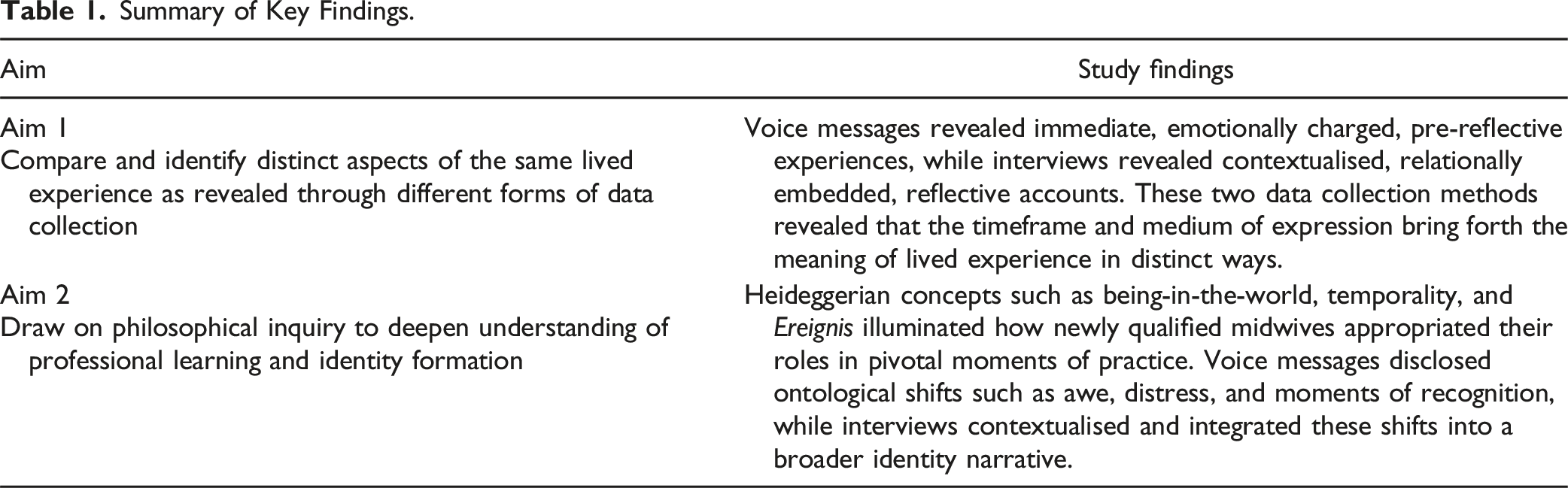
These findings reflect not only the practical distinctions revealed by the two methods of data collection, but also the ontological depth that hermeneutic phenomenology can bring to research, both in general, and specifically in relation to questions of becoming and professional identity. In what follows, we situate these insights within a broader interpretive engagement with Heideggerian phenomenology.
In this study, we have compared and identified distinct aspects of the same lived experience as they were revealed in different forms of data collection; and have drawn on philosophical inquiry to deepen our understanding of professional learning and identity formation for newly qualified midwives. The endeavour when utilising Heideggerian hermeneutic phenomenology is not to remain strictly within the bounds of what this philosophy meant to Heidegger or those who have followed, but rather to think and interpret along the way, expanding horizons of thought and journeying in new directions to broaden our understanding of phenomena (Smythe et al., 2008, p. 7). Polt wrote that “if we simply remain within Heideggerian language we are imitating, not interpreting” (2005, Loc. 6741). Capobianco has commented on the application of Heideggerian hermeneutic phenomenology for research beyond philosophy, noting that its use brings ontological depth to the analysis of lived experiences (2014, p. 7). Similarly, Todres et al. highlighted the positive potential of phenomenology in human science research, remarking that its application has “mined the richness of [Husserl’s] thought,” contributing to a deeper understanding of human phenomena (2001, p. 3). These authors underscore the value of phenomenology in enriching research by providing a profound philosophical framework for interpreting lived experiences.
Interpretation and Lived Experience Descriptions
Lived experience descriptions, which form the basis for phenomenological research, are coloured by the point in time in which they are told. Smythe contends that “there is no right time from which to gain the perfect perspective” (2011, p. 41). Lived experience descriptions shared closely to the point in time of the experience might bear witness to fore-structures of understanding, nevertheless, regardless of the point in time when a lived experience is shared, it reveals Dasein’s being in the world. In engaging with the world, seeing is always ‘seeing as’ (Lafont, 2005). The essence of something is revealed through the experience of it and reflecting on that experience helps to uncover its fundamental nature. Thus, while the point in time when the lived experience description is collected is significant and will impact the interpretation, the embeddedness of the descriptions in lived experience will also impact the interpretation (Van Manen, 1990/2016).
Reflection, as a manner of interpretation, is always historical and contextual. Telling a story, which is one way to reify an experience and share how “it was,” will never fully capture the essence of that experience, regardless of how much time has passed since the event (Van Manen, 1990/2016). Thus, lived experience descriptions gathered closer to the event are not necessarily better, even though they may be less reflected upon. They are not evaluated for factual accuracy, nor is there an attempt to verify whether the retelling perfectly reflects the actual events (Smythe et al., 2008). Instead, the focus is on interpreting the meaning embedded in the experience (Van Manen, 1990/2016). Comparing two different modes of gathering lived experience descriptions allowed for an exploration demonstrating that temporality and reflection shape interpretation and understanding, addressing both methodological and philosophical concerns. Neither voice messaging nor interviews were inherently superior; rather the use of both methods enhanced the rigour of the study, providing a more nuanced and in-depth perspective on skill development and the formation of professional identity over time.
Voice messages, when compared to interviews, tend to be shorter, more fragmented, and focused on specific moments or feelings captured in the present ‘now’ of temporal being. When shared shortly after an experience, voice messages captured Dasein’s pre-reflective temporal engagement with the world, offering a direct window into lived encounters and interactions as they unfolded in the present moment. They reveal Dasein’s thrownness as midwives are caught in the flow of experience, situated in the immediacy of being-in-the-world, where world, mood and body interact, making visible the immediacy of lived experience and mood. These fragments revealed participants’ initial responses after moving events, and were often mediated by reflection on their recent past experiences, particularly those from their training.
In contrast, interview data, collected after a longer passage of time, disclosed participants’ reflection on and reinterpretation of their experiences, integrating them into broader life narratives which included past, present, and future. This reflective mode demonstrated that Dasein engages historically with its world, contextualising and reinterpreting past events in light of relational and practical dimensions. In this way, the newly qualified midwives broadened their horizon and paved a path for their future experiences as they acquired new skills. Considered together, the voice message and interview stories align with Heidegger’s view of world as a dynamic interplay of past, present, and future, and facilitated a profound understanding of midwives’ professional development.
Events as Ereignis: Making an Experience “One’s Own”
Heidegger discusses Ereignis in his later philosophy and proposes viewing it as an event in which what is given –called by Heidegger “it gives” (es gibt) –reveals to Dasein ‘world’ in a new way. World, as it is revealed through the event, is appropriated and made one’s own (Polt, 2006). This aligns with Capobianco’s observation that Heidegger’s philosophical project sought to understand “es gibt” (it gives) and explore how Dasein arrives in a clearing where beings are disclosed as something, as well as how Dasein interprets and finds meaning in what is given within this openness (2014, p. 7). In this sense, Ereignis is not understood just as an event or happening. Ontologically, these events constitute moments of appropriation, where meaning is revealed through a fundamental shift in understanding, extending beyond personal, subjective experiences.
In the midwives’ voice messages and stories, their lived experience involved moments in the world that shaped both their self-understanding and the professional environment in which they were working. These moments reflected ontological shifts. As newly qualified midwives navigated their being-in-the-world, professional encounters reshaped their understanding of both self and practice. The experiences conveyed through the voice messages possess the quality of mineness, while the experiences retold in the interviews revealed a broader constellation. Drawing on philosophical existential concepts helped uncover that these transitions were not merely shifts in knowledge but moments of appropriation (Ereignis), where meaning is disclosed and made one’s own within a shared social and professional context. Although the mineness of the lived experience descriptions in the interviews remained palpable, their reflective retelling placed these experiences within a more complex web of relationships and place, suggesting that the transition from immediate experience to retrospective interpretation reveals the embeddedness of midwifery knowledge within historical and relational contexts.
In all three birth stories, the voice messages provided rich, pre-reflective data for interpretation, revealing the newly qualified midwives’ emotional responses, whether distress, uncertainty, or awe. Between the voice message and the interview, they had the opportunity to reflect on these experiences, integrating them into their evolving professional identity. Michael Van Manen wrote that “some impressions have a dormant latency whereby their meaning is only later and gradually revealed. The latency of such impressions is their meaningfulness, a meaning that is not merely significant because it lasts but also because it grows in depth” (2024, p. 381). The newly qualified midwives’ visceral reactions, which were so prominent in the voice messages sent close to the event, were partially covered over when retold in the interview. The awe-inspiring and distressful moments were reduced from an Ereignis and were later recounted as a collective and procedural experience, reflecting collegial and professional norms (Polt, 2005). This transformation from appropriation (Ereignis) to process (Vorgang) demonstrates that reflection can both reveal and conceal aspects of lived experience, an original finding in this study.
Lived Experience, Ontological Shifts, and Methodological Insights
Through the application of Heideggerian concepts, particularly Ereignis, newly qualified midwives’ lived experiences were revealed to be more than just personal narratives; they were ontological events that reshaped their being-in-the-world. The ontological shift they underwent was not merely cognitive, but rather an existential transformation in which their professional identity was re-formed through lived experience. Their movement from pre-reflective immediacy in voice messages to reflective meaning-making in interviews demonstrates that being-in-the-world evolves through participation in professional practice. By bringing together various methods of data collection and engaging with Heideggerian philosophy, this paper provides examples showing that different forms of data collection reveal distinct aspects of lived experience. By employing phenomenological concepts to interpret these differences, it demonstrates that philosophical inquiry can deepen our understanding of professional learning and identity formation. This study offers a valuable contribution to qualitative research methodology and provides a new lens for understanding that professional identity is not merely developed but ontologically reconfigured through experience and reflection.
Strengths and Limitations
To our knowledge, this is the first time a comparison of data collection methods to capture lived experience descriptions in hermeneutic phenomenological research has been undertaken. It is important to note that this comparison was not the original intention of the study, but rather a secondary focus that emerged due to the notable differences in what these two methods of data collection captured. Together, these methods complemented one another, providing a more layered and nuanced understanding of lived experiences, which is a key strength of the study. Although voice messaging captures immediate, pre-reflective responses, it has certain limitations. The format may constrain participants to share brief or fragmented accounts, potentially lacking the depth and contextual richness of reflective interviews. Additionally, the absence of relational engagement with the researcher when leaving voice messages limits the opportunity for co-constructed meaning, which makes interpretation more challenging than with in-person interviews. Despite these constraints, the voice messages uniquely privileged the emotional intensity and immediacy of lived experiences.
While the sample size does not allow generalisability, the strength of this approach lies in its depth. Hermeneutic phenomenology prioritises rich, meaningful interpretations over representativeness, and the approach to data collection ensured a robust engagement with the dynamic interplay between immediate and reflected lived experiences. Newly qualified midwives and free-standing birth centres were self-selecting, which is a further limitation; however, the richness of the data mitigates this concern by using crafted stories that show the variation in individual experience. Further research in diverse contexts is needed to explore the broader applicability of voice messaging and interviews when used together.
Conclusions
This study identified notable differences between lived experience descriptions when captured through voice messaging compared to in-depth interviews within a hermeneutic phenomenological framework. Voice messaging offered pre-reflective insights into participants’ immediate emotional responses, while interviews provided reflected, contextualised accounts that integrated experiences into broader narratives. This use of these two data collection methods concomitantly aligns with Heideggerian phenomenology by engaging with both the immediacy of Dasein’s being-in-the-world and the reflective reinterpretation of lived experiences over time. Together, these methods provided complementary insights, enriching the understanding of participants’ professional growth.
This study not only advances phenomenological methodology by combining two data collection methods, but also develops the theoretical concept of appropriation (Ereignis), offering new ways to interpret lived experiences within professional and existential contexts. The broadening of the Heideggerian notion of appropriation to include moments of awe, as expressed in participants’ voice messages, highlights the emotional depth and significance of these experiences in shaping midwives’ evolving understanding of their role, as well as their skill acquisition. This study demonstrates the potential of combining these methods to uncover new dimensions of lived experiences, advancing phenomenological methodology in emotionally charged research contexts such as childbirth.
Implications for Midwifery Practice and Education
The use of voice messages in this study suggests practical applications for mentoring and orientation for newly qualified midwives. While not originally intended as a reflective tool, the format revealed how newly qualified midwives articulate uncertainty, emotional intensity, and moments of learning as they unfold. Orientation programmes might consider inviting new midwives to record voice reflections during their early practice period. These recordings require little preparation and may offer an accessible way to track experiences over time. With the midwife’s consent, selected messages could be shared with mentors to support dialogue. Rather than functioning as assessment, the recordings might serve as conversation openers and highlight areas of growth, tension, or support needs that may not emerge in formal supervision.
Used in this way, voice messaging becomes a flexible complement to existing forms of mentorship. It allows new midwives to bring forward experience as it is lived, while supporting mentors to respond to that experience in a timely and situated way. This study points to the value of such reflective formats, not only as research tools, but as part of a broader effort to support identity formation and integration in the early years of practice.
Footnotes
Acknowledgements
The authors gratefully acknowledge the German Federal Ministry of Education and Research (grant number 01GY2007) for funding this study. We would also like to thank Prof. Dorothea Tegethoff for her contributions to the study’s funding acquisition and conceptualization. Finally, we extend our sincere appreciation to the midwives who participated in this study.

Author Contributions
Nancy Iris Stone: Writing – review & editing, Writing – original draft, Validation, Project administration, Methodology, Funding acquisition, Formal analysis, Data curation, Conceptualization. Gill Thomson: Writing – review & editing, Validation, Methodology, Formal analysis, Data curation, Funding acquisition.
Funding
The authors disclosed receipt of the following financial support for the research, authorship, and/or publication of this article: This postdoctoral research was funded by the German Federal Ministry of Education and Research, grant number 01GY2007, from 2021–2024.
Declaration of Conflicting Interests
The authors declared no potential conflicts of interest with respect to the research, authorship, and/or publication of this article.