




Abstract
Researchers employ numerous methods to explore phenomena, but few studies feature linguistic prompts as a primary data collection strategy. This paper will describe the use of linguistic analysis to uncover organizational culture, grounded in Schein’s (2010a, 2020) levels of culture and Whitcomb and Deshler’s (1983) linguistic analysis framework. The notion that individuals experience culture at a profound and subconscious level and express their response to that culture through their use of language has practical applications in many qualitative approaches. Linguistic perspectives reveal how participants perceive the organizational ethos and observable forms; how they view themselves and other culture-bearers; how they perceive cultural norms, beliefs, and assumptions; how they assimilate newcomers; how they place themselves within their organizational culture, distinguishing individual self-consciousness versus group self-consciousness; and how they describe the workings of their organization. The very nature of the problem, i.e., asking individuals to describe culture through essence statements, storytelling, free word association, metaphors, similes, and cultural references, elicits rich, personal insights about an organization. Whitcomb and Deshler’s (1983) three levels of thematic, emotional-barometer, and cultural values clusters enable researchers to uncover cultural patterns in the language participants choose, probing cultural conditions where the importance of context, setting, organizational fit, and the culture bearer’s frame of reference are pivotal (Schein, 2010a). Although this study specifically pertains to the study of organizational culture, this method can be effectively applied in all disciplines.
Introduction
Why Study Culture?
Culture is experienced consciously but felt subconsciously. It affects people deeply, even when they are not fully aware of its impact (Ouchi & Wilkins, 1985; Schein, 2010a). Therefore, the notion that individuals experience culture at a conscious and subconscious level and are then able to express their response to that culture through language, has practical applications in many qualitative approaches. Language offers a safe entry point, where a person can describe the organization in a way unique to them, their sense of role and place in the organization, and their point of reference with regards to internal and external expressions of culture (O’Donovan & McAuliffe, 2020).
Over three decades, I conducted studies that probed the power of language as one of many observable cultural markings, noting the shift from conscious to subconscious perspectives (Kuh & Whitt, 1988; Masland, 1985; Schein, 2020). Asking individuals to share their perceptions of organizational culture in a way that does not heighten their vulnerabilities acknowledges that shift. In other words, when culture becomes ingrained in the psyche, the individual internalizes the impact of culture (Schein, 1984; Smircich, 1983). Moreover, using language to share feelings that may seem otherwise unacceptable provides humans with a safe space to express themselves. For many, choosing from a variety of linguistic devices (words, metaphors, similes, free choice word associations) to convey deeper feelings allows an individual to feel less exposed (Fainsilber & Ortony, 1987; Ginsburg & Bain, 2017; O’Donovan & McAuliffe, 2020). While this study reflects my specific focus on organizational culture, using language as a bridge to deeper insights, this method can be effectively applied in all disciplines.
Defining Organizational Culture
The concept of culture as an organizational force originates with the theories of numerous scholars (Schein, 1984, 1987, 1991, 2010a; Alvesson & Sveningsson, 2015; Berquist & Pawlak, 2008; Kuh & Whitt, 1988; Pace, 1962; Tierney, 2008; Van Maanen & Barley, 1985). Contemporary scholars have renewed this interest in culture but with a greater focus on organizational functioning (Burton & Peachey, 2014; Denison et al., 2014; Hatch, 2004; Latham, 2013; Onday, 2016; Rousseau, 1990). Although culture can be viewed as relatively stable (Cameron & Quinn, 2011; Schein, 2010a, 2020), it is also viewed as an evolving phenomenon, continually created, recreated, and refined by the ongoing patterns of interaction between individuals, groups, and the interplay of external and internal stakeholders (Berquist & Pawlak, 2008; Van Maanen & Barley, 1985). This dynamic interpretation promotes culture as both a product and a process, exerting powerful influences in its evolution (Smircich, 1983). This duality supports the notion that culture can be observed as well as felt.
Numerous definitions of culture abound, but the most concise definition remains Becher’s (1984), who defines culture as “a shared way of thinking and a collective way of behaving” (p. 166). Ouchi and Wilkins (1985) extend the definition by citing culture as an independent variable characterized as a complex, continually evolving web of assumptions, beliefs, symbols, and interactions enacted by the group’s culture bearers, who cannot be purposefully controlled by any other person or group. Conversely, culture as a dependent variable merges shared values and beliefs and is manifested through rituals, ideologies, and patterns of behaviors (Smircich, 1983). A more contemporary view, one that reinforces earlier definitions but acknowledges the complexities of organizational functioning, lies in Schein’s definition (2010a, 2020). He states that culture is the learned product of group experiences reflecting that group’s significant personal history and the traditions, customs, practices, transmitted knowledge, and beliefs, mores, and norms. Becher (1984) supports this noting that culture behaves as a socializing “glue,” linking a group’s past with its future.
Culture conveys an organization’s sense of identity, enhances the stability of a group’s social system, acts as the sense-making device that shapes and guides collective behavior, and acculturates newcomers (Alevesson & Sveningsson, 2015; Craig, 2004; Janicijevic, 2013; Lok et al., 2005; Parker, 2000; Schein, 2010a). This dynamic property provides meaning, direction, mobilization, and a social energy that moves an organization into either destructive or productive action, facilitating commitment to a routine of practices and behaviors within the dominant culture and its subcultures (Kuh & Whitt, 1988; Siehl & Martin, 1983; Tierney & Lanford, 2018). Organizational design and functioning may similarly affect culture bearers in significant ways (Cohen & March, 1974; Weick, 1976), prompting further exploration into an individual’s response to and internalizing of cultural properties (Ashkanasy et al., 2000; Berquist & Pawlak, 2008; Hui-Min, 2009).
During periods of change and transition, an understanding of culture serves a particularly important purpose insofar as cultural awareness assists organizational members in interpreting the organization (Schein, 2020; Silver, 2003; Tierney, 2008). Any disruption or upheaval causes these members to seek a stabilizing force that provides structure and grounding; thus, a deeper understanding of organizational culture as a cohesive element remains critical to institutional health and generativity (Akpa et al., 2021; Warrick, 2017). At its worst, culture can behave as an alienating ethnocentric force that provokes members, or causes anxiety and fear (Cameron & Quinn, 2011). At its best, culture acts as a guide for culture bearers and newcomers, inferring behavioral regularities, implicit rules, contextual clues necessary to interpret behaviors, words, acts, and rituals, and provides a frame of reference as the group evolves (Berquist & Pawlak, 2008; Schein, 2020). As Thomas (1949) states, “If men define situations as real, they are real in their consequences” (p. 301).
Theoretical Framework: Schein’s Levels of Culture
Edgar Schein, a renowned organizational psychologist, studied organizational culture from the perspective of the individual’s experience. Schein’s definition of culture states: The culture of a group can now be defined as a pattern of shared basic assumptions learned by a group as it solved its problems of external adaptation and internal integration, which has worked well enough to be considered valid and, therefore, to be taught to new members as the correct way to perceive, think, and feel in relation to those problems. (2010a, p. 18)
In seeking to understand culture, Schein suggests that it is appropriate to question participants on how they view their worlds. Therefore, his model explains how individuals experience culture which, in turn, helps researchers devise ways to question participants.
Moreover, Schein contends that we cannot understand organizational phenomena without considering culture both as a cause and a way of explaining those phenomena.
Schein’s model includes three levels, beginning with the observable and conscious and moving to the subconscious level. The positioning of the individual as they move from outward experiences of culture to internalizing that culture is reflected in each level (Schein, 2020). What makes this model unique is that it works in reverse, where the third level of basic assumptions guides behavior at the second and first levels. The intrinsic, almost unknown but dominating, assumptions that individuals internalize shape how values and beliefs are expressed (Level 2). In turn, the outwardly visible and observable artifacts in Level 1 represent the Level 2 espoused values and beliefs, which originate from the foundational assumptions embedded in Level 3. These levels are described below: Level 1: Conscious and Observable. Cultural forms and markings act as manifestations of culture to include outward, visible artifacts such as ceremonies, rites, rituals, traditions, organizational sagas, heroes/heroines, legends, myths, and dramaturgical events. At the operational level, these markings reflect space and time, acceptable dress and appearance, behavioral norms, symbolism, jargon, and language. Level 2: Conscious to Subconscious. Espoused values and beliefs represent a culture and acculturate individuals as they become immersed in the organization. The markings at this level are less visible but foundational. Stated organizational mission, vision, and purpose, criteria for organizational membership, and ideology comprise these values. The longer individuals inhabit a culture, the more embedded these values become in their lived experience. Additionally, acculturation to cultural norms mirrors the same progression of development that occurs in group formation (Tuckman & Jensen, 2010). The absorption of the visible forms of culture into the implicit understanding of that culture is where the conscious to the subconscious shift occurs. Level 3: Subconscious Assumptions. Deeply help assumptions exist at this level and act as the underpinning for the culture. They are ingrained and represent the core characteristics of a culture. Assumptions represent what the organization believes, even if members cannot clearly articulate those assumptions and are rarely questioned or challenged by other organizational members. Organizational health and functioning depend on the power of these assumptions to direct individual work philosophies, team dynamics, cooperation and collaboration, and overall performance.
One way to position Schein’s model is to consider its intersection with the concept of psychological safety. As an organizational psychologist, Schein believed that perceived psychological safety was essential to eliciting an individual’s authentic description of culture. Schein (1992) defines psychological safety as the way individuals feel safe and accepted, which allows them to express complex or difficult aspects of their organizational experience. Edmondson and Bransby (2023) concur, defining psychological safety as “the felt permission for candor,” while the McKinsey & Company (2021) define it as “the absence of personal fear.” Therefore, feeling safe enough to express oneself is necessary for free expression. Language provides a safe haven for individuals (Barley, 1983; Schein, 1984).
Language as a Vehicle to Describe Culture
Schein’s (2020) model was never intended as a framework for data analysis in my studies. Instead, his model illustrates the role language plays in the way an individual describes their culture when language represents a distinct cultural form. Schein’s first level of consciously observed forms showcases language in this way. Linguistic devices make space for an individual to express viewpoints that may otherwise feel uncomfortable or unacceptable, enabling individual expression and cultural manifestation. In this approach, the researcher provides an opportunity for individuals to choose their own words and frame their experience with a measure of self-protection, giving power to the individual. For these reasons, a connection develops between a choice of methods and the research objectives (Patton, 2014).
Linguistic Analysis in Social Science Research
Language remains an integral and complex element of organizational culture. Every culture possesses its own unique set of conceptual components and elements from which its language or jargon originates. Consequently, language represents the concepts, beliefs, norms, values, and practices of the culture, and affects the way people think about things (Denzin & Lincoln, 2005; Hofstede et al., 1993; Smircich, 1983). While these aspects of culture have been studied closely, many cultural studies employ quantitative measures to determine relationships and causation (Cooke & Rousseau, 1988; Denison et al., 2014; Edmondson & Bransby, 2023; Gershon et al., 2004; Hofstede et al., 1990; Xenikou & Furnham, 1996) or employ inventories to assess the extent to which culture affects organizational functioning (Cooke & Lafferty, 1989; Cooke & Szumal, 1993, 2000). Conversely, qualitative approaches seek to reveal the ethos or “soul” of an organizational culture, using language to expose or understand cultural norms from the perspectives of culture bearers (Bolman & Deal, 2017). Yet, despite these varied approaches, few studies feature language as the primary vehicle to uncover organizational culture.
Methodological Procedures
I originally applied this linguistic analysis methodological approach to the study of collegiate subcultures. Subsequent studies employed linguistic devices to explore organizational functioning, organizational fit, cultural cohesion, cultural expression, and the role of leadership in developing and sustaining culture. Various qualitative research designs were applied to frame these problems including case study, phenomenology, cultural analysis, and ethnography. Correspondingly, research objectives and research questions were aligned with these research designs.
Adherence to sound methodological and ethical practices grounded my work. Trustworthiness strategies were employed to ensure standards of quality and rigor (Lincoln & Guba, 1985). Researcher positionality and corresponding reflexive practices were similarly implemented to address ethical and inherent bias concerns. In qualitative inquiry, the exchange between the researcher and the researched is more than mere discourse; it is the beginning of a relationship, one where the quality of the data depends on the rapport established between the researcher and the participant. These considerations are even more critical when participants reveal their personal, and often intimate, perspectives on the multifaceted aspects of culture, some of which manifest outwardly; others only exist in the individual’s subconscious (Barley, 1983: Schein, 2010a, 2010b). In effect, cultural studies are particularly susceptible to the impact of researcher sensitivity. Therefore, a researcher’s bracketing must be fully transparent (Lincoln & Guba, 1985; Patton, 2014).
Sequencing Linguistic Devices and Designing the Interview Protocol
When a researcher engages a participant in an interview, it may take some time for the interviewee to feel comfortable enough to express their deeper feelings about their organizational culture. Yet, when the paradigm is flipped, and the participant is asked to frame their word choices or phrasing with regard to their culture rather than merely answering pre-determined questions, language plays a different and more powerful role. The interview becomes a participant-directed exchange rather than a researcher-directed exchange, even though the researcher provides the nominal structure to solicit participant views. In this shift, the conscious expression diminishes, and the subconscious response to the culture surfaces. Language provides cover for the participant. It is always easier to use a linguistic form to talk about a difficult environment. Instead of saying, “I feel very anxious when I am here,” that individual might say something like, “We are all captives in a cage,” an expression that achieves the same result but with less vitriol.
Five specific linguistic strategies, in an intentional sequence, support this process (Figure 1). These devices include (a) essence statements about the soul or ethos of the organizational culture (safe entry), (b) storytelling about distinctive characteristics of culture (transition from conscious to subconscious), (c) key words or phrases in a free association exercise (i.e., asking interviewees to respond with the first word or phrase that comes to mind) to describe organizational functioning and probe deeper insights, (d) guiding phrases to prompt metaphors (e.g., ―this institution operates like...) or similes, whichever comes more easily to participants, to identify the core extractions of culture and highlight the subconscious expression of the lived experience, and (e) cultural references, eliciting references from the broader cultural milieu to describe the holistic experience of the culture bearer’s organizational environment (safe exit). Sequenced Linguistic Interview Devices.
Defining and Applying the Linguistic Devices
Essence Statements
Asking a participant to characterize their organizational culture by defining its essence or ethos is sufficiently broad and allows for safe entry into the conversation. The question acts as a pathway to more complex questions and responses. A sample essence statement question might read as “How would you describe your organizational culture in a word or a phrase?”
Storytelling
Asking a participant to tell a story about the distinctive characteristics and markings of their organizational culture builds on the essence statement about that culture. Moving from a phrase or a few carefully chosen words to a brief story about the culture allows a participant to invest in the discussion. It takes the participant another step away from the conscious level of cultural awareness to the subconscious level of deeper awareness and expression. Stories highlight a moment or incident that helps the researcher understand how the organization operates and how the culture bearers engage one another. A transition sample question might read as “Can you share a brief story that would characterize your organizational culture?”
Free Word Associations
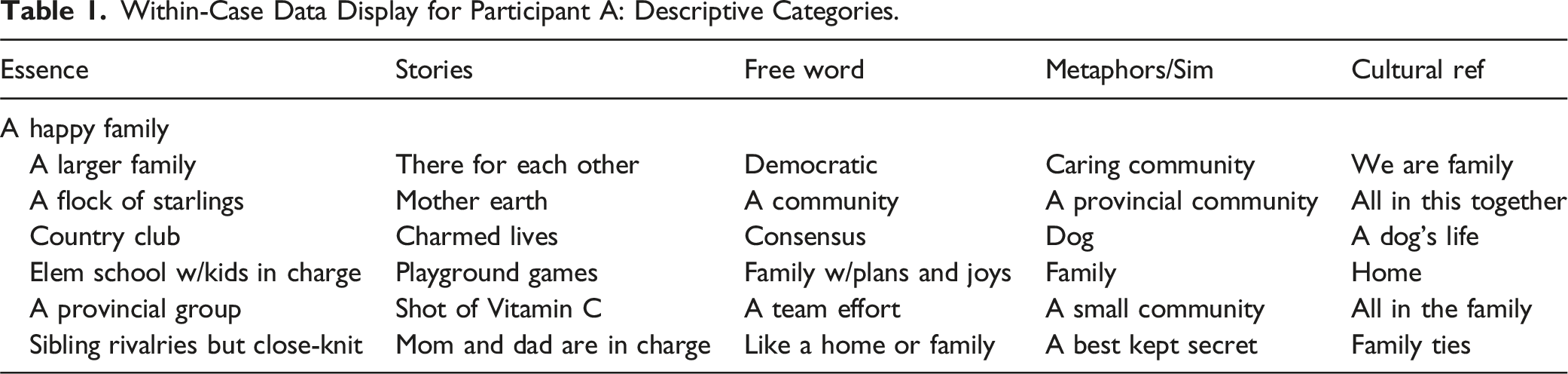
Within-Case Data Display for Participant A: Descriptive Categories.
Metaphors and Similes
Metaphors are defined as figures of speech that make a non-literal comparison between two unlike things. They comprise a form of linguistic analysis which assists researchers who are interested in an intensive, focused evaluation of organizational culture (Schmitt, 2005). Since language serves as a pivotal cultural artifact, metaphors emerge from that sphere as a particularly expressive language form. They behave as powerful forms of organizational language because they communicate symbolic inference beyond the obvious meaning of the words. They help people make sense of their environment, organize information, and resolve apparent conflicts and contradictions. Schmitt (2005) and Wittink (2011) identify metaphor analysis as means of securing imagery that mirrors organizational culture at many levels.
Metaphor analysis, as part of the interview process, facilitates an individual’s disclosure of their surroundings and probes the beliefs and guiding assumptions that underpin organizational functioning (Smircich, 1983; Tierney & Lanford, 2018; Trice & Morand, 1991). These devices allow for imaginative and emotional descriptions while serving as a safeguard that avoids more direct or confrontational language. For example, if an individual uses the metaphor “like a zoo” or “a sinking ship” to describe their working environment, those words provide specific clues as to the emotional and cultural context of the organization without compromising the vulnerability of the respondent.
Debate persists regarding the interchangeability of similes with metaphors in a linguistic study. Similes, defined as words or phrases that compare one thing to another using the words “like” or “as,” can also serve as a vehicle to elicit cultural perspectives, but there is no consensus among scholars as to the superiority of one device over the other. Regardless, without giving participants a chance to access a more complex personal and emotional level of their experience, their experiences can remain hidden. The process of eliciting metaphoric language erodes a person’s hesitancy to share perceptions, anecdotes, and stories that cannot be captured in a survey questionnaire or a structured set of questions. A sample core extraction question might read as, “Please select a metaphor or simile that best describes your organization for each prompt,” where the researcher would define metaphors and similes and give the participant freedom to choose their device.
Cultural References
The final device employed in this sequence is one of safe exit and closure for the participant. Participants use this prompt to step back from the intensity of the discussion when they select a cultural reference to characterize the organization’s culture. A sample closure/exit question might read as “Choose a cultural reference (poem, song, movie, book) that best describes your cultural experience.”
Designing the Interview Protocol with the Linguistic Sequence
Traditional studies of organizations and cultural artifacts, oriented toward quantification of rationally conceived patterns, cannot adequately capture the dynamics of culture (Kondra & Hurst, 2009; Tierney & Lanford, 2018). This qualitative method provides a means of identifying the perceptions of cultural participants, the characteristics of their cultural surroundings, and the degree of experience and social integration in that culture (Alvesson & Sveningsson, 2015). An interview guide that is designed to direct interview dialogue towards expanding uses of language must follow a specific sequence and questioning route to achieve its goals.
Opening questions provide comfortable entry into the discussion, and help the participant frame the topic from their own perspective. Subsequent questions range from a mix of directional queries about cultural context to storytelling and then to free association exercises. At this point in the interview, participants should feel more trust and more openly engage with the interviewer. This is also the point where the interviewer migrates from a participant’s conscious expression of their experiences with culture to the deeper level of their experience.
After free word associations, the next few questions shift the focus to linguistic extrapolations that conjure imagery and descriptive language in the form of metaphors and similes. This is the heart of the study, the central application of linguistic devices to the characterization of culture. Participants are emotionally invested at this point and feel safe enough to share more deeply and descriptively. Finally, asking a participant to think of a cultural reference is a useful way to ease an individual out of the session, in case they feel exposed or wish they could pull back from their declarations. Thus, the final question provides an opportunity for the participant to clarify what they have shared.
While interviews persist as the most effective means of gathering data on beliefs, attitudes, and values, interviews alone cannot fully capture the way culture operates as viewed by culture bearers. As Masland (1985) notes, interview questions must inquire about the cultural context or cultural “windows.” Asking respondents what makes their organizational culture unique uncovers the markings, symbolism, and other manifestations of culture (Clark, 1972). Figure 2 displays how the sequence of devices works in tandem with sample interview protocol. Sample Interview Protocol for Linguistic Analysis Projects.
Data Analysis: Applying Whitcomb & Deshler’s Values Categories
Figure 3 illustrates the data analysis process. In the first phase, the researcher examines data within each case so the researcher can fully immerse and re-immerse themselves in the words of each participant. This is followed by across case analysis. In this way, within case and across case analyses help the researcher understand the individual as well as the collective perspectives of participants. These two steps form the basis for initial coding and creation of a code book to identify broad patterns in the data, i.e., in the language used by participants. By doing this, the researcher categorizes language into descriptive clusters such as social systems, relationships, animal imagery, water imagery, nature imagery, machine imagery, or expressions of emotions or behaviors. Three Phases of Linguistic Analysis.
The second phase deconstructs the researcher’s initial impressions of the data by consolidating the final descriptive categories. In this level, the researcher reexamines the initial categories, collapses those categories, and creates preliminary clusters aligned with Whitcomb and Deshler’s (1983) three linguistic levels (thematic, emotional, and cultural). The researcher may also co-code data for multiple code categories, as many expressions or linguistic devices can be assigned to different levels in the Whitcomb-Deshler model. For instance, “a pit of fire” or “a dark cave” can represent thematic as well as emotional categories; something like “that is the norm, what we collectively feel” or “we believe in compassion” can represent cultural as well as emotional values. In all, coding and clustering help the researcher finalize the assignment of language to one of the three levels.
Whitcomb and Deshler’s Levels
As noted, Whitcomb and Deshler (1983) developed an inventory of linguistic clusters to analyze levels of culture. These three levels are defined below: • The thematic approach searches for any similarity or clustering of metaphors according to the secondary subject (nonliteral description) rather than viewing meaning according to the primary subject. • The emotional-barometer approach analyzes metaphors for their emotionally laden qualities, categorized by the range of emotions revealed through language choices, representing both positive and negative responses. • The cultural values approach examines metaphors as surface manifestations of underlying values that particular conditions in the environment either affirm or frustrate.
Thematic Clusters
Assigning thematic categories to the data allows the researcher to understand broad perspectives of a culture and assign different theme categories to these data. Different types of imagery can be interpreted in many ways, but animal and nature images, for instance, are often perceived to reflect basic human needs and survival instincts; machinery and combat images are often seen as a reflection of a highly political and intense cultural environment (Burton & Peachey, 2014; Dill, 1982; Howard-Grenville, 2006); symbolic imagery is often viewed as a reflection of the psyche, the unacknowledged or unexpressed emotions within each human (Quinn & Spreitzer, 1991; Schneider, 2000). Examples of thematic expressions include animal or nature imagery (“we are lame ducks”, “two porcupines dancing”, “hanging off a cliff”); water imagery (“drowning in the ocean”, “up a creek without a paddle”); machine imagery (“we are a well-oiled machine”); social systems (“cogs in the proverbial wheels”, “a network of workers”), relationships (“we are a family”), or symbolic representations (“we are like pawns in a game of chess”). These thematic clusters confirm a cultural awareness and cohesion among cultural members.
Emotional Clusters
Language can also be analyzed for the extent and breadth of expressed emotion in response to culture. Since metaphors and language allow respondents to dilute or subordinate their emotions through language, the richness and extent of these emotional clusters is notable. Some participants may choose words that suggest a sense of fear or intimidation; in other cases, they may express solidarity or stability. Language is used in both instances to vent these feelings through the relative safety of graphic and emotional metaphors. This tension between group self-consciousness and the broader culture conflicts with expressed emotions such as sadness, lack of control, fear, anger, defiance, pride, resilience, or even hope and solidarity. Examples of emotional-barometer clusters include sadness (“tears of my soul”); fear (“you clutch every time someone calls a meeting”); anger (“they tell us our voices matter, but they hold all the power”); defiance (“what more can they do to us now?”); resilience (“we never gave up on finding joy”); hope (“the sun also rises”), or solidarity (“we act as one unit, glued together with conviction”).
Cultural Clusters
Whitcomb and Deshler’s (1993) third level consists of values-based cultural clusters. As Schein’s first level of forms and markings (observable, conscious) shifts to the second level (values, beliefs), cultural norms are expressed consciously until they become internalized and shift to subconscious understanding. Schein’s third level (assumptions) is where the subconscious, and not fully understood, level of cultural impact is profoundly felt. This level is reflected in expressions such as acceptable behaviors, shared philosophy of work, teamwork and collaboration, pride, and dedication. The cultural values level in Whitcomba and Deshler’s (1983) model stands not only as a separate category for participant language but also serves to connect the other categories of themes and emotions into the cultural clusters. Examples of these cultural values include acceptable behaviors (“we practice what we preach”, “never openly criticize the leadership”, “always be on time for work”); a shared philosophy of work (“passion for the work”, “permeable office spaces”, “open door policy”, “mutual commitment”); teamwork and collaboration (“consent, consensus, collegiality, trust, transparency”); and pride and dedication (“we believe in what we have built”).
Across-Case Analysis: Using Whitcomb-Deshler Clusters.

Notably, individuals who are content in their organizational environments often have less to say; individuals who feel a disequilibrium and are ill at ease in their organizations may have more to say and their words are far more descriptive. In both instances, individuals offer an equal representation of negative and positive commentary. Whitcomb and Deshler (1983) acknowledge this basic truth about humans, that we share our pain more freely than we share our joy. This inclination means there may be more data in one participant’s data set than another. Regardless, patterns can emerge quickly and definitively, and the researcher can generally identify the cultural essence of each participant’s organization with clarity. Through their language, participants explicitly identify the visible characteristics of their culture while concurrently expressing the culture’s subconscious assumptions and deeply held values.
Lessons Learned
While many aspects of this approach worked well over the years, some aspects required refinement or expansion. In my earliest efforts I realized the sequencing of linguistic devices in interviews required adjustments. During a study with faculty regarding a subculture under duress, I began data collection with a series of targeted depth interviews. Due to their situation, these faculty were already sensitive, cautious, and emotionally fragile. When I introduced the free word association exercises and probes to elicit metaphors/similes too quickly, participants resisted my questions and visibly struggled with the linguistic series. They appeared uncomfortable and seemed to feel rushed; the timing yielded superficial and inconsistent results. Participants were not ready to convey their deepest feelings. Upon reflection, it was clear I had not established sufficient rapport nor were the interviewees given ample time to reflect and process the prompts. Similar occurrences happened in other studies I was conducting during this period, and I realized I needed a different approach.
Consequently, I aligned my approach with Schein’s levels of culture (2020) to ground the interview framework and better understand how individuals respond to culture on different levels. Using Schein’s framework allowed me to acknowledge an individual’s transition from simplistic, surface descriptions to deeper insights. Ultimately, my projects realized enhanced discourse and better interactions with participants as I adjusted the timing and pace of our exchanges. Through experimentation, and over the course of time, an optimal sequence of linguistic devices emerged as the one which yielded the richest and most revealing results.
These types of adjustments reflect best practices in two areas: (1) pilot testing and (2) developing context sensitivity as a researcher. Excellent resources regarding pilot study practices include Malmquist et al.’s (2019) article on qualitative pilot studies and Shakir and ur Rahman’s (2022) equally excellent resource about developing qualitative instruments and the processes for testing them with individuals. The issue of developing context sensitivity with participants to elicit truth-telling and openness in an interview exchange is equally important. There are several comprehensive resources that provide a guide to qualitative interviewing. Rubin and Rubin (2013) orient their text to novice interviewers, not only focusing on the practical aspects of qualitative interview but also the relational and interactive considerations that must be addressed. Patton’s (2014) discussion on interviewing in the latest version of his text is detailed and understandable, also focused on the nature of the relationship between the interviewer and interviewee. Seidman (2013) and Alvesson (2012) serve as supplementary resources to Patton and Rubin and Rubin, although they speak to the issues of cultivating interviewer transparency from their different disciplinary perspectives. For more discussion on nuanced interactions with individuals, Reissman (2008), Denzin (2001), and Corbin and Morse (2003) are valuable resources regarding verbal and nonverbal cues observed in an interview and positioning oneself to put the participant at ease during an exchange.
The second change I made to my linguistic series extended my approach to a wider range of research problems. Although the original project focused on the study of organizational subcultures, I eventually applied the approach to other types of organizational dilemmas, such as the impact of leadership, maximizing group cohesion, group dynamics and team building, organizational change, organizational functioning, and organizational fit. Over and over, language served as the conduit to an individual’s personal truths.
Akpa et al. (2021) make an excellent case for how individuals respond to organizational functioning, using culture as the foundation for their studies. Similarly, Warrick (2017) discusses the need to engage with employees about their experiences, creating spaces for discourse, free expression, and conflict resolution. In these ways, the benefits of featuring language in a research project are significant, providing a window into the ways humans experience their environments and interact with one another.
As noted earlier, this approach allows participants to intentionally choose their own words, phrases, and expressions in response to questions about culture rather than answering what a researcher poses, which may only skim the surface of an experience. This does not imply that a linguistic approach is more effective in the study of organizational culture – or any other type of study - than other approaches, but rather that it provides a unique and multifaceted view of the individual’s perspective. Where many cultural studies probe language as one of many cultural forms, linguistic studies feature an individual’s language choices as the singular lens through which to better understand an individual’s experience, which supports a depiction of the cultural ethos. It helps a researcher move beyond the observable level of cultural markings and engage the layers of culture that are enacted but not necessarily intentionally expressed. Essentially, the myriad applications of this linguistic method extend far beyond cultural studies.
Conclusion
This paper focused on one particular strategy used to probe organizational culture. Yet, linguistic analysis is an adaptable methodology that can applied to many disciplines. Capturing an individual’s personal experience in their own words, guided by an intentional series of linguistic devices, can be a powerful strategy. That strategy becomes more impactful when individuals are prompted to shed superficial or fleeting descriptions of their experiences, revealing profound and even surprising results.
Whenever humans interact with other humans, they tell their stories. As researchers, we cannot hope to hear those stories unless we invite them to share without fear or discomfort. We need to communicate with each other; spoken language is one way we do that. Yet, until we feel safe and valued, we hide behind our words and tell partial stories, confusing stories, contradictory stories, or stories that we think others want to hear.
But those stories are still there to be uncovered. I have consistently found linguistic devices to be highly effective in capturing participant experiences at a deeper level. Whether I was studying organizational behavior, group dynamics, conflict resolution, or subcultures within dominant cultures, I have used this method to study an individual’s response to their world. Individuals seek stability, order, and purpose in their daily lives (Weick, 1976), yet our fast-paced world often disrupts that pursuit. Asking people to share their stories cultivates their sense of self and purpose, reconciles contradictions and uncertainty, and encourages creative thinking (Bolman & Deal, 2017; Schein, 1984, 2010a). By respecting our participants and engaging them in careful and sensitive ways, we, as researchers, become the beneficiaries of their rich disclosures.
Footnotes
Author Note
This paper, prepared for its first publication in the International Journal of Qualitative Methods, is the author’s original work, with all residual rights. No copyright-protected works are included in this paper other than the author’s own work. Finally, this work is not being considered for, nor has it already been published elsewhere.
Acknowledgements
I would like to thank Linda Liebenberg and Kristina Moulton for the opportunity to publish this article on a subject I have long studied. Additionally, I would like to thank Jennifer Broderick for her assistance in the preparation of my final manuscript.

Statements and Declarations
Funding
The authors received no financial support for the research, authorship, and/or publication of this article.
Conflicting Interests
The authors declared no potential conflicts of interest with respect to the research, authorship, and/or publication of this article.
Data Availability Statement
Data presented in this paper’s tables were populated with data created to resemble original data but not to represent those data.