




Abstract
Focus group discussions (FGDs) differ from other qualitative data collection techniques because they offer unique insights into how collective sense-making occurs in real time in social settings. However, systematic qualitative tools to analyze interaction in FGDs and the richness of data it yields remain scarce. In this article, we propose a seven qualitative indicator model, adapted from previous studies on FGD data quality, to assess group interaction. We apply the model to FGDs (n = 12) conducted via the instant messaging application WhatsApp as part of a study on access to social protection programs in Colombia conducted during the COVID-19 pandemic. Our findings show that the proposed indicators can assess meaningful interaction as it unfolds in asynchronous online FGDs. Unlike existing tools that examine interaction in online FGDs quantitatively and through a dichotomous understanding (either absent or present), our proposed model seizes the idea of varying types of meaningful interaction: stance-only, basic interaction, and complex interaction. Our results suggest that complex participant interactions can emerge in online FGDs conducted via WhatsApp, therefore situating messaging apps as promising data collection sites for including hard-to-reach and highly mobile populations in research. The proposed qualitative indicators model is a useful tool for assessing interaction in FGDs and provides insights into whether and how collective sense-making occurred.
Keywords
Introduction
Focus group discussions (FGDs) are widely used across disciplines and research topics. Initially developed in the 1920s for marketing studies to assess consumer interests, group approaches have been adopted in the Social Sciences to identify and explore collective sense-making in real time (Kitzinger, 1994). Researchers are increasingly turning to online platforms, including instant messaging (IM) applications, to examine social behavior in everyday contexts (Alencar & Camargo, 2022; Kaufmann et al., 2021). As such, IM has become a widespread communication tool worldwide and, more recently, a new way to conduct FGDs.
The shift to conducting FGDs via IM raises important questions about participant interaction and data richness in online environments and how to assess it. Previous research has used quantitative quality indicators like word count to contrast in-person and online interactions (Abrams et al., 2015; Chen & Neo, 2019; de Souza et al., 2024; Guest et al., 2020; Schneider et al., 2002; Underhill & Olmsted, 2003; Woodyatt et al., 2016). There has been limited methodological reflection on how to assess FGD data quality qualitatively, including the key issue of meaningful interaction, defined here as the ongoing process of participants responding to each other’s ideas, negotiating them, and creating in-depth collective sense-making (e.g., Crossley, 2002; Grønkjær et al., 2011; Kitzinger, 1994; Wilkinson, 2006). We seek to fill this gap by proposing a set of qualitative indicators to assess interaction in FGDs conducted via IM.
Using data from a case study on social protection responses to forced displacement in Colombia, we aim to contribute to the broader understanding of data richness assessment using qualitative indicators and explore whether and how online platforms can be leveraged to generate meaningful interaction. Our research questions are: Can meaningful interaction emerge in FGDs conducted via IM? If so, can it be assessed using qualitative indicators?
Interaction in Focus Group Discussions
A key feature of FGDs is the ability to observe how individuals process and negotiate meaning in a social setting (Morgan, 1997). However, analysis often focuses on what is said rather than how interactions unfold (Kitzinger, 1994; Wilkinson, 2006). Some authors argue that studying interaction depends on the research question (Morgan, 2010) and the study’s epistemological framework (Belzile & Öberg, 2012). Others argue that neglecting interaction analysis leads to findings lacking contextual information for understanding how individual contributions result from layered collective processes in which meanings are constantly debated, negotiated, proposed, and responded to (Wilkinson, 2006). This omission overlooks how meaning emerges through social interaction.
Recent studies have taken a practical approach to analyzing interaction in FGDs, proposing tools informed by conversation analysis, discourse psychology, and position analysis (Halkier, 2010). These tools aim to identify how consensus-making and collective challenging of consensus develop in FGDs (Grønkjær et al., 2011; Hermann et al., 2024; Wilkinson, 2006) and how these collective processes help to establish socially shared knowledge (Kristiansen & Grønkjær, 2018). Interaction analysis reveals taken-for-granted narratives, how they are collectively grappled with (Grønkjær et al., 2011; Kristiansen & Grønkjær, 2018), how moral sense-making develops (Crossley, 2002), and how group identities form (Crossley, 2002; Grønkjær et al., 2011). Identifying meaningful interaction adds value by evaluating the depth of sense-making the FGD generated (Hydén & Bülow, 2003).
Assessing Meaningful Interaction in Online Focus Group Discussions
The adoption of online methods for data collection, including FGDs, has provided insights into the transition from face-to-face to virtual settings, highlighting practical and technical nuances, challenges, and benefits regarding cost and logistics. Drawbacks of online FGDs include the risk of bias towards participants with technology access, maintaining confidentiality, and connectivity issues (Pelletier et al., 2024). Benefits include reduced costs for transportation and accommodation (Alves et al., 2023), flexible scheduling to fit difficult-to-access participants (Bueno-Roldán & Röder, 2022; Heywood et al., 2022), and more straightforward data transcription and encryption (Alves et al., 2023). IM platforms like WhatsApp, Signal, Telegram, Facebook Messenger, etc., can capture in-situ data, such as participants’ relationship with technology, which is harder to obtain in conventional research settings (de Gruchy et al., 2021; Kauffman, 2018). In many low- and middle-income countries, these apps are essential for communication and are deeply embedded into daily practices (Manji et al., 2021; Poushter, 2024).
While there is a fair amount of literature on the practical aspects of conducting virtual FGDs, specifically via IM, the literature examining the interactions these online settings can foster is relatively scarce (LaForge et al., 2022; Roald et al., 2024; Woodyatt et al., 2016). A few studies addressing this issue have examined group interaction as a data quality feature. Most employ quantitative methods to compare online versus in-person FGDs using indicators such as word count for individual utterances, discussion length at group level, speech proportion between moderator and participants, number of themes generated, and the number of instances of agreement or disagreement among participants (Abrams et al., 2015; Chen & Neo, 2019; de Souza et al., 2024; Guest et al., 2020; Schneider et al., 2002; Underhill & Olmsted, 2003; Woodyatt et al., 2016).
Studies comparing the data quality of online versus in-person FGD interactions have yielded mixed results (Chai et al., 2024; Jones et al., 2022). Some researchers report more extended participant responses and more frequent discussions of sensitive topics, suggesting online platforms can maintain or enhance interaction quality (Chen & Neo, 2019; Guest et al., 2020; Woodyatt et al., 2016). Conversely, other studies caution against moving FGDs online, citing shorter responses and reduced interaction due to the lack of eye contact, non-verbal cues, and immediate responses —all inherent to face-to-face interactions (Abrams et al., 2015; de Souza et al., 2024; Schneider et al., 2002; Underhill & Olmsted, 2003). While online platforms may limit some interaction aspects, few studies explore new opportunities in this environment (Estrada-Jaramillo et al., 2023). Additionally, there is little consensus on the definition and empirical assessment of interaction quality in online FGDs (Reñosa et al., 2021), highlighting the need for a more systematized qualitative analysis tool.
A significant gap in FGD interaction literature is the lack of a strategy to evaluate its depth beyond quantification. The dialogical tradition informs our focus on the depth and complexity of interaction, emphasizing the outcome of joint action (and discourse) in situated social encounters and its role in creating a shared reality (Belzile & Öberg, 2012; Condor, 2006). This strategy would address earlier scholars’ concerns about the need to analyze how different perspectives emerge, how the group negotiates them, and how they create in-depth collective sense-making.
Case Study: Social Protection Responses to Forced Displacement in Colombia
This study draws on data from a larger research project focused on Colombia’s displaced population’s access to social protection and humanitarian aid. The project aimed to inform strategies for integrating social protection programs and humanitarian assistance efforts (Ham et al., 2022). It used a mixed-methods design, combining household surveys, in-depth interviews with key informants, and FGDs with Venezuelan migrants, internally displaced persons, and host community members in low-income neighborhoods in Bogotá, Colombia’s capital city, and Cúcuta, located on the northern border with Venezuela.
Focus Group Discussions over WhatsApp
The qualitative component of the study aimed to capture participants’ perceptions and experiences with social protection programs and humanitarian assistance through FGDs. It also explored their views on social cohesion in their neighborhoods and interactions with other groups entitled to these services.
Although initially designed for in-person implementation, the FGDs were adapted for remote use due to the COVID-19 lockdowns. WhatsApp, the most widely used social media app in Colombia (DataReportal, 2024), was chosen for its popularity in both personal and professional communication (Ministerio de Tecnologías de la Información y las Comunicaciones, 2021; Telefónica, 2022). The method was applied asynchronously, allowing participants to engage at their convenience (Lobe, 2017). FGDs lasted a week, with daily prompts delivered via videos, images, texts, and emoticons.
The pool of potential FGD participants comprised individuals who had been surveyed as part of the study and had agreed to be re-contacted for the qualitative component. The survey sample was drawn using a geographic sampling strategy. Data from the National Geostatistical Framework of the National Administrative Department of Statistics (DANE) and the International Organization for Migration (IOM) were used to identify low-income city blocks with a large proportion of migrant and displaced individuals. Sixty-five randomly selected blocks in each site were selected for house-by-house canvassing. Participants were surveyed to obtain 1500 household surveys equally distributed between the three relevant populations in this study (displaced Venezuelans, IDPs, and host community individuals).
Number of Focus Group Discussions by Subgroup.
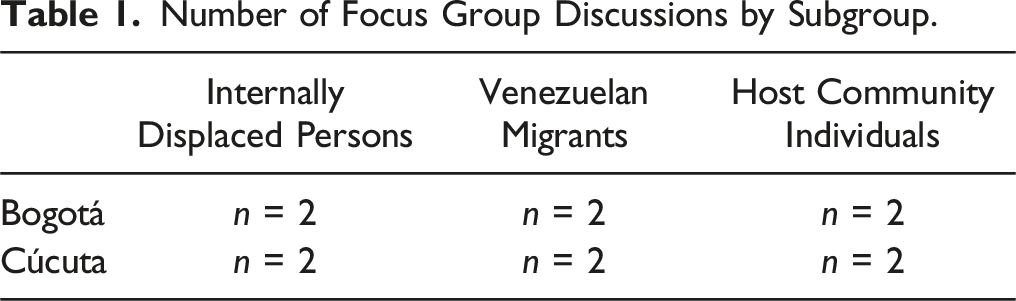
A first-contact telephone call was made to potential participants to explain the FGDs, explain the informed consent, and answer any questions regarding the study. Informed consent was obtained via text message. Connectivity was ensured by providing a one-week unlimited data plan that matched the focus group duration. Participants also received a COP 15,000 (about USD 5) incentive. The research team created short videos and tutorials to guide participants through key aspects of the research process: informed consent, maintaining confidentiality, and deleting the conversations after the FGDs ended.
Each FGD had two moderators —one junior and one senior researcher—who conducted two FGDs per week. Moderators kept conversations engaging, encouraging various forms of communication through text, voice notes, GIFs, and memes. Shy participants were contacted directly to encourage participation. Moderators noted higher interaction in the early morning, lunchtime, and late afternoon, aligning with workday rhythms, so prompts were sent during these times to increase participation. At the end of the week, participants were removed from the group chat, and chat content and voice notes were downloaded and transcribed.
Methods
Development of Indicators
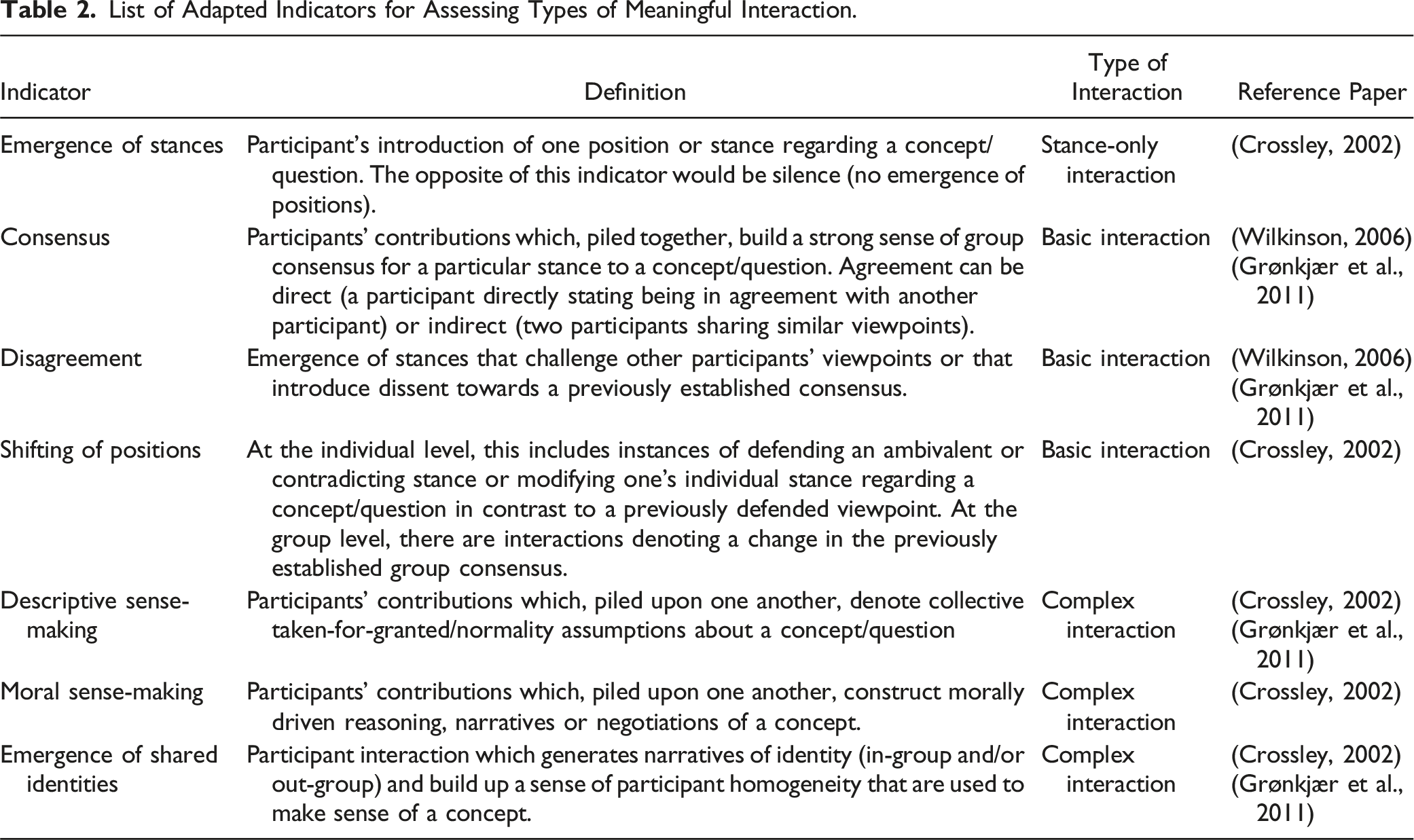
We adapted a set of qualitative indicators to assess the presence (or lack thereof) of meaningful interaction in the FGDs. We built on prior criteria to assess quality in qualitative datasets of in-person FGDs. However, we found no existing indicators to fully capture the primary feature of FGDs: promoting interaction to generate rich data. While previous studies have compared face-to-face and online FGDs (Abrams et al., 2015; Chen & Neo, 2019; de Souza et al., 2024; Guest et al., 2020; Schneider et al., 2002; Underhill & Olmsted, 2003; Woodyatt et al., 2016), none have tailored qualitative indicators to assess interaction quality. Hence, our focus was to develop indicators to assess the quality of interaction during online FGDs.
The research team reviewed extensive methodological literature to identify candidate indicators, but only a few approaches provided suitable options for adaptation to the online environment (Crossley, 2002; Grønkjær et al., 2011; Wilkinson, 2006). In this setting, interaction cannot be assessed through physical cues (such as laughter, pauses, or tone of voice), as has been previously proposed with face-to-face FGDs (Belzile & Öberg, 2012; Myers, 1998; Nicholson & Shrives, 2022). Instead, in chat-based FGDs, interaction appears to rely solely on the ideas produced by the participants as they build discussion with each other in the chat and, especially, the depth these ideas reach as a result of this exchange. Hence, candidate indicators were selected and adapted, considering their appropriateness for the online environment. The initial set of indicators was applied as codes to one FGD transcript, which was separately coded by three team members (MCDS, AG, MMG). The indicators used in this initial coding round were the emergence of stances, consensus, disagreement, descriptive sense-making, moral sense-making, the emergence of shared identities, relevance for the research question, trust in the interaction, and negotiation of stances. This exercise yielded a revised list, with some indicators withdrawn or modified. Relevance for the research question was discarded as interaction appeared without the indicator (e.g., participants having important back and forth even if they had strayed from the research topics or questions). Trust in the interaction was also discarded because it was hard to capture in the data set and presented low agreement between coders. Most of this content was captured by the disagreement indicator. Negotiation of stances was refined as the shifting of positions indicator, which could be more easily tracked in the dataset.
List of Adapted Indicators for Assessing Types of Meaningful Interaction.
Coding Process
Examples of Coding Across Types of Interaction.

Results
This section presents the main findings from our analysis of the FGDs carried through WhatsApp. The analysis is structured around the seven interaction indicators and organized into three progressive levels of meaningful interaction: stance only, basic interaction, and complex interaction. In the following sections, we provide illustrative extracts from the transcripts demonstrating the different interaction levels and the content produced during the discussions. As we present the results, we note the opportunities IM provides for facilitating each of these types of interactions.
Stance-Only Interaction
Stance-only interactions occur when a participant presents a defined stance on a core concept or question (emergence of stances indicator) without prompting further engagement or discussion from the rest of the group. This type of interaction represents the most basic type in a group discussion. The absence of stance-only interactions indicates a group where participants do not express their individual opinions.
Extract One: Stance-Only Interaction
In this extract, non-beneficiary migrants discuss what they would recommend to other migrants recently arriving in Colombia to receive help. The discussion takes place during the late afternoon: 17:32. Moderator (MA): 17:33. MA: <Same message as above but in audio form> 17:38. Participant (P) 2: I would say they should be guided by the president of the community 17:38. P3: The first step I would take right now if a relative arrived is to go to Migración Colombia and apply for refugee status, then after the refugee document, go to Sisbén, and after Sisbén look for an ARS like Comfanorte, Comfaoriente or the new EPS. After you have all these, they could start looking for work. And for employment; the main thing is to ask them how much money they have and suggest they start selling something because, honestly, it’s tough to get a job by just submitting resumes. At the moment, we have been here for four years, and I have not found much, only short-term jobs from recommendations, like working on a camera, an electric fence, and that’ about it, I used to have a business that collapsed due to the pandemic and now we’re trying to see how to rebuild it. Thank God we still have some machines but no supplies. That’s my advice, and they should head towards areas where the factories are, like Medellín or Bogotá, because here in Cúcuta the employment rate is very low, I mean, here you cannot get it because there barely are any industries or companies, so they’ll have to go where jobs are. That would be my first support: first, get their documentation and make sure it’s up to date, so they can then find a job, so that if they get sick at work or something happens, they can access healthcare, or if they enter a company, they can contribute and be fully legal so they won’t be expelled for any reason. 17:52. P5: Well, I would tell them that whatever skills they have like baking or any other trade they know well, they should practice it here. In my case I make arepas, sell arepas amongst other things, because right now there isn’t much work so my support would be to tell them that whatever they know how to do, whether it’s making cakes or arepas, they can go out and sell them, because the good thing here is that whatever you go out to sell, you will sell it. People support you here. Everything you offer to the public gets sold, thank God, that’s the good thing here. The other thing is that if they can they should get their permit, go to migration, and get their permit because, for example, if they want to go to Bogotá or other places like Medellín, they can get there, that would be my support and well to keep moving forward, never backward, not even to gain momentum. Always looking forward and, above all, trying to support their family, which is the purpose for coming here as a migrant. 17:56. MA: (P2), which president are you referring to? The presidents of the neighborhood action boards? 18:03. P2: Yes, the president of the neighborhood. 18:04. MA: Thank you very much, (P3)! 18:04. MA: Thanks a lot for your input (P5)! How would you guide a person who has just arrived from Venezuela so that they can access some benefits that will allow them to live well in this new country?1
The extract shows how participants express different stances toward a specific issue without engaging with one another. In response to the moderator’s question, participants share their advice for a recent migrant seeking help in Colombia: approach the president of the Community Action Board, get your documentation, secure a job, or start a small business for income, among other suggestions. While this sharing of various stances provides researchers with insight into the participants’ positions on core topics, it reflects a stance-only interaction. Stance-only data indicates when people share their views and opinions. However, interaction is absent between the participants themselves. For interaction to occur, participants would need to directly or indirectly reference each other’s stances, either agreeing or disagreeing. Stance-only utterances lack the relational interpretation of ideas in a social setting.
IM, such as WhatsApp, offers unique features for developing FGDs even in stance-only interactions. Its flexible communication formats allow moderators and participants to respond in writing or via voice notes, allowing accessibility. While the extract only shows text and one voice note, participants also used voice notes to respond in other sections of the conversation (not shown). In IM, acknowledging participants’ contributions by thanking and tagging them can build rapport, make them feel included, and encourage them to participate. Additionally, by allowing asynchronous discussions, FGDs developed over IM give participants more time to contribute to the discussion. In this case, the whole discussion around this question spanned 5.5 hours (not shown), with the last response arriving 3 hours after the session ended for the day, allowing participants to engage at their convenience, often during the night after working during the day.
Basic Interaction
A basic interaction goes a step further by involving instances where the specific stance proposed by an individual is debated by others, leading to agreement (consensus indicator), disagreement (disagreement indicator), or a shifting of positions. The indicators of basic interaction provide evidence of participants’ active engagement in the discussion.
Extract Two: Basic Interaction with Consensus, Disagreement, and Shifting of Positions
In the following extract, local beneficiaries from Bogotá debate whether the support received by migrants in Colombia should be extended to disadvantaged Colombian citizens. The discussion takes place during the late afternoon and early evening: 16:10. MA: 16:14. P7: Yes, I agree 16:15. MB: Thank you @P7, could you tell us a bit more about why you agree that this aid should be shared, and how this should be done? 16:16. MB: Remember, you can respond with a text 16:22. P6: Migrants in general? 16:27. P12: Yes I agree, they are human beings just like us, they also have their needs 16:31. MB: Yes, thinking about migrants in general, and especially the Venezuelan migrants who have been arriving in Colombia due to the crisis in their country. 16:33. P3: Yes of course equally we all have needs and we don’t know under what conditions they are coming or what they need 16:36. P5: I agree because we all have needs, although as Colombians, we should have the priority 16:40. P6: Well, I think the aid should be distributed, but it would be a difficult task, and I also think that assistance should be prioritized for vulnerable Colombians before thinking about distributing what is given to migrants 16:41. P1: Of course, because many of them are illegal in this country and cannot get a job because of paperwork issues 17:35. MB: Thank you very much @P6 for your input. How do you think the process of prioritizing could be carried out? 17:45. P7: Because Colombians also have needs since there are many people living in extreme poverty and who don’t receive any help 19:47. MB: What do others think about the opinion shared with us that aid should be prioritized for vulnerable Colombians before distributing what is given to migrants? 19:52. P7: I do believe aid should be prioritized for vulnerable Colombians before migrants, for example by giving jobs, providing access to technology to facilitate education, and for those who cannot work offering them assistance with food or a voucher  If migrants receive aid, do you think it should also be distributed to Colombians living in poverty? What do you think about this issue?
 or a voice message . How could this process be carried out?
The excerpt shows how FGDs in IM can unveil participants’ varied and sometimes contrasting views on a contested issue. This happens through the expression of agreement or disagreement with the stances of other participants. P7 starts the interaction by taking a stance on whether government-allocated benefits should be equally distributed among migrants and locals (emergence of stances indicator). P12 and P3 agree and provide supporting arguments. However, P5 disagrees, arguing that Colombians should be prioritized instead, which challenges the initial consensus. This view gains support from P6, who believes equal aid distribution would be challenging and leans toward prioritizing locals. P1 then goes back to the initial stance that migrants should also receive assistance due to their difficulty finding jobs without documentation. Finally, P7 and P5 reinforce their initial stance that Colombians should come first, indicating a shift in positions from the initial consensus reached by the group.
The extract illustrates a moment where participants directly interact with one another, situating themselves with one of two contrasting views on the same topic. By responding to their fellow FGD participants —agreeing or disagreeing with their views—the interaction shows that the issue of splitting government benefits between Colombian locals and migrants is not seen uniformly by all participants. The analysis using interaction indicators shows that this focus group discussion provides a platform for expressing and debating different perspectives, fostering basic interaction among participants. This suggests success in creating an environment that encourages the collection of diverse opinions, even in a setting where participants might feel pressure to conform to certain social expectations or avoid challenging others.
IM provides a platform where active participation among FGD participants becomes possible, as well as consensus-making, disagreement, and collective shifts in positions. As seen in the extract above, some features from these platforms that appear to facilitate this active type of engagement involve allowing moderators to follow up on participants’ comments by tagging them and asking clarifying or probing questions to keep discussions dynamic and inclusive. The platform also allows multiple conversations to happen simultaneously, enabling individual contributions to be addressed while still engaging the whole group.
Complex Interaction
Complex interactions extend beyond basic interaction, providing deeper insights into how participants process, negotiate and assign meaning to a discussion topic. Through these interactions, participants construct systems of social norms (descriptive sense-making indicator), express values and morals (moral sense-making indicator), and develop a sense of in-group identification (emergence of shared identities indicator).
Extract Three: Complex Interaction with Emergence of Shared Identities
In this extract, non-beneficiary IDPs openly share their perspectives regarding the relationships between people in their neighborhoods. The discussion begins at midday and continues into the afternoon. 12:28. MA: 12:37. P10: Well, the relationships with neighbors, you can say, are good with some of them really, they offer their friendship without any conditions. With coworkers, it’s excellent because they support you in everything you do at work, and if I have doubts about my job, they give me ideas, and everything flows. And with the community, it’s just good morning, good afternoon, or good evening and that’s it. 12:43. P1: In my neighborhood it’s just a greeting I’ve only been here for 8 months and I don’t know anyone else around here I don’t see any Venezuelan migrants. I’m not interested in Venezuelans because it’s their fault I lost a spot in a good school where I wanted to enroll my child, and because of those women, the government supported them for food, education, and everything, and we were left behind. 12:45. P1: And now, with everything happening now, those Venezuelans want to leave out of a sudden. 12:46. P1: Because of them, Venezuelans, we have lost many things 13:27. P6: I wouldn’t know because in the neighborhood where I live, I don’t know any displaced people 14:49. MA: Thank you very much for your responses! What do you all think, @P2 @P3 @P7 @P8 @P9? 16:37. MA: Thank you for the contributions so far 16:38. MA: We are still waiting to hear from the other participants if they want and can participate with their responses 16:38. MA: Let’s continue talking about relationships with other people: 16:59. MA: <Same message as above but in audio form> 16:59. MA: 17:08. P8: It’s difficult because the Venezuelan population if we are tough they’ve outdone us and without meaning to offend and I apologize but this population is very lazy I remember when I was displaced I arrived here at the age of 10 and my parents apologized for what we were going to go live from now on we gathered in a room and they said kids from today on we have to find our own means of survival and two months later I was working at a workshop tightening bolts I say this because there are people who already have these problems and no job is good enough for them, I’m not saying it’s easy but you have to work on whatever comes up to get back on your feet. 17:10. P11: I think the same way if you notice the government gives them more help than it does to the same Colombians many people really need help like us DISPLACED people and we don’t get nearly as much aid and they forget about us 17:13. P2: Well I’ve always gotten along with people just fine 17:18. P2: Well it’s not out of envy, but the government helps the Venezuelans more than it helps us who need it just as much or even more Thinking about your neighborhood, how do displaced people, those who have lived in the neighborhood for a long time, and Venezuelan migrants get along? What good or bad things have the aid that other families have received brought to the relationships you have with others in your neighborhood? Or do you know of any experiences from other people that you’d like to share
This excerpt, prompted by the moderator’s questions about perceptions of relationships between IDPs and migrants in the neighborhood, shows a complex interaction. Two main stances emerge: one asserts that IDPs have a good relationship with their Venezuelan neighbors and the other claims that Venezuelan migrants cause problems in the neighborhood. As the discussion unfolds, participants progressively build a sense of in-group identity and an “us versus them” narrative to support their stances.
P1 initiates this identity formation by sharing a personal story, explaining how their son cannot attend a good school because the government supports “those” Venezuelan women (moral sense-making), leaving people like “us” (implicitly referring to IDPs, labeled as “us”) abandoned and without the support they deserve as victims of the conflict. In doing so, this participant constructs two contrasting group identities: Venezuelan migrants, who are seen as undeserving recipients of government aid, and Colombian IDPs, who deserve support from the government yet “lose it” to migrants. This narrative sets the tone for discussing tensions in the relationships between Colombians and migrants in the neighborhood.
Other participants build on this argument, reinforcing the division. For example, P8 describes migrants as lazy, contrasting them with hardworking IDPs who have resiliently rebuilt their lives after displacement, much like they did. This back-and-forth contributes to the consolidation of in-group and out-group identities. P11 and P2 conclude by explicitly pitting the two groups against each other, with P11 emphasizing that migrants are prioritized over IDPs, who feel forgotten by the government —a sentiment strongly echoed by P2.
The excerpt illustrates how a group identity develops through interactions in which participants not only take a specific stance on an issue but also share and leverage their own stories to form and negotiate a sense of unified identity collectively and to create out-group identities. This interaction facilitated the acquisition of rich and complex data regarding the participants’ stances toward the research topic.
Extract Four: Complex Interaction with Descriptive and Moral Sense Making
The following extract refers to a later discussion with the same FGD subgroup mentioned earlier, in which participants’ views towards the allocation of benefits between Colombian locals and migrants are explored. The discussion begins in the morning. 8:50. MA: 8:57. P10: Good morning. I think they should receive the same help, as they are people who also need assistance. They are human beings, too, arriving in a country that accepted them with nothing (no housing, no jobs, no healthcare support). 9:21. P1: Good morning, the help Venezuelan migrants need is to be sent back to their country 9:55. P8: Venezuelan migrants need much more help and I say they should receive the same aid but come on if they can’t even handle with the people here imagine how it would be with them and the aid that comes from abroad for them almost 100% of it gets stolen just like what’s approved for us here. 14:59. MA: Thank you all for your contributions! 15:00. MA: What do the participants @P3 @P4 @P6 @P7 @P9 think? 15:33. P6: I don’t know, I do not really agree with that, but on the other hand it would be good because they would have a chance to get ahead and have better living conditions 16:15. P9: Well, I’d say yes... because they’ve been displaced too... in a different way but for me it’s still a displacement. 16:18. P9: Although Venezuelans currently need more help than we displaced people do... because we have a roof over our heads and food every day, thank God 16:20. P1: Here in Colombia they have nothing but in their country they do have their house and family what are they doing here nothing just taking the little we have. 16:25. P9: I don’t see what the Venezuelans are taking from us... and if you’re talking about the aid they aren’t being given anything either 16:27. P9: Do you want them to go back to Venezuela and starve to death? 16:31. P1: That you don’t know anything about supposedly when they arrived here in Colombia they were given more than us the best spots in public schools I lost a spot for my child because of Venezuelan women they didn’t even line up they were given food on top of that they looked down on us and laughed at us Colombians in better words you all don’t know anything about them so that’s why they should be extradited to their country those women because of gifting themselves up at work so that they were payed less money kicking us out of restaurants, stores everywhere 16:32. P9: Wow, I requested a spot for my child, and it was assigned without any hassle... some people just sleep; that’s all 16:33. P1: I don’t like Venecos
2
16:36. P9: Hahaha, I understand and respect your opinion and point of view 16:40. MA: We can express all our opinions and personal views, always keeping respect in mind. 17:00. P10: We are brothers, and we must help each other. The history of any country can change. Thinking about the help that Venezuelan migrants need, should they receive the same assistance as displaced people? Why? but them. Many of them have neither.
This excerpt with non-beneficiary IDPs illustrates a group discussion on the government’s allocation of benefits to locals and migrants, negotiated through arguments of normality and morality. The interaction begins with P10 and P1, who, in response to the moderator’s prompt, introduce opposing views: P10 argues that migrants and Colombian locals should receive equal support while P1 believes migrants should only be expelled from Colombia.
P8 supports P10, stating that migrants deserve the same help as Colombians, adding that government corruption and its inability to protect even its citizens mean that migrants will likely be ignored —presenting an argument based on the normality of state failure and its consequent inability to protect both nationals and migrants.
As other participants respond, the discussion shifts to a moral debate. Two prominent moral positions emerge. P9 argues that denying migrants the same (or more) help than locals contradicts the core value of human solidarity —helping those in need. In contrast, P1 claims that migrants unjustly take resources from locals, framing the issue as one of injustice. The exchange between P9 and P1 highlights the moralization of the issue and intertwines with arguments of normality. For example, P9 asserts that locals lose opportunities due to their own negligence. Other participants contribute to the moral debate, with P10 concluding that migrants should be supported because they are “our brothers and sisters”.
The extract above illustrates how the IM platforms held interactions through which moral stances and perceptions of reality were co-constructed and negotiated in conversation. The exchange between participants reveals how, throughout the interaction, concepts of normality and morality were shaped to deepen their understanding of the issue at hand. By including moments where participants questioned their moral stances and expressed ambivalence (for example, P6 in extract four stating they both disagreed with and understood the rationale behind splitting benefits between Venezuelans and Colombians to improve migrants’ quality of life), the extracts highlight the focus group’s effectiveness in developing multiple layers of meaning and depth through group interaction.
Extracts three and four hint at how IM, such as WhatsApp, might support complex interactions in FGD participants. Moderators can tag different group chat members to request their perspectives, enriching the FGD and generating deeper insights into the topics. Secondly, multimedia such as pictures, videos, links, emojis, stickers, and GIFs —a feature inherent to IM— can support participants in contributing messages to the discussion. In the fourth extract, P9 uses a smiling emoji to indicate that, despite their disagreement with P1’s moral stance, they have no hard feelings. This emoji provides insight into the social negotiation of research topics, reduces tension, and encourages other participants to express their opinions freely and safely.
The extracts suggest that the absence of face-to-face interaction between participants and moderators may have provided an opportunity to reduce social pressure in FGDs, allowing participants to express their value-driven perspectives more openly. Furthermore, IM was found to be well-suited for openness by allowing for data collection to be asynchronous and span extended periods of time (a week in our case). In the case of the fourth extract, discussions about the most sensitive issues were scheduled for the final days of the FGD, giving participants time to become familiar with the moderators, each other, and the group chat dynamics. The construction of a safe environment for open expression was also promoted with moderators’ messages about the value of sharing and respecting different viewpoints. Participants’ ease with the method and the discussions was perceived during the closing of the FGDs when various individuals from different groups expressed gratitude for the discussions held. They mentioned that they felt comfortable with the research process, enjoyed connecting with others, and valued their opinions being heard. As one participant said, “Thank you for the opportunity to participate in this forum and see different points of view. I really liked that each participant’s opinion was greatly respected” (woman, FGD 10).
Discussion
Our study sought to generate a systematized tool for qualitatively analyzing group interaction in FGDs. We adapted seven key indicators from existing literature on FGD interaction. We applied them to FGDs conducted via WhatsApp with internally displaced persons, Venezuelan migrants, and individuals from host communities in Colombia. We found that it is possible to assess meaningful interaction as it unfolds in online FGDs with the proposed indicators and further identify types of interaction. Additionally, our results suggest that IM-based FGDs can produce complex interactions among participants, making them valuable for research involving high-mobility marginalized groups.
Our study contributes to the existing literature with a set of indicators to qualitatively assess meaningful interaction in FGDs and how it may arise in an instant text messaging setting. Previous studies have focused on the logistical aspects of online FGDs (LaForge et al., 2022; Roald et al., 2024) or have analyzed interaction through a quantitative lens (Abrams et al., 2015; Chen & Neo, 2019; de Souza et al., 2024; Guest et al., 2020; Schneider et al., 2002; Underhill & Olmsted, 2003; Woodyatt et al., 2016). Only one very recent research study (Hermann et al., 2024) proposed examining it by coding agreement, disagreement, and change of opinion —what we define as instances of basic interaction. Our study expands on this by proposing and testing empirically a methodological tool to evaluate interaction in online FGDs through seven qualitative indicators assessing three types of meaningful interaction. As shown by our results, the indicators can offer a deeper understanding of whether the online FGD environment achieved the “synergism” of collective sense-making (Kitzinger, 1994, p. 112), which is the distinguishing feature of this data collection method. They help us understand how the production and negotiation of moral and normality narratives operate in a specific social setting (Condor, 2006; Crossley, 2002; Grønkjær et al., 2011). Therefore, our indicators are useful for researchers who align with dialogic epistemology in their research and approach to in-person and online FGDs (Belzile & Öberg, 2012).
Using the seven-indicator tool in this study has broader implications for qualitative methodologies. When applying the indicators to our data, we observed that interaction is not a straightforward characteristic in FGDs. It may sometimes involve simple agreement or disagreement between participants (basic interaction). At other times, it may involve a more complex exchange where participants collectively make sense of research concepts through negotiations of normality, morality, and/or identity (complex interaction). There are also instances where participants take stances and present viewpoints to the group, including elaborated ones, but do not receive any feedback from others, indicating stance-only interaction. By introducing these three concepts, we aim to move away from treating interaction in FGDs as a binary phenomenon (either present or absent) as done in previous studies (Abrams et al., 2015; de Souza et al., 2024; Guest et al., 2020; Schneider et al., 2002; Underhill & Olmsted, 2003). Instead, we find that there are different types of interaction, with some interactions providing richer information than others. This understanding aligns with the argument introduced by LaForge et al. (2022), who differentiate degrees of richness in interaction and warn against equating high participation in FGDs with a richness of data. The former could, for example, be comprised of stance-only interactions. The latter would require interactions entailing the shifting of positions, the buildup of consensus, and deeper engagement, yielding complex collective sense-making.
Our findings inform the question of whether FGDs conducted over IM can produce rich data and how to study group interaction in online platforms. Previous literature has debated whether online FGDs maintain, improve, or hamper interaction compared to in-person FGDs (Abrams et al., 2015; Chen & Neo, 2019; Guest et al., 2020; Schneider et al., 2002; Underhill & Olmsted, 2003; Woodyatt et al., 2016). Using our adapted qualitative indicators, we found that complex interactions, when moral, normative, and identity sense-making unfolds, can occur in IM-based FGDs. We also identified key features of IM platforms, including WhatsApp, that could enhance group interaction, such as flexibility and diverse communication options —text, audio, video, memes, emojis, gifs, and links. Additionally, the ability to conduct asynchronous discussions allows participants to contribute during off-work hours. This format can also improve discussions on sensitive topics by giving participants time to familiarize themselves with each other and the platform and allowing semi-anonymous contributions (Wettergren et al., 2016; Woodyatt et al., 2016). Finally, tagging group members to encourage participation seemed helpful in motivating engagement.
Using IM-based FGDs with marginalized groups is a key implication of our findings. Some authors have criticized the term “hard-to-reach” for blaming marginalized groups rather than placing responsibility on researchers to make participation accessible (Fry et al., 2023). Online research can help overcome community participation barriers (Bonevski et al., 2014; Pelletier et al., 2024; Sugie, 2018). Previous research shows IM is convenient for data collection among migrant and refugee populations in Europe, Africa, and Latin America, reducing mobility barriers and increasing research acceptance due to familiarity with the platforms (Alencar & Camargo, 2022; de Gruchy et al., 2021; Kauffman, 2018). Our study illustrates qualitative data collection with displaced populations, who are considered “hidden populations” due to their high mobility (Alencar & Camargo, 2022; Shultz et al., 2014). Participants appreciated the flexibility of FGDs and felt comfortable engaging at their preferred times, leading to meaningful conversations on sensitive topics. Previous research shows that in-person FGDs can be adapted to include participants from marginalized communities and foster meaningful interactions on challenging subjects in a safe environment (Jenkinson et al., 2019; Rodríguez et al., 2011; Wilkinson, 1999). Our findings suggest that FGDs can also be effectively conducted online.
These findings should be understood considering the following limitations. First, we adapted indicators from in-person FGDs, which were not designed to capture technology-mediated interactions. The indicators do not account for visual elements and non-textual communication, like emojis, videos, and songs commonly used online (Hand, 2016). Future research should incorporate these elements when assessing meaningful interaction in online group methodologies. However, the indicators’ strengths are their potential usefulness across different FGD settings. Future studies could apply them to other online methods, such as video-based FGDs, synchronous text-based FGDs, and in-person FGDs.
Conclusions
In this article, we present an indicator model for analyzing meaningful group interaction in WhatsApp FGDs, offering a systematic qualitative approach for researchers. The indicators help identify whether the FGD produced in-depth data through meaningful interaction among participants and the types of interaction that occurred. This model is a valuable tool for assessing if collective sense-making occurs within an online social setting and the richness of the data it yields.
Footnotes
Acknowledgments
The authors thank the study participants for their time and willingness to share their views and personal experiences with the research team.
Author’s Contributions
Declaration of Conflicting Interests
The author(s) declared no potential conflicts of interest with respect to the research, authorship, and/or publication of this article.
Funding
The author(s) disclosed receipt of the following financial support for the research, authorship, and/or publication of this article: This work stems from a project carried out in Colombia under the “Building the Evidence on Protracted Forced Displacement: a Multi-stakeholder Partnership” program. The program was funded by UK Aid from the United Kingdom´s Foreign, Commonwealth, and Development Office (FCDO). It was managed by the World Bank Group and the Overseas Development Institute (ODI), and was established in partnership with the United Nations High Commissioner for Refugees (UNHCR). This work does not necessarily reflect the views of FDCO, the World Bank Group, or UNHCR. Additional funding included the Fund for Assistant Professors and Vice-Dean of Research at Los Andes University under Grant Agreement No. P20.283622.001/01.
